
IXD stands for Inbound Cross Dock. It’s the Amazon facility that receives seller and vendor freight, sorts it, and sends it toward fulfillment centers. IXDs don’t ship customer orders. RXD stands for Regional Cross Dock. It takes freight bound for one region and routes it to the fulfillment centers there.
Your inventory is sold from neither one. It’s sold from a fulfillment center (FC).
Most brands never see these buildings by name, but they feel them. A shipment sits in receiving for a week. Units park in Reserved for days. Which route your freight takes depends mostly on one choice you make in Send to Amazon.
How Amazon’s Inbound Network Fits Together
Amazon’s inbound network changed in 2024. It added a national layer of inbound cross docks, and the older IXDs became regional sites. That means most freight can make up to three stops before it sells.
Here’s how the three layers work together:

- National IXD. The entry point when you ship everything to one place. It takes in large single shipments and splits them across the country.
- Regional cross dock (RXD). Stocks the fulfillment centers in one region.
- Fulfillment center (FC). Where your units are stored, picked, packed, and shipped to customers. It’s the only one of the three built to hold sellable stock for weeks or months.
A cross dock is built to empty out. Freight comes in, gets sorted by destination, and leaves on the next truck heading that way. Some IXDs near ports also hold import containers as a buffer. Most seller freight just passes through.
| National IXD | Regional cross dock (RXD) | Fulfillment center (FC) | |
|---|---|---|---|
| Main job | Receives large shipments and splits them by region | Routes freight to FCs in its region | Stores stock and ships customer orders |
| Ships customer orders | No | No | Yes |
| How long freight stays | A day or two in a normal week | Short, freight keeps moving | Weeks to months |
| How your freight gets there | You pick a single-location or minimal split | Amazon assigns it | Amazon assigns it |
What Happens Inside a National IXD
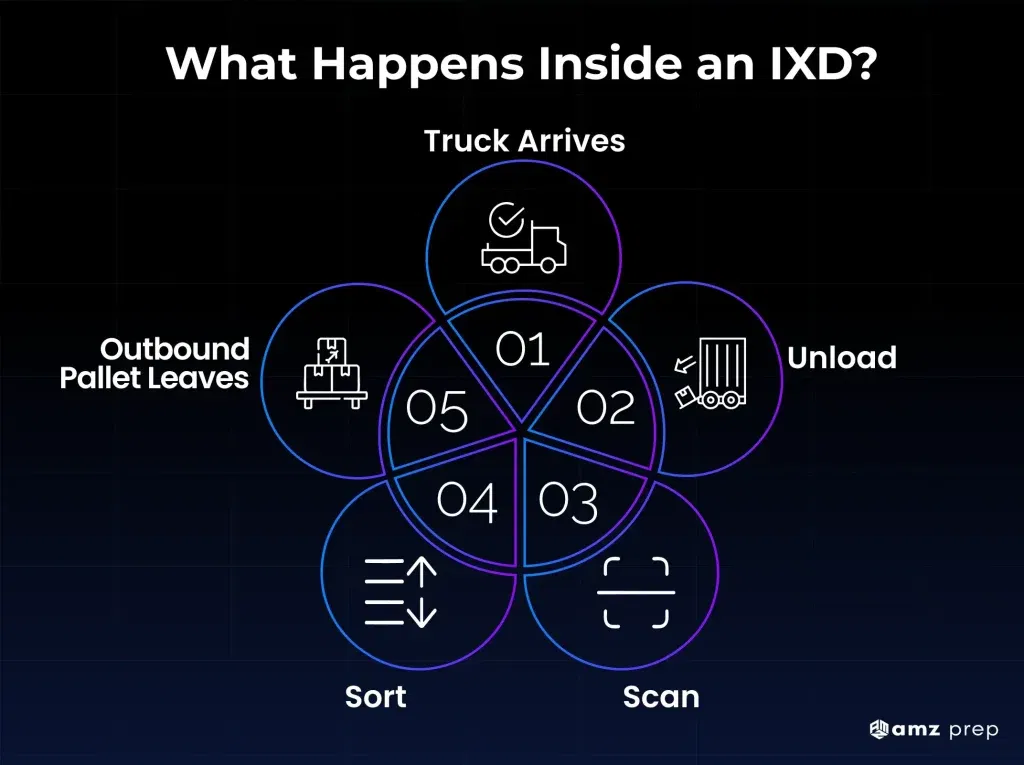
Picture one full truckload of mixed SKUs, booked as a single-location shipment. It rolls into a national IXD. The building breaks it down by pallet and sends each pallet to the regional site that needs it. One inbound truck can feed several regions.
That spreading is the service Amazon charges for. Pick a minimal split and you pay an inbound placement fee on every unit.
Inside, the work runs in three steps:
- Trucks unload and every carton is scanned against the shipment plan. A mismatch stops that freight for a manual check.
- Cartons and pallets are sorted by destination region.
- Freight heading to the same place is loaded together and sent out.
Common IXD challenges that create delays:
Most delays we see trace back to the carton, not the building.
- Missing or smudged FNSKU labels
- Boxes that don’t meet Amazon’s packaging requirements
- Box contents that don’t match what was entered in Send to Amazon
- Mixed-SKU pallets without clear case labels
- Q4 volume, when every building slows at once
Why Q4 Hurts the Single-Location Route Most
In fall 2024, Amazon warned sellers about tight capacity at some West Coast sites. Seller advisors traced much of the delay to the hand-off between national and regional cross docks. Some said it could add weeks to normal inbound times.
That’s the risk with one location. It feels simpler, and most of the year it is. In October and November, it can mean stockouts right when demand peaks. I’d rather plan a split shipment than lose a week in December.
Keep after it, slightly reworded: For brands weighing Amazon AWD alternatives, regional routing is another way to keep FBA stocked.
What an RXD Does
An RXD is the last stop before your inventory reaches an FC. Its job is local: take freight bound for one region and get it to the right buildings there.
You can’t book an RXD as a destination. Amazon assigns destinations when you build a shipment. Your placement choice still decides whether your freight goes through a national IXD first.
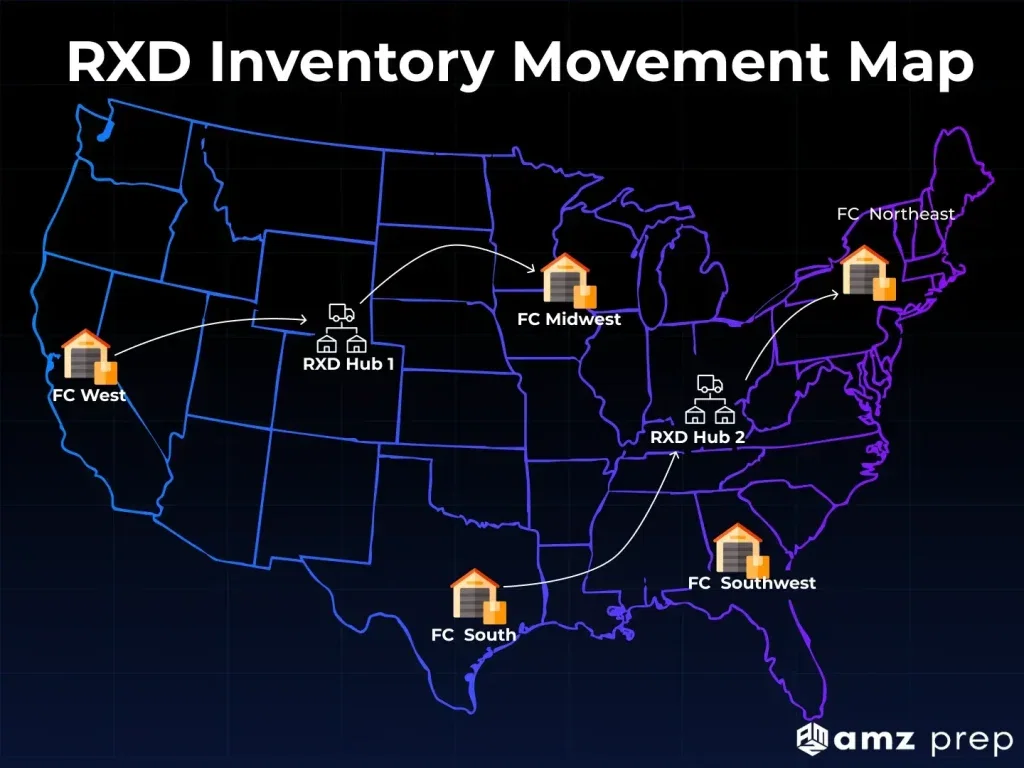
Reserved status is a separate issue. When units show Reserved, Amazon is often moving them between FCs or holding them for open orders. It’s internal, and you can’t speed it up. Good inventory management means planning around those days. Amazon also runs regional distribution centers that hold slower movers, covered in our Amazon RDC guide.
RXD operations resemble IXD workflows but focus on inter-FC transfers rather than inbound seller shipments.
Fulfillment centers send excess inventory or products needed elsewhere to RXD facilities,
shipments arrive consolidated onto trucks carrying inventory from multiple origin FCs,
And at RXD, associates sort inventory by destination FC, much like IXD sorts by initial placement.
Products get consolidated with other transfers heading to the same destination, loaded onto outbound trucks, and dispatched.
The goal is to maintain continuous inventory flow without creating storage bottlenecks that slow down the entire network.
| Critical RXD Metrics | What It Measures | Business Impact |
|---|---|---|
| Transfer Accuracy | Percentage reaching the intended destination FC correctly | Prevents availability gaps and customer dissatisfaction |
| Cycle Time | Duration for transfers to move through RXD | Impacts inventory availability and sales velocity |
| Consolidation Efficiency | How effectively RXD combines transfers | Reduces transportation costs significantly |
| Damage Rate | Units damaged during transfer | Internal quality metric affecting profitability |
| Throughput Capacity | Daily unit processing capability | Critical during peak seasons like Q4 |
The beauty of the RXD system for Amazon is efficiency because they can consolidate transfers from multiple origin FCs onto single trucks heading to the same regional destinations.
Maximizing truck utilization and minimizing transportation costs.
The challenge for sellers is visibility and control since you can’t see when Amazon decides to transfer your inventory, can’t control the routing, and have to simply trust that the system is working optimally for your business while watching units sit in “reserved” status.
Understanding inventory management principles helps sellers anticipate these transfers and plan accordingly.
Single Location vs Optimized Split: How Your Choice Changes the Route
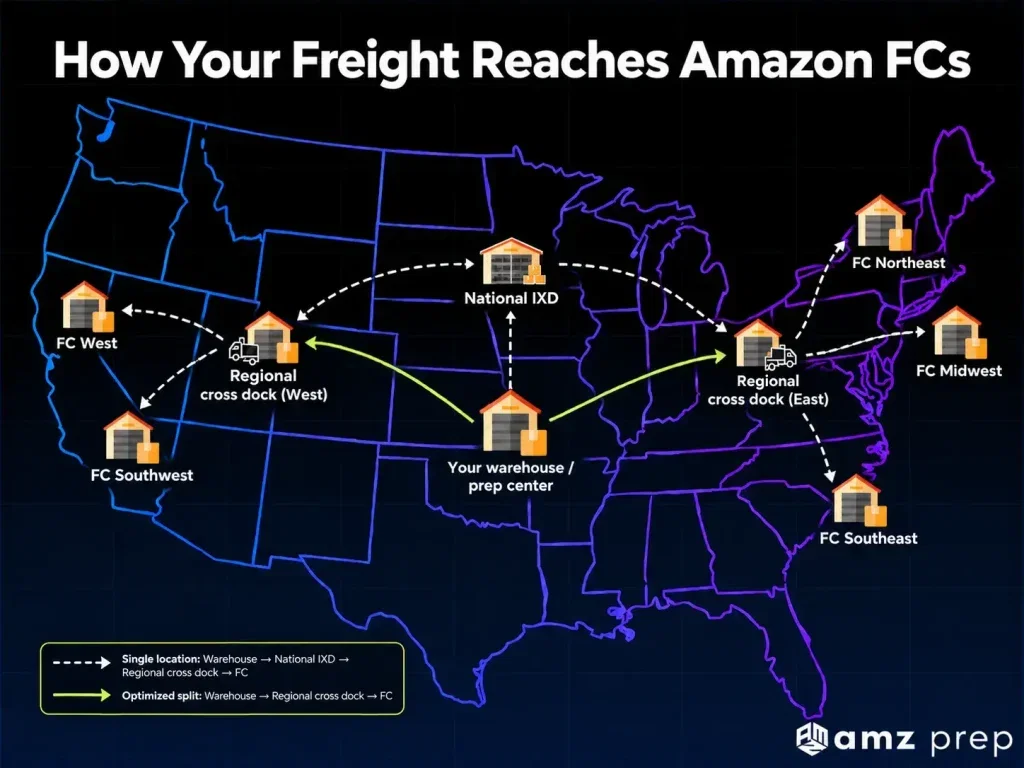
A single-location shipment usually makes four stops: your warehouse, a national IXD, a regional site, then the FC. Each stop adds handling time.
- Single location: Warehouse → National IXD → Regional site → FC → Customer
- Optimized split: Warehouse → Regional site → FC → Customer
Amazon’s optimized split changes the route. Amazon assigns several regional destinations, so your freight often skips the national IXD.
The trade sits on your side of the dock. You build more shipments, book more appointments, and need cleaner forecasts. Optimized splits carry no inbound placement fee, though. On the lanes we run, freight sent this way is usually sellable in 3 to 4 days. Through a national IXD it’s often 7 to 10, and longer in peak.
Not every brand can split freight that many ways. Many FBA prep centers will break a container down and ship to each destination for you.
| Situation | Better route | Why |
|---|---|---|
| Full truckloads, steady forecast | Optimized split | Fewer stops, no placement fee |
| Small or mixed shipment | Single location | Simpler booking, but you pay the placement fee |
| October to December inbound | Optimized split | National-to-regional hand-offs back up in peak |
| New SKU, unknown demand | Single location | Amazon spreads it while you learn demand |
Prep Rules That Keep Freight Moving
Since January 1, 2026, Amazon no longer offers its own prep and labeling services in the US. This work now happens before your freight leaves.
- Put a scannable FNSKU on every unit, on a flat surface away from seams. Thermal labels hold up best.
- Keep boxes at 50 lb or less unless a single item weighs more. Use sturdy corrugated cartons with enough cushioning to survive sorting. Our shipping box size guide covers the dimensions.
- Match box contents to the shipment plan before the truck leaves. Put the shipment ID on every carton.
Role-Specific Practice for Fulfillment Teams
Different jobs inside fulfillment need different kinds of practice. Here’s what each role should focus on, explained in plain English.
Software Engineers (who build fulfillment tech)
Engineers working on FC, SC, or delivery systems should practice:
- How to design systems that update inventory in real time
- How to optimize routes, picking paths, or order batching
- How to build services that don’t break during peak (big traffic spikes)
Simple examples:
- Designing a system that chooses the fastest bin for a picker
- Creating a tool that helps carriers pick the best route automatically
Operations Managers (who run the buildings)
Ops leaders should practice:
- Designing smoother warehouse workflows that reduce processing time
- Planning how much volume they can handle and when they’ll break
- Finding the true cause of problems—not just the surface symptoms
Simple examples:
- Changing the layout to reduce walking time
- Implementing best practices to reduce errors in order fulfillment
- Improving UPH (units per hour) without burning out associates
Product Managers (who build tools for fulfillment teams)
PMs need to practice:
- Thinking like both engineers and operators
- Deciding which features matter most
- Defining clear success metrics
Simple examples:
- Writing a feature that speeds up receiving by removing extra clicks
- Choosing which inventory tool gets built first
- Defining metrics like “dock-to-stock time” or “stow accuracy.”
Technical Program Managers (who connect tech + operations)
TPMs must be good at everything: tech, operations, coordination, and planning.
They should practice:
- Explaining complex fulfillment flows in simple words
- Managing programs that touch many teams (FC, SC, AMZL, transportation)
- Understanding real-world trade-offs
Simple examples:
- Explaining why bypassing a cross-dock speeds up delivery but raises cost
- Coordinating changes that affect IXD/RXD pathways
- Aligning tech teams with building operations
Clear, Real-World Fulfillment Examples
Network Design Example
A three-layer cross-dock (National → Regional → Local) saves money but adds extra stops.
Sending freight directly (IXD bypass) speeds things up but costs more. This teaches how networks balance:
- Speed
- Cost
- Accuracy
Process Improvement Example
Removing the IXD step can cut processing time from 7–10 days to 3–4 days.
But you pay more inplacement fees and need better forecasting.
This shows that every operational gain comes with a trade-off.
Metrics Everyone Should Know
These simple numbers explain how healthy a fulfillment operation is:
- Throughput speed: units per hour processed in pick and pack operations
- Accuracy: how often things are picked or sorted correctly
- Damage rate: items hurt during handling
- Cycle times: how fast inventory moves through each step
These numbers affect cost, speed, and customer happiness.
| Amazon Leadership Principle | How IXD/RXD Knowledge Helps | Example Application |
|---|---|---|
| Customer Obsession | Explain how IXD speed impacts delivery promises | Reducing IXD dwell time by 6 hours improves delivery estimates. |
| Invent and Simplify | Discuss process improvements to workflows | Implementing automated sortation reduces manual touchpoints. |
| Dive Deep | Demonstrate detailed operational knowledge | Understanding throughput metrics and their business impacts. |
| Deliver Results | Show grasp of operational constraints | Balancing speed with accuracy in high-volume environments. |
| Think Big | Propose network-level optimizations | How RXD facilities enable regional inventory strategy. |
Many successful sellers partner with 3PL fulfillment providers to optimize their cross-dock strategy and maintain competitive advantages.
Conclusion
IXD and RXD decide how many stops your freight makes before it sells. Fewer stops usually means faster check-in, and the gap widens from October to December. Before your next Q4 inbound, price the single-location and optimized-split options side by side in Send to Amazon.
FAQs
What’s the difference between shipping to one location vs. multiple for FBA?
One location is simpler to book but slower. Freight goes through a national IXD, and peak check-in can take 7 to 10 days. An optimized split goes to regional sites and is often sellable in 3 to 4 days.
Can sellers control where their inventory goes?
Not fully. Amazon assigns destinations based on demand, capacity, and delivery speed. Your placement choice in Send to Amazon is the main lever. After check-in, Amazon may still move units between FCs, which shows as Reserved.
What packaging and labeling issues cause delays?
Most delays come from missing or smudged FNSKU labels and weak boxes. Mixed-SKU cartons without case labels cause trouble too. So do contents that don’t match the shipment plan. Each one forces a manual check.
Why does my inventory stay ‘Reserved’ or ‘In-Transit’?
Reserved usually means Amazon is moving units between fulfillment centers or holding them for open orders. These transfers often clear in a few days but run longer in peak. Reserved units can’t be sold until they land.
What does IXD mean at Amazon?
IXD means Inbound Cross Dock. It’s an Amazon building that receives seller and vendor freight and sorts it by destination. From there, freight moves to regional sites or fulfillment centers. IXDs don’t ship customer orders.
What is the difference between IXD and RXD?
A national IXD receives large shipments from sellers and splits them by region. An RXD, or regional cross dock, takes freight for one region and routes it to that region’s fulfillment centers. Amazon assigns RXD routing.
What are the IXD charges for Amazon sellers?
Amazon doesn’t bill a separate IXD fee. The cost shows up as the inbound placement service fee when you choose a minimal split. Amazon-optimized splits carry no placement fee, but you ship to more locations.







Helpful explanation of “Reserved.” It looks like something broke, but often it’s just Amazon shifting stock between FCs through RXDs.
Easy to miss the Q4 bottleneck between national and regional. Shipping to one location feels simpler until those extra days leave you out of stock in December.
3–4 day inbound sounds great, but you pay for it in splits and placement fees. Is single-location still the better call for slow movers?
A 99.5% accuracy target at IXDs means one seller’s bad labels slow the whole truck, not just their own shipment.
Unlabeled case packs on mixed-SKU pallets feel like the most avoidable delay here. A few minutes of labeling saves a full re-sort.