
Key Takeaways
- An eCommerce fulfillment center stores, picks, packs, and ships online orders to end customers.
- One order moves through seven physical steps: receive, put-away, WMS routing, pick, pack and SLAM, sort, and carrier handoff.
- Fulfillment centers split into eight types: single-node, multi-node, hub-and-spoke, micro-fulfillment, cold storage, hazmat, big-and-bulky, and FBA prep-capable.
- The warehouse holds inventory. The distribution center moves it between businesses. The fulfillment center ships individual orders to individual customers.
- Fulfillment cost breaks into five buckets: receiving, storage, pick, pack, and outbound shipping.
Most guides on this topic tell you what a fulfillment center is. That is not what I want to give you.
I run the operations side of AMZ Prep’s fulfillment network. What I can offer is what the floor actually looks like the moment an order lands in the system. The truck at the dock. The scanner in the picker’s hand. The label coming off the SLAM tunnel three minutes before the carrier cutoff.
You will see one order move from receive to carrier handoff with real time stamps. You will see how we sort the eight main types of eCommerce fulfillment centers. You will see the definitional table for warehouse and distribution center. You will see the industry cost buckets that shape what a brand pays every month. And you will see a short operator’s comparison of the providers most brands shortlist.
What an Ecommerce Fulfillment Center Is
An eCommerce fulfillment center is a physical facility where inventory is stored, orders are picked and packed, and packages are shipped to end customers. Fulfillment centers process online orders one at a time using warehouse management software, barcode scanners, and pack stations. Both Amazon and independent 3PL providers operate them.
An old-school warehouse holds inventory for long stretches with slow inbound and outbound movement. A fulfillment center turns inventory over daily, sometimes hourly. The building can look similar. The operating model is not.
The term covers both Amazon-owned facilities and independent 3PL eCommerce fulfillment centers. Both do the same core work. Amazon FCs run inside the FBA program. Independent fulfillment centers ship for any channel the brand sells on. That is the fulfillment center definition most explainers get wrong by conflating the two.
Inside an eCommerce Fulfillment Center: One Order, Start to Finish
Here is how a fulfillment center works between the moment a customer clicks buy and the moment the tracking event fires. I will walk you through one order in one of our facilities. Time stamps are real. So are the steps most brands never see.
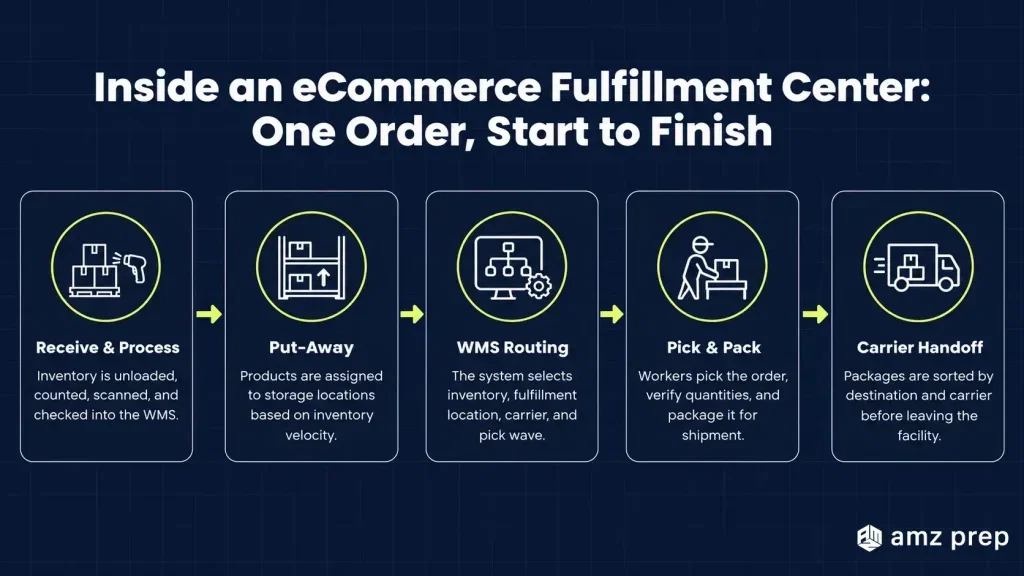
Receive dock and inbound processing (0 to 2 hours after truck arrival)
Every order starts long before the customer places it. Inventory has to be in the building first. That work happens at the receiving dock.
A truck pulls up. The driver hands over the bill of lading. My team checks the seal, breaks it, and starts unloading. Pallet count first. SKU counts, carton conditions, and lot codes follow.
Every carton gets a receiving scan. That scan tells our WMS the inventory is on-site but not yet sellable. Receiving accuracy is where eCommerce fulfillment operations are won or lost. A miscount here shows up as a stockout six weeks later.
Standard inbound processing runs 0 to 2 hours after the truck arrives. Complex loads with mixed SKUs or damaged cartons take longer. Well-run fulfillment centers push over 99% receive accuracy because the scan process leaves no undocumented movement. You can see how our team runs fulfillment operations end-to-end from receive through outbound.
Put-away and slot assignment (2 to 6 hours)
Received inventory does not stay on the dock. It moves to a bin location fast.
Put-away happens in one of three ways. A fixed slot means every SKU has one home. Dynamic slot means the WMS picks the best location based on velocity. Chaotic slot means each carton goes wherever fits, and the barcode is the address.
Chaotic slotting is what most modern fulfillment centers use. It sounds messy. It is not. The scanner tells the picker exactly where every unit lives.
Slot assignment is where fulfillment cost starts to compound. Slow SKUs in prime pick zones waste labor. Fast SKUs in the back of the building add seconds to every pick. A good fulfillment partner re-slots inventory weekly based on order data.
Standard put-away runs 2 to 6 hours after receiving. Once put-away is scanned, the inventory turns sellable in your storefront.
WMS routing inside the fulfillment center (real-time)
Your customer clicks buy. The order lands in your Shopify, Amazon, or Walmart storefront. Two seconds later it lands in our WMS through API.
The WMS does four things at once. It confirms inventory is available. It picks the fulfillment center closest to the customer. It selects the carrier based on rate and service level. And it drops the order into a pick wave.
Wave assignment is not random. Orders group by carrier cutoff, product type, and pick zone. A same-day cutoff order gets a different wave than a next-day order.
WMS integration depth matters more than most brands realize. A shallow integration syncs orders hourly. A real one syncs in seconds. Hourly sync will fail a Seller Fulfilled Prime program on the first miss.
Pick path optimization
Once the wave releases, pickers get to work. A pick path is the route through the building the WMS builds for each picker.
Four picking models cover most eCommerce fulfillment operations. Batch picking pulls multiple orders in one route. Best for high-volume single-item orders. Zone picking assigns pickers to sections of the building.
Best for facilities with 10,000+ SKUs. Wave picking releases orders in scheduled batches tied to carrier cutoffs. Best for peak season. Discrete picking handles one order at a time. Best for high-value or fragile items.
Most eCommerce fulfillment centers run a hybrid model. High-velocity SKUs get batch-picked. Fragile or oversized SKUs get discrete picks. The WMS chooses based on the SKU flag.
Pick accuracy runs 99.5% or better in a well-run facility. Anything under that shows up as returns and chargebacks. Our team on eCommerce order fulfillment runs sub-1% error rates across the network.
Pack station and SLAM
Picked orders route to pack stations. A packer scans each unit against the order, confirms the count, then chooses the right box or mailer.
Pack accuracy is where brand experience lives. Damaged goods in a right-sized box lose customers. Perfect goods in a giant box waste dim weight and drive up shipping cost. Every pack station has box guidance built into the WMS.
Then comes SLAM. Scan, label, apply, manifest. The package moves through a tunnel that scans the barcode, prints the shipping label, applies it, and manifests the package with the carrier. In a modern facility this happens in under 4 seconds per package.
SLAM is where the tracking number is generated. Once the package clears SLAM, it exists in the carrier system. The customer can see it move.
Sort wall and outbound fulfillment
After SLAM, packages are sorted by carrier and destination. A sort wall or automated sorter routes each package to the right dock door.
Every carrier has a cutoff. UPS Ground picks up at one time. FedEx SmartPost picks up at another. USPS runs on its own schedule. The sort wall groups packages by carrier so the outbound team can stage each pickup fast.
Missing a cutoff is not a small error. A late pickup pushes the delivery by a full day. For same-day cutoff programs, that is an SLA breach.
Outbound staging happens 2 to 4 hours before each carrier cutoff. My team confirms package count against the manifest before the driver signs. Every scan matches. Nothing goes unmanifested.
Carrier handoff
The carrier truck arrives. The driver scans the manifest. Every package on the manifest gets loaded. Any missing package flags a discrepancy before the driver leaves.
Once loaded, the packages are the carrier’s responsibility. The tracking event fires. The customer gets a shipping confirmation. The order is officially in transit.
From the moment the order dropped into the WMS to the moment it left the dock, the full eCommerce fulfillment process took roughly 4 to 8 hours in a facility running same-day cutoffs. Peak season stretches that. Well-planned fulfillment centers do not.
That is the full walk. One order, seven touch points, and dozens of small decisions the brand never sees.
Types of Ecommerce Fulfillment Centers
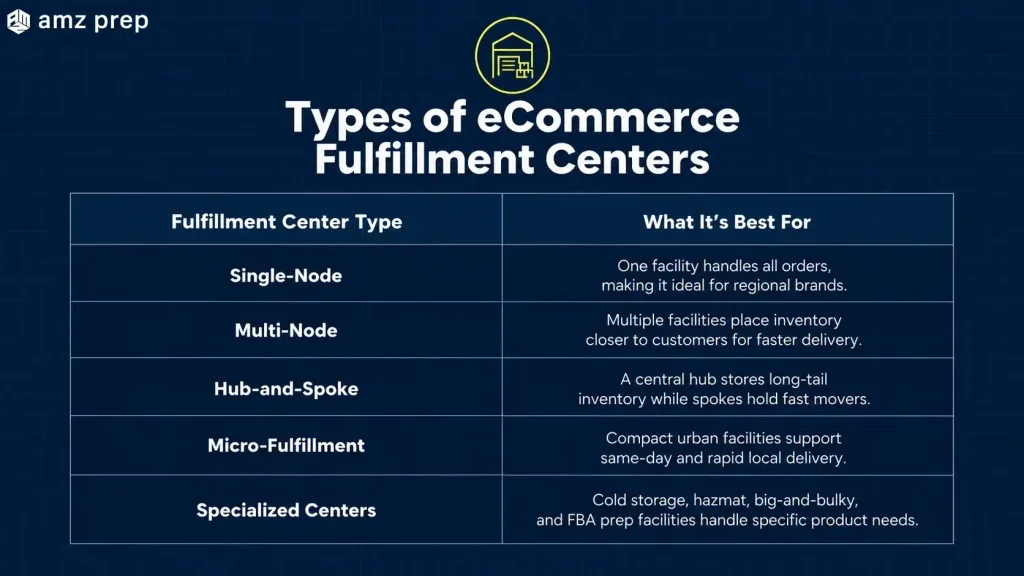
Not every fulfillment center is built for every product or brand. The category splits eight ways. Each type solves a different operational problem, and knowing the difference is how brands avoid picking the wrong fulfillment provider.
Single-node fulfillment center
A single-node fulfillment center ships every order from one location. Simple. Cheap to run. Fast to set up.
The trade-off is shipping cost. A single East Coast facility ships zone 7 or 8 to California. That is expensive and slow. Single-node works well under 500 orders a day for regional brands. Beyond that, most brands add nodes.
Multi-node fulfillment center network
A multi-node fulfillment network distributes inventory across two or more facilities. Orders route to the node closest to the customer. Zone shipping costs drop. Transit times drop with them.
Multi-node add complexity. Inventory has to balance across nodes. Reorder points calculated per location. eCommerce fulfillment operations at this scale need real WMS depth to stay accurate. AMZ Prep runs 50+ nodes across 6 countries for exactly this reason.
Hub-and-spoke fulfillment centers
Hub-and-spoke networks use one large hub for bulk storage and smaller spokes for last-mile fulfillment. The hub holds long-tail SKUs. The spokes hold fast movers close to the customer.
This model fits brands with 5,000+ SKUs and uneven velocity distribution. It reduces storage cost at the spokes while keeping fast SKUs close to buyers.
Micro-fulfillment centers
Micro-fulfillment centers compress a full fulfillment operation into a small urban footprint, often 10,000 to 30,000 square feet. Located inside cities, they enable same-day and 2-hour delivery windows carriers cannot hit from suburban facilities.
The model is expensive per square foot but earns its keep on last-mile speed. Best for high-frequency, low-cube DTC brands where 2-hour delivery is a real product feature. Rich Pearl’s full breakdown of micro-fulfillment centers covers when the math works and when it does not.
Cold storage fulfillment centers
Cold storage fulfillment centers handle temperature-controlled inventory. Refrigerated ranges from 33 to 41 degrees Fahrenheit. Frozen holds under 0 degrees. Some facilities run climate-controlled zones between 55 and 75 degrees for cosmetics and meltables.
Cold storage requires FIFO rotation, lot tracking, and expiration date management inside the WMS. A regular fulfillment center cannot pretend to be one. The insulation, refrigeration, and monitoring systems have to be built in.
Hazmat-certified fulfillment centers
Hazmat fulfillment centers ship products classified as dangerous goods. That includes lithium batteries, aerosols, flammable liquids, and some cosmetics. The facility needs a DOT hazmat certification. Every packer needs annual hazmat training. Every carton needs UN specification markings.
Regular carriers will refuse a hazmat package that ships from an uncertified facility. Some brands do not know their SKU is hazmat until a carrier rejects it at the dock.
Oversized and big-and-bulky fulfillment centers
Big-and-bulky facilities handle products over 50 pounds or 60 inches on the longest side. Mattresses, furniture, exercise equipment. Regular parcel carriers cannot ship these, so freight and freight class matter.
The building itself is different. Higher ceilings for double-stacking. Wider aisles for pallet jacks. Loading docks built for LTL and full truckload freight. Standard eCommerce fulfillment centers cannot cover big-and-bulky without retrofitting.
FBA prep-capable fulfillment centers
FBA prep-capable fulfillment centers run every step Amazon requires before inventory enters an FBA warehouse. FNSKU labeling. Poly bagging. Bubble wrap. Case pack configuration. Shipment plan creation inside Seller Central.
Most independent 3PL fulfillment providers cannot do this at compliance level. Amazon rejects roughly 1 in 8 non-compliant shipments. AMZ Prep runs FBA prep as a core service and processes over 8 million FBA items annually across our network.
Which type fits which brand
| Type | Best for |
|---|---|
| Single-node | Regional brands under 500 orders per day |
| Multi-node | National brands over 500 orders per day |
| Hub-and-spoke | Brands with 5,000+ SKUs and mixed velocity |
| Micro-fulfillment | Urban DTC brands with same-day delivery as a feature |
| Cold storage | Food, beverage, supplements, cosmetics with heat sensitivity |
| Hazmat | Batteries, aerosols, flammables, hazmat cosmetics |
| Big-and-bulky | Products over 50 lbs or 60 inches |
| FBA prep-capable | Amazon-first brands with FBA volume |
Fulfillment Center vs Warehouse vs Distribution Center
The three terms get used interchangeably. They should not be. Each one describes a different operational model with different economics.
| Factor | Warehouse | Distribution center | Fulfillment center |
|---|---|---|---|
| Primary purpose | Long-term storage | Bulk movement between businesses | Individual order fulfillment to consumers |
| Order type | Pallet or container | Pallet or case to retailers | Individual units to end customers |
| Dwell time | Weeks to months | Days to weeks | Hours to days |
| Technology | Basic WMS or none | WMS plus TMS | WMS, OMS, carrier integrations, real-time visibility |
| Throughput unit | Pallets received per day | Cases shipped per day | Orders shipped per day |
| Typical operator | Manufacturer, importer | Retailer, wholesaler | 3PL, Amazon, brand-owned |
A warehouse is built to hold inventory. A distribution center is built to move inventory between businesses. A fulfillment center is built to ship individual orders to individual customers.
The confusion between the three costs brands real money. Renting warehouse space for eCommerce leaves the brand with no pick path, no WMS, and no carrier integrations. The fulfillment cost per order runs 40 to 60% higher than a purpose-built eCommerce fulfillment center.
What It Costs to Run Inventory Through a Fulfillment Center
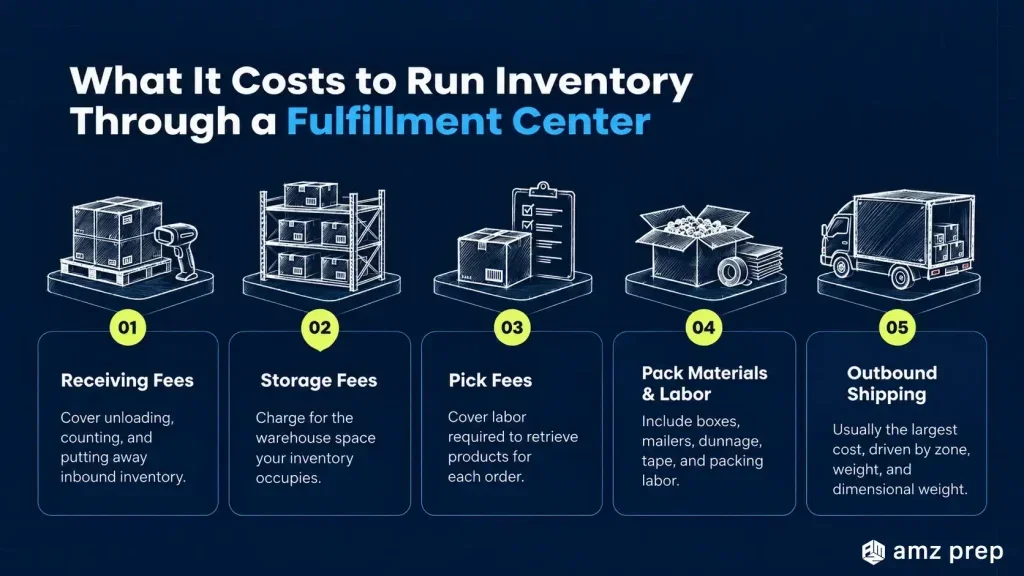
Fulfillment cost breaks into five buckets. Every 3PL charges on some version of these. The buckets do not change. What changes is the rate structure across different eCommerce fulfillment companies.
Receiving fees
Receiving fees cover the labor to unload, count, and put away inbound inventory. Most fulfillment centers charge per pallet or per unit. Industry pricing sits in the single-digit to low-double-digit dollar range per pallet, with per-unit hand-receive at a few cents per unit.
Where brands overpay: freight arriving damaged or unpalletized. Both add labor at the receive dock, and the surcharge hits the invoice next month.
Storage fees
Storage fees run per cubic foot per month or per pallet per month. Off-peak storage typically prices at cubic foot rates in the low tens of cents range. Peak season from October through January doubles or triples that at Amazon FBA, while most independent fulfillment centers hold flatter pricing through Q4.
Where brands overpay: slow-moving SKUs sitting in prime storage space. Weekly cycle review moves those to lower-cost bulk storage.
Pick fees
Pick fees are charged per order or per unit. Two structures exist. Per-item pricing charges for every unit picked, so multi-pick orders get expensive fast. First-pick-plus-additional-pick pricing charges more for the first pick, then a lower rate for each additional unit in the same order.
Amazon MCF uses per-item pricing. Most independent eCommerce fulfillment centers use the first-pick model. For any brand with average order size above 1.5 units, the first-pick model saves 15 to 30% on fulfillment cost.
Pack materials and labor
Pack cost covers the box, dunnage, tape, and pack labor. A standard mailer or poly bag runs at the lower end of pack costs. Corrugated with dunnage runs higher. Branded inserts, tissue paper, and gift wrap add on top.
Branded packaging is a real differentiator, but the cost has to be modeled per order. Some brands underprice fulfillment quotes by 30% because pack materials were quoted separately.
Outbound shipping
Outbound shipping is the largest cost in most fulfillment invoices. Zone, weight, and dim weight drive it. A 2-pound package shipped cross-country from a single-node facility runs materially higher than the same package shipped in-zone from a multi-node fulfillment network.
Zone reduction is where multi-node networks earn their keep. Every zone saved on a package saves roughly 12 to 18% on shipping cost. Regional carriers stack on top of the majors for an extra 5 to 10% saving on last-mile.
How to Evaluate an Ecommerce Fulfillment Center
Most evaluation checklists come from the buyer’s side and cover the basics. This is the operator’s version. If I were shortlisting a fulfillment partner for my own brand, this is the list I would run.
Node topology, not warehouse count
Ask how the nodes are structured. Single-node, multi-node, hub-and-spoke. The count matters less than the pattern.
WMS API depth
Ask if the WMS syncs orders in seconds via real-time API or hourly via batch. Batch will fail SFP and any same-day cutoff program the first time volume spikes.
Pick and pack accuracy number, not a claim
Ask for the actual measured number for the last 90 days. Anything vague or under 99.5% is a chargeback problem waiting to happen.
Regional carrier layer
Ask which regional carriers are in the mix, not just the national ones. A regional-carrier stack is where 5 to 10% of last-mile cost gets clawed back.
Cutoff flexibility during Q4
Ask what the same-day cutoff moves to during peak. If the answer is ‘we hold at 2 PM’ you have a real operator. If cutoffs shift earlier in November, walk away.
Slack channel or ticket queue
Ask specifically. Ticket queues are where brand issues die. Named account managers with direct Slack access is the operator standard.
Q4 capacity model
Ask what happens when your volume triples in November. If the answer includes the word ‘surcharge,’ you have your answer.
Returns processing SLA
Ask how many hours from return receipt to restocked sellable. Anything over 48 hours ties up inventory that should be moving.
Data dashboard cadence
Ask what the dashboard shows and how often it refreshes. Live dashboards beat weekly reports every time, especially during peak.
Operator Quick-Look: How the Shortlist Stacks Up
Most brands run the shortlist against three or four providers. Here is the operator’s quick-look on the ones we see most often at the negotiation table, ranked on the criteria above.
| Provider | Node count | WMS sync | Stated accuracy | Cutoff flexibility |
|---|---|---|---|---|
| AMZ Prep | 50+ across 6 countries | Real-time API | 99.8% | Same-day to 12 PM local, extended in Q4 |
| ShipBob | 40+ across 4 countries | Real-time API | 99.95% claimed | Same-day varies by node |
| Flexport (Deliverr) | 80+ US nodes | Real-time API | Not published | Varies by lane |
| ShipHero | Self-service software or hosted 3PL | Real-time API | Varies by operator | Varies by operator |
| Red Stag | 3 US nodes | Real-time API | 100% claimed | Same-day to 5 PM local |
This is the operator’s quick view, not the full comparison. The best 3PL eCommerce fulfillment companies list covers the full eCommerce fulfillment companies shortlist most brands work through.
Conclusion: Where the Category Is Going
The fulfillment center category is shifting faster than most brands notice. Single-site operations that worked at 2019 volumes cannot cover 2026 delivery expectations. Multi-node fulfillment networks are becoming the baseline, not the upgrade. Cold storage, hazmat, micro-fulfillment, and FBA prep-capable facilities are moving from niche to expected.
The brands making better provider decisions in the next 12 months will be the ones who understand what actually happens on the floor. They receive scans. The pick path. The SLAM tunnel three minutes before cutoff.
AMZ Prep runs 50+ eCommerce fulfillment centers across the US, Canada, UK, Germany, Netherlands, and Dubai for exactly this reason. Every one is built to ship orders, not to store them.
Ecommerce Fulfillment Center FAQ
What is a fulfillment center?
A fulfillment center is a facility where eCommerce inventory is stored, picked, packed, and shipped to individual customers. Both Amazon and independent 3PL providers operate them. Fulfillment centers use WMS software and barcode scanners to process orders one at a time.
How does a fulfillment center work?
Inventory arrives at the receive dock and is scanned into the WMS. Orders drop from the storefront in real time. Pickers pull items on WMS-guided paths. Pack stations box and label the package. Carriers pick up at scheduled cutoffs.
What is the difference between a fulfillment center and a warehouse?
A warehouse holds inventory for weeks or months with minimal daily activity. A fulfillment center turns inventory over hourly or daily, using WMS software, pick paths, and carrier integrations to ship individual orders to end customers.
What are the different types of fulfillment centers?
Eight main types cover most eCommerce operations. Single-node, multi-node, hub-and-spoke, and micro-fulfillment split by network structure. Cold storage, hazmat, and big-and-bulky split by product handling. FBA prep-capable fulfillment centers handle Amazon compliance requirements.
























Comments