
International Freight Forwarder for Amazon and Ecommerce
International freight forwarding from China, Vietnam, India, Europe and Canada into AMZ Prep centers in the US and Canada. Ocean or air, FCL or LCL, with ISF, HTS classification, duties and agency checks handled by our own customs team, prep done in the receiving building, and delivery into Amazon, Walmart, Target, Costco or your own warehouse with the appointment booked.
On this page
Key Takeaways
- A general freight forwarder's job ends at the port or a warehouse door. An FBA freight forwarder carries the goods through customs, receiving, prep and the dock appointment.
- AMZ Prep forwards from China, Vietnam, India, Europe and Canada by ocean (FCL and LCL) or air.
- Our own customs team handles HTS classification, ISF on ocean imports, entries, duties, agency checks and CBSA clearance for Canada.
- Buy FOB or FCA and stay the importer of record, so you control the entry, the duty and the date.
- One itemized quote with no minimum volume; duties and taxes pass through at cost.
What is a freight forwarder, and how is an FBA freight forwarder different?
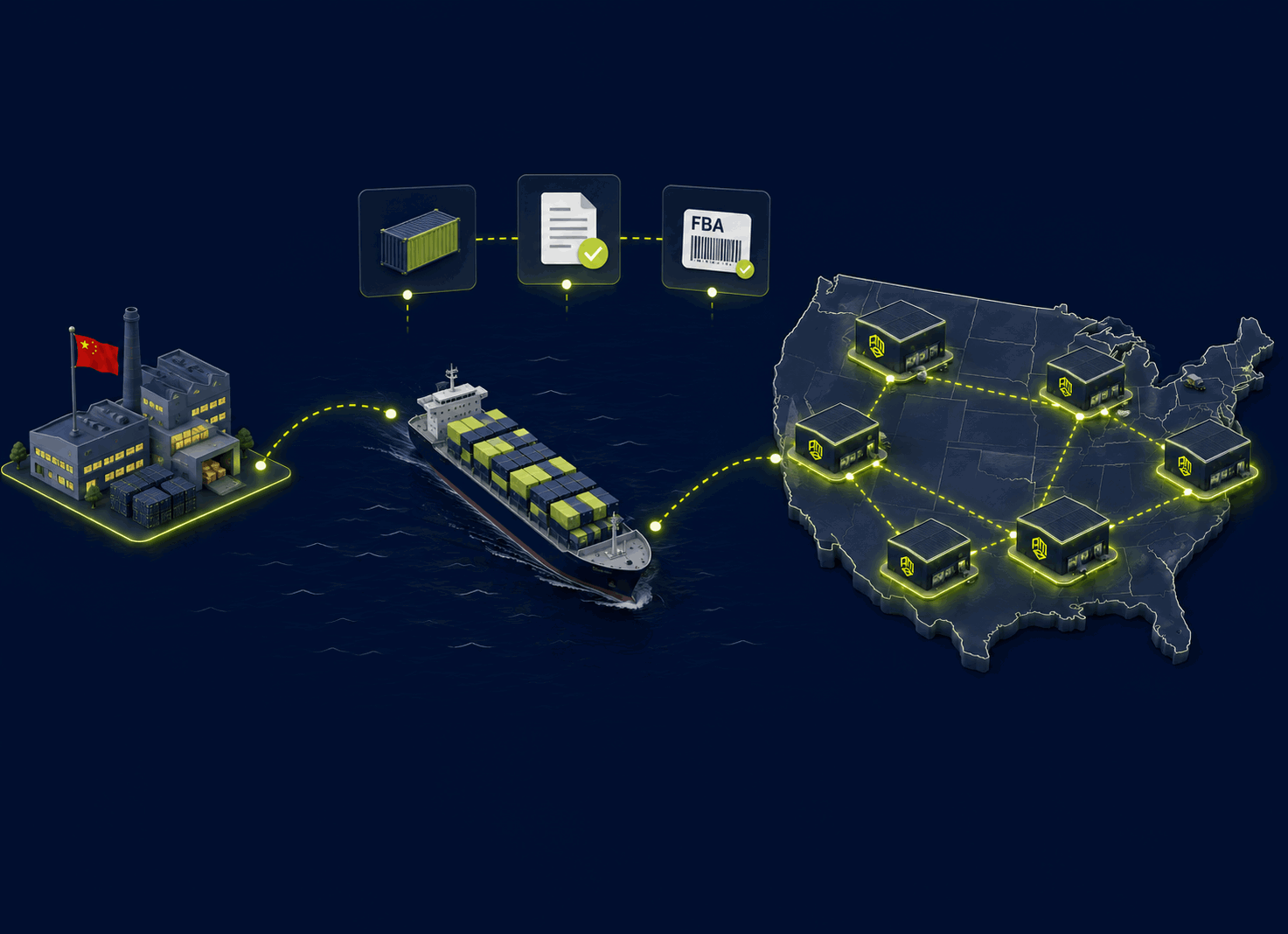
A freight forwarder arranges international shipping for a business: it books ocean or air space, prepares the export and import paperwork and coordinates delivery. An FBA freight forwarder carries the same goods through customs, receiving, Amazon or retail prep and the dock appointment.
A general international freight forwarder delivers cargo to a port, an airport or a warehouse you name. For plain B2B freight that is enough. For an ecommerce brand, the goods still need to be received, counted, labeled to Amazon's spec or a retailer's routing guide, and delivered against an appointment. When the forwarder, the prep center and the inbound carrier are three companies, each waits on the one before it, and the 5 to 10 days that adds is where the quoted transit time and your calendar part ways.
AMZ Prep runs the whole chain under one quote. The company that booked the container drays it from the port, receives it, preps it, and puts it on a Middle Mile lane into Amazon or onto a booked appointment at a Walmart, Target or Costco DC. The person you call when the ship is late is the person who booked the appointment.
Key Takeaway
Ask any freight forwarding company where its responsibility ends. If the answer is the port or a warehouse door, plan for the extra handoff and the extra invoice.
What does the AMZ Prep freight forwarding service cover?
Origin pickup and export
Factory pickup in China, Vietnam, India, Europe or Canada, delivery to the origin port or airport, and export documents: commercial invoice, packing list and certificate of origin where preferential duty applies.
Ocean freight, FCL and LCL
Vessel space booked to the port closest to the receiving center. Full containers sealed at origin; LCL consolidated at the origin CFS. Transit and container pricing are on the ocean freight page.
Air freight
Standard and express air for launches and stockouts from Shenzhen, Shanghai, Hong Kong, Delhi, Mumbai and European gateways. Rates are on the air freight page.
Customs brokerage
Our own customs team files the ISF on ocean imports, classifies goods by HTS code, files the entry, pays duties, and handles FDA, CPSC, FCC and USDA requirements. Canada-bound freight clears with CBSA.
Drayage, receiving and prep
The container or air cargo goes to the nearest AMZ Prep center, is counted against the packing list within 24 to 48 hours, and is prepped in the same building: FNSKU, poly bag, bundle, carton labels and shipment plan, or the retailer equivalent.
Delivery to every destination
Middle Mile into Amazon FBA with no placement fee, PO deliveries to Vendor Central against the ASN, appointment-booked pallets to retailer DCs, and DTC orders shipped from the same stock.
How does freight forwarding work with AMZ Prep?
Share the shipment Quote
Product, dimensions, weight, HS codes, quantity, origin, Incoterm and the date you need stock sellable. You get one itemized quote with the mode recommended from your volume and timeline.
Booking and pickup Origin
We book the vessel or flight and arrange factory pickup. For US ocean imports, the ISF is filed before the container loads.
Transit Relay
Vessel or flight tracked in Relay with port and airport ETAs. A delay is flagged while there is still time to change the inbound plan.
Customs clearance CBP or CBSA
HTS classification, entry, duties and agency checks at the port of entry. Goods are released and drayed straight to the receiving center.
Receiving and prep Destination
Counted against the packing list, received and prepped to Amazon or routing-guide spec in the same building.
Appointment-booked delivery Outbound
Middle Mile into Amazon, PO delivery to Vendor Central, or routing-guide delivery to retailer DCs, with the appointment booked before the truck leaves.
Where does AMZ Prep forward freight from?
| Origin | Main ports and airports | Modes | Typical door to Amazon |
|---|---|---|---|
| China | Shenzhen, Shanghai, Ningbo, Yiwu; Hong Kong air | FCL, LCL, air, express | 4 to 6 weeks by ocean, 1 to 2 weeks by air |
| Vietnam | Ho Chi Minh, Hai Phong | FCL, LCL, air | 4 to 6 weeks by ocean, 1 to 2 weeks by air |
| India | Mumbai, Nhava Sheva, Chennai; Delhi air | FCL, LCL, air | 5 to 7 weeks by ocean, 1 to 2 weeks by air |
| Europe and UK | Rotterdam, Hamburg, Felixstowe; Frankfurt, Amsterdam air | FCL, LCL, air | 3 to 5 weeks by ocean, 1 to 2 weeks by air |
| Canada and US (cross-border) | Toronto, Vancouver, Montreal | FTL, LTL, reefer | 3 to 7 days with PARS/PAPS pre-clearance |
Key Takeaway
Receiving near the port matters more than most sellers expect. A container into Long Beach received in Southern California, or into Newark received in New Jersey, skips a cross-country dray and reaches Amazon's receiving queue the same week it lands.
How does customs clearance work on an import into the US or Canada?
Importer of record (IOR)
The company legally responsible for the import, its declared value and its duties. For Amazon brands it is usually you, not the supplier.
HTS classification
Every SKU gets an HTS (HS) code that sets the duty rate. We classify before it ships, so duty is in the landed cost. Estimate it with the import duty calculator.
Tariffs
Section 301 duties on many Chinese goods and US reciprocal tariffs sit on top of the base duty rate. The tariff calculator shows them by origin.
ISF 10+2
Required on US ocean imports and due before the container loads at origin. It does not apply to air or truck freight. We file it with the booking.
Customs bond
US imports need a customs bond, either single-entry or continuous for brands that import regularly. It guarantees duties and penalties to CBP.
Customs entry
The entry (CBP Form 7501) declares the goods, value and duty. With de minimis suspended, low-value imports now need an entry too.
Partner agency checks
FDA for food, supplements and cosmetics, including prior notice; CPSC for children's products; FCC for electronics; USDA for plant and animal products. We confirm what applies before it ships.
Canada: CBSA, CARM and CUSMA
Canadian imports clear with CBSA. The importer needs a business number and a CARM account, and goods that qualify under CUSMA move at preferential duty.
Bonded storage
AMZ Prep is bonded, so goods can be handled under customs control where a shipment needs it.
Which Incoterm should you buy on: EXW, FOB, FCA, DAP or DDP?
| Incoterm | Who pays for the main freight | Who clears import customs | When it suits an Amazon brand |
|---|---|---|---|
| EXW (Ex Works) | You, from the factory door | You | When you want full control and your forwarder handles export at origin |
| FCA (Free Carrier) | You, from the named handover point | You | A cleaner version of EXW: the supplier clears export |
| FOB (Free On Board) | You, from the vessel at the origin port | You | The most common choice for ocean imports |
| DAP (Delivered At Place) | The supplier, to the named place | You | When the supplier has better freight rates and you still want to own customs |
| DDP (Delivered Duty Paid) | The supplier | The supplier | Simple on paper, but you lose sight of what was declared and paid |
Key Takeaway
Buying FOB or FCA keeps the freight leg, the customs entry and the landed cost in your hands, which is what lets one team plan the date into Amazon.
Where does international freight forwarding go wrong, and how is each case handled?
The forwarder's job ends at the port
The container clears, then waits for a drayage company, a prep center and a carrier, none of which has booked the Amazon appointment.
How we handle it: One company drays, receives, preps and books the appointment, under one quote.
The base rate that is half the cost
Origin charges, destination charges, documentation, drayage and detention arrive as separate lines after the quote.
How we handle it: One itemized quote; only duties and taxes pass through, at cost.
The wrong HTS code
A misclassified SKU means the wrong duty, a penalty risk and a landed cost that breaks the margin after the stock is sold.
How we handle it: Every SKU is classified before it ships, and duty is part of the quote.
The FDA or agency hold
Supplements, food, cosmetics or electronics arrive without prior notice or the right agency data and sit at the port.
How we handle it: Our customs team confirms agency requirements per SKU before booking.
The supplier as importer of record
Under DDP the supplier declares the goods, and errors or undervaluation come back to your brand later.
How we handle it: We advise buying FOB or FCA with your company as importer of record.
Invoice and packing list that do not match
Quantities or values differ between documents, triggering exams and delays.
How we handle it: Documents are checked against each other and the booking before the cargo loads.
FBA freight forwarder vs general freight forwarder: what changes?
| Capability | General freight forwarder | AMZ Prep |
|---|---|---|
| Factory pickup and export | Yes | Yes |
| Ocean and air freight | Yes | Yes, FCL, LCL, standard and express air |
| Customs brokerage | Usually, often through a partner | Our own customs team, US and Canada |
| Delivery point | Port, airport or a warehouse you name | Amazon FC, Vendor Central dock, retailer DC or your warehouse |
| FNSKU labeling and FBA prep | No, a separate prep center | In the receiving building |
| Amazon inbound appointment | Seller books it | Booked before the truck leaves |
| Amazon placement fees | Not addressed | $0 on Middle Mile |
| Retail routing guides, EDI, ASN | No | Walmart, Target, Costco, Nordstrom, Vendor Central |
| Storage between shipments | Short-term at best | 50+ centers, drip-fed into Amazon's capacity limits |
| Who you call when the ship is late | The forwarder, then the prep center, then the carrier | One freight team |
Key Takeaway
If you ship plain B2B freight dock to dock with your own receiving and prep, a good general forwarder will do the job for less, and we will say so.
How much does a freight forwarder charge, and what is in the quote?
What is in the quote
Freight per container, CBM or kg, origin and terminal handling, customs brokerage and ISF, drayage, receiving, prep and the inbound delivery. Peak carrier surcharges, October to January, are shown as their own line at cost.
What is not
Import duties and taxes, which depend on HTS code and origin and are billed at cost. Estimate them first with the import duty calculator.
What moves it
Mode, season, container size against cargo volume and the port chosen. Book ocean 8 to 12 weeks ahead of Q4. The CBM calculator shows whether an order is LCL or FCL.
Volume
No minimum. Brands importing a container or more a quarter get the volume rates we buy across 5,000+ brands, and a first LCL test order is quoted the same way.
How do you choose a freight forwarder for Amazon FBA?
| What to ask | What goes wrong if it is missed | How AMZ Prep handles it |
|---|---|---|
| Is the quote all-in, with origin, destination and documentation fees? | The base rate is half the real cost. | Itemized, with only duties and taxes at cost. |
| Is customs brokerage in-house, for the US and Canada? | Another handoff, and nobody owns a hold. | Our own customs team files ISF, entries and agency data. |
| Who is the importer of record, and who holds the customs bond? | Your brand carries the risk of a declaration it never saw. | Your company as IOR, with entries you can see. |
| Where does the cargo go after customs? | It waits at the port for a second provider. | Drayed to the nearest AMZ Prep center. |
| Who preps and books the Amazon or retailer appointment? | Fast ocean leg, slow check-in, or a chargeback. | Prep in the same building and appointment booked before the truck leaves. |
| How do you see delays? | You hear about a rolled container after it sails. | Vessel and flight tracking in Relay. |
| Can they hold stock and drip-feed Amazon? | Amazon's capacity limits block the inbound. | Storage across 50+ centers, sent in as capacity allows. |
Do you need an FBA freight forwarder?
- You source from China, Vietnam, India, Europe or Canada
- Your goods go into Amazon FBA, Vendor Central or a retailer DC
- You have had shipment-plan rejections, labeling errors or chargebacks
- You sell on Amazon plus another channel from the same stock
- You need to hold stock outside Amazon's capacity limits
- You source inside the US: start with LTL freight or full truckload
- Your factory ships to Amazon on its own account and it works
- You ship dock to dock B2B with your own receiving and prep
Brands that import through AMZ Prep freight
Midday Squares
Temperature-controlled chocolate from Canada into US Amazon fulfillment centers, with cross-border pre-clearance, cold storage consolidation and the cold chain held to receiving.
Beekeeper's Naturals
Weekly FTL and LTL freight across the AMZ Prep network in the US and Canada, into Amazon on Middle Mile, scaling without adding carriers or prep vendors.
Eight Sleep
Ocean freight from China and Vietnam into Canadian fulfillment centers, with stock balanced between British Columbia and Ontario and prep done at receiving.
Renwil
LTL consolidation for large-format home goods, routed across the AMZ Prep network to cut transit time and delivery cost into retail and marketplace channels.
Zoplenti
Freight for eight brands under one program, including temperature-controlled chocolate lines, with FBA prep and freight on a single contract.
SimplyThick
Domestic FBA freight from Missouri into AMZ Prep receiving, with freight and prep consolidated to shorten the inbound lead time to Amazon.
Freight forwarding and FBA inbound, explained by the AMZ Prep team
How to Choose a Freight Forwarder (7-Factor Scorecard)
How AMZ Prep Handles International Fulfillment Customs and Duties
Amazon Inbound Freight Guide: How to Stop Losing Thousands on Every FBA Shipment
How AMZ Prep Handles FBA Freight Globally
Cross-Border Ecommerce Fulfillment: How US Brands Expand Internationally the Right Way
Amazon FBA Freight Consolidation: The Complete Guide
Freight forwarding questions, answered
A freight forwarder arranges international shipping for a business: it books ocean or air space, prepares export and import documents, and coordinates customs and delivery. It does not usually own the ships, planes or trucks.
It books the vessel or flight, handles origin pickup and export papers, coordinates customs clearance and duties, and arranges delivery. An FBA freight forwarder also receives, preps and delivers into Amazon or a retailer.
A general forwarder's job ends at the port or a warehouse door. An FBA freight forwarder carries the goods through receiving, Amazon or retail prep and appointment-booked delivery, which removes a handoff and a second invoice.
If you source overseas, yes. Amazon does not book freight from your factory. Someone has to book transport, clear customs, pay duties, prep to Amazon's rules and book the inbound appointment.
No. A customs broker files the import entry and handles duties with CBP or CBSA. A forwarder arranges the transport. AMZ Prep does both, with our own customs team.
Most charge the freight rate plus origin, destination, documentation and customs fees, so the base rate can be half the real cost. Ask for an all-in quote; ours itemizes everything except duties, which pass through at cost.
Plan 4 to 6 weeks door to Amazon by ocean and 1 to 2 weeks by air, including pickup, customs, receiving and prep. Port and airport transit by route are on the ocean and air pages.
Usually your own company, so you control the customs entry, duty costs and compliance. When the supplier acts as importer under DDP terms, you lose visibility of what was declared and paid.
Most brands buy FOB or FCA so they control the main freight leg and its cost. EXW adds origin work for you; DAP and DDP leave freight, or freight and duties, to the supplier.
The Importer Security Filing, or ISF 10+2, applies to ocean imports into the US and must be filed before the container loads at origin. It does not apply to air or truck freight. Our customs team files it.
No. The US suspended de minimis entry for every country in August 2025 and made the suspension indefinite in 2026, so imports now clear on a formal or informal entry. Our customs team files it.
Yes. Imported stock is received once at an AMZ Prep center and delivered to Amazon FBA on Middle Mile, to Vendor Central docks against the PO and ASN, or to retailer DCs under each routing guide.
Yes. Canada-bound freight clears with CBSA through our customs team, with CUSMA preferential duty where goods qualify. Importers need a Canadian business number and a CARM account to pay duties.
Within 1 hour during working hours on working days. Send the product, HS code if known, cartons or CBM, origin, destination and the date you need the stock sellable.
Tell us the origin, the product and where it needs to land
One itemized quote covering pickup, freight, customs, receiving, prep and appointment-booked delivery, within 1 hour during working hours.


