68 percent of brands now sell through both wholesale and direct-to-consumer channels. That single number changes what a wholesale fulfillment partner has to do in 2026.
I have spent years on both sides of the fulfillment decision. The brands I talk to every week share the same problem. Their wholesale order fulfillment sits in one warehouse. Their DTC lives in another. Their Amazon replenishment sits in a third. Nothing connects.
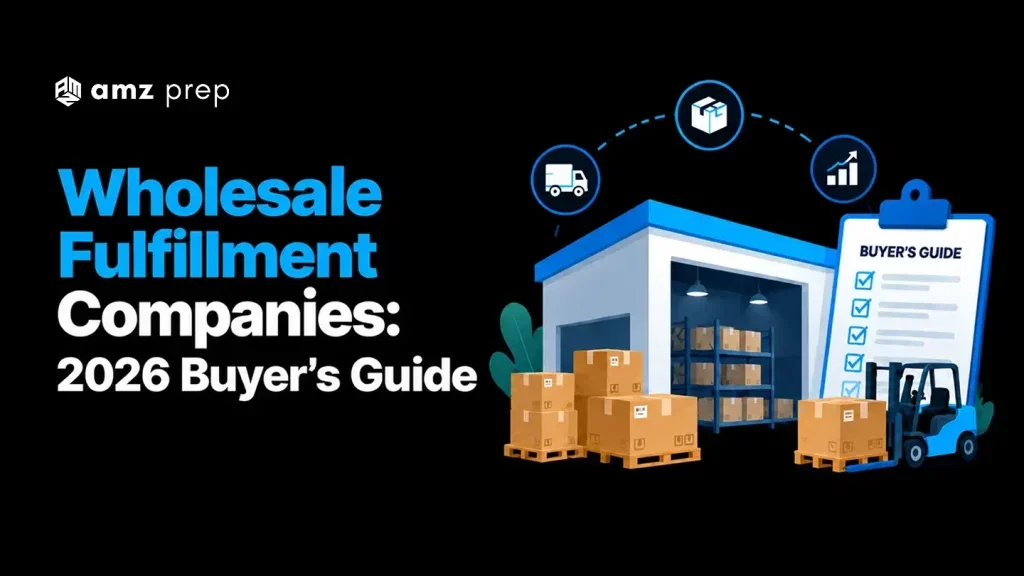
This guide walks through how wholesale fulfillment actually works in 2026. What separates a real wholesale fulfillment company from a DTC 3PL running a side program. Real 2026 pricing benchmarks. The top providers in the category. And a 5-step framework to pick the right partner.
Wholesale Fulfillment in 60 Seconds
Wholesale fulfillment, also known as wholesale logistics, is the process of storing bulk B2B inventory, receiving purchase orders from retailers, packing cases and pallets to retailer specifications, and coordinating LTL or FTL freight. A wholesale fulfillment company manages the full lifecycle from receiving orders to delivery.
The best providers do four things well.
- EDI integration with major retailers.
- Retail compliance and routing guide accuracy.
- LTL and FTL freight rates through established carrier networks.
- Hybrid support for DTC and Amazon in the same facility.
What Is Wholesale Fulfillment? (Also Known as Wholesale Logistics)
Wholesale fulfillment covers every step between a retailer sending a purchase order and receiving that order at their distribution center. The fulfillment provider stores your inventory, processes the PO, picks the cases, palletizes, labels to retailer specs, and coordinates freight.
The wholesale customer in this model is not the shopper. It is the retailer, distributor, or marketplace vendor account. Walmart, Target, Costco, Whole Foods, Amazon Vendor Central, and regional chains all sit on that list.
Inside the wholesale scope, the fulfillment center manages several jobs.
- Bulk receiving and quality control.
- Pallet racking and lot-controlled storage.
- Purchase order intake through EDI or portal upload.
- Case and pallet build for each retailer’s routing guide.
- LTL, FTL, and drayage coordination.
Wholesale distributors and 3PLs offering distribution services all operate on this playbook. The details are where they differ.
When You Need a Wholesale Fulfillment Company
A few clear signals tell you it is time to bring in a wholesale fulfillment service.
You are shipping direct to Walmart, Target, Costco, Whole Foods, Kroger, or Amazon Vendor Central. Retail POs now sit alongside your DTC volume.
You are seeing chargebacks on ASN accuracy, on-time delivery, or routing guide violations. Retailers charge 1 to 3 percent of PO value for compliance failures.
You are storing pallets in a garage, self-storage, or your DTC warehouse. Space is running out. Large quantities of case-pack inventory need real pallet racking.
You are hitting minimums with LTL carriers on your own. Rates are 20 to 40 percent higher than a 3PL with volume commitments.
You are running wholesale from the same warehouse as DTC and the workflows are colliding. Pack teams switch between single-parcel and pallet builds every hour.
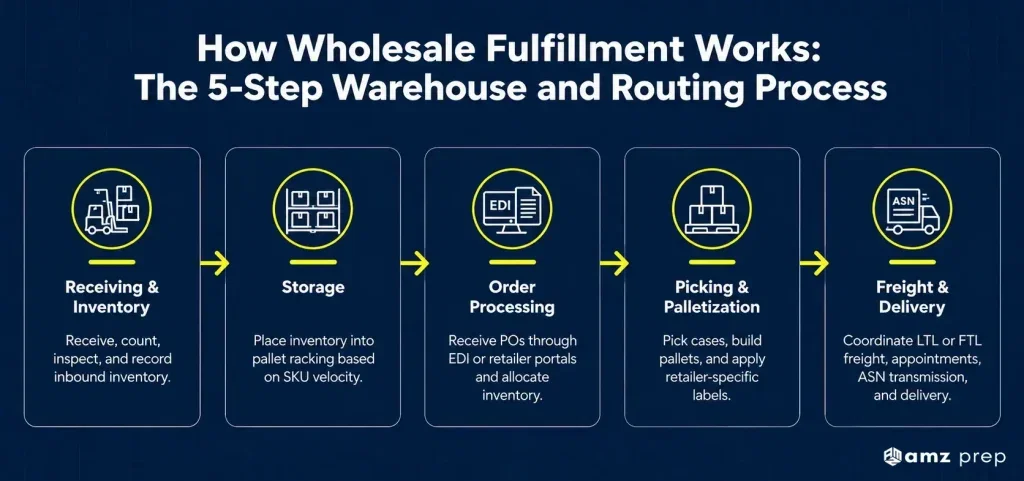
How Wholesale Fulfillment Works: The 5-Step Warehouse and Routing Process
The order fulfillment process for wholesale looks different from DTC at every step.
Step 1: Receiving and Inventory
The fulfillment operations team receives inbound container freight. They check case counts against ASNs and QC samples. Inventory logs into the warehouse management system with lot codes and expiration dates. Inventory accuracy starts here.
Step 2: Storage
Product moves to pallet racking. Efficient inventory management relies on smart slotting. Fast-moving SKUs sit close to dock doors. Slow-moving SKUs live deeper in the facility. Multi-location warehousing and distribution cuts freight zones.
Step 3: Order Processing
POs land through EDI 850 or a retailer portal. The management system validates the PO against on-hand inventory, allocates stock, and generates a pick ticket. Order processing and inventory management run through the same inventory management system.
Step 4: Picking, Packing, and Palletization
Case-picking pulls full cases from pallets. Each-picking pulls individual units for split cases. The pack team applies GS1-128 pallet labels, retail-ready custom packaging, and routing paperwork. Pick and pack for wholesale accounts demands retailer-specific expertise.
Step 5: Freight and Delivery
LTL or FTL freight moves the shipment. The logistics process includes carrier tender, appointment scheduling, EDI 856 ASN transmission, and proof of delivery. Timely delivery protects the on-time-in-full score with the retailer.
Wholesale vs DTC vs Retail Fulfillment Operations
B2B fulfillment and b2c fulfillment run on different economics, tech stacks, and packaging rules. The table below compares the three main models.
| Dimension | Wholesale (B2B) | DTC (B2C) | Amazon Vendor (Retail) |
|---|---|---|---|
| Order size | Cases and pallets | Single unit, small basket | Bulk PO |
| Packaging | Retail-ready, case pack, GS1-128 | Branded parcel, inserts | Amazon carton compliance |
| Shipping | LTL, FTL, drayage | Small parcel | Amazon partnered carrier |
| Tech stack | EDI 850, 856, 810, ERP | Shopify, WMS | Vendor Central, EDI |
| Returns | Batch, credit memo | Individual, refund | Vendor-managed |
| Success metric | OTIF, chargeback rate | Delivery speed, NPS | Retail readiness score |
Wholesale distribution rewards accuracy and compliance. Ecommerce fulfillment rewards speed and unit economics. A fulfillment company that treats them as the same job gets both wrong.
Top Wholesale Fulfillment Companies in 2026
Not every 3PL runs real wholesale fulfillment operations. The list below covers providers with proven retail experience, EDI capability, and freight networks.
| Company | Best For | Retail Compliance | DTC + Wholesale in One Warehouse | Amazon Replenishment | Freight Network |
|---|---|---|---|---|---|
| AMZ Prep | Hybrid brands scaling Amazon, retail, and DTC | Yes, EDI and routing guides | Yes | Yes, ARP and Middle Mile | 20+ carriers |
| Ryder Ecommerce | Enterprise wholesale | Yes | Limited | No | In-house fleet |
| Cart.com | Mid-market omnichannel | Yes | Yes | Limited | Third-party |
| ShipBob | DTC-first with light wholesale | Limited | Yes | Basic | Third-party |
| ShipMonk | Subscription and DTC | Limited | Partial | Limited | Third-party |
| Red Stag | Heavy, oversized, high-value | Case-by-case | No | Limited | LTL specialists |
| ShipHero | Software-first | No (BYO compliance) | Yes | Limited | Third-party |
| Falcon Fulfillment | Regional wholesale specialist | Yes | Limited | No | Regional LTL |
Enterprise providers like Ryder Ecommerce and Cart.com serve national retail programs. DTC-first 3PLs like ShipBob and ShipMonk added wholesale later. Red Stag handles heavy and oversized products. ShipHero is a software play with warehouse partners.
What Sets AMZ Prep Apart
AMZ Prep runs Amazon channels, DTC, and B2B retail from a single inventory pool. Most providers split each channel into its own account and its own warehouse. That fragmentation drives duplicate storage, forecasting errors, and slower replenishment cycles.
Cross-border movement between the US and Canada uses the same network. Brands ship into Canadian nodes without treating Canada as a side project or a separate partner.
Amazon placement fees land at zero through 5-way split routing on the Middle Mile program. Brands running Seller Fulfilled Prime keep the Prime badge on shipments leaving AMZ Prep warehouses. That combination is rare in the wholesale fulfillment category.
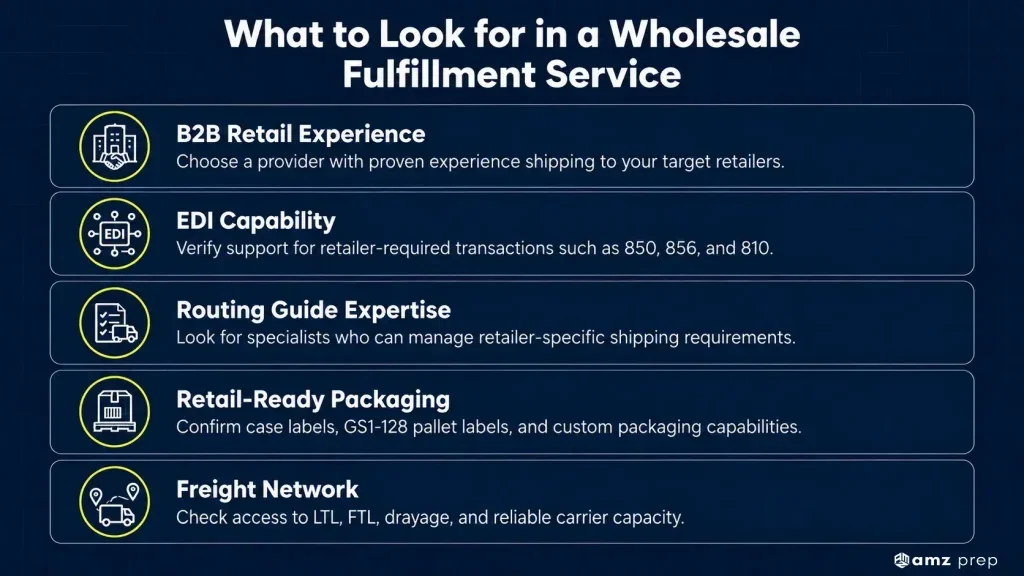
What to Look for in a Wholesale Fulfillment Service (Compliance, Tech, Freight)
Seven filters cut a shortlist quickly.
B2B experience and named retail clients
Ask which retailers they ship into today. Ask for chargeback data.
EDI capability
Full 850, 855, 856, 810, 940, and 945 support. VAN or API options. Compliance requirements vary by retailer.
Routing guide expertise
Walmart OTIF, Target Assortment, Costco DDU, and Amazon Vendor Central each have their own rules. Ask if the provider has routing and compliance specialists on staff.
Retail-ready packaging
GS1-128 pallet labels, case labels, and custom packaging capability.
Freight relationships
LTL, FTL, drayage, and dedicated freight through 15+ carriers.
WMS and ERP integration
Warehouse management with lot control, expiration date tracking, and batch traceability. Real-time visibility into the order fulfillment process through APIs or dashboards.
Hybrid workflow support
Wholesale fulfillment, DTC, and Amazon FBA replenishment from one facility. Fulfillment solutions that split pick paths without splitting inventory.
Wholesale Fulfillment Cost Breakdown (2026 Benchmarks)
Real pricing rarely appears on wholesale fulfillment company websites. Here are the benchmarks I see across proposals.
- Receiving: $0.25 to $1.00 per unit.
- Storage: $15 to $40 per pallet per month.
- Case picking: $2 to $5 per order.
- Each picking: $0.50 to $2.00 per unit.
- LTL shipping: $150 to $500 per shipment.
- Value-added services (kitting, labeling, poly bagging): $0.50 to $3.00 per unit.
Pricing structures to compare when reviewing proposals:
- Setup and onboarding fees.
- Minimum monthly commitments.
- Month-end inventory count fees.
- Storage overflow tiers past pallet caps.
- Accessorial freight charges for lift gate, residential, or reclassification.
The benchmark table:
| Cost Component | Low | Medium | High |
|---|---|---|---|
| Receiving (per unit) | $0.25 | $0.60 | $1.00 |
| Storage (per pallet/mo) | $15 | $27 | $40 |
| Case pick (per order) | $2.00 | $3.50 | $5.00 |
| LTL freight (per shipment) | $150 | $325 | $500 |
| Value-added (per unit) | $0.50 | $1.75 | $3.00 |
Ask for pricing on a sample PO with your real SKU mix. That is the only apples-to-apples comparison.
The Hybrid Model: Wholesale, DTC, and Amazon Fulfillment in One Warehouse
The hybrid model is the fastest-growing structure I see in enterprise fulfillment strategy. One warehouse. One inventory management system. Three channels moving through separate pick paths.
The benefits are clear. Unified inventory removes forecasting errors. Operational efficiency improves because purchasing power on freight scales across all channels. One reporting layer replaces three. Supply chain management simplifies.
The operational challenges come from workflow conflict. DTC picks single units and packs branded parcels. Wholesale picks cases and builds pallets. Amazon replenishment picks cartons and forwards through partnered carriers.
A hybrid-ready fulfillment provider builds separate pick paths and dedicated pack zones inside one facility. Flexible warehouse management software allocates inventory dynamically. Split routing for Amazon FBA replenishment runs through the WMS automatically.
Brands running this model see business growth without the network complexity of three separate partners. AMZ Prep runs this exact structure across the network. See the Fulfillment page for operational detail.
Retailer Compliance, Routing Guides, and Chargeback Prevention
Retailer compliance is where wholesale programs make or break. Chargebacks on OTIF alone can erase margin on an entire retail account.
EDI documents by function:
- 850: purchase order from retailer.
- 855: PO acknowledgment.
- 856: advance ship notice (ASN).
- 810: invoice.
- 940: warehouse ship order.
- 945: warehouse ship advice.
Retailer routing guide highlights:
- Walmart OTIF: 98 percent on-time and 98 percent in-full. Missing either triggers chargebacks per PO.
- Target Assortment: ASN accuracy within a 24-hour window. Late ASNs trigger fines.
- Costco DDU: delivered duty unpaid with a 24-hour delivery appointment window.
- Amazon Vendor Central: Direct Fulfillment routing rules on carton dimensions and prep.
Common chargeback categories include ASN accuracy, on-time delivery, label placement, pallet build, and carton compliance. The right fulfillment company absorbs the routing guide load and reports chargeback trends monthly.
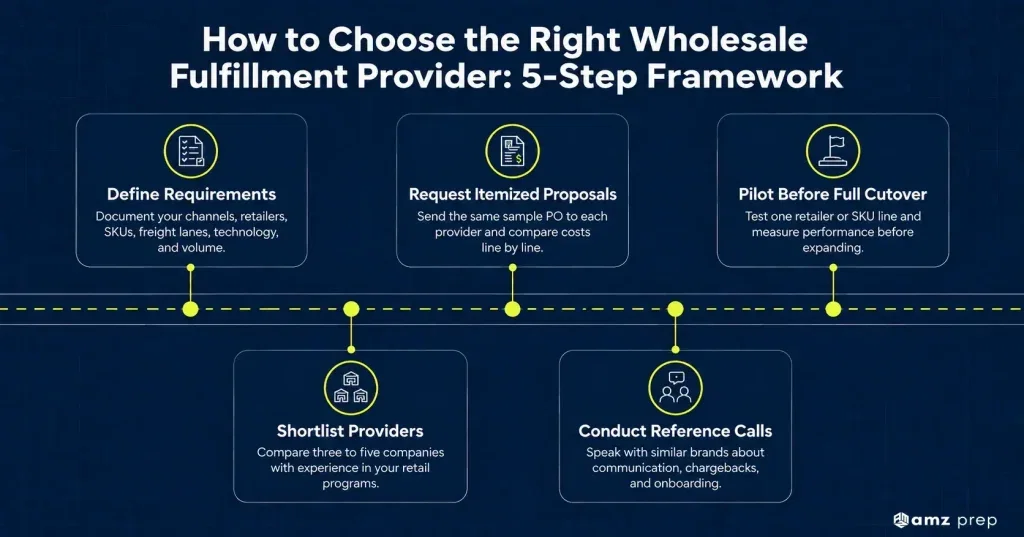
How to Choose the Right Wholesale Fulfillment Provider: 5-Step Framework
I walk enterprise brands through this framework every week.
Step 1: Define Business Requirements
List channels, SKUs, retailers, freight lanes, tech stack, and volume. Write down current chargeback rates. Write down current freight spend. Every fulfillment provider conversation starts here.
Step 2: Shortlist Three to Five Companies
Focus on providers with proven experience in your retail accounts. Ask industry peers. Read case studies with retailers matching yours.
Step 3: Request Itemized Proposals with a Sample PO
Send the same sample PO to every shortlisted order fulfillment company. Compare line by line. Watch for hidden minimums and unspecified accessorials.
Step 4: Reference Calls with Similar Brands
Talk to two brands of similar profile using each provider. Ask about chargeback trends, communication cadence, and onboarding pain.
Step 5: Pilot Before Full Cutover
Start with one retailer or one SKU line. Run for 60 to 90 days. Measure OTIF, chargeback rate, freight cost, and pick accuracy. Then commit.
Conclusion
Wholesale fulfillment is a different discipline from DTC. Different orders, different tech, different freight, different economics. The right fulfillment company treats it that way from the start. Use the 5-step framework. Ask for itemized pricing on a real PO. Pilot before you commit.
Frequently Asked Questions
What is a wholesale fulfillment company?
A wholesale fulfillment company stores bulk B2B inventory, processes retailer purchase orders, packs cases and pallets to routing guide specs, and coordinates LTL or FTL freight to retailers, distributors, and marketplace vendor accounts.
How is wholesale fulfillment different from retail fulfillment?
Wholesale fulfillment ships bulk POs to retailers who resell your product. Retail fulfillment refers to the retailer’s own distribution and fulfillment network moving product to stores or end shoppers. Different scope, different economics.
How much does wholesale fulfillment cost per order?
Case-pick orders run $2 to $5 per order. Storage adds $15 to $40 per pallet per month. LTL freight ranges $150 to $500 per shipment. Value-added services add $0.50 to $3.00 per unit.
Do I need EDI to work with a wholesale fulfillment company?
Most major retailers require EDI. Walmart, Target, Costco, and Amazon Vendor Central all mandate EDI 850 and 856 at minimum. Your fulfillment provider should offer EDI VAN or API connectivity.
Can one 3PL handle wholesale, DTC, and Amazon FBA replenishment?
Yes, if the fulfillment strategy supports split pick paths inside one warehouse. Providers like AMZ Prep run all three channels from a single inventory pool with dedicated workflows for each.
What is the minimum volume for wholesale fulfillment?
Most 3PL fulfillment providers set minimums around 500 to 1,000 orders per month or $2,500 to $5,000 in monthly spend. Enterprise-focused providers may set higher thresholds tied to case volume.
What retailers require routing guide compliance?
Walmart, Target, Costco, Kroger, Whole Foods, Amazon Vendor Central, and most national chains publish detailed routing guides. Each has unique ASN, label, and delivery appointment rules that drive chargebacks.
How long does onboarding a wholesale fulfillment partner take?
Standard onboarding runs 30 to 60 days. EDI integration adds 15 to 30 days if new connections are needed. Pilot programs launch inside 30 days. Full production cutover for complex accounts can take 90 days.

Rich Pearl is a Head of U.S Enterprise at AMZ Prep, drawing from his proven experience in the fulfillment industry gained at ShipBob. Rich helps provide strategic guidance and consultation to growing e-commerce businesses looking to master their logistics and achieve operational success.























Comments