
Flatbed Trucking for Oversized and Non-Stackable Freight
Flatbed trucking for freight that will not fit through trailer doors: machinery, building materials, outdoor structures and oversized products. We match the trailer to your tallest piece, plan permits, escorts, tarping and securement before pickup, and confirm how the load comes off at the other end.
On this page
Key Takeaways
- Flatbeds carry freight that is too tall, wide, heavy or awkward for an enclosed trailer, loaded from the top or sides.
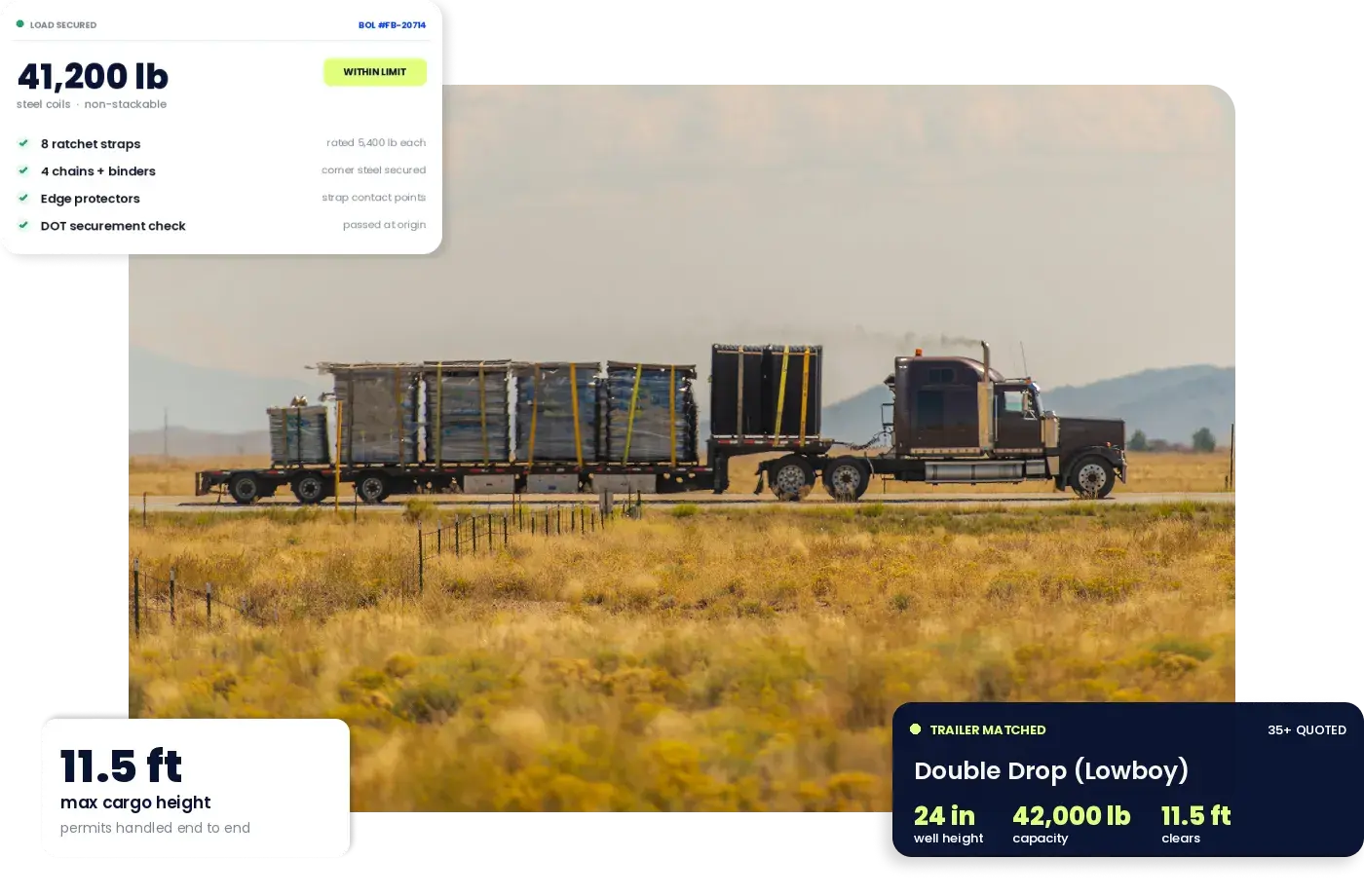
- The trailer sets legal cargo height: about 8.5 ft on a flatbed, about 10 ft on a step deck, about 11.5 ft on a double drop.
- Above legal limits, each state or province on the route issues its own permit, and some loads need escorts.
- FMCSA securement rules require tiedowns rated for at least half the cargo weight; tarps protect freight that must stay dry.
- Plan the unload first: most Amazon FCs and retail DCs are built for van docks, not flatbeds.
What is flatbed trucking, and when do you need it instead of a dry van?
Flatbed trucking moves freight on an open trailer with no walls, roof or doors. Because the deck is open, cargo can be loaded from the top or the sides by forklift, crane or overhead gantry, and freight that is too tall, wide or awkward for an enclosed trailer can still travel.
Use a flatbed when cargo cannot pass through the rear doors of a dry van, cannot be stacked, needs a crane to load, or exceeds van dimensions: building materials, machinery, outdoor structures, large furniture and oversized ecommerce products. If your freight is palletized and fits a van, a dry van is cheaper and protects it from weather without tarps.
Key Takeaway
The trailer choice decides everything else: legal height, permits, tarping and how the load comes off. Palletized freight that fits a van belongs on full truckload or LTL freight.
Flatbed, step deck, double drop or Conestoga: which trailer do you need?
| Trailer | Deck height | Legal cargo height | Typical payload | Best for |
|---|---|---|---|---|
| Standard flatbed | About 5 ft | About 8.5 ft | Up to about 48,000 lb | Lumber, steel, pipe, palletized building materials |
| Step deck (drop deck) | About 3.5 ft on the lower deck | About 10 ft | Up to about 46,000 lb | Taller machinery and equipment |
| Double drop (lowboy) | About 2 ft in the well | About 11.5 ft | Around 40,000 lb | Extra-tall or heavy equipment |
| RGN (removable gooseneck) | Low, with a front ramp | About 11.5 ft | Varies with axles | Drive-on vehicles and construction equipment |
| Conestoga | As flatbed or step deck | Slightly lower, under a rolling tarp | Slightly less than open deck | Freight that needs side loading and weather cover |
| Hotshot | Pickup truck with a flatbed trailer | As flatbed | Lighter loads | Smaller urgent loads that cannot wait |
Tell us the dimensions and weight of the largest piece. We match the trailer, and quote specialized equipment such as double drops and RGNs through our carrier network when a load needs it.
What are the legal limits for flatbed loads, and when do you need permits and escorts?
| Limit | Typical legal maximum | Above it |
|---|---|---|
| Width | 8.5 ft | Oversize permit; wider loads may need escorts and daylight-only travel |
| Height (road) | 13.5 to 14 ft depending on the state | Oversize permit and a route survey for bridges and wires |
| Length | Trailer length plus limited overhang | Permit, flags and lights for overhang |
| Gross weight | 80,000 lb on the interstate | Overweight permit, more axles, sometimes bridge analysis |
Every state and province on the route issues its own oversize or overweight permit, and many restrict travel to daylight hours and weekdays. Escort (pilot) cars are required past width, height or length thresholds that each state sets. Permits, routing and escorts are coordinated with the carrier and shown on the quote before booking.
How is flatbed freight secured and tarped?
Tiedowns
FMCSA cargo securement rules set the number of tiedowns by load length and weight. Their combined working load limit must be at least half the cargo weight.
Straps or chains
Straps protect finished goods; chains and binders hold steel, machinery and heavy equipment. Edge protectors stop straps cutting into freight.
Blocking and bracing
Wheeled or round items are blocked so they cannot roll, and stacked loads are braced against shifting under braking.
Tarps
Lumber, steel and smoke tarps protect freight from rain, road grime and exhaust. Tarping is quoted per load.
Conestoga instead
When freight needs both side loading and full weather cover, a Conestoga's rolling tarp avoids manual tarping.
Inspection stops
Drivers re-check securement during the trip, and roadside inspections can stop a truck that is under-secured.
How does flatbed trucking work with AMZ Prep?
Request Day 0
Dimensions and weight of each piece, commodity, how it loads and unloads, both addresses and dates.
Trailer and route Quote
We match the trailer, check legal limits on the route and price permits, escorts and tarping into the quote.
Book and permit Before pickup
The carrier is booked, permits pulled for each state or province, and the delivery time agreed with the receiver.
Load and secure Pickup
Freight is loaded by forklift or crane, secured and tarped to FMCSA rules.
Transit Relay
Live tracking in Relay with the planned delivery time.
Unload and POD Delivered
Unloaded with the receiver's forklift or crane, with proof of delivery in Relay.
How much does flatbed trucking cost?
| Rate factor | How it moves the price | Send with your request |
|---|---|---|
| Trailer type | Step decks, double drops and RGNs cost more than a standard flatbed. | Dimensions and weight of each piece |
| Distance and lane | Per load for the lane, plus deadhead to reach remote pickups. | Both addresses |
| Tarping | A tarp fee per load, higher for full lumber tarps. | Whether freight must stay dry |
| Permits and escorts | Each state's permit fee, plus escort cars where required. | Exact over-dimensions |
| Season | Spring and summer construction demand tightens flatbed capacity. | Your ship window |
| Loading time | Detention if loading or unloading runs past free time. | Equipment at each end |
Can a flatbed deliver to Amazon, a retail DC or a site with no dock?
Amazon FCs and retail DCs
Most are built for dock-height van unloading, so a flatbed delivery must be agreed with the receiver. Oversized goods bound for Amazon usually go to one of our centers first, then into Amazon on Middle Mile Plus.
Sites with no dock
Flatbeds are often the right choice for construction sites, yards and stores, as long as a forklift that can reach the trailer from the side is on site.
Unloading checklist
Forklift rated for the heaviest piece, firm ground beside the trailer, space to work both sides, and a crane booked for anything a forklift cannot lift.
Where does flatbed freight go wrong, and how is each case handled?
The load that shifts
Too few tiedowns or no blocking, and freight moves under braking. The truck is stopped or the cargo is damaged.
How we handle it: Loads are secured to FMCSA rules, with blocking and edge protection agreed with the carrier.
Rain on unprotected freight
Finished goods ride uncovered and arrive wet, rusted or dirty from road spray.
How we handle it: Tarps or a Conestoga are quoted whenever freight must stay dry.
The wrong deck height
A tall machine goes on a standard flatbed, ends up over legal height and needs a permit at the last minute.
How we handle it: We match the trailer to the tallest piece before booking, so a step deck is used when it avoids a permit.
Permit and route delays
Permits are pulled late, or the route has a weekend or night travel ban, and the load sits.
How we handle it: Permits and routing are checked before the pickup date is confirmed.
No way to get it off the truck
The receiver has no forklift that can reach the trailer, so the driver waits and detention or redelivery follows.
How we handle it: Unloading equipment at the delivery site is confirmed when the load is booked.
Bridge and wire strikes
A tall load takes a route with a low overpass or wires.
How we handle it: Over-height loads get a route survey and permitted routing.
How does flatbed freight cross the US-Canada border?
Pre-cleared
PARS (into Canada) or PAPS (into the US) is filed before the truck reaches the border by our own customs team.
CUSMA where goods qualify
Goods that qualify under CUSMA clear at preferential duty, with HTS codes checked on the commercial invoice.
Permits in both countries
Oversize loads need permits from every state and province on the route, coordinated with the carrier before pickup.
How do you compare flatbed trucking providers?
| What to ask | What goes wrong if it is missed | How AMZ Prep handles it |
|---|---|---|
| Which trailer, and why? | Over height on the wrong deck, and a late permit. | Trailer matched to the tallest piece. |
| Who pulls permits and books escorts? | A load parked waiting for paperwork. | Coordinated before pickup, shown on the quote. |
| Is tarping included? | Wet freight, or a tarp fee after delivery. | Tarping quoted upfront when needed. |
| How is the load secured? | Shifted cargo or a roadside violation. | FMCSA securement agreed with the carrier. |
| Who confirms unloading equipment? | Detention and redelivery at the site. | Confirmed with the receiver at booking. |
| How will I see the load? | Check calls to find the truck. | Live tracking and POD in Relay. |
| Can you cross the border? | A second broker and a hold at the line. | Pre-clearance by our own customs team. |
Who is AMZ Prep flatbed trucking built for?
- Brands shipping oversized products such as pergolas, sheds and large furniture
- Manufacturers moving machinery, equipment or materials
- Shippers with freight loaded by crane or side forklift
- US and Canadian shippers moving open deck freight across the border
Freight that fits a van
Palletized goods that fit through trailer doors ship cheaper and drier on full truckload or LTL freight.
Bulky and oversized freight, explained by the AMZ Prep team
Fastest Amazon Shipping for Food and Beverage, CPG and Bulky Goods
Why Mattress Fulfillment Needs Two Separate Operations
How to Handle Sensitive Products in Amazon Inbound Freight
Flatbed trucking: questions shippers ask
Flatbed trucking moves freight on an open trailer with no walls or roof, so it can be loaded from the top or sides by forklift or crane. It suits oversized, heavy or non-stackable cargo.
When freight is too tall, wide or heavy for an enclosed trailer, cannot be loaded through rear doors, or needs a crane or side forklift. Palletized goods that fit a van ship cheaper by van.
A standard flatbed deck sits about 5 ft off the ground. A step deck drops to about 3.5 ft on its lower section, so cargo up to about 10 ft tall can travel without a height permit.
A flatbed or step deck with a rolling tarp system on a frame. It opens for top and side loading, then closes like a van, protecting freight without manual tarping.
Flatbed is priced per load, driven by distance, trailer type, tarping, permits and escorts, loading time and season. Spring and summer construction demand lifts rates. We quote your exact load.
Freight is generally legal up to 8.5 ft wide, about 8.5 ft tall on a standard flatbed and 80,000 lb gross vehicle weight. Height limits vary by state.
Yes, if the load is wider, taller, longer or heavier than legal limits. Each state or province on the route issues its own permit, and some restrict travel times.
Escort or pilot cars are required for wider, taller or longer loads past thresholds that each state sets. The route survey and permits decide it, and the quote includes them.
The carrier brings securement and tarps for the load. Tarping usually adds a fee, which is quoted upfront along with any edge protection the freight needs.
FMCSA cargo securement rules set how many tiedowns a load needs by length and weight, and their combined working load limit must be at least half the cargo weight.
Most Amazon FCs and retail DCs are built for dock-height van unloading, so flatbed delivery must be agreed with the receiver. Oversized goods for Amazon usually go through our warehouse first.
A forklift rated for the heaviest piece, with room to reach the trailer from the side, or a crane for very heavy items. Without it, the driver waits and detention applies.
Yes. Pre-clearance is filed before the truck reaches the border by our customs team, and permits are pulled for each state and province on oversize routes.
Within 1 hour during working hours on working days. Send piece dimensions, weights, the commodity, how it loads and unloads, both addresses and dates.
Send your piece dimensions and get a flatbed quote
Dimensions and weight of each piece, how it loads and unloads, both addresses and dates. We quote within 1 hour during working hours, with permits and tarping on the quote.


