
If you sell on Amazon, fulfillment is one of the biggest decisions you have to make.
You can send your inventory to Amazon and use Fulfillment by Amazon (FBA), fulfill orders yourself through Fulfillment by Merchant (FBM), or use both.
So, what percentage of Amazon sellers use FBA?
Based on the latest industry data, about 82% of active Amazon sellers use FBA. Other research puts FBA usage at 89% when including sellers who use both FBA and FBM.
The exact number varies by source, but one thing is clear: FBA is the most widely used fulfillment option among Amazon sellers.
Key Takeaways
- About 82% of active Amazon sellers use FBA.
- An estimated 1.56 million active sellers use FBA based on seller counts.
- 68% of sellers use FBA only.
- 21% use both FBA and FBM.
- 11% use FBM only.
- 89% use FBA in some capacity in the dataset.
- More than 60% of Amazon store sales come from independent sellers.
- More than 75,000 independent sellers generated over $1 million in sales in 2025.
The figures come from different research sources, so they should be treated as industry estimates rather than an official Amazon FBA seller count.
Fulfillment terminology can vary by market, but fulfillment vs. fulfilment refers to the same basic process: storing, picking, packing, and shipping customer orders.
What Percentage of Amazon Sellers Use FBA?
The latest data estimates that 82% of active Amazon sellers use FBA.
Estimates are around 1.9 million Amazon sellers were active in 2025.
Using those numbers:
1.9 million active sellers × 82% = approximately 1.56 million FBA sellers
That gives us a reasonable estimate of the number of active sellers using FBA.
However, Amazon does not publish an official global FBA adoption rate. Different research companies also use different definitions of an “active seller.”
For that reason, it is better to describe 82% as an industry estimate rather than a fixed Amazon statistic.
FBA Adoption Rate in 2026
FBA adoption has increased significantly over the past decade.
| Period | Estimated FBA adoption |
|---|---|
| 2016–2018 | 53% |
| 2019–2020 | 63% |
| 2021–2022 | 73% |
| 2023–2024 | 81% |
| 2025 | 82% |
The trend is straightforward. FBA went from being used by roughly half of sellers to being used by more than 8 in 10 active sellers.
That growth reflects the value sellers place on Amazon’s fulfillment network, Prime delivery, and the ability to outsource much of the fulfillment process.
FBA vs. FBM Statistics
FBA is dominant, but Amazon sellers do not all use the same fulfillment model.
| Fulfillment model | Percentage of sellers |
|---|---|
| FBA only | 68% |
| FBA + FBM | 21% |
| FBM only | 11% |
| FBA in any capacity | 89% |
| FBM in any capacity | 32% |
The numbers overlap because sellers using both FBA and FBM are included in both groups.
This is an important distinction.
If you ask how many sellers use FBA at all, the answer can be 89% based on datasets.
If you look at the estimates of active sellers using FBA, the figure is 82%.
Both figures can be useful when the methodology is clearly explained.
FBA Only vs. FBM Only
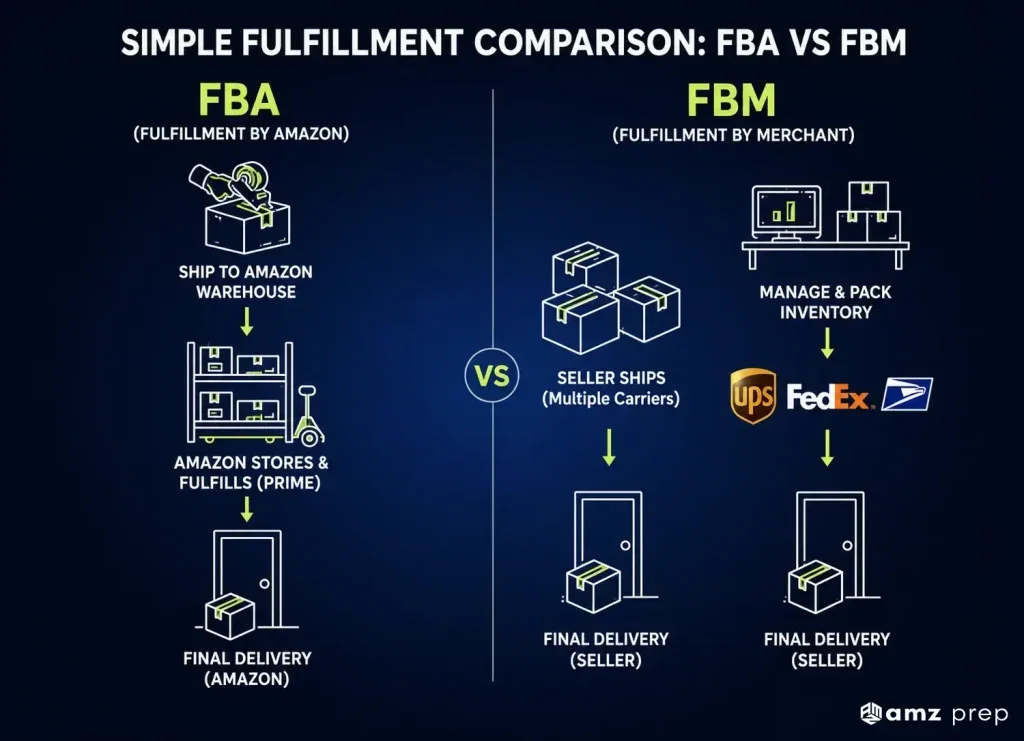
The largest group of sellers uses FBA exclusively.
- 68% use FBA only.
- 21% use both FBA and FBM.
- 11% use FBM only.
This means almost 7 out of 10 sellers in the dataset rely entirely on FBA.
At the same time, more than 1 in 5 use a hybrid strategy.
That matters because FBA and FBM do not have to be competing choices.
A seller can use FBA for some products and FBM for others.
Why Do So Many Amazon Sellers Use FBA?
FBA solves several operational problems for Amazon sellers.
1. Amazon handles fulfillment
With FBA, Amazon stores inventory and handles picking, packing, and shipping eligible orders.
Amazon also manages customer service and returns for eligible FBA orders.
This allows sellers to spend less time running day-to-day fulfillment operations.
2. Access to Prime fulfillment
FBA gives eligible products access to Amazon’s fulfillment network and Prime delivery.
Fast delivery has become an important part of the Amazon customer experience.
3. Easier to scale
A seller shipping 100 orders per month can potentially manage fulfillment internally.
At 10,000 or 50,000 orders per month, the operational requirements are very different.
FBA allows sellers to use Amazon’s existing fulfillment infrastructure instead of building the same network themselves.
4. Less warehouse work
Sellers do not need to handle every individual Amazon order when inventory is stored with Amazon.
That can reduce the need for warehouse space, fulfillment labor, packing materials, and shipping operations.
Does FBA Make More Money Than FBM?
Not necessarily.
FBA can reduce operational work, but it comes with Amazon fulfillment and storage costs.
FBM can give sellers more control over fulfillment costs, but the seller takes responsibility for the operation.
Research has also shown that FBM and FBA sellers can have different revenue and profitability profiles. Those differences do not mean one model is automatically better.
The right choice depends on the economics of the product.
For example, a seller with a small, fast-moving product may benefit from FBA.
A seller shipping large, heavy products may find FBM or third-party fulfillment more economical.
Oversized products can be particularly challenging with FBA and Amazon AWD. Amazon changed AWD eligibility in July 2026, limiting it to sortable units under 18 × 14 × 8 inches and under 20 pounds. For a detailed breakdown, see our guide to Amazon AWD size limits for oversized products.
When Does FBA Make Sense?
FBA can be a strong option for:
- Fast-moving products
- Standard-size products
- Products with predictable demand
- Sellers who want less fulfillment work
- Sellers who want access to Amazon’s fulfillment network
- Businesses that do not want to operate their own warehouse
But sellers should calculate the total cost before moving inventory into FBA.
That includes:
- FBA fulfillment fees
- Storage fees
- Inbound shipping
- Inventory placement costs
- Long-term storage exposure
- Removal or disposal costs
- Prep and labeling costs
The lowest fulfillment price is not always the lowest total cost.
When Does FBM Make Sense?
FBM can be useful when sellers need more control over inventory and fulfillment.
It can make sense for:
- Oversized products
- Heavy products
- Slow-moving products
- Seasonal inventory
- Products requiring special handling
- Products with high FBA storage costs
- Sellers with an existing warehouse
- Products where third-party fulfillment is cheaper
For these sellers, keeping inventory outside Amazon can provide more flexibility.
Why Do Some Sellers Use Both FBA and FBM?
The 21% hybrid figure shows that many sellers do not choose just one fulfillment model.
A seller might use FBA for its best-selling products and FBM for products that are expensive to store or ship through Amazon.
For example:
| Product | Possible fulfillment strategy |
|---|---|
| Fast-moving standard-size product | FBA |
| Oversized product | FBM |
| Slow-moving product | FBM |
| High-volume bestseller | FBA |
| Seasonal product | FBA + FBM |
| Product requiring special handling | FBM |
| Product with tight margins | FBA or 3PL, depending on costs |
This approach can give sellers more control over their fulfillment costs without giving up the benefits of FBA.
When a 3PL Makes More Sense
A 3PL can be useful when you want to keep inventory outside Amazon while still outsourcing the physical work.
This can be especially valuable when you:
- Sell through Amazon and your own website
- Have oversized or heavy products
- Need B2B or wholesale fulfillment
- Want to reduce dependence on Amazon’s warehouse network
- Need more control over inventory
- Have slow-moving or seasonal products
- Need kitting, bundling, or special handling
- Want one inventory pool for multiple sales channels
Instead of sending everything to FBA, you can keep inventory with a 3PL and replenish Amazon as needed.
That can give you more flexibility over where inventory sits and how it is used.
Using FBA and a 3PL Together
For many growing Amazon brands, the decision is not FBA versus 3PL.
It is FBA plus 3PL.
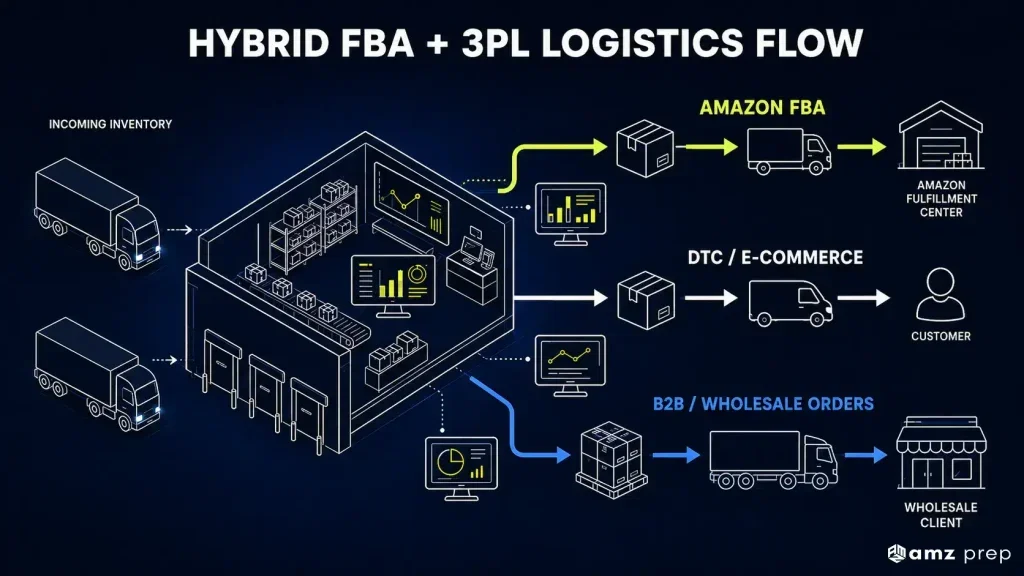
For example, a seller could:
- Store the majority of inventory with a 3PL.
- Send fast-moving Amazon inventory into FBA.
- Replenish FBA based on sales velocity.
- Fulfill oversized products through the 3PL.
- Use the same 3PL inventory for Shopify, wholesale, and other channels.
- Keep slower-moving inventory outside Amazon until it is needed.
This approach can reduce the amount of inventory sitting inside Amazon while giving the seller more control over the overall supply chain.
Where AMZ Prep Fits
AMZ Prep supports sellers that want to use FBA without making Amazon the only place they keep inventory.
As a 3PL and FBA prep provider, AMZ Prep can receive inventory, inspect and prepare products, label and bundle units, forward inventory to Amazon, and fulfill orders outside Amazon.
That makes a hybrid model possible.
For example, a brand can keep its core inventory with AMZ Prep, send selected products into FBA, and use 3PL fulfillment for products or channels that are better suited outside Amazon.
This can be particularly useful for brands managing Amazon alongside DTC, wholesale, or other sales channels.
The goal is not to replace FBA.
It is to give sellers another option when sending everything to Amazon no longer makes operational or financial sense.
How Many Amazon Sellers Are There?
Another important point is the difference between registered sellers and active sellers.
Estimates are Amazon has around 9.7 million registered seller accounts, but only about 1.9 million active sellers.
That difference matters when calculating FBA adoption.
Using the 9.7 million registered accounts would make the FBA seller count look much larger than it should.
The 82% FBA adoption estimate is based on active sellers.
Active Amazon Sellers
| Year | Estimated active sellers |
|---|---|
| 2021 | 2.4M |
| 2022 | 2.2M |
| 2023 | 2.0M |
| 2024 | 1.9M |
| 2025 | 1.9M |
Another important point is the difference between registered sellers and how many active Amazon sellers are actually selling on the marketplace.
The number of active sellers has declined from its 2021 level, but the Amazon third-party marketplace remains very large.
How Much of Amazon’s Sales Come From Third-Party Sellers?
FBA adoption is only one part of the Amazon marketplace.
Independent sellers now account for more than 60% of sales in Amazon’s store, according to Amazon’s 2025 Small Business Empowerment Report.
Amazon also reported that more than 75,000 independent sellers surpassed $1 million in sales in 2025.
That shows why fulfillment has become such an important part of the Amazon seller ecosystem.
As sellers grow, fulfillment decisions become more important because storage, shipping, prep, and inventory management can have a direct effect on margins.
Independent sellers now account for more than 60% of sales in Amazon’s store. This makes the distinction between Amazon 1P vs. 3P important when looking at how the marketplace operates.
What Does the FBA Adoption Rate Tell Us?
The main takeaway is not simply that 82% of sellers use FBA.
It is that FBA has become the standard fulfillment option for a large majority of Amazon sellers.
But the data also shows that there is no single fulfillment strategy that works for everyone.
Around 21% of sellers according to data use both FBA and FBM.
That suggests many sellers are already making fulfillment decisions at the product level rather than choosing one model for their entire business.
For growing brands, the right question is:
Which fulfillment model gives us the best combination of cost, speed, control, and scalability?
How to Choose Between FBA, FBM, and 3PL Fulfillment
The decision should start with your product and order profile.
| Factor | FBA | FBM | 3PL |
|---|---|---|---|
| Prime fulfillment | Strong | Possible with requirements | Possible with requirements |
| Operational control | Lower | High | High |
| Warehouse ownership | No | Usually required | No |
| Scalability | High | Depends on operation | High |
| Oversized products | Can be expensive | Often better | Often better |
| Inventory flexibility | Lower | High | High |
| Fulfillment workload | Low | High | Low |
| Best for | Amazon-focused sellers | Sellers with fulfillment capability | Growing multi-channel brands |
For some businesses, FBA will remain the simplest option.
For others, FBM or a 3PL can reduce costs or provide more control.
Many established sellers use a combination.
The Bottom Line
So, what percentage of Amazon sellers use FBA?
The latest industry estimate is approximately 82% of active Amazon sellers.
Based on around 1.9 million active sellers, that represents roughly 1.56 million active sellers using FBA.
Reports indicate a higher 89% figure when sellers using FBA in any capacity are included.
The exact number varies because Amazon does not publish an official global FBA adoption rate.
What the available data does show is clear: FBA is the dominant fulfillment model on Amazon.
But FBA is not automatically the best option for every product.
For some sellers, FBM or third-party fulfillment can provide better control over costs and inventory. For others, FBA provides the scale and convenience they need.
The best fulfillment strategy depends on your products, order volume, margins, and operational requirements.
Frequently Asked Questions
How many Amazon sellers use Fulfillment by Amazon?
There is no official Amazon-published global FBA seller count.
Estimates are approximately 1.9 million sellers were active in 2025. If 82% use FBA, that equals approximately 1.56 million active FBA sellers.
How many Amazon sellers use FBA only vs. FBM only?
68% of sellers use FBA only, 21% use both FBA and FBM, and 11% use FBM only.
What percentage of Amazon sellers use FBA in 2026?
The latest industry estimate is approximately 82% of active Amazon sellers. Another dataset reports 89% using FBA in some capacity.
Is FBA more popular than FBM?
Yes. FBA is significantly more widely used.
Reports indicate that 89% of sellers use FBA in some capacity, compared with 32% using FBM in some capacity.
How many Amazon sellers use both FBA and FBM?
Approximately 21% of sellers use both FBA and FBM.
What percentage of Amazon sales come from third-party sellers?
More than 60% of sales in Amazon’s store come from independent sellers, according to Amazon’s 2025 Small Business Empowerment Report.
How many Amazon sellers made over $1 million in 2025?
More than 75,000 independent sellers surpassed $1 million in sales on Amazon in 2025.
Is FBA cheaper than FBM?
Not always.
FBA includes fulfillment and storage fees, while FBM requires the seller to cover its own warehouse, labor, packaging, and shipping costs.
The cheaper option depends on the product, order volume, size, weight, and fulfillment operation.
Should Amazon sellers use FBA or FBM?
There is no single answer.
FBA can work well for fast-moving, standard-size products. FBM or 3PL fulfillment may make more sense for oversized, slow-moving, or specialized products.
Many sellers use both.

Arishekar N is a Vice President (VP) of Marketing at AMZ Prep, specializing in ecommerce fulfillment and Amazon logistics strategies with a proven track record of driving growth for e-commerce businesses. He is a strategic leader with extensive expertise in marketing, e-commerce operations, SEO & advertising, and branding.
Stay updated on his latest insights by following him























Comments