
Ever wonder what happens after a customer clicks “BUY” on your site or any e-commerce site for that matter?
Here’s a peek into the process: as soon as the order is confirmed, it triggers a sequence of events known as ecommerce order processing, a system that has to balance speed, accuracy, and cost simultaneously.
Every step has to ensure speed and accuracy. On top of that your customer has to get their order on time and in perfect condition. What goes on behind the scenes is more than just a simple click of the Buy button.
Ensuring a smooth website checkout system is just as critical as optimizing fulfillment, since friction at the point of sale can cancel out even the fastest order processing setup. And it may hold the answer to faster delivery times and better customer satisfaction.
Curious about optimizing this process? Let’s explore how you can make each step work even better for your business.
What is Order Processing Time?
Order processing time (OPT) is the time taken to fulfill a customer’s order. ie from the order placement to delivery. Effective order processing time management involves understanding the ins and outs of order processing logistics.
Strategic Importance of Order Processing Time on Key Metrics
Order processing time is more than speed. It’s a key metric that influences business success.
Impact on Customer Delivery Promise (CDP)
Order processing time is an important metric for Customer Delivery Promise (CDP), The CDP has three main components.
- The time it takes to pick, pack, and hand off the package to the carrier.
- The time the carrier takes to deliver the package.
- Extra time added for unforeseen delays like carrier issues or weather.
Shorter order processing time reduces handling time, which speeds upthe CDP.
How to Calculate Order Processing Time?
Track the time for each step in the fulfillment process and divide it by total orders. This will give you an average.
Quantifying the Link Between Order Processing Speed, Customer Loyalty, and NPS
While direct data may be limited, the evidence strongly points to a link between fast order processing, customer loyalty, and Net Promoter Score (NPS). Here’s what we know
- Customer Satisfaction and Loyalty
Fast, accurate delivery shaped by efficient order processing will boost satisfaction. Satisfied customers are more likely to be loyal, repeat buyers, and recommend the brand, positively impacting NPS.
- Handling Time Impact
Studies reveal that merchants often overestimate handling times, which leads to longer delivery promises and missed sales. Faster order processing means shorter delivery promises, a factor that can attract and retain customers.
- Delayed Delivery Consequences
Late deliveries are detrimental, with studies showing that delays of just two days can reduce the likelihood of a repeat purchase by two-thirds. Efficient order processing helps businesses meet deadlines and maintain customer trust.
- Operational Benefits and Customer Impact
Improved inventory management, warehouse efficiency, and network optimization results of simplified order processing which will strengthen reliability, which supports customer satisfaction and loyalty.
- The Role of Technology
Order processing software directly impacts customer satisfaction by reducing errors and optimizing speed. Adopting headless ecommerce can further improve system flexibility and processing efficiency, ultimately strengthening customer loyalty.
What is the business impact of Order Processing Time?
Simply put, Success is inversely proportional to OPT. Long OPT can lead to customer frustration, cancellations, and negative reviews. Short OPT boosts satisfaction, loyalty, and sales.
The Impact of Fast Delivery Listings on Amazon Metrics for Featured Offer Eligibility

Fast delivery plays a significant role in determining the eligibility for the Featured Offer on Amazon.
Visibility and Sales Metrics
- Featured Offer Impact
Winning the Featured Offer significantly enhances visibility on Amazon’s platform. Products in this position attract more clicks and purchases due to increased trust from customers.
- Conversion Rates
Listings with the Featured Offer generally experience higher conversion rates. Fast delivery is a compelling factor that influences customer decisions, leading to more sales.
Industry Benchmarks for Order Processing Time?
- Benchmarks vary by industry, order complexity, and season. But here are the standards
- 24-48 hours for most e-commerce fulfillment
- 24-48 hours for most Consumer Packaged goods.
- Same-day delivery for groceries.
Seller Account Health Metrics related to Order Processing
- Performance Monitoring
Amazon closely tracks seller performance metrics, including on-time delivery rates, order defect rates, and customer feedback scores. These metrics directly affect a seller’s ability to maintain a healthy account status.
- Consequences of Late Deliveries
Late deliveries negatively impact account health, potentially leading to penalties or suspension. Efficient order processing helps ensure timely deliveries, thus preserving seller ratings.
Order Processing Workflow: A Detailed Technical Breakdown
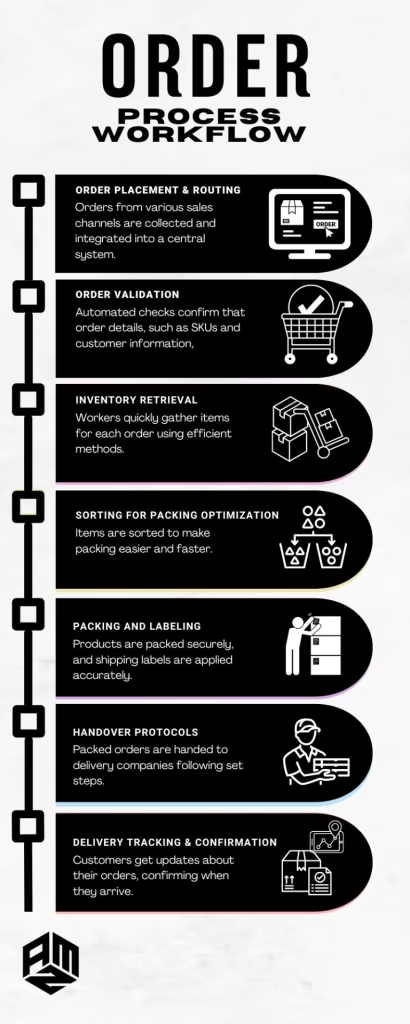
Understanding your ecommerce order processing workflow from end to end is what separates brands with 24-hour fulfillment from those struggling to ship in 72 hours. This technical breakdown outlines each stage of the workflow in detail.
Following the key order processing steps will form an efficient ecommerce order processing system, the operational backbone that receives orders, validates them, routes them, and hands them off to carriers without manual intervention.
1. Order Placement and Routing
- E-commerce Platform Integrations
This integration ensures that order data like customer details, product information, and shipping addresses transfers automatically.
- Multi-channel Order Reception
Orders can come from various channels. An effective OMS consolidates these orders, providing a centralized view.
- Routing Mechanisms
Intelligent routing mechanisms allocate orders to warehouses or fulfillment centers based on factors like inventory availability, shipping destination, and delivery speed requirements.
2. Order Validation
- Automated Validation Scripts
After an order is received, automated validation scripts verify the order’s completeness and consistency. Checks include:
- Correct product SKUs and quantities
- Valid customer information (addresses, payment details)
- Feasibility of the selected shipping method
- Error Handling
Discrepancies trigger the system to flag the order for manual review or notify relevant teams. This prevents the processing of incomplete or inaccurate orders, reducing fulfillment errors and enhancing customer satisfaction.
3. Picking Strategies and Inventory Retrieval
Strategies like wave picking, zone picking, and batch picking can optimize inventory retrieval
Technical Picking Strategies
- Wave Picking
Group orders are based on shipping deadlines, allowing simultaneous collection for multiple orders. For example, Let’s say a warehouse has 100 orders to ship by day’s end. Orders are grouped by shipping deadlines. This allows the pickers to prioritize these orders.
- Zone Picking
A large fulfillment center is divided into zones for different product categories. Each picker is assigned to a specific zone. This reduces travel time for pickers.
- Batch Picking
A grocery warehouse receives an order for apples, bananas, and milk. Instead of picking each item separately, the picker collects all items for multiple orders in one trip,.
- Technology-Assisted Picking
Utilizing barcode scanners, RFID tags, and voice picking systems enhances picking accuracy and speed, providing real-time guidance to pickers.
4. Sorting Logic for Packing Optimization
Systems like conveyor belts, robotic arms, and intelligent sorting machines can be directed to packing stations based on predefined criteria.
- Algorithm-Driven Sorting: Advanced algorithms categorize items based on:
- Destination: Grouping items for the same delivery region.
- Fragility: Identifying delicate items requiring special handling.
- Size and Weight: Optimizing packaging based on item dimensions.
5. Packing and Labeling Standards
Most e-commerce platforms required maintaining acceptable levels of standard
- Industry-Compliant Packing
Compliance with packaging standards is essential for product protection and regulatory adherence.
- Labeling Software Integrations
Integrated labeling software automatically generates shipping labels with accurate customer addresses and carrier requirements.
- Multi-carrier Shipping Considerations
The system must accommodate various carrier-specific labeling formats and documentation needs if multiple carriers are used.
6. Handover Protocols and Carrier service level agreements
Defined protocols ensure timely transfers of packaged orders to carriers, involving
- Scheduled pickups with carriers.
- Manifest generation for accurate tracking.
- Package scanning upon handover to initiate tracking.
- Carrier SLAs
Understanding and adhering to carrier service level agreements (SLAs) is nesscary for meeting delivery timeframes and avoiding penalties.
- Tracking Integration
Real-time tracking integration allows for continuous monitoring of package status, facilitating proactive issue resolution and customer updates.
7. Delivery Tracking and Confirmation
- Real-Time Tracking Solutions
Integrating tracking systems provides customers visibility into their order’s journey.
- Customer-Facing Delivery Confirmation
Automated notifications confirm delivery, providing customers peace of mind.
- Delivery Exception Management
The system should flag delivery exceptions and trigger actions like re-routing or customer communication.
The order processing flow will be enhanced by mixing and matching various order processing types in e-commerce.
Influencing Variables in Order Processing Time
Various factors will influence the Order Processing Times
Suggested Read: Curious how long inventory stays on the shelves before it’s sold? Read about Days Inventory Outstanding (DIO) that explains why it’s a critical metric for improving cash flow and operational efficiency.
Product-Specific Handling Requirements
- SKU Diversity
Different Stock Keeping Units (SKUs) have unique handling needs that directly impact processing time. For example:
- Perishable Goods
Items like fresh produce require temperature-controlled environments, complicating storage and retrieval. Cold storages are the best options for perishable goods.
- Hazardous Materials
These items require specialized handling, documentation, and compliance protocols, which can extend processing time.
- Implementation
Businesses should incorporate SKU-specific protocols into their workflows, such as
- Designated storage areas for sensitive items.
- Specialized equipment and trained personnel to handle regulated products.
Failure to account for these unique requirements can result in delays, safety risks, and compliance issues.
Advanced Packaging Configurations
The packaging process significantly affects order processing time
- Bulk Orders
These often require palletization and optimized loading to reduce handling time and maximize space.
- Fragile Items
Delicate products need protective packaging. This will require more time compared to standard orders.
- Customized Packaging
Personalizing or branding packaging enhances the customer experience, but leads to adding time.
Companies must balance packaging efficiency with product protection. Investing in packaging automation, optimizing box sizes, and selecting appropriate materials can expedite the process while ensuring safety and presentation.
This blog on Amazon FBA Prep and Packaging Requirements will provide more information on the topic
Cost-Efficiency vs. Speed Trade-offs
Order processing optimization requires careful analysis of speed versus cost:
- Labor Costs
Hiring more staff will reduce OPT but increase costs. Strategies like cross-training and flexible scheduling can increase productivity with some expense.
- Shipping Costs
While faster shipping options decrease transit times, they come at a premium..
- Technology Investments
Advanced technologies (e.g., automation systems and order management software) can decrease OPT, but businesses must weigh initial and maintenance costs.
Labor Allocation and Workforce Automation
Aligning workforce capacity with demand is essential
- Demand Forecasting
Historical data and predictive analytics help anticipate order volume changes, enabling proactive staffing adjustments.
- Labor Scheduling Algorithms
These algorithms optimize task assignments based on employee availability, skill sets, and order complexity.
Utilizing robotic automation for repetitive tasks can greatly improve efficiency. However, tasks requiring human judgment or delicate handling should remain with skilled employees to ensure quality.
Advanced Strategies for Faster Ecommerce Order Processing
This analysis explores advanced techniques to reduce order processing time by integrating automation. Whether you manage fulfillment in-house or partner with dedicated ecommerce fulfillment providers, these strategies apply across the board and can drive meaningful reductions in your order cycle time.
End-to-End Process Automation
- Integrating Automation Tools
Automate repetitive tasks to streamline operations and reduce manual effort. Robotic Process Automation (RPA) can handle tasks like order confirmation, label generation, and stock updates. This frees up employee time for complex tasks.
- Software Solutions
Use Order Management Systems (OMS) and Warehouse Management Systems (WMS) to create a flow of information to automate tasks.
A modern retail order management system centralizes inventory across channels, enables BOPIS and ship-from-store, and routes orders to the optimal location – reducing handling time and improving delivery accuracy.
One of the most essential software sellers often use is Inventory Management Software. Here is a Blog on Inventory Management Tools
Demand Forecasting Algorithms
Most Inventory management tools will have a Demand Forecasting Feature
- Anticipating Future Demand
Accurately predicting demand helps adjust resources and optimize inventory levels, reducing stockouts and delays.
- Leveraging Predictive Algorithms
Use machine learning models to analyze historical sales data and seasonal trends.
- Resource Scaling
Adjusting staffing and shipping resources during peak seasons.
- Inventory Optimization
Ensuring high-demand items are stocked and positioned for efficient picking.
- Proactive Planning
Identifying potential bottlenecks before they impact order processing.
Carrier and Shipping Partner Evaluation
Evaluate potential shipping partners based on
- Delivery timelines, especially during peak seasons.
- Base rates, volume discounts, and surcharges.
- API Integration with your other systems
- Assess on-time delivery rates
- Assees the claims handling procedures.
Automated Customer Communication Systems
Automatic communication at the first level saves you and your customers time.
These items can be made automatic
- Confirmations, shipping updates, and estimated delivery times via email or SMS.
- Prompt notifications about delays with revised delivery estimates.
- Enable customers to monitor their orders easily.
Real-Time Inventory Management Systems
Real-time inventory management prevents delays caused by stockouts:
- Utilize data from Point of Sale (POS) systems, WMS, and supplier portals to maintain visibility.
- Automatically reorder items at predetermined thresholds.
- Allocate warehouse space based on real-time inventory data.
Enterprise Resource Planning (ERP) Integration
- Integrate ERP systems with inventory management, CRM, and ERP optimization to synchronize operations
- Access order status, inventory levels, and customer information across departments.
- Trigger tasks and notifications based on predefined rules.
- Use data for informed decision-making and process optimization.
Order Processing Software and WMS
Specialized software improves warehouse efficiency
- Group orders by shipping destination, product type, or priority.
- Allocate tasks based on employee skills.
- Automate picking routes and packing instructions.
Defining and Automating Workflow Logic
Implement if-then logic to guide order processing:
- Order Routing
Direct orders based on delivery location or availability using logic commonly implemented through app programming frameworks.
- Stock Replenishment
Automate purchase orders when inventory drops below thresholds to minimize backorders and out of stock items, ensuring orders continue moving through the fulfillment process without unnecessary delays.
- Exception Handling
Define procedures for common issues like backorders or damaged goods.
Automated Scanning and RFID Technology
Use automated scanning and RFID technology for inventory management:
- Barcode Scanning
Ensure correct item selection during receiving and packing.
- RFID Tags
Provide real-time visibility into inventory movement without line-of-sight scanning.
Optimizing the order processing cycle and considering order processing in supply chain management minimizes order processing costs.
How to Improve Ecommerce Order Delivery Times: 6 Proven Strategies
Knowing how to improve ecommerce order delivery times is where theory meets revenue. The technical knowledge of how order processing works means little if you can’t translate it into measurable speed gains.
Every extra day in your fulfillment cycle is a day a competitor could be winning back your customer.
Here are six strategies that high-growth brands actively use to shave hours, and sometimes days off their delivery cycle.
Strategy 1: Set Hard Processing Cutoff Windows
Establish same-day processing cutoffs – for example, all orders placed before 2pm local warehouse time ship the same business day. Clearly communicating this cutoff on product pages and at checkout sets accurate customer expectations and creates internal accountability for your fulfillment team to hit that window consistently.
Strategy 2: Use a Distributed Fulfillment Network
Centralizing inventory in one location is the single biggest driver of slow delivery times. Distributing stock across multiple regional warehouses reduces the average distance between your inventory and your customers, bringing more orders within 1-2 day ground shipping range without paying for air freight.
Strategy 3: Implement Real-Time Inventory Syncing
Out-of-stock discoveries after order placement are a silent killer of delivery speed. Real-time inventory syncing across all channels ensures your system never sells what isn’t available, eliminating the backorder delays that frustrate customers and harm your seller metrics.
Strategy 4: Automate Order Routing with Smart OMS Rules
A well-configured ecommerce order processing system should automatically route each order to the optimal fulfillment location based on inventory availability, proximity to the customer, and carrier pickup schedules – not manual decision-making. This alone can reduce handling time by several hours per order at scale.
Strategy 5: Partner with Professional Ecommerce Order Processing Services
One of the most effective levers available to growing brands is partnering with professional ecommerce order processing services. A 3PL like AMZ Prep brings pre-built fulfillment infrastructure, carrier relationships, and same-day processing SLAs that would take years and significant capital to replicate in-house. This is especially impactful for brands scaling beyond what their current warehouse setup can support.
Strategy 6: Offer Carrier Options That Match Customer Expectations
Not every customer has the same delivery urgency. Offering a range of shipping speeds at checkout – from economy ground to next-day – lets customers self-select based on their needs while ensuring your fulfillment operation isn’t bearing the cost of expedited shipping on every order.
Technical Setup for Shopify Order Processing Time
This guide outlines how to configure order processing time in Shopify, impacting delivery estimates and improving the customer experience.
Accessing Processing Time Settings in Shopify
- Navigate to Shipping and Delivery:
- Go to the Settings tab in your Shopify admin panel.
- Click on Shipping and delivery to access shipping settings, including processing times.
Configuring Processing Time
You can set up processing time based on three scenarios: when Shop Promise is deactivated, activated, or when a merchant is ineligible for Shop Promise.
Scenario 1: Shop Promise is Deactivated
- In the Expected delivery dates section, click on Show delivery dates at checkout.
- Check Show expected delivery dates at checkout to display delivery dates for customers.
- From the Order processing time dropdown menu, select a preset processing time or choose Custom processing time.
Scenario 2: Shop Promise is Activated
- In the Expected delivery dates section, click on Show fallback delivery dates for orders without a Shop Promise.
- Check Show fallback delivery dates at checkout to show delivery dates for orders not eligible for Shop Promise.
- Select a preset processing time from the Order processing time dropdown or opt for Custom processing time.
Scenario 3: Ineligible for Shop Promise
- In the Expected delivery dates section, click on Show delivery dates at checkout.
- Check Show expected delivery dates at checkout to display delivery dates for customers.
- Choose a preset processing time or select Custom processing time from the dropdown menu.
Modifying Processing Time
To modify or remove the processing time for any scenario:
- Navigate back to the relevant section under Expected delivery dates.
- Select a new processing time from the Order processing time dropdown or uncheck the display options to remove them.
Understanding Processing Time Options
- Preset Processing Times: Quickly select common processing durations like:
- Same business day
- Next business day
- Two business days
- Custom Processing Time: Set a specific duration ranging from 3 to 40 business days or 1 to 8 weeks. You can input the desired value directly or use the arrows to adjust the time.
Shop Promise and Fallback Delivery Dates
- Shop Promise automatically calculates and displays delivery dates for eligible orders at checkout, enhancing the customer experience with accurate expectations.
- Fallback Delivery Dates are shown for orders not qualifying for Shop Promise, ensuring customers receive estimated delivery timeframes even if their order doesn’t meet the criteria. To enable this:
- Select Show fallback delivery dates for orders without a Shop Promise and configure the processing time.
Impact of Processing Time on Fulfillment Dates
The selected processing time directly affects the “Fulfill by” date shown in the order index and order details page. This date indicates the deadline for fulfilling the order and handing it over to the shipping carrier.
Supplier Processing Time Dependencies and Customer Delivery Times

Supplier processing times significantly influence customer delivery timelines. Consider the following scenario
- Internal Processing Time: 1 day (receiving the order, packaging, etc.)
- Supplier Processing Time: 3 days
Total Processing Time:
- The total processing time is 4 days (1 day internal + 3 days from the supplier).
- This combined processing time determines the earliest possible shipping date.
Impact on Customer Expectations
- Failing to account for supplier processing times can result in inaccurate delivery estimates, leading to customer frustration.
Supplier SLA Negotiation and Compliance Tracking
Service Level Agreements (SLAs) define the performance expectations for suppliers. Here’s how to manage them effectively
- Processing Time SLAs
Clearly outline expected processing times for each supplier. For example, “Supplier shall process and ship all orders within two business days of receipt.”
Shipping is a complex topic. If you need a bird’s eye view of the topic. Go to E-commerce Shipping Best Practices for 2024
Real-time Tracking Technologies
To monitor supplier compliance, consider implementing these technical solutions:
- API Integrations
- Integrate with suppliers’ APIs to receive real-time updates on order status, inventory levels, and estimated shipping times.
- Electronic Data Interchange (EDI)
- For larger operations or suppliers without APIs, EDI can facilitate the exchange of structured data.
- Webhooks:
- Utilize webhooks for automated notifications from the supplier’s system to your system upon specific events.
- Performance Dashboards:
- Use visualization tools to create dashboards displaying key supplier performance metrics, such as:
- Average Processing Time
- Use visualization tools to create dashboards displaying key supplier performance metrics, such as:
Compare actual processing times against SLA targets.
- On-time Fulfillment Rate
Measure the percentage of orders processed within the agreed-upon timeframe.
- Order Backlog
Track the number of outstanding orders with the supplier to identify potential delays.
Incorporating Supplier Lead Times into Customer Promises
Supplier lead time is the duration between placing an order with a supplier and receiving the goods. This is different from when a customer places an order.
- Dynamic Processing Time Calculation
- The system should automatically calculate total processing time by combining internal processing time with real-time or estimated supplier lead times.
- Displaying Accurate Estimates
- Display this dynamically calculated processing time during checkout or on product pages. For instance, instead of stating “Ships in 3 days,” show “Ships in 5-7 days” to account for supplier lead times.
- Handling Time vs. Shipping Time
- Clearly differentiate between “handling time” (time to prepare the order) and “shipping time” (transit time from the supplier or warehouse to the customer) on customer-facing platforms.
Building a healthy relationship with your supplier often gives divedends down the line. This Blog on Top Strategies for Finding the Best SRM for Your Organization would be useful
Technical Implementation Considerations
Some limitation to keep in mind while implemeting
- Shopify API Limitations
- Shopify’s native features might not support all required functionalities. Custom app development or third-party integrations may be necessary.
- Scalability and Maintenance
- As your business grows and supplier numbers increase, ensure your system can handle the complexity and data volume.
- Error Handling
- Implement robust error handling to manage potential disruptions in API connections or data inconsistencies. Centralizing those logs in a dedicated log management platform lets your team trace an API failure or data inconsistency back to its root cause fast.
- Security
- Prioritize data security when integrating with external systems by ensuring secure API authentication, data encryption, and compliance with relevant data privacy regulations.
Final Takeaway
According to multiple studies, fast delivery is a prime driver of sales. Keeping ecommerce order processing efficient is key to happy customers and staying ahead of the competition. It’s important to factor in both your processing times and your suppliers. This helps you give customers accurate delivery estimates. Using automation and real-time tracking makes things smoother and builds trust. Regularly checking your processes and ensuring secure integrations will help your business grow and adapt.
In the end, a solid approach to ecommerce order processing boosts efficiency, reduces costs, and keeps customers coming back for more.
Whether you’re optimizing in-house workflows or exploring professional ecommerce order processing services, the goal remains the same: every ecommerce order your customer places should reach them faster than they expected.
Who offers the fastest ecommerce order processing and delivery services?
3PLs with distributed warehouse networks offer the fastest ecommerce order processing and delivery services. AMZ Prep provides same-day processing, 50+ warehouse locations, and nationwide 1–2 day shipping with direct integrations across major ecommerce platforms.
What is a realistic ecommerce order processing time benchmark?
For most ecommerce businesses, 24–48 hours from order placement to shipment handoff is the industry standard. High-volume sellers using optimized ecommerce order processing services can regularly achieve same-day or next-day processing.
What’s the difference between order processing time and shipping time?
Order processing time covers validation, picking, packing, and carrier handoff. Shipping time is transit from warehouse to customer. Both combined determine your total delivery promise, reducing ecommerce order processing time directly improves the customer experience.
When should a brand outsource to an ecommerce order processor?
When fulfillment consistently misses cutoffs, struggles with accuracy, or can’t scale during peak seasons, partnering with a dedicated ecommerce order processor removes the bottleneck, giving your team infrastructure and SLAs already built for speed.

Arishekar N is a Vice President (VP) of Marketing at AMZ Prep, specializing in ecommerce fulfillment and Amazon logistics strategies with a proven track record of driving growth for e-commerce businesses. He is a strategic leader with extensive expertise in marketing, e-commerce operations, SEO & advertising, and branding.
Stay updated on his latest insights by following him
























Comments