
Amazon Middle Mile Logistics for FBA Sellers: $0 Placement Fees
AMZ Prep is a 3PL for Amazon FBA with its own middle mile network. Send one shipment to any AMZ Prep center. We split it across the fulfillment centers in Amazon's optimized split, put it on daily full truckloads with the dock appointments already booked, and get it checked in 2 to 4 days after pickup, with no inbound placement fee.
On this page
Key Takeaways
- Amazon charges no inbound placement fee when you accept its optimized split; Middle Mile trucks that split for you, so the fee is $0.
- You send one shipment to an AMZ Prep center instead of one per fulfillment center, from your supplier, your warehouse or another prep center.
- Freight is consolidated onto daily full truckloads with Amazon appointments booked 90+ days ahead, and checks in 2 to 4 days after pickup.
- Middle Mile is one flat rate per cubic foot; Middle Mile Plus moves intact pallets per pallet, including oversized and temperature-controlled goods.
- By our comparisons of real shipments, Middle Mile costs less than paying Amazon's placement fee about 75% of the time.
What is Amazon middle mile logistics?
Middle mile logistics is the freight leg that moves inventory from a warehouse or prep center into Amazon's fulfillment centers. The first mile brings goods from the factory or port to the warehouse, and the final mile takes each order to the shopper. It is also called middle mile delivery or middle mile transportation. Getting middle mile for Amazon sellers right comes down to two things: what Amazon charges in placement fees, and how fast inventory becomes sellable.
How do Amazon inbound placement fees work in 2026?
Amazon's FBA inbound placement service fee has applied since March 2024, and new rates took effect on January 15, 2026. When you create a shipment, Amazon offers placement options: send everything to one or a few locations and pay a per-unit fee, or accept its optimized split across several fulfillment centers and pay nothing. Our guide to Amazon inbound placement fees covers the rate card in detail.
Per-unit fee
Everything goes to one location. Convenient, but every unit carries a fee that rises with size, weight and destination region.
Reduced fee
A few locations, for eligible items. Lower than minimal, still charged per unit.
$0 placement fee
Amazon chooses several FCs. No fee, but you have to get freight to every one of them, which is where Middle Mile comes in.
Amazon sets the rates and eligibility rules and changes them, so check the live numbers in Send to Amazon before you choose.
How does AMZ Prep Middle Mile get you $0 placement fees?
Create the shipment like always Seller Central
Build your FBA shipment in Seller Central the usual way and accept Amazon's optimized split, the option with no placement fee.
Send one shipment to us, or we pick it up 1 destination
Ship to the nearest AMZ Prep center, or email us the details and we truck it from your warehouse to our hub. One destination, not one per FC.
We consolidate by Amazon region Full truckload
Your cartons join other sellers' freight bound for the same Amazon regions on full truckloads, and one consolidated load routes to 5 to 10 FCs.
Daily trucks with booked appointments 3 PM cutoff
Prepped inventory ready by 3 PM local time leaves on that day's truck, with the Amazon dock appointment already booked.
Checked in at Amazon 2 to 4 days
Inventory is checked in 2 to 4 days after pickup, tracked the whole way and confirmed in weekly performance reports.
Need prep first? FBA prep services run in the same building, so prepped stock goes straight onto the next truck.
How does Amazon freight consolidation get stock in faster and cheaper?
A single seller's shipment rarely fills a truck, so it pays partial LTL rates and waits at terminals. Middle Mile pools freight from many brands at our cross-dock hubs, builds full truckloads by Amazon region, and sends them straight to the fulfillment centers. You pay for the space your cartons take on a full truck, not for a half-empty one.
What is the cheapest way to ship inventory to Amazon FBA?
There are five realistic ways to get stock into FBA. The cheapest depends on your carton count, how many FCs Amazon assigns and how much freight management you want to own. By our comparisons of real shipments, Middle Mile beats paying the placement fee about 75% of the time.
| Way to inbound | Placement fee | Who handles the split | Trade-off |
|---|---|---|---|
| Minimal split, pay the fee | Per-unit fee, rising with size and weight | Nobody: one destination FC | A fee on every unit you send |
| Amazon-optimized split, shipped yourself | $0 | You: a separate shipment and appointment per FC | Several LTL or parcel shipments to manage and pay for |
| Amazon Partnered Carrier | Depends on the split you choose | You, on Amazon-negotiated carrier rates | Transport only; it doesn't remove the fee |
| Amazon Warehousing and Distribution (AWD) | No separate fee on AWD replenishment | Amazon, from its own storage network | Storage, processing and transport charges; stock sits inside Amazon |
| AMZ Prep Middle Mile | $0 | AMZ Prep, on consolidated full truckloads | Inventory goes through an AMZ Prep center first |
Want your own numbers? Our free seller data export tool pulls your Amazon shipment history, and we compare what you pay today against Middle Mile.
How fast does Middle Mile get inventory checked in at Amazon?
Speed claims in this market measure different clocks, so compare the clock before the number. Ours starts when the truck collects your freight at our dock and stops when Amazon checks it in.
| Speed claim | Starts | Stops | What it hides |
|---|---|---|---|
| Dock to dock | Truck leaves the 3PL | Truck arrives at the FC | Time waiting for an appointment and for Amazon to receive |
| Pickup to check-in (ours) | Pickup at our dock | Amazon checks the inventory in | Nothing between our dock and Amazon's receiving: 2 to 4 days |
| Hub to FC (our network average) | Truck leaves our hub | Amazon receipt at the FC | 1.44 days across all brands on our network, 90-day window |
| Check-in to sellable | Amazon receives | Units are available to buy | Amazon's own stowing, which no 3PL controls |
Appointments booked early
Amazon dock appointments are booked 90+ days ahead, so freight never waits in a yard for a slot.
Live unloads
More than 95% of our loads are unloaded live, and containers are floor-loaded floor to ceiling, so there is no drop-trailer wait.
FCs reviewed every week
Every Amazon facility we deliver to is reviewed week on week, and when one is backed up we shift freight to its secondary facilities.
Amazon's receiving queues get longer for every seller in peak season. We lock appointments early and plan your peak inbounds with you weeks ahead, on lanes rate-shopped across 35+ carriers.
Middle Mile vs Middle Mile Plus: which AMZ Prep lane fits your freight?
For freight that ships in cartons
- Cartons consolidated onto full truckloads by Amazon region
- One flat rate per cubic foot, no zones
- Daily departures with a 3 PM local time cutoff
- Into Amazon FBA on the optimized split
For freight that ships on pallets
- Pallets stay intact, with no breakdown or repacking
- Priced per pallet, not per unit
- Full truckloads straight to Amazon, or up to 5 LTL pickups from your facility
- Oversized and temperature-controlled goods, on reefer when needed
- Also into Walmart WFS, Target, Costco and other retailer DCs
Moving a whole trailer? See full truckload freight.
How is Amazon middle mile freight priced?
Per cubic foot
You pay for the truck space your cartons take. Ten boxes or a thousand ship on the same flat rate, with no zone surcharges.
Per pallet
Big products take pallet space, not per-unit slots, so pricing follows the pallet.
Amazon's placement fee
Shipments on Middle Mile use Amazon's optimized split, so the inbound placement fee is $0.
Rates for prep, storage and fulfillment are on our pricing page.
How does middle mile delivery to Amazon FCs run through our hubs?
Inbound freight converges on two cross-dock hubs: Las Vegas for the West and our East hub in Kentucky. There it is consolidated by Amazon region and leaves as full trucks to fulfillment centers nationwide. Get freight to a hub from wherever your stock sits: our pickup from your warehouse, your supplier, another prep center or any of our 50+ AMZ Prep centers.
From your warehouse
Email the shipment details and we truck it to the hub, instead of you booking a separate LTL to every FC Amazon assigns.
From your supplier
Factory or port freight lands with us, gets prepped if it needs it, and goes out on the next Middle Mile truck.
From another prep center
Use our carrier network even if someone else does your prep. Prepped cartons join the same lanes.
Receiving addresses are shared during onboarding. See all our sites on locations served.
How do you track Middle Mile shipments and prove delivery?
Every Middle Mile shipment is booked and tracked in The Hub, our customer portal. Each pickup scan, hub receipt and Amazon FC receipt becomes data you can see, and each brand sees only its own freight. Because we ship for so many brands, we also see how every Amazon FC is performing, and route around the slow ones.
Proof at every pickup
The carrier's photos of your load and its seal, plus the signed BOL, are sent to you for each pickup, so there is a record before the freight leaves.


What the portal shows
- Units shipped into Amazon and the shipments in transit
- Average time from pickup to hub, and from hub to Amazon receipt
- Cubic feet shipped and spend booked
- Every lane from hub to FC on a live map
- Fastest FCs, busiest FCs and new FCs Amazon starts assigning
Watch: Amazon middle mile explained
 2:56
What Is Middle Mile Logistics? The FBA Strategy Most Sellers Miss
Joel den Boer, Head of Partnerships at AMZ Prep, explains the three stages of an Amazon seller's supply chain, where the middle mile fits and what it costs sellers who skip it.
 7:56
How to Reduce Amazon Placement Fees, SKU by SKU
A walkthrough of the tool AMZ Prep uses to measure placement fee impact on every SKU, and how inventory is routed to cut those fees or remove them.
 3:48
Middle Mile 101: FBA Load Consolidation With Blair
Blair Forrest, founder of AMZ Prep, draws out on a whiteboard how freight from many sellers is consolidated onto full trucks and split across Amazon fulfillment centers.
 2:34
Middle Mile vs Middle Mile Plus: Which One Fits Your Freight
Blair Forrest explains Middle Mile Plus for palletized, bulky and heavy products such as beverages and pet food, and how it differs from carton-level Middle Mile.
 2:59
How Amazon's New RDC Facilities Delay Your Q4 Inventory
Diggy from AMZ Prep explains Amazon's Regional Distribution Centers and why stock that makes the Black Friday cutoff can still sit unsellable if the inbound route is wrong.
 4:42
Amazon FBA Placement Fees Explained: How Middle Mile Cuts Them
In an interview on Vova Even's Amazon FBA Freedom Podcast, Joel den Boer of AMZ Prep explains what placement fees are, why Amazon charges them and how Middle Mile avoids them.
Quick answers on Middle Mile
Short clips on freight lanes, LTL vs FTL and dock appointments. Swipe for more.
 1:00
 0:44
 0:43
 0:51
 0:43
 0:59
 0:55
 6:21
What do sellers say about Middle Mile?
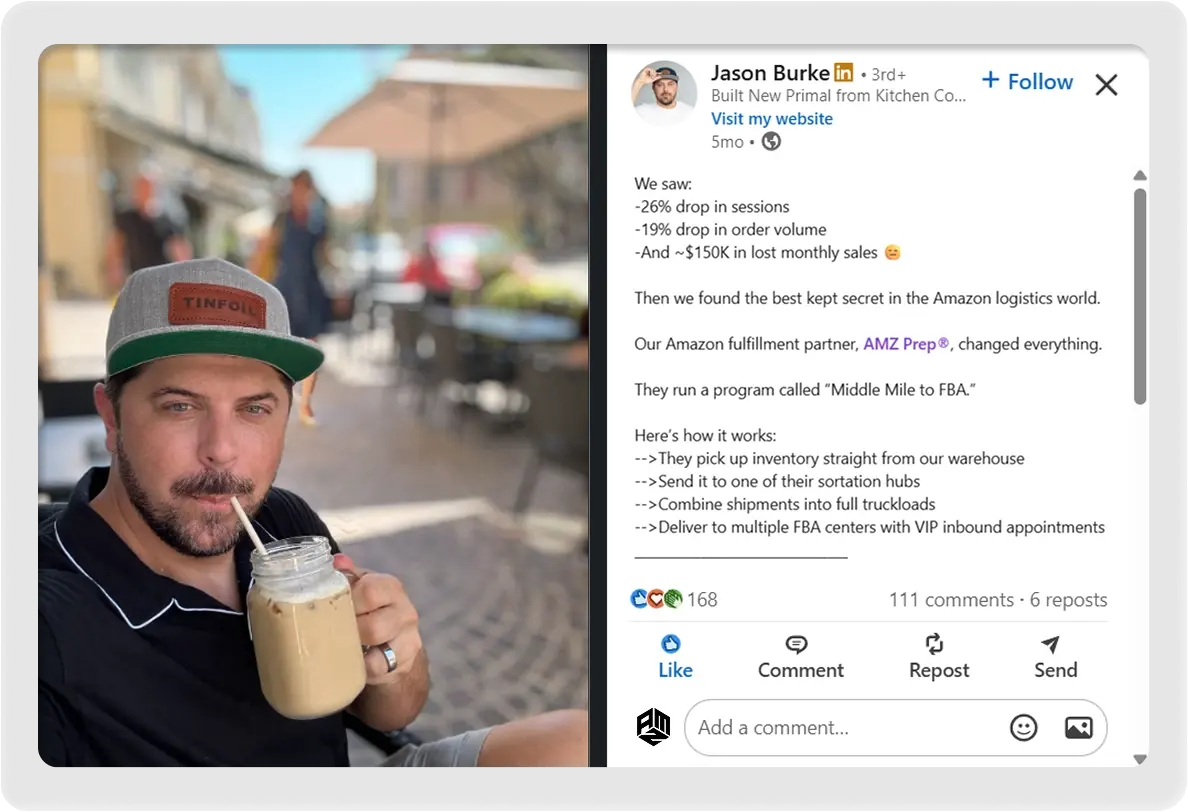
"Our Amazon fulfillment partner, AMZ Prep, changed everything."
Before Middle Mile, The New Primal shared what the problem was costing them on Amazon:
Jason then described the fix in four steps: we pick up from their warehouse, send it to a sortation hub, combine it into full truckloads and deliver to multiple FBA centers with booked inbound appointments.
"With Amazon's inventory restrictions, inbound delays were crushing us, and we were constantly going out of stock. AMZ Prep helped us fix it fast. Their freight program alone has likely saved us seven figures this year in lost sales."
Evan Sheraton, Market Defense
"Getting inventory into Amazon with AMZ Prep is way faster than doing it ourselves. It's a huge help when we're low on stock and need it live fast."
Jessica O., Director of eCommerce, The New Primal
What should you ask a 3PL for Amazon FBA middle mile?
| Ask any provider | Our answer |
|---|---|
| Do you guarantee $0 inbound placement fees? | Yes, on FBA shipments that move through Middle Mile on Amazon's optimized split. |
| Who manages the destination splits? | You create the shipment as usual; we truck every FC in the split. |
| Full truckloads or individual LTL loads? | Consolidated full truckloads; Middle Mile Plus adds up to 5 LTL pickups for smaller pallet volumes. |
| How are Amazon appointments booked? | Dock appointments are booked 90+ days ahead and before the truck leaves. |
| What exactly does your speed number measure? | 2 to 4 days from pickup at our dock to checked in at Amazon. |
| Daily or weekly departures? | Daily, with a 3 PM local time cutoff for prepped inventory. |
| How is it priced? | One flat rate per cubic foot, no zones; Middle Mile Plus per pallet. |
| Can you show performance data? | Every shipment is tracked in The Hub, with weekly performance reports. |
| Is there proof of each pickup? | Load and seal photos plus the signed BOL, sent for every pickup. |
Amazon middle mile FAQs
Amazon charges no placement fee when you accept its optimized split across several fulfillment centers. Middle Mile carries that split on our consolidated trucks, so you get the $0 option without shipping to each FC yourself.
About 75% of the time, based on our comparisons of real shipments. We price your lanes from your own shipment history first, so you know the answer before you switch.
At pickup from our dock, and it stops when Amazon checks the inventory in. Some providers quote dock-to-dock time instead, so ask which clock any speed claim measures.
Yes. Your prep center or supplier sends prepped cartons to the nearest AMZ Prep center, and they move on our consolidated lanes like any other Middle Mile freight.
Prepped inventory ready by 3 PM local time leaves on that day's truck to Amazon. Freight that misses the cutoff goes out on the next day's departure.
Yes, through Middle Mile Plus. Pallets stay intact from your dock to Amazon, pricing is per pallet, and oversized and temperature-controlled goods run on the same lanes, including reefer.
Yes. You build the shipment the usual way and choose Amazon's optimized split. We truck every destination in that split, so your Seller Central workflow doesn't change.
Every seller ships into the same FCs at once, so appointment slots fill and receiving queues grow. Middle Mile can't skip Amazon's queue, but pre-booked appointments and live unloads mean your freight isn't also waiting for a slot.
Work back from the day you need stock sellable: allow our 2 to 4 days from pickup to check-in, plus a buffer for Amazon's slower peak stowing. We plan those dates with you weeks ahead.
It means the truck is received when it arrives instead of waiting days for a slot. Stowing after check-in still runs on Amazon's clock, which no 3PL controls.
We rebook it in Carrier Central straight away and your freight waits on our side, not in a yard. You see the new date in The Hub the same day.
Yes. Send that stock first: prepped cartons ready by 3 PM local time leave on that day's truck and are checked in 2 to 4 days after pickup.
Freight converges on two cross-dock hubs: Las Vegas for the West and our East hub in Kentucky. From there it leaves on full trucks to Amazon fulfillment centers nationwide.
Yes. Email us the shipment details and we truck it from your warehouse to the hub, then on to Amazon, so you never book an LTL to each fulfillment center yourself.
We book Amazon dock appointments 90+ days ahead and plan your peak inbounds with you weeks early, so your freight already has slots when receiving queues get longer.
No. The fee depends on the placement option, not the truck. You pay $0 only on Amazon's optimized split. Middle Mile builds every shipment to that split and delivers each destination, so the fee is $0.
AWD stores stock inside Amazon and replenishes FBA automatically, with its own storage and processing charges. A middle mile 3PL keeps inventory in your control for Shopify and retail too, and trucks it to FBA when you need it.
Stop paying Amazon to split your shipments.
Send us your typical shipment and we will show you what Middle Mile costs against the placement fee you pay today.


