
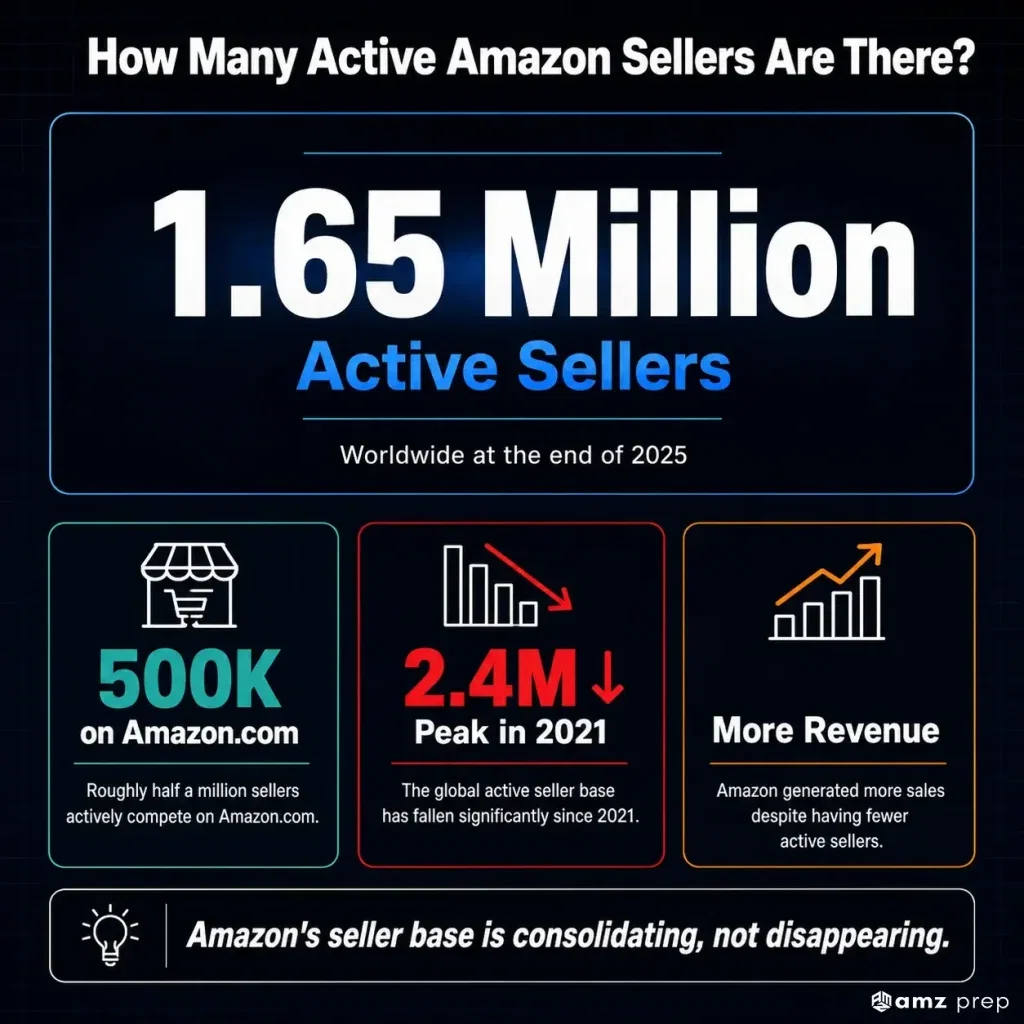
Amazon has about 1.65 million active sellers worldwide as of the end of 2025, according to Marketplace Pulse. Around 500,000 of those sell on Amazon.com. The widely quoted 9.7 million figure counts every account registered since 2000, and most sit dormant. Third-party sellers now drive roughly 61% to 62% of all units sold in the Amazon store.
I track this number every quarter for our own planning. Most published answers are wrong, and they’re wrong in a specific way. They count accounts instead of businesses.
That distinction changes how you read the competitive picture on Amazon in 2026.
How Many Sellers Are on Amazon in 2026?
There is no single official count. Amazon does not publish one. So the honest answer uses four separate measures, each with its own definition.
| Measure | Figure | Source and date |
|---|---|---|
| Total registered seller accounts worldwide | 9.7 million | Cumulative since 2000 |
| Active sellers worldwide, feedback-based | ~1.65 million | Marketplace Pulse, end of 2025 |
| Active sellers on Amazon.com, strict definition | ~500,000 | Marketplace Pulse, March 2026 |
| New sellers who launched a listing in 2025 | 165,000 | Marketplace Pulse, January 2026 |
| Sellers above $1 million in annual sales | 100,000+ | Marketplace Pulse, 2026 |
| Sellers above $100 million in annual sales | 235 | Marketplace Pulse, 2026 |
The first row and the third row differ by a factor of nineteen. Both are accurate. They answer different questions.
If you want the number of sellers on Amazon for a market-size slide, use 9.7 million. If you want to know who you’re actually competing against this week, use 500,000.
Why the 9.7 Million Seller Figure Is Misleading
That number is a running total of every account ever opened. It includes accounts created in 2013 and abandoned in 2014. It includes test accounts. It includes sellers who listed one item and quit.
Roughly 80% of those registered sellers are dormant. They hold no live listings and process no orders.
Using it as a competition benchmark inflates the picture badly. A brand launching in Home and Kitchen is not up against 9.7 million businesses. It’s up against the few thousand active sellers ranking in its subcategory.
I’d treat the 9.7 million as a historical artifact. It tells you Amazon has been popular for 25 years. It tells you nothing about 2026.
How Many Active Amazon Sellers Are There in 2026?
About 1.65 million active sellers worldwide, down from 2.4 million active sellers in 2021. That’s a 31% contraction in four years.
The US-only picture is sharper. Active sellers on Amazon.com fell from 584,000 in January 2025 to roughly 500,000 by March 2026.
What counts as an active seller
Marketplace Pulse defines an active seller as an account that received at least one piece of buyer feedback in the past twelve months. Feedback is a proxy for real orders.
Other trackers use looser tests, like maintaining a live listing. That’s why you’ll see 1.9 million active sellers quoted alongside the 1.65 million figure. Neither is fabricated. The threshold differs.
I use the feedback-based number because it filters out sellers who list but never ship.
Active sellers by year
| Year | Active sellers worldwide |
|---|---|
| 2021 | 2.4 million |
| 2022 | ~2.2 million |
| 2023 | ~2.0 million |
| 2024 | ~1.8 million |
| End of 2025 | 1.65 million |
The contraction is real and ongoing. What it does not mean is that Amazon is shrinking. Amazon sales hit $716.9 billion in 2025, up 12% year over year.
Fewer sellers. More revenue. That combination is the whole story of this marketplace right now.
How Many Third-Party Sellers Are on Amazon?
Nearly all active sellers are third-party sellers. Amazon’s first-party retail arm accounts for a small share of listings and a shrinking share of units.
Third-party sellers account for about 61% to 62% of all units sold, an all-time high. Independent sellers generated an estimated $305 billion in US GMV and $575 billion globally in 2025.
Amazon’s own framing is consistent with this. The company reports that more than 60% of sales in the Amazon store come from independent sellers, most of them small and medium-sized businesses.
First-party sales actually declined in 2025, while third-party marketplace sales grew 15%. Amazon is functioning less as a retailer and more as a platform each year. Anyone reviewing the full breakdown of Amazon marketplace data will see that trend line running back to 2018.
How Many Amazon Sellers Are There by Country?
Country-level active counts are not published by Amazon or any tracker with a defensible method. Several articles present precise country tables. Those tables are estimates layered on estimates.
What is measurable is where new sellers come from, and that shift is significant.
- Chinese sellers registered about 59.9% of new Amazon seller accounts in 2025
- US sellers accounted for 16.3% of new listing launches, down from 26.8% in 2024 and 70.8% in 2016
- Chinese sellers now represent more than half of active sellers worldwide
Revenue tells a different story than headcount. Marketplace Pulse estimates the average US seller generates about $884,000 in annual revenue, against roughly $393,000 for Chinese sellers.
Amazon operates 23 marketplaces globally. About 69% of sellers operate in only one of them. Cross-border expansion remains the most underused growth lever available to a mid-size brand, and the fulfillment center footprint supporting it keeps widening.
How Many New Sellers Joined Amazon in 2025?
165,000 sellers launched their first product listing on Amazon.com in 2025. That’s the lowest annual figure since Marketplace Pulse began tracking it in 2015, and a 44% drop from 2024.
One detail matters here. In April 2026, Marketplace Pulse clarified that this metric counts sellers who listed at least one product. It does not count raw new seller registrations, which include dormant signups.
A lot of coverage missed that correction and reported the number as registrations. It isn’t.
The decline in new sellers joining reflects higher entry costs. Advertising, Amazon fees, and tariffs all rose together. Casual entry stopped being viable around 2023.
How Many Amazon FBA Sellers Are There?
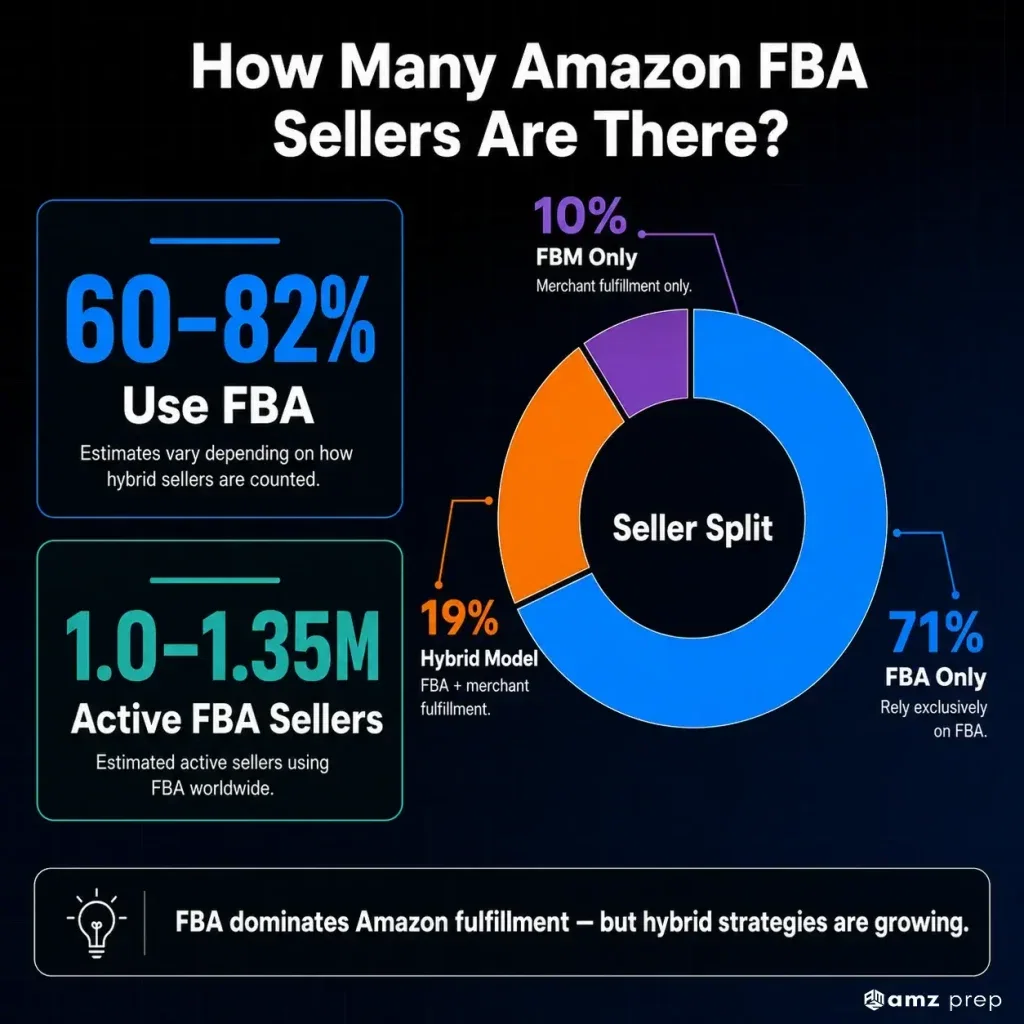
Fulfillment by Amazon adoption sits somewhere between 60% and 82% of active sellers, depending on the source. That’s a wide range, and I’d rather show it than pick a number.
- SmartScout and Red Stag put FBA adoption at roughly 82% of active sellers, counting exclusive and hybrid use
- A 2026 Jungle Scout study puts it closer to 60%
- Sumtracker’s split shows 71% FBA only, 10% FBM only, and 19% hybrid
Applied to 1.65 million active sellers, that gives a working range of roughly 1.0 million to 1.35 million FBA sellers worldwide.
The variance comes from how each study handles hybrid sellers. A brand running FBA on fast movers and FBM on oversized SKUs gets counted differently by each methodology.
Adoption keeps climbing regardless. Prime eligibility and Buy Box preference make FBA the default for most catalogs, which is why FBA prep accuracy has become an operational requirement rather than a nice-to-have.
How Many Amazon Sellers Make $1 Million or More?
More than 100,000 sellers now clear $1 million in annual sales, up from about 60,000 in 2021. At the top, 235 sellers clear $100 million, against roughly 50 four years ago.
Amazon reports a lower figure, 55,000+ sellers above $1 million in annual sales as of 2024. The gap comes down to timing and scope. Amazon’s number is a year older and counts differently.
Revenue concentration is the headline. The top 2% of US sellers generate more than half of total third-party revenue. Fewer than 8,000 sellers account for roughly half of US third-party sales.
Amazon also reports average annual sales of $290,000+ per US independent seller. That average sits far above the median, because the top decile pulls it upward. The seller earnings breakdown covers that distribution in detail.
On profitability, Jungle Scout data shows about 63% of Amazon sellers turn a profit within their first year.
What the Seller Count Means for Your Amazon Business in 2026
Here’s the part most marketplace statistics roundups skip.
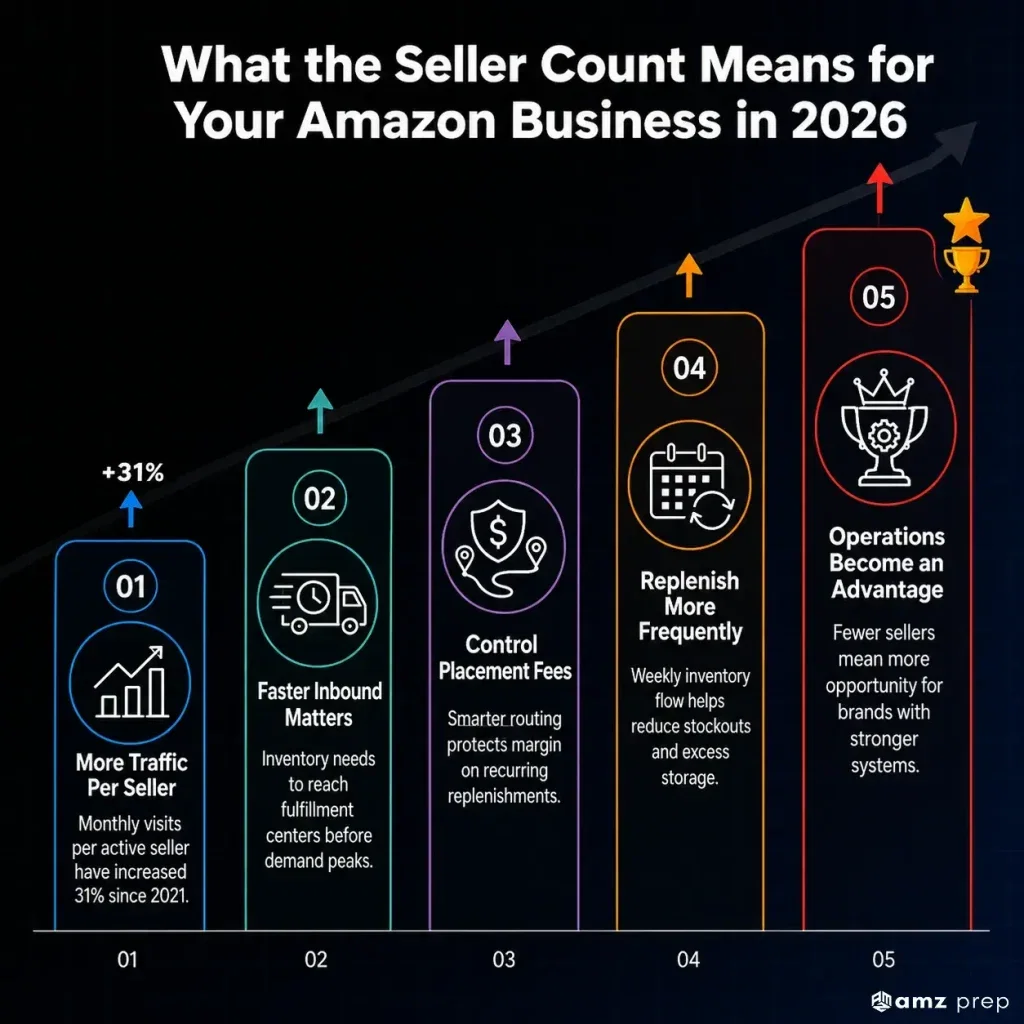
Traffic per active seller rose 31% since 2021, from 2,162 to 2,837 monthly visits. Fewer sellers are splitting a larger pool of Amazon customers. Amazon has over 310 million active customers worldwide.
Prime Day 2026 showed the same pattern. The event ran June 23 to 26, and US online spending reached $26.4 billion across the four days, up about 9.3% year over year. Independent sellers again posted record results.
More traffic per seller only converts if inventory is in stock and in position. That’s where the contraction creates real opportunity.
Three things separate the sellers capturing this traffic:
Inbound speed
Stock sitting at a 3PL for two weeks earns nothing during a demand spike. Our Middle Mile program moves the inventory dock to FC in two to four days, and the step-by-step inbound process explains the split-routing logic behind it.
Placement fee control
Five-way split routing removes placement fee exposure entirely. On steady replenishment volume, that recovers margin every month.
Replenishment cadence
Weekly drip-feed keeps IPI healthy and storage costs down. Huel cut FBA check-in times from over 20 days to three to five after moving replenishment to our network. Drip feeding to FBA works the same way for brands with restock limits.
800,000+ brands are now enrolled in Brand Registry, up 20% year over year. The majority of Amazon growth is going to sellers who treat operations as a competitive input, not overhead.
The seller base will likely keep contracting through 2027. Revenue per remaining seller will keep rising. Brands that fix inbound speed now will hold more of that gain than brands that wait for Q4 to expose the gap.
Conclusion
The direction is set. Fewer sellers, more revenue per seller, higher operating standards.
I expect active sellers to keep contracting through 2027 as costs rise and casual entry stays flat. New listing launches have no obvious catalyst to rebound. Meanwhile third-party unit share keeps climbing toward two-thirds of everything sold.
That leaves a smaller amazon seller base capturing a larger market. Sellers still treating Amazon as a passive sales channel will lose ground to operators who plan inventory around it.
The count is a benchmark, not a verdict. What decides the next two years is execution: how fast stock reaches a fulfillment center, how consistently it stays in stock, and how much margin survives fees.
Brands that fix those three now will be counted among the 100,000 clearing seven figures. Most won’t.
Frequently Asked Questions
How many sellers does Amazon have?
Amazon has about 1.65 million active sellers worldwide as of late 2025, and roughly 9.7 million total registered accounts since 2000. Most registered accounts are dormant and no longer sell.
How many 3rd party sellers are on Amazon?
Nearly all active Amazon sellers are third-party sellers, so the figure is close to 1.65 million worldwide. They account for roughly 61% to 62% of all units sold on Amazon.
How many FBA sellers are on Amazon?
Estimates range from 60% to 82% of active sellers using FBA. That works out to roughly 1.0 million to 1.35 million FBA sellers worldwide, depending on how hybrid sellers are counted.
How many Amazon sellers are in the US?
About 500,000 sellers were active on Amazon.com as of March 2026, down from 584,000 in January 2025. Country-level counts of US-based sellers are not officially published.
Are Amazon seller numbers growing or shrinking?
Shrinking. Active sellers fell from 2.4 million in 2021 to 1.65 million by the end of 2025. New seller launches hit a decade low of 165,000 in 2025.
How many Amazon sellers make over $1 million?
More than 100,000 sellers now generate over $1 million in annual sales, up from around 60,000 in 2021. A further 235 sellers exceed $100 million annually.

Arishekar N is a Vice President (VP) of Marketing at AMZ Prep, specializing in ecommerce fulfillment and Amazon logistics strategies with a proven track record of driving growth for e-commerce businesses. He is a strategic leader with extensive expertise in marketing, e-commerce operations, SEO & advertising, and branding.
Stay updated on his latest insights by following him
























Comments