
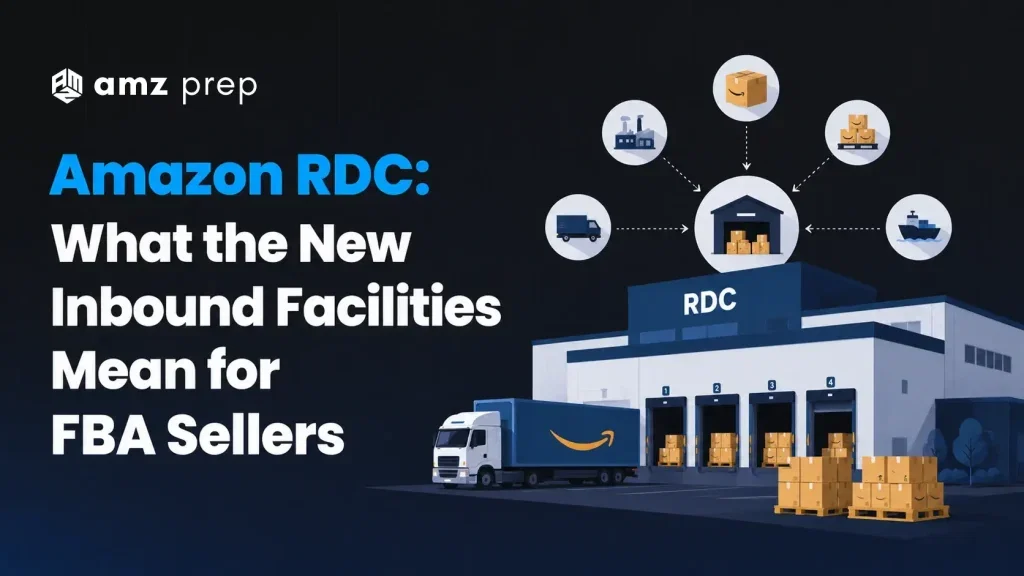
An Amazon RDC is an inbound facility that holds FBA inventory before replenishing fulfillment centers. Amazon has not published the term or added it to its facility taxonomy. Eleven appeared in AMZ Prep shipment data as of August 2026. Slow-moving SKUs carrying high weeks of supply are the ones getting routed there, and sellers cannot opt out.
I run FBA prep and fulfillment operations at AMZ Prep. We move more than 8 million FBA items a year for over 5,000 brands. That volume gives our team a view of destination assignments no single seller gets. Over recent weeks, a new destination type started appearing across our book of business.
Here is what we know so far, and what to do about it before peak season.
What Is an Amazon RDC?
An Amazon regional distribution center, or RDC, is a facility that receives FBA inventory and holds it before forwarding stock to fulfillment centers on demand. It sits between the inbound cross-dock layer and the fulfillment centers that actually ship customer orders.
Amazon’s published network covers fulfillment centers, inbound cross-docks, regional cross-docks, sortation centers, delivery stations, and Amazon Warehousing and Distribution. RDCs appear in none of that documentation. What we have is pattern recognition across thousands of shipment plans.
The behavior is what defines it. A cross-dock is engineered to empty out. An RDC holds.
One note on naming. AMZ Prep uses the term RDC for our own bulk storage sites across Kentucky, Nevada, Texas, Pennsylvania, South Carolina, Alberta, and California. Those are separate facilities under our control. This article covers Amazon’s facilities only.
How Is an Amazon RDC Different From an IXD or RXD?
Most sellers already know two layers of Amazon’s inbound network. The third is new. Dwell time separates them cleanly.
| Feature | IXD (national cross-dock) | RXD (regional cross-dock) | RDC (new) | FC (fulfillment center) |
|---|---|---|---|---|
| Primary function | Receives and sorts seller freight | Routes stock to nearby FCs, rebalances between them | Holds inventory before replenishing FCs | Stores, picks, packs, ships orders |
| Typical dwell time | 24 to 48 hours normally, 7 to 10 days in Q4 | 1 to 3 days | Extended. Storage behavior. | Weeks to months |
| Appears in shipment plans | Yes | Sometimes, for full truckload freight | Yes, assigned by Amazon | Yes |
| Seller control | Destination can be planned around | Limited | None | Limited |
| Bottom line | Fast but congested at peak | Fastest route into the network | Slowest path to sellable stock | Where inventory becomes buyable |
Routing through the national layer historically adds 7 to 10 days to inbound time. Shipping full truckloads direct to a regional cross-dock cuts that to 3 to 4 days. Our Amazon cross-dock guide covers both layers in operational detail.
An RDC changes that math because the inventory stops moving for a while.
Why Does Amazon Route Some Skus to an RDC?
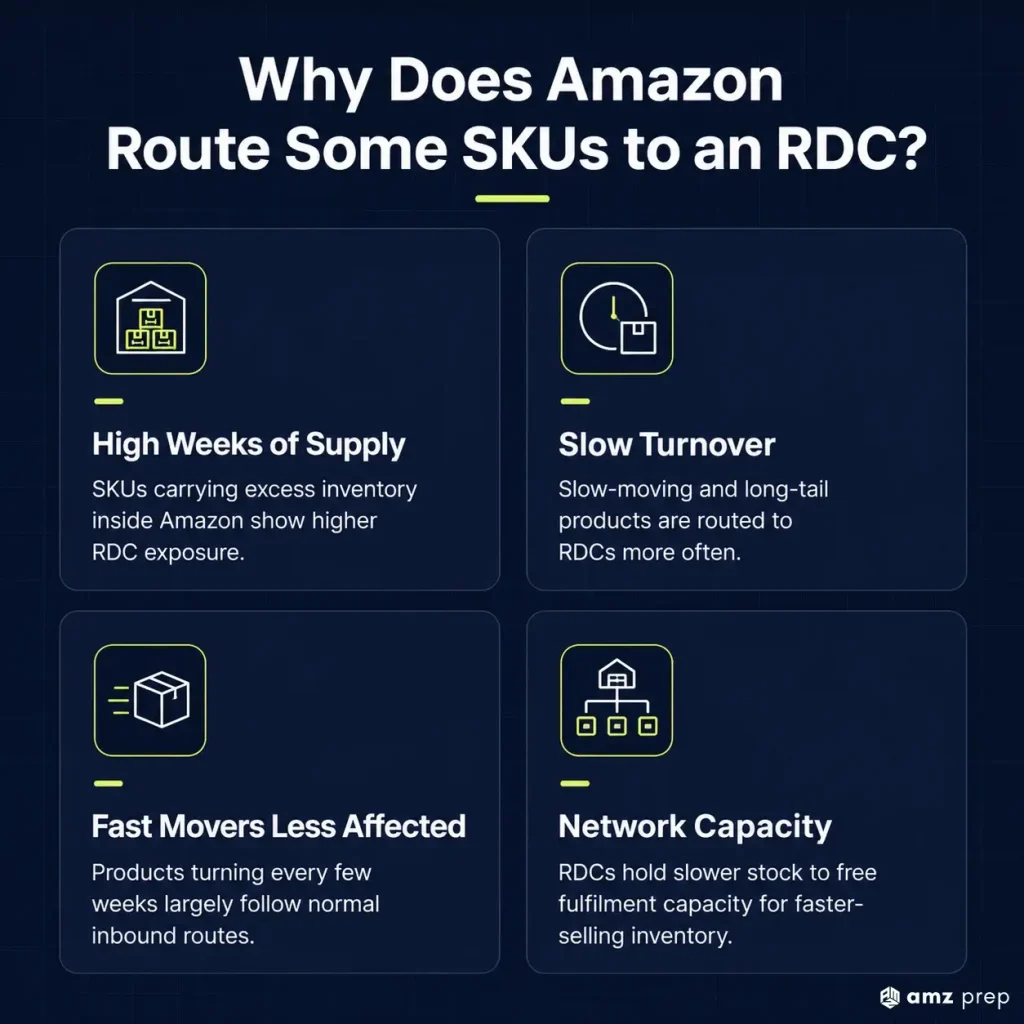
Two indicators show up consistently in our data.
The first is weeks of supply held inside Amazon’s network. A SKU sitting on a long runway gets flagged. The second is turnover rate. Slow movers and long-tail SKUs appear far more often than top sellers.
Fast movers look largely untouched. A SKU turning every two weeks tends to route where it always did.
That pattern fits the operational logic. Peak pressure lands hardest on the buildings doing the most outbound volume. Moving slower inventory into a holding layer keeps those buildings clear for stock that sells.
Both signals also drive your Amazon IPI score. Brands already managing inventory health tightly carry less exposure here. Our IPI score guide breaks down how those inputs are calculated and what moves the number.
In the video below, we walk through why RDCs are showing up now, which SKUs are getting flagged, and what this means for your inbound timeline heading into Q4. If you manage FBA replenishment for a brand with any long-tail SKUs, this is worth five minutes before you lock in your peak season shipment plan.
Where Are Amazon’s RDCs Located?
Eleven facilities appeared in AMZ Prep shipment data as of August 2026. Three states are confirmed from our own inbound freight: North Carolina, Texas, and Washington.
We are verifying the remaining locations before publishing codes or addresses. Amazon does not publish a facility directory, so the only reliable source is the destination shown on your live shipment plan in Seller Central. Our Amazon fulfillment center location list covers the documented network.
Treat any published list as a snapshot. This footprint was expanding while we wrote this article.
How Do RDCs Affect FBA Check-in Times?
Getting stock into these buildings has been fast. Appointment availability has held up. Transit has held up.
Downstream check-in is the open question.
We do not yet have enough receiving data at RDCs to publish an average, and any figure circulating right now is a guess. What we can say is that a facility built to hold inventory checks in on a different rhythm than one built to clear it in 48 hours.
That gap matters most for sellers using minimal shipment splits. One destination means one building sets your entire inbound timeline. Splitting across five spreads the risk across four other facilities. Amazon restructured placement fees on January 15, 2026, which changed the math on that trade-off. Our inbound placement fee guide has the current rate structure.
How to Reduce RDC Exposure Before Peak Season
Destinations are assigned, not chosen. The signals feeding that assignment are within your control.
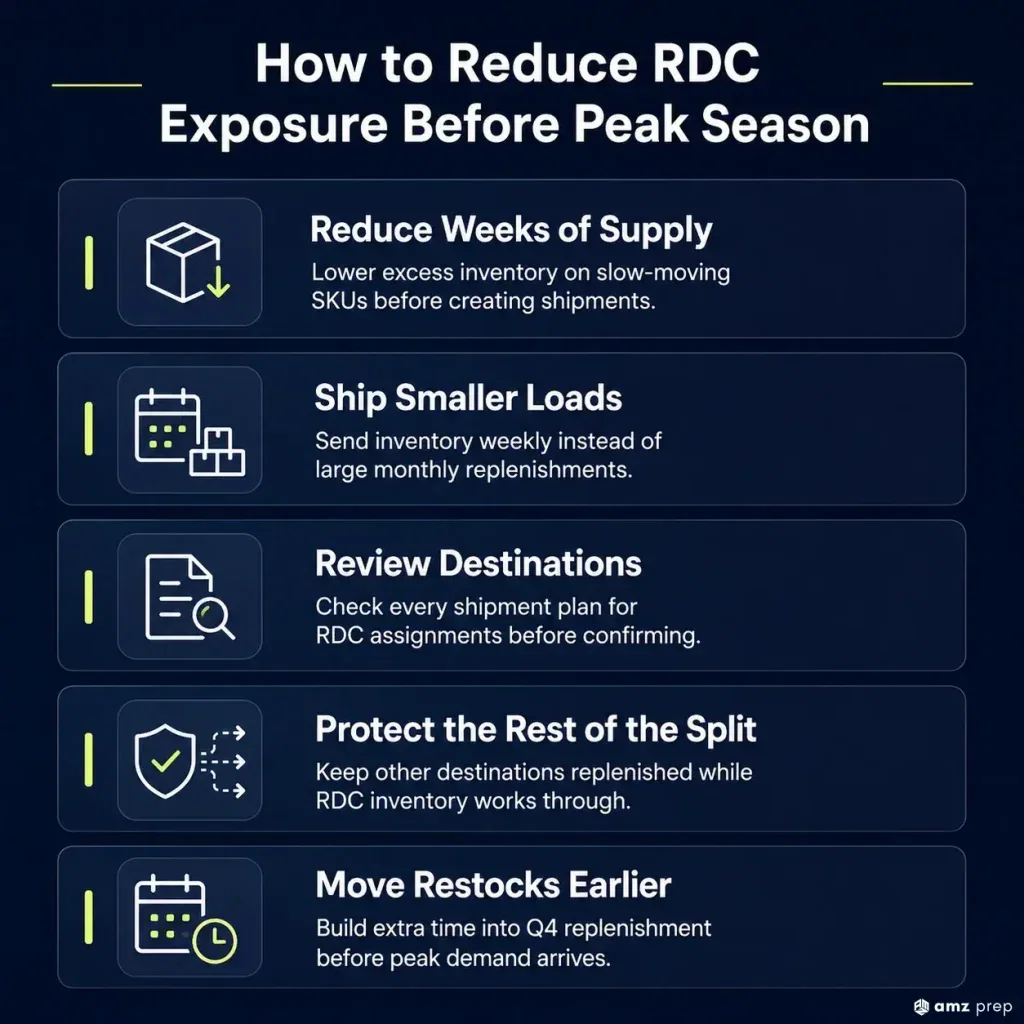
Reduce weeks of supply on slow movers
This is the highest-leverage change available. Long runways on slow SKUs are the clearest flag in our data. Bringing them down changes what Amazon’s system reads when it builds your plan.
Ship smaller loads more often
Weekly beats monthly. A brand sending four weeks of stock at once carries a much higher days-of-supply figure than one splitting the same volume across four shipments. We run weekly drip-feed replenishment for a large share of our FBA brands for this reason.
Review the destination list before confirming
Check every plan. You will not be able to change an RDC assignment once it appears. You will know it is coming, which lets you adjust timing and set internal expectations before freight moves.
Protect the rest of the split
If one of five destinations is an RDC, the other four carry your sell-through. Track which buildings those are and how fast they receive. A strong remaining set keeps stock selling while the slower assignment works through.
Move your restock calendar earlier
Amazon’s holiday peak fee window runs October 15, 2026 through January 14, 2027. Inventory that needs to be sellable in November should already be in motion. Our Q4 prep timeline has the full schedule.
What Does RDC Placement Mean for Inbound Freight Costs?
New facilities start with thin lane density. Fewer trucks running the lane, fewer consolidation partners, less volume to spread fixed cost across. That is normal for any building in its first year, and it narrows as volume builds.
For most brands the freight difference on one destination out of five stays small. Placement remains the larger line item. Our guide on how to avoid Amazon placement fees covers split routing strategy in full.
Consolidated freight gives you more room here. AMZ Prep’s Middle Mile program piggybacks brand inventory onto existing FBA truck volume, which supports multi-destination splits without the freight cost of running them independently.
Amazon RDC vs Amazon AWD: What Is the Difference?
Both hold inventory upstream of fulfillment centers. The similarity ends there.
| Feature | Amazon RDC | Amazon AWD |
|---|---|---|
| Enrollment | Assigned by Amazon, no opt-in | Seller creates a delivery request in Seller Central |
| Opt-out | None | Yes, seller controlled |
| SKU eligibility | Assigned by system logic | Sortable items only as of July 31, 2026 |
| Visibility | Destination appears in the shipment plan | Full inventory view in Seller Central |
| Replenishment control | None | Seller triggers or automates |
| Bottom line | A routing outcome you manage around | A program you choose and control |
AWD narrowed this year. It stopped accepting oversize units on July 31, 2026, which removed a large set of SKUs from the program. Brands looking for bulk storage with full control over replenishment timing should compare it against a third-party alternative before peak.
How Do You Track RDC Assignments Across Your Shipments?
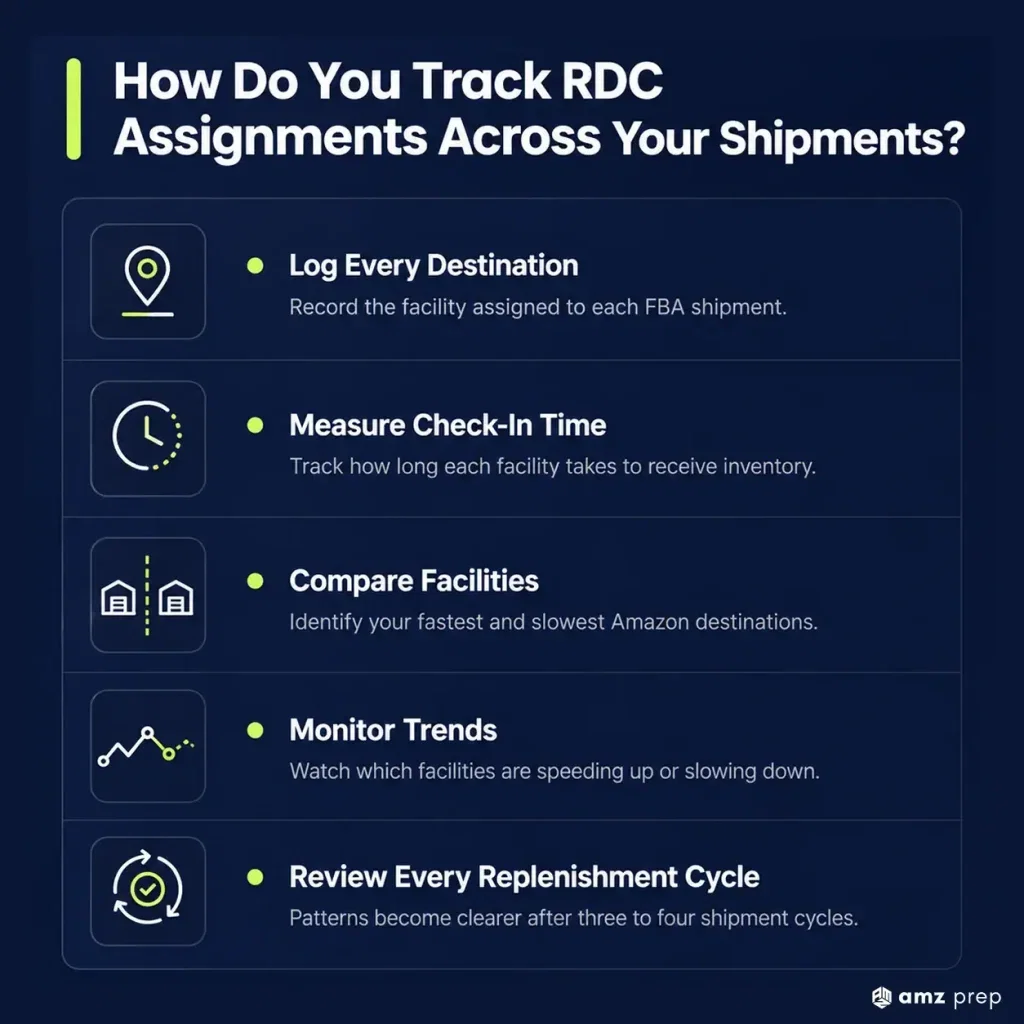
Visibility is the practical answer while the network settles.
Our inbound team tracks every destination our freight touches. Check-in times by building, fastest and slowest receiving facilities, transit reliability, and which locations are speeding up or slowing down. New destination types surface in that data before they surface anywhere public. That is how our team identified this pattern.
Sellers managing their own FBA inbound shipment process can build a manual version. Log the destination and the check-in date for every shipment. The pattern becomes visible within three or four replenishment cycles.
The brands handling this well are the ones already measuring inbound performance by building, not by shipment.
What Comes Next
The open question is whether this is permanent architecture or a peak season measure.
Amazon’s holiday peak window closes January 14, 2027. If RDC assignments taper after that, this was capacity management for Q4. If the count keeps climbing through Q1, Amazon has added a lasting storage layer between the cross-docks and the fulfillment centers. Inbound planning changes for every brand carrying a long tail.
Two signals will show which way it goes. Watch whether new facilities keep appearing past November. And watch whether fast-moving SKUs start getting flagged, which would mean the routing logic widened beyond slow inventory.
Our team is tracking both. We will update this page as the data comes in.
Frequently Asked Questions
What is an Amazon RDC?
An Amazon RDC is an inbound facility that holds FBA inventory before replenishing fulfillment centers. Amazon has not published the term. Eleven appeared in AMZ Prep shipment data as of August 2026.
Is an Amazon RDC the same as an IXD or RXD?
No. IXDs clear stock in 24 to 48 hours and RXDs in 1 to 3 days. An RDC holds inventory for an extended period before forwarding it to fulfillment centers.
Can sellers opt out of Amazon RDC placement?
No. Amazon assigns RDC destinations inside the shipment plan. Sellers reduce exposure by lowering weeks of supply on slow-moving SKUs and shipping smaller loads more frequently.
Do Amazon RDCs slow down FBA check-in times?
Transit and appointment times have held up so far. Downstream check-in performance is still unmeasured. AMZ Prep is tracking receiving data at these facilities and will update this page.
Which SKUs get routed to an Amazon RDC?
Slow-moving and long-tail SKUs carrying high weeks of supply. Fast movers turning every two weeks show far fewer RDC assignments in AMZ Prep shipment data across 5,000 brands.
How many Amazon RDCs are there?
Eleven appeared in AMZ Prep shipment data as of August 2026, with North Carolina, Texas, and Washington confirmed. The footprint is expanding, so treat any published count as a snapshot.

















Comments