
Your biggest logistics decision isn’t about warehouses or shipping rates, it’s about control.
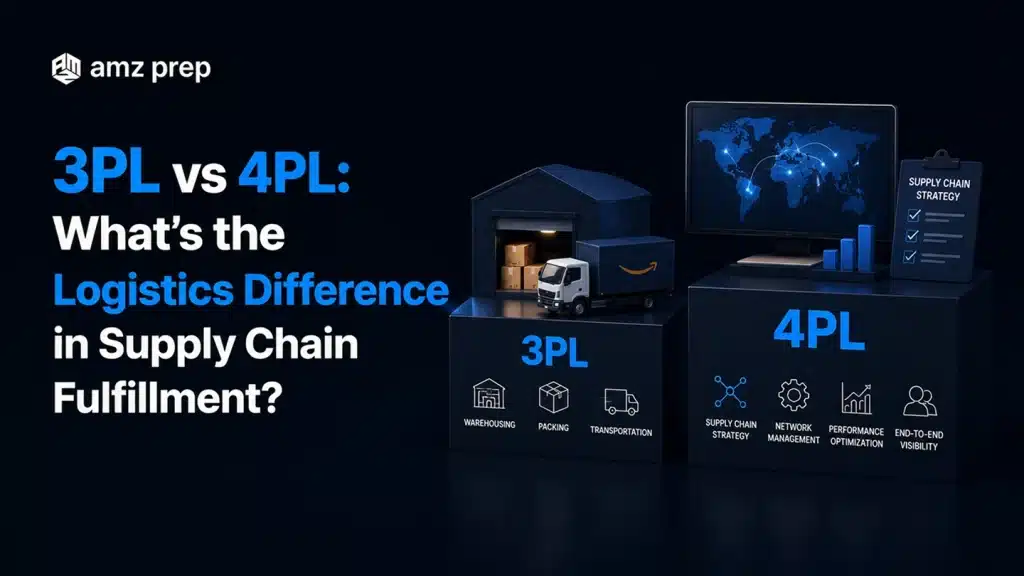
Choosing between 3PL and 4PL isn’t just about adding services, it’s about changing how your eCommerce business approaches supply chain strategy. While some companies use 3PLs for basic fulfillment, other brands are discovering that 4PLs offer something entirely different.
With the logistics market exploding toward $1.88 trillion by 2030, choosing between 3PL and 4PL services isn’t just about current needs, it’s about positioning your eCommerce business for scalable growth.
This guide breaks down what each model offers, when to choose which approach, and how to make the decision that aligns with your business goals.
What is a Third Party Logistics (3PL)?
3PL is a logistics provider, who physically handles your inventory, warehousing, and shipping operations. These businesses have warehouses, their own teams, and handle your things directly from storage to delivery.
When you work with a 3PL, you are practically outsourcing your ecommerce order fulfillment to specialists who become a full extension of your team, responsible for everything from inventory collection to return processing.
The 3PL relationship is hands-on and direct. You work with their operations team, use their warehouse management systems, and have direct visibility into how your products are handled. This direct relationship often leads to better communication and faster problem resolution.
Here’s a breakdown of core 3PL services and how they support growing eCommerce brands.
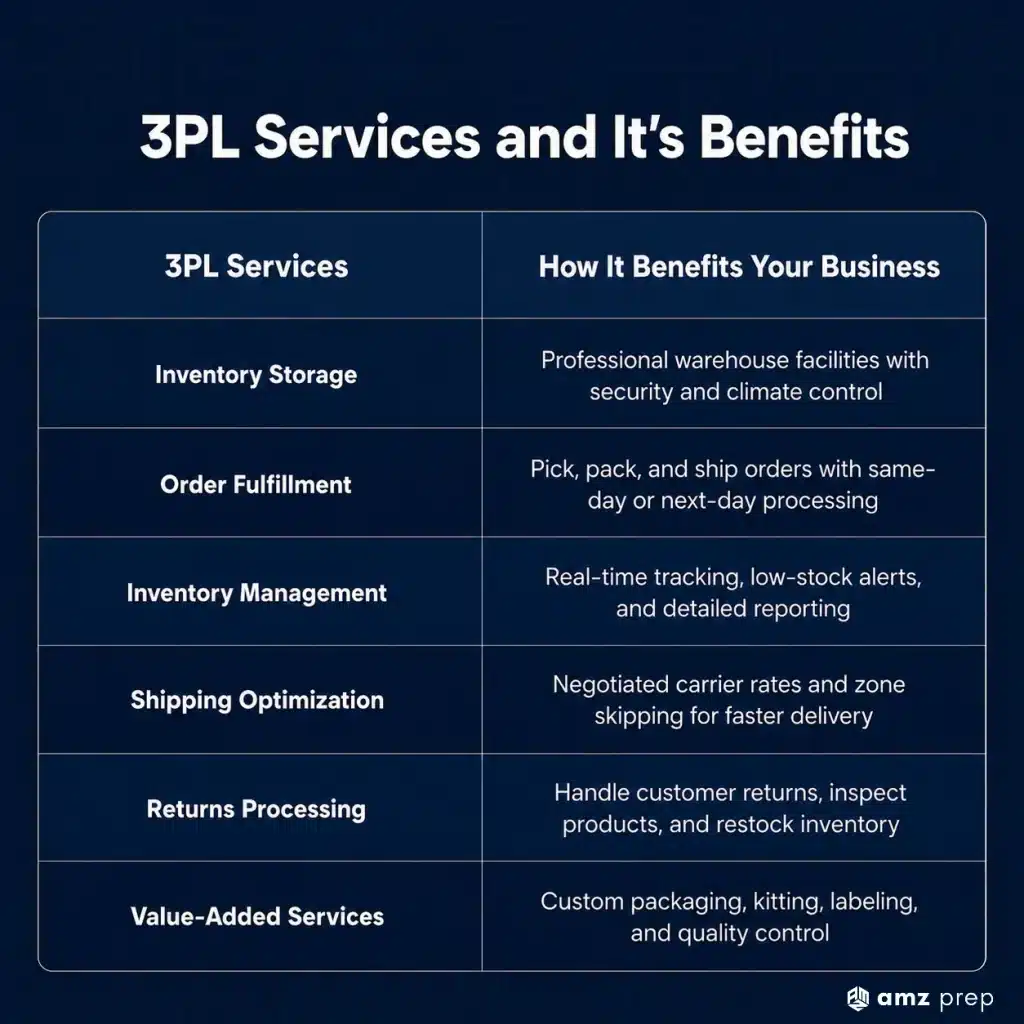
The 3PL model works best for businesses who want direct control over their fulfillment operations. You can maintain close relationships with the people who are actually handling your products, which often results in better service quality.
How 3PL Works?
The 3PL provider handles all fulfillment operations directly. You send your products to their warehouse, and they take care of:
- Receiving and storing inventory
- Picking and packing orders
- Labeling (including FBA-compliant prep)
- Shipping through chosen carriers
- Handling returns and restocking
You communicate with their warehouse team or account manager. This gives you operational control, but you manage strategy, vendor relationships, and channel expansion yourself.
Example: You ship 10,000 orders/month through Amazon and Shopify. A 3PL stores your inventory and ships directly to customers.
Suggested Read: Shopify Fulfillment Services Ultimate Guide
What is Fourth Party Logistics (4PL)?
4PL stands for ‘Fourth Party Logistics’ – a supply chain integrator that manages other logistics providers on your behalf. These fourth party logistics companies don’t own warehouses or trucks unlike traditional logistics companies. Instead, they act as your logistics command center, coordinating everything behind the scenes.
Think of 4PL as your logistics project manager. They handle the strategy, relationships, and coordination while other companies, and do the physical work. This approach gives you enterprise-level logistics capabilities without the need of any massive infrastructure investment.
Let’s take a closer look at how 4PLs function behind the scenes to manage the entire supply chain and logistics.
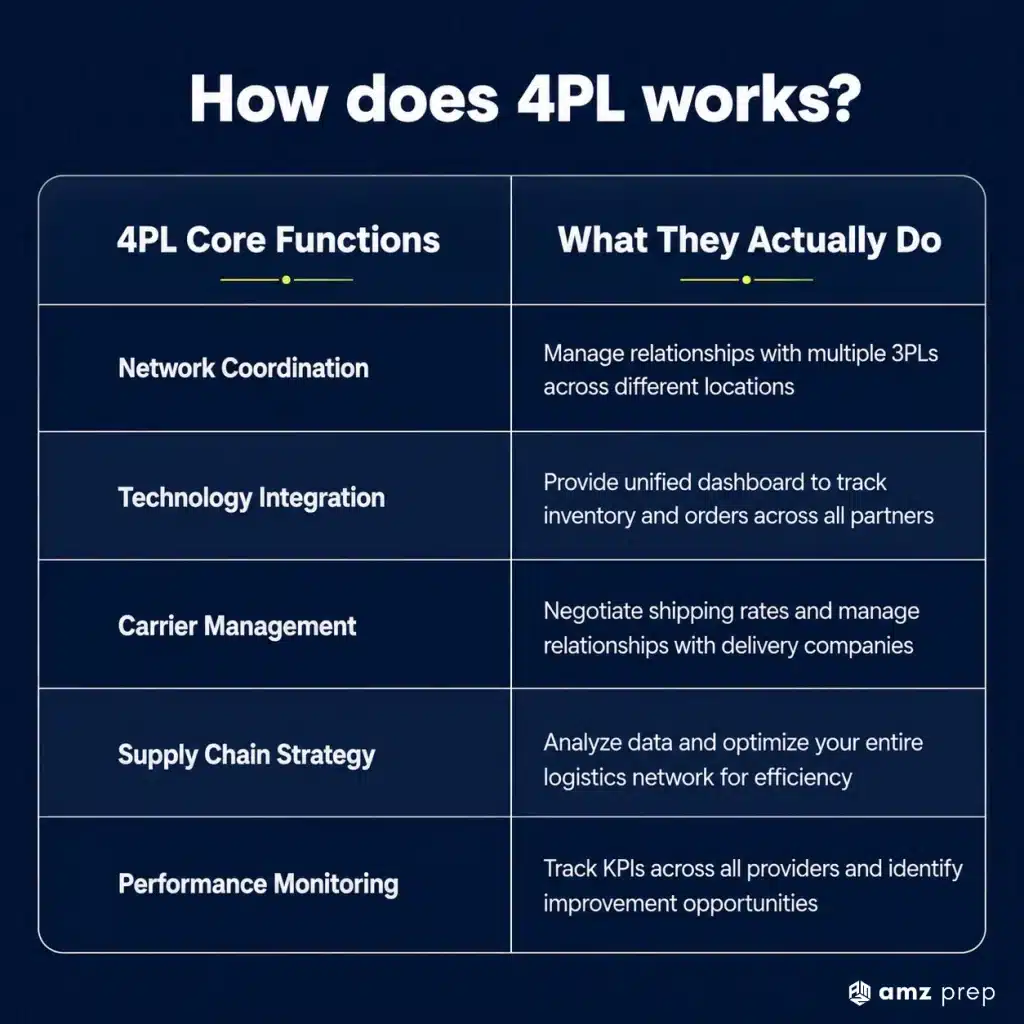
4PL logistics is highly effective for businesses with complex supply networks. If you’re handling several product lines, selling through multiple channels, or expanding overseas, 4PL’s can help you simplify your operations.
Fourth-Party Logistics Operations
In simple terms, a 4PL provider acts as your logistics consultant and coordinator. The 4PL model doesn’t involve owning warehouses or trucks. Instead, 4PL companies focus on specific logistics functions:
- Design your entire supply chain strategy
- Choose and manage multiple logistics providers including 3PLs or carriers
- Integrate your systems with theirs (WMS, TMS, OMS)
- Monitor performance and costs across partners
- Serve as your single point of contact for all logistics
The goal of a 4PL is to provide you with a complete view of your supply chain, ideal for complex operations, global expansion, or businesses working with various logistics providers. 4PL might handle specific logistics tasks while coordinating the entire logistics process.
Example: You sell on Amazon, Target+, and Wayfair in the U.S. and Europe. A 4PL builds your supply chain by connecting different 3PLs in each region and managing the entire backend while you focus on sales.
Transport and Logistics Integration
Modern 4PL solutions integrate transport and logistics functions easily. 4PL coordinates many means of transportation (road, rail, sea, and air) and works with specialized rail freight companies to optimize pricing and delivery timelines.”
4PL handles agreements with multiple carriers to ensure capacity and competitive pricing. Advanced 4PL systems optimize delivery routes across the supply chain network.
Difference Between 3PL and 4PL Logistics in eCommerce Fulfillment
A 3PL handles the physical aspects of order fulfillment like warehousing and shipping. A 4PL manages the supply chain on behalf of the client, including overseeing 3PLs, technology, and logistics strategy.
Below are the key differences between 3PLs and 4PLs:
| Key Differences | 3PL | 4PL |
|---|---|---|
| Physical Assets | Owns/leases warehouses, trucks, equipment | Coordinates assets owned by others |
| Your Primary Contact | Operations manager at the warehouse | Strategic account manager/coordinator |
| Control Level | High – direct operational oversight | Medium – strategic oversight only |
| Best Business Size | $1M-$50M annual revenue | $50M+ annual revenue |
| Ideal Complexity | Single/few channels, straightforward ops | Multi-channel, international, complex |
| Scaling Method | Gradual expansion of facilities | Rapid through network partnerships |
| Problem Resolution | Direct communication with ops team | Issues escalated through coordinator |
| Technology Access | Direct access to their WMS | Integrated view across providers |
| Pricing Structure | Transparent per-order/item costs | Management fees + underlying costs |
| Implementation Time | 2-6 weeks typically | 3-6 months for full setup |
Common eCommerce Fulfillment Challenges in 3PL and 4PL
Before selecting between 3PL and 4PL, it’s critical to understand the real-world challenges that many sellers deal with during their logistical process. These difficulties frequently cause businesses to consider changing their logistical approaches.
1. Hard to Keep Track of Inventory
As your business expands across channels or locations, it becomes more difficult to locate your products. Without real-time tracking, you risk running out of stock or ordering too much inventory.
3PL Solution: Gives you control and real-time updates for inventory stored in their warehouse.
4PL Solution: Connects all your warehouses and suppliers into one view so you can track everything from one dashboard, managing the entire supply chain.
2. Not Enough Visibility into Orders
It’s quite difficult when you don’t know where an order is or why it’s delayed. The lack of visibility results in missed shipping deadlines and unhappy customers.
3PL Solution: Offers visibility into orders being shipped from their facility.
4PL Solution: Gives you full visibility across all shipping partners, stages, and carriers through one platform, acting as your lead logistics coordinator.
3. Trouble Handling More Orders
When you get more orders than usual or enter new markets, your existing setup might not be enough. That leads to delays, mistakes, and lost sales.
3PL Solution: Lets you gradually grow order volume within their facility.
4PL Solution: Can instantly add new partners to meet rising demand through their supply chain network.
4. Too Many Advanced Systems
Using multiple tools for orders, inventory, and shipping can cause errors and delays if they’re not connected.
3PL Solution: Gives you access to their in-house system, but may require manual adjustments.
4PL Solution: Integrates all your systems and partners into one smooth workflow, overseeing the entire supply chain.
Advantages of 3PL
Partnering with a 3PL offers several key benefits for businesses looking for direct operational control:
Direct Operational Control
3PL providers give you hands-on control over your fulfillment operations, allowing direct communication with warehouse teams and immediate visibility into logistics operations.
Cost-Effective Solutions
3PL logistics typically offers transparent pricing with clear per-order or per-item costs, making it easier to calculate and predict logistics expenses.
Faster Implementation
Working with a 3PL usually involves shorter setup times (2-6 weeks) compared to complex 4PL implementations, getting your operations running quickly.
Specialized Expertise
Many 3PL companies specialize in specific industries or requirements (like Amazon FBA prep, cold storage, or fragile items), providing targeted logistics services.
Direct Relationship Management
3PLs offer direct relationships with the teams handling your products, leading to better communication, faster problem resolution, and customized logistics solutions.
Advantages of 4PL
Working with a 4PL provides multiple significant benefits for complex supply chain operations:
Strategic Supply Chain Management
4PL partners provide strategic oversight of your complete supply chain on your behalf, providing experienced logistics management that extends beyond basic fulfillment.
Single Point of Contact
Partnering with a 4PL is about having one logistics service provider handle multiple logistics providers, which simplifies communication and accountability.
Scalability and Flexibility
4PL businesses can quickly increase operations by using their network of partners, making them perfect for enterprises with changing demand.
Advanced Technology Integration
4PL logistics providers offer advanced technology platforms that integrate with your existing systems, providing complete visibility across your supply chain network.
Cost Optimization
4PL manages costs across multiple providers, often achieving better rates through their buying power and logistics expertise.
3PL Services and Logistics Solutions
3PL services encompass a comprehensive range of logistics and supply chain management functions:
Core Fulfillment Services
Third-party logistics providers carry out key logistics tasks such as receiving, storing, picking, packing, and delivering your products under specialized warehouse management.
Inventory Management
3PL suppliers provide real-time inventory tracking, product counting, and stock level optimization to ensure that your products are always ready for fulfillment.
Order Processing
3PLs handle the full logistics process from order receipt to shipment, including order verification, accurate picking, and quality control.
Returns Processing
3PL logistics provides reverse logistics services, including returns processing, restocking, and product inspection, to ensure inventory quality.
Value-Added Services
Many 3PL companies provide specific logistics services like kitting, bundling, labeling, and custom packaging to meet unique business requirements.
Amazon FBA Preparation
Specialized 3PL companies provide Amazon-specific services such as FBA preparation, labeling, and compliance with Amazon’s strict regulations.
4PL Services and Supply Chain Solutions
4PL services offers a wide range of supply chain and logistics functions:
Lead Logistics Provider Services
As a lead logistics provider, 4PL acts as the primary coordinator for all logistics tasks, managing relationships with third-party logistics providers and other logistics companies.
Reverse Logistics Management
4PL provides reverse logistics solutions, handling returns, repairs, and product lifecycle management across the supply chain.
Global Logistics Coordination
For international operations, 4PL takes responsibility for coordinating global logistics, including customs, compliance, and multi-country distribution.
Supply Chain Analytics
4PL logistics services include advanced analytics and reporting, helping businesses optimize their supply chain operations and logistics process.
When to Use a 4PL vs 3PL Model?
Choosing the right logistics model depends on your business complexity and operational needs. Here’s a quick comparison table to help you decide which model suits your current supply chain management needs:
| Business Scenario | Best Fit | Why |
|---|---|---|
| You sell on Amazon, Shopify, or Walmart with < $10M/year revenue | 3PL | Direct control, cost-effective, faster onboarding |
| You’re expanding into multiple regions or marketplaces (EU, UAE, retail) | 4PL | Offers network-wide coordination & scalability |
| You need hands-on support for prep, bundling, kitting | 3PL | 3PLs directly handle product customization |
| You use a 4PL scenario: 2–3 different logistics partners and want one point of control | 4PL | Centralized oversight and unified reporting |
| You want to reduce operational overhead and focus on growth | 4PL | Acts as your outsourced logistics department |
| You need fulfillment for a high-SKU catalog with temperature-sensitive items | 3PL | Specialized handling, especially in cold/frozen categories |
| Your team lacks logistics expertise or software integration skills | 4PL | Manages providers, software, and execution under one roof |
Which is Better for eCommerce Fulfillment in USA, Canada, EU?
The choice between 3PL and 4PL varies significantly across different regions due to market value, infrastructure, and business practices. Here’s what works best in each major eCommerce market:
United States Market
The US offers the most mature logistics infrastructure globally, making both 3PL and 4PL viable options depending on your business needs.
3PL Advantages in the US:
- Access to over 18,000 specialized providers offering every conceivable service
- Excellent Amazon FBA integration with providers experienced in prep, labeling, and compliance
- Competitive pricing due to market saturation and high competition
- Direct operational control with transparent cost structures
- Regional coverage enabling 1-2 day shipping to 90% of customers
4PL Advantages in the US:
- Strategic coordination of complex multi-brand operations
- Management of multiple 3PL relationships under one umbrella
- Enterprise-level supply chain optimization capabilities
- Advanced technology integration across multiple providers
- Scalability for rapidly growing businesses
Best Choice: 3PL works well for businesses under $50M revenue. 4PL becomes valuable for larger businesses managing multiple brands, complex channel strategies, or coordinating 10+ logistics partners.
Canadian Market
Canada presents unique challenges that influence the 3PL vs 4PL decision, particularly around cross-border operations and regulatory compliance.
3PL Advantages in Canada:
- Deep expertise in CBSA customs requirements and duty calculations
- Regional distribution knowledge for Canada’s vast geography
- Direct cost transparency in CAD currency
- Specialized knowledge of Canadian regulations and consumer protection laws
4PL Advantages in Canada:
- Coordination of complex US-Canada cross-border strategies
- Integration of multiple service providers across North America
- Strategic market expansion support for multi-national brands
- Management of seasonal capacity fluctuations
- Regulatory navigation across different provinces
Best Choice: 3PL works well for businesses focusing primarily on the Canadian market or simple cross-border needs. 4PL becomes valuable for complex North American strategies, multi-national operations, or businesses requiring cross-border coordination.
European Union Market
Europe’s regulatory complexity and diverse market requirements make it the most strategic region for logistics decisions.
3PL Advantages in the EU:
- Direct regulatory compliance knowledge for specific countries
- Cost-effective operations for focused market strategies
- Language-specific operations and customer service
- Established relationships with local carriers and customs authorities
4PL Advantages in the EU:
- Multi-country coordination across diverse regulatory environments
- Complex VAT management and cross-border tax optimization
- Brexit navigation and UK-EU coordination strategies
- Regulatory harmonization across different compliance requirements
- Strategic expansion support for pan-European growth
Best Choice: 3PL works well for businesses focusing on 1-3 main EU markets with direct compliance needs. 4PL becomes essential for operations spanning 5+ countries, complex regulatory requirements, or businesses needing multi-language coordination.
When to Prefer a Hybrid Approach (3PL + 4PL)
Many successful businesses find that combining 3PL and 4PL services creates the optimal logistics strategy. Here’s when and how to implement a hybrid approach:
1. Growing Multi-Channel Businesses ($10M-$50M Revenue)
- 3PL Role: Handle core fulfillment operations (Amazon, Shopify, direct-to-consumer)
- 4PL Role: Coordinate expansion into retail partnerships (Target, Walmart, international markets)
Benefit: Maintain operational control while accessing strategic expansion capabilities
2. Seasonal or Campaign-Driven Brands
- 3PL Role: Manage consistent, predictable order volumes and inventory
- 4PL Role: Coordinate overflow capacity and temporary partnerships during peak seasons
Benefit: Cost control during slow periods with scalability during peak demand
3. Product Line Diversification
- 3PL Role: Handle standard products with established fulfillment processes
- 4PL Role: Coordinate specialized products requiring unique handling or expertise
Benefit: Optimize each product category without compromising service quality
| Product Category | 3PL Advantages | 4PL Advantages | Recommendation |
|---|---|---|---|
| Fashion & Apparel | Direct handling expertise Size/color management Return processing | Multi-season coordination Global sourcing integration | 3PL for most brands |
| Electronics | Specialized packaging Anti-static handling Warranty processing | Complex supply chains Multi-channel distribution | 3PL for standard items 4PL for complex catalogs |
| Beauty & Cosmetics | FDA compliance, expiration tracking Temperature control | Global regulatory navigation Multi-brand coordination | 3PL for single brands 4PL for brand portfolios |
| Books & Media | High-volume processing Custom packaging | Multi-channel optimization Print-on-demand coordination | 3PL for traditional publishing 4PL for complex strategies |
| Home & Garden | Seasonal expertise Oversized item handling | Multi-supplier coordination Regional optimization | 4PL for complex catalogs 3PL for focused product lines |
| Automotive Parts | Technical specification management | Complex B2B/B2C channel coordination Supplier integration | 4PL for complex operations 3PL for focused segments |
| Food & Beverage | FDA compliance, cold chain management Expiration tracking | Multi-temperature coordination Regulatory navigation | 3PL for single-temperature needs 4PL for complex requirements |
| Health Supplements | FDA regulations, lot tracking Expiration management | Multi-regulatory navigation Global compliance | 3PL for domestic operations 4PL for global expansion |
| Toys & Games | Safety compliance Seasonal management | Multi-channel seasonal coordination | 3PL for standard operations 4PL for complex seasonal strategies |
| Furniture | White glove services Assembly coordination | Multi-service provider coordination Regional optimization | 4PL |
| Jewelry | High security Insurance management Specialized packaging | Multi-channel security coordination | 3PL for focused operations 4PL for complex channels |
Conclusion
In conclusion, for Amazon sellers specifically, working with specialized 3PL providers often delivers better results than 4PL coordination. Companies like AMZ Prep understand Amazon’s requirements thoroughly, have direct experience with FBA systems, and can adapt quickly to policy changes.
4PL services make sense for very large businesses with complex, multi-channel operations that require strategic coordination across many providers and locations. However, these situations apply to a small percentage of eCommerce businesses.
Whether you choose partnering with a 3PL or use a 4PL depends on your specific business needs, complexity, and growth objectives. Both models offer various advantages in modern supply chain management.
3PL and 4PL FAQs
Can I switch from a 4PL back to a 3PL (third-party logistics)provider if I’m not satisfied?
Yes, moving from 4PL to 3PL is possible, but it takes careful planning. You may need to manage inventory transfers, renegotiate agreements with underlying service suppliers, and even pay termination costs.
How do I handle inventory liability and insurance with 3PL vs 4PL providers?
With 3PL providers, you will deal directly with their insurance policies and liability coverage for your inventory. With 4PL services, liability becomes more complex as multiple logistics providers handle your products. Always verify coverage limits and ensure gaps don’t exist between different providers in the 4PL network.
What happens to my data and customer information when working with these providers?
3PL providers usually offer direct data ownership with clear privacy agreements. 4PL arrangements involve data sharing across various logistics providers, potentially increasing security risks. Always review data handling policies, ensure GDPR compliance, and verify how customer information flows through the provider network before signing contracts.
Do 3PL and 4PL providers offer seasonal flexibility for businesses with fluctuating demand?
Most 3PL providers offer flexible pricing and space allocation for seasonal businesses, with direct communication about capacity planning. 4PL providers coordinate seasonal capacity across their network but may have less flexibility due to managing multiple logistics provider commitments. Discuss seasonal requirements upfront with both provider types.
How do return rates and customer satisfaction typically compare between 3PL and 4PL fulfillment?
Studies show 3PL providers often achieve better accuracy rates (99.1% vs 97.8%) due to direct operational control and specialized systems. 4PL coordination can introduce additional touchpoints where errors occur. However, large 4PL networks may offer faster delivery times in some regions, improving overall customer satisfaction.
What is the goal of a 4PL?
The goal of a 4PL is to oversee the entire supply chain on behalf of the client, providing strategic coordination and optimization across all logistics functions.
How does a 4PL differ from other logistics models?
The key difference between 3PLs and 4PLs is that 4PLs coordinate various logistics providers rather than owning physical assets.
When should I consider working with a 4PL?
Consider working with a 4PL when you need to coordinate multiple logistics providers, expand globally, or require strategic supply chain management expertise.
What are the main services of 4PL?
Services of 4PL include strategic planning, vendor management, technology integration, performance monitoring, and logistics coordination.

Blair Forrest is the Founder of AMZ Prep, one of North America’s fastest-growing third-party logistics and fulfillment networks, built entirely without outside capital since 2016. Under his leadership, AMZ Prep has scaled to 50+ fulfillment centers across 6 countries, processing over 10 million plus units monthly and powering $2 billion+ in annual GMV for more than 5,000 brands worldwide including 437, Silverts, Saltyface, Unilever, Duracell, and JBL. A recognized authority in eCommerce logistics, Amazon FBA strategy, and supply chain optimization, Blair has helped thousands of sellers and brands master their fulfillment operations from first shipment to enterprise scale. He regularly consults on FBA prep, multi-channel fulfillment, last mile delivery, international expansion, and cost reduction strategies that save brands 20–40% compared to traditional 3PL providers. Blair’s insights on Amazon logistics, 3PL operations, and eCommerce growth are widely cited across the industry. Through AMZ Prep’s content, guides, and resources, he continues to share battle-tested strategies drawn from managing one of the largest independently owned fulfillment networks in North America.

















Appreciate the real-world examples showing when to use each type of provider.
I’ll be sharing this with our logistics team to improve our supply chain decisions.
Loved the section on cost implications—it’s critical for budgeting.
The pros and cons list was super helpful for deciding which partner fits my business.
I didn’t realize 4PL was more of a consultancy role—this was eye-opening.
Helpful guide for startups trying to figure out how to scale their fulfillment.
Great insight on how 4PL manages the entire supply chain, not just logistics.
Would love to see a follow-up article on integrating 3PL and 4PL services.
The comparison chart really summarized everything in an easy-to-digest format.
This helped clear up the confusion between 3PL and 4PL—thanks for the simple explanations!