
Frozen food fulfillment services for ecommerce brands
Temperature-controlled storage. FEFO lot tracking. Dry ice and gel pack shipping from the same warehouse as your FBA prep.
Frozen food fulfillment costs more and breaks more often than ambient ecommerce. Insulated packaging, dry ice compliance, FEFO rotation, and Amazon’s meltable restrictions are all variables that general 3PLs are not built to manage. This page covers what frozen fulfillment services actually require and how AMZ Prep handles frozen food across Amazon, DTC, and retail.
If we ship outside the agreed temperature spec, we cover the order.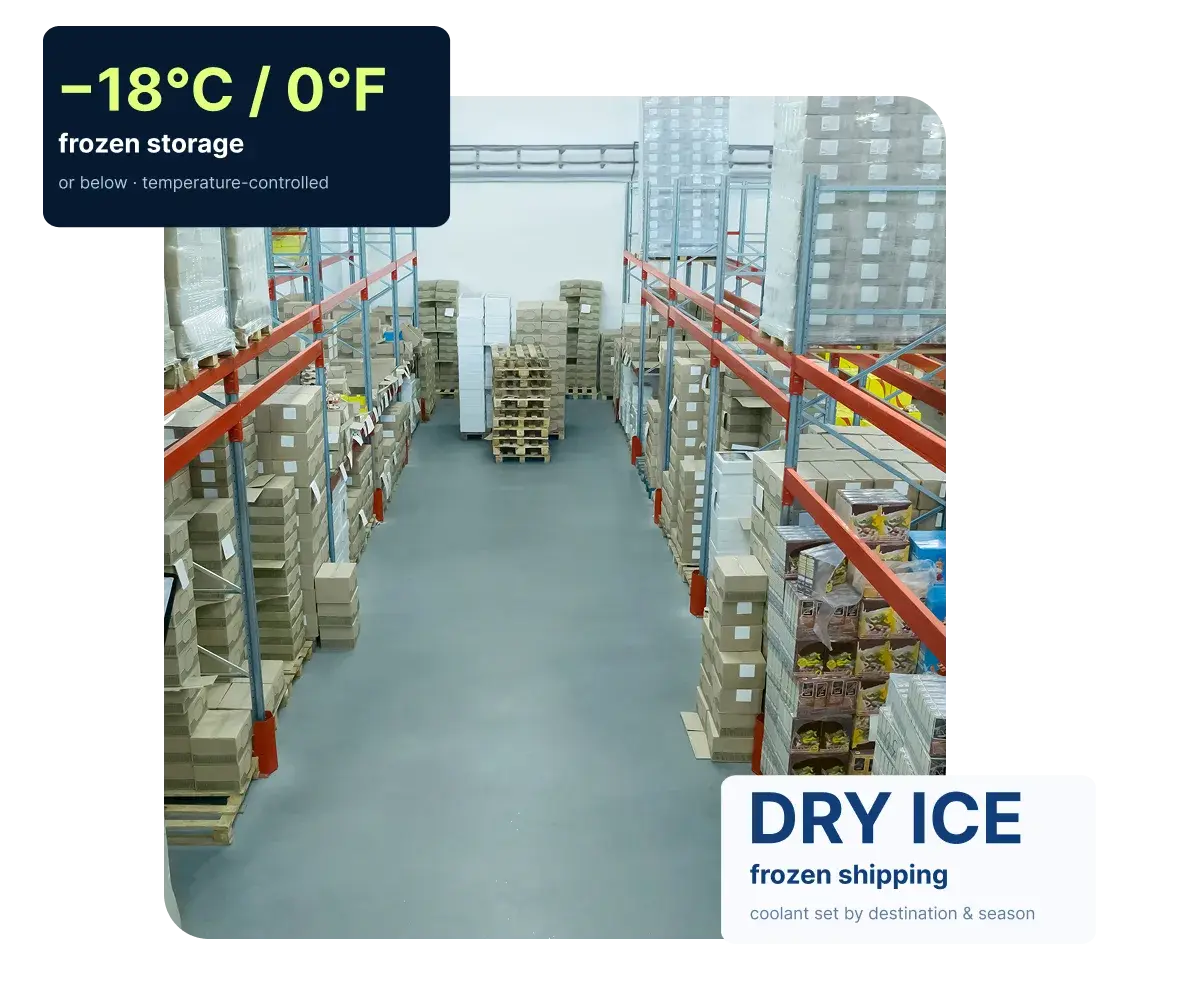
On this page
What to know before you choose a frozen food 3PL
- Frozen food fulfillment costs more per order than ambient. Insulated packaging, dry ice or gel packs, and temperature-controlled carrier rates add $3.50 to $12 or more before pick-and-pack.
- Any frozen food 3PL that offers generic “cold storage” without naming actual temperature ranges per zone is not running a compliant cold chain.
- FEFO lot tracking is a baseline requirement. Frozen products carry best-by dates, and a recall is traced by lot. Ask to see it working in the WMS before you commit.
- Every dry ice shipment requires a UN1845 declaration under IATA and 49 CFR. A missed declaration is a carrier compliance failure, not an admin oversight.
- AMZ Prep fulfills frozen food across Amazon, DTC, and retail from temperature-controlled fulfillment centers with FEFO lot tracking built into Navigate.
What frozen food fulfillment covers
Frozen food fulfillment is the storing, picking, packing, and shipping of frozen and perishable products at controlled temperatures, using insulated packaging and appropriate coolants to protect products in transit.
It goes beyond standard ecommerce fulfillment because it requires named temperature zones, FEFO lot rotation to manage best-by dates, dry ice or gel pack selection per order, carrier routing by transit zone, and regulatory compliance on every dry ice shipment.
For how to choose between dry ice and gel packs, carrier options, and transit zone planning, the frozen food shipping guide covers those decisions in detail.
Why frozen food breaks standard ecommerce logistics
Unnamed temperature zones
“Cold storage” without a named range is not a frozen food warehouse. Frozen and refrigerated products need separate zones at specific temperatures.
No FEFO rotation
Without first-expired-first-out enforcement in the WMS, older stock sits behind new arrivals and ships past its best-by date.
Dry ice compliance gaps
A missing UN1845 declaration delays or returns a shipment and creates regulatory exposure for your brand.
Wrong carrier per order
Frozen DTC only works if the carrier and service level match the transit zone. One contract carrier for all outbound frozen orders leads to either product loss or unnecessary overnight air spend.
Meltable FBA restrictions ignored
Amazon restricts meltable products from FBA roughly April through October. Brands without an alternative channel lose Prime coverage for up to six months.
No lot hold capability
A recall requires a system-level lot hold across all channels within hours. If the WMS cannot do this, the 3PL is not built for perishable fulfillment.
Temperature zones and dry ice: the two variables that set frozen fulfillment cost
| Zone | Temperature | Typical products |
|---|---|---|
| Frozen | −18°C / 0°F or below | Meal kits, frozen seafood, ice cream, frozen produce |
| Refrigerated | 0°C to 4°C (32°F to 40°F) | Fresh produce, dairy, some beverages |
| Chilled | Product-specific | Cheese, cured meats, some health products |
| Coolant | Best for | Key requirement |
|---|---|---|
| Dry ice | Frozen products; longer transit zones | UN1845 declaration with net weight on every shipment |
| Gel packs | Refrigerated products; short transit | Transit time must stay within gel pack integrity window |
| Combination | Frozen products in warm weather or longer zones | Amounts calibrated per destination zip code and season |
AMZ Prep calibrates coolant amounts per destination zip code and season. Every dry ice shipment includes a UN1845 declaration as required under IATA and 49 CFR.
Frozen food and perishable products we handle every day
| Product type | How it should be handled | Where it goes wrong | Ask your 3PL |
|---|---|---|---|
| Frozen meal kits and prepared meals | −18°C storage; dry ice per transit zone; FEFO lot tracking | Partial thaw in transit; expired stock shipped | What is your actual frozen storage temperature, and how is dry ice set per zip code? |
| Frozen seafood and meat | Frozen storage; FEFO; UN1845 declaration on every shipment | Regulatory non-compliance; lot untraceable on recall | Show me how lot numbers and best-by dates are captured at receiving |
| Frozen desserts and ice cream | −18°C storage; insulated packaging; Amazon meltable rules applied | Partial melt in transit; meltable rules not applied for FBA | How do you handle the Amazon meltable restriction, and what is the alternative? |
| Refrigerated products | Separate refrigerated zone; gel packs for transit; FEFO | Stored in wrong zone; temperature excursion in transit | Do you have separate zones for frozen and refrigerated, with named ranges? |
| Frozen subscription boxes | Built on a schedule; dry ice adjusted per season and destination; dispatch timed to avoid weekend delivery | Insufficient dry ice for summer; kit incomplete | Can you adjust dry ice by season and destination, and how do you time dispatch to avoid weekends? |
FEFO lot tracking: the control that makes frozen food fulfillment auditable
| Control | What to verify | Why it matters |
|---|---|---|
| Lot capture | Lot number and best-by date recorded at receiving | Required for recall traceability |
| FEFO rotation | Enforced in the WMS, not managed manually | Manual rotation breaks at volume |
| Lot holds | A lot can be held across all channels within the same day | Stops affected product shipping on any channel during a recall |
| Traceability report | Shows which orders received which lot, on demand | Required for regulatory reporting and customer notification |
| Returns inspection | Returned frozen products inspected on receipt before restock | Frozen returns without inspection create food safety risk |
How ecommerce frozen fulfillment works in practice
Reaching most US customers on 2-day ground instead of overnight air requires frozen food warehouses placed on both coasts. For destinations outside 2-day ground reach, overnight air with the correct dry ice load is the only viable option. Carrier and service level are selected per order in Navigate based on the destination zone.
Weekend deliveries are a specific risk for frozen DTC. An order that arrives at a residential address on Saturday and sits until Monday is a product loss. Dispatch timing for frozen DTC orders is configured to avoid Friday cutoffs that push delivery to Monday.
One frozen food inventory for Amazon, DTC, subscription, and retail
Amazon FBA prep
FNSKU labeling, bundling, and shipping plan creation with a 1 to 3 day turnaround. Meltable season restrictions applied before every inbound is planned. FBA shipments carry zero placement fees.
Amazon Seller Fulfilled Prime
Prime eligibility from AMZ Prep warehouses without sending frozen inventory to Amazon. The practical alternative when meltable restrictions make FBA unavailable for the season.
Shopify and your own store
Ecommerce frozen fulfillment starting at $1.00 per order, with carrier selection per transit zone, dry ice calibrated per destination, and insulated packaging per product spec.
Subscription and meal kits
Recurring frozen orders and meal kit boxes built on a schedule, with dry ice adjusted per season and dispatch timing set to avoid weekend holds.
Walmart and retail
Frozen food fulfillment for brands in Walmart and other retail programs, with EDI support for wholesale replenishment orders.
Wholesale and distributors
Pallet and case shipments with lot documentation and cold chain records per shipment.
Amazon and frozen food: what brands need to know
Meltable season restrictions
Amazon restricts meltable products from FBA roughly April through October. Brands without an alternative channel lose Prime coverage for up to six months. AMZ Prep reviews every frozen SKU against the current meltable classification during onboarding so the alternative is set up before the restriction window opens.
Seller Fulfilled Prime
AMZ Prep is an Amazon-approved provider for Seller Fulfilled Prime. Frozen products that cannot go to FBA during meltable season can still carry the Prime badge, fulfilled directly from AMZ Prep’s temperature-controlled fulfillment centers.
FBA inbound planning
FBA prep covers FNSKU labeling, bundling, and shipping plan creation with a 1 to 3 day turnaround. No inbound is planned for a restricted meltable window without an alternative already confirmed.
Seasonal planning for frozen food brands
| Period | What changes | What to do before it starts |
|---|---|---|
| April to October | Amazon meltable restrictions limit FBA inbounds | Set up Seller Fulfilled Prime or DTC as the channel alternative before April |
| Summer | Dry ice requirements increase; transit risk rises across warmer zones | Confirm coolant calibration is adjusted for summer in Navigate |
| Q4 and holiday gifting | Frozen gift sets and subscription boxes spike across DTC and retail | Build gift kits early; confirm dry ice amounts for winter transit; book inbound freight ahead of the rush |
| New Year | Meal plan subscriptions and frozen health food brands lift in January | Confirm subscription volumes and dispatch schedules are configured before December |
Amazon meltable season dates change annually. Confirm the current dates with your account team during onboarding and again before each April.
General cold storage or frozen-ready 3PL: how to tell the difference
| Evaluation area | General cold storage | Frozen-ready 3PL |
|---|---|---|
| Storage temperature | Unnamed; pallet-only access | Named range per zone confirmed in writing; pick-and-pack from frozen storage |
| Lot tracking | Pallet-level only | Lot and best-by date per unit; FEFO in the WMS |
| Dry ice compliance | Not supported or manual | UN1845 on every shipment; coolant calibrated per destination |
| DTC orders | Pallet orders only | Individual order pick-and-pack with perishable packaging |
| Carrier selection | One contract carrier | Carrier and service level selected per order based on transit zone |
| Amazon FBA | Not supported | FBA prep with meltable restriction management and SFP alternative |
| Best for | Food manufacturers shipping pallets to retailers | DTC frozen food brands, meal kits, and subscription boxes |
Questions to ask before choosing a frozen food 3PL
| When | What to ask | What a good answer includes |
|---|---|---|
| Discovery call | What is the actual temperature in your frozen storage zone? | A named temperature confirmed in writing |
| Discovery call | How and when are lot numbers and best-by dates captured? | At receiving, before stock is put away |
| Discovery call | Can you ship frozen DTC with dry ice, and how is the amount determined? | Per destination zip code and season; UN1845 declarations confirmed |
| Discovery call | Do you handle frozen food across Amazon, Walmart, and retail? | Yes, with meltable rules mentioned for FBA and an SFP alternative described |
| Demo | Show me lot capture at receiving and FEFO rotation in your WMS | The actual receiving screen in Navigate |
| Demo | Show me a lot hold being applied | The hold confirmed across all channels simultaneously |
| Pricing call | What are all fees, including frozen storage, dry ice, packaging, and carrier access? | A written rate card with cold chain costs itemized separately |
Frozen food fulfillment pricing
| Item | Detail |
|---|---|
| DTC frozen fulfillment | Starts at $1.00 per order |
| FBA shipments | Zero placement fees |
| Frozen storage | Temperature-controlled at −18°C / 0°F or below; quoted from your volume and SKU count |
| Dry ice and packaging | Quoted per product and destination zone |
| Minimum volume | 300 orders per month: DTC, FBA prep, subscription, and retail all count |
| Transition cost | Free 3PL transition program for qualifying brands |
| Your quote | Built from order profile, storage zones, dry ice requirements, and channel mix |
Frozen food fulfillment close to your customers
Storage and locations
Frozen storage at −18°C / 0°F or below; refrigerated zones stored separately. See AMZ Prep locations for the full warehouse footprint.
United Kingdom
In the UK, AMZ Prep runs five facilities. See the UK 3PL network.
Cold storage
For cold storage details beyond fulfillment, see the cold storage 3PL page.
Headquarters
Corporate headquarters: Brampton, Ontario, Canada.
What sellers say, on platforms AMZ Prep does not control

Top 3PL 2024/2025/2026, 100+ verified reviews

40 reviews

“Excellent” rating, 56 reviews
Watch: compliance, Amazon and retail fulfillment explained
 7:10
How Do You Avoid Stockouts and Storage Fees at Amazon Fulfillment Centers?
How to keep inventory flowing into Amazon fulfillment centers without running out of stock or paying excess storage fees.
 1:10
What Happens If Your Retail Orders Miss Walmart's On-Time-In-Full Target?
What a missed on-time-in-full target costs on retail orders, and why compliance on wholesale shipments matters.



Frozen food fulfillment questions, answered
Storing, picking, packing, and shipping frozen products at controlled temperatures using insulated packaging and dry ice or gel packs, with FEFO lot tracking and carrier routing based on transit time and destination.
Look for named frozen storage temperature ranges, FEFO lot tracking in the WMS, dry ice calibration per destination, UN1845 compliance, and FDA registration. The difference shows up in a live demo, not in the sales call.
AMZ Prep stores frozen food at −18°C / 0°F or below. Refrigerated and chilled products are stored in separate zones with their own named ranges. Ask any frozen food 3PL for the actual range per zone in writing.
Yes. Dry ice amounts are calibrated per destination zip code and season, and every shipment includes a UN1845 declaration under IATA and 49 CFR. Carrier and service level are selected per order based on the transit zone.
Yes, from the same frozen food 3PL network. FBA inbounds are planned around Amazon’s current meltable restrictions. When FBA is unavailable, Seller Fulfilled Prime from AMZ Prep warehouses keeps the Prime badge active.
FEFO is first-expired, first-out: the stock closest to its best-by date ships first. AMZ Prep enforces FEFO in Navigate, and a lot can be held across all channels within the same day if a recall or quality issue arises.
Every frozen SKU is reviewed against Amazon’s current meltable classification during onboarding, and Seller Fulfilled Prime or DTC is set up as the channel alternative before the restriction window opens.
DTC frozen fulfillment starts at $1.00 per order. FBA shipments carry zero placement fees. Frozen storage, dry ice, and insulated packaging are quoted from your order profile and destination mix.
300 orders per month. DTC, FBA prep, subscription, and retail all count toward the total.
2 to 4 weeks, covering storage zone assignment, FEFO lot tracking, dry ice calibration, Amazon meltable classification, and subscription dispatch setup. Qualifying brands can use the free 3PL transition program.
Ready to move your frozen food fulfillment?
Share your monthly order volume, product types, storage zone requirements, and sales channels. AMZ Prep builds a frozen fulfillment plan and quote from your real numbers. Onboarding takes 2 to 4 weeks.


