
Refrigerated Freight (Reefer) for Food, Supplements, Beauty
Refrigerated freight for food, supplement, beauty and meltable brands. We set the load to your product specification, put the setpoint and continuous mode on the BOL, book the delivery appointment, and connect the truck to cold storage in Toronto, Salt Lake City and Dothan so the cold chain holds from dock to dock.
On this page
Key Takeaways
- A reefer holds a set temperature from pickup to delivery; it does not cool warm product, so load at temperature into a pre-cooled trailer.
- Frozen, chilled, climate-controlled and protect-from-freeze loads each need a different setpoint, stated on the BOL.
- Continuous mode, airflow space and pre-cooling prevent most temperature failures.
- Amazon does not accept meltable FBA inventory from April 15 to October 15; cold storage and Seller Fulfilled Prime keep sales going.
- Cross-border food loads need pre-clearance and FDA prior notice, filed by our own customs team.
What is refrigerated freight, and what does a reefer actually do?
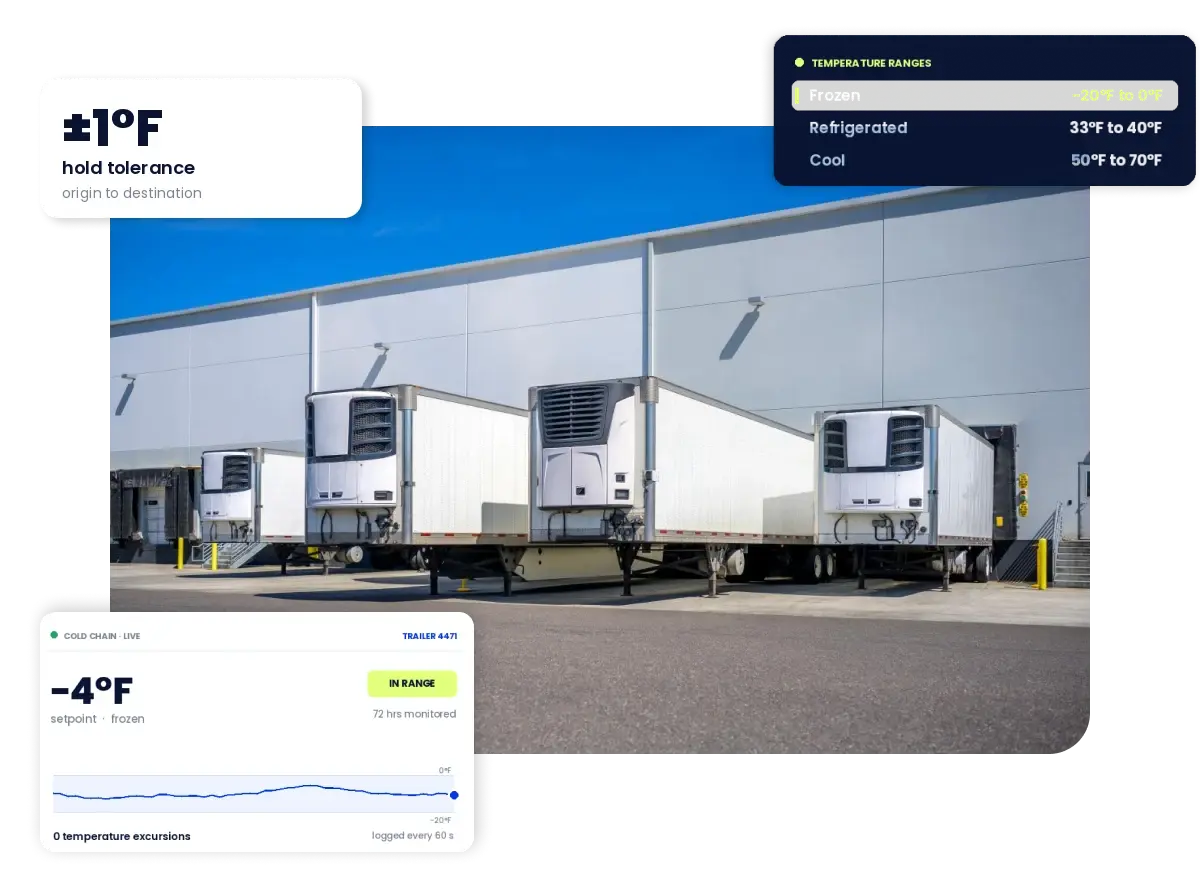
Refrigerated freight, usually called reefer freight, is cargo shipped in an insulated trailer with its own refrigeration unit. The unit is set to a fixed temperature, the setpoint, and holds it from pickup to delivery, whether the load is frozen, chilled or simply kept out of summer heat.
Two things trip up brands new to cold chain. First, a reefer is built to maintain temperature, not to pull it down, so product has to be loaded at its target temperature into a pre-cooled trailer. Second, the same unit heats as well as cools, which matters in winter for liquids, beverages and anything that should not freeze.
Key Takeaway
Refrigerated freight protects the product between buildings. Pair it with cold storage at each end so the cold chain is not broken at the dock.
Which temperature range does your product need?
| Range | Typical setpoint | Common products |
|---|---|---|
| Frozen | -20 F to 0 F | Ice cream, frozen meals, frozen seafood |
| Chilled | 33 F to 40 F | Dairy, fresh food, probiotics, some beverages |
| Cool or climate-controlled | 50 F to 70 F | Chocolate, supplements, cosmetics, candles, wine |
| Protect from freeze | Heat mode above freezing | Liquids, beverages, sauces, aerosols in winter |
Your product specification decides the range, not the carrier. If you are unsure, send the manufacturer's storage temperature and we will set the load to it.
How does refrigerated freight work with AMZ Prep?
Request Day 0
Product, setpoint, pallet count, weight, both addresses, dates, and whether the receiver needs a temperature record.
Quote and carrier Within the hour
We rate-shop reefer carriers for the lane and confirm equipment that can hold your range.
Appointment and BOL Before pickup
The delivery appointment is booked and the BOL states the setpoint and continuous mode.
Pre-cool and load Pickup
The trailer arrives pre-cooled. Product is loaded at temperature with room for airflow, and the reading is checked.
Transit Relay
Live tracking in Relay with the planned delivery time and alerts if it slips.
Delivery POD
Unloaded on the appointment with proof of delivery; the unit download is available if a load is disputed.
What should you confirm before a reefer load leaves the dock?
| Confirm | Why it matters |
|---|---|
| Setpoint in °F written on the BOL | Avoids the driver guessing, or confusing Celsius and Fahrenheit |
| Continuous mode, not cycle | Cycle mode lets air stop moving between cycles; sensitive loads can warm in spots |
| Trailer pre-cooled to the setpoint | A warm trailer passes its heat to the first pallets loaded |
| Product at temperature when loaded | The unit holds temperature; it cannot pull warm product down evenly |
| Space for airflow | Pallets off the walls and the rear doors, nothing blocking the air chute or return air |
| Clean, odor-free trailer | Food loads need washout records under FDA's sanitary transportation rule |
| Temperature record if the receiver needs one | Retail and food DCs may check temperature at receiving |
How much does reefer freight cost, and why is it more than dry van?
| Rate factor | How it moves the price | Send with your request |
|---|---|---|
| Equipment | Reefer trailers cost more to own and run than dry vans. | Setpoint and product |
| Unit fuel | The refrigeration unit burns its own fuel for the whole trip. | Nothing; built into the rate |
| Season | Produce season and summer heat tighten reefer capacity. | Your ship window |
| Lane and distance | Rate per load for the lane; remote or one-way lanes cost more. | Both addresses |
| Load size | Full trailer vs a shared reefer lane or cold storage consolidation. | Pallet count and weight |
| Accessorials | Detention, multi-stop, lumper and appointment fees. | Dock hours and who unloads |
Can refrigerated freight deliver to Amazon FBA, and what about meltable products?
Amazon's meltable window
Amazon stops accepting meltable FBA inventory from April 15 to October 15 and can dispose of what is left after May 1. Our meltable inventory guide covers the dates.
Reefer into FBA in the open season
Middle Mile Plus carries reefer loads from cold storage into Amazon FCs with the appointment pre-booked and $0 placement fees.
Keep selling in summer
Store meltables in our temperature-controlled centers in Toronto, Salt Lake City and Dothan, and ship orders through Seller Fulfilled Prime or FBM.
Retail DCs check temperature
Grocery and club DCs can refuse a load that arrives out of range. We book the appointment and set the range from your product specification.
Where does refrigerated freight go wrong, and how is each case handled?
Warm product, cold trailer
Pallets come straight from a warm dock into the trailer. The unit holds the air temperature while the product stays warm inside.
How we handle it: Product temperature is checked at loading, and the trailer is pre-cooled to the setpoint.
Cycle mode on a sensitive load
The unit switches off between cycles to save fuel, and pallets near the doors drift out of range.
How we handle it: Continuous mode is written on the BOL for sensitive products.
Pallets blocking the air
Freight is loaded tight to the walls and doors, so cold air cannot circulate and hot spots form.
How we handle it: Pallets are loaded with space for airflow and nothing blocking the air chute.
Frozen in transit
Beverages and liquids ship on a dry van in January and arrive frozen and split.
How we handle it: Winter loads of liquids run on reefer equipment set to heat above freezing.
Rejected at the dock
The receiver checks temperature, finds it out of range, and refuses the load with no record to show where it went wrong.
How we handle it: The setpoint comes from your product specification and the unit download is requested when a load is disputed.
Food held at customs
A load of food reaches the US border without FDA prior notice, or Canada without the right import documents.
How we handle it: Our customs team files prior notice and Canadian import paperwork before the truck leaves.
How does refrigerated freight cross the US-Canada border?
Into the US
PAPS pre-clearance and FDA prior notice for food are filed before the truck reaches the border.
Into Canada
PARS pre-clearance and the importer's Canadian food import requirements are handled with the load, so it does not wait at the line.
CUSMA and both-way lanes
Goods that qualify under CUSMA clear at preferential duty. Reefer loads run to and from our fulfillment centers in Canada, including the Toronto cold storage site.
Reefer truckload, shared reefer or cold storage: which fits your shipment?
| Option | How it works | Best for |
|---|---|---|
| Reefer full truckload | A dedicated refrigerated trailer, loaded once and delivered direct | Large or high-value temperature-sensitive loads |
| Shared reefer lane | Your pallets share a refrigerated truck at the same setpoint | A few pallets on lanes we run, quoted on request |
| Cold storage plus parcel | Stock held at temperature, orders shipped from the warehouse | Meltables during Amazon's restriction period |
| Dry van | No temperature control | Products that tolerate heat and cold; see full truckload or LTL freight |
How do you compare refrigerated freight providers?
| What to ask | What goes wrong if it is missed | How AMZ Prep handles it |
|---|---|---|
| Is the setpoint and mode on the BOL? | Wrong temperature, or cycle mode on a sensitive load. | Setpoint and continuous mode stated on every BOL. |
| Is the trailer pre-cooled? | Warm pallets at the front of the trailer. | Pre-cool confirmed before loading. |
| Can I get a temperature record? | No proof when a receiver disputes the load. | Unit download requested when needed. |
| Are carriers set up for FSMA? | A food load in an unclean trailer. | Reefer carriers vetted for food loads. |
| Who books Amazon or retail appointments? | A reefer idling at the gate. | Booked before pickup. |
| Is there cold storage at either end? | The cold chain breaks at the dock. | Our own cold storage in three cities. |
| Can you clear food across the border? | A load held for prior notice. | Our own customs team files it. |
Which brands ship temperature-controlled freight with AMZ Prep?
Mid Day Squares
Meltable chocolate brand moving temperature-controlled freight from Canada to US Amazon fulfillment centers, pre-cleared at the border.
Beekeeper's Naturals
Weekly freight across the US and Canada, with temperature-controlled shipments for heat-sensitive products.
Who is AMZ Prep refrigerated freight built for?
- Food, beverage and supplement brands selling on Amazon and in retail
- Chocolate, candy and other meltables working around Amazon's summer window
- Beauty and wellness brands with heat-sensitive formulas
- US and Canadian brands shipping cold chain across the border
Validated pharmaceutical cold chain
Regulated drugs that need validated GDP lanes and qualified packaging are a job for a specialist pharma carrier. Tell us your requirement and we will say plainly whether we fit.
Cold storage, meltables and temperature-sensitive freight, explained by the AMZ Prep team
Cold Storage Fulfillment Centers: Temperature-Controlled Amazon Warehouses
Cold Storage for Amazon Sellers: Never Lose Your Prime Badge
Cold Product Fulfillment on Amazon: SFP vs FBM
Fastest Amazon Shipping for Food and Beverage, CPG and Bulky Goods
Middle Mile vs Middle Mile Plus: The Fastest Way to Get Stock Into Amazon FBA
How to Handle Sensitive Products in Amazon Inbound Freight
Refrigerated freight: questions brands ask
Refrigerated freight, or reefer freight, is cargo shipped in a trailer with its own cooling and heating unit, set to hold a fixed temperature from pickup to delivery.
A reefer is a truck or trailer with an insulated box and a diesel or electric refrigeration unit. It can keep freight frozen, chilled or at a controlled cool temperature, and can also heat.
Reefer usually costs more than dry van because of the equipment, the fuel the unit burns and tighter capacity, especially in produce season. We quote each load for its lane and temperature.
Most reefer units hold from about -20 F for frozen goods up to 70 F for climate-controlled loads, and can heat in winter to stop liquids freezing. The setpoint goes on the BOL.
No. A reefer is built to hold temperature, not to pull it down. Product should be loaded at its target temperature and the trailer pre-cooled before loading.
In continuous mode the unit's fan runs all the time for steady airflow. In cycle (start-stop) mode it switches off between cooling cycles to save fuel. Sensitive products should run continuous.
Reefer units log the trailer temperature through the trip, and the download can be requested for a disputed load. Ask for it at booking if your receiver requires proof.
Reefer full truckload is our main service. Smaller temperature-controlled shipments can move on shared reefer lanes or through our cold storage. Ask, and we will quote what fits your lane.
Yes, outside Amazon's meltable restriction period. Middle Mile Plus carries reefer loads from cold storage into Amazon FCs with the appointment booked and $0 placement fees.
Amazon stops accepting meltable FBA inventory from April 15 to October 15. In those months, sell through Seller Fulfilled Prime or FBM from cold storage, then restock FBA from October 16.
An FDA rule for food moved by truck or rail. It covers vehicle cleanliness, temperature control, training and records, so carriers should show washout and pre-cool practices on request.
Yes. Our customs team files pre-clearance, FDA prior notice for food entering the US, and Canadian import documents, so temperature-controlled freight does not wait at the border.
Frozen and fresh food, dairy, beverages, probiotics and some supplements, chocolate, cosmetics with oils or waxes, and any product that degrades in summer heat or freezes in winter.
Within 1 hour during working hours on working days. Send the product, setpoint, pallet count, weight, both addresses and the pickup and delivery dates.
Send your product and setpoint and get a reefer quote
Product, temperature, pallet count, lane and dates. We quote within 1 hour during working hours and book the delivery appointment before the truck leaves.


