
Every week I help brands figure out whether they should ship LTL or FTL to get inventory where it needs to go. The decision seems simple on the surface. You either share a truck or rent the whole thing.
But the real question is not which method is better. It is which method makes sense for your specific shipment, timeline, and destination.
I have seen brands waste thousands on FTL freight when LTL would have worked fine. I have also seen brands choose LTL to save $200 upfront, then lose $8,000 in missed sales because inventory sat in transit for three extra weeks.
This blog breaks down the operational and cost differences between LTL vs FTL shipping. You will know exactly when to use each method and how to calculate which option actually costs less when you factor in speed, damage risk, and downstream fees.
What LTL and FTL Freight Actually Mean
LTL freight (Less Than Truckload) means sharing truck space with other shippers, paying only for the pallets you use, typically 1-10 pallets or 150-15,000 pounds.
FTL freight (Full Truckload) means renting the entire truck at a flat rate, typically for shipments over 10 pallets or 10,000 pounds. LTL costs less for small shipments but takes longer, while FTL delivers faster but only makes sense at higher volumes.
| Factor | LTL (Less Than Truckload) | FTL (Full Truckload) |
|---|---|---|
| Truck Space | Share trailer with other shippers | Entire truck dedicated to your freight |
| Typical Weight Range | 150 – 15,000 lbs | 10,000+ lbs |
| Typical Pallet Count | 1 – 10 pallets | 10 – 26 pallets |
| Routing | Hub-and-spoke with terminal stops | Direct point-to-point |
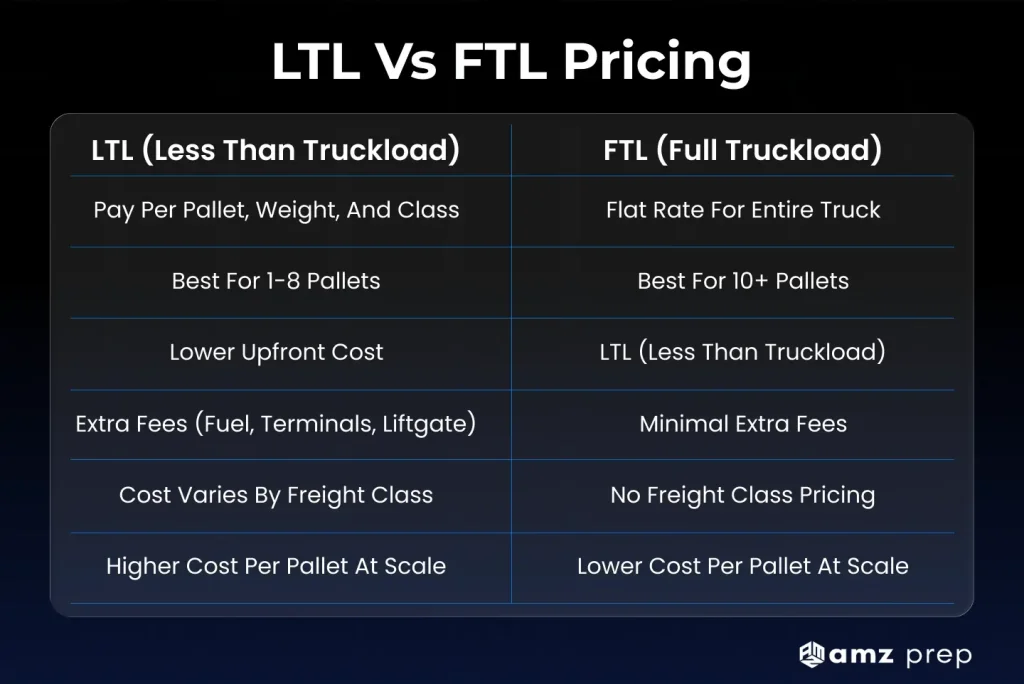
| Pricing Model | Pay for space used (per pallet/weight) | Pay flat rate for entire truck |
| Transit Time | 3 – 10+ days | 1 – 5 days |
| Handling Touchpoints | 4 – 8 touchpoints | 2 touchpoints (load and unload) |
The Core Operational Difference
The difference between LTL and FTL freight comes down to routing and handling.
LTL = multiple stops, terminal transfers, longer transit. Your pallets get moved on and off the truck several times. They share space with other shipments. Transit time is less predictable because it depends on the carrier’s consolidation schedule.
FTL = direct delivery, faster transit, fewer touchpoints. Your pallets stay on the same truck from origin to destination. You get priority scheduling. The driver is focused on your shipment, not 12 other pickups along the way.
When I am routing freight for a client, this is the first question I ask: does this shipment need to arrive by a specific date, or is there flexibility? Before selecting the right transportation strategy, it also helps to understand the differences between a freight broker vs freight forwarder, since each plays a different role in managing shipments. A DOT number lookup can also help verify a motor carrier’s identity when evaluating transportation providers. That answer determines whether we go LTL or FTL before we even look at cost.
LTL vs FTL Cost Comparison
How LTL Freight Pricing Works
LTL carriers price based on freight class, weight, and distance. Freight class is determined by density, handling difficulty, and liability. Denser shipments (heavy items in small boxes) get lower classes and cheaper rates. Light, bulky items (furniture, pillows) get higher classes and cost more per pound.
LTL Freight Class System
| Freight Class | Density (lbs per cubic ft) | Example Products |
|---|---|---|
| Class 50 | 50+ | Nuts, bolts, bricks |
| Class 55 | 35 – 50 | Bricks, cement, hardwood flooring |
| Class 60 | 30 – 35 | Car accessories, car parts |
| Class 65 | 22.5 – 30 | Bottled beverages, books |
| Class 70 | 15 – 22.5 | Car engines, food items |
| Class 85 | 12 – 15 | Crated machinery, cast iron |
| Class 92.5 | 10.5 – 12 | Computers, monitors |
| Class 100 | 9 – 10.5 | Boat covers, wine cases |
| Class 110 | 8 – 9 | Cabinets, framed artwork |
| Class 125 | 7 – 8 | Small household appliances |
| Class 150 | 6 – 7 | Auto sheet metal parts |
| Class 175 | 5 – 6 | Clothing, stuffed furniture |
| Class 200 | 4 – 5 | Auto parts, aluminum tables |
| Class 250 | 3 – 4 | Bamboo furniture, mattresses |
| Class 300 | 2 – 3 | Wood cabinets, tables, chairs |
| Class 400 | 1 – 2 | Deer antlers |
| Class 500 | <1 | Bags of gold dust, ping pong balls |
You also pay terminal handling fees, fuel surcharges, and accessorial charges for things like liftgate service or inside delivery. These fees stack up fast.
For shipments under 6-8 pallets, LTL shipping is almost always cheaper than FTL. A 4-pallet shipment from Ohio to California might cost $800-$1,200 via LTL. Renting an entire truck for the same lane would run $3,500-$4,500.
The economics flip once you hit 10+ pallets. At that volume, LTL per-pallet rates start approaching or exceeding the cost of just renting the truck outright.
How FTL Freight Pricing Works
FTL carriers charge a flat rate per truck. It does not matter if you load 12 pallets or 26 pallets. You are paying for the entire truck.
Average FTL Rates by Lane (2026)
| Lane | Distance | Average Cost | Cost per Mile |
|---|---|---|---|
| Los Angeles to Dallas | 1,435 miles | $2,800 – $3,200 | $1.95 – $2.23 |
| Dallas to Atlanta | 782 miles | $2,200 – $2,600 | $2.81 – $3.33 |
| Chicago to New York | 790 miles | $2,400 – $2,800 | $3.04 – $3.54 |
| Seattle to Los Angeles | 1,135 miles | $2,600 – $3,000 | $2.29 – $2.64 |
| Miami to New York | 1,280 miles | $2,800 – $3,400 | $2.19 – $2.66 |
Rates vary by lane, distance, and demand. Backhaul lanes (routes where trucks are heading home empty) are cheaper. High-demand lanes during peak season cost more.
There are no freight class calculations. No terminal fees. No accessorial charges unless you request special services like a team driver for faster delivery.
The breakeven point depends on your lane and shipment size. In most cases, FTL freight becomes more cost-effective once you cross 10,000-12,000 pounds or 10+ pallets.
Finding Your Breakeven Point
Here is the framework I use with clients to determine when FTL makes sense.
Breakeven Analysis Example:
| Pallet Count | LTL Cost | LTL Per Pallet | FTL Cost | FTL Per Pallet | Best Choice |
|---|---|---|---|---|---|
| 4 pallets | $1,120 | $280 | $2,800 | $700 | LTL |
| 6 pallets | $1,680 | $280 | $2,800 | $467 | LTL |
| 8 pallets | $2,240 | $280 | $2,800 | $350 | LTL |
| 10 pallets | $2,800 | $280 | $2,800 | $280 | Equal |
| 12 pallets | $3,360 | $280 | $2,800 | $233 | FTL |
| 14 pallets | $3,920 | $280 | $2,800 | $200 | FTL |
| 16 pallets | $4,480 | $280 | $2,800 | $175 | FTL |
Example based on Los Angeles to Dallas lane, Class 70 freight
The crossover point for most lanes is 10-12 pallets. But it shifts based on freight class, lane density, and time of year. Before making the comparison, it is worth taking a minute to calculate freight density since density has a direct impact on LTL classification and pricing. During the Q4 peak season, LTL rates spike 30-50%. FTL rates go up too, but not as dramatically. That moves the breakeven point lower.
If you are shipping 8-9 pallets and the LTL vs FTL cost difference is within 10-15%, I almost always recommend FTL. The speed and reliability are worth the marginal cost increase.
LTL vs FTL Speed and Transit Time
To see how these transit time differences actually impact your Amazon inbound timeline, watch the breakdown below:
LTL Transit Times and Variability
Average LTL Transit Times by Distance
| Distance | Standard LTL | Expedited LTL |
|---|---|---|
| Under 500 miles | 3 – 5 days | 2 – 3 days |
| 500 – 1,000 miles | 4 – 7 days | 3 – 5 days |
| 1,000 – 1,500 miles | 5 – 9 days | 4 – 6 days |
| 1,500 – 2,000 miles | 6 – 10 days | 5 – 7 days |
| Over 2,000 miles | 7 – 12 days | 6 – 9 days |
The bigger issue is variability. LTL carriers do not guarantee delivery dates unless you pay extra for expedited service. Your freight moves when the consolidation schedule allows. If the terminal is backed up or the carrier does not have enough volume heading to your destination, your shipment waits.
During Q4, winter weather, or peak freight season, LTL delays get worse. I have seen standard 5-day lanes stretch to 12-14 days because terminals could not process volume fast enough.
FTL Transit Times and Reliability
Average FTL Transit Times by Distance
| Distance | Solo Driver FTL | Team Driver FTL |
|---|---|---|
| Under 500 miles | 1 – 2 days | 1 day |
| 500 – 1,000 miles | 2 – 3 days | 1 – 2 days |
| 1,000 – 1,500 miles | 2 – 3 days | 1 – 2 days |
| 1,500 – 2,000 miles | 3 – 4 days | 2 – 3 days |
| Over 2,000 miles | 4 – 5 days | 2 – 3 days |
FTL freight moves faster because there are no terminal stops. The truck picks up, drives, and delivers. A solo driver can cover 500-600 miles per day. Team drivers (two people alternating shifts) can cover 1,000+ miles per day.
Los Angeles to Dallas via FTL: 2-3 days with a solo driver, 1-2 days with a team. The same lane via LTL: 5-7 days on average, longer during peak.
FTL also gives you appointment control. You schedule the delivery window with the receiving dock. LTL shipments arrive when the carrier’s routing schedule allows. That lack of control creates problems at facilities with limited receiving hours.
I had a client shipping to a Walmart distribution center that only accepted freight between 8 AM and 2 PM. Their LTL shipments kept missing the window and sitting outside for 24-48 hours. We switched them to FTL. Deliveries hit the appointment slot every time. No detention fees. No delays.
If your shipment needs to arrive by a specific date, FTL is the only reliable option.
Impact on Amazon FBA Inbound Speed
This is where the LTL vs FTL shipping decision gets critical for Amazon sellers.
Amazon FBA Check-In Times
| Shipping Method | Average Check-In Time | Range |
|---|---|---|
| LTL direct to Amazon FC | 18 – 28 days | 12 – 40 days |
| FTL direct to Amazon FC | 8 – 14 days | 5 – 20 days |
| FTL to consolidation + middle mile | 2 – 6 days | 1 – 10 days |
Amazon splits your inventory across 4-5 different FCs. Shipping LTL to each location separately would cost more than your entire product margin.
Most sellers choose Amazon’s placement service to avoid that. But placement service fees can hit $0.30-$3.00 per unit depending on size tier. For a 1,000-unit shipment, that is $300-$3,000 just to let Amazon move your inventory around their own network.
The alternative is FTL shipping to a consolidation point like AMZ Prep’s Middle Mile program, then letting us handle the FC splits. Your freight arrives in 2-3 days. We break it down by FC destination. We route it using our carrier network that already has trucks running to those FCs daily. Inventory goes live in 2-6 days total. Zero placement fees.
Damage Risk and Handling Differences
LTL Handling and Damage Exposure
LTL Damage Statistics
| Product Type | Average Damage Rate | Primary Causes |
|---|---|---|
| Properly palletized freight | 2 – 5% | Terminal transfers, stacking pressure |
| Poorly packaged freight | 8 – 12% | Inadequate wrapping, weak boxes, no corner boards |
| Fragile items (glass, electronics) | 10 – 15% | Multiple touchpoints, improper handling |
| High-value goods | 3 – 7% | Transit shifts, forklift incidents |
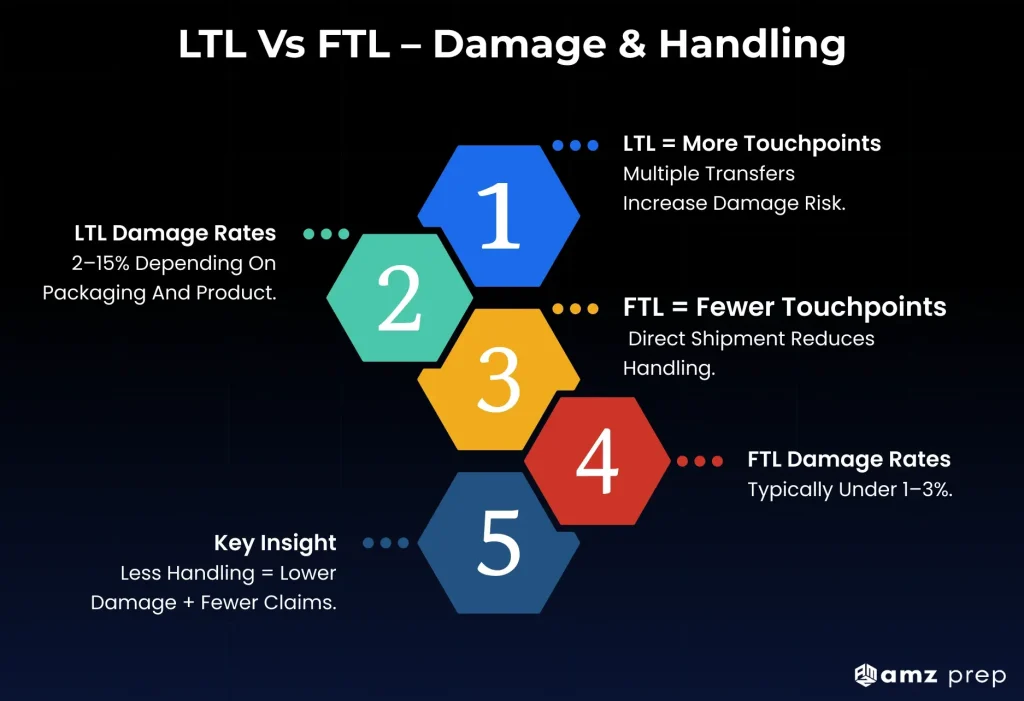
LTL freight gets touched more. Your pallets are loaded at your dock, moved off at the first terminal, sorted and transferred to another truck, potentially moved again at a second terminal, then delivered to the destination.
If you are shipping via LTL, proper palletization is non-negotiable. Shrink wrap every pallet edge-to-edge. Corner boards on all four sides. Boxes stacked evenly with no overhang. Following Amazon FBA packaging requirements prevents both damage and receiving dock rejections.
FTL Handling and Protection
FTL Damage Statistics
| Product Type | Average Damage Rate | Reduction vs LTL |
|---|---|---|
| Standard palletized freight | Under 1% | 50 – 80% lower |
| Fragile items | 1 – 3% | 70 – 85% lower |
| High-value goods | Under 2% | 60 – 75% lower |
Damage rates on FTL shipments typically run under 1%. The reduction comes from fewer touchpoints and more control over how freight is secured in the trailer.
For high-value goods (electronics, cosmetics, supplements), the damage savings alone can justify FTL over LTL. I worked with a beauty brand that was losing $4,000-$6,000 per quarter on LTL damage claims.
We moved them to FTL for shipments over 8 pallets. Damage dropped to near zero. The FTL premium was $300-$500 per shipment. They saved $3,500+ per quarter just on avoided claims.
If your product has high unit value or is fragile, factor damage risk into your FTL vs LTL comparison. The cheapest freight option is not always the most cost-effective when you include replacement costs and lost sales from damaged inventory.
When To Use LTL Freight
LTL Freight Decision Matrix
| Your Situation | Use LTL? | Rationale |
|---|---|---|
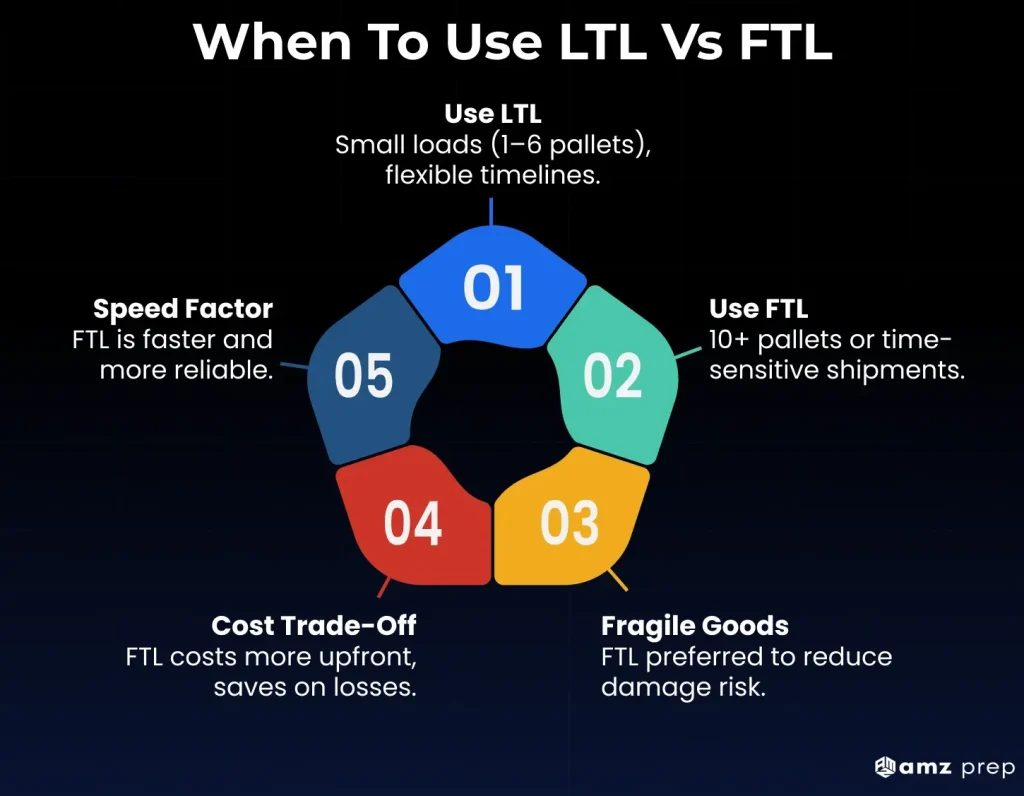
| 1 – 6 pallets, non-urgent | Yes | Most economical option |
| 6 – 10 pallets, flexible timeline | Yes | Still cost-effective if timing allows |
| 10+ pallets, any timeline | No | FTL likely cheaper on per-pallet basis |
| Fragile/high-value products | Maybe | Only with excellent packaging and insurance |
| Time-sensitive shipment | No | LTL transit too variable |
| Multiple destination routing | No | Use FTL to consolidation point instead |
| Regular weekly replenishment | Yes | Predictable, non-urgent flow |
LTL Freight Decision MatrixMost brands shipping 1-8 pallets of non-urgent inventory use LTL. It is the default choice for regular replenishment when cost matters more than speed. Combining LTL for replenishment with other strategies to reduce Amazon shipping costs creates a complete cost optimization plan.
When To Use FTL Freight
FTL Freight Decision Matrix
| Your Situation | Use FTL? | Rationale |
|---|---|---|
| 10+ pallets or 10,000+ lbs | Yes | Cost-competitive with LTL on per-pallet basis |
| 6 – 10 pallets, time-sensitive | Yes | Speed justifies premium |
| Fragile or high-value products | Yes | Damage reduction saves money long-term |
| Amazon FBA shipment (multi-FC) | Yes | Use with consolidation to avoid placement fees |
| Product launch or Q4 restock | Yes | Speed to market critical |
| Appointment-required delivery | Yes | FTL guarantees delivery window |
| 70%+ truck capacity utilization | Yes | Maximizing value of flat-rate pricing |
I had a client shipping 9 pallets from their warehouse to an AMZ Prep facility in Kentucky. LTL quote was $1,240. FTL quote was $1,680. That is a $440 difference, or $49 per pallet.
We chose FTL. Why? The shipment was time-sensitive (Q4 restock). The product was supplements in glass bottles (fragile, high damage risk). And the FTL delivered in 2 days vs 6-7 days for LTL. The extra $440 was worth it to avoid potential damage and get inventory live faster.
LTL vs FTL for Amazon FBA Sellers
The Placement Fee Problem
Amazon’s inbound placement system creates a trap for sellers trying to decide between LTL and FTL.
You create a shipment in Seller Central. Amazon tells you to split your inventory across 4-5 different fulfillment centers. You have three options:
- Ship LTL directly to each FC (costs $4,000-$8,000 for freight alone)
- Pay Amazon’s placement service fee to let them distribute it ($0.30-$3.00 per unit)
- Handle the distribution yourself somehow
Most sellers choose option 2 because options 1 and 3 seem impossible. But placement fees destroy margins. A 2,000-unit shipment at $0.50 per unit placement fee is $1,000 just to let Amazon move your inventory around their own network.
Amazon Placement Fee Schedule (2026)
| Size Tier | Minimal Shipment Splits | Partial Shipment Splits | Standard Placement |
|---|---|---|---|
| Small standard | $0.17/unit | $0.19/unit | $0.27/unit |
| Large standard | $0.32/unit | $0.37/unit | $0.47/unit |
| Large bulky | $1.01/unit | $1.19/unit | $1.58/unit |
| Extra-large (0-50 lbs) | $1.52/unit | $1.80/unit | $2.43/unit |
| Extra-large (50+ lbs) | $2.53/unit | $3.00/unit | $4.05/unit |
There is a fourth option that beats all three. Ship FTL to a consolidation point and use enterprise middle mile services to manage the FC splits and final routing.. Let the consolidation partner handle the FC splits and routing. You avoid placement fees entirely. You get faster inbounds. And if your shipment is 10+ pallets, FTL is already cheaper than LTL anyway.
Real breakdown for a 16-pallet shipment (2,000 units, large standard size) from California to Amazon FBA:
| Method | Freight Cost | Placement Fees | Check-In Time | Total Cost |
|---|---|---|---|---|
| LTL direct to Amazon (5 FCs) | $6,800 | $0 | 18-28 days | $6,800 |
| Amazon placement service | $1,680 | $940 | 18-28 days | $2,620 |
| FTL to consolidation + middle mile | $2,800 | $0 | 2-6 days | $3,440 |
Placement fee calculation: 2,000 units × $0.47/unit = $940
Option C costs $40 less than Amazon’s placement service and delivers 12-20 days faster. That speed difference is worth thousands in avoided stockouts during Q4 or product launches. Before choosing any option, run your actual numbers through a placement fee calculator to see your specific exposure.
Learn more about how to avoid Amazon placement fees with strategic freight routing.
Check-In Speed Impact
Amazon receiving docks prioritize full truckloads. An FTL delivery gets an appointment slot and moves to the front of the unloading queue. An LTL shipment sits behind every FTL in line.
Amazon Check-In Performance Data (based on 500+ tracked shipments):
| Shipping Method | Average Check-In | 90th Percentile | Best Case | Worst Case |
|---|---|---|---|---|
| LTL direct to Amazon FC | 22 days | 35 days | 12 days | 40+ days |
| FTL direct to Amazon FC | 11 days | 18 days | 5 days | 25 days |
| FTL consolidation + middle mile | 4 days | 8 days | 1 day | 10 days |
The difference comes down to dock priority. Amazon knows a full truck will get unloaded and cleared faster than managing 8 different LTL deliveries. They schedule FTL appointments tightly. LTL shipments arrive whenever the carrier’s routing allows.
For sellers running lean inventory or launching new products, that 12-20 day speed advantage changes everything. Faster check-ins mean fewer stockouts, better IPI scores, and more consistent Buy Box access.
When you factor check-in speed into your FTL vs LTL freight logistics cost difference, FTL starts looking a lot cheaper. Missing sales for two weeks because inventory is stuck at Amazon’s dock costs more than the freight premium.
The Middle Mile Strategy
Here is how the consolidation model works for Amazon sellers:
You create your FBA shipment in Seller Central like normal. Amazon tells you to send inventory to 4-5 different FCs. Instead of shipping to Amazon, you route everything to one consolidation facility.
The consolidation team breaks it down by FC destination. They create individual shipping plans for each FC. Middle mile logistics partners can then load freight onto trucks already running to those FCs daily, consolidating shipments from multiple brands going to the same Amazon facilities.
Each FC receives a full truckload delivery with priority dock appointments. Your inventory gets checked in fast. You pay zero placement fees because you handled the distribution, not Amazon.
Middle Mile Consolidation Cost Breakdown
| Service Component | Typical Cost | What It Includes |
|---|---|---|
| FTL inbound to consolidation | $0.08 – $0.12 per lb | Pickup to facility delivery |
| Receiving and breakdown | Included | Unload, inventory, sort by FC |
| FC routing and delivery | $0.04 – $0.08 per lb | Consolidation, delivery to Amazon |
| Total per-pound cost | $0.12 – $0.20/lb | Complete door-to-door service |
Example: 16,000 lb shipment = $1,920 – $3,200 total cost vs $940+ in placement fees plus slower inbounds
The total landed cost is almost always lower than LTL direct or Amazon placement service. And you get your inventory live 75% faster.
This is the strategy I recommend to every Amazon seller shipping 10+ pallets. Ship FTL from your warehouse to a consolidation point. Let them handle the middle mile routing. You get the speed and economics of FTL plus the distribution efficiency of consolidated freight.
It is the only way to beat Amazon’s placement fee trap without sacrificing inbound speed.
How To Decide Between LTL and FTL Freight
Quick Decision Flowchart
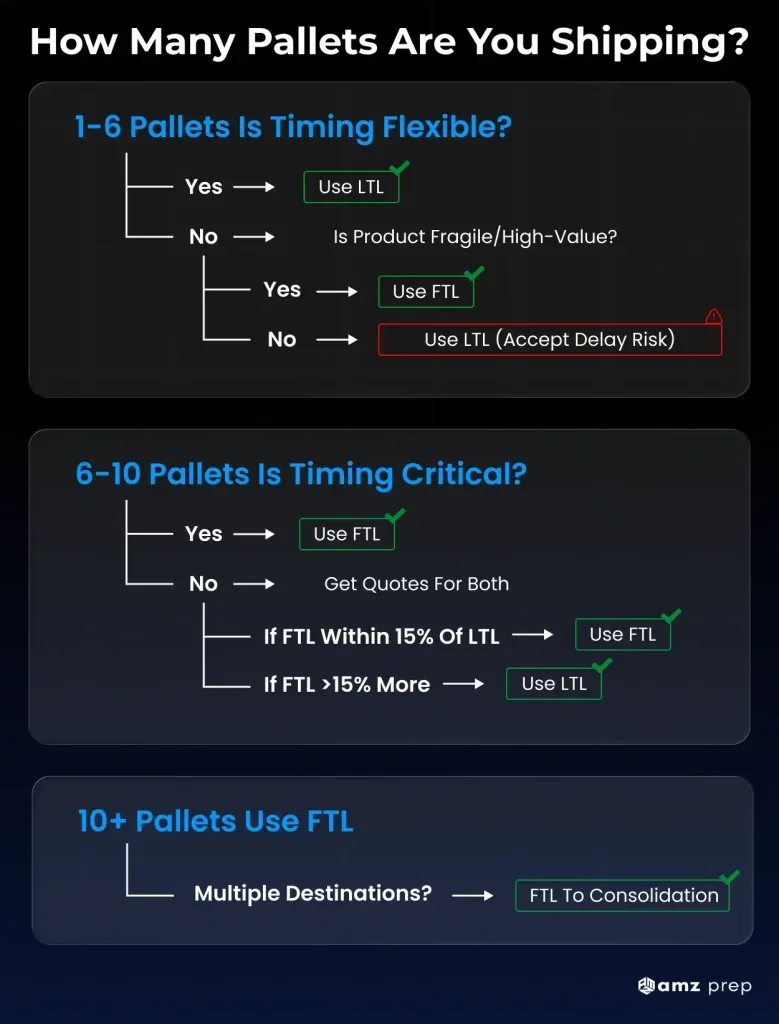
Here is the decision framework I use when routing freight for clients:
Step 1: Calculate total shipment weight and pallet count
If you are under 6 pallets or 6,000 pounds, LTL is almost always the right choice. Over 12 pallets or 12,000 pounds, FTL usually wins. Between 6-12 pallets, you need to run the full cost analysis.
Step 2: Identify your delivery timeline requirements
Does this shipment need to arrive by a specific date? Is there any flexibility? If timing is critical, FTL is the only reliable option regardless of cost. If you have 2-3 weeks of buffer, LTL can work.
Step 3: Assess product value and damage sensitivity
High unit value, fragile items, or products where damage claims exceed $500 per shipment favor FTL. Durable, low-value goods can handle LTL.
Step 4: Determine if you are shipping to one location or multiple FCs
Single destination with flexible receiving hours? LTL works. Multiple FCs or tight appointment windows? Route FTL to a consolidation point.
Step 5: Get quotes for both methods and compare total landed cost
Do not just look at the freight quote. Factor in placement fees, potential damage claims, and the cost of delayed inbounds (lost sales from stockouts).
Step 6: Factor in downstream costs
For Amazon sellers, add placement fees and calculate the value of faster check-ins. For retail distribution, consider appointment scheduling and dock fees. Total landed cost is what matters, not just the freight line item.
When I run this analysis for clients, FTL wins about 60% of the time for shipments over 8 pallets once we include all the downstream costs. The upfront freight quote looks higher, but the total delivered cost is lower.
Conclusion
The choice between LTL and FTL freight is not about which method is better. It is about which method fits your shipment profile, timeline, and total cost structure.
Get quotes for both options. Run the math on total landed cost. Factor in speed, damage risk, and downstream fees like placement charges or dock detention.
For detailed information on LTL shipping best practices, read our complete guide to LTL freight shipping. If you are shipping to Amazon FBA, middle mile logistics eliminates placement fees and cuts check-in time by 75%.”
Frequently Asked Questions
What is the main difference between LTL and FTL freight?
LTL (Less Than Truckload) means you share trailer space with other shippers and pay only for the space your freight uses. FTL (Full Truckload) means you rent the entire truck at a flat rate. LTL costs less for small shipments (1-8 pallets) but takes longer due to terminal stops. FTL is faster with direct delivery but only economical for larger shipments (10+ pallets).
What is the weight limit for LTL shipping?
LTL shipping handles freight between 150 and 15,000 pounds. Shipments under 150 pounds ship via parcel. Over 15,000 pounds typically requires FTL. The practical upper limit for LTL is around 10,000-12,000 pounds before FTL becomes more economical on a per-pound basis.
How many pallets fit in an FTL truck?
A standard 53-foot dry van trailer fits 26-30 standard pallets (48″ × 40″) in a single layer. Actual capacity depends on pallet size, whether you double-stack, and how the freight is loaded. Most FTL shipments range from 10-26 pallets. The trailer can hold approximately 45,000-48,000 pounds total weight.
At what point does FTL become cheaper than LTL?
FTL freight typically becomes more cost-effective than LTL at 10-12 pallets or 10,000-12,000 pounds. The exact breakeven point varies by lane, freight class, and season. During peak season (Q4), the crossover point drops to 8-10 pallets because LTL rates spike more than FTL rates.
How long does LTL shipping take compared to FTL?
LTL shipping takes 3-10+ days depending on distance and terminal stops. Cross-country LTL averages 7-10 days. FTL shipping takes 1-5 days for the same routes. A Los Angeles to Dallas shipment is 2-3 days FTL vs 5-7 days LTL. FTL delivers 40-60% faster because there are no terminal transfers.
Can I combine LTL and FTL for different shipments?
Yes. Use LTL vs FTL based on each shipment’s volume, timeline, and destination. Most brands ship LTL for regular replenishment (4-6 pallets weekly) and FTL for bulk restocks or time-sensitive inventory (12+ pallets quarterly). Choose the right tool for each job based on the decision framework above.
What is partial truckload shipping?
Partial truckload (PTL) fills the gap between LTL and FTL. You use more than half the truck but less than a full load (typically 8-16 pallets or 12-20 linear feet). Some carriers offer PTL-specific pricing that beats LTL per-pallet rates without paying for a full truck. PTL is ideal for the 8-12 pallet range where LTL is expensive but FTL feels wasteful.
Do I need to book FTL in advance?
Yes. FTL freight requires booking 2-7 days ahead depending on lane and season. Q4 peak, major holidays, or high-demand lanes need more lead time (7-14 days). LTL can often be booked with 1-2 days notice, though pricing improves with advance booking. For time-sensitive FTL shipments, book as early as possible to secure capacity.
Which shipping method is better for Amazon FBA?
For Amazon FBA shipments over 10 pallets, FTL to a consolidation point is almost always better than LTL direct or Amazon placement service. FTL consolidation eliminates placement fees ($0.30-$3.00 per unit), cuts check-in time from 18-28 days to 2-6 days, and costs less total when you factor in all fees. For shipments under 6 pallets, use LTL if timing is flexible.
How do I calculate freight class for LTL shipping?
Freight class for LTL is determined by density (weight per cubic foot). Measure your pallet: length × width × height in inches, divide by 1,728 to get cubic feet. Divide weight in pounds by cubic feet to get density. Use the freight class chart above to find your class. Denser shipments get lower classes (cheaper rates). Light, bulky items get higher classes (higher rates).
What causes damage in LTL vs FTL shipping?
LTL damage happens primarily from multiple handling touchpoints (4-8 times) at terminals, stacking pressure from other shipments, and forklift incidents during transfers. LTL damage rates run 2-5% for properly palletized freight and 8-12% for poorly packaged goods. FTL damage is much lower (under 1%) because freight is loaded once and unloaded once with no terminal stops or transfers.
How much does LTL shipping cost per pallet?
LTL shipping cost per pallet ranges from $150-$400 depending on freight class, weight, distance, and destination. Class 50-70 freight (dense, heavy items) costs $150-$250 per pallet. Class 100-150 freight (medium density) costs $200-$300 per pallet. Class 200+ freight (light, bulky items) costs $250-$400+ per pallet. Add 15-25% for fuel surcharges and accessorial fees.
What is the average FTL shipping cost per mile?
FTL shipping costs average $1.95-$3.50 per mile depending on lane, demand, and season. High-volume lanes (LA-Dallas, Chicago-NY) run $1.95-$2.50 per mile. Low-volume or backhaul lanes run $2.50-$3.50+ per mile. Peak season (Q4) adds 20-30% to base rates. Total FTL cost for most lanes ranges from $2,200-$4,500 depending on distance.
Can I use FTL for shipments under 10 pallets?
Yes, you can use FTL for smaller shipments (6-10 pallets) when timing is critical, products are fragile/high-value, or you need guaranteed delivery windows. While LTL may be cheaper on freight alone, FTL can save money when you factor in damage reduction, faster transit (fewer stockout days), and appointment control. The decision depends on total landed cost, not just freight price.
What documentation do I need for LTL vs FTL shipping?
Both LTL and FTL require a Bill of Lading (BOL) with shipper/consignee info, freight description, weight, pallet count, and special instructions. LTL also requires freight class designation and NMFC code. FTL needs BOL and delivery appointment confirmation. For Amazon FBA, both need Amazon shipment ID, FC destination, and FBA labels. Add commercial invoice for cross-border shipments.
How do I get LTL and FTL freight quotes?
Contact freight brokers, 3PLs, or carriers directly with your origin, destination, weight, pallet count, freight class (for LTL), and timeline. An Amazon freight calculator provides instant quotes for common lanes. Request quotes for both LTL and FTL. Compare total delivered cost, not just the base rate.

Chadwick Collins is an Enterprise Fulfillment Consultant at AMZ Prep, where he partners with high growth ecommerce brands to design and scale Amazon first logistics strategies. He brings extensive experience in freight, supporting brands across domestic and cross border transportation, routing optimization, and cost control.
At AMZ Prep, Chadwick works closely with enterprise clients to improve inventory flow, reduce landed costs, and accelerate delivery performance across North America. His expertise spans FBA, DTC, and B2B fulfillment, with a strong focus on aligning freight strategy with overall supply chain efficiency. He helps brands navigate complex logistics challenges while turning operations into a competitive advantage.
















Comments