
Freight consolidation is the process of combining multiple smaller shipments into one larger load headed the same way. Each shipper pays for the space its cargo takes up. Nobody pays for the empty part of the trailer.
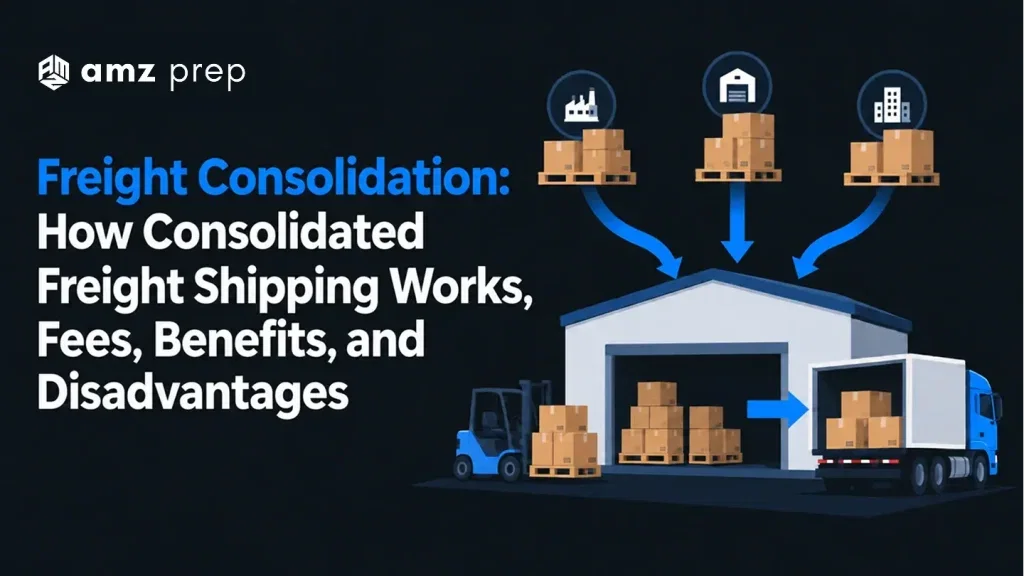
Most brands I talk to have the same problem. They ship eight or ten pallets to Amazon every week, which is too much for parcel and nowhere near a full truck. So they pay LTL rates and wait on terminal transfers. Consolidation fixes that gap.
I plan consolidated freight into Amazon and retail DCs every week. This guide covers how it works on the dock, what it really costs, and where it stops making sense.
What Is Freight Consolidation?
Freight consolidation is a logistics practice where a freight consolidator groups shipments from various shippers into a full truckload or a full container load. The consolidator books one carrier move and splits the freight cost by space used. At the other end, the load is deconsolidated and each shipment goes its own way.
Picture three brands with six pallets each, all bound for the same Amazon region. Alone, each one pays a partial-load rate and books its own dock appointment. On one truck, they share full-truck pricing and a single appointment. Same freight, fewer trucks, a lower bill for everyone.
You’ll also hear it called consolidation freight or co-loading. Carriers use the terms loosely.
Freight Consolidation vs Deconsolidation
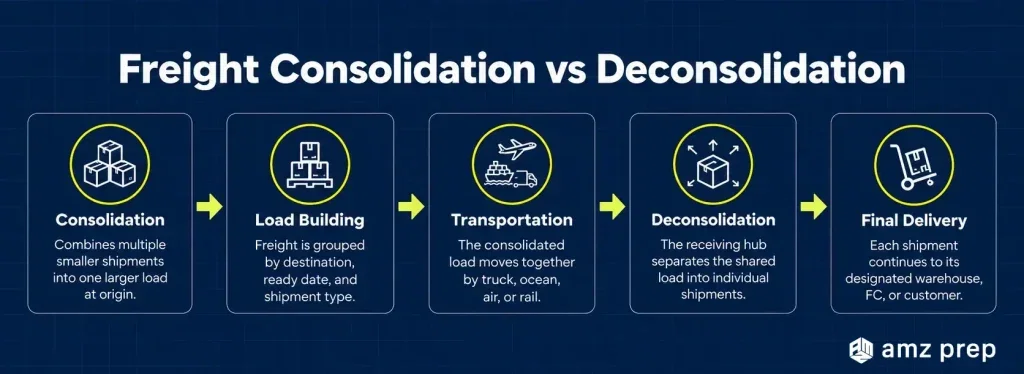
Consolidation happens at origin. Deconsolidation is the reverse, at destination, when the load is broken back into separate shipments for each recipient.
In ocean freight, both steps usually happen at a container freight station, or CFS. In trucking, they happen at a cross-dock or a 3PL warehouse. The two steps are billed separately, which matters later when we get to fees.
Freight Consolidation vs Cross-Docking vs Zone Skipping
People mix these three up all the time, and in fairness they overlap.
| Term | What it does | Typical use |
|---|---|---|
| Freight consolidation | Groups multiple smaller shipments into one larger load | LCL, LTL, inbound freight to Amazon or retail DCs |
| Cross-docking | Moves freight from inbound to outbound trucks with little or no storage | Retail replenishment, Amazon inbound cross-docks |
| Zone skipping | Moves parcels in bulk to a hub near buyers before carrier handoff | Outbound DTC parcels |
Amazon runs its own cross-dock network for FBA inbound. Zone skipping takes the consolidation idea and applies it to outbound parcels instead of pallets.
What a Freight Consolidator Does
A freight consolidator builds and manages the shared load. That can be a 3PL, a freight forwarder, a shipping company, or, in ocean freight, an NVOCC.
The day-to-day work is less glamorous than it sounds. The consolidator handles routing, load plans, paperwork, and the carrier booking. Many add consolidation services like palletizing, labeling, and short-term storage while a load fills.
Most forwarders consolidate cargo themselves, and it’s one of the clearer ways a forwarder differs from a broker.
Types of Consolidated Freight Shipping
Consolidated freight shipping shows up at almost every point in the supply chain. What changes is where the grouping happens and who does it.
| Type | How it works | Best fit |
|---|---|---|
| LCL ocean consolidation | Cargo from several shippers shares one ocean container | Imports smaller than a full container load |
| Air consolidation | A forwarder groups air cargo under one master air waybill | Urgent or high-value imports |
| LTL consolidation | Multiple LTL shipments ride one trailer to the same region | Pallet freight short of a full truckload |
| Buyer’s (multi-vendor) consolidation | Several suppliers’ goods ship together for one buyer | Brands sourcing from many factories |
| Multi-brand 3PL consolidation | A 3PL combines freight from many brands to shared destinations | Inbound freight to Amazon and retail DCs |
| Parcel consolidation | Orders ride in bulk to a hub near buyers | Outbound DTC parcels |
LCL Cargo Consolidation for Import and Export
LCL means less than container load. LCL shipments from many shippers get packed into one box at an origin CFS, then sail together.
The paperwork has two layers. The carrier issues one master bill of lading to the consolidator. The consolidator then issues a house bill of lading to each shipper. The gap between a master and a house bill of lading confuses a lot of first-time importers, and it matters at customs.
Customs requirements still apply to every shipment in the container. US ocean imports need an Importer Security Filing, and for consolidated cargo it names the consolidator and the stuffing location.
There’s a tipping point, though. Once a brand fills most of a container on its own, sea freight as FCL usually comes out cheaper than LCL.
Consolidated Shipping for LTL Freight
LTL, or less-than-truckload, is pallet freight that doesn’t fill a trailer. A consolidator pools multiple LTL shipments headed the same way into one FTL move. In domestic trucking, this is the consolidated shipping most brands actually use.
LTL freight is priced on weight, distance, and freight class. Where it flips to FTL depends on pallet count, weight, and the lane. Our breakdown of LTL vs FTL shipping shows how to find that point.
Intermodal freight adds rail for long hauls. Trucks handle pickup and final delivery, and rail carries the middle. It’s cheap. It’s also slow, so intermodal only fits when the calendar has room.
Inbound Freight Consolidation to Amazon and Retail DCs
This is where I spend most of my week. Inbound consolidation groups freight from many brands bound for the same Amazon fulfillment centers or retail DCs. Full trucks with booked appointments tend to get worked faster at the receiving dock than scattered partials.
There’s a fee angle too. Amazon updated its inbound placement fee on January 15, 2026, and minimal-split rates went up again. Sellers avoid the fee by splitting shipments across the locations Amazon picks. Shipping five separate partial loads to do that rarely makes sense on its own. Consolidated trucks make the split affordable.
Amazon 1P vendors consolidate as well. Several Vendor Central purchase orders bound for the same fulfillment center can ride one load. Our Amazon 1P fulfillment team builds those loads to Amazon’s routing rules, because a mislabeled pallet there turns into a chargeback.
Outbound Freight Consolidation
Outbound works in the other direction. Orders leaving a warehouse for the same region or retailer get grouped, and pool distribution sends one truck to a regional point where orders split for local delivery.
For DTC parcels, zone skipping does the same job at a smaller scale.
The Freight Consolidation Process: How a Consolidated Shipment Moves
On paper, the consolidation process has seven steps. In practice, almost every delay I see traces back to step one or step three.
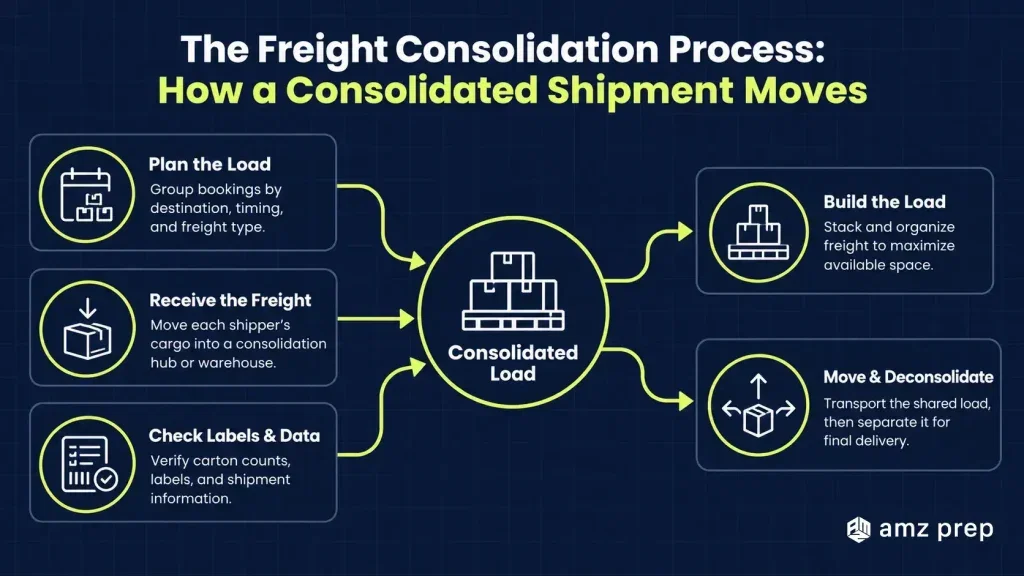
- Plan the load. The consolidator groups bookings by destination, ready date, and freight type.
- Receive the freight. Each shipper’s cargo arrives at a hub, CFS, or 3PL dock.
- Check labels and data. Carton counts, labels, and the advance ship notice get matched to the booking.
- Build the load. Freight is sorted by destination and stacked to maximize cube and weight utilization.
- Issue documents. The carrier issues the master bill of lading, and the consolidator issues house bills or a manifest.
- Move it. The load travels by ocean, air, LTL, FTL, or intermodal, tracked the whole way.
- Deconsolidate and deliver. The receiving hub splits the load, and each consolidated shipment heads to its final destination.
Here’s why step three matters so much. If one shipper’s ASN says 40 cartons and 38 show up, that pallet waits. On a shared load, so might everyone else’s. That’s how consolidation works best: clean data before the freight moves, not after.
Freight Consolidation Fees and How They Affect Freight Cost
A freight consolidation fee is any charge for building, handling, or splitting a shared load. It sits on top of the linehaul rate, and it’s where a lot of LCL quotes quietly get more expensive.
| Fee | Where it appears | How it is billed |
|---|---|---|
| CFS consolidation fee | Origin, ocean LCL | Per cubic meter or weight |
| CFS deconsolidation fee | Destination, ocean LCL | Per cubic meter or weight |
| Storage after free time | CFS or consolidation hub | Per day, after free days end |
| House bill and documentation fee | Ocean and air freight | Per shipment |
| ISF filing fee | US ocean imports | Per filing |
| Palletizing or relabeling | Consolidation hub or 3PL | Per pallet or per unit |
| Accessorials (liftgate, appointment, inside delivery) | Trucking | Per occurrence |
| Minimum charge | All modes | Per shipment |
A small LCL shipment can pick up four or five of these at once. On very small loads, they can eat most of the savings. That’s why I always compare the all-in number against FCL or straight LTL before booking.
On the trucking side, accessorials are the line items that grow fastest. It helps to know the common freight accessorial charges before signing a quote. LTL rates also hinge on freight class, which a freight class calculator can estimate from density.
For freight into Amazon, our Middle Mile program uses one flat rate per cubic foot. Receiving, compliance checks, routing, and FC delivery are inside that rate. No minimums, no placement fees.
Benefits of Freight Consolidation
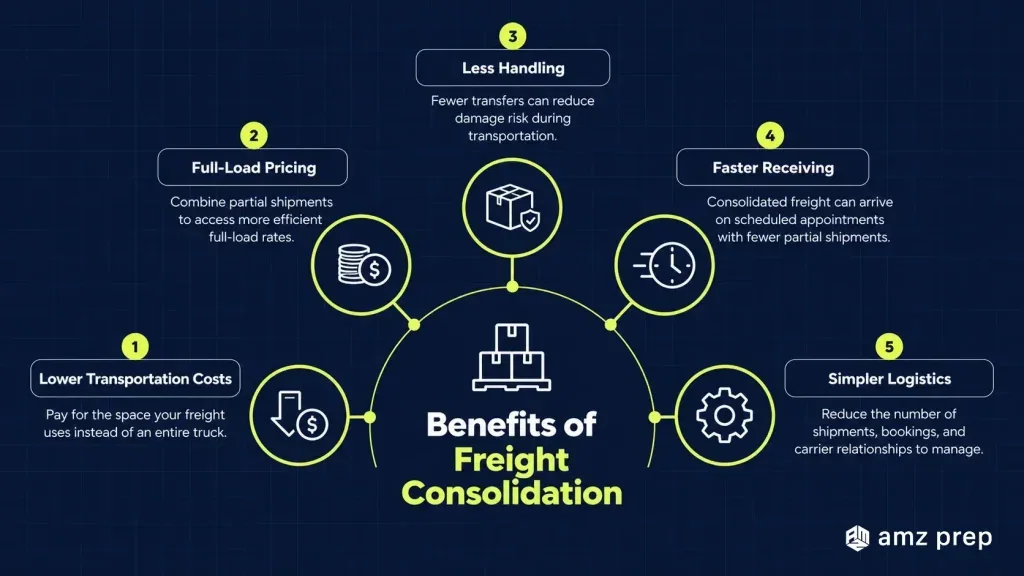
The benefits of freight consolidation come down to paying full-load prices on partial-load volume. Freight consolidation offers that to brands that would never fill a trailer on their own.
Lower transportation costs
Shippers pay for the space they use. On partial loads, it’s the most direct way to reduce costs, and the cost savings grow with every pallet that joins the truck.
Less handling, lower risk of damage
A typical LTL pallet can pass through several terminals before delivery. A consolidated trailer goes more directly. Less handling means a lower risk of damage, and fewer claims to chase.
Faster receiving at Amazon
Full trucks on booked appointments get through receiving faster than scattered partials. Our Middle Mile freight checks in within 1 to 3 days, against a 7 to 10 day industry average, with zero placement fees.
Fewer trucks and lower emissions
Fewer trucks carrying the same cargo means less emission per unit shipped. It’s a real benefit, even if it rarely drives the decision.
Less to manage
Fewer bookings, fewer BOLs, fewer tracking numbers. Consolidation helps streamline carrier management and cuts the number of shipments a team has to watch.
For most brands, this is the quickest way to start cutting costs without renegotiating a single carrier contract. And lower freight cost per unit shows up directly in profitability.
Disadvantages of Freight Consolidation and How to Offset Them
Consolidation isn’t free of trade-offs, and I’d rather name them up front. Most come down to timing and shared risk.
Waiting for the load to fill
A consolidated load leaves when it’s full or on its schedule, not the minute your pallets are ready. The fix is a consolidator with daily or fixed weekly departures.
Longer transit on some lanes
A stop at a CFS or hub can add days. Compare door-to-door transit times, not the linehaul number alone.
Shared customs exposure
If customs examines one shipment in an LCL container, the whole box can sit. Checking documents at origin, before the container is stuffed, prevents most of this.
More touches at the hub
Loose cartons get handled at both ends. Palletizing at origin keeps freight moving as whole units.
Fees on very small loads
CFS and paperwork fees can outweigh the savings. Under a few cubic meters, direct LTL or parcel is often cheaper.
Freight that doesn’t belong on a shared truck
Urgent, oversized, hazmat, or temperature-controlled loads may need their own trailer. Expedited or reefer freight handles those.
When Freight Consolidation Makes Sense for a Shipper
Short version: consolidate when volume is steady, loads are partial, and destinations repeat. Ship direct when cargo is urgent or fills a truck by itself.
| Factor | Consolidate | Ship direct |
|---|---|---|
| Volume | Less than a full truck or container | A full truck or container on its own |
| Timing | Flexible by a day or two | Fixed, same-day deadline |
| Destinations | Same region or the same Amazon FCs, repeatedly | Scattered, one-off destinations |
| Product | Standard cartons or pallets | Oversized, hazmat, or high-value single loads |
| Frequency | Weekly or monthly | One-time shipment |
The brands that get the most out of it treat consolidation as part of their logistics strategy, not a one-off rate trick. They plan replenishment around consolidated lanes. Their shipping strategy gets steadier, and rush orders drop.
Freight Consolidation Software, Live Tracking, and Logistics Network Design
Freight consolidation software plans loads, compares rates, and tracks shared freight. Most shippers use it through a TMS, a transportation management system, or simply through their 3PL’s platform.
The features that matter in practice:
- Load planning by cube and weight
- Rate shopping across carriers and modes
- Live tracking on every truck
- ASN and EDI links with suppliers and retailers
- Dock appointment scheduling
- Amazon shipment plan integration
Still, software can only do so much. Network design decides the rest: where hubs sit, how dense each lane is, and how often trucks leave. The aim is to optimize load fill without holding freight so long it misses a sales window.
In my experience, visibility does more to improve logistics than any single rate cut. When tracking covers the entire logistics flow, slow lanes show up early.
Our freight clients get live, white-labeled tracking on every truck. Amazon inbound shipments and inventory sit in Navigate, our Amazon inventory platform.
How AMZ Prep Consolidates Freight for Ecommerce Brands
We run freight consolidation services at three points: imports, inbound to Amazon and retailers, and outbound orders.
On imports, our freight services cover ocean FCL and LCL, air freight, ISF filing, and customs clearance.
Inbound is the core of it. Our Middle Mile program combines freight from many brands into full trucks bound for the same Amazon fulfillment centers. Daily departures and pre-booked appointments get inventory checked in within 1 to 3 days.
Pallets get their own lane. Middle Mile Plus keeps pallets intact with per-pallet pricing, and reefer trucks carry temperature-controlled goods from cold storage to Amazon or a retailer DC.
For Amazon 1P, we build Vendor Central PO loads to Amazon’s routing rules and handle chargeback prevention. On the outbound side, Prep Parcel by AMZ Prep zone skips DTC parcels to hubs near buyers.
With 50+ warehouses, freight usually consolidates close to where it’s going. That’s half the battle.
Conclusion
Consolidation works when the lanes are planned and the data is clean. Start by listing every lane you ship partial loads on each month. The ones that repeat are where full-load pricing is waiting.
Freight Consolidation FAQs
What does freight consolidation mean?
Freight consolidation means combining multiple smaller shipments into one larger load headed the same way. Each shipper pays for the space its cargo uses. The load is split apart again near the final destination.
What is consolidation in logistics?
Consolidation in logistics means grouping goods, orders, or shipments so they move together. It applies to inbound freight, warehouse storage, and outbound orders. The goal is fewer, fuller moves at a lower cost per unit.
What is consolidation shipping?
Consolidation shipping groups several shipments into a single larger shipment that travels as one load. It’s common in LCL ocean freight, LTL trucking, air cargo, and inbound freight to Amazon fulfillment centers.
What is a freight consolidation fee?
A freight consolidation fee is a charge for building or splitting a shared load. It covers handling at a CFS, hub, or 3PL. Most are billed per cubic meter, per pallet, or per shipment.
What is the difference between freight consolidation and deconsolidation?
Consolidation combines shipments from several shippers into one load at origin. Deconsolidation splits that load back into separate shipments at destination. Both usually happen at a CFS, cross-dock, or 3PL warehouse.
What is a house bill of lading?
A house bill of lading is the document a consolidator issues to each shipper in a shared load. The carrier issues one master bill of lading to the consolidator for the whole container or truck.
Does freight consolidation slow down delivery?
It can add a day or two while a load fills or splits apart. Consolidators with daily departures avoid most of that wait. Full trucks also tend to clear Amazon receiving faster than partial loads.
Is freight consolidation worth it for Amazon sellers?
For sellers with steady inbound volume, usually yes. Consolidated trucks make Amazon’s optimized shipment split affordable, which avoids inbound placement fees. Full-truck appointments also help inventory check in faster than scattered partials.

Chadwick Collins is an Enterprise Fulfillment Consultant at AMZ Prep, where he partners with high growth ecommerce brands to design and scale Amazon first logistics strategies. He brings extensive experience in freight, supporting brands across domestic and cross border transportation, routing optimization, and cost control.
At AMZ Prep, Chadwick works closely with enterprise clients to improve inventory flow, reduce landed costs, and accelerate delivery performance across North America. His expertise spans FBA, DTC, and B2B fulfillment, with a strong focus on aligning freight strategy with overall supply chain efficiency. He helps brands navigate complex logistics challenges while turning operations into a competitive advantage.
















Comments