
Last month, one of our clients sent us a screenshot of their Amazon Seller Central dashboard. The placement fees for a single shipment? $14,627.
Update: This got worse on January 15, 2026. Amazon just increased inbound placement fees again – adding another $0.05 per unit to minimal splits. That same shipment would now cost $15,127 in placement fees , a $500 increase for the exact same inventory.
Not their total FBA costs for the month. Not their shipping budget for the quarter. Just the placement fees for one shipment because Amazon wanted to split their inventory across 4 fulfillment centers.
This is the reality for most Amazon sellers in 2026. You are stuck choosing between two bad options. Pay Amazon a per-unit placement fee to distribute your inventory. Or ship to multiple FCs yourself and watch your freight costs double or triple.
We run one of the largest FBA prep and middle-mile logistics operations in the country. Every week, we move thousands of pallets from seller warehouses to Amazon fulfillment centers. And every week, sellers ask us the same question: “How to avoid Amazon placement fees without tanking my inbound speed?”
Our founder breaks down the exact problem (and our solution) in this video:
Here’s what we’ve learned from helping brands eliminate over $2.3 million in placement fees in the last 18 months and how you can do the same without adding 3-4 weeks to your inbound times.
What Are Amazon Placement Fees?
Simply put, they’re fees Amazon charges when they distribute your inventory across multiple fulfillment centers on your behalf. Instead of you shipping to each location yourself, Amazon takes your inventory from one receiving point and spreads it across their network and charges you for the convenience.
These fees were introduced as part of Amazon’s FBA Inbound Placement Service, designed to “simplify” your shipping process. But what are Amazon placement fees really costing you? They’re a way to pass Amazon’s distribution costs directly to you.
When you create a shipment in Seller Central, Amazon’s algorithm decides where your products need to be stored for optimal delivery speed to customers. If you don’t want to handle shipment splits yourself, sending inventory to multiple inbound locations you pay Amazon to do it. That’s the placement fee.
Fees start well under a dollar per unit for small standard items. They climb sharply for heavier large standard and bulky products. For high-volume sellers moving thousands of units per month, the annual total often lands in the tens of thousands.
Understanding the Placement Fee Trap
Let’s start with what are placement fees on Amazon FBA and what Amazon isn’t telling you about them.
When you create an FBA inbound shipment plan in Seller Central, Amazon’s algorithm decides where your inventory needs to go. In 2019, you might ship to one fulfillment center. In 2026, that same shipment gets split across 3, 4, sometimes 5 different locations.
Why? Because Amazon optimized their network for their efficiency, not yours.
They want your dog toys in Kentucky, your coffee mugs in New Jersey, and your yoga mats in California all so they can deliver fast shipping to customers. Smart for them. Expensive for you.
What Those Fees Actually Look Like
Amazon restructured the placement fee on January 15, 2026. It is no longer one flat rate per size tier. Fees now vary by weight band inside each tier.
| Product Size | 2026 Structure | Minimal Split Fee |
|---|---|---|
| Small standard | 2 weight bands (was 1) | Roughly $0.14 to $0.32 per unit |
| Large standard | 5 weight bands from 3 to 20 lb (was 1) | Roughly $0.20 to $1.90 per unit |
| Small Bulky | New tier, split from old Large Bulky | Varies by weight |
| Large Bulky | Rebuilt tier | Up about $0.27 per unit on average |
| Extra-large | Not charged | No inbound placement fee |
Three things changed at once. Minimal split fees for standard-size items rose about $0.05 per unit. Large standard items between 3 and 20 pounds moved into five bands, so heavier items in that tier now cost disproportionately more. And the old Large Bulky tier split in two.
Extra-large products are exempt. If your catalog sits in that tier, placement fees are not your problem.
Rates shift by weight and destination. Pull your exact per-ASIN fee from the Seller Central rate card before you model this.
Run the math on a 5,000-unit shipment of large standard items in a heavier band. Placement fees alone can clear $3,000 before you pay a cent of freight.
But here’s the catch: Amazon knows most sellers can’t afford to ship LTL to 4-5 different fulfillment centers either. The alternative – handling partial shipment splits yourself which means coordinating inventory to multiple FBA warehouse locations, which drives up your shipping costs significantly.
So they position placement services as the “easy button.” Just pay a reduced fee (their words, not ours), and they’ll handle the distribution. The problem? There’s nothing “reduced” about it when you look at the total number of shipments and inbound routing required, and it gets worse every year.
We’ve tracked this across hundreds of seller accounts. Placement service fees have become a line item that rivals your actual freight costs. For some brands we work with, Amazon inbound placement fees were eating 8-12% of their total product margins. Understanding what are placement fees on Amazon FBA and their actual impact is the first step to solving this problem.
What Changed on January 15, 2026
Amazon implemented several fee changes that affect your placement fee strategy:
Placement Fees Increased
Minimal split inbound placement fees rose by $0.05 per unit on average for standard items . On a 10,000-unit shipment, that’s an extra $500 just for placement.
New “Small Bulky” Tier = Savings for Some
Products between 18-37 inches longest side or 20-50 pounds now fall into a new “Small Bulky” category with fees 21-23% lower than before . If your products fit this tier, you actually save money versus 2025.
Stricter Low Inventory Penalties
The Low-Inventory-Level fee is now calculated at the individual FNSKU level, not parent ASIN . You can’t hide out-of-stock red shirts behind overstocked blue shirts anymore.
New Defect Penalties
Amazon introduced a consolidated Inbound Defect Fee of $0.60 per unit. It replaces the separate placement and defect charges that used to stack. It applies to shipments that never arrive, arrive late or abandoned, or land at the wrong location. Prep quality matters more than ever.
AWD Shipments Skip Inbound Fees
Inventory routed through Amazon Warehousing and Distribution pays no inbound placement fees. AWD users also qualify for a storage utilization surcharge waiver. The tradeoff is transfer time into FBA, covered further down.
The Hidden Math Behind Shipment Splits
When you create a shipping plan in Seller Central, Amazon’s algorithm determines your shipment splits. You might get offered two options:
Minimal shipment splits: You send inventory to one or a few inbound locations. Amazon fans it out across the network on your behalf. You pay the inbound placement service fee.
Amazon-optimized splits: You send to the locations Amazon recommends and pay no placement fee. To qualify, you must send at least five identical cartons or pallets per item. Each carton needs the same quantity and item mix.
Neither option is cheap. Minimal splits keep your freight simple but add a per-unit fee on every item. Optimized splits remove the fee, but you handle distribution to multiple destinations, and freight costs often double or triple.
Most sellers cannot hit the identical-carton requirement on a mixed catalog. That is why the fee applies to so many shipments.
Partial shipment splits are no longer an option for standard-size products. Amazon retired that choice on February 20, 2025. It still exists for bulky items.
These are the hidden costs that do not show up clearly in your profit calculations until it is too late.
The “Solutions” Most Sellers Try (And Why They Don’t Work)
Before we get to what actually works, let’s talk about what doesn’t.
Option 1: Just Pay the Placement Fees
This is what most sellers do. It’s the path of least resistance. Click “accept placement fees” in Seller Central, and Amazon handles the distribution through their inbound placement system.
The problem is that it adds up quietly.
One of our clients, a supplement brand doing about $3M annually on Amazon, was paying nearly $30,000 per month in placement service fees. That’s $360K per year money that could’ve gone to new product development, better packaging, or actual marketing.
They didn’t even realize how much it was costing until we ran the numbers. The Amazon’s inbound placement fees just blended into their overall FBA fees.
Option 2: Ship to Multiple FCs Yourself
Some sellers think, “Fine, I’ll just ship LTL to each fulfillment center myself.”
Here’s why that doesn’t work either:
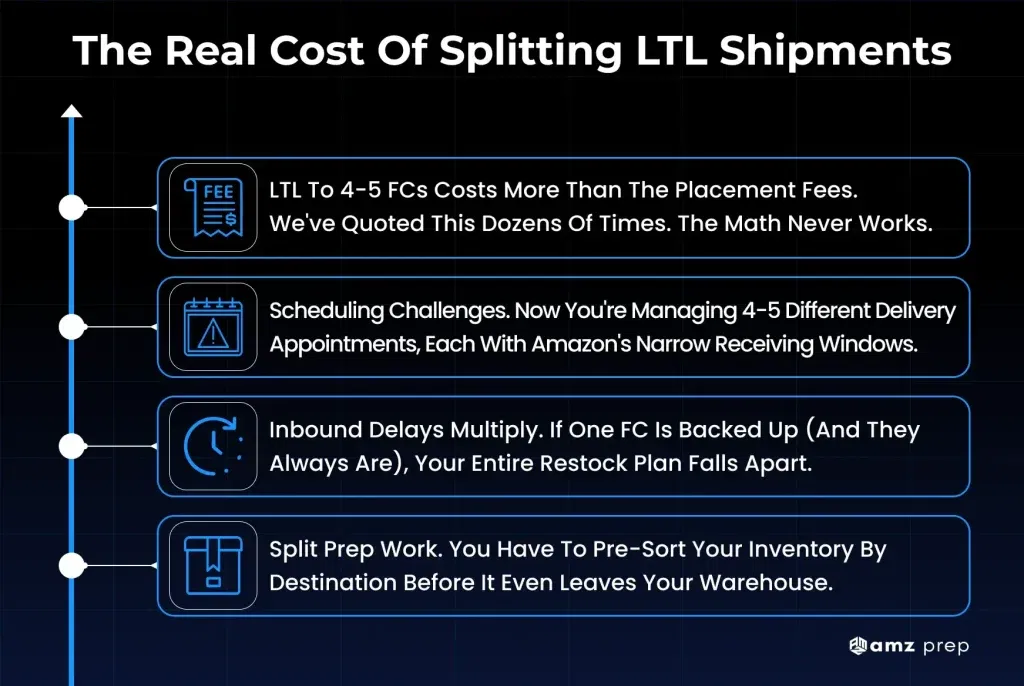
We had a pet supply brand try this for one quarter. Their freight costs went up 140%, and their average inbound time jumped from 14 days to 23 days. They came back to us after 90 days. The challenge of how to avoid placement fees Amazon charges while managing logistics yourself is nearly impossible at scale.
Option 3: Amazon Warehousing and Distribution (AWD)
Amazon’s own solution sounded promising: send everything to AWD, let them hold it, then auto-replenish to FBA as needed.
In practice? When comparing AWD vs middle mile logistics, the differences are stark. AWD transfer times into FBA have stretched badly.
Last Q4, we had a client pull their entire operation out of AWD after transfer times to FBA hit 40+ days. Their listings got suppressed. They lost the Buy Box. West Coast facilities stopped accepting shipments entirely.
We ended up moving their inventory through our dedicated middle mile logistics providers network instead and got it into FBA in 4.2 days. They saved 26.4% compared to AWD fees.
The 2026 Reality: Placement Fees Just Got More Expensive
Amazon defended the January 2026 fee increases by claiming they’re ‘less than what major carriers have levied the past two years’ . But here’s what they’re not telling you:
The Compounding Effect
It’s not just placement fees going up. Storage fees, transportation fees, and placement fees all increased at once . When they hit together, the real impact is 8-10% higher than Amazon’s headline ‘$0.08 average increase’ suggests.
The Middle Mile Advantage Grew
Every time Amazon raises placement fees, our middle-mile model saves you more money. Clients who switched in late 2025 are now saving even more in 2026 because:
- We absorb freight consolidation costs through volume
- You avoid the new $0.05/unit placement fee increase
- You skip the $0.60 defect fee through our quality control
- Faster check-in times mean lower holding costs
What the Numbers Showed
- We tracked 847 shipments in December 2025 vs. January 2026:
- Average placement fee cost: UP 9.2% per shipment
- Average middle-mile savings vs. placement fees: UP to 31% (was 26% in 2025)
- Average inbound time through our network: 4.8 days (no change)
How Middle Mile Consolidation Actually Works
Here’s the model that’s working for brands doing anywhere from $500K to $50M on Amazon.
It is called middle-mile consolidation. The model is simple.
Instead of shipping to 5 Amazon FCs or paying Amazon to distribute for you, you ship everything to one consolidation point. We break it down and route it to the correct FCs for you.
The hub sorts to your cost structure, not Amazon’s placement preferences.
The Actual Flow
- We receive and sort your inventory by Amazon FC destination (all the SKUs labeled and ready)
- You send us one full truckload (FTL) from your warehouse or 3PL to our facility

- We consolidate with other sellers’ freight going to the same FCs
- We deliver to each FC using our carrier network that already has trucks running those routes
The Result?
- No placement fees (you’re handling distribution, not Amazon)
- Lower freight costs (you’re only paying for one FTL inbound to us, then we handle last-mile efficiently)
- Faster inbounds (average 2-6 days vs. 18-28 days with placement fees)
- Zero sorting headaches (we handle the FC breakdown)
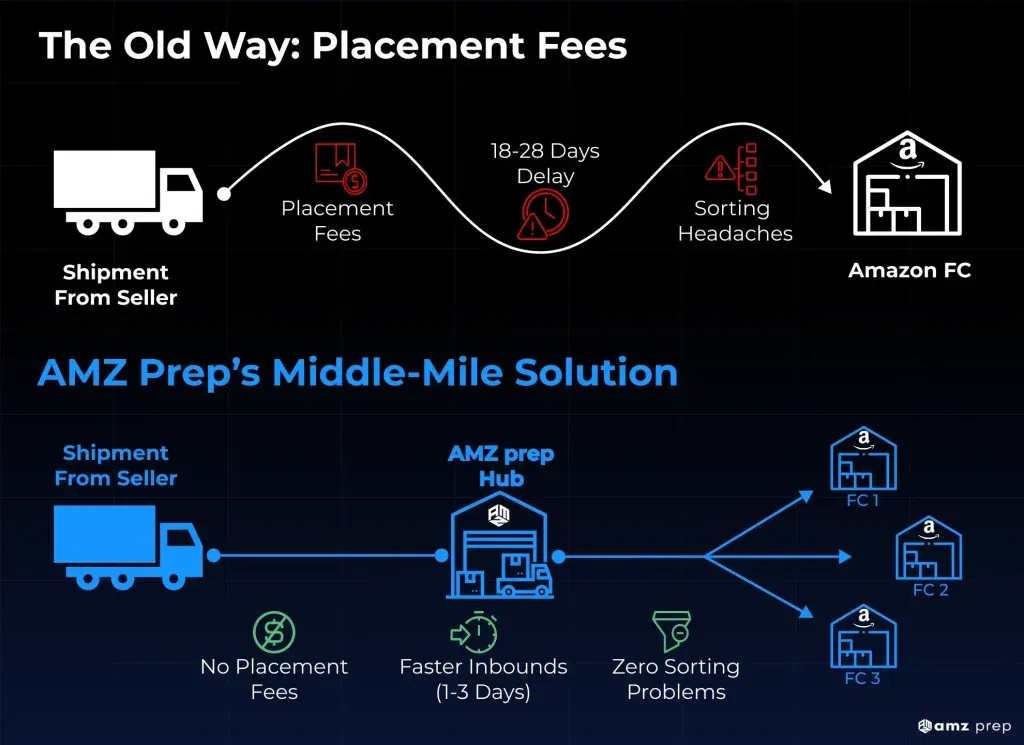
You can learn more about our middle-mile program here: Middle Mile Logistics FBA Fast Track.
Why This Is the Best Way to Avoid Amazon’s New Fee Structure
This is the most effective way to avoid placement fees Amazon charges, addressing both Amazon’s inbound placement fees and the complexity of managing separate FBA shipments yourself.
Unlike Amazon’s new Amazon fee model that forces you to choose between expensive placement services or complicated shipment splits, middle-mile consolidation gives you a third option: the speed and simplicity of a single location drop-off with the cost savings of avoiding the placement fee entirely.
You’re not paying for Amazon inbound placement because you’re handling the distribution – but unlike doing it alone, you’re not drowning in higher shipping costs or splitting the shipment logistics yourself.
This is how you avoid the inbound placement fee without sacrificing speed. You avoid the inbound placement cost structure entirely while actually getting fast shipping times to new Amazon fulfillment centers.
The key difference: you send inventory once, we handle inventory to multiple inbound locations, and you don’t pay the new fee that Amazon charges for their inbound placement option. This is how to avoid placement fees Amazon imposes while maintaining or even improving your inbound speed.
How to Calculate What You’re Actually Paying
Most sellers don’t know their true placement fee costs because the data is buried in Seller Central reports. Running a freight bill audit alongside your shipment analysis helps uncover additional transportation costs that often go unnoticed. Before you can figure out how to avoid Amazon placement fees, you need to know exactly what you’re paying now.
Here’s how to pull it:
Step 1: Install Our Free Chrome Extension
We built a tool that makes downloading your FBA data actually usable: Amazon Shopify Data Exporter Chrome Extension
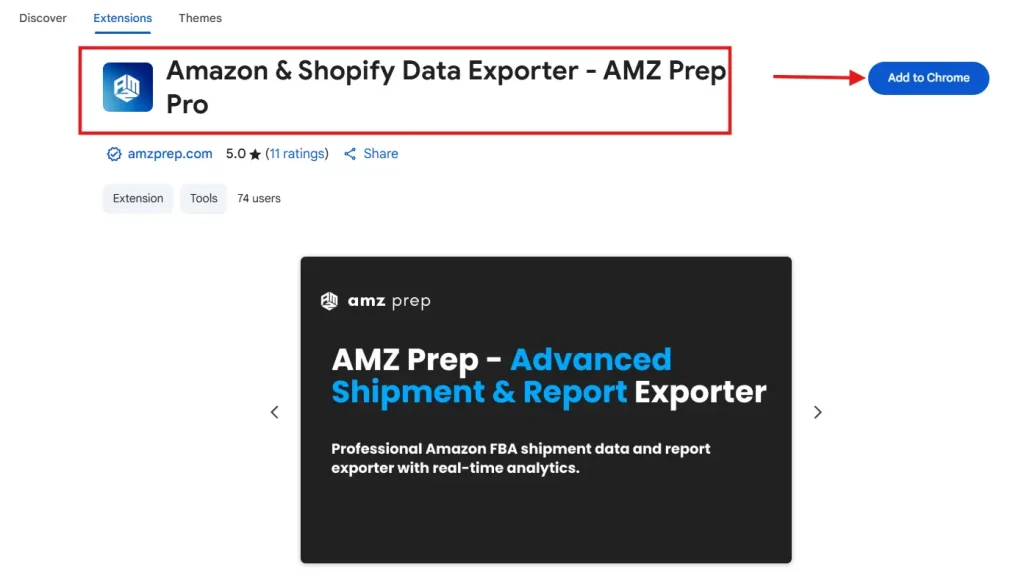
Step 2: Download These 3 Reports
Once installed, go to Seller Central and use the extension dropdown to select “Middle Mile Analysis.” Download:
- FBA Shipments report
- Monthly Storage Fees report
- FBA Placement Fees report
Step 3: Send It to Us for a Free Audit
Email those reports to info@amzprep.com and we’ll send you back:
- Your total placement fee spend (last 90 days)
- Projected annual placement fee cost
- What your freight would cost using our middle-mile network
- Estimated savings breakdown
No sales pitch. Just real numbers.
Most sellers are shocked when they see it in black and white. One brand we audited was on track to pay $487K in placement fees this year. They had no idea.
3 Requirements to Make This Work
Middle-mile consolidation isn’t for everyone. Here’s what you need:
1. You’re Shipping at Least 5-10 Pallets Per Month to Amazon
If you’re only sending 1-2 pallets sporadically, the consolidation model doesn’t pencil out. You’re better off paying placement fees or finding a smaller regional 3PL.
But if you’re moving volume? This is where the math gets interesting.
2. Amazon is Splitting Your Shipments to 3+ FCs
If Amazon is only sending you to one fulfillment center, you don’t have a placement service fees problem. Keep doing what you’re doing.
But in 2026, most sellers with established catalogs are getting split to 4-6 FCs per shipping plan. These shipment splits are where Amazon’s inbound placement fees destroy your margins, and that’s where consolidation saves you real money.
You’re avoiding both the inbound placement fees and the chaos of managing inventory to multiple destinations yourself.
3. You Want Faster Inbounds (Not Slower Ones)
Some consolidation models add time to your supply chain. Ours is built for speed.
Our average transit time from client warehouse → our DC → Amazon FC is 6 days total. Compare that to Amazon’s placement fee timeline (18-28 days) or AWD transfers (30-40+ days).
Speed matters here. Stockouts cost you rank and momentum, and this model protects both.
How to Get Started
If you’re tired of watching placement service fees eat your margins, here’s what happens next:
Option 1: Run a Free Freight Audit
- Install our Chrome extension
- Download your FBA shipment, storage fees, and placement fee reports
- Email them to info@amzprep.com
- We’ll send you a detailed breakdown within 48 hours
Option 2: Book a Trial Shipment
If you already know your placement service fees are a problem, we can run one shipment through our network and show you the difference in real-time.
We’ll handle pickup from your warehouse or 3PL, route it through our DC, split it to the correct FCs, and get it checked in. You compare the cost and speed to your current method.
No long-term contracts. No setup fees. Just one shipment so you can see the difference yourself.
Option 3: See How Our Middle Mile Program Works
We’ve built a complete middle-mile logistics solution designed specifically for Amazon sellers, including:
- Consolidation and FC sortation
- Two-day delivery to Amazon FCs
- International freight forwarding
- Full freight claims management
The Bottom Line
Amazon built their fulfillment network for their benefit, not yours. They want inventory everywhere so they can deliver fast. You pay for that distribution either way. Placement fees or higher freight.
The middle-mile model flips that. You ship once, we handle the breakdown, and your inventory gets to Amazon faster and cheaper than either of Amazon’s options.
We’ve run this model for supplement brands, pet products, electronics, home goods, and everything in between. It works for $1M sellers and $50M sellers.
Most sellers do not know their real placement fee spend until they pull the report.
Get your free freight audit: Email your FBA reports to info@amzprep.com

Arishekar N is a Vice President (VP) of Marketing at AMZ Prep, specializing in ecommerce fulfillment and Amazon logistics strategies with a proven track record of driving growth for e-commerce businesses. He is a strategic leader with extensive expertise in marketing, e-commerce operations, SEO & advertising, and branding.
Stay updated on his latest insights by following him
















Practical reminder to review fee structures regularly
Clear guidance that any Amazon seller can apply right away
Concise and informative advice for sellers focused on cost control
Good insights on optimizing listings to avoid extra placement fees
The cost‑saving tips here are really practical for sellers of all sizes
Solid tips that help improve profitability by minimizing fees
Simple and useful makes fee management much easier to understand
Helpful explanation of what placement fees are and how to avoid unnecessary charges
I liked the actionable strategies for reducing overall selling costs
Great breakdown of placement fees and how to manage them effectively