
Most middle mile comparisons treat every shipper the same. Enterprise shippers are not the same.
At enterprise scale, middle mile transportation is a contracted network, not a series of freight bookings. Volume is committed. Lanes are recurring. The provider operates as a partner, not a spot vendor.
This guide is written for supply chain teams evaluating enterprise middle mile transportation at that level. That includes shippers negotiating dedicated capacity agreements, managed transportation programs, or lead logistics contracts. It covers the four operating models used in enterprise networks, which providers fit each model, and how to structure a provider evaluation that reflects how large networks actually run.
For readers looking for a broader survey of middle mile providers across ecommerce, retail, and Amazon FBA, our middle mile logistics companies guide covers 19 options across those segments.
TL;DR
- Enterprise middle mile is contracted transportation between manufacturers, ports, DCs, fulfillment centers, and retail networks under committed volume and recurring lanes.
- Most enterprise programs run on one of four operating models: dedicated transportation, managed transportation, intermodal, or fulfillment-connected middle mile.
- Provider fit depends on lane density in your critical corridors, capacity commitment terms, technology integration, and how much transportation management the shipper wants to outsource.
- US-focused asset and managed providers on this list include Ryder, J.B. Hunt DCS, Schneider, NFI, Penske Logistics, Averitt, and ArcBest.
- AMZ Prep fits enterprise B2B retail and omnichannel networks that need a middle mile connected to multi-node fulfillment across North America and Europe.
What Is Enterprise Middle Mile Logistics?
Enterprise middle mile logistics is the movement of inventory and freight between major supply chain locations before the final delivery to a customer.
At enterprise scale, this is different from spot freight or standard 3PL shipping. The relationship is governed by a contract, the capacity is committed in advance, and the lanes are engineered to match a repeatable network flow. That is the shift this guide covers: from booking freight to running a network.
A typical enterprise network may look like:
Manufacturer or Port → Distribution Center → Regional Hub → Fulfillment Center or Retail DC → Store or Customer
The exact structure varies by industry. A consumer goods company may move pallets from a national distribution center to regional retail distribution centers. An ecommerce business may transfer inventory between fulfillment locations. A manufacturer may use scheduled transportation to move components between plants and assembly facilities.
The middle mile therefore sits between the first mile and last mile. It is less about delivering a single parcel to an individual customer and more about moving larger quantities of inventory between operational nodes.
For enterprise companies, this becomes more complicated because shipments may move through different transportation modes and locations. A network could combine truckload, LTL, intermodal, cross-docking, consolidation, and dedicated transportation.
The practical takeaway is that middle mile logistics for enterprises is a network problem, not simply a freight booking problem.
Enterprise Middle Mile vs. Standard Freight Transportation
Enterprise middle mile transportation typically involves more planning and coordination than one-off freight moves.
| Factor | Standard Freight Movement | Enterprise Middle Mile |
|---|---|---|
| Shipment planning | Often shipment-by-shipment | Planned around recurring lanes and network demand |
| Capacity | Spot or contracted | Dedicated, committed, or managed capacity |
| Transportation modes | Often one primary mode | Truckload, LTL, intermodal, and other modes may be combined |
| Facilities | Origin to destination | Multiple DCs, hubs, cross-docks, and fulfillment nodes |
| Visibility | Shipment tracking | Network-level visibility and reporting |
| Technology | Carrier portal or basic tracking | TMS, API, EDI, ERP, and control-tower integrations |
| Optimization | Rate and transit time | Network cost, utilization, capacity, inventory positioning, and service |
| Best fit | Individual or occasional shipments | Recurring, high-volume supply chain flows |
The difference is important because an enterprise may move thousands of shipments through the same network every year. Small improvements in routing, consolidation, trailer utilization, or scheduling can therefore have a larger cumulative impact.
How Enterprise Middle Mile Transportation Works
A typical enterprise middle mile network has several connected layers.
1. Origin Nodes
Freight may begin at a manufacturing plant, import facility, port, supplier warehouse, or national distribution center.
2. Consolidation and Cross-Docking
Shipments can be consolidated, sorted, transferred, or reloaded at intermediate facilities. Cross-docking can reduce unnecessary storage when freight is already assigned to a downstream destination.
3. Line-Haul Transportation
The freight then moves through scheduled truckload, dedicated, LTL, or intermodal lanes.
4. Regional Distribution
Products reach regional distribution centers, fulfillment facilities, retail DCs, or other downstream locations.
5. Final Distribution
The middle mile eventually connects into the next stage, which may be parcel delivery, store replenishment, customer delivery, or another business-to-business movement.
For enterprise operations, these stages need to work together. A fast line-haul is less useful if the destination cannot receive the shipment on schedule, and a low transportation rate may not deliver savings if it creates additional handling or inventory delays.
The middle mile eventually connects into the next stage, which may be parcel delivery, store replenishment, customer delivery, or another business-to-business movement. Depending on service requirements, downstream fulfillment may also include options such as overnight shipping for time-sensitive orders.
How We Evaluated Enterprise Middle Mile Providers
There is no single enterprise middle mile provider that fits every network.
For this list, the main factors considered were:
Network capability: Does the provider operate across the US and support recurring enterprise freight flows?
Transportation options: Can the company support dedicated transportation, truckload, LTL, intermodal, or multimodal requirements?
Supply chain services: Does the provider offer more than transportation when an enterprise network requires warehousing, distribution, consolidation, or managed transportation?
Technology: Can the provider support visibility, transportation management, analytics, and integration requirements?
Enterprise fit: Is the service designed to support large manufacturers, retailers, distributors, ecommerce companies, or other high-volume shippers?
Contract structure: Does the provider work through committed capacity agreements, managed transportation programs, or lead logistics contracts, rather than transactional freight bookings?
The providers below are therefore not ranked solely by company size. Each has a different operating model and may be better suited to a particular type of enterprise network.
8 Enterprise Middle Mile Providers to Consider
1. AMZ Prep
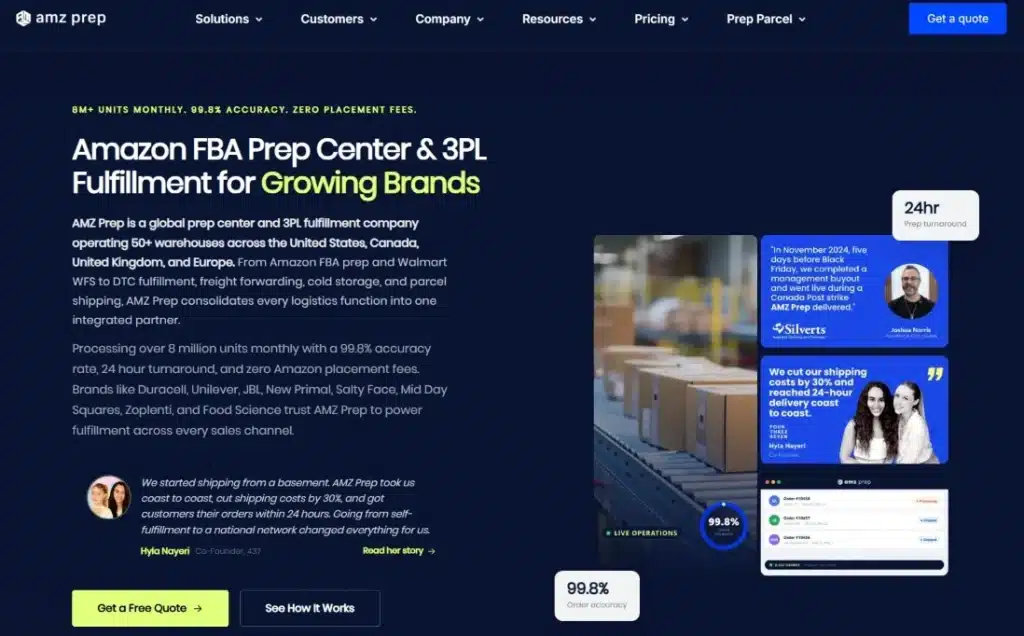
Best fit: Enterprise B2B retail, omnichannel, and multi-node ecommerce shippers that want a middle mile connected to their fulfillment footprint rather than run as a separate freight contract.
AMZ Prep operates a fulfillment-connected middle mile model across more than 50 B2B retail and enterprise fulfillment locations in six countries. In the US, this includes multi-facility inventory positioning, cross-dock consolidation, scheduled line-haul, and freight into retail DCs, wholesale networks, and marketplace inbound points.
The reason this model matters at enterprise scale is control. When the same operator handles inventory receiving, storage, consolidation, and outbound transportation, shippers avoid the handoff friction that appears when a fulfillment 3PL and a middle mile carrier are two separate contracts. Inventory can be pre-positioned closer to demand, released on scheduled truckloads, and re-routed as network conditions change, without a second provider needing to be looped in.
This is most relevant for enterprise brands with committed volume moving between enterprise fulfillment centers, regional DCs, and wholesale or retail destinations under recurring lane commitments.
Key capabilities
– Middle mile transportation on recurring lanes
– FTL, LTL, and consolidated freight
– Cross-dock consolidation across 50+ facilities
– B2B retail and wholesale distribution
– Multi-node inventory positioning and transfers
– International freight forwarding and port-to-DC drayage
– Integrated WMS and TMS with enterprise API access
Pricing: Custom enterprise pricing tied to committed volume, lane structure, and connected fulfillment services.
Strengths: Fulfillment-connected middle mile, multi-country footprint, single-operator control across receiving, storage, and outbound transportation.
Considerations: Shippers whose only requirement is a large dedicated private fleet or long-haul intermodal capacity will find a better fit with an asset-based transportation specialist.
Best fit: Enterprise B2B, retail replenishment, wholesale distribution, and multi-node omnichannel networks with committed volume across recurring lanes.
2. Ryder
Best fit: Enterprise shippers evaluating whether to keep a private fleet or convert to a contracted dedicated model, often with lead logistics wrapped around it.
Ryder provides dedicated transportation, managed transportation, warehousing, distribution, freight brokerage, fleet management, and other supply chain services throughout North America. Its dedicated transportation operation includes customized fleets, drivers, routing, scheduling, maintenance, and technology support.
This makes Ryder particularly relevant when an enterprise is evaluating whether to operate its own private fleet or outsource part of that operation.
Ryder currently reports more than 400 dedicated customers, 12,000+ professional drivers, and more than 18,000 vehicles supporting its dedicated transportation business.
Key capabilities
- Dedicated transportation
- Transportation management
- Truckload and LTL
- Fleet management
- Warehousing and distribution
- Network engineering
- Real-time transportation visibility
Pricing: Custom enterprise pricing based on fleet requirements, routes, equipment, and transportation scope.
Strengths: Dedicated transportation, network engineering, integrated supply chain services.
Considerations: The model can be more infrastructure-heavy than what a company needs for smaller or less predictable networks.
Best fit: Manufacturers, retailers, automotive companies, technology businesses, and other enterprises with recurring transportation requirements.
3. J.B. Hunt
Best fit: Enterprises negotiating long-term dedicated capacity contracts, often paired with intermodal on long-haul lanes.
J.B. Hunt Dedicated Contract Services (DCS) is the segment most relevant for enterprise middle mile. DCS provides customer-specific fleets, drivers, and equipment on multi-year contracts. Its intermodal and Integrated Capacity Solutions arms then connect to the DCS backbone for long-haul and overflow lanes.
Its intermodal capabilities can be particularly relevant for long-distance enterprise middle mile lanes where rail and truck transportation can be combined.
The company’s managed logistics offering also supports single-source, consolidated, or hybrid transportation models depending on the customer’s requirements.
Key capabilities
- Intermodal
- Truckload
- LTL
- Dedicated Contract Services
- Managed logistics
- Brokerage
- Transportation technology
Pricing: Quote-based, with rates depending on lane, mode, volume, equipment, and contractual requirements.
Strengths: Multimodal network, intermodal scale, dedicated transportation, transportation technology.
Considerations: Enterprises with a highly specialized ecommerce fulfillment requirement may need a provider that connects transportation more closely to inventory and fulfillment operations.
Best fit: Large manufacturers, retailers, distributors, and companies moving consistent high-volume freight across the US.
4. Schneider
Best fit: Enterprises that need asset-backed transportation, dedicated capacity, intermodal, and specialized freight options.
Schneider is a US-based transportation and logistics provider with capabilities spanning truckload, dedicated transportation, intermodal, and logistics services. The company also highlights temperature-controlled transportation and dedicated solutions for food and beverage shippers.
For enterprise networks, Schneider can be relevant when transportation requirements are predictable enough to support dedicated capacity rather than relying primarily on the spot market.
Key capabilities
- Dedicated transportation
- Truckload
- Intermodal
- Temperature-controlled transportation
- Logistics management
- Regional and long-haul transportation
Pricing: Custom contract or lane-based pricing.
Strengths: Asset-backed transportation, dedicated capacity, multimodal services.
Considerations: Companies looking for a full fulfillment and warehouse technology stack may need additional supply chain partners.
Best fit: Retail, manufacturing, food and beverage, automotive, and other high-volume freight networks.
5. NFI Industries

Best fit: Enterprises looking for transportation, distribution, warehousing, and port-related services through one provider.
NFI is a privately held North American supply chain company headquartered in Camden, New Jersey. Its services include dedicated transportation, warehousing and distribution, transportation management, brokerage, port drayage, intermodal, and global logistics.
NFI can be particularly relevant for companies where middle mile transportation connects closely with port operations and domestic distribution. Its California Cartage operations also provide port logistics, transloading, deconsolidation, and warehousing capabilities.
Key capabilities
- Dedicated transportation
- Transportation management
- Distribution
- Warehousing
- Port drayage
- Transloading
- Intermodal
- Freight brokerage
Pricing: Quote-based and dependent on transportation, warehousing, and network requirements.
Strengths: Broad supply chain scope and strong connection between transportation, distribution, and port logistics.
Considerations: Companies looking for a highly specialized parcel or ecommerce middle mile network may require a more channel-specific provider.
Best fit: Retailers, manufacturers, CPG companies, importers, and enterprise distribution networks.
6. Penske Logistics
Best fit: Enterprises that want dedicated transportation integrated with broader supply chain management.
Penske Logistics provides dedicated transportation, distribution center management, lead logistics, freight management, transportation management, brokerage, freight forwarding, consulting, and supply chain technology.
This broader portfolio can be useful for companies that want to outsource a significant part of transportation management rather than simply contract for individual freight lanes.
Key capabilities
- Dedicated transportation
- Distribution center management
- Transportation management
- Freight management
- Brokerage
- Lead logistics
- Supply chain technology
Pricing: Enterprise quote based on transportation scope, facilities, fleet requirements, and managed services.
Strengths: Combination of transportation operations and supply chain management.
Considerations: The right model depends heavily on how much of the transportation function the enterprise wants to outsource.
Best fit: Large retailers, manufacturers, automotive businesses, and companies with complex distribution networks.
7. Averitt
Best fit: Enterprises that need dedicated transportation alongside LTL, truckload, distribution, and specialized transportation.
Averitt operates an asset-based transportation network offering LTL, truckload, dedicated transportation, distribution and fulfillment, intermodal, port logistics, and other supply chain services.
Its dedicated operation combines fleet, drivers, equipment, technology, and management support. Averitt also operates both an LTL distribution network and a truckload fleet, which can give enterprise customers more flexibility when network needs change.
Key capabilities
- Dedicated transportation
- Truckload
- LTL
- Distribution
- Cross-docking
- Intermodal
- Port logistics
- Specialized equipment
Pricing: Quote-based according to lanes, equipment, volume, and service requirements.
Strengths: Combination of dedicated fleet and LTL infrastructure.
Considerations: Companies with primarily national long-haul intermodal requirements may find a more mode-specialized carrier a better fit.
Best fit: Retail, manufacturing, distribution, and multi-facility enterprise networks.
8. ArcBest
Best fit: Enterprises that want managed transportation and freight optimization across multiple carriers and modes.
ArcBest provides managed transportation services that can include carrier relationship management, mode optimization, freight bill auditing, transportation planning, and ongoing logistics support.
A managed transportation approach can be useful when an enterprise does not want to rely on one physical carrier for every movement. Instead, a logistics partner can help coordinate multiple carriers and transportation modes across a wider network.
Key capabilities
- Managed transportation
- Carrier management
- Mode optimization
- Freight bill auditing
- Transportation planning
- LTL and truckload
- Logistics management
Pricing: Custom managed-service and transportation pricing based on the scope of the program.
Strengths: Carrier management and transportation optimization.
Considerations: Enterprises seeking dedicated physical fleets may want to compare this model against asset-based transportation providers.
Best fit: Large shippers managing multiple transportation providers, modes, and recurring freight lanes.
Enterprise Middle Mile Provider Comparison
| Provider | Primary Enterprise Strength | Dedicated Transportation | Intermodal | Managed Transportation | Distribution / Fulfillment |
|---|---|---|---|---|---|
| AMZ Prep | Ecommerce and omnichannel middle mile | Available | Available | Available | Yes |
| Ryder | Dedicated and integrated supply chain | Yes | Available | Yes | Yes |
| J.B. Hunt | Multimodal transportation | Yes | Yes | Yes | Selected services |
| Schneider | Asset-based transportation | Yes | Yes | Yes | Selected services |
| NFI | Integrated supply chain and distribution | Yes | Yes | Yes | Yes |
| Penske Logistics | Dedicated and managed logistics | Yes | Available | Yes | Yes |
| Averitt | Dedicated plus LTL and distribution | Yes | Available | Yes | Yes |
| ArcBest | Managed transportation and optimization | Available | Available | Yes | Selected services |
The table shows why provider selection should not be based only on fleet size. Two companies may both move enterprise freight but operate very different models. One may specialize in dedicated assets, while another may focus on managed transportation or integration with fulfillment and distribution.
How Businesses Should Choose an Enterprise Middle Mile Provider
Rather than focusing on which provider is universally better, enterprises should evaluate the provider against the structure of their own supply chain.
Network Geography
Start with the lanes that matter most.
A transportation provider may have strong national coverage but still be a poor fit if it lacks density around your highest-volume origins and destinations. Analyze manufacturing locations, ports, DCs, fulfillment facilities, and major customer markets before choosing a provider.
Freight Profile
The type of freight matters.
A consumer electronics company, food manufacturer, automotive supplier, and ecommerce brand may have completely different transportation requirements.
Consider:
- Pallet and carton dimensions
- Weight and density
- Temperature requirements
- Hazardous material requirements
- Shipment frequency
- Equipment requirements
- Delivery appointments
- Retail compliance
For ecommerce and omnichannel businesses, transportation planning should also account for what happens after delivery, including return management solutions and inventory moving back through the fulfillment network.
Capacity Requirements
Enterprise networks often need more predictable capacity than occasional shippers.
Ask whether the provider can offer:
- Dedicated equipment
- Contracted capacity
- Seasonal surge capacity
- Backup capacity
- Drop trailers
- Recurring lane commitments
- Multi-mode alternatives
Technology and Integration
Enterprise middle mile transportation often has to connect with existing systems.
Depending on the organization, this may include:
- TMS
- ERP
- WMS
- EDI
- APIs
- Transportation visibility platforms
- Yard management systems
- Freight payment systems
AMZ Prep J.B. Hunt, Ryder,and other enterprise-focused providers promote technology and visibility capabilities that can support more complex transportation programs.
Network Flexibility
Enterprise demand rarely remains completely static.
Seasonal sales, new distribution centers, acquisitions, product launches, retail expansion, and supply chain disruptions can all change freight patterns.
For Amazon-focused businesses, marketplace policy and operational changes can also affect inventory planning and fulfillment requirements. Keeping up with the latest Amazon updates can help logistics teams account for changes that may affect their network.
A provider should therefore be evaluated not only on today’s network but also on how easily transportation capacity can change as the business grows.
Common Enterprise Middle Mile Models
Different companies may use different operating models depending on the structure of their network.
Dedicated Transportation
A carrier assigns vehicles, drivers, and operational resources to a specific customer or network.
This can provide greater control and predictability for recurring routes.
Managed Transportation
The provider manages transportation activity across multiple carriers and modes.
This can be useful when an enterprise does not want to manage every carrier relationship internally.
Intermodal
Freight combines truck transportation with rail.
This can make sense for long-distance or high-volume lanes where transportation mode selection is a major cost consideration.
Cross-Dock Distribution
Freight moves through a facility with limited storage time.
This model can support high-volume networks where inventory needs to move quickly between inbound and outbound transportation.
Consolidation
Multiple smaller shipments are combined into larger transportation moves.
For enterprises with fragmented freight, consolidation can improve trailer utilization and reduce the number of individual shipments that need to be managed.
Questions to Ask a Middle Mile Logistics Provider
Before signing an enterprise transportation agreement, supply chain teams should ask:
What lanes do you operate most frequently?
A provider’s overall network is less important than its actual strength on your critical lanes.
Can you guarantee capacity during peak periods?
Ask how the provider handles holidays, promotional periods, product launches, and unexpected demand increases.
Do you support dedicated transportation?
Dedicated capacity may be important for predictable, high-volume lanes.
Which transportation modes can you manage?
Consider whether your network would benefit from truckload, LTL, intermodal, or multimodal optimization.
What technology integrations are available?
Ask about APIs, EDI, TMS integrations, real-time shipment visibility, reporting, and data exports.
How do you measure performance?
Enterprise contracts should define measurable KPIs such as on-time performance, tender acceptance, transit time, claims, dwell time, and cost per shipment or lane.
What happens when the network changes?
A provider should be able to explain how it handles new facilities, lane changes, acquisitions, seasonal peaks, and unexpected disruptions.
Conclusion
The right enterprise middle mile solution is the one that fits your contract structure, not just your freight profile. A manufacturer with recurring national lanes may prioritize dedicated transportation, while a retailer may require a combination of distribution, LTL, and managed transportation.
Rather than selecting a provider based only on fleet size or headline coverage, businesses should evaluate network density, capacity, transportation modes, technology integration, freight requirements, and scalability. The strongest fit is the provider whose operating model matches the way inventory actually moves through the business.
For companies comparing enterprise middle mile transportation, the next step is to map the highest-volume lanes and identify where consolidation, dedicated capacity, cross-docking, or better transportation management could improve the network. That creates a more practical basis for comparing providers and negotiating an enterprise transportation program.
Frequently Asked Questions
What is the middle mile for enterprise businesses?
Middle mile for enterprise businesses is contracted transportation between major supply chain locations under committed volume and recurring lanes. It covers plant-to-DC, port-to-DC, DC-to-DC, and DC-to-retail movements before final delivery.
The defining feature is the contract structure. Enterprise middle mile runs on dedicated capacity agreements, managed transportation programs, or lead logistics contracts rather than spot freight bookings.
What is the difference between enterprise middle mile and spot freight?
Spot freight is a single shipment booked at a market rate, usually through a broker or load board, with no volume commitment on either side.
Enterprise middle mile is a contracted program with committed volume, agreed capacity, known lanes, and structured SLAs. Rates are negotiated against forecasted network flow, not per-load market conditions. That structure is what makes it possible for large shippers to plan inventory, staffing, and downstream fulfillment against predictable transportation performance.
Which operating model fits our network: dedicated, managed, intermodal, or fulfillment-connected?
Dedicated transportation fits shippers with predictable, high-volume lanes where consistent equipment and drivers reduce cost and improve service. Managed transportation fits shippers with fragmented carrier bases who want to consolidate control without buying capacity themselves.
Intermodal fits long-haul, high-volume lanes where combining rail and truck moves reduces landed cost and emissions. Fulfillment-connected middle mile fits enterprise B2B, retail, and omnichannel shippers whose middle mile is inseparable from inventory positioning across a multi-node fulfillment network.
When does dedicated transportation make sense versus a managed transportation program?
Dedicated transportation makes sense when three conditions hold: lanes are predictable, volume is committed for 12 months or longer, and consistent equipment or driver behavior matters for the freight profile.
Managed transportation makes more sense when volume is variable, the shipper already has multiple carriers under contract, or the priority is centralized control and reporting rather than owning capacity.
How is enterprise middle mile priced in an RFP?
Enterprise middle mile is priced through a custom contract rather than a public rate card. Most RFPs include per-lane rates, a fuel surcharge model, accessorial schedule, minimum volume commitments, and SLA penalty terms.
Beyond the per-lane rate, enterprise pricing conversations usually cover tender acceptance guarantees, dedicated equipment costs, driver retention incentives, technology integration fees, and how new lanes or facilities are added mid-contract.
Should middle mile transportation and fulfillment run under the same provider?
It depends on whether the enterprise treats the middle mile as a freight function or a network function.
When middle mile is a freight function, the shipper wants the lowest cost per lane with strong SLAs, and prefers a dedicated or managed transportation specialist that focuses only on movement.
When middle mile is a network function, transportation is inseparable from inventory positioning, receiving, and downstream fulfillment. In that case, running both under one provider reduces handoff friction, gives the shipper single-point accountability, and makes it easier to reposition inventory as demand shifts.

Chadwick Collins is an Enterprise Fulfillment Consultant at AMZ Prep, where he partners with high growth ecommerce brands to design and scale Amazon first logistics strategies. He brings extensive experience in freight, supporting brands across domestic and cross border transportation, routing optimization, and cost control.
At AMZ Prep, Chadwick works closely with enterprise clients to improve inventory flow, reduce landed costs, and accelerate delivery performance across North America. His expertise spans FBA, DTC, and B2B fulfillment, with a strong focus on aligning freight strategy with overall supply chain efficiency. He helps brands navigate complex logistics challenges while turning operations into a competitive advantage.

















Comments