
A freight forwarder and a freight broker both help you move goods. Both roles sit inside the freight industry. They are not the same. A freight forwarder takes possession of your freight. It arranges the full shipment, including ocean freight and air. It handles documentation and customs coordination.
A freight broker never touches your cargo. A freight broker acts as a middleman. It connects a shipper with a carrier that hauls the load. Brokers and freight forwarders overlap, but their jobs differ.
I book both for AMZ Prep clients every week. Pick a forwarder for an international shipment. Pick a broker for domestic truckload capacity. This guide covers the key differences, so you match the right one to your lane.
What Is a Freight Forwarder?
A freight forwarder arranges transportation of your goods from origin to destination. This coordination is the core of freight forwarding. A forwarder takes possession of the freight along the way. Most freight forwarders operate internationally. Freight forwarders are licensed to arrange ocean and air moves.
A forwarder books space with ocean lines and airlines. Forwarders arrange consolidation of smaller shipments into full containers. Freight forwarders handle the bill of lading and export paperwork. Many freight forwarding companies coordinate customs clearance too.
When I move a client’s inventory from China to a US port, I use a forwarder. It tracks the ocean leg, the drayage, and the inland move. A forwarder can transport freight across several carriers in one journey.
One related role worth naming here is the NVOCC. An NVOCC issues its own bills of lading and acts as a carrier on paper.
What Is a Freight Broker?
A freight broker is a company that connects you with a carrier that has trucks. The broker never takes possession of your freight. Freight brokers don’t own equipment. A freight broker acts as a non-asset intermediary. Freight brokers connect loads to available capacity.
Here is how it works when I need capacity fast. I have a load that needs to move. The freight broker typically finds a vetted carrier at a fair rate. Brokers negotiate freight rates on your behalf. The carrier picks up and delivers. The broker earns a small commission on the cost of the shipment.
The freight broker’s job is mostly domestic trucking. That covers LTL (less than truckload) and FTL (full truckload) freight. A freight carrier still does the actual driving. I lean on a broker when speed matters more than control.
What Is the Main Difference Between a Freight Broker and a Freight Forwarder?
The core split is possession. A forwarder takes custody of your freight. A broker never does. Understanding the key differences starts there.
Key differences between freight brokers and freight forwarders
The table shows the differences between the two roles across possession, mode, and liability.
| Factor | Freight forwarder | Freight broker |
|---|---|---|
| Takes possession of freight | Yes, takes custody | No, never touches it |
| Primary mode | Ocean, air, multimodal, international | Domestic trucking (LTL, FTL) |
| Documentation | Handles BOL, export docs, customs coordination | Minimal, arranges the load |
| Asset model | Non-asset, may consolidate and warehouse | Non-asset intermediary |
| Cargo liability | Can carry liability for the cargo | Limited, matches shipper to carrier |
| Best for | International, complex, multi-leg shipments | Fast domestic truckload capacity |
Both freight forwarders and freight brokers move goods for a fee. The freight forwarder vs broker choice comes down to distance and complexity. International and multi-leg goes to a forwarder. Domestic point A to point B goes to a broker.
Freight Broker vs Freight Forwarder: Which One Do You Need?
The way I make this call is simple. I match the role to the shipment.
Choose a freight forwarder when your freight crosses borders. It handles ocean, air, and the customs coordination that comes with them. It also consolidates smaller loads into full containers to cut costs.
Choose a freight broker when you need domestic truckload capacity. A single lane from your warehouse to a retailer fits a broker well. So does LTL freight that needs a reliable carrier fast.
Some shipments need both. On a China import, I use a forwarder for the ocean leg and a broker for the final haul. Many growing brands end up managing several of these relationships at once.
Benefits of Using a Broker or a Forwarder
The right pick depends on the lane. Here is what each option gives you.
Benefits of using a freight broker
Using a freight broker gives you fast access to domestic capacity. You skip cold-calling carriers yourself. A broker knows which carriers run your lanes well and often relies on accurate shipment dimensions and freight density calculations to secure the most competitive LTL rates. Working with a freight broker suits single domestic lanes and quick turnarounds.
Benefits of using a freight forwarder
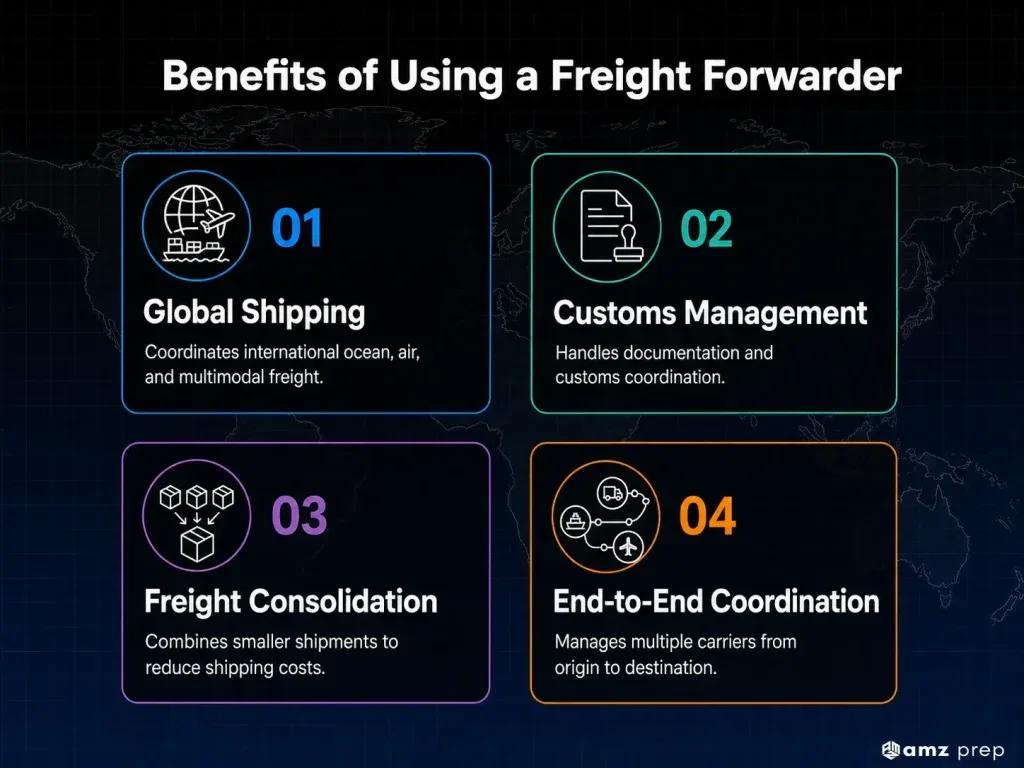
Using a freight forwarder helps on complex international moves. Working with a freight forwarder means one partner handles ocean, air, and customs. Forwarders consolidate freight to lower your rate. They also help ensure that your freight clears customs on time.
Freight Broker vs 3PL: How Are They Different?
A freight broker moves one thing well: a load, from a carrier, on a lane. A 3PL runs your broader logistics operation. The scope is the difference.
A 3PL stores your inventory. It preps and picks and packs orders. It manages fulfillment across Amazon, DTC, and retail. Freight brokerage is one narrow slice of logistics, not the whole job.
So the 3PL vs freight broker question is really about how much you want handled. A broker solves a capacity problem. A 3PL solves the full operation.
Here is where I watch scaling brands feel the strain. Managing a broker, a forwarder, and a carrier separately eats time. A 3PL with freight capability folds those into one relationship. Our Middle Mile freight network does exactly that for brands moving steady FBA inventory.
Freight Broker vs Carrier: What’s the Difference?
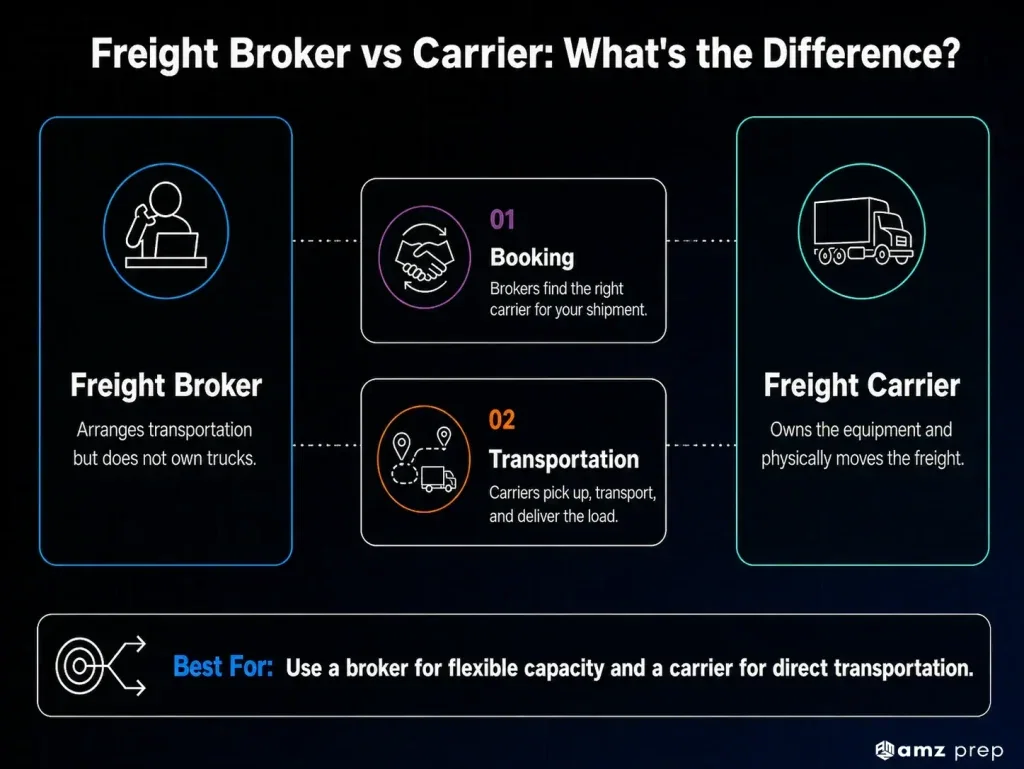
A freight carrier owns the trucks and moves the freight. A freight broker arranges the move but owns no equipment. That is the whole distinction.
When I book through a broker, a carrier still does the driving. The broker is responsible for booking, not for hauling freight. Its value is finding the right carrier at the right price.
You can go direct to a carrier if you have the volume and the lanes to manage it. Most brands I work with use brokers because they lack the time to source and vet capacity.
Freight Forwarder vs Carrier: What’s the Difference?
A carrier operates the vessel, plane, or truck. A freight forwarder coordinates the whole shipment across those carriers. The forwarder is responsible for planning. The carrier executes.
On an international move, I might use an ocean carrier, a drayage carrier, and a trucking carrier. The forwarder ties all three together into one shipment. It also consolidates freight to fill containers and lower your rate.
So the freight forwarder vs carrier line is coordination versus execution. A forwarder rarely owns assets. It manages the carriers that do.
Customs Broker vs Freight Forwarder: Are They the Same?
No. A customs broker clears your goods through customs. A freight forwarder moves your goods. The two roles overlap but are not identical.
A customs broker files entries with the customs authority. It classifies goods, calculates custom duties, and keeps your shipment compliant. Its job starts at the border.
A forwarder handles the physical movement across the full route. On the imports I run, the forwarder coordinates clearance through a licensed customs broker. Some large forwarders hold their own customs brokerage license.
So the customs broker vs freight forwarder answer is this. You often need both on an import. Sometimes one company provides both services.
Can a Freight Forwarder Also Be a Freight Broker?
Yes. A company can hold both roles with the right operating authority. Plenty of logistics providers do exactly that.
FMCSA operating authority for brokers and forwarders
To broker domestic freight in the US, a company needs operating authority from the Federal Motor Carrier Safety Administration (FMCSA). A USDOT lookup by DOT number can help verify a company’s USDOT registration details, although registration and operating authority are separate checks. To act as an ocean forwarder, it needs a separate FMC license. A firm that holds both can arrange your ocean freight and your domestic trucking.
Some partners I work with hold both. It lets one partner cover the international leg and the domestic delivery. Fewer handoffs usually means fewer things fall through.
How a 3PL Simplifies These Freight Decisions
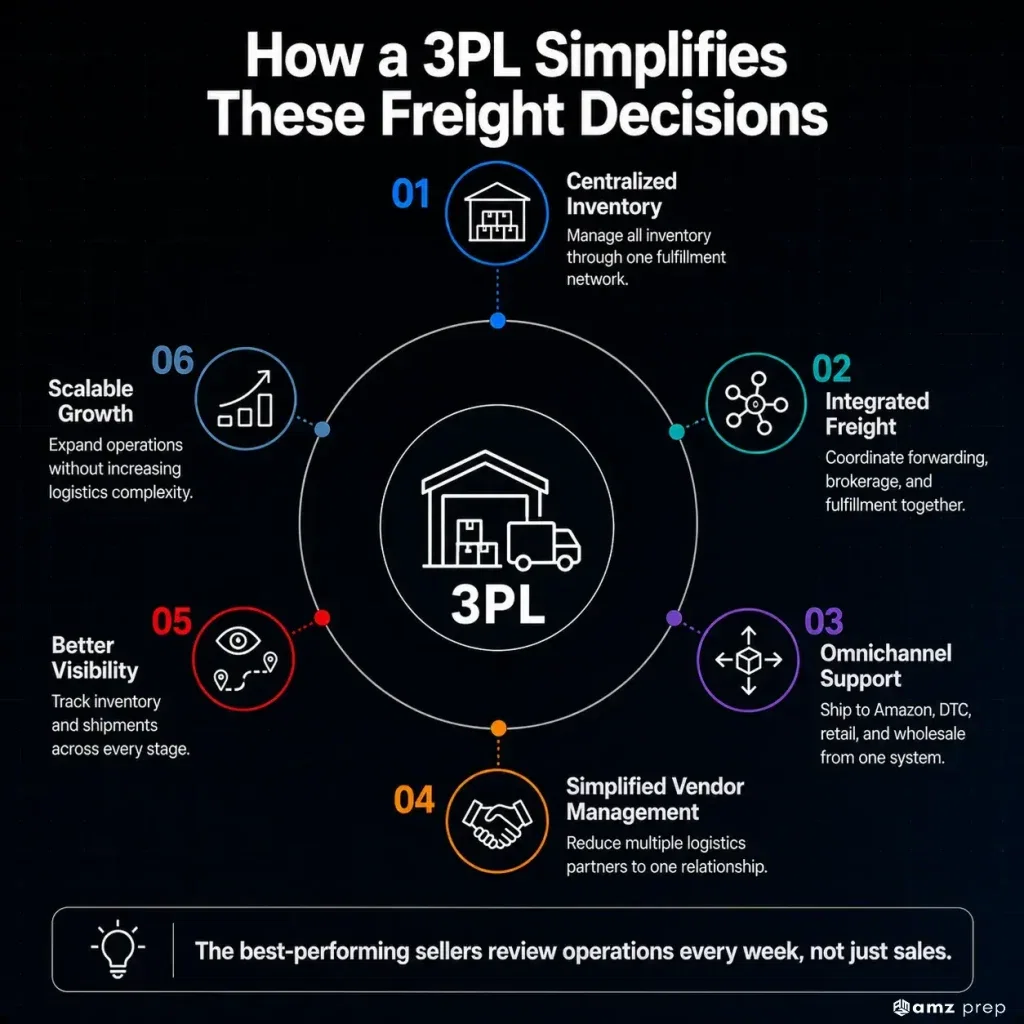
Here is what I see with scaling brands. They start with one broker. Then they add a forwarder for imports. Then a second carrier for a new lane. Soon they manage a web of vendors.
A 3PL with real freight capability removes most of that juggling. Storage, prep, fulfillment, and freight run through one team. You get one point of contact instead of five.
That does not mean a 3PL replaces every role. On some international lanes, a specialized forwarder still makes sense. The goal is fewer moving parts, not more.
Conclusion
The freight broker or freight forwarder choice comes down to the lane and the complexity. A freight forwarder takes possession of your cargo and arranges the full international shipment, including customs. A freight broker never touches the freight. It connects a shipper with a carrier for domestic truckload runs.
Understanding the key differences helps you avoid paying for scope you do not need. Domestic points to a broker. Cross-border points to a forwarder. A full operation points to a 3PL.
Map your lanes first. Then match the right partner to each one.
Frequently Asked Questions
Can freight brokers make 7 figures?
Yes, some top brokers earn seven figures. It takes years of carrier relationships, high load volume, and a strong book of business. Most people who become a freight broker earn far less early on.
Will freight brokers be replaced by AI?
AI is automating load matching and pricing. It is unlikely to fully replace brokers soon. Complex problem-solving, relationships, and exception handling still need people. Expect the role to shift, not disappear.
Who makes more money, a freight broker or a dispatcher?
Freight brokers usually earn more than dispatchers. Brokers carry more risk and own the shipper relationship. Dispatchers work on behalf of carriers for a flat fee or percentage, with lower earning ceilings.
Do I need a freight forwarder for domestic shipping?
Usually no. Domestic loads move well through a broker or a 3PL. A forwarder adds the most value on international ocean and air freight, where documentation and customs coordination matter most.
Is a freight forwarder more expensive than a freight broker?
Not directly comparable. Forwarders price full international journeys with more services included. Brokers price single domestic lanes. Compare them by the scope of work, not by a flat rate.

Chadwick Collins is an Enterprise Fulfillment Consultant at AMZ Prep, where he partners with high growth ecommerce brands to design and scale Amazon first logistics strategies. He brings extensive experience in freight, supporting brands across domestic and cross border transportation, routing optimization, and cost control.
At AMZ Prep, Chadwick works closely with enterprise clients to improve inventory flow, reduce landed costs, and accelerate delivery performance across North America. His expertise spans FBA, DTC, and B2B fulfillment, with a strong focus on aligning freight strategy with overall supply chain efficiency. He helps brands navigate complex logistics challenges while turning operations into a competitive advantage.
















Comments