Scalable fulfillment services are 3PL operations built to handle growing order volume without losing speed, accuracy, or cost efficiency. They combine warehouse network scale, technology, carrier flexibility, and multi-channel integration so brands can grow without switching providers.
This guide covers what makes fulfillment scalable, 10 companies known for scaling ecommerce brands, when a brand needs to move to a scalable 3PL, and how to evaluate a partner that can actually grow with the business.
What Are Scalable Fulfillment Services?
The Definition of Scalable Fulfillment Services
Scalable fulfillment services are logistics operations designed to handle order volume growth without breaking. A scalable 3PL processes 500 orders a day and 50,000 orders a day using the same infrastructure, technology, and workflows.
The word ‘scalable’ is not a marketing language. It’s operational. A truly scalable service adds capacity without adding proportional cost, error rates, or delivery delays.
What ‘Scalable’ Actually Means in Fulfillment Operations
Scalable fulfillment means four things stay stable as volume grows. Speed of order processing. Accuracy of picking and packing. Cost per order shipped. Customer experience at delivery.
If any of those four break as volume climbs, the operation is not truly scalable. It’s just working until it doesn’t.
Who Benefits From Scalable Fulfillment
Brands preparing for growth need it. Brands already growing need it more.
DTC brands scale from Shopify to Amazon and marketplaces. Amazon sellers expanding into DTC and B2B through ecommerce order fulfillment partners. Aggregators managing portfolio brands across channels. Any operation where the cost of switching providers mid-growth would be worse than the cost of scaling in place.
What Makes Fulfillment Services Scalable?
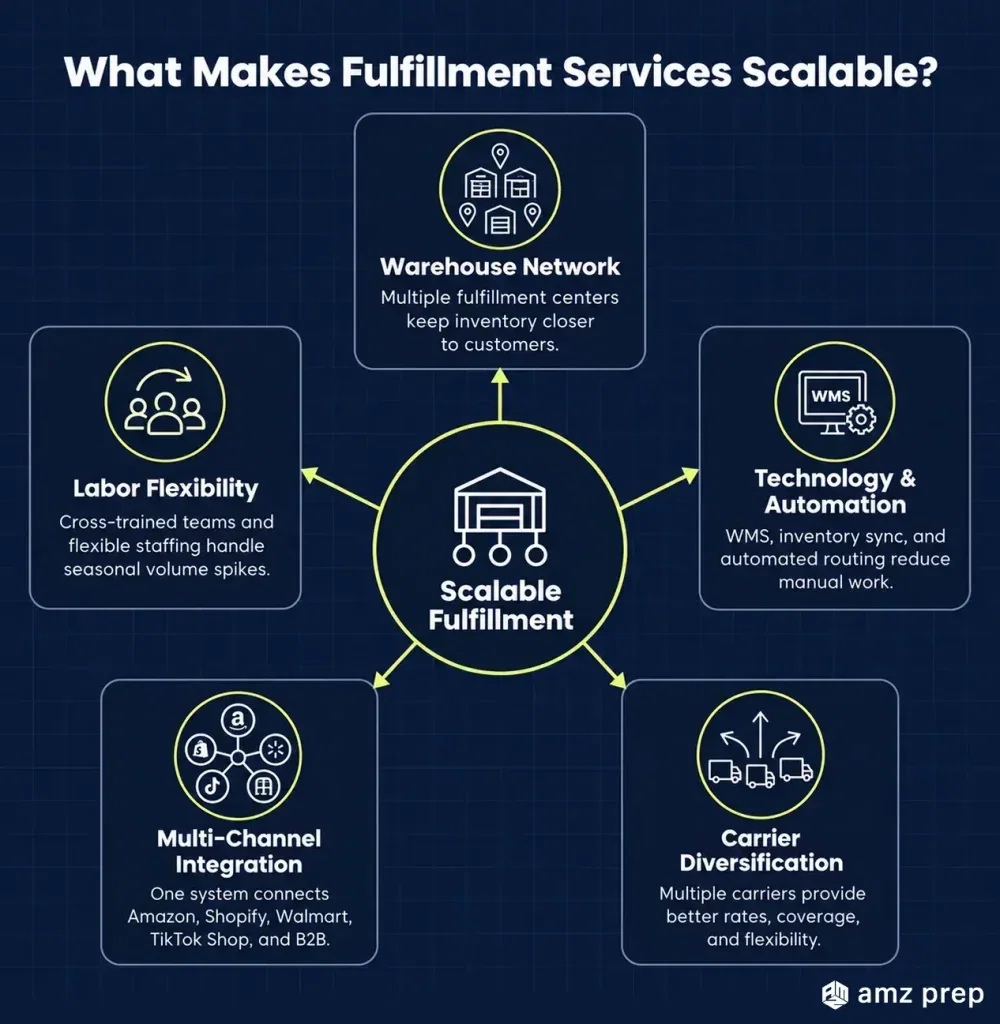
Five components make a fulfillment operation scalable. All five have to work together.
Warehouse Network and Geographic Footprint
A single-warehouse 3PL cannot scale. Shipping zones stretch, delivery times slow, and carrier costs climb as customers spread out geographically.
Scalable 3PL networks operate multiple fulfillment centers positioned near major population centers. Inventory sits closer to the customer, shipping zones stay short, and 2-day delivery is possible without paying express rates.
Technology and Warehouse Automation
Manual operations do not scale. Every process running on spreadsheets or paper hits a ceiling.
Scalable fulfillment requires a warehouse management system, real-time inventory sync across channels, automated order routing, and integration with ecommerce platforms. Automation removes human error and lets one operator manage the volume that used to require ten.
Carrier Diversification
Depending on one or two carriers creates a chokepoint. Carrier rate hikes, service disruptions, and regional gaps all become blockers.
Scalable operations run 30 or more carriers across parcel, LTL, and regional lanes. Every shipment gets routed to the cheapest, fastest carrier for that specific zone.
Multi-Channel Integration
High volume fulfillment rarely comes from one sales channel. Growth usually means adding Amazon, Shopify, TikTok Shop, Walmart, and B2B retail at the same time. See how AMZ Prep handles global marketplace fulfillment across all major channels.
A scalable 3PL integrates natively with all of them. Orders flow into one system regardless of source. Inventory allocates across channels without manual intervention.
Labor and Operations Flexibility
Fixed headcount does not match variable order volume. Peak season demands three times normal staffing. In-house teams cannot flex that fast.
Scalable 3PLs use cross-trained labor pools, seasonal contractors, and shift optimization to match staffing to demand. Cost per order stays flat even when volume spikes 300 percent.
10 Scalable Fulfillment Companies to Know in 2026
Ten providers worth knowing when evaluating scalable fulfillment. Alphabetical order, not ranked. Each one solves a different scaling problem.
AMZ Prep: Multi-channel 3PL operating 50+ fulfillment centers across six countries. Handles DTC, Amazon, marketplaces, and B2B in one operation. Best for brands scaling multi-channel from Shopify plus Amazon into international markets.
Cart.com: Full-stack commerce platform combining fulfillment, marketing, and technology. Best for brands scaling with complex tech stack integrations across multiple sales channels.
Flexport: Freight forwarding plus ecommerce fulfillment after the 2022 Deliverr acquisition. Best for scaling brands managing the full supply chain from overseas manufacturing through last-mile delivery.
Pattern: Ecommerce acceleration platform with 3PL services across Amazon, Walmart, TikTok Shop, and 60+ global marketplaces. Best for scaling brands running heavy marketplace operations who want fulfillment plus growth acceleration in one partner.
Red Stag Fulfillment: Specialist in heavy, oversized, and high-value inventory. Best for brands scaling non-standard SKUs like furniture, fitness equipment, or fragile electronics that standard 3PLs won’t handle.
ShipBob: Runs 50+ fulfillment centers across the US, UK, EU, Canada, and Australia. Deep native integrations with 90+ ecommerce platforms. Best for scaling DTC brands going global.
ShipHero: Warehouse management software combined with a 3PL network. Brands can use ShipHero to run their own warehouse or plug into ShipHero’s fulfillment operations. Best for tech-first brands wanting flexibility between in-house and outsourced.
ShipMonk: Omnichannel 3PL operating across the US, Mexico, Canada, UK, and EU. Bundled subscription-box fulfillment and standard ecommerce. Best for scaling subscription and DTC brands with variety-heavy operations.
Whiplash (Ryder E-commerce): Part of the Ryder logistics network. Large domestic US warehouse footprint with fulfillment and returns handling. Best for scaling brands prioritizing US-only coverage backed by enterprise logistics infrastructure.
ZonPrep: Largest FBA-prep-focused 3PL in the US with 300,000+ sq ft across Georgia facilities. Offers FBA prep, cross-dock consolidation, kitting, bundling, and fulfillment. Best for Amazon-heavy brands scaling FBA operations with high inbound prep volume.
When Do You Need a Scalable 3PL?
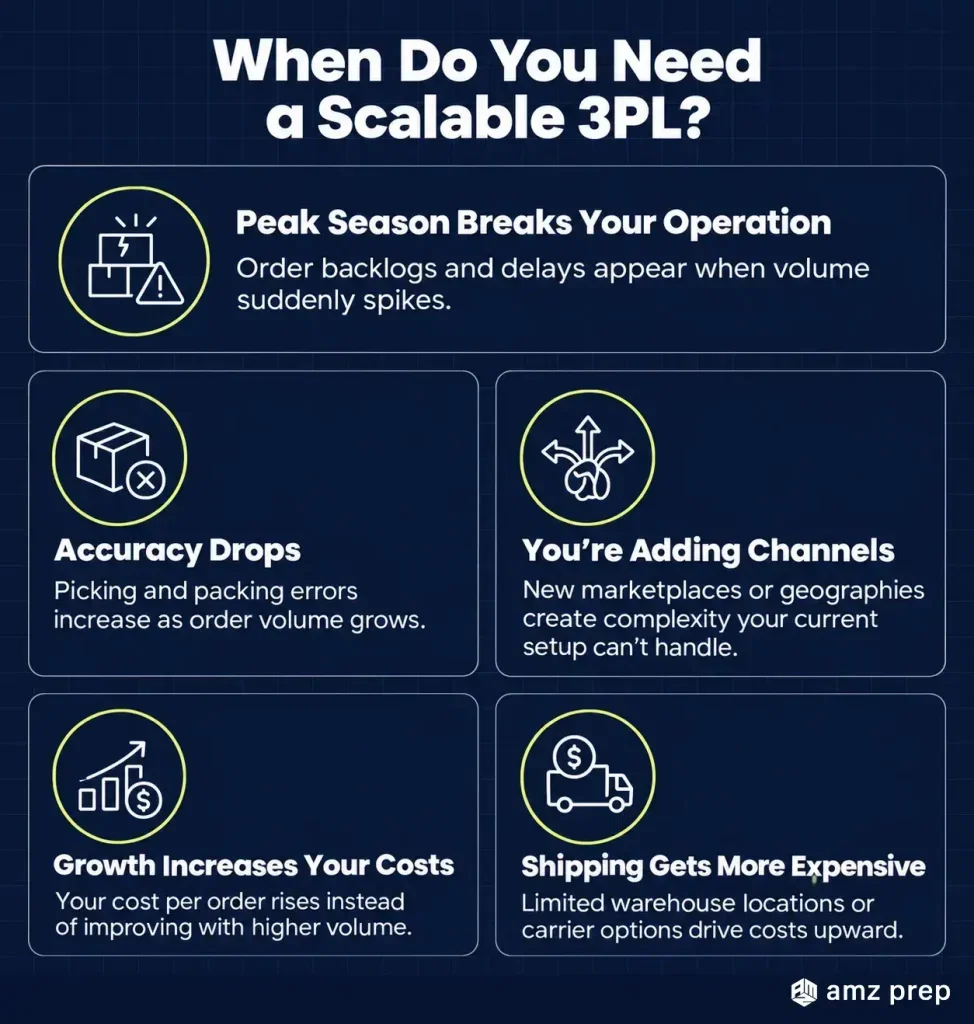
Five signals tell a brand it’s time to move.
You’re Breaking Under Peak Season Volume
Black Friday, Cyber Monday, and holiday peaks are the ultimate stress test. If orders back up, shipping delays multiply, and customer complaints spike during peak, the current fulfillment setup cannot scale.
A scalable 3PL treats peak as normal operating volume. Delivery times and accuracy hold steady even at 5 to 10 times baseline.
Order Accuracy Is Dropping as Volume Grows
Manual operations lose accuracy under load. Wrong SKUs shipped, missing items, mislabeled packages. Every accuracy point lost costs customer trust and margin.
If accuracy is drifting below 99.5 percent as volume climbs, the fulfillment operation has hit its ceiling.
You’re Launching in New Sales Channels or Geographies
Adding Amazon to a Shopify operation. Expanding from the US to Canada. Launching on TikTok Shop or Walmart. Each new channel adds complexity the current 3PL may not handle.
Multi-channel expansion is the most common trigger for switching to a scalable 3PL.
Your Current 3PL Charges Premium Rates for Growth
Some fulfillment providers price growth punitively. Additional storage, extra pick fees, surcharges for new channels. If scaling with the current 3PL costs more per order at higher volumes than at lower ones, the pricing model is broken.
Scalable providers price growth flat or lower per unit.
Shipping Cost Per Order Keeps Climbing
Rising shipping costs at scale usually means the 3PL is not routing intelligently. Single-warehouse operations, weak carrier negotiations, or manual carrier selection all inflate cost per order as volume grows.
Scaling fulfillment should reduce cost per order, not increase it.
What to Look for in a Scalable Fulfillment Partner
Six criteria separate a scalable 3PL from one that just claims to be scalable.
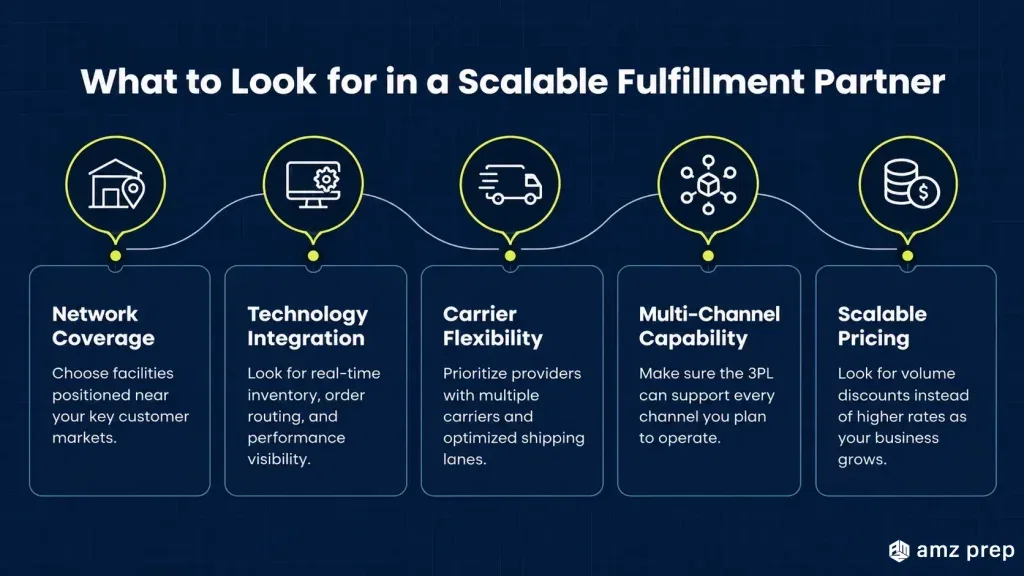
Network Scale and Geographic Coverage
The number of fulfillment centers matters. So does where they sit. Ask how many facilities the 3PL operates and whether they cover your primary customer geography.
Providers running 20 or more centers across multiple countries handle scale that single-network 3PLs cannot.
Technology and Platform Integrations
Real-time inventory sync. Native integrations with Shopify, Amazon, Walmart, TikTok Shop, and B2B EDI. Automated order routing. Real-time reporting dashboards.
A scalable 3PL should give the brand full visibility into inventory, orders, and performance across every channel. No spreadsheets, no manual updates.
Carrier Flexibility and Lane Optimization
Ask how many carriers the 3PL works with and how they select carriers per shipment. Providers running 30 plus carriers can optimize every order for cost and speed. Providers with two or three carriers cannot.
Multi-Channel and Marketplace Capability
Multi-channel is not optional at scale. The 3PL must handle Amazon FBA prep, DTC packaging, retail EDI compliance, and marketplace order flows in one facility. Sellers expanding into TikTok Shop should also account for FBT Fulfillment Fees when comparing fulfillment costs across channels.
Ask specifically about channel coverage before signing. For deeper detail on how AMZ Prep runs enterprise-scale multi-channel operations, see the enterprise fulfillment solutions breakdown.
Transparent Pricing That Scales With Volume
Get the full pricing model in writing. Storage, pick and pack, receiving, returns, packaging, additional services. Look for volume discounts, not volume surcharges.
The right pricing model rewards growth. The wrong one punishes it. Providers positioned in the premium fulfillment services tier often bundle these fees differently than volume-first 3PLs.
Proven Track Record at Your Growth Stage
Ask for references from brands at your current volume and one tier above. A 3PL serving 100 orders per day brands well may struggle with 10,000. A 3PL running enterprise operations may over-serve small brands.
Match the partner to the growth stage.
How to Prepare Your Business for Fulfillment Scale
Scaling fulfillment is not the 3PL’s job alone. The brand has to prepare too.
Forecast Demand Accurately Across Channels
Bad forecasts break scalable operations. Under-forecast and inventory runs out. Over-forecast and storage costs eat margin.
Build monthly demand forecasts per SKU, per channel. Update them quarterly. Share them with the 3PL so inventory placement can match expected demand.
Standardize SKU Data and Product Information
Inconsistent SKU data breaks inventory sync. Different names, different variants, different barcodes across channels create errors at scale.
Clean the master SKU file before onboarding a new 3PL. Fix duplicates, standardize naming, confirm every SKU has correct dimensions and weight.
Align Inventory Placement With Customer Geography
Distributing inventory across warehouses only works if the placement matches where customers actually order from.
Pull order history by state or region. Weight inventory placement toward high-order geographies. Reassess quarterly as sales patterns shift.
Build Carrier Redundancy Before You Need It
Single-carrier dependence is a risk at scale. Rate hikes, strikes, or regional service disruptions become brand-threatening events.
Ask the 3PL which carriers cover which lanes. Confirm backup carriers exist for every major zone.
Set Clear Performance SLAs With Your 3PL
Vague expectations create vague performance. Set specific SLAs on order processing time, accuracy, shipping cost per order, and inventory availability. Returns processing SLAs matter too, and Amazon FBA returns especially require tight turnaround targets at scale.
Review the SLAs monthly. Escalate breaches immediately. A scalable 3PL welcomes performance accountability.
Conclusion
Scaling fulfillment is not about hitting a specific order volume. It’s about building operations that don’t crack under growth.
The brands that get scaling right treat fulfillment as growth infrastructure. The brands that get it wrong treat it as a cost line to minimize. That distinction shows up in customer experience, unit economics, and how fast the business can move when the market opens up.
The right scalable partner does not slow down. The right one speeds up.
Frequently Asked Questions About Scalable Fulfillment
What Is Scalable Fulfillment?
Scalable fulfillment is a 3PL service designed to handle growing order volume without losing speed, accuracy, or cost efficiency. It combines warehouse network scale, technology, carrier diversification, and multi-channel integration to support brand growth.
What Is the Difference Between Scalable and High-Volume Fulfillment?
Scalable fulfillment adapts to growth over time. High volume fulfillment processes large order counts at a specific moment. A scalable 3PL is inherently high-volume capable, but a high-volume provider is not always scalable long-term.
What Are the Best Scalable Fulfillment Companies?
Well-known scalable providers include AMZ Prep, ShipBob, ShipMonk, Cart.com, Flexport, ShipHero, Red Stag, The Fulfillment Lab, Ware2Go, and Whiplash. Each fits a different scaling profile depending on channel mix, product type, and geography.
When Should I Switch to a Scalable 3PL?
Switch when accuracy drops under load, when peak season breaks the operation, when adding new sales channels stalls, when shipping cost per order rises with volume, or when the current provider charges more per unit as you grow.
How Do I Know If My Current 3PL Can Scale With Me?
Ask three questions. Can they handle 5 to 10 times your current order volume without changing infrastructure? Do their pricing terms improve as volume grows? Do they support every sales channel you plan to launch on?
Do 3PLs Charge More for Scalable Fulfillment?
Not the good ones. Scalable 3PLs typically charge less per order at higher volumes because their infrastructure and technology absorb the cost of scale. If your 3PL charges premium rates for growth, the model is wrong.
How Long Does It Take to Onboard With a New Scalable 3PL?
Most scalable 3PLs onboard new brands in 2 to 4 weeks. Onboarding covers inventory transfer, SKU setup, channel integrations, and workflow testing. Enterprise brands with complex multi-channel operations may take 6 to 8 weeks.
















Comments