
A freight accessorial charge is an extra accessorial fee a carrier adds on top of the base line-haul rate. It pays for any service beyond standard pickup and delivery. Common examples include liftgate use, residential delivery, and detention time. Most of these fees appear after a shipment moves, which is why they surprise shippers.
I review freight invoices every week. Accessorials are where most of the hidden cost sits. Once you know what triggers each fee, you can plan around nearly all of them in your shipping process.
What accessorial charges are in freight
An accessorial charge is any service a carrier performs outside the standard dock-to-dock move. The base rate covers picking freight up at one loading dock and dropping it at another. Anything past that gets billed separately.
These fees show up as line items on your invoice, usually grouped under ‘accessorials’ or ‘other charges.’
Freight accessorial charges exist because carriers price the base move tightly. Extra labor, equipment, or time costs them more, so they pass it through as an additional charge.
The main point is simple. Most accessorial charges are predictable. They fire when a shipper asks for something, or when the freight needs something, the base rate did not include.
Common accessorial charges list
Here is a list of common accessorial charges grouped by cause, with typical ranges for each.
| Charge | When it triggers | Typical range |
|---|---|---|
| Liftgate | No loading dock at pickup or delivery | $30–$150 per shipment |
| Residential delivery | Delivery to a home address | $30–$120 per shipment |
| Limited access | Delivery to a school, farm, or job site | $50–$180 per shipment |
| Inside delivery | Carrier moves freight past the threshold | $30–$120 per shipment |
| Detention | Driver waits past the free load or unload window | $30–$100 per hour |
| Layover | Driver held overnight before load or unload | $150–$400 per day |
| Reweigh | Actual weight differs from the bill of lading | $10–$50 plus the corrected weight |
| Reclassification | Freight class is wrong on the BOL | Billed as the class rate difference |
| Appointment | Delivery needs a scheduled window | $25–$70 per shipment |
| Redelivery | First delivery attempt failed | $50–$150 per attempt |
| Storage fee | Freight sits at the terminal past free time | $5–$10 per 100 lbs, per day |
These ranges reflect typical LTL market rates as of early 2026. Exact amounts vary by carrier, lane, contract, and accessorial schedule. Confirm the figures against your carrier’s current rate sheet before you quote a customer or budget a lane.
These common accessorial fees fall into three groups.
Delivery-location charges
These fire based on the delivery location and how freight comes off the truck. Liftgate applies when there is no dock. Residential and limited access fees apply to non-commercial sites. Inside delivery applies when the driver carries freight past the entrance.
Location fees are the easiest to plan for. They depend on details you already know at booking.
Handling and equipment charges
Detention, layover, reweigh, and reclassification live here. Detention bills the time a driver waits to load or unload past the free window. A layover accessorial applies when the driver is held overnight. Reweigh and reclassification correct a bill of lading that did not match the freight on the pallet.
These come from paperwork gaps or slow docks. Both are fixable on your side.
Scheduling and access charges
Appointment, notification, redelivery, and storage fee charges sit here. They fire when a delivery needs coordination or when a first attempt fails. Storage bills freight that waits at the terminal too long.
Accessorial charges in LTL vs truckload
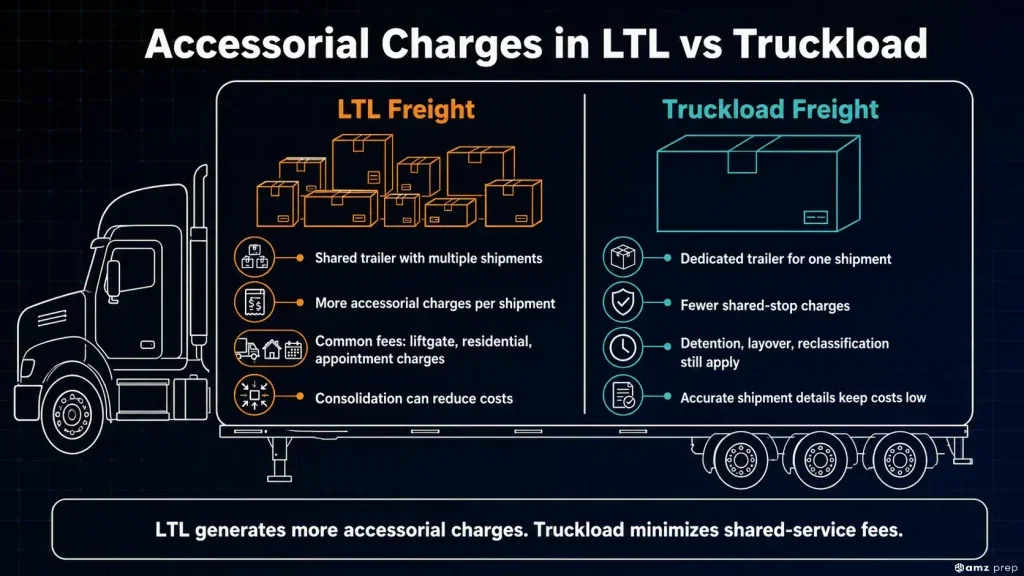
The same fee behaves differently depending on how your freight ships. That difference shapes how you manage it.
In LTL freight, one trailer carries loads from several shippers. LTL carriers bill accessorials for anything specific to your freight, like a liftgate or a residential stop.
Because the trailer is shared, an LTL accessorial is common and adds up quickly across stops. Many brands cut these fees by consolidating shipments into fuller, more efficient loads through AMZ Prep’s Middle Mile freight program.
Accessorial charges in truckload work on a different logic. In truckload, you book the whole trailer, so there are fewer shared-stop fees. Detention, layover, and reclassification still apply. Across truckload and LTL freight, the goal is the same: give the carrier accurate shipment details so the base rate holds.
Parcel carriers add their own surcharges. UPS and FedEx apply package-level accessorials like additional handling or address correction. These are still accessorial services, but the triggers are parcel-level, not freight-level. For anyone tracking FedEx freight accessorial charges for 2026, note that FedEx publishes freight and parcel accessorials on separate rate sheets. Pull the current one before you quote.
What an accessorial fee adjustment is
An accessorial fee adjustment is a billing change the carrier makes after pickup. It usually follows a reweigh or reclassification.
Here is a common case. Your bill of lading lists 400 pounds at class 70. The carrier reweighs at the terminal and finds 520 pounds. The invoice gets adjusted to the real weight and freight class.
Adjustments are not penalties. They correct the bill to match the actual freight. Accurate paperwork at booking keeps them off your invoice.
How to manage freight accessorial charges
A lot of advice online says to ‘ship smarter.’ That helps no one. Here is how you actually manage freight accessorial charges, mapped to what causes each one.
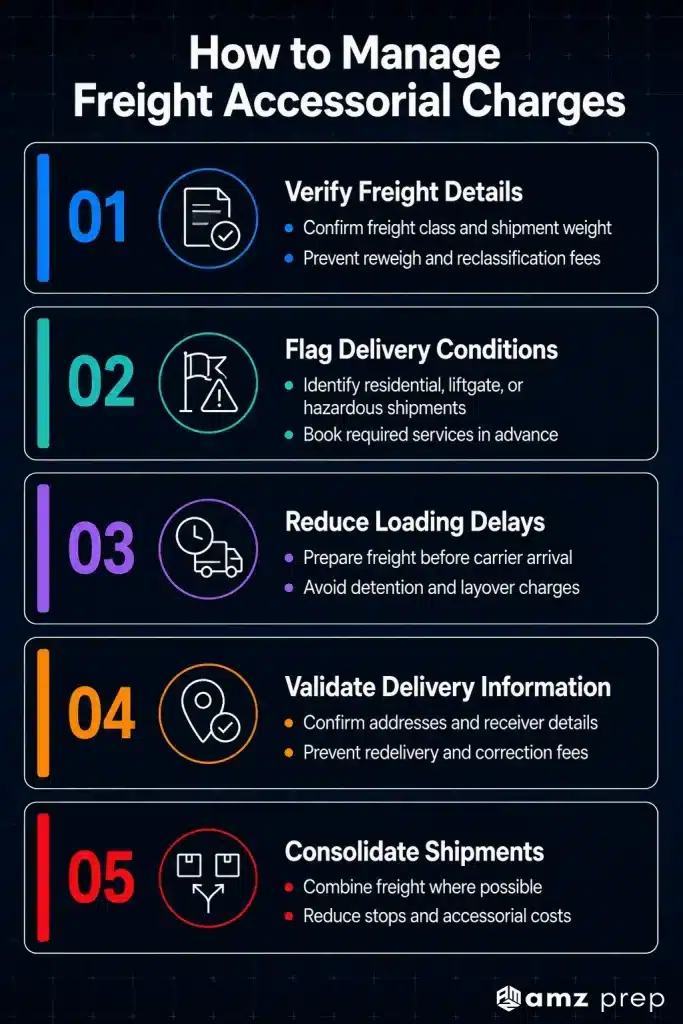
Fix your freight class and weight first
Reweighs and reclassifications are the most expensive accessorial charges I see. Confirm the class, calculate shipment density with a freight density calculator, and get an accurate scale weight before the BOL goes out. This one habit removes the biggest freight accessorial fees risk.
Flag delivery conditions at booking
If the site is residential, has no dock, or sits off a main road, say so upfront. A booked liftgate costs less than one added after a failed delivery. Surprise site fees are an avoidable cost.
Clear the dock inside the free window
Detention and layover build fast on busy docks. Stage freight before the driver arrives. Keep the door moving so you stay inside the free time and avoid a detention charge.
Get the address and contact right
Redelivery and address-correction fees come from bad data. Confirm the delivery point, the receiver, and the phone number before the shipment leaves.
Flag hazardous materials early
Hazardous materials carry their own handling and documentation fees. Declare them at booking so the carrier assigns the right equipment and avoids a mid-transit correction.
Consolidate where you can
Fewer, fuller shipments mean fewer stops that trigger accessorials. Consolidation also lowers your base freight charges, so the shipping costs savings stack.
That is how you avoid surprise charges at the source. In my experience across the logistics industry, prevention beats disputing a fee after the fact every time.
Where a freight partner keeps accessorials in check
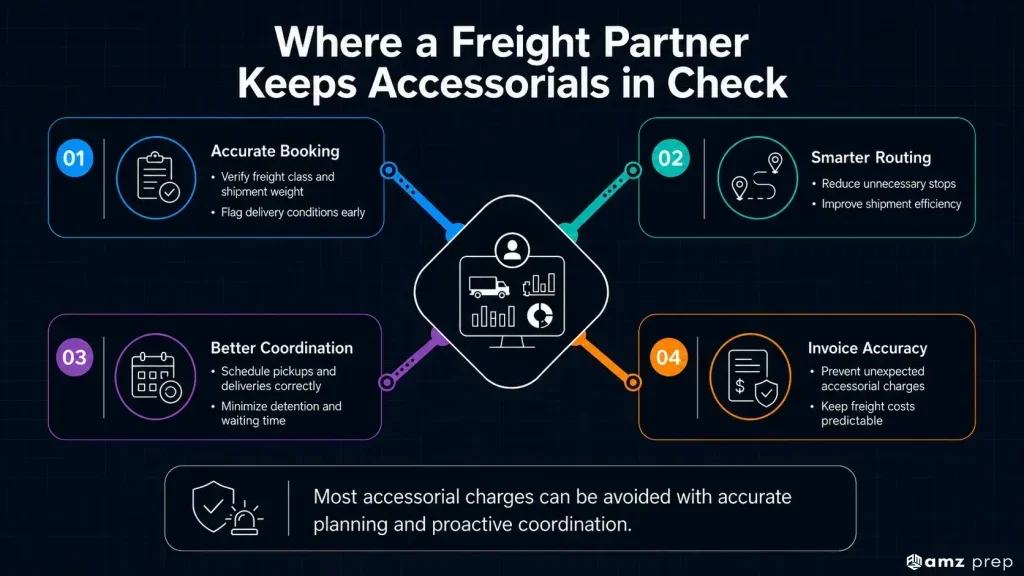
Accessorials get harder to track as volume grows across your supply chain. A logistics partner with freight buying power books with accurate class and weight, flags site conditions upfront, and routes to keep stops efficient. That keeps most accessorials off the invoice before they fire.
Inside our omnichannel fulfillment and freight network, we handle this booking discipline as part of every move. The point is a freight bill you can predict, where the base rate and the accessorials are both planned in advance.
Conclusion
Accessorial charges are not random. Each one traces back to a condition at booking, a gap on the bill of lading, or time lost at the dock. Once you can name the trigger, you can plan the cost. That shifts freight from a monthly surprise into a line you control.
Start with the two fees that cost the most: accurate freight class and accurate weight. Get those right on every BOL, then work down the list from there. As your volume grows, a freight partner who books with that same discipline turns accessorial control into a standing part of your operation rather than a monthly cleanup.
Frequently Asked Questions
What is an example of an accessorial charge?
A liftgate fee is a common example. The carrier uses a hydraulic platform to lower freight when no dock is available. Other examples include residential delivery, detention, and inside delivery fees on an LTL shipment.
What does accessorial mean in LTL?
In LTL, accessorial means any service beyond standard dock-to-dock pickup and delivery. Because LTL shares trailer space across shippers, carriers charge separately for liftgates, residential stops, appointments, and limited-access sites.
What is an accessorial fee for UPS?
A UPS accessorial fee is a surcharge added to the base rate for extra services. Examples include address correction, additional handling, and delivery area surcharges. UPS lists current amounts in its published rate sheet.
What is an accessorial fee adjustment?
An accessorial fee adjustment is a billing correction a carrier makes after pickup. It usually follows a reweigh or reclassification. If the freight differs from the bill of lading, the carrier updates the invoice to match.
How do you manage freight accessorial charges?
Give the carrier accurate details upfront. List the correct freight class, weight, and full delivery address. Flag liftgate, residential, or hazardous materials needs at booking. Accurate paperwork prevents most reweighs, reclassifications, and unexpected fees.
Are freight and parcel accessorial charges the same?
No. Freight accessorials apply to LTL and truckload shipments, like detention or liftgate. Parcel accessorials are surcharges from UPS or FedEx, like additional handling. Both add cost beyond the base rate, but the triggers differ.

Chadwick Collins is an Enterprise Fulfillment Consultant at AMZ Prep, where he partners with high growth ecommerce brands to design and scale Amazon first logistics strategies. He brings extensive experience in freight, supporting brands across domestic and cross border transportation, routing optimization, and cost control.
At AMZ Prep, Chadwick works closely with enterprise clients to improve inventory flow, reduce landed costs, and accelerate delivery performance across North America. His expertise spans FBA, DTC, and B2B fulfillment, with a strong focus on aligning freight strategy with overall supply chain efficiency. He helps brands navigate complex logistics challenges while turning operations into a competitive advantage.

















Comments