
I talk to enterprise brands every week about shipping costs. One pattern I see consistently is most brands accept national carrier rates as a fixed cost of doing business. They price their products around them. They absorb the hit every quarter and move on.
What I have found is that the distance a parcel travels through a carrier network is directly tied to what you pay and that distance is more controllable than most operators realize. Zone skipping is the strategy that addresses it.
Now at AMZ Prep, I’m seeing brands cut per-parcel costs by 20 to 40 percent on their highest-volume cross-country lanes using this approach. It is not complicated once the math is on the table. This blog walks through how it works, where it saves money, and how to assess whether it fits your operation.
What Are Shipping Zones?
Before getting into zone skipping, it helps to understand what shipping zones are.
Parcel carriers like FedEx, UPS, and USPS divide the US into zones numbered 1 through 9. These are not fixed geographic regions. Zones are relative to the origin ZIP code. A package shipping from Memphis to Nashville sits in zone 2. The same package shipping from Memphis to Los Angeles sits in zone 8.
What most brands underestimate is the compounding effect. Every zone crossed adds cost. Each additional zone typically adds 8 to 15 percent to the base parcel shipping rate. By the time a package moves from zone 2 to zone 8, the per-unit cost can be two to three times higher.
How Zone Costs Compound Across Distance
Here is a simplified rate escalation example for a 2 lb standard parcel via a major national carrier:
| Zone | Approximate Rate |
|---|---|
| Zone 2 | $7.50 |
| Zone 4 | $9.80 |
| Zone 6 | $13.40 |
| Zone 8 | $16.90 |
Note: Rates vary by carrier, contract tier, and DIM weight. These figures are illustrative.
A brand shipping across multiple zones like zone 4 to zone 8 on 1,000 parcels per day pays roughly $7,100 more per day on that single lane. When I show operators that number annualized, the reaction is usually the same, mostly they had no idea it was that material.
Zone skipping is designed to close that gap.
What Is Zone Skipping?
Zone skipping is a shipping strategy that consolidates individual packages headed to the same destination region into a single freight move.
That freight shipment travels directly to a carrier hub or sorting facility near the final destination, bypassing every intermediate hub and zone crossing along the route. A local carrier or regional carrier then handles final-mile delivery at local rates.
So, the result is brands pay freight rates for the long-haul leg and local parcel rates only for the last zone. They avoid the per-zone markups that national carriers apply every time a package crosses a zone boundary.
One thing I want to be direct about zone skipping is, it is often confused with carrier injection. They are related but not the same thing.
Difference Between Zone Skipping vs. Carrier Injection
I hear these two terms used interchangeably on sales calls. They are not the same execution model.
Carrier injection means inducting parcels directly into a carrier’s network at a hub closer to the final destination. It is common with USPS, DHL eCommerce, and Pitney Bowes programs. The brand or 3PL moves parcels to a regional entry point, and the carrier delivers from there.
Zone skipping uses freight like FTL or LTL to move a consolidation of parcels from origin to the destination zone. The freight move handles the long haul. Parcel carriers handle last-mile delivery only after the consolidated load arrives in the destination region.
Carrier injection is a handoff strategy. Zone skipping is a freight-first consolidation strategy. Both reduce zone exposure. The operational execution is different.
How Zone Skipping Works: Step by Step
When I walk brands through this model, I break it into four steps. The operational logic is cleaner than most operators expect.
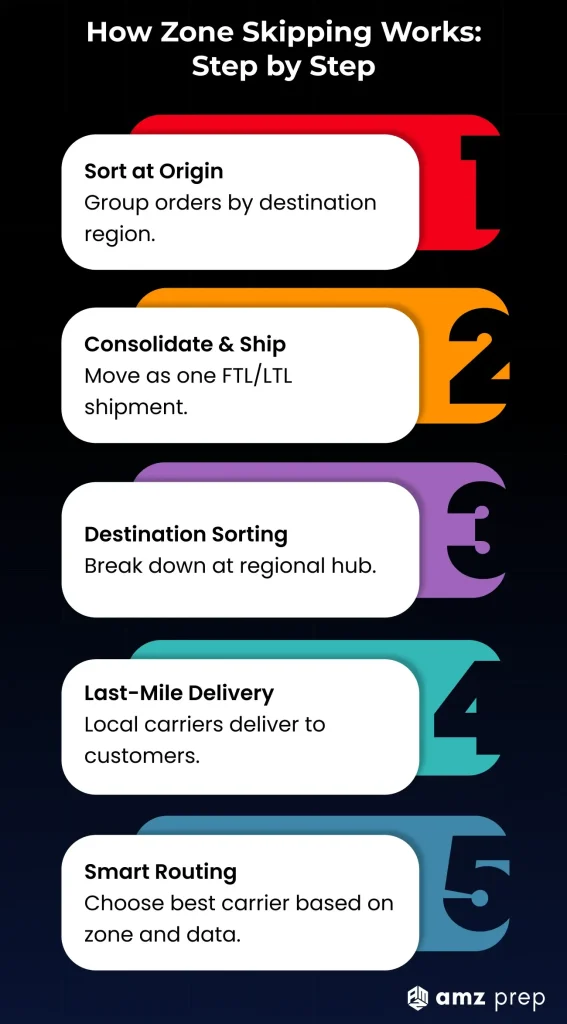
Step 1: Sort and consolidate at the origin fulfillment center
Orders are sorted at the origin fulfillment center by destination zone or region. All individual packages headed to the West Coast, for example, are pulled together before they leave the building. This sorting step is where most of the operational setup lives.
Step 2: Single freight move to the destination region
The consolidating shipments into a single FTL or LTL load ships directly to a sorting facility or carrier hub near the customer base. The load bypasses every intermediate hub. It does not cross multiple zone billing points on the way.
Step 3: Offload and sort at the destination hub
Once the freight arrives at the destination zone, the load breaks down. Parcel carriers or local carriers receive the individual packages and sort them for final delivery.
Step 4: Regional last-mile delivery
A regional or local carrier completes last-mile delivery at local rates. Customers receive their orders from a carrier operating within the same market they are in.
At AMZ Prep, we run this model across 50+ fulfillment center locations using UPS, FedEx, USPS, OnTrac, and regional carriers. Orders route automatically to the optimal carrier based on destination zone, package weight, and real-time carrier performance data.
Zone Skipping Cost Savings: The Real Math
Most content I have seen on this topic gives one static example and moves on. What brands actually need is a formula they can run on their own lanes.
Here is how I model it with enterprise accounts:
Current per-parcel cost: Current zone 6–8 rate x daily parcel volume = current daily spend
Zone skip cost: (FTL or LTL freight cost per load / total parcel count in that load) + regional last-mile rate per parcel = zone skip cost per parcel
The threshold: Zone skipping cost savings exist when the zone skip total per parcel is below the current national carrier rate for that lane.
Worked example: A brand ships 2,000 parcels per day from an East Coast warehouse to West Coast customers at $15.80 per parcel (zone 8 rate).
- Current daily spend: $31,600
- FTL freight to West Coast hub: $4,500 per load ($2.25 per unit freight cost)
- Regional last-mile rate from West Coast hub: $7.20 per parcel
- Zone skip total: $9.45 per parcel
- Daily savings: $12,700
- Annual savings on that single lane: approximately $3.3 million
I have modeled versions of this with brands coming from single-warehouse 3PLs. The numbers change with volume and lane specifics, but the directional cost savings on high-zone cross-country lanes consistently land in the 20 to 40 percent range.
Which Lanes Benefit Most From Zone Skipping?
From what I see in practice, East-to-West and West-to-East cross-country lanes at zone 6, 7, and zone 8 generate the most compelling savings. These are the lanes where national carrier pricing compounds the hardest.
Short-haul lanes at zone 2 or zone 1 rarely justify the operational setup. The freight consolidation overhead does not produce enough per-parcel savings when shipping across multiple zones is not a real factor.
If I am talking to a brand that ships primarily within one or two zones, I tell them zone skipping is not their highest-leverage move. Carrier contract renegotiation almost always is.
The more zones a package currently crosses, the stronger the zone skipping case.
Benefits of Zone Skipping Beyond the Per-Parcel Rate
The per-parcel cost savings are why brands come to the conversation. But the benefits of zone skipping extend further, and these are the ones I flag with enterprise accounts that are not thinking about them yet.
Fewer touchpoints, fewer damage claims In standard parcel shipping, packages pass through three to five sortation facilities before reaching the customer. Each transfer is a damage and loss risk point.
In zone skipping, the consolidating shipments travel palletized on a single truck. The freight does not move again until it reaches the destination region. Fewer hands on the product means fewer claims. For high-value or fragile products, this is a material operational benefit, not just a rounding error.
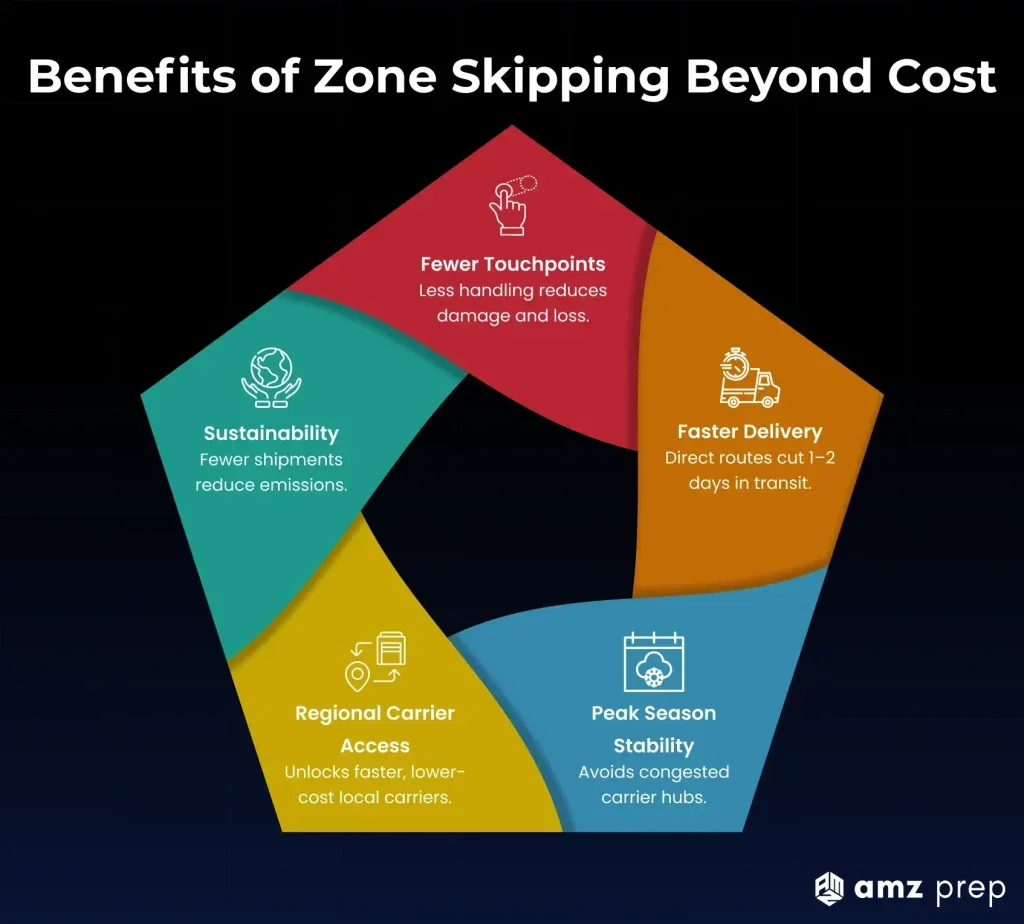
Faster delivery on long-haul lanes
Shipping individual packages through a national carrier’s hub-and-spoke network means packages take indirect routes. A package from New York to Phoenix might route through Dallas or Denver before reaching its final destination. A zone-skipped load moves in a direct line haul. Transit time on long-haul lanes typically drops by one to two days.
Peak season resilience
This is the one I push hardest with brands doing Q4 planning. During peak season, national carrier networks are under maximum strain. Packages sit at intermediate hubs waiting for sortation capacity. Zone skipping removes that exposure entirely. The consolidated freight moves point-to-point, independent of the congested intermediate hubs that slow down standard parcel shipments in November and December.
Regional carrier access
Zone skipping opens up regional parcel carriers OnTrac, LSO, CDL, and others that are not accessible from a single-origin direct ship model. making enterprise middle mile providers relevant for brands managing high volume regional distribution. In my experience, these carriers often outperform national networks on delivery time and per-parcel cost within their coverage areas. Getting inventory into the region first is what unlocks that access.
Sustainability
Consolidating shipments into a single freight move reduces the number of vehicles required to move the same volume. Fewer trucks, fewer miles, lower emissions per unit. For brands with sustainability commitments, this is a measurable and reportable operational benefit.
When Zone Skipping Works and When It Does Not
I am direct with brands about this. Zone skipping is not the right model for every operation. Here is the framework I use to assess fit quickly.
Works well when
- Consistent outbound volume to a specific region is at or above 500 parcels per day. This is the threshold most content avoids naming. I name it because it is where the freight consolidation economics start working in the brand’s favor.
- The origin-to-destination lane crosses three or more zones
- Products are under 10 lbs per unit
- Order flow is stable enough to fill FTL or LTL loads on a regular schedule
Does not work well when
- Daily volume fluctuates sharply and unpredictably, making it hard to fill consolidation loads consistently
- Orders are dispersed across dozens of micro-regions with no geographic concentration
- Products are heavy or oversized, compressing the freight savings margin
- Customer SLAs require continuous scan-point tracking at every stage of transit
I have seen brands try to force zone skipping into operations where the volume or lane profile does not support it. The result is usually inconsistent load fill, delayed shipments, and a decision to reverse course. The model requires the right conditions to deliver.
The Tracking Gap: What It Is and How Good Partners Handle It
Visibility is the concern I hear most from brands when zone skipping comes up for the first time. It is legitimate, and I want to address it directly rather than minimize it.
Here is what happens: once parcels load onto the consolidation truck, they are in motion but not being individually scanned. There is typically a 1 to 3 day window during the line-haul leg where tracking shows no forward movement. Logistics teams can also use GPS tracker apps to monitor consolidated freight movement during this line-haul stage, helping reduce visibility gaps before parcels receive their next carrier scan.
This is called a ghost code window. It is a real customer experience risk if it is not managed.
Good logistics partners solve it in two ways. First, they apply a dummy or ghost code that confirms the parcel has been loaded onto the outbound truck. Second, they use branded tracking pages that communicate expected delivery windows proactively. Customers are not interpreting silence as a problem because they have already been told what to expect.
At AMZ Prep, our last-mile delivery network provides branded tracking pages, SMS updates at each scan point, and email notifications at carrier handoff and delivery confirmation. The ghost code window exists, but the customer experience around it is managed end to end.
Zone Skipping vs. Multi-Node Fulfillment: Two Strategies, One Goal
This is a comparison I make regularly on discovery calls, and I have not seen it addressed clearly anywhere else in the content on this topic. Both strategies reduce shipping costs by reducing zone exposure. They are not the same approach, and they are not mutually exclusive.
Zone skipping starts from a single origin. It uses freight consolidation to move inventory close to the customer, then uses local carriers for last-mile delivery. It requires high and consistent volume on specific lanes to generate savings.
Multi-node fulfillment positions inventory at multiple fulfillment center locations before orders are placed. When an order arrives, it ships from the nearest location. Zone exposure is reduced at the inventory positioning stage rather than the shipping stage.
| Factor | Zone Skipping | Multi-Node Fulfillment |
|---|---|---|
| Inventory location | Single origin | Multiple nodes |
| Volume requirement | High, lane-concentrated | Moderate, geographically spread |
| Savings mechanism | Freight consolidation | Reduced origin-to-destination zones |
| Operational complexity | Freight coordination | Inventory split and replenishment |
| Best for | High-volume, lane-concentrated brands | Brands with dispersed customer geography |
The strongest shipping strategy for high-volume brands usually involves both.
Zone Skipping and Amazon FBA: How It Applies to Replenishment
This application does not appear in most zone skipping content, which surprises me. It is one of the most directly relevant use cases for Amazon sellers, and it is one I talk through with FBA-heavy brands regularly.
FBA replenishment from a 3PL to Amazon fulfillment centers across the country is, at its core, a zone skipping application.
When we send inventory from AMZ Prep RDCs in Kentucky, Nevada, Texas, Pennsylvania, and South Carolina to Amazon FCs, we consolidate FBA-bound shipments into freight moves routed directly to the receiving FC. The individual case does not cross multiple zone billing points on the way in.
AMZ Prep’s Middle Mile program runs exactly this model. FBA replenishment inventory is consolidated and routed directly to Amazon fulfillment centers via our existing truck volume. Inbound speed is 2 to 4 days.
Brands pay freight economics on the long haul, not per-unit national carrier rates. Our 5-way split routing logic eliminates placement fee exposure on top of that.
For brands managing FBA replenishment from a single-origin 3PL today, this is where zone skipping produces the clearest and most measurable return. I have seen this move materially change the unit economics on FBA replenishment for brands that had never looked at their inbound cost structure that way.
How to Assess if Zone Skipping Is Right for Your Operation
Before I recommend implementing zone skipping for any brand I work with, I run through four questions. They are worth going through before committing to the model.
1. Do 15 percent or more of daily orders consistently ship to the same region?
Geographic concentration is the prerequisite. Without it, consolidation loads cannot fill reliably. No consistent load fill means no consistent savings.
2. Are those orders currently shipping at zone 5 or higher?
Below zone 5, the per-parcel savings on most lanes do not justify the freight coordination overhead. High-zone lanes are where the model earns its keep.
3. Is daily outbound volume stable enough to fill FTL or LTL loads regularly?
Brands with sharp, unpredictable volume swings struggle to run zone skipping efficiently on their own. If volume is inconsistent, a 3PL that pools across multiple clients is a better entry point than building the model independently.
4. Is there a 3PL or carrier partner with regional injection capability already in place?
Trying to implement zone skipping without established freight lanes, carrier relationships, and hub access in the destination region is where the operational complexity outweighs the savings. The infrastructure needs to exist before the economics work.
If the answer to all four is yes, zone skipping is worth modeling on the highest-volume cross-country lanes. If two or more are no, DTC fulfillment from distributed nodes or carrier rate renegotiation likely offers a faster return with less operational lift.
Conclusion
The brands I work with that overpay on parcel shipping the longest share one thing in common. They treat carrier rates as a fixed input rather than a variable one. Zone skipping is one of the most direct ways to change that.
For brands managing ecommerce fulfillment from a single warehouse today, zone skipping is worth modeling before the next carrier contract renewal. For brands replenishing Amazon FBA from a single-origin 3PL, the same logic applies directly to the inbound supply chain.
At AMZ Prep, last-mile delivery networks give brands access to zone-skipping economics, a 20+ carrier network, and regional injection capability across 50+ fulfillment locations. Brands plug into infrastructure that is already operating at scale without managing freight lanes, carrier contracts, or volume thresholds independently.
If the lane analysis makes sense for your operation, our team can model it against your current spend.
Frequently Asked Questions About Zone Skipping
What is zone skipping?
Zone skipping is a logistics strategy that consolidates individual packages headed to the same region into a single freight shipment. The load bypasses intermediate carrier hubs and delivers to a sorting facility near the final destination. A local carrier handles last-mile delivery at regional rates.
How much can zone skipping save on parcel costs?
Zone skipping cost savings on long-haul lanes at zone 5 or higher typically range from 20 to 40 percent per parcel. Actual savings depend on lane volume, freight rates negotiated, and the regional last-mile rate at the destination.
How does zone skipping work with USPS, UPS, and FedEx?
Zone skipping involves consolidating parcels into a freight load and moving them to a regional hub near the customer. At that point, carriers like USPS, UPS, or FedEx receive the parcels and complete final-mile delivery within their local network at regional rates.
What is the difference between zone skipping and carrier injection?
Carrier injection places parcels directly into a carrier’s network at a regional entry point. Zone skipping uses LTL or FTL freight to move a consolidation to the destination zone. Both reduce zone exposure. The freight execution model is different.
What volume do you need for zone skipping to make sense?
In my experience, a consistent outbound volume of 500 or more parcels per day to a specific region is the practical starting point for running zone skipping independently. Below that threshold, partnering with a 3PL that pools volume across multiple clients is the more efficient path.
Does zone skipping slow down delivery?
On long-haul lanes, zone skipping typically reduces transit time by one to two days. Packages travel point-to-point on a direct freight lane rather than routing through multiple intermediate hubs. The delivery time advantage is strongest on zone 6 to zone 8 lanes.
How does a 3PL enable zone skipping?
A 3PL with a multi-location network and established freight lanes pools volume across clients to fill consolidation loads. Brands access zone skipping economics through the 3PL’s existing carrier relationships without meeting volume thresholds independently.
Is zone skipping useful for Amazon FBA shipments?
Yes. FBA replenishment from a 3PL to Amazon fulfillment centers is a direct zone skipping application. Consolidating FBA-bound inventory into freight moves routed directly to Amazon FCs reduces per-unit inbound costs and improves check-in speed vs. standard carrier replenishment.

















Comments