
It’s not just another time to buy on Amazon in Q4. For FBA sellers, it means that 35% to 60% of their yearly income is made in just twelve weeks.
But 2026 will offer a unique set of problems that haven’t been seen before: stricter storage limits, earlier deadlines for incoming shipments, the threat of the FBA prep service shutting down in January 2026, and ongoing instability in freight networks.
You need to take these structural changes into consideration in your Amazon Q4 strategy while also making sure that your Christmas inventory planning goes off without a hitch.
If you’re reading this in August or September, you’re already behind sellers who started making predictions in June.
You need to hurry if you’re reading this in October. Every year, the difference between sellers who get ready early and those who are in a hurry in November gets bigger.
Amazon’s infrastructure doesn’t allow for late arrivals during peak season.
Preparing for Amazon Q4 2026 correctly can mean the difference between making six figures and running out of goods.
This blog has all you need to know, from weekly schedules to safety stock formulas, packaging stress tests, and 3PL blackout readiness. Some parts of this will apply to your business right now.
Some of these can seem like too much until you have your first Q4 problem. Keep this reference close by.
Why Q4 2026 Demands More Preparation Than Previous Years
Three structural shifts make this holiday season fundamentally different from 2024 and 2025.
Costs for advertising and competition keep going up.
More and more renowned brands and private label merchants are joining FBA in every area.
The upshot is that bids for sponsored products are higher, the buybox margins are less, and it is harder to stay on page one.
Your plan for the fourth quarter now needs both great Inventory management tools and effective advertising. When you run out of stock, you give sales directly to competitors who are more prepared.
Carrier and fulfillment center traffic patterns have changed.
From October 15, 2026, to January 14, 2027, peak fulfillment costs will be in effect for FBA prep services, Remote Fulfillment, Multi-Channel Fulfillment, and Buy with Prime programs.
The seasonal per-unit increase over non-peak fulfillment rates remains unchanged from last year, averaging $0.32 per unit in the U.S. However, Amazon updated its 2026 base FBA rates, and the 3.5% fuel and logistics-related surcharge applies on top of holiday peak fulfillment fees.
Inventory Performance Index criteria, refill limits, and windows for receiving goods provide additional restrictions than in the past.
Lead times aren’t a lot worse than they were in 2023–2024, but they are more variable. In August, it might take five days to check in a shipment, but in November, it might take fifteen days. Amazon can’t handle an endless amount of incoming packages.
When fulfillment centers reach their limit, your shipments linger in receiving lines while your listings show that they are out of stock.
Critical Q4 2026 Dates and Amazon FBA Deadlines
Missing inbound cutoffs doesn’t just delay sales. It can eliminate your entire holiday revenue window for affected ASINs.
Official Amazon Deadlines for Prime Eligibility
In Q4 2026, Amazon will enforce strict inbound shipping deadlines. If sellers do not meet these deadlines, their products will not be eligible for Prime membership during those peak shopping times of the year.
When preparing for a successful Amazon Prime Day (similar to holiday sales), one needs to take a highly organized approach.
| Event | Minimal Split Deadline | Distributed Split Deadline | AWD Deadline |
|---|---|---|---|
| Prime Big Deal Days (October) | September 9, 2026 | September 16, 2026 | September 2, 2026 |
| Black Friday / Cyber Monday | October 21, 2026 | October 28, 2026 | October 14, 2026 |
These are arrival dates at Amazon facilities, not ship dates from your warehouse or 3PL. Factor in carrier transit time, potential delays, and FC receiving backlogs. Experienced sellers aim to beat published deadlines by at least seven days.
Carrier Behavior During Peak Season
Small parcel carriers and LTL freight companies experience massive volume surges starting in October. Understanding how different carriers perform helps you plan realistic timelines.
| Carrier Type | Normal Transit | Q4 Transit | Cutoff Shift | Reliability Rating |
|---|---|---|---|---|
| Small Parcel (UPS/FedEx) | 3-5 days | 5-8 days | 5-7 days earlier | Medium-High |
| LTL Freight | 5-7 days | 10-17 days | 10-14 days earlier | Low-Medium |
| Air Freight | 2-3 days | 3-5 days | Minimal | High |
| Amazon AWD to FBA | 7-10 days | 10-14 days | N/A | Medium |
Your regular carrier may have shorter pickup cutoff times, “surge pricing” for delivery guarantee, delayed appointments at major terminals, and slower response times for customer service.
LTL (less than truckload) carriers are subject to the greatest delay risk during the fourth quarter of the year.
California, Northeast Corridor, and Midwest terminals are heavily congested with hub traffic, which creates bottlenecks that can extend quoted transit times by five to ten days.
Despite its reliability, air freight is very costly, causing the majority of its products to sell below cost due to the high amounts charged for shipping delay.
Your Internal Planning Calendar
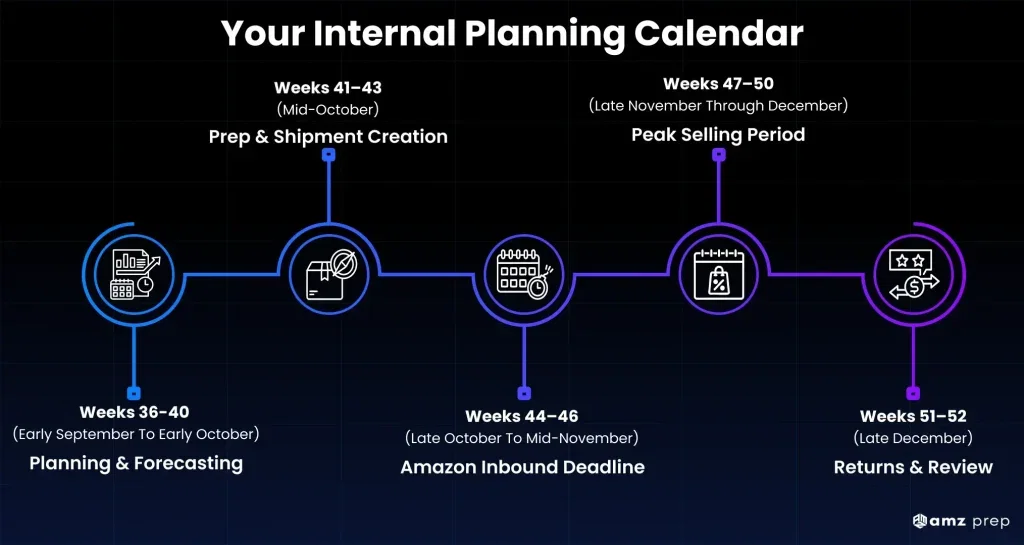
Working backward from Amazon’s deadlines, your internal operations should follow this schedule:
Weeks 36-40 (Early September to early October)
Finalize demand forecasts, place all factory purchase orders, confirm 3PL capacity reservations, submit Lightning Deal and Best Deal applications for BFCM. This is your last window for strategic decisions before execution mode begins.
Weeks 41-43 (Mid-October)
Complete all prep work, process 3PL intake, resolve any labeling or packaging issues, create FBA shipments, and book carrier pickups. If prep problems surface during this window, you still have time to fix them before critical deadlines.
Weeks 44-46 (Late October to mid-November)
All holiday inventory must be inbound to Amazon. After week 46, you’re no longer sending stock for Black Friday. You’re sending an emergency replenishment that might not arrive until after Cyber Monday ends.
Weeks 47-50 (Late November through December)
This is your selling period. Monitor inventory levels daily, track shipments in transit, prepare replenishment orders for top performers, and keep reserve stock ready at your 3PL for fast movers that exceed forecasts.
Weeks 51-52 (Late December)
Process final holiday orders, ship any last inventory for extended holiday shopping, prepare for the returns surge starting December 26, and begin post-Q4 analysis for 2026 improvements.
Inventory Forecasting That Actually Works
Generic advice says “forecast based on last year’s sales.” That’s incomplete. Accurate Q4 forecasting requires multiple data inputs and risk-adjusted safety buffers. Successful holiday inventory planning combines historical analysis with forward-looking adjustments for growth and market conditions.
Building Your Q4 Demand Model
Start by evaluating the historical performance of all applicable years (2022 through 2024) prior to determining your projections for 2024.
The result will show how many sales were made above what would normally have occurred during a typical period of time (Not including the Peak Holiday 3 months) and the percentage increase over Baseline sales.
Some ASINs will have a factor of 2.5 (A modest Holiday bump) some may exceed a factor of 5 or higher (gifting–heavy gifting ASINs).
Identifying which products have a higher factor will allow you to avoid both UNDERSTOCKING a good ASIN, as well as OVERSTOCKING a poor ASIN based upon an Assumed Holiday Order Quantity.
Adjust for Growth Trajectory. If your account grew 40 percent YOY from Q3 – Q4 2023 to Q4 2024, apply this growth assumption to the Q4 forecast.
Do not use the assumption of Linear Growth… Review Category Trends, Competitive Intensity, & if you are losing or gaining Market Share within the Segment.
Categorizing Your Product Portfolio
Separate your catalog into three tiers for inventory planning:
| Product Tier | Characteristics | Inventory Strategy | Safety Buffer |
|---|---|---|---|
| Hero ASINs (Top 20% by revenue) | Proven Q4 performers, high review counts, strong conversion rates | Aggressive stocking at upper forecast range | 1.5x multiplier |
| Growth ASINs (Rising stars) | Gaining momentum, climbing BSR, strong early indicators | Moderate stocking with close monitoring | 1.4x multiplier |
| Replenishment ASINs (Stable performers) | Predictable demand, established baseline | Conservative forecasts, standard buffers | 1.3x multiplier |
Hero ASINs require aggressive stock positioning with higher safety buffers. A stockout on a hero ASIN during Black Friday costs more than overstocking penalties on lower-tier products. Plan for the top end of your forecast range here.
Growth ASINs are products showing strong momentum but without a full Q4 history. Maybe you launched them mid-2024, or they’re gaining traction from advertising. These need careful estimation, checking competitor performance for similar products, looking at review accumulation rates, and monitoring daily velocity trends leading into Q4.
Replenishment ASINs have stable, predictable demand. Calculate conservative forecasts here. Overbuying slow movers ties up cash you need for hero products and creates aged inventory problems in Q1.
Safety Stock Calculation for Peak Season
Standard safety stock formulas don’t account for Q4 volatility. Use this adjusted calculation:
Safety Stock = (Peak Daily Sales × Maximum Lead Time in Days) × Q4 Risk Multiplier (1.3-1.5)
Using Peak Daily Sales as the Highest Single-Day Performance from Q4 (Not Average Daily Sales).
Maximum Lead Times Include Worst Case Scenarios: 3PL Prep Disruptions, Carrier Delays, and FC Receiving Backlogs Combined (Worst Case).
Multiplier for Risk in Q4 Reflects Volatility – Use 1.3 for Products with Established Suppliers and Reliable Supply Chains; Use 1.5 for Products with Unpredictable Demand, New Suppliers, or Complex Prep Requirements.
Example of a Hero ASIN Selling 150 Units Using Multipliers. Maximum Lead Time Factory to Available Inventory is 14 Days with All Delays Taken into Account. (based on 2025 Q4 performance).
150 Units Sold @ Peak Day × 14-Day Max Lead Time × 1.4 Multiplier = 2940 Safety Stock Units.
This May Seem Like Too Much Safety Stock Until You Lose $15,000 Due to Stock-Outs on Cyber Monday Because You Took a Conservative Approach to Buffers.
Supplier Lead Time Buffers
Your suppliers face Q4 demand surges too. Factories prioritize large buyers and established relationships. If you’re a smaller account, your production slots might shift when bigger customers increase orders.
Add 15-30% buffer time to quoted lead times from suppliers during Q4. A factory that typically delivers in 30 days might actually need 40 days in October. Port congestion, customs delays, and domestic freight challenges compound these issues for international shipments.
Confirm production slots in writing by August at the latest. Verbal commitments don’t hold up when factories get overwhelmed.
The Three-Layer Inventory Positioning Strategy
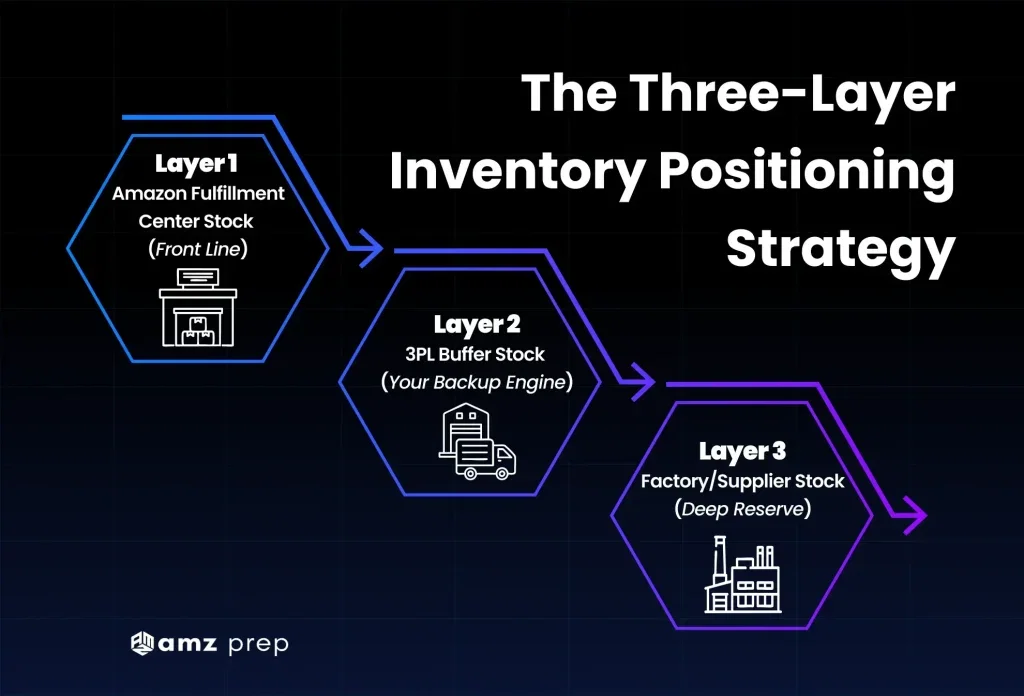
Amazon storage costs money. Fulfillment center space is finite. Smart sellers distribute inventory across three layers to balance cost, speed, and flexibility. This multi-tiered approach forms the foundation of any effective Amazon Q4 strategy for managing cash flow while maintaining stock availability.
Layer 1: Amazon Fulfillment Center Stock
This is your front line. Stock here should equal 2-3 weeks of peak projected demand for hero ASINs.
This layer directly feeds the buybox and must never run empty during the selling window from Thanksgiving through December 20.
Monitor your Inventory Performance Index score constantly. Maintaining an IPI above 450 prevents restock limit restrictions.
During Q4, storage fees nearly double from standard rates, so excess inventory here becomes expensive quickly.
Amazon imposes restock limits based on your sales velocity and IPI performance. If you hit these limits mid-season, you physically cannot send more inventory regardless of demand. This makes Layer 2 critical.
Layer 2: 3PL Buffer Stock
Position 30-40% of your total Q4 inventory at a third-party logistics provider within 2-5 days of major Amazon fulfillment centers.
This creates rapid replenishment capability without paying Amazon storage fees for the entire volume.
| 3PL Buffer Benefit | How It Works | Q4 Advantage |
|---|---|---|
| Cost savings vs. FBA storage | Hold 2-4 weeks of additional inventory outside Amazon | Save 40-50% on storage fees during peak |
| Rapid replenishment capability | 3-5 day transit to Amazon FCs | Emergency stock reaches Amazon mid-week |
| Quality control checkpoint | Final inspection before FBA inbound | Catch prep errors before Amazon rejects shipments |
| Flexibility for multi-channel | Quick pivot to DTC or other marketplaces | Redirect inventory if Amazon underperforms |
| Restock limit workaround | Keep inventory ready outside Amazon caps | Ship when limits open without factory delays |
Layer 3: Factory or Supplier Stock
For products with reliable suppliers, negotiate to hold finished goods at the factory. This represents your deepest reserve, inventory that costs nothing in storage fees until you need it shipped.
The limitation: lead time from the factory to Amazon can be 3-4 weeks for international shipments.
This layer doesn’t help with immediate replenishment. It provides backup for sustained demand that exceeds forecasts or helps you avoid massive pre-Q4 purchases when capital is constrained.
Some sellers also use Amazon Warehousing & Distribution as Layer 3, though AWD comes with its own fee structure and slower replenishment times to FBA fulfillment centers.
FBA Shipping Planning and Compliance
Peak-season receiving moves quickly but becomes highly restrictive. Amazon does not change its requirements during Q4, but enforcement becomes significantly stricter as fulfillment centers operate at 3–4× normal volume.
Effective shipment planning, correct packing, and strong packaging quality are essential to prevent delays, rejections, and slow check-ins.
Case Pack vs. Individual Pack Configuration
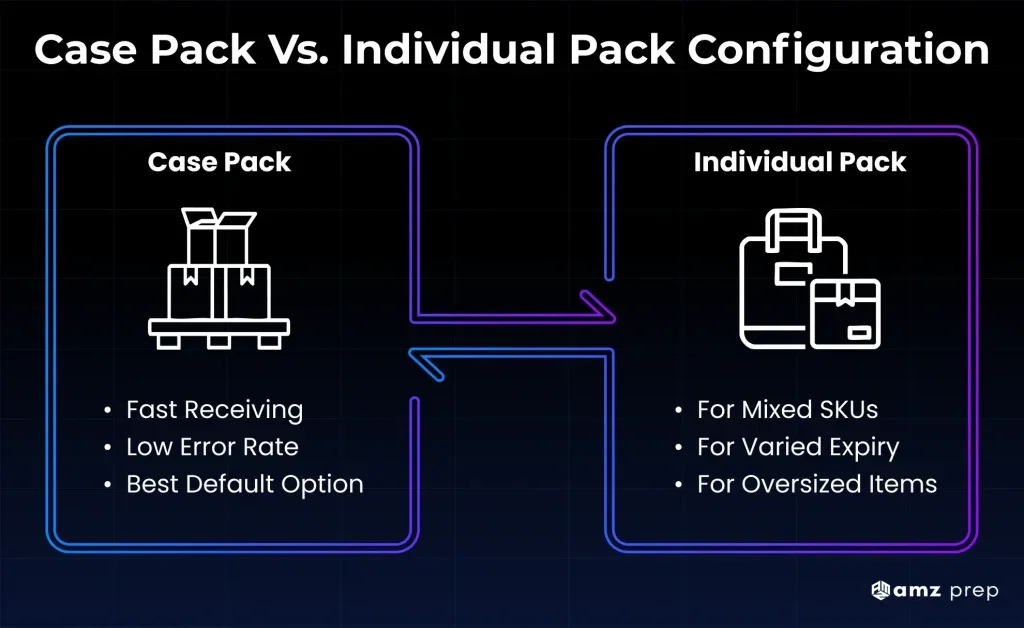
- Case-packed shipments receive 40–60% faster with lower error rates.
- Use the case pack as the default unless a product must be individually packed.
- Individual packing applies only to mixed SKUs, bundles, variable expiration dates, or heavy/oversized items.
Box Weight and Dimensional Standards
- Standard boxes must stay under 50 lbs unless the product itself exceeds that weight.
- Q4 violations trigger immediate rejections instead of warnings.
- Use strong, high-grade corrugated boxes to prevent collapse under pallet loads.
Labeling Requirements
- FNSKU labels must be high-resolution, placed flat, and fully unobstructed.
- A single failed scan can push the carton into manual processing, adding 7–10 days.
- Test labels early with pressure, smudge, and shipping simulations before Q4.
Shipment Splitting Strategy
- Never send your entire Q4 inventory in one shipment.
- Split across multiple fulfillment centers, carrier types, and staggered delivery dates.
- Diversifying shipments minimizes the risk of major delays or total inventory disruption.
Packaging Compliance and Stress Testing
- Q4 handling is harsher; packaging safe in Q2 may fail during peak season.
- Perform six-edge, three-corner, and three-face drop tests on each product.
- Any structural or product damage indicates packaging failure and requires redesign.
Cold Weather and Humidity Considerations
- Test packaging for the temperature and humidity variations across different FC regions.
- Cold conditions weaken adhesive strength; humidity weakens corrugate.
- Use weather-resistant adhesives, tapes, and inks for Q4 durability.
Ships in Product Packaging (SIPP)
- SIPP removes prep requirements and significantly speeds receiving.
- Benefits include lower costs, reduced handling, and faster Q4 processing.
- Certification takes time; plan for next year’s peak season.
3PL Selection and Blackout Preparedness
Even if you’re not directly affected by the prep service shutdown, you probably use a 3PL Logistics provider for receiving, storage, or prep work during high-volume periods. Q4 pushes every 3PL to their limits.
Recognizing When Your 3PL Approaches Capacity
Watch for these warning signs:
- Communication response times slow from hours to days
- Check-in appointments get delayed by 3-5 days compared to normal
- Prep turnaround times extend beyond quoted SLAs
- Unexpected fee increases or “peak surcharges” appear
- Outbound cutoffs shift earlier (pickup by noon instead of 4pm)
These signals mean your 3PL is entering overload. By the time you notice, you’re already experiencing delays. Prevention requires proactive communication.
Securing Priority Treatment
3PLs prioritize clients based on:
- Volume (larger accounts get attention first)
- Relationship length (established clients over new ones)
- Communication quality (detailed shipping instructions vs. vague requests)
- Payment terms (accounts in good standing get better service)
You can’t change your volume overnight, but you can control other factors. Provide detailed shipment specifications, clear labeling instructions, and advance notice of incoming inventory.
Pay invoices promptly. Maintain regular communication throughout the year, not just during Q4.
Discuss Q4 expectations directly with your 3PL account manager by August. Ask about capacity limits, blackout dates, and what happens if they get overwhelmed.
Good 3PLs will be honest about constraints. If they promise unlimited capacity with no restrictions, be skeptical.
Multi-3PL Redundancy Strategy
Spreading operations across 2-3 3PLs prevents single points of failure:
- Primary 3PL handles 60-70% of your volume. This is your main operational partner with the deepest integration.
- Secondary 3PL manages 20-30% of volume or serves as overflow capacity. Test them during Q2 and Q3 with real shipments so the relationship is established before peak.
- Emergency 3PL remains available for crises. This might be a smaller, regional provider with limited capacity, but the ability to move quickly when you’re stuck.
The cost of maintaining relationships with multiple 3PLs is minimal compared to the cost of having nowhere to turn when your primary provider goes dark during Thanksgiving week.
Transportation Mode Selection and Carrier Risk
Not all carriers perform equally during Q4. Understanding modal differences helps you make better shipping decisions.
| Transport Mode | Cost Level | Q4 Reliability | Transit Time | Best Use Case | Delay Risk |
|---|---|---|---|---|---|
| LTL Freight | Low | Low-Medium | 10-17 days | Palletized shipments, early Q4 | High |
| Small Parcel | Medium | Medium-High | 5-8 days | Mixed products, moderate urgency | Medium |
| Air Freight | High (3-5x) | High | 3-5 days | Emergency replenishment, hero ASINs | Low |
| Amazon AWD | Medium-High | Medium | 10-14 days | Overflow storage, auto-replenishment | Medium |
LTL (Less Than Truckload) Freight
LTL offers the best rates for palletized shipments but carries the highest delay risk during peak season.
Hub-and-spoke networks create bottlenecks at major terminals. One missed connection can add 5-7 days to quoted transit times.
California, the Northeast corridor, and the Midwest terminals experience the worst congestion. If you’re shipping from or through these regions, build extra transit buffers into your planning.
LTL works best for:
- Shipments that can absorb 3-5 day delivery windows
- Non-time-sensitive replenishment early in Q4
- Cost-sensitive products where margins don’t support premium shipping
Avoid LTL for:
- Emergency replenishment needed within 7 days
- Shipments approaching critical deadlines
- Products with high revenue impact from stockouts
Small Parcel Delivery (SPD)
UPS, FedEx, and regional carriers offer more reliability than LTL but at higher per-pound costs. Most SKUs work economically via small parcel when shipping individual cartons or mixed products.
SPD experiences mid-level congestion during Q4. Delays occur but typically measure in days, not weeks. Ground service maintains reasonable reliability for most lanes.
Book carrier accounts and negotiate rates before Q4. Capacity constraints can prevent new account openings during peak season.
Air Freight for Emergency Replenishment
Air freight costs 3-5x surface transportation but delivers in 3-5 days anywhere in the continental U.S. This mode makes sense for:
- Hero ASINs experiencing unexpected stockouts
- Products with high profit margins that absorb premium shipping
- Emergencies where lost sales exceed freight costs
- Time-critical replenishment near major shopping days
Don’t default to air freight for routine shipments. Use it strategically for high-value situations where speed justifies cost.
Amazon Warehousing & Distribution (AWD)
AWD requires earlier inbound deadlines but provides automatic replenishment to FBA fulfillment centers once configured. The trade-off: slower replenishment velocity and additional fees versus immediate FBA availability.
AWD works best as a buffer layer for overflow inventory you don’t need immediately accessible but want positioned within Amazon’s network for automatic replenishment later.
Daily Monitoring and Contingency Execution
The best Q4 plans require real-time adjustments. Static forecasts don’t survive contact with actual demand patterns.
Critical Metrics to Track Daily
From November 1 through December 23, check these metrics every morning:
- Units in stock at Amazon for each major ASIN. When inventory drops below 7 days of projected sales, trigger replenishment protocols.
- Sell-through rate comparison against forecast. Are products moving faster or slower than expected? Adjust reordering accordingly.
- Shipment status for all inbound inventory. Track carrier locations, estimate arrival dates, and identify delays immediately.
- Fulfillment center check-in times. How long from delivery to available inventory? FC receiving backlogs can add unexpected days.
- Competitor pricing and buybox status. Monitor whether you’re winning the buybox and at what price points.
- Advertising performance and ACOS. Q4 advertising costs spike. Ensure campaigns remain profitable.
- Restock limit utilization. How much capacity remains? Can you send an emergency replenishment if needed?
Contingency Options When Things Go Wrong
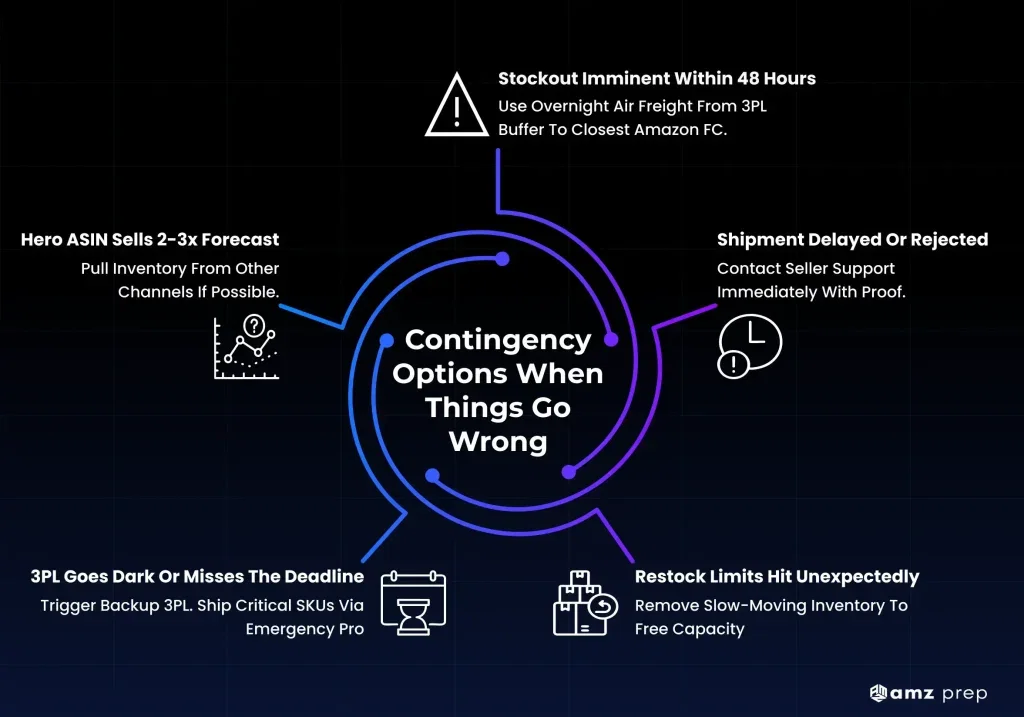
Despite perfect planning, problems emerge during Q4. Having predetermined contingency responses prevents panic decisions:
Stockout imminent within 48 hours
Overnight air freight from the 3PL buffer stock to the Amazon FC closest to your buyer concentration. Yes, it’s expensive. No, you don’t have better options.
Shipment delayed or rejected
Contact Amazon Seller Support immediately with tracking proof. Document everything. Open a case within 24 hours. Meanwhile, source alternative inventory from any available channel.
Restock limits hit unexpectedly
Remove slow-moving inventory to free capacity. Create removal orders for aged stock. Consider liquidating underperformers through Amazon Warehouse Deals.
3PL goes dark or misses the deadline
Activate secondary 3PL immediately. Ship anything critical via your emergency provider, even if it costs more.
Hero ASIN sells 2-3x forecast
Pull inventory from other channels if possible. Contact the factory for expedited production. Use air freight for replenishment. Don’t let winners starve while slow movers sit in stock.
Post-Q4 Analysis and 2026 Preparation
When December 26 arrives, your Q4 operation doesn’t end. It transitions into reverse logistics management and performance analysis.
The Returns Surge
In 2026, expect returns processing to extend through February 2027. Categories like apparel, electronics, toys, and beauty see 25-35% return rates for gift purchases.
Prepare by:
- Maintaining 3PL capacity for returned inventory inspection and refurbishment
- Monitoring removal orders from Amazon fulfillment centers
- Having liquidation channels identified for unsellable returns
- Creating automated replacement rules in Seller Central for common return reasons
Returns represent sunk costs, but processing them efficiently recovers more value than passive approaches.
Liquidation Strategy for Excess Inventory
Products that didn’t sell as forecasted create aged inventory problems in Q1. Options for moving excess stock:
| Liquidation Channel | Recovery Rate | Processing Time | Best For | Volume Capacity |
|---|---|---|---|---|
| Amazon Outlet/Warehouse Deals | 5-10% of cost | 1-2 weeks | Generic products, overstock | High |
| External liquidators (B2B) | 10-15% of the cost | 2-4 weeks | Branded items with retail value | Very High |
| Flash sales to email list | 15-25% of cost | 1 week | Existing customer base | Medium |
| DTC clearance section | 20-30% of cost | Ongoing | Products with brand equity | Medium |
- Amazon Outlet and Warehouse Deals: Amazon’s built-in liquidation channels. Recovery rates typically reach 5-15% of wholesale cost.
- External liquidators: B2B liquidation partners often pay 10-20% of the cost for branded products with retail value.
- Flash sales to existing customers: Email list clearance sales can recover 20-30% of cost while maintaining some brand control.
- DTC clearance sections: Direct-to-consumer channels on your own website provide the highest recovery rates but require operational infrastructure.
Act quickly on liquidation decisions. Every month holding aged inventory costs money in storage fees and ties up capital needed for 2026 inventory purchases.
Building Your 2027 Prep Operating Procedures
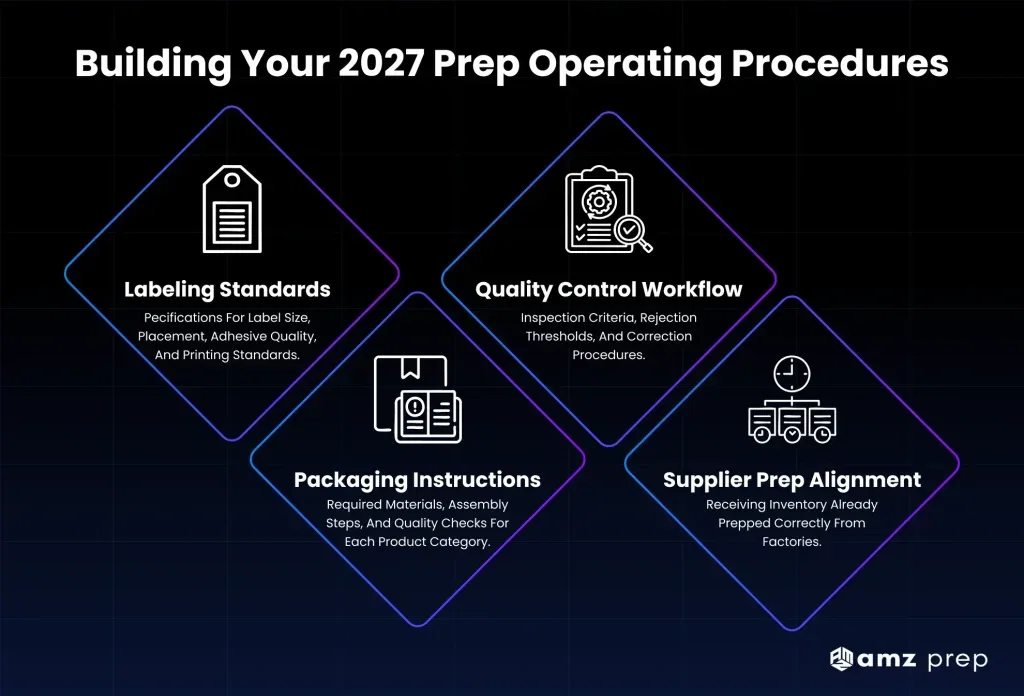
Use Q4 2026 as your lab to develop the prep systems you’ll need after Amazon’s service shutdown. Final size:
- Complete labeling guidelines with specifications for label size, placement, adhesive quality, and printing standards.
- Packaging instructions detailing required materials, assembly steps, and quality checks for each product category.
- Quality control workflows defining inspection criteria, rejection thresholds, and correction procedures.
- Supplier coordination processes for receiving inventory already prepped correctly from factories.
- These documents are now essential for Q4 2026 and beyond, as Amazon’s prep service is no longer available.
Forecasting Accuracy Review
Compare actual Q4 2026 sales against forecasts by ASIN. Calculate:
- Forecast accuracy percentage (actual / forecast × 100)
- Stockout days lost due to under-forecasting
- Excess inventory units from over-forecasting
- Revenue impact from stockouts versus storage costs from excess
Products where forecasts missed by >30% require investigation. Did market conditions shift? Did advertising underperform? Did competitors launch superior products? Understanding forecast misses improves 2026 accuracy.
Conclusion
Q4 2026 represents more than a revenue opportunity, it’s your operational stress test before the January 2026 prep service shutdown.
Sellers who execute disciplined forecasting, secure 3PL relationships, and implement redundant supply chains will capture market share from unprepared competitors.
The difference between six-figure Q4 success and catastrophic stockouts comes down to preparation timing, not capital or talent.
Start your inbound shipments by week 42, document every prep process, and treat this season as your 2026 training ground. Your competition is waiting until October. You’re moving now.
FAQs
When should I start shipping inventory for Black Friday/Cyber Monday 2026?
Inventory must arrive by Oct 19 (minimal splits) or Oct 29 (distributed splits). Add 5–7 days for transit and delays. Most sellers ship in early October; many start in September. AWD replenishment deadline: Oct 9.
What is Amazon discontinuing in the Jan 2026 prep shutdown?
As of January 1, 2026, Amazon no longer provides FBA prep and labeling services. This applies to all inbound paths. Shipments created before Jan 1 still get prep, but after that, all units must arrive fully prepped.
How do I calculate Q4 safety stock?
Use: Safety Stock = (Peak Daily Sales × Max Lead Time) × 1.3–1.5.
Peak = your highest Q4 day. Lead time = worst-case delays. Use a higher multiplier for uncertain demand.
What are the Q4 2026 peak fees, and how do they affect margins?
Peak fees apply Oct 15–Jan 14, with storage nearly doubling. Margins drop noticeably – e.g., 30% may fall to ~22%. Use the FBA Revenue Calculator and adjust pricing early.
Should I use case packing or individual packing?
Use case packing by default, it’s 40–60% faster to receive. Use individual packing only for mixed SKUs, bundles, differing expiries, or oversized items.

Danny is a Fulfillment Expert at AMZ Prep who has established himself as a leader in supply chain optimization. His proven methodologies have helped organizations reduce fulfillment errors by 95%, implement sustainable packaging programs, and build distribution networks that scale profitably.

















Comments