Ready for a sales surge like no other? Amazon Prime Day 2026 is your golden ticket.
In 2025, Prime Day ran four days, from July 8 to 11, and set new sales records. For 2026, Amazon has moved the event earlier. It now runs June 23 to 26.
Sellers who prepared strategically saw average sales increases of 5-10x their normal daily volume, proving that Prime Day remains the single biggest opportunity for Amazon sellers each year.
With over 200 million Prime members shopping in 2024, it became the biggest Amazon sales day ever. And 2026? It’s expected to be even bigger.
If you’re asking ‘When is Amazon Prime Day 2026?’ or ‘How do I stand out in the chaos?’ – you’re in the right place. This guide breaks down everything you need to know to maximize profits, dominate your niche, and make Prime Day your biggest win yet. Let’s dive in and get you Prime-ready!
What Is Amazon Prime Day?
Amazon Prime Day is Amazon’s biggest annual shopping event, exclusively available to Prime members worldwide. Originally launched in 2015 to celebrate Amazon’s 20th anniversary, Prime Day is a multi-day mega-sale that competes with Black Friday and Cyber Monday in terms of sales volume and seller opportunities.
How Prime Day Works?
Prime Day operates as a members-only shopping event featuring:
- Lightning Deals: Limited-time offers with restricted quantities that sell out quickly
- Prime Day Deals: Exclusive discounts available throughout the full event
- Prime Exclusive Offers: Special pricing only available to Prime members
Why Prime Day Matters for Sellers?
For Amazon sellers, Prime Day is the single biggest sales opportunity of the year. Unlike regular promotional periods, Prime Day creates a unique shopping rush where:
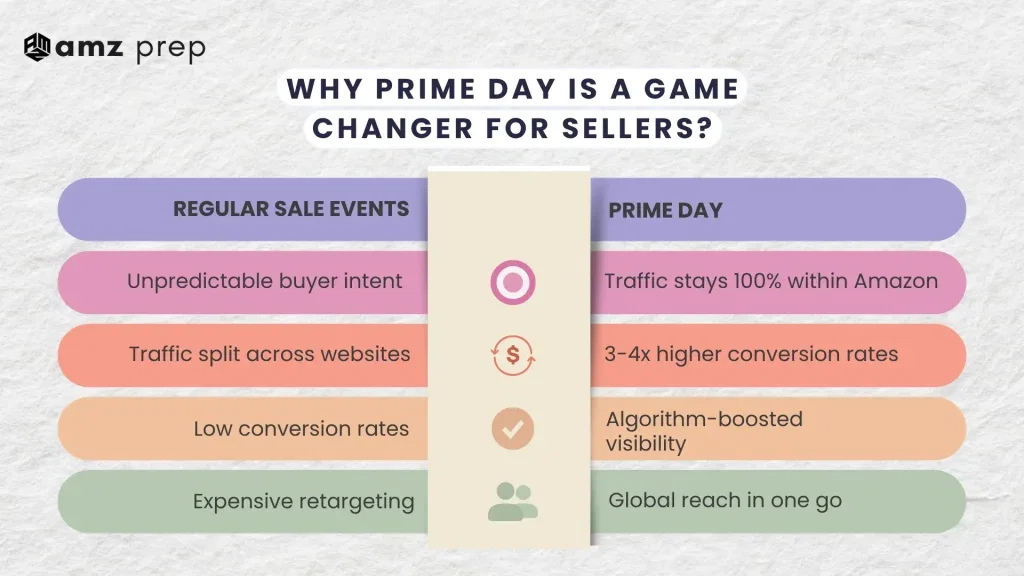
- Customer Intent is Maximized: Shoppers specifically log in to find deals and are ready to buy
- Competition is Intense but Fair: All sellers compete on the same playing field with clear rules
- Traffic Volume Peaks: Amazon drives massive marketing spend to promote the event globally
- Conversion Rates Soar: Shoppers expect deals and convert at 3-4x normal rates
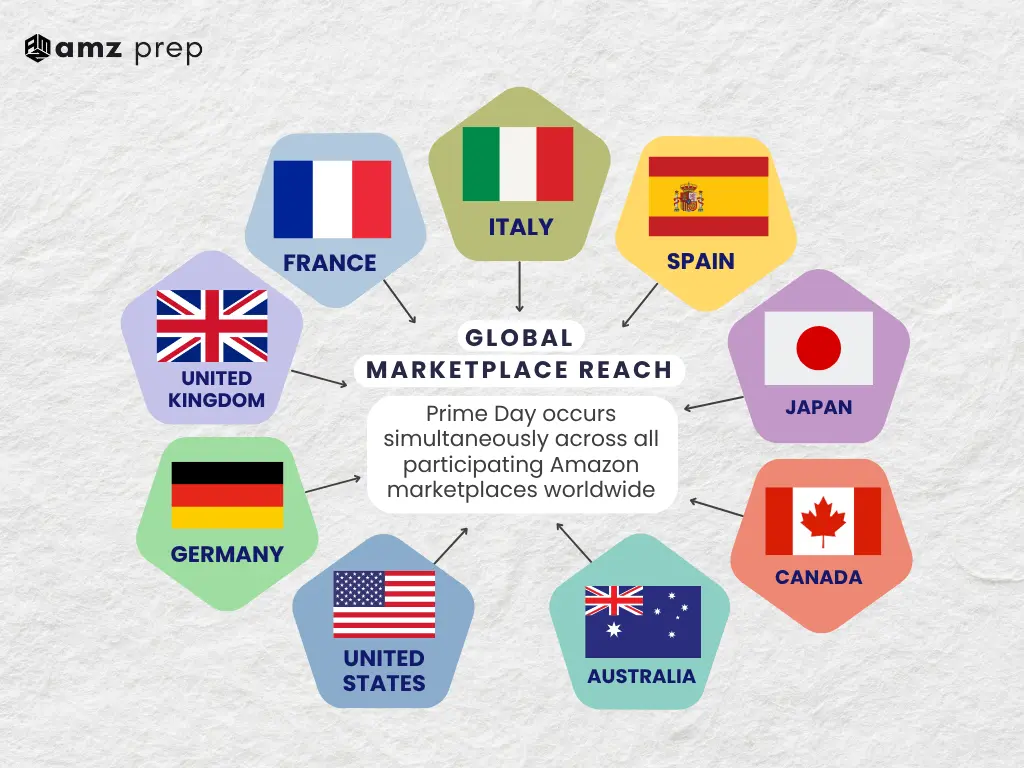
The event has grown from a single-day sale to a global phenomenon in multiple countries, with each marketplace running its own version of Prime Day. This event creates opportunities for sellers to participate across multiple international markets simultaneously.
Prime Day vs. Other Sales Events
While Black Friday and Cyber Monday dominate the broader retail and eCommerce world, Amazon Prime Day stands apart for one key reason. I.e., it lives entirely within Amazon’s ecosystem.
Recent economic trends have changed how customers approach online shopping, making Prime Day even more strategically important for sellers:
Inflation-Driven Deal Seeking (2023-2025)
With inflation rates affecting everyday purchases, customers have become increasingly deal-conscious and selective about their spending. According to McKinsey’s State of the Consumer 2025, three-quarters of customers traded down in purchasing decisions during 2024, with inflation expectations rising significantly.
Shift Toward Value-Based Shopping
Customer spending patterns show a clear trend toward “planned splurging” – where buyers research deals in advance and make larger purchases during specific sale events. Data reveals that the average consumer spent $57.97 on Prime Day 2024.
Economic Uncertainty and Prime Membership Value
During economic uncertainty, customers prioritize subscriptions that deliver consistent value. Amazon Prime subscription service hit a new high of 180 million US shoppers in March 2024, an 8% increase from the previous year, with nearly three-quarters of all US households now being Prime members.
What makes Amazon Prime Day different?
- 100% Amazon-Centric Traffic
Unlike other sales events where traffic is split across platforms and websites, Prime Day keeps all traffic within Amazon. Every shopper is already on the platform and ready to buy and no need to redirect or retarget. - Prime Member Exclusivity = High-Intent Buyers
With over 200 million Prime members globally, the event is limited to Amazon’s most loyal and purchase-ready customers. These shoppers are more likely to convert, spend more, and shop faster. - Algorithm-Driven Visibility Boost
Amazon favors Prime Day deals with increased search placement, featured listings, and personalized recommendations. If your listing is optimized and part of a deal, you get a massive visibility lift that can carry over post-event. - Globally Synchronized Event
Prime Day isn’t just a U.S. event, it runs simultaneously across key international marketplaces like the UK, Canada, Germany, India, and Japan. That means sellers with global inventory can benefit from a coordinated surge in demand across markets.
Because of these unique elements, Prime Day isn’t just another sales holiday – it’s a carefully held, high-stakes sales accelerator. Success requires tailored prep: lightning deals, inventory planning, ad strategy, listing optimization, and fulfillment coordination.
So, if you’re approaching Prime Day like any other promotional event, you’re already falling behind.
Do continue to read and find out how to get deals approved in Amazon, inventory planning, fulfillment coordination, and much more.
Amazon Prime Day 2026: Official Dates and Timeline
Amazon has confirmed the dates for Amazon Prime Day 2026. The event runs June 23 to 26, 2026. It starts at 12:01 a.m. PDT on June 23 and lasts four full days.
This is earlier than the usual July window. The last time Prime Day landed in June was 2021. The event is open to Prime members only, with deals across more than 35 categories.
With Prime Day in late June, your prep window moves up. Start now to meet FBA submission deadlines and lock in inventory positioning.
Key dates at a glance:
- Event window: June 23 to 26, 2026 (four days)
- Start time: 12:01 a.m. PDT, June 23
- Access: Prime members only
- FBA inventory: submit 3 to 4 weeks before the event
Why Amazon Extended Prime Day to 4 Days in 2025?
Amazon’s decision to extend Prime Day 2025 to four days reflects several strategic shifts:
Increased Global Participation
With Prime membership growing to over 200 million globally, the extended timeline accommodates different time zones and shopping patterns across international markets, allowing for more coordinated global participation.
Competition Response
The four-day format directly competes with other major retail events like Singles Day (11.11) and Black Friday weekend, positioning Amazon as the dominant mid-year shopping event.
Enhanced Customer Experience
Amazon’s data shows that longer sale periods reduce website congestion, improve customer satisfaction, and allow shoppers more time to research and make informed purchasing decisions rather than impulse buying under time pressure.
What Sells Most on Prime Day: Top Categories and Products
Understanding what products perform best during events like prime day is crucial for sellers looking to maximize their success and increase sales.
2026 Trending Categories to Watch:
Based on 2025 Prime Day performance and emerging consumer trends, these categories are positioned for exceptional growth in Prime Day 2026:
- AI-Powered Home Devices: Smart home integration with AI assistants
- Sustainability Products: Eco-friendly alternatives seeing 45% YoY growth
- Home Office Upgrades: Continued hybrid work driving desk accessories, ergonomic furniture
- Health Tech: Wearables, sleep trackers, at-home health monitoring
Outdoor Recreation: Post-pandemic outdoor activity trend sustaining strong
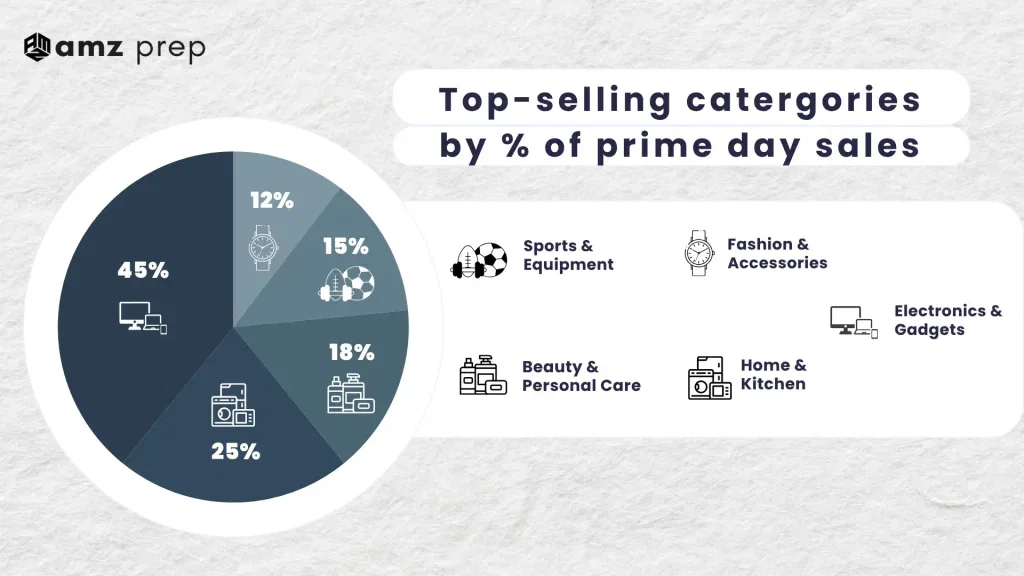
1. Electronics & Tech Gadgets (45% of Total Sales)
Electronics dominate sales on prime day, with some products seeing 8-12x their normal sales volume. These products consistently appear on the amazon deals page during the event:
- Wireless earbuds and headphones
- Smart watches and fitness trackers
- Phone accessories and cases
- Smart home devices and tech gear
Success in electronics requires average price discounts of 30-50%, but sellers can typically maintain profit margins of 15-25% even with these significant discounts. The high conversion rates during Prime Day, often 3-4 times normal levels, make these margins worthwhile for the volume generated, especially when targeting new customers.
2. Home & Kitchen Appliances (25% of Total Sales)
Small appliances under $100 perform exceptionally well during the biggest prime day events, consistently ranking among the best deals and lightning deals:
Top sellers:
- Air fryers and kitchen gadgets
- Coffee makers and espresso machines
- Robot vacuums and cleaning devices
- Storage and organization products
The appeal of this category lies in its practicality. These aren’t impulse purchases but rather practical items that consumers actively need. This means conversion rates are typically 35-40% higher than normal during Prime Day. Also, customer satisfaction tends to be high because buyers are purchasing products they’ll actually use on a daily basis from your amazon store.
3. Beauty & Personal Care (18% of Total Sales)
Beauty products see massive spikes during Prime Day, particularly with bundle strategies that offer prime-exclusive price discounts:
Best performers:
- Skincare sets and routines
- Makeup palettes and tools
- Hair styling devices
- Men’s grooming products
The bundling strategy works particularly well in beauty because prime customers like to try complete routines rather than individual products. These exclusive deals help attract new customers while satisfying existing prime subscribers.
4. Fashion & Accessories (15% of Total Sales)
Summer fashion items align well with the late-June Prime Day timing, giving you a strong window to showcase your best products:
- Swimwear and summer clothing
- Sandals and summer footwear
- Sustainable fashion options
- Athleisure and activewear
The key in fashion is timing inventory to summer trends. Plan for back-to-school demand that builds later in the summer, after the late-June event.
5. Sports & Fitness Equipment (12% of Total Sales)
Outdoor and home fitness equipment perform surprisingly well during Prime Day. This category benefits from summer activity trends and the general fitness motivation that many people experience during warmer months, making it perfect for prime-exclusive offers.
Popular products include:
- Yoga mats and accessories
- Resistance bands and weights
- Outdoor recreation gear
- Home gym equipment
Optimizing Your Listings for Top-Selling Categories
Now that you understand which categories dominate Prime Day sales, optimizing your product listings for these high-performing niches becomes critical.
Your keyword strategy should target four distinct categories that align with Prime Day shopping behavior:
Event-Specific Terms:
- ‘Prime Day deals,’ ‘Prime exclusive,’ ‘Lightning deals’
- Amazon Prime Day 2026,’ ‘June deals,’ ‘Prime member special
Seasonal Modifiers:
- ‘Summer 2026,’ ‘June deals,’ ‘back-to-school’
- ‘Summer essentials,’ ‘outdoor gear 2026’
Urgency Keywords:
- ‘Limited time,’ ‘today only,’ ‘while supplies last’
- ‘Flash sale,’ ‘countdown deal,’ ‘expires soon’
Category + Discount Combinations:
- ‘Electronics 50% off,’ ‘kitchen deals,’ ‘beauty bundle sale’
- ‘Fitness equipment discount,’ ‘summer fashion clearance’
Check out our Amazon Prime Day ROI Calculator to see how much profit you could make this Prime Day. Know your numbers. Maximize your sales.
How to Prepare for Prime Day: Your 4-Week Action Plan
Success on Prime Day requires the right strategy. Here’s your 4-week action plan that helps you with the preparation for Prime Day, designed to help third-party sellers and independent sellers maximize their opportunities:
Week 1: Inventory & Deal Strategy
Inventory planning requires careful analysis of your previous sales history, seasonal trends, and category-specific multipliers that predict Prime Day performance, Sellers should also account for packaging needs in advance, especially if using custom size mailer boxes to streamline fulfillment and protect product presentation. Start by conducting a comprehensive audit of your current stock levels across all products.
This isn’t just about counting units – you need to analyze which products have the sales velocity and customer satisfaction scores that make them viable for deals for prime members. Products with consistent daily sales and ratings above 4 stars are your best options for the big spring sale and similar events.
Calculate your inventory needs using the Prime Day formula:
Prime Day Inventory Need = (Normal Daily Sales × Category Multiplier × 4 Days) + Safety Stock
Don’t forget that running out of stock during Prime Day is one of the most expensive mistakes you can make, especially when you’ve invested in creating promotion campaigns.
Week 2: Systems Testing & Supplier Coordination
Focus on testing your inventory management systems and finalizing supplier arrangements. Coordinate delivery schedules and position inventory strategically across your fulfillment network.
Make sure to:
- Test all inventory and order processing systems
- Implement quality control checkpoints for incoming stock
- Update product listings and prepare basic advertising campaigns
Week 3: Final Testing & Pre-Launch
Week three focuses on testing all your systems and launching your pre-Prime Day marketing campaigns. This is your last chance to identify and fix any issues before the intense four-day period when problems become very expensive.
Complete all inventory positioning and verify your real-time tracking systems are functioning correctly. Brief your fulfillment team on Prime Day procedures and volume expectations.
System testing should include verifying your inventory management systems, testing pricing and repricing tools, and briefing your customer service team on Prime Day procedures.
Launch your external marketing campaigns during this week:
- Activate social media countdown campaigns to create excitement
- Send email teasers to your subscriber list targeting new prime members
- Launch retargeting campaigns targeting previous customers and website visitors
Week 4: Execution & Real-Time Management
Your final week before Prime Day is about ensuring flawless execution of all the preparation you’ve done over the previous weeks. This is not the time for major changes or new strategies.
During Prime Day execution, monitor your performance every 2 hours. Track key metrics including:
- Stock levels
- Sales velocity
- Ad performance
- Customer feedback
Be prepared to adjust PPC bids in real-time based on performance, and respond to customer inquiries immediately to maintain high customer satisfaction scores while managing amazon fees effectively.
Get our interactive checklist that has everything from initial planning to post-event optimization!
Cross-Border Selling Opportunities During Prime Day
Prime Day presents unique opportunities for cross-border sellers to maximize their international reach and revenue potential. Understanding how to use global marketplaces during this high-traffic period can significantly expand your customer base and sales volume.
International Marketplace Strategy
Prime Day 2026 runs at the same time across all participating Amazon marketplaces worldwide, June 23 to 26, creating a global shopping event. This synchronized timing means sellers enrolled in Amazon’s global selling programs can maximize their reach during a concentrated 4-day period across markets including the US, UK, Germany, France, Italy, Spain, Japan, Canada, Australia, and many others.
The simultaneous global timing intensifies competition but also creates massive opportunities for sellers who can effectively manage inventory and campaigns across multiple marketplaces during the same period.
Currency and Pricing Optimization
Cross-border selling during Prime Day requires sophisticated pricing strategies that account for currency fluctuations, local competition, and regional purchasing power. Use Amazon’s automated pricing tools to maintain competitive positioning across different currencies while protecting your profit margins.
Inventory Positioning for Global Sales
Successful cross-border Prime Day selling requires strategic inventory placement. Amazon’s Global Selling program allows you to fulfill orders from your home marketplace to international customers using Fulfillment by Amazon (FBA).
Allocate inventory based on historical performance in each marketplace, accounting for the fact that Prime Day multipliers can vary significantly between regions based on local competition and customer behavior.
Compliance and Documentation
Each international marketplace has specific requirements for product compliance, labeling, and documentation. Ensure all your products meet local regulatory requirements well before Prime Day. This includes product certifications, ingredient listings for consumables, and proper classification for customs purposes.
Prepare all necessary customs documentation in advance, as any delays during Prime Day can result in lost sales and customer dissatisfaction.
Multi-Marketplace Campaign Management
Running Prime Day campaigns across multiple international marketplaces requires careful coordination of advertising spend, deal timing, and inventory allocation. Use Amazon’s global campaign management tools to synchronize your promotional activities while accounting for local holidays, cultural preferences, and competitive landscapes.
Monitor performance across all marketplaces in real-time, as successful campaigns in one region can inform quick optimizations in others during the Prime Day period.
Understanding Amazon’s Seasonal Rules and Compliance Requirements
Getting to know about Amazon’s seasonal rules is important as you get prepared for Amazon Prime Day 2026.
Inventory Performance Index (IPI) Requirements
Amazon enforces stricter performance metrics during Prime Day. The platform requires a minimum IPI score of 400, but during peak seasons like Prime Day, sellers with scores below this threshold face storage limitations and reduced inventory capacity.
FBA Capacity and Shipment Restrictions
FBA capacity and shipment restrictions also tighten during Prime Day preparation. Monthly storage limits are often reduced during peak seasons and inbound shipment processing can take up to 5 business days instead of the usual 2-3 days.
Amazon enforces stricter requirements for shipment preparation and labeling. Limited space availability at fulfillment centers will make you wait until the last minute to send in your inventory.
2026 FBA Capacity Restrictions: What Sellers Must Know
CRITICAL UPDATE: Amazon has implemented stricter FBA capacity limits in 2026. Starting January 2026:
- Capacity is now measured by volume (cubic feet) rather than units
- Limits are personalized based on your IPI score and sales velocity
- Prime Day inventory must be submitted 3-4 weeks earlier than previous years
Action Required:
- Check your capacity limits in Seller Central → Inventory → FBA Dashboard
- Use AMZ Prep’s distributed fulfillment network to supplement FBA capacity
- Consider Seller Fulfilled Prime (SFP) for overflow inventory
- Monitor restock recommendations daily starting 8 weeks before Prime Day
Enhanced Performance Standards
During Prime Day, Amazon expects:
- Customer service response times under 24 hours (ideally under 12 hours)
- Order Defect Rates below 1%
- Return and refund processing within 2 business days
Amazon also enforces stricter listing quality standards during peak periods, so any issues with your product listings need to be resolved well before Prime Day.
Category-Specific Restrictions
Category-specific restrictions can also impact your ability to participate in Prime Day deals. Health, beauty, and electronics categories often require additional approvals, enhanced safety documentation, and may face shipping restrictions for hazmat or oversized items.
Certain categories require pre-approval for Lightning Deals, so research your category requirements early in your preparation process.
International Seller Considerations
International sellers face unique challenges during Prime Day that require specialized preparation:
- Currency fluctuations can dramatically impact Prime Day profitability
- Exchange rate changes of even 3-5% can affect profit margins entirely
- VAT registration required in all selling countries before Prime Day
- Tax settings must be updated for promotional pricing
- Increased tax reporting requirements with higher sales volume
Disclaimer: Amazon policies and requirements are subject to change. Always verify current requirements through Amazon Seller Central and consult with tax professionals for international compliance.
2026 Cost Considerations: Tariffs, Inflation, and Pricing Strategy
Tariff Updates: As of February 2026, tariffs on Chinese imports remain at 7.5-25% depending on product category. Factor these into your landed cost calculations:
Landed Cost = (Product Cost + Shipping + Tariffs + Duties) × 1.15 (Amazon fees) × 1.3 (desired margin)
Inflation Impact: With inflation moderating but still present:
- Warehouse storage costs up 15-20% since 2024
- Shipping rates increased 10-15% for most carriers
- Labor costs for prep and fulfillment up 8-12%
Pricing Strategy for 2026: Don’t discount so deeply that you lose money. Calculate minimum profitable selling price BEFORE applying Prime Day discounts. Use this formula:
Minimum Price = All Costs + (All Costs × 0.15)
Never discount below this number, even for Prime Day visibility.
How To Get Your Deals Approved on Amazon?
Getting your deal approved is one of the biggest challenges sellers face in Prime Day preparation. Amazon receives thousands of deal applications and approves only a fraction of them.
Understanding what Amazon looks for and how to position your products for approval can make a huge difference. Let’s look into it!
Lightning Deals Application Strategy
The Lightning Deals application process begins with checking your eligibility. You need at least a 3-star rating on your products, though 4+ stars significantly improve your approval odds. Brand Registry enrollment also helps, as Amazon prefers to promote products from verified brands.
Steps to Apply:
- Navigate to Advertising → Deals → Lightning Deals
- Select your best performers: Choose products with consistent sales
- Set competitive discounts: Minimum 20%, but 30%+ improves approval odds
- Choose time slots: Submit early as popular slots fill quickly
- Submit 6 weeks early: Don’t wait until the last minute
What Amazon Looks For:
- Sales velocity: Consistent daily sales history
- Customer satisfaction: High ratings and low return rates
- Inventory levels: Sufficient stock to meet expected demand
- Price competitiveness: Fair regular pricing before discounts
Tips for Higher Approval Rates
Successful sellers use several tactics to improve their deal approval rates. Some of the tactics are,
- Submit multiple products to increase overall approval odds
- Use seasonal keywords in product titles
- Ensure all product images are mobile-optimized
- Maintain at least 50 reviews before applying
- Keep return rates low with accurate product descriptions
Pricing & Mobile Optimization Strategy for Prime Day
Mobile devices drove $7 billion in Prime Day 2024 sales, nearly half of all purchases. Your pricing strategy must work seamlessly across all devices, especially mobile where users make decisions 40% faster.
Strategic Discount Framework
Use the 30-20-10 rule for maximum impact:
- 30% discount: Lightning Deals (maximum visibility)
- 20% discount: Regular Prime Day deals
- 10% discount: Prime-exclusive offers
Mobile-Optimization
Since mobile users make lightning-fast decisions, your pricing display is critical:
Psychological Pricing Tactics:
- End prices in 7, 9, or 5 (not 0) for perceived value
- Use bold “Was $X, Now $Y” formatting that’s readable without zooming
- Create urgency with “Limited quantities” messaging
- Bundle products for higher perceived value
Mobile Display Requirements:
- Large, high-contrast pricing visible on small screens
- Countdown timers that work on mobile devices
- Star ratings prominently displayed (mobile users rely heavily on social proof)
Quick Mobile Optimization Checklist
Images:
- Hero image compelling at thumbnail size
- Product fills 80-85% of image frame
- High contrast, no cluttered backgrounds
Titles & Content:
- Front-load keywords in first 80 characters (mobile truncation point)
- Keep bullet points short and scannable
- One key benefit per line
Performance Requirements:
- Load speed under 3 seconds (critical during traffic surges)
- Test pricing display on actual mobile devices before Prime Day
Mobile Advertising Adjustments
Increase mobile bids by 50-100% during Prime Day, higher conversion rates justify the cost.
Target mobile-specific keywords: “cheap phone case” vs. “affordable protective smartphone accessory”
Note: Your pricing strategy means nothing if mobile users can’t see or understand your deals quickly. Test your complete pricing presentation on mobile devices, what looks perfect on desktop often becomes unreadable on phones, costing thousands in lost Prime Day sales.
Prime Day Advertising Strategy: Maximize Your ROI
Prime Day advertising requires a completely different approach than normal Amazon advertising. The increased competition, higher costs, and less timeframe mean that your regular advertising strategies won’t be sufficient to make use of the huge opportunity.
Strategic Budget Allocation for Maximum Impact
Successful Prime Day advertising starts with increasing your advertising budget. Plan to increase your normal advertising spend by 3-5x during Prime Day, but allocate this increased budget strategically across different campaign types:
- 60% to Sponsored Products campaigns (highest ROI during Prime Day)
- 25% to Sponsored Brands campaigns for maximum visibility
- 15% to Sponsored Display campaigns to retarget viewers
Bidding Strategy
Increase your bids by 200-300% during Prime Day compared to your normal bidding levels. Use dynamic bidding with the ‘Down only’ setting to control costs while still competing for high-value placements.
Target your highest-converting keywords, even if the cost per click looks high. The increased conversion rates during Prime Day often make these higher costs worthwhile.
Make sure to pause your low-performing campaigns during Prime Day to focus your entire budget on what actually wins.
External Marketing Channels
Don’t rely solely on Amazon’s traffic during Prime Day. Social media advertising on Facebook, Instagram, TikTok, and Pinterest can drive additional qualified traffic to your Amazon listings. Target users interested in Prime Day deals and your specific product categories.
Implement a strategic email marketing sequence including:
- Pre-Prime Day teasers to create excitement
- Prime Day launch announcements
- Limited-time reminders to create urgency
- Post-Prime Day thank you messages with cross-sell opportunities
2026 Advertising Cost Reality: Prime Day 2026 advertising costs are expected to increase 15-25% compared to 2025:
- Average CPC for top keywords: $2.50-$8.00 (up from $2.00-$6.50 in 2025)
- Sponsored Brand costs: $1.50-$5.00 per click
- Sponsored Display: $0.50-$2.00 per click
Budget Strategy: Plan for 300-500% increase in daily ad spend during Prime Day, but expect 400-800% increase in conversion rates, making the higher costs worthwhile.
AMZ Prep’s Complete Prime Day Fulfillment Solution
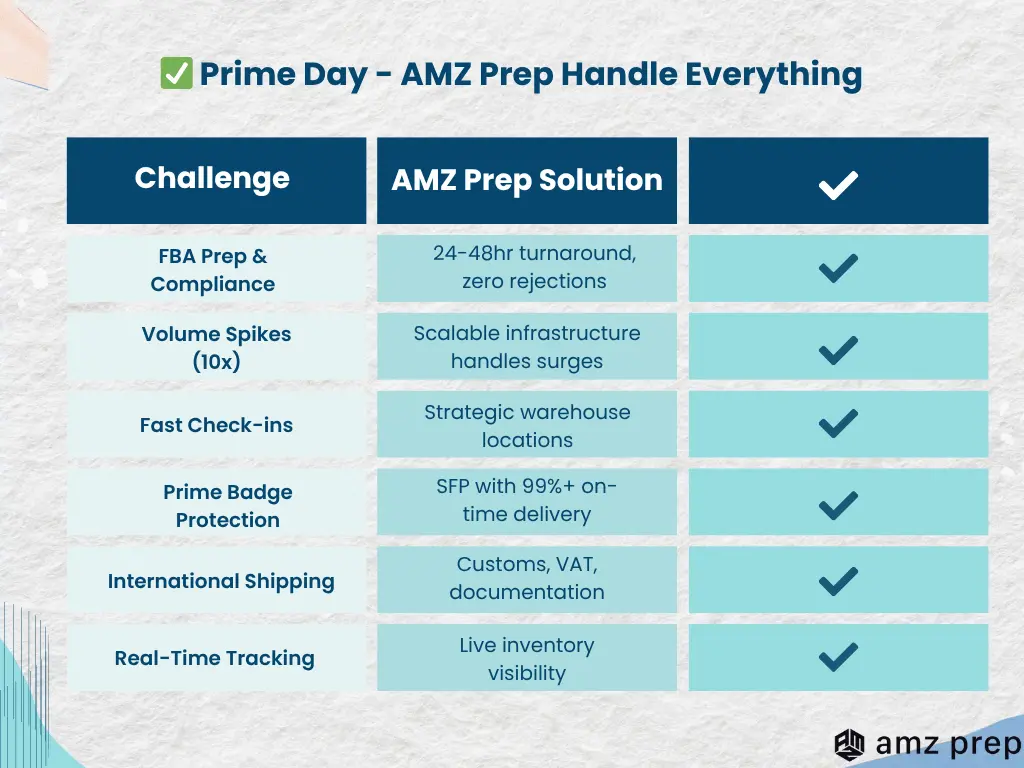
Amazon Prime Day isn’t just another sales event, it’s a logistical stress test. Sellers often face order spikes of 5x–10x their normal volume, and the slightest error in prep, labeling, or timing can lead to missed check-ins, lost Buy Boxes, or stranded inventory. At AMZ Prep, we provide a purpose-built Prime Day logistics solution designed to help Amazon sellers scale seamlessly, maintain compliance, and turn this high-pressure period into their most profitable sales window.
FBA Prep & Compliance
Amazon’s FBA requirements become even more challenging during Prime Day. From labeling to palletizing, every detail must be perfect to avoid delays or rejections.
Our FBA prep teams process tens of thousands of units daily, meeting Amazon’s exact standards. Here’s what we deliver:
- 24 – 48 hour prep turnaround (same-day available for scheduled inventory)
- Barcode labeling, bundling, poly bagging, and custom packing
- Amazon-compliant documentation: box content info, Bill of Lading (BOL), pallet labels
- 5-point inspection and QA at every step to ensure zero rejections
Warehouse Locations:
We strategically located warehouses across the USA, Canada, Australia, and Europe for seamless delivery. That means:
- Shorter inbound shipping times
- Lower freight costs
- Faster check-ins
Seller Fulfilled Prime (SFP) Excellence
Maintaining your Prime badge during peak season requires ultra-fast shipping and high on-time delivery rates. AMZ Prep handles this at scale. We support SFP across the U.S., keeping your orders compliant with Amazon’s 1–2 day delivery promises.
Highlights:
- Fulfillment from strategically placed warehouses for national 2-day coverage
- Carrier integrations with USPS, UPS, FedEx, and regionals
- Performance monitoring to safeguard your account health
Even with 500% volume increases, our systems handle the load, without missing a delivery deadline.
International Compliance & Customs
Selling from outside the U.S.? Prime Day gets even more complex. Our team handles customs clearance, regulatory paperwork, and VAT documentation, so your inventory lands on time and without friction. Support Includes:
- HS code classification and import documentation
- Coordination with freight forwarders and customs brokers
- Pre-booked delivery appointments to Amazon FCs
Real-Time Inventory Management
During Prime Day, you need real-time data and not just guesswork. Our Navigate Platform gives you full visibility into your supply chain, from receiving to delivery.
Key Features:
- Live inventory dashboards by SKU and warehouse
- Reorder alerts based on velocity and lead times
- Prep and processing timelines, tracked in real time
- Easy integration with Amazon
- When every minute counts, Navigate ensures you stay in control.
Scalable Fulfillment Network
Our multi-location fulfillment centers handle sudden volume spikes without compromising quality. When your sales increase 10x during Prime Day, our infrastructure scales seamlessly while maintaining same-day processing and shipping standards.
Custom Packaging & Brand Protection
Maintain your brand image during high-volume periods with our custom packaging options. Our brand protection protocols ensure your products arrive in perfect condition, supporting the customer experience that helps you drive positive reviews and repeat purchases.
Amazon Prime Day Mistakes & Solutions for Sellers
These mistakes given below are common, even among experienced sellers, because the intensity of Prime Day creates situations that don’t occur during normal selling periods.
Inventory Management
Problem: Running out of stock during Prime Day represents the most expensive mistake sellers can make. When you run out of stock during Prime Day, you lose your Lightning Deal slot permanently, your product ranking drops dramatically, competitors capture your customers, and lost sales can range from $10,000 to $100,000+ in just four days.
Solution: Use 90-day sales velocity + 50% buffer. Set reorder alerts at 7-day inventory levels.
Pricing Errors
Problem: Setting prices without researching competitor pricing results will either result in no sales if you’re overpriced, or no profit if you’re underpriced.
Solution: Use repricing tools for hourly price monitoring. Always calculate with a 35% fee buffer to avoid pricing errors.
Marketing Mistakes
Problem: Using normal advertising spend levels during Prime Day and making the mistake of relying solely on Amazon’s internal traffic
Solution: Increase ad budget 3-5x. Set hourly bid adjustments. Drive external traffic via other social platforms like Facebook/ Instagram.
Prime Day Crisis Management Plan
Even with perfect preparation, things can go wrong during Prime Day. Having crisis management protocols in place can mean the difference between a minor setback and a complete disaster. The key is preparing for problems before they occur and having response systems ready to activate immediately.
24/7 Monitoring Strategy for Early Problem Detection
Successful Prime Day monitoring requires checking key metrics every 2 hours during the event. Make sure you monitor stock levels to prevent stockouts, track sales velocity to identify underperforming products early, optimize ad performance hourly based on real-time data, and respond to customer feedback immediately to maintain high seller ratings.
Emergency Response Protocols
Account suspension during Prime Day requires immediate action. Contact Seller Support immediately, have a Plan of Action document template ready to customize quickly, keep legal team contact information readily available, and ensure any backup selling accounts are compliant and ready if needed.
Listing suppression can also occur during Prime Day due to increased scrutiny. Have backup ASINs ready for critical products, test all listings 48 hours before Prime Day to identify potential issues, and keep all images and keywords compliant with Amazon’s guidelines.
Post-Prime Day Optimization: Turning Short-Term Success into Long-Term Growth
Prime Day success extends far beyond the four-day event itself. The customers you acquire, data you collect, and momentum you build during Prime Day can drive business growth for months afterward.
Return Management & Post-Prime Day Strategy
Prime Day often leads to increased return rates due to impulse purchases and high-volume sales. The psychology of deal shopping encourages customers to buy items they might not normally purchase, leading to higher return rates in the weeks following Prime Day.
Proper return management protects your metrics and profitability during this critical period. Understanding why Prime Day returns increase helps you prepare more effectively.
Deal shoppers often purchase multiple similar items intending to return some, buy gifts without knowing exact preferences, or purchase items they later realize they don’t need. This behavior pattern is predictable and manageable with proper preparation.
Return Surge Preparation:
- Increase return processing capacity by 300% for 2 weeks post-Prime Day
- Prepare additional return inventory storage space
- Set up automated return processing workflows
Return prevention strategies can significantly reduce your post-Prime Day return rates while improving customer satisfaction.
Week 1 After Prime Day: Immediate Analysis and Action
Your first week after Prime Day should focus on comprehensive performance analysis.
Make sure to;
- Compare sales to goals and previous years
- Calculate true ROI after all costs
- Analyze new vs. repeat customers
- Assess inventory performance
To retain your customers,
- Send thank you emails to customers
- Request reviews from satisfied buyers
- Cross-sell related products
- Offer subscriptions for consumable products
Month 1: Long-Term Strategic Planning
Use your Prime Day data to identify winning products for future promotional events. You can analyze which strategies failed so you can improve them for next time. You can also optimize your advertising ROI based on what you learned during the Amazon Prime Day sale.
During other sales you can target your previous Prime Day customers with special offers by adjusting your pricing strategy based on what you learned.
Advanced Post-Prime Day Strategies
How to Buy Discounted Inventory from Other Sellers?
Not every seller sells out on Prime Day. Many end up with excess inventory or slow-moving products they want to liquidate. This opens up buying opportunities for other sellers.
Here’s how to source post-Prime Day inventory from other sellers:
Check Amazon Seller Forums and Groups: Many sellers post bulk inventory for sale after Prime Day.
Connect with local Amazon sellers: Facebook groups, Reddit, and Meetup groups often include sellers looking to offload surplus stock.
Scout Amazon itself: Amazon deals on returned items frequently surface at steep discounts in the weeks after Prime Day, and sellers who monitor these listings systematically can identify sourcing opportunities before other resellers spot them.
Buying discounted inventory can lower your cost per unit and improve margins when resold later.
Retail Arbitrage & Wholesale Opportunities After Prime Day
Prime Day creates fertile ground for retail arbitrage and wholesale reselling strategies.
Retail Arbitrage Strategies Using Prime Day Deals
Deal hunters aren’t the only ones watching Prime Day. Experienced sellers use the event to grab discounts and flip products post-event.
How to do it:
- Use price-tracking tools to find price gaps
- Buy fast-selling items with stable sales rank but Prime Day markdowns
- List them at regular price once the deal ends and supply tightens
- Be cautious with category restrictions and gated brands, but if done right, this strategy can be highly profitable.
Wholesale Opportunities from Overstock Situations
Some brands and private label sellers are left with too much stock after Prime Day. This creates wholesale buying opportunities.
What to do:
- Approach small brands that didn’t meet sales expectations
- Offer to take bulk units off their hands at discounted prices
- Negotiate direct-from-manufacturer deals for future buying
This method also builds long-term supplier relationships, especially if you show consistent interest during post-event liquidation phases.
Amazon Prime Day Tips: Final Success Strategies
Success strategies vary depending on your experience level and business size, but certain principles apply to all sellers looking to maximize their Prime Day results.
For New Sellers
Focus on 1-2 products rather than trying to sell too many products. Choose proven categories like electronics or home goods where demand patterns are predictable. Ensure you have at least 50 reviews before applying for deals, as this significantly improves your approval odds. Consider partnering with experienced prep services for logistics support, as the operational requirements can be overwhelming for new sellers.
For Experienced Sellers
Try selling multiple categories to boost sales and profit. Use Prime Day to test new products in your existing categories, as the high traffic provides excellent market testing opportunities. Use your historical data to optimize inventory planning with greater precision than newer sellers can achieve. Consider international expansion if you haven’t already, as Prime Day occurs globally.
Universal Success Factors
Maintain 4+ weeks of inventory post-Prime Day to capitalize on the momentum and avoid stockouts when demand remains elevated. Monitor competitor prices hourly during the event, as pricing can change rapidly during the competitive four-day period
Respond to customer inquiries within 2 hours to maintain high customer satisfaction scores. Have backup plans for every potential problem, from account issues to inventory problems to advertising campaign failures.
Conclusion
Amazon Prime Day 2026 represents a massive opportunity that occurs just once per year. Remember thatPrime Day success extends far beyond the four-day event itself.
The customers you acquire during Prime Day often become repeat buyers, the momentum you build carries forward for months, and the data you collect improves your business operations long-term.
The sellers who will dominate Prime Day 2026 are those who start preparation now, follow proven strategies, and execute with precision when June arrives. By implementing the strategies outlined in this guide, you’ll be positioned to make Prime Day 2026 your biggest sales event yet.
Frequently Asked Questions
When is Amazon Prime Day 2026?
Amazon confirmed Prime Day 2026 runs June 23 to 26. The four-day event starts at 12:01 a.m. PDT on June 23. It is open to Prime members only. Start FBA prep three to four weeks early.
How much inventory should I order for Prime Day 2026 given the new FBA restrictions?
With 2026 FBA capacity restrictions, use this formula: (Normal daily sales × Category multiplier × 4 days) + 50% safety stock + Additional overflow inventory with SFP/3PL. Due to earlier submission deadlines and stricter limits, work with fulfillment partners like AMZ Prep to supplement FBA capacity.
What products sell best during Prime Day?
Electronics (45% of sales), home & kitchen appliances (25%), beauty products (18%), fashion (15%), and sports equipment (12%) are top performers. Small appliances under $100 and tech gadgets see 8-12x normal sales volume.
How much inventory should I order for Prime Day?
Use this formula to order inventory for Prime Day: Normal daily sales × Prime Day multiplier × 4 days + 25-50% safety stock.
Can I participate in Prime Day without using FBA?
Yes, through Seller Fulfilled Prime (SFP) or regular FBM. However, Prime-eligible products get significantly more visibility. SFP requires meeting 2-day delivery standards consistently.
What happens if I run out of stock during Prime Day?
You’ll lose Lightning Deal slots permanently, rankings will drop, and you’ll miss sales opportunities. Always order 50% more inventory than calculated and have backup FBM stock ready.
How do I get my Lightning Deals approved?
Submit 6 weeks early, maintain 3+ star ratings, offer 25-35% discounts, and ensure sufficient inventory. Products with consistent sales velocity have higher approval rates.
Should I use a 3PL service for Prime Day?
Yes, if you’re processing 1000+ units or expanding internationally. 3PLs like AMZ Prep handle surges efficiently, ensure compliance, and let you focus on marketing and sales.
How do tariffs affect my Prime Day pricing?
Include tariff costs (7.5-25% on Chinese imports) in your landed cost calculations. Adjust Prime Day discounts accordingly to maintain profit margins, or consider alternative suppliers.
What’s the biggest mistake sellers make on Prime Day?
The biggest mistake sellers make on prime day is insufficient inventory planning. Running out of stock costs sellers $10K-$100K+ in 48 hours and permanently damages rankings. Always overestimate demand rather than underestimate.


















AMZ Prep continues to impress with their in-depth and practical content. This guide is a fantastic tool for any seller.
The tips on preparing for Prime Day are spot on. I’m already planning my strategy based on this guide.
This guide is a game-changer! The detailed breakdown of Prime Day’s timeline and seller strategies is invaluable. Can’t wait to implement these tips for the upcoming event.
The focus on logistics and fulfillment is exactly what I needed. This guide has given me a clear roadmap for Prime Day.
The section on fulfillment capabilities is especially helpful. Understanding the logistics behind Prime Day is crucial for success.
AMZ Prep’s expertise shines through in this post. The strategies outlined will definitely help sellers maximize their Prime Day sales.
I love how AMZ Prep breaks down complex information into easy-to-understand steps. This guide is a valuable resource.
appreciate the clarity on the expanded 96-hour Prime Day. It’s great to see AMZ Prep providing such comprehensive insights for sellers.
This blog post is a must-read for any seller looking to make the most of Prime Day. The insights are practical and actionable.
I found the information on Seller Fulfilled Prime particularly useful. It’s great to have such detailed guidance on this topic.