
Amazon shipping delays come from fulfillment center receiving backlogs, carrier scheduling issues, inbound prep errors, and upstream port congestion. In 2026, most delays for FBA sellers start inside Amazon’s own network, not at the port.

Amazon shipping delays in 2026 come from two places. Some start upstream, at ports and in winter weather. Most now start inside Amazon’s own network.
What changed for Amazon sellers in 2026
I run fulfillment operations every day. The biggest shift this year is not the weather. It is Amazon’s own rule changes. Four of them change how a delay hits your account.
OTDR enforcement update (February 28, 2026)
Amazon enforces a 90 percent on-time delivery rate on seller-fulfilled listings. The threshold did not change. The enforcement did.
Before, one weak area could take down your whole catalog. A drop below 90 percent deactivated all seller-fulfilled listings.
From February 28, 2026, Amazon only deactivates the listings driving the low score. Your other listings stay active.
This is better news for most sellers. It is not a free pass. If your OTDR sits far below 90 percent, or you fail repeatedly, Amazon can still deactivate every seller-fulfilled listing.
You can protect tracked orders. Pairing shipping settings automation with Amazon Buy Shipping and automated handling time shields you from carrier-caused delays.
FBA inbound prep changes (January 1, 2026)
As of January 1, 2026, Amazon stopped offering prep and labeling for US inbound shipments. This covers FNSKU labeling, poly-bagging, bubble wrapping, bundling, and boxing.
You now prep and label before the units reach the fulfillment center. Shipments created before January 1, 2026 could still use the old service.
Units that arrive unprepared get rejected, returned at your cost, or marked unfulfillable. That turns a small labeling miss into a delay or a loss. Correct FBA prep at the source keeps your inbound moving.
Commingling phase-out (March 31, 2026)
Starting March 31, 2026, Amazon changes how it handles commingled inventory. Resellers must apply FNSKU labels to all units.
Brand-registered owners can switch to manufacturer barcodes for virtual tracking. Reseller inventory received without proper barcodes after that date is treated as defective.
Clear labeling keeps your stock identifiable and moving through receiving.
FBA fee changes (January 15, 2026)
Amazon raised FBA fulfillment fees on January 15, 2026. The increase averages about $0.08 per unit, which Amazon states is less than 0.5 percent of an average item’s selling price.
The fee now also varies by product price band. Small standard items under the mid band rose more on average. Higher-priced standard items saw the largest average increase.
Holding extra stock to cover delays now costs more. Storage and fulfillment fees reward tighter inventory planning, not bigger safety stock.
How Long Do Amazon Shipping Delays Last?
Delay length depends on the cause. Here is what sellers typically see in 2026:
| Delay Type | Typical Duration | Notes |
|---|---|---|
| FBA receiving backlog | 3 to 10 business days | Peaks during Q4 and Prime events |
| Carrier transit delay | 1 to 5 business days | Weather or volume dependent |
| Inbound prep rejection | 5 to 14 business days | Units returned, re-prepped, reshipped |
| Port congestion | 5 to 20 business days | Ocean freight, varies by lane |
| Customs clearance | 2 to 7 business days | International shipments |
| Commingling barcode error | 3 to 10 business days | Units flagged as defective |
Amazon targets FBA receiving in 3 to 7 business days under normal conditions. During high-volume periods, sellers report waits beyond 14 days. Prep-related rejections are the most operationally costly because they require full return and reshipping before inventory goes live.
Where Amazon shipping delays start now
For years, sellers blamed the ocean. Ports and canals still matter. But most delays I see now start closer to home.
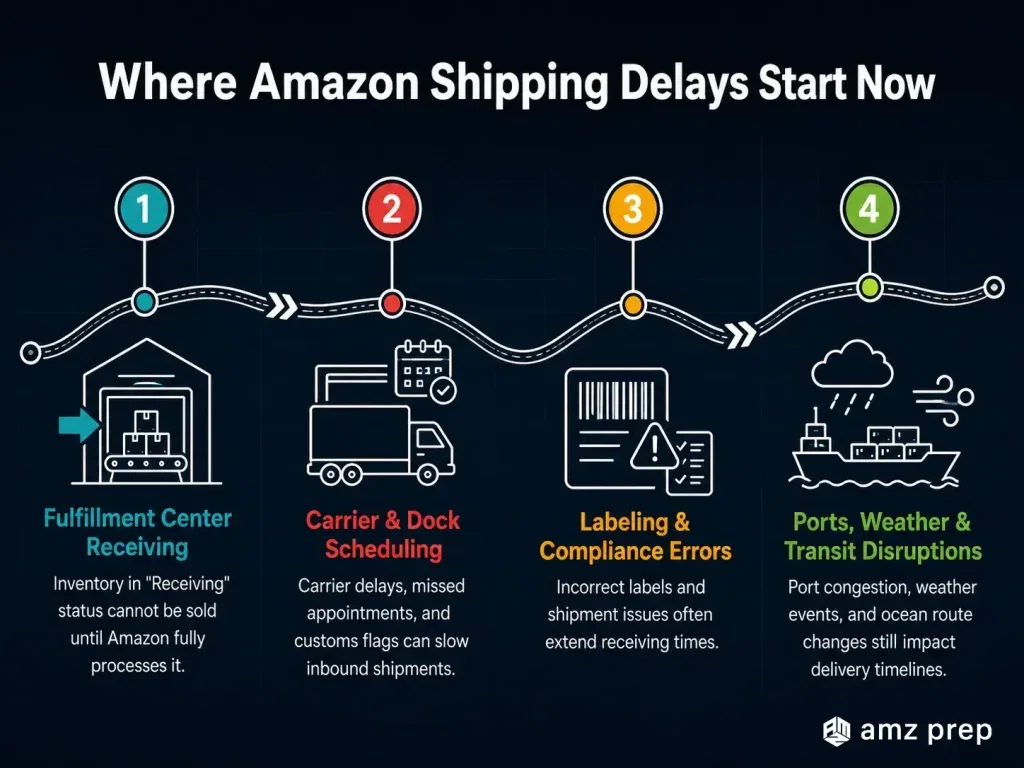
Fulfillment center receiving
Amazon targets receiving of inbound shipments in 3 to 7 business days. In practice, sellers report longer waits during busy periods.
Inventory in “Receiving” status is not yet sellable. Amazon has not fully accepted it. Your stock exists, but it cannot fill orders.
Congestion, labeling errors, and missed unload appointments all extend this window. Each one delays the moment your inventory goes live.
Carrier and dock scheduling
The carrier you pick affects your receiving speed. Carriers without live unload appointments sit in drop-trailer queues.
Some carriers mix domestic and international pallets on one truck. That can flag a domestic shipment for customs review. The result looks like an Amazon delay. The cause is the carrier.
A flagged inbound can also surface as a shipment exception that needs separate resolution. Choosing carriers with Amazon dock experience keeps your inbound predictable.
Upstream ports and weather
Upstream causes still exist. Port congestion, winter weather, and rerouted ocean lanes added time over the 2025 to 2026 peak.
These are real, but they are the smaller share for most sellers. If your goods move by ocean, plan timing with a freight forwarding partner. Build the transit buffer into your reorder dates.
How shipping delays hit your seller metrics
A late shipment is not one problem. It triggers a chain of account effects. This is the part sellers underestimate.
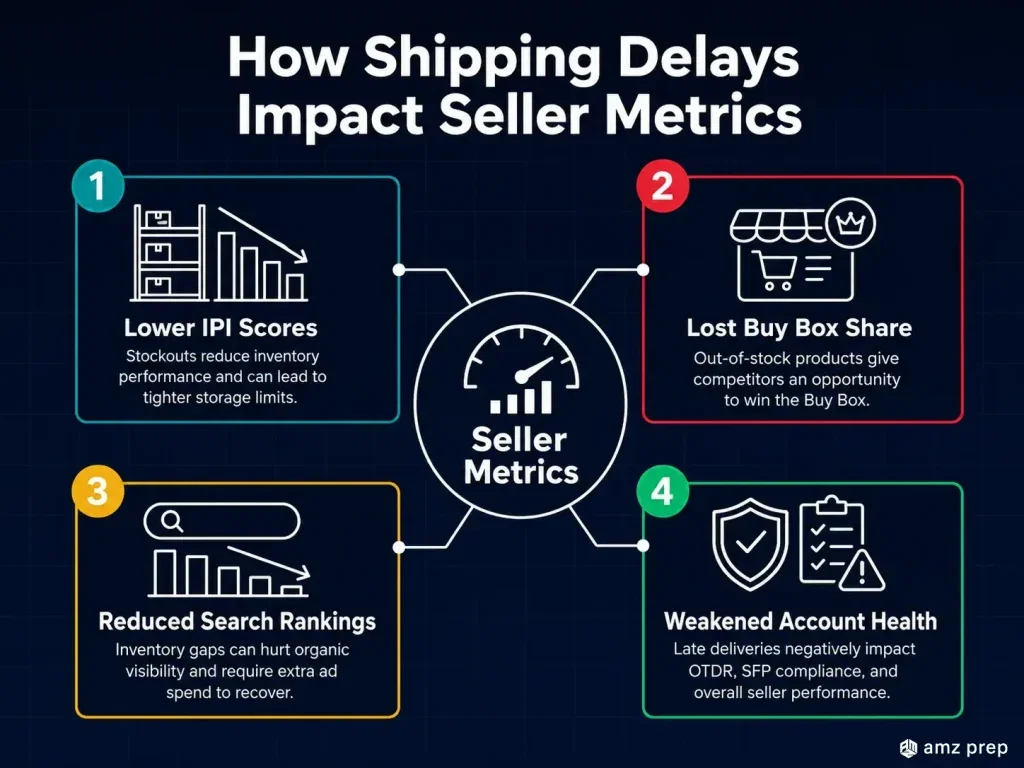
IPI score and storage limits
Delays drop your in-stock rate. That pulls down your Inventory Performance Index. A lower IPI can cut your storage limits.
Tighter limits force hard choices during your best selling weeks. Recovery from an IPI dip can take more than one cycle.
Buy Box and search ranking
A few days out of stock can reset hard-won momentum. Competitors capture the Buy Box while you are out of stock. Each day off the Buy Box is lost revenue you rarely recover.
Out-of-stock products often lose search positions too. Rebuilding rank takes time and ad spend. Each stockout makes the next recovery harder.
OTDR and account health
For seller-fulfilled and SFP orders, late deliveries lower your OTDR. Under the 2026 rules, that can suppress the affected listings.
SFP carries a higher bar. The program requires an on-time delivery rate above 93.5 percent, a valid tracking rate of 99 percent, and a cancellation rate below 0.5 percent. Amazon also raised SFP delivery-speed thresholds starting July 6, 2026. A single bad carrier weekend can move these numbers.
How to limit your exposure to shipping delays
You cannot remove every delay. You can build operations that absorb them. These are the steps that work for the sellers I run operations for.
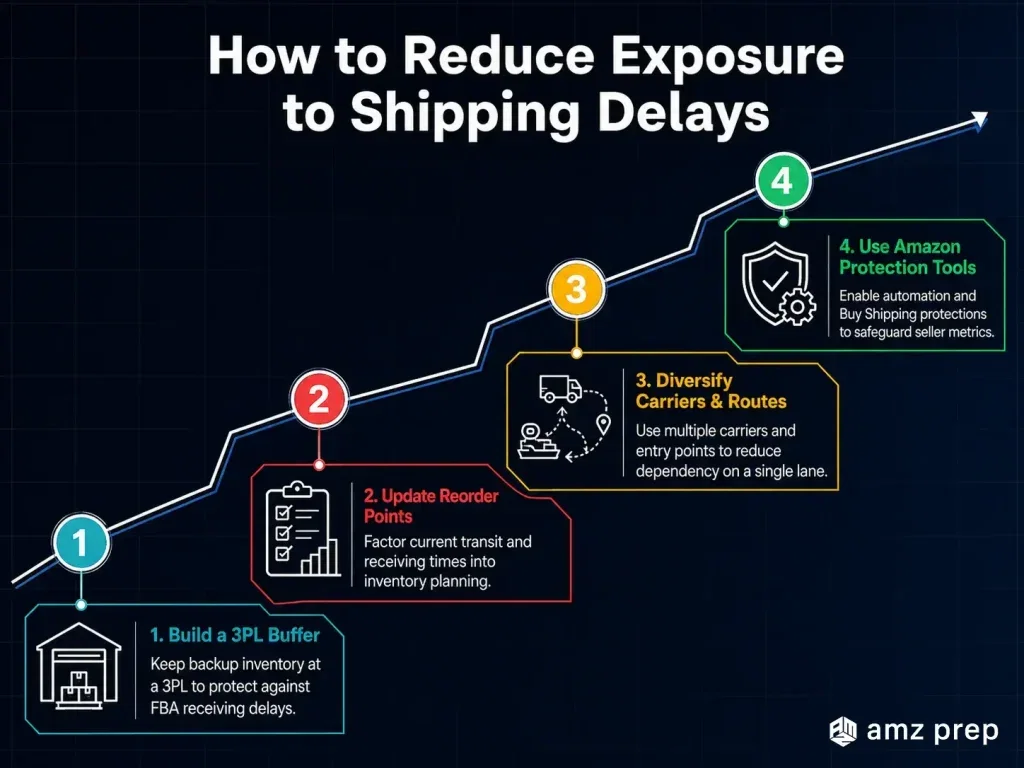
Build a 3PL buffer
Hold a portion of your inventory at a US third-party fulfillment partner. Forward stock to Amazon when FBA hits a trigger point.
This 3PL buffer absorbs receiving and transit delays. Your in-stock rate holds while competitors wait on inbound. It adds some complexity. The protection is worth it.
Adjust reorder points and lead times
Set reorder points around today’s timelines, not pre-2020 ones. Add the receiving window to your math, not just ocean transit.
Around peak, work backward from carrier cut-off dates so inbound lands before the rush. Build the delay buffer into cash flow so a slow lane does not stall sales.
Diversify carriers and inbound routing
Avoid depending on one port or one carrier. Route through more than one entry point when volume allows.
Pick carriers with live unload appointments and Amazon dock experience. Plan a secondary routing option for each shipment.
Use Amazon’s protection tools
Turn on shipping settings automation and automated handling time. Add OTDR Protected labels through Amazon Buy Shipping.
These steps keep carrier-caused delays from counting against you. They take an afternoon to set up and protect your metrics all year.
What to do next
Shipping delays are now a fixed input in Amazon planning, not a seasonal event. The sellers who build for them this quarter will protect their rankings through the next disruption. Start by setting your reorder triggers around current receiving times, then add a 3PL buffer for your top SKUs.
What Should I Do If My Amazon Order Is Late?
If you are a shopper and your Amazon order has not arrived by the expected delivery date, here is what to do:
Check the tracking first. Go to Your Orders in your Amazon account and click Track Package. Most delayed orders show a revised estimated delivery date.
Wait one full day past the delivery date before contacting support. Carrier scan delays often resolve within 24 hours without the order actually being lost.
If the tracking shows delivered but nothing has arrived, check around your property and with neighbours first. Then contact Amazon through the Help section and select “Package didn’t arrive.” Amazon typically refunds or reships within one to two business days.
If the order shows “In Transit” with no updates for more than five days, the package may be lost. Contact Amazon support and request a replacement or refund.
Frequently asked questions
Why are Amazon shipments delayed in 2026?
Most Amazon shipping delays now start inside Amazon’s own network, at fulfillment center receiving and seller-fulfilled delivery. Port congestion and weather still contribute. The 2026 prep and labeling changes add delay risk when inventory arrives unprepared.
How do shipping delays affect my Amazon account?
Delays lower your in-stock rate and IPI score. Stockouts can cost you the Buy Box and search ranking. For seller-fulfilled orders, late deliveries reduce your OTDR and can suppress affected listings under the 2026 enforcement rules.
What is the Amazon OTDR requirement in 2026?
Amazon requires a 90 percent on-time delivery rate for seller-fulfilled listings. From February 28, 2026, only the listings driving a low score get deactivated, not your whole catalog. Protection tools are available through Amazon Buy Shipping.
Can a 3PL reduce Amazon shipping delays?
Yes. A third-party logistics partner holds buffer inventory close to customers. You forward stock to Amazon before FBA runs low. This protects your in-stock rate during port, weather, or receiving delays without tying up all your capital.







The IPI point is the big one. A stockout can shrink storage limits right before peak, so the delay costs you twice.
Didn’t know mixed domestic and international pallets could trigger a customs review. That’s a carrier problem that looks like an Amazon delay.
The commingling change will catch resellers off guard. Skip the barcodes after March 31 and the stock gets marked defective.
The Feb 28 OTDR change helps, but the listings it suppresses are usually your best sellers anyway.
5–14 days for a prep rejection is brutal. A missed label now means a full return and reship.
I always underestimated ranking drops from stockouts. Thanks to AMZ Prep for highlighting this.
Shipping delays are killing my Q4 momentum. Great to see this guide addressing them head-on.
Diversifying ports + 3PL buffer = smart move. Thanks for laying out the strategy.
Amazing insights on how delays impact IPI and Buy Box. This is exactly what I needed to know.
Freight forwarders often ignore delay risk until it’s too late. AMZ Prep’s tips changed how I plan now.
Your strategic routing section is gold — going to test alternative port paths next cycle.
Shipping delays have become the new normal’ — that line hit hard.
Implementing advanced forecasting today. The examples you shared make it less abstract.
Buffer inventory used to feel wasteful — but now I see it’s essential.
Customs and port congestion are silent profit killers. This article nailed it.