
You are setting up your store’s checkout page. Two options sit in front of you.
Standard Shipping vs Economy Shipping.
One costs less. One arrives faster. But which one actually works for your store and your customers?
After working with hundreds of eCommerce brands on shipping and fulfillment strategy, I can tell you this decision quietly affects your conversion rate, your support inbox, and your repeat purchase rate all at once.
The wrong choice costs you more than just shipping fees.
Let us break it down properly.
Economy Shipping and Standard Shipping Are Not What Most People Think
Economy shipping is the lowest cost tier a carrier offers. Your package gets grouped with other shipments and travels through extra sorting points before it reaches your customer. That grouping is exactly how carriers keep costs low.
Standard shipping moves in a dedicated lane. No consolidation. Fewer stops. More predictable delivery windows and better tracking throughout.
But here is what most blogs skip: neither term is an official carrier product name. Every carrier labels their tiers differently.
When your checkout page says ‘Economy Shipping’ or ‘Standard Shipping,’ that is your label, not the carrier’s. This creates a lot of confusion for sellers and customers alike.
Here is what the actual carrier products look like, side by side:
| Carrier | Economy Service | Economy Transit | Standard Service | Standard Transit | Key Difference |
|---|---|---|---|---|---|
| USPS | Ground Advantage | 2 to 5 days | Priority Mail | 1 to 3 days | Priority includes $100 insurance |
| FedEx | Ground Saver | 2 to 7 days | FedEx Ground | 1 to 5 days | Ground Saver hands off to USPS for last mile |
| UPS | Ground Saver / SurePost | 2 to 7 days | UPS Ground | 1 to 5 days | SurePost also hands off to USPS |
| DHL | eCommerce Standard | 3 to 8 days | DHL Express | 1 to 3 days | Express is significantly pricier |
One detail worth flagging: FedEx Ground Saver and UPS SurePost both hand off your package to USPS for final delivery. Your tracking goes quiet for a day or two during that handoff. To your customer, the package looks like it disappeared. That gap drives ‘where is my order’ emails – a classic shipping delay your customer never expected and those emails cost you time and trust.
Now here is a real cost comparison to show how small the price gap actually is.
A 3 pound package from Pittsburgh to New York City:
- UPS Ground Saver (economy): $6.80, arrives in 3 days
- UPS Ground (standard): $7.06, arrives in 2 days
The difference is $0.26 per package. For 1,000 orders a month, you are either saving $260 by going economy or spending $260 for a meaningfully better customer experience by going standard. Both decisions make sense depending on your margins and your customer base.
How Long Is Standard International Shipping?
This gets asked constantly and rarely gets a direct answer. So here it is.
For most international routes, standard shipping takes between 6 and 14 business days. Economy international shipping takes 14 to 30 or more business days. That gap matters enormously when your customer is waiting on a gift or a time sensitive purchase.
Here is the full breakdown:
Economy international:
- USPS First Class Package International: up to 20 business days
- FedEx International Economy: 7 to 30 business days across 215 plus countries
- DHL eCommerce budget tiers: 14 to 30 plus business days
Standard international:
- USPS Priority Mail International: 6 to 10 business days to 190 plus countries
- UPS Worldwide Expedited: typically 2 to 5 business days
- FedEx International Priority: 1 to 3 business days (this is premium tier, not standard)
By route:
- China to US: 7 to 15 days by air, 20 to 40 days by ocean
- Europe to US: 5 to 10 days by air, 15 to 30 days by sea
- UK to US: 5 to 10 days standard
- Canada to US: 3 to 7 days standard
- Australia to US: 7 to 14 days standard
Always factor in customs clearance. It can add 2 to 7 days to any international shipment regardless of which tier you use. Incomplete paperwork is the most common reason packages stall at the border, this is where having a solid international shipping checklist in place can prevent costly delays.
Standard shipping services typically include customs documentation support. Economy shipping often does not. For international orders, that support alone can make the standard tier worth it.
The Hidden Cost That Makes Economy Shipping More Expensive
You pick economy shipping to save money. Reasonable move. But there is a pricing mechanic called dimensional weight, or DIM weight, that quietly changes the math.
Carriers do not only charge by actual weight. They also calculate a dimensional weight based on your box size.
The formula: Length x Width x Height divided by 139 for UPS and FedEx domestic shipments.
If your box is large but light, think a pillow, a foam product, or a bundled gift set, the dimensional weight often comes out higher than the actual weight. Carriers charge whichever is greater.
A 2 pound product in a large box can get priced like an 8 pound shipment. That completely erases the savings economy shipping was supposed to deliver.
Before you commit to economy shipping across your product catalog, run the DIM weight math on your most common package sizes. It changes the decision more often than people expect.
How the Right Fulfillment Setup Makes This Decision Easier
Most brands confuse over economy versus standard shipping as if it is purely a carrier decision. But in reality, your fulfillment setup determines which tier actually makes sense for you more than any carrier rate card does.
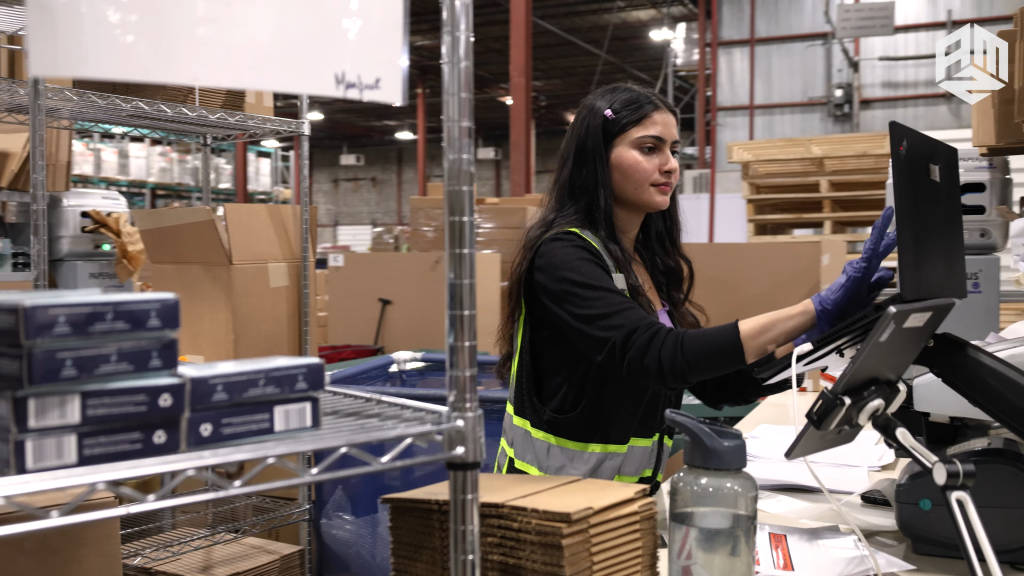
Let me give you a real example.
437, a Canadian activewear brand, came to AMZ Prep with a shipping problem. The costs of cross border shipping were eating into margins, delivery times were frustrating loyal customers, especially during periods of blank sailing disruptions that affected international freight schedules. and peak periods like Black Friday were near impossible to manage.
They were not choosing between economy and standard shipping. They were losing money on both because their fulfillment setup was working against them.
Here is what changed.
By partnering with AMZ Prep, 437 cut shipping costs by 25 to 30% per package, saving up to $4 on every single order. But the number that really tells the story is, they achieved 48-hour coast-to-coast delivery across Canada from a single warehouse location in Toronto.
One warehouse. The entire country. Two days.
That is not a shipping tier upgrade. That is a fulfillment strategy that makes the economy versus standard debate almost irrelevant. When your warehouse is already close to your customer, ground shipping arrives fast enough to compete with standard air rates, at economy pricing.
As 437 expanded into the US, AMZ Prep used order data and network analysis to launch a second fulfillment location in Texas. The result was faster US delivery, lower costs, and a cleaner separation of product lines for US and Canadian customers.

Hyla, co-founder of 437, put it simply after a Vancouver customer received her order within 24 hours of leaving Toronto: ‘I realized how transformative this partnership really is.’
The takeaway for any brand reading this: before you lock in a shipping tier, look at where your inventory lives. A strategically placed fulfillment center can make economy shipping feel like standard to your customer, without you paying standard rates.
See the full 437 case study here
The Word You Use at Checkout Changes Everything
This almost never makes it into a shipping guide. But from a marketing standpoint it might be the highest leverage point on this entire list.
The label you put on your shipping option affects conversion independently of price or speed.
The word ‘economy’ signals slow and cheap to a shopper. Even if your economy option arrives in 3 days, that word creates doubt. And doubt at checkout leads to abandoned carts.
Baymard Institute found that 48% of shoppers abandon carts due to unexpected shipping costs. Another 23% leave because the delivery timeline feels too slow. These are not small numbers. These are conversion problems wearing a logistics costume.
A simple fix: replace ‘Economy Shipping, $0.00’ with ‘Free Shipping (5 to 7 days).’ Customers respond to free far more than they respond to economy. The delivery time is identical. The perception is completely different.
An even better approach: show the actual arrival date instead of a range. ‘Arrives by Thursday, free’ converts better than ‘Economy Shipping, 5 to 7 business days.’ A specific date builds confidence. A range feels like a guess.
This one change costs nothing to implement and can meaningfully lift your checkout conversion.
How to Actually Decide Between Economy and Standard Shipping
Here is a simple way to think through the decision.
Go with economy shipping if:
- Your product price is under $15 and buyers expect budget options
- Delivery urgency is low, like subscription boxes or bulk replenishment orders
- You want to protect margin on return shipments
- Your items are large or heavy and need specialized carrier rates
Go with standard shipping if:
- Your customers expect fast delivery as the norm
- Your products are mid to high value or fragile
- You ship internationally and transit time directly affects satisfaction
- Reducing support tickets around delivery is a priority
Use both if:
- You can offer a free economy option with a paid standard upgrade at checkout
- Your order volume is growing and you want to capture revenue from time sensitive buyers
The two tier checkout model works well for most stores. Label both options by expected delivery date rather than tier name. It sets clear expectations, reduces anxiety, and gives your customer the control to choose what works for them.
One more note: if you are shipping more than 50 to 100 orders a week, have a direct conversation with your carrier about negotiated rates. At that volume, the cost gap between economy and standard often shrinks. And for a small additional spend you can offer a meaningfully better delivery experience.
Conclusion
The standard shipping versus economy shipping question is not really about speed or price on its own. It is about matching your shipping strategy to your customer expectations, your product type, and your fulfillment setup.
Neither tier is universally better. A premium DTC skincare brand and a bulk B2B supplier will make completely opposite decisions and both will be right.
What matters is that you stop treating this as a default setting and start treating it as a conversion and retention lever. Because that is exactly what it is.
At AMZ Prep, we help eCommerce brands get this right from warehouse to doorstep. If your shipping costs or delivery times are not where they need to be, that is a good place to start.
Frequently Asked Questions
Is economy shipping the same as standard shipping?
No. Economy is the slowest and cheapest tier a carrier offers. Standard is one step above with faster delivery and better tracking. The two are different products, even if some stores use the terms interchangeably on their checkout pages.
How long does economy shipping take compared to standard shipping?
For domestic shipping, economy takes 2 to 7 business days and standard takes 1 to 5 business days. Internationally, economy can take 14 to 30-plus days while standard typically runs 6 to 14 business days.
Why is my economy shipping package taking so long?
Economy packages are consolidated with other shipments and pass through more sorting facilities, which also increases the chance of a shipment exception – a carrier flag that means something interrupted normal transit. During peak season from October through January, carriers also deprioritize economy shipments. Add 2 to 3 extra buffer days during that window.
Can I switch shipping tiers once a package is already in transit?
No. Once a package enters a carrier’s network under a set service level, that service stays until delivery. Get the tier right before the shipping label is printed, once it’s generated and scanned into the carrier’s system, the service level is locked.
Which shipping option is better for Amazon sellers?
FBA sellers should focus on economy inbound freight to keep prep costs low. FBM sellers should default to standard shipping. Late deliveries on FBM directly hurt your seller metrics and Buy Box eligibility, especially in Q4.
Should I offer both economy and standard shipping in my store?
Yes. A free economy option plus a paid standard upgrade at checkout captures both price-sensitive and time-sensitive buyers. Label both by delivery date, not tier name. Dates convert better than labels.
Does economy shipping include tracking?
Yes, but minimally. Most economy services only scan at pickup, sort facility, and delivery. If your carrier hands off to USPS for last-mile delivery, expect a 1 to 2 day tracking gap where the package appears to stop moving.

Blair Forrest is the Founder of AMZ Prep, one of North America’s fastest-growing third-party logistics and fulfillment networks, built entirely without outside capital since 2016. Under his leadership, AMZ Prep has scaled to 50+ fulfillment centers across 6 countries, processing over 10 million plus units monthly and powering $2 billion+ in annual GMV for more than 5,000 brands worldwide including 437, Silverts, Saltyface, Unilever, Duracell, and JBL. A recognized authority in eCommerce logistics, Amazon FBA strategy, and supply chain optimization, Blair has helped thousands of sellers and brands master their fulfillment operations from first shipment to enterprise scale. He regularly consults on FBA prep, multi-channel fulfillment, last mile delivery, international expansion, and cost reduction strategies that save brands 20–40% compared to traditional 3PL providers. Blair’s insights on Amazon logistics, 3PL operations, and eCommerce growth are widely cited across the industry. Through AMZ Prep’s content, guides, and resources, he continues to share battle-tested strategies drawn from managing one of the largest independently owned fulfillment networks in North America.
















Comments