
Blank sailing happens when an ocean carrier cancels a scheduled voyage or skips planned port calls on a fixed route.
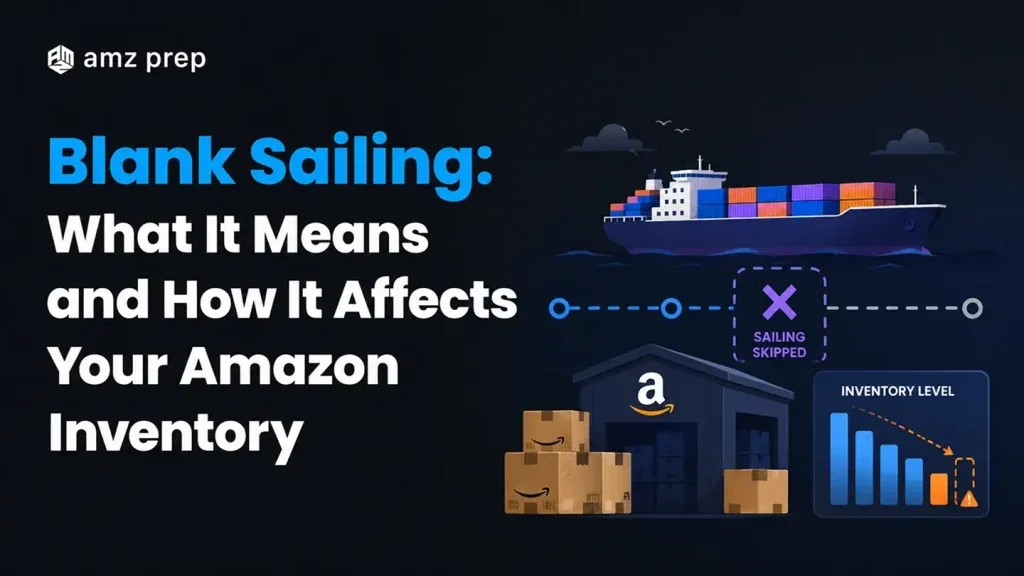
For Amazon sellers importing from Asia, that means 7 to 14 days added to your inbound timeline. It means stockout risk. It can mean demurrage charges at the origin port.
Carriers owe you no compensation. They classify it as standard operational practice.
Here is what blank sailing actually means, why carriers do it, and how to protect your FBA inventory when it happens.
What Is Blank Sailing in Ocean Freight?
A blank sailing, also called a void sailing, occurs when a carrier cancels a voyage or skips one or more port calls on a fixed route.
Vessels in container shipping operate on fixed weekly rotations called strings. A string is a set sequence of port calls that repeats each week.
If a vessel sailing from Shanghai to Los Angeles skips Yokohama, that is a port omission. If the carrier cancels the entire voyage, that is a full blank sailing.
Either way, your cargo is delayed or rerouted.
Blank Sailing vs. Port Omission vs. Rollover
These three terms are not the same thing.
| Term | What it means | Who triggers it |
|---|---|---|
| Blank sailing | Carrier cancels an entire scheduled voyage | Carrier decision |
| Port omission | Carrier skips one or more ports but continues the voyage | Carrier decision |
| Rollover | Your cargo is bumped to the next available vessel | Consequence of a blank sailing |
Blank sailing is the event. Rollover is what happens to your cargo.
A rollover can cascade. If the next vessel is also at capacity, your cargo rolls again.
Why Do Carriers Use Blank Sailings?
A blank sailing is a deliberate capacity management tool. There are four main reasons carriers use it.
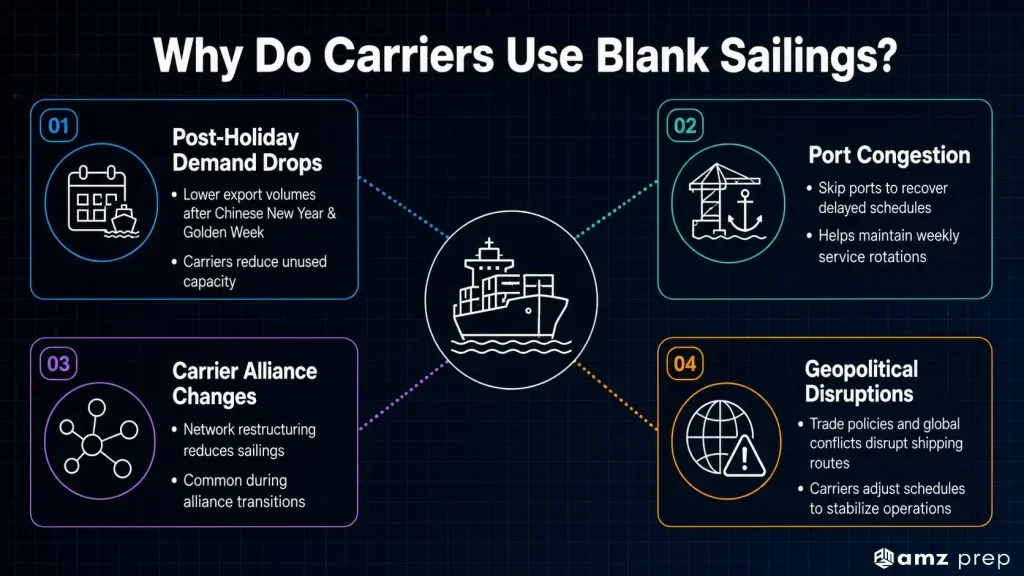
Post-Holiday Demand Drops
After Chinese New Year and Golden Week, factories pause across China. Export volumes fall sharply.
Carriers cancel sailings rather than operate half-empty vessels. Running a vessel at low utilization hurts margins and pushes freight rates down.
Blank sailings pull capacity off the market and stabilize rates.
According to Drewry’s Container Capacity Insight, 136 sailings were cancelled across transpacific and Asia-Europe routes in February 2026 alone. That was a 122% increase from January, driven by Lunar New Year demand collapse.
Port Congestion and Schedule Recovery
When a vessel falls behind at a congested port, skipping the next port is how it recovers.
Missing one berth creates a cascade of missed berths across the entire rotation.
The Ports of Los Angeles and Long Beach handle over 40% of US containerized imports. Terminal backlogs there in early 2025 caused port omissions across several transpacific strings.
Carrier Alliance Restructuring
The Gemini Cooperation launched in February 2025. The Ocean Alliance and THE Alliance also consolidated during the same period.
When alliances restructure, total weekly sailings on major lanes decrease. The transition almost always produces a wave of blank sailings.
This is a structural driver of blank sailings 2025, not a seasonal one.
Geopolitical Disruptions
The Red Sea crisis in late 2023 forced carriers to reroute around the Cape of Good Hope. That added two to three weeks of transit time on Asia-Europe routes.
The ripple effect hit transpacific lane scheduling as vessels were repositioned globally.
US-China tariff escalations in April 2025 created a separate demand shock. Brands paused shipments. Carriers blanked sailings to stop rate collapse.
Sea-Intelligence data showed 367,800 TEU of blanked transpacific capacity across a four-week window in April and May 2025.
What Happens to Your Cargo During a Blank Sailing?
The impact depends on where your container is when the blank sailing is announced.
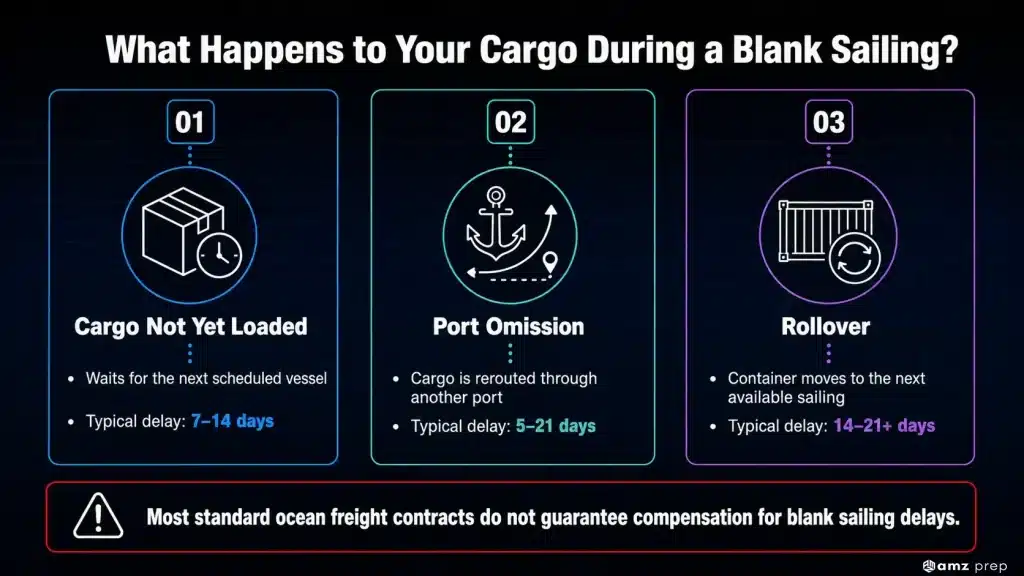
| Scenario | What happens | Typical delay |
|---|---|---|
| Cargo not yet loaded at origin port | Waits for the next scheduled vessel on the same string | 7-14 days |
| Cargo on vessel, port omitted | Carrier arranges feeder or inland transport back to original destination | 5-21 days |
| Rollover triggered | Cargo bumped to a later sailing due to limited space on the next vessel | 14-21+ days |
Containers sitting beyond their last free day accumulate demurrage and detention charges. These freight accessorial charges can run from a few hundred to several thousand dollars per container.
Standard ocean freight contracts do not guarantee a specific vessel or departure date.
You will almost never receive compensation for a blank sailing delay.
How Blank Sailings Hit Amazon FBA Sellers
This is where container shipping delays become a direct Amazon business problem.
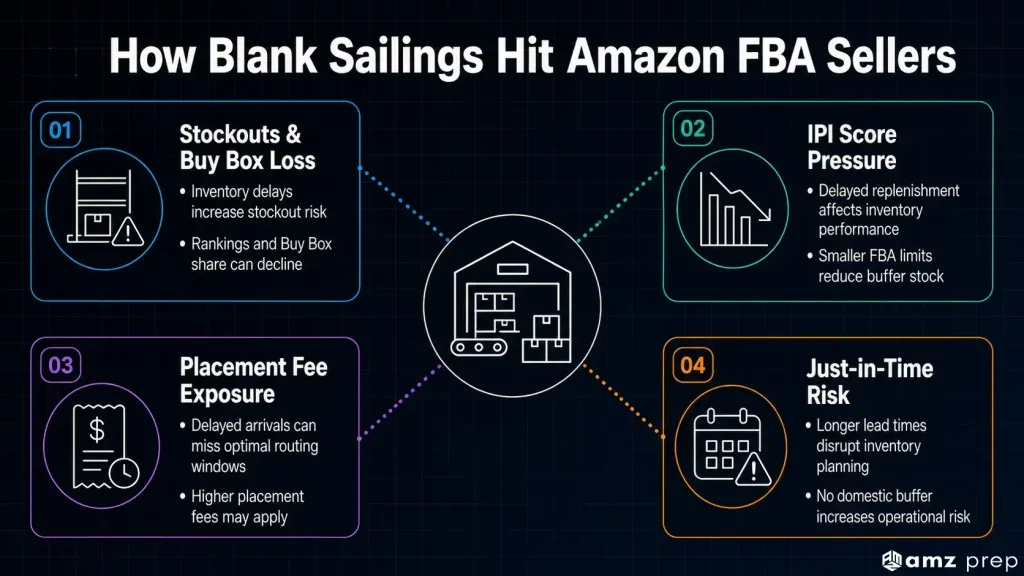
Stockouts and Buy Box Loss
If your FBA inventory runs out while replacement stock is rolled to a later vessel, your listings go out of stock.
Amazon’s algorithm responds fast. Out-of-stock listings lose ranking and lose the Buy Box.
A few days of stockout can take weeks to recover from in ranking velocity.
For brands targeting 30 to 45 days of FBA cover, a 14-day sailing delay wipes the buffer entirely.
IPI Score Pressure
Amazon cut FBA storage limits by up to 75% for many sellers in May 2025.
Brands can no longer use FBA as a buffer. They need to send inventory more frequently in smaller quantities.
That works when inbound timing is predictable. A blank sailing pushes your next replenishment back two weeks.
There is no reserve to absorb that gap.
Placement Fee Exposure
AMZ Prep’s 5-way split routing eliminates placement fees by routing inventory to the right fulfillment centers. That depends on predictable inbound arrival.
When a blank sailing shifts your timing by two weeks, the optimal routing window may have closed.
You end up with placement fee exposure on a load you expected to be fee-free.
The Just-in-Time Risk
Just-in-time inventory models assume predictable transit times.
Blank sailings break that assumption.
A 7 to 14 day extension on a 25 to 30 day transpacific transit is a 25 to 50% increase in lead time. Brands with no domestic safety stock have no recovery path.
How to Reduce Blank Sailing Risk
You cannot prevent a blank sailing. You can build a supply chain that absorbs one without derailing your Amazon business.
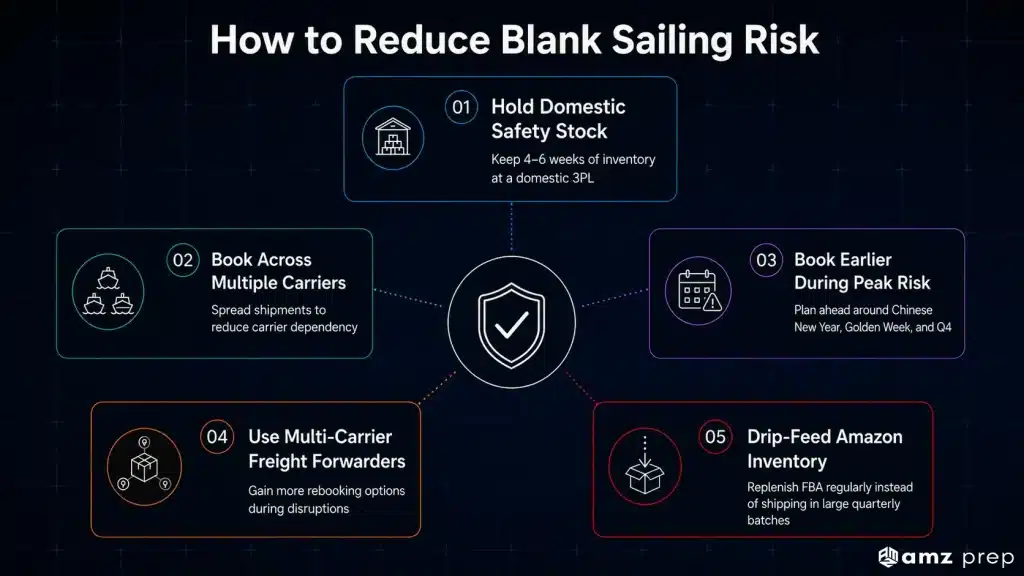
Hold Domestic Safety Stock
This is the most effective mitigation available.
Four to six weeks of inventory at a domestic 3PL removes your dependency on any one ocean leg arriving on time.
AMZ Prep’s Amazon Replenishment Program is built on this model. Inventory lands at an AMZ Prep regional distribution center first. From there, it feeds Amazon weekly via our Middle Mile network.
A 14-day sailing delay affects the next inbound container. It does not affect the replenishments already running from domestic stock.
Book Across Multiple Carriers
Relying on a single carrier concentrates your exposure.
If one alliance runs a blank sailing program during a demand trough, every container you have booked is affected. Splitting volume across two or three carriers on the same lane hedges that risk.
Book Earlier on High-Risk Windows
Post-Chinese New Year, post-Golden Week, and the Q4 transition period carry the highest blank sailing frequency on transpacific routes.
During Golden Week 2025, Sea-Intelligence data showed carriers had historically cut 15.4% of Asia-North America West Coast capacity. Brands that booked four to six weeks early secured space before last-minute cuts were announced.
Use Freight Forwarders With Multi-Carrier Contracts
When your sailing is blanked, rebooking speed depends entirely on your forwarder’s carrier relationships.
A forwarder with one preferred carrier queues for the same space as everyone else who was rolled. A forwarder with diversified relationships finds alternatives faster.
Drip-Feed FBA Instead of Bulk Quarterly Drops
Large quarterly shipments from the factory to Amazon put all your inbound timing in one basket.
One blank sailing can affect your entire next quarter of FBA stock.
Shifting to weekly or bi-weekly replenishments from a domestic buffer changes that exposure entirely.
One blank sailing delays the next container. It does not stop the replenishments already flowing from domestic stock into Amazon.
Blank Sailings in 2025 and 2026: The Current Picture
Blank sailings 2025 were driven by structural and event-based factors that are not reversing quickly.
Transpacific routes account for 46 to 56% of global blank sailing volume. Asia-Europe and Mediterranean routes account for another 27 to 28%, per FreightAmigo analysis of Drewry data.
The Gemini alliance launch permanently reduced weekly sailings on major lanes. US-China tariff escalations in April 2025 triggered a sharp ocean freight capacity pullback. Sea-Intelligence recorded 367,800 TEU of blanked transpacific capacity in a four-week window.
The demand rebound after the tariff pause drove rates back up fast. That cycle demand shock, blank sailing wave, rapid rate recovery is likely to repeat as trade policy stays volatile.
As of late June 2026, Drewry’s Cancelled Sailing Tracker shows 31 blank sailings expected across major east-west trades over the next five weeks. That is a 4% cancellation rate. Transpacific eastbound accounts for 55% of those.
That is well below the February 2026 peak of 136 cancellations in a single month.
The seasonal pattern and structural reduction from alliance consolidation remain in place. Brands importing from Asia should treat blank sailings as a recurring variable in their supply chain planning, not a rare exception.
Build Before the Next Blank Sailing Hits
Blank sailings are not going away. Carrier alliances are consolidating. Trade policy is volatile. Seasonal demand swings hit the same windows every year.
The brands that absorb disruptions fastest are not the ones with the best freight forwarder. They are the ones with domestic inventory already positioned before the sailing goes blank.
If your supply chain runs direct from the factory to Amazon, one cancelled voyage puts your FBA stock at risk. A domestic buffer at AMZ Prep changes that equation entirely.
Talk to our team about how the Amazon Replenishment Program protects your inbound inventory from blank sailing disruptions.
Frequently Asked Questions
What is the blank sailing definition?
A blank sailing is when an ocean carrier cancels a scheduled voyage or skips planned port calls on a fixed route. Carriers use it to manage capacity and stabilize freight rates during low-demand periods. Cargo is typically rolled to the next available vessel.
What is the difference between a blank sailing and a rollover?
A blank sailing is the carrier’s decision to cancel a voyage or skip a port. A rollover is what happens to your cargo as a result. Your container is bumped to the next available vessel because the original sailing is gone.
How long does a blank sailing delay last?
Most blank sailing delays add 7 to 14 days to your inbound timeline. If the next vessel is also heavily booked, a second rollover is possible. Total delays can reach three weeks or more on transpacific routes.
Can I get compensation for a blank sailing?
In almost all cases, no. Standard ocean freight contracts do not guarantee a specific vessel or departure date. Carriers classify blank sailings as normal operational practice. Premium guaranteed-space contracts may offer limited protection at a higher rate.
How do blank sailings affect freight rates?
Blank sailings remove capacity from the market. Less capacity against stable demand pushes spot rates up. Carriers use this deliberately during demand troughs to prevent rate collapse. Shippers often pay higher rates on the next available sailing.

Chadwick Collins is an Enterprise Fulfillment Consultant at AMZ Prep, where he partners with high growth ecommerce brands to design and scale Amazon first logistics strategies. He brings extensive experience in freight, supporting brands across domestic and cross border transportation, routing optimization, and cost control.
At AMZ Prep, Chadwick works closely with enterprise clients to improve inventory flow, reduce landed costs, and accelerate delivery performance across North America. His expertise spans FBA, DTC, and B2B fulfillment, with a strong focus on aligning freight strategy with overall supply chain efficiency. He helps brands navigate complex logistics challenges while turning operations into a competitive advantage.

















Comments