
Weekend shipping wasn’t always part of the Seller Fulfilled Prime deal. Then February 2021 happened, and Amazon changed the rules.

Now, if you want that Prime badge on your listings, you need to work at least one weekend day. Saturday or Sunday – your choice, but you have to pick one.
Most sellers go with Saturday. The reasons are pretty straightforward: USPS already delivers on Saturdays at no extra charge, finding weekend staff is easier, and the whole carrier ecosystem just works better on Saturdays than Sundays.
But here’s the thing nobody mentions upfront: weekend operations aren’t just ‘weekday fulfillment on a Saturday.’ The costs are higher, the logistics get trickier, and your performance metrics become a lot harder to maintain.
Amazon sellers who are enrolled in SFP quickly discover that sellers must meet much stricter standards for weekend fulfillment than they initially expected.
Let’s walk through what weekend SFP actually looks like in practice.
What Amazon Actually Requires for Weekend Shipping
The rule itself is simple enough. You need to operate one weekend day for order fulfillment. That means downloading prime orders, packing them, and getting them to your carrier.
Saturday or Sunday. Pick whichever fits your business better. Amazon doesn’t care which one, just that you’re operational one of the two days.
Now here’s where it gets interesting. When Amazon says ‘operate,’ they mean the full deal. Processing SFP orders that come in, getting packages ready, and coordinating carrier pickup. You can’t just turn on weekend listings and hope for the best. This applies to everyone who joined SFP after February 2021.
What happens if you skip weekends?
Your Prime badge disappears. Amazon is pretty firm on this one – no weekend operations means no Prime eligibility. Sellers are responsible for maintaining weekend operations to maintain Prime selling privileges.
The Saturday-only problem most sellers hit
Let’s say you decide to operate Saturdays only. Seems reasonable, right? You’re meeting the requirement.
But here’s what actually happens: A customer browses your product Saturday afternoon. Amazon’s system shows ‘Get it Sunday’ because the algorithm looks at your location, the customer’s location, and figures Sunday delivery is possible.
Except you don’t ship on Sundays. That order sits until Monday morning.
The customer doesn’t get their package Sunday. Amazon marks it as a late delivery. Do this enough times and you’re looking at losing your Amazon Prime badge anyway, which means removal from the program.
This is what sellers call the ‘page view problem,’ and it catches a lot of people off guard. The delivery promises Amazon shows Prime customers don’t always match up with your actual operating schedule.
The metrics Amazon watches
Three numbers determine whether you keep your Prime badge:
- On-time delivery needs to stay above 93.5%. Drop below that for three weeks straight and you’re out. This is part of Amazon’s strict performance requirements.
- Valid tracking rate needs to hit 99%. Nearly every order needs a working tracking number uploaded on time.
- Cancellation rate has to stay under 0.5%. Cancel too many orders and Amazon figures you can’t handle the volume. making effective backorder management and inventory planning essential.
Weekend orders count the same as weekday orders in these calculations. There’s no separate scoring or easier standards just because it’s Saturday. Sellers must meet strict requirements regardless of when orders are placed.
Your Carrier Options for SFP Saturday Delivery
Choosing your weekend carrier matters more than you might think. The costs vary wildly, coverage isn’t equal, and pickup schedules work differently on Saturdays.
USPS for Weekend SFP
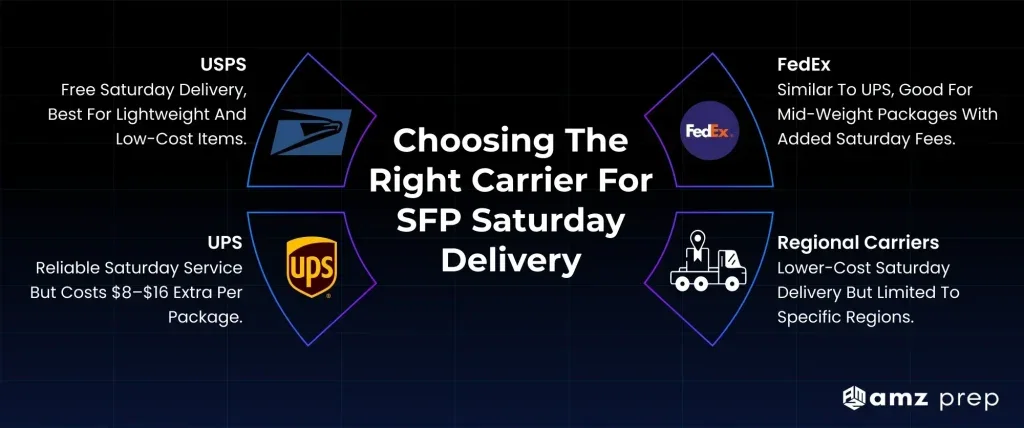
USPS delivers on Saturday as part of their normal service. Priority Mail, First Class – they all show up on Saturday just like they do on Tuesday. No extra fees, no special scheduling required.
This is why most SFP sellers default to USPS for weekend orders, as it’s one of the most commonly used SFP approved carriers for cost-effective weekend fulfillment. The economics just make sense. You can use shipping services like USPS to meet Amazon’s weekend requirements without additional surcharges.
The catch? Sunday delivery exists, but you can’t rely on it. USPS does deliver some packages on Sunday, but it’s mostly for Amazon handles through its own logistics network in select areas. As an SFP seller, Sunday USPS delivery isn’t really in your toolkit.
Tracking can also be less consistent than the private carriers. And if you’re shipping to rural areas, delivery times stretch out a bit more.
When USPS works best:
Lightweight products under a pound. Items priced under fifty bucks. Situations where you’re watching every dollar in shipping costs.
What it costs:
Same as weekday rates. Zero additional charges for Saturday. This helps sellers to offer Prime shipping without dramatically increasing costs.
UPS for Weekend Fulfillment
Many sellers have this question – does ups ship on weekends? UPS will pick up and deliver on Saturday. Sellers who are also wondering about UPS delivery on Sunday can review the service limitations before building weekend fulfillment plans. They’re reliable, professional, and they’ll cost you.
The Saturday surcharge runs eight to sixteen dollars per package on top of your regular shipping rate. For every hundred Saturday orders, you’re looking at an extra eight hundred to sixteen hundred dollars in carrier fees. Every single week.
And here’s something that catches sellers: UPS doesn’t deliver everywhere on Saturday. Plenty of rural areas and small towns don’t get Saturday UPS service. Amazon’s system doesn’t always know this, so it’ll promise Saturday delivery to a customer in rural Montana, you’ll ship UPS, and that package won’t move until Monday.
The customer doesn’t get it when promised. Your metrics take a hit. UPS did their part, they just don’t serve that area on Saturdays.
Pickup timing
UPS shows up earlier on Saturdays. During the week they might swing by at 2 PM or 3 PM. On Saturday? You’re looking at 9 AM to 11 AM in most places. That means your cutoff times need to shift way earlier in your shipping settings.
When UPS makes sense
Higher value products over a hundred dollars. Urban delivery zones where Saturday coverage is solid. Times when you need delivery certainty more than you need to save money.
FedEx Weekend Service
FedEx Ground does Saturday delivery. Their pricing is competitive with UPS in most lanes, and they have similar coverage patterns.
Rural gaps? Same as UPS. Earlier Saturday pickups? Yep. Surcharges in that eight to sixteen dollar range? You got it.
Think of FedEx as the alternative to UPS when their rates are better in your specific shipping lanes. Many Amazon sellers ship via FedEx for mid-weight packages.
When FedEx works
Medium-weight packages, two to five pounds. Areas where FedEx pricing beats UPS.
Regional Carriers
OnTrac in the West, LaserShip in the East, Lone Star in Texas. These regional carriers often undercut UPS and FedEx on price, and most offer Saturday service in their coverage zones.
The limitation is obvious: they only cover specific regions. You can’t build a nationwide delivery coverage SFP program around OnTrac alone.
But as part of a multi-carrier setup? They can save you money where they operate.
How Weekend Carriers Compare
| Carrier | Saturday Surcharge | Rural Coverage | Pickup Time | Best For |
|---|---|---|---|---|
| USPS | $0 | Excellent | Regular route | Under $50, lightweight |
| UPS | $8-16/package | Limited | 9-11 AM | Over $100, high-value |
| FedEx | $8-16/package | Limited | 9-11 AM | 2-5 lb mid-weight |
| Regional | Varies | Zone-dependent | Varies | Cost savings in their area |
Picking the Right Carrier
- Your product determines your carrier more than anything else: Cheap, lightweight stuff? USPS all day.
- Mid-priced items between thirty and a hundred bucks? USPS or FedEx depending on weight.
- Expensive products over a hundred dollars? UPS with signature confirmation.
- Shipping to rural areas? USPS has the best Saturday coverage.
- Shipping to cities? Pretty much any carrier works.
You can automate this with shipping software like ShipStation. Set up rules based on value, weight, and destination, and let it pick the cheapest option that hits your delivery speed standards. Some sellers also use Amazon Buy Shipping to streamline carrier selection.
What Weekend Operations Actually Cost
Let’s talk real numbers, because weekend fulfillment isn’t just ‘regular fulfillment on a Saturday.’
Labor Costs
People expect to get paid more for working Saturdays. Figure somewhere between 1.25 and 1.5 times your weekday rate.
Paying fifteen bucks an hour during the week? Plan on twenty to twenty-two on Saturday.
One person can typically handle thirty to forty orders an hour for straightforward products. So a hundred Saturday orders means you need two to three people working three to four hours.
That’s two hundred to three hundred fifty dollars in labor for those hundred orders.
Carrier Fees
USPS adds nothing for Saturday. Same rates as Tuesday.
UPS and FedEx tack on eight to sixteen bucks per package.
Hundred orders via UPS on Saturday? That’s eight hundred to sixteen hundred dollars in extra carrier costs alone.
Keeping the Lights On
Utilities, climate control, security systems – your facility needs to be operational. Budget fifty to a hundred fifty bucks per Saturday depending on your warehouse size.
This is usually the smallest piece of your weekend costs.
What It All Adds Up To
| Cost Category | USPS Route | UPS/FedEx Route | Mixed Carriers |
|---|---|---|---|
| Labor (100 orders) | $200-350 | $200-350 | $200-350 |
| Carrier surcharges | $0 | $800-1,600 | $400-800 |
| Facility costs | $50-150 | $50-150 | $50-150 |
| Cost per order | $2-4 | $10-18 | $4-8 |
When the Math Works
You need decent volume and healthy margins to make weekend SFP pencil out.
A hundred or more Saturday orders makes in-house fulfillment viable. Below that and you’re spreading fixed costs too thin.
Product margins north of 30% can usually absorb weekend costs. Below 20% and things get tight fast.
Here’s the counterbalance: The Prime badge typically bumps conversion rates 20-35%. So even with higher weekend costs, most sellers come out ahead if their margins can handle it.
What 3PLs Charge
Third-party fulfillment centers charge prices per order. That includes storage, picking, packing, and shipping – the complete prep services.
At two hundred orders a month, 3PL pricing starts competing with doing it yourself. Below that volume, in-house usually wins. Above five hundred monthly orders, 3PLs often save you money through scale.
Participating in SFP through a 3PL can make sense when you want control over their inventory without handling weekend operations yourself.
Four Ways to Handle Weekend Fulfillment
You’ve got options for how you actually run weekend operations. Each works for different situations. Understanding the pros and cons of Seller Fulfilled Prime models helps you pick the right approach.
Hire Weekend-Only Staff
Bring in people who only work Saturdays. Students looking for weekend gigs, people with second jobs, gig workers – there’s a labor pool that actually prefers weekend work.
The good part? You pay lower hourly rates than giving overtime to your weekday crew. And you can scale up during Q4 and back down in January.
The challenge? Turnover runs 60-80% annually for weekend-only positions. You’re constantly training new people. And error rates run about double or triple what your experienced weekday staff produces.
Quality control becomes critical. Double-check everything when you’ve got new weekend staff learning your products.
This works when: You’ve got high volume, standardized products, and straightforward pick-and-pack operations.
Rotate Your Full-Time Team
Your regular staff takes turns covering Saturdays. Two or three week rotations keep anyone from feeling like they’re stuck on permanent weekend duty.
The upside? Your people already know your products and systems. Quality stays consistent. You’ve got flexibility in scheduling.
The downside? You’re paying premium weekend rates to experienced staff. Burnout becomes a concern if rotations are too frequent. And recruiting gets harder when candidates find out weekend work is in the job description.
This works when: You’re doing one hundred to five hundred Saturday orders with an established team that knows your operation.
Partner with a 3PL
Send your inventory to a fulfillment center that operates on weekends. They handle receiving, storage, processing, packing, and shipping.

What to look for: Saturday operations at all their locations, not just one. At least three to four warehouses for decent geographic coverage. Direct integration with Seller Central. Written guarantees of 95% or better on-time delivery.
Questions you need to ask:
‘Which of your facilities actually operate on Saturday?’ Some 3PLs have one location with Saturday capability but not others.
‘What’s your average on-time delivery rate for SFP clients?’ Below 95% should make you pause.
‘What are your Saturday cutoff times?’ You need to know if they can handle late Friday orders.
‘What happens if my metrics drop?’ You want a partner who monitors and fixes issues, not one who shrugs.
Standard pricing runs thirty to fifty cents per unit for receiving, fifty cents to a buck fifty per cubic foot monthly for storage, two to five bucks per order for pick and pack, and shipping at cost or marked up 5-15%.
Get real quotes, not estimates.
This works when: You’re above two hundred monthly orders, have multiple product lines, are growing fast, or just value your Saturdays.
Automate with Minimal Staff
Pre-pick Friday afternoon. Stage everything near your packing area. Print labels Friday evening. One person comes in Saturday morning for two to four hours and just hands packages to the carrier.
You need decent warehouse software with automation, label printers, and barcode scanning.
The benefit? Minimal Saturday labor cost. One person can handle a hundred to two hundred orders when everything’s already staged. Error rates drop because you’re working from pre-picked inventory.
The limitation? Doesn’t handle Friday evening or Saturday morning orders well. Maxes out around two hundred orders. Requires Friday afternoon prep work.
This works when: You’re above two hundred monthly orders, have multiple product lines, are growing fast, or just value your Saturdays. This is particularly valuable for sellers to offer Prime without weekend staffing challenges.
How These Models Compare
| Model | Order Volume | Advantages | Challenges | Cost |
|---|---|---|---|---|
| Weekend-only staff | 200+ | Scales easily, lower hourly rate | Constant turnover and training | Medium |
| Rotating full-time | 100-500 | Quality control, product knowledge | Higher cost, burnout risk | High |
| 3PL partnership | 200+ | No staffing headaches, multi-warehouse | Less control, minimums | Medium |
| Automated + 1 person | 50-200 | Minimal labor, fewer errors | Limited flexibility | Low |
Common Weekend SFP Challenges and Solutions
Weekend fulfillment creates challenges that just don’t exist during the week. Here’s what trips up most sellers and can lead to suspension of Prime eligibility if not addressed.
Your Carrier Shows Up Early
UPS tells you pickup is between 9 AM and noon on Saturdays. You set your cutoff for 11 AM figuring you’re covered.
UPS rolls in at 9:15.
Two dozen orders came in between 9 and 11. They miss the truck. Those customers don’t get packages on time. Your metrics slide.
The fix
Set your Saturday cutoff conservatively. 10 AM is safer than 11 AM. Get exact pickup times in writing from your carrier. Have a backup plan for when you miss the truck, like driving packages to the carrier facility yourself.
The Sunday Delivery Promise Problem
You operate Saturdays only. Customer orders Saturday afternoon. Amazon shows ‘Get it Sunday’ because the algorithm thinks you can make it happen.
You can’t. Package sits until Monday. Customers didn’t get it Sunday. Amazon marks it late.
This impacts your day delivery promise accuracy and can affect whether you’re still displaying the Prime badge on your listings.
Why this happens
Amazon’s delivery exceptions are based on when customers browse, not just when they order. Saturday browsers see Sunday promises even when you don’t operate Sundays.
How to handle it
Run a multi-warehouse network where different locations cover different days. Some sellers do East Coast on Sunday, West Coast on Saturday. Time zones help.
Or just accept some weekend metric pressure and keep your weekday performance really strong. Aim for 96% on-time overall instead of barely clearing 93.5%.
Rural Saturday Delivery Gaps
UPS and FedEx don’t deliver everywhere on Saturday. Lots of small towns and rural routes don’t get weekend service.
Amazon’s system promises Saturday delivery to someone in rural Montana. You ship UPS. UPS doesn’t deliver there Saturday.
The customer’s package is late. Your account gets dinged.
How to handle it
Use USPS for rural orders. They’ve got the best Saturday coverage nationwide. Get multi-carrier software that can spot rural ZIP codes and automatically route to USPS. And accept that some variance is unavoidable when carriers have coverage gaps.
Losing Your Prime Badge
Drop below 93.5% on-time delivery for three weeks running and Amazon pulls your Amazon Prime badge automatically.
It happens fast. There’s no negotiating.
Getting it back
Fix whatever’s causing late deliveries. Could be carrier issues, warehouse problems, unrealistic handling times, figure it out. You can contact Seller Support for guidance on what’s affecting your metrics.
Keep performance solid for two to four weeks. Amazon needs to see consistent improvement.
Reapply for Prime. You’ll go through the Seller Fulfilled Prime trial period again: thirty days, minimum one hundred orders, all metrics have to hit targets. This Prime trial resets your eligibility.
When you turn Prime back on
Do it on Sunday. Starting fresh at the beginning of the week is safest.
Turning it on Friday means immediate weekend orders testing your rebuilt system. Not smart.
Q4 Volume Explosion
Weekend orders jumped 150-300% during the fourth quarter. Prime Day does the same thing. Staff availability tanks during holiday weekends. Carriers get slammed.
How to prepare
- Ninety days out: Start recruiting temporary weekend staff.
- Sixty days out: Train new people and test your workflows.
- Thirty days out: Get inventory positioned and finalize schedules.
- During peak: Check performance daily and adjust staffing.
You must offer same-day or next-day processing even during high-volume periods to meet Amazon’s standards.
Getting Weekend Operations Running
Starting weekend fulfillment takes about four weeks from planning to the first Saturday. Here’s the basic roadmap for getting products for SFP weekend operations launched.
Week one: Pull ninety days of order data from Seller Central. Look at Saturday volume specifically. Calculate what weekend operations will cost – labor, carriers, facility. Decide in-house or 3PL.
Week two: Get carriers lined up. For USPS, call your local post office and confirm Saturday pickup happens on your route. For UPS or FedEx, contact your rep and set up standing Saturday pickup. Get the time in writing. Line up a backup carrier.
Week three: Configure Seller Central. Enable weekend pickup and delivery. Create Saturday shipping templates. Set cutoff times – maybe 4-5 PM Monday through Thursday, 2 PM Friday, 10 AM Saturday. Set handling time to zero or one day. Consider order limits while testing.
Week four: Run your first Saturday. Staff shows up at 6 AM, downloads orders, processes and packs everything, hands it to the carrier, uploads tracking by 2 PM. Watch the delivery performance the next week and figure out what went wrong if anything did.
Ongoing: Check order processing daily. Review on-time delivery weekly in your Seller Fulfilled Prime performance dashboard. Calculate costs and compare weekend versus weekday performance monthly.
Seller Fulfilled Prime vs FBA for Weekend Operations
Understanding when Seller Fulfilled Prime isn’t the right choice helps you make better fulfillment decisions. Let’s look at SFP vs Fulfillment by Amazon (FBA) for weekend operations.
When SFP Makes Sense for Weekends
Control and flexibility: SFP gives sellers complete control over their inventory and shipping processes. You decide which carrier to use, how to pack products, and when to ship.
Cost advantages: For higher-margin products, SFP weekend costs (three to seven dollars per order) often beat FBA fees, especially for larger or heavier items.
Prime badge access: SFP allows Prime members to see the Prime service badge on your listings without sending inventory to Amazon warehouses.
When FBA Handles Weekend Better
No weekend staffing: Amazon handles all fulfillment including weekends. You don’t need to find weekend staff or manage Saturday operations.
Nationwide coverage: FBA provides automatic nationwide delivery coverage without building a multi-warehouse network.
Easier scaling: FBA scales automatically during Q4 and Prime Day without you recruiting temporary staff.
The Key Differences
| Factor | Seller Fulfilled Prime | Fulfillment by Amazon |
|---|---|---|
| Weekend staffing | You handle it | Amazon handles it |
| Warehouse locations | You need multiple | Amazon provides |
| Saturday operations | Required to maintain | Automatic |
| Cost structure | Per-order fulfillment | Storage + fulfillment fees |
| Control | Full control | Limited control |
Seller Fulfilled Prime isn’t the best choice for every product or business model. Evaluate based on your margins, volume, and operational capabilities.
Monitoring Your Weekend SFP Performance
Your Seller Fulfilled Prime performance dashboard is critical for tracking weekend operations. Amazon provides this dashboard to help sellers to offer Prime delivery while monitoring key metrics.
Key Metrics to Track
On-time delivery rate: Check this twice weekly minimum. You need to meet 93.5% to stay eligible for Prime.
Valid tracking rate: Must stay at 99% or higher. Orders on Saturday need tracking uploaded within your handling time window just like weekday orders.
Cancellation rate: Keep this under 0.5%. Weekend volume can sometimes lead to inventory issues that cause cancellations.
Using the Performance Dashboard
The Seller Fulfilled Prime performance dashboard shows:
- Weekly performance trends
- Geographic delivery success rates
- Late delivery reasons
- Customer delivery experience metrics
Check this dashboard every Monday to review weekend performance specifically. Look for patterns in late deliveries that might indicate carrier issues or processing bottlenecks.
What Happens When Metrics Drop
If you fall below thresholds, Amazon sends warning emails. After three consecutive weeks below 93.5%, you face removal from the program.
Early intervention matters. When you see metrics trending down, investigate immediately. Common weekend-specific causes:
- Carrier pickup timing issues
- Saturday staffing problems
- Rural delivery coverage gaps
- Friday order surge overwhelming Saturday capacity
Address these quickly to avoid suspension of Prime privileges.
Conclusion
Weekend operations are part of Seller Fulfilled Prime now. Amazon requires one weekend day, Saturday or Sunday – for everyone who joined after February 2021.
Go in-house when you’re doing a hundred or more Saturday orders, your margins are above 30%, and you’ve got warehouse space with people who’ll work weekends.
Use a 3PL when Saturday volume runs under a hundred orders, you need warehouses in multiple states, or you’d rather skip the weekend staffing headaches.
Keep your on-time delivery above 93.5%. Check your metrics twice a week. Fix problems fast.
Plan for at least two warehouses, better yet four to six. One location only covers 30-40% of the country for two-day ground on weekends.
Weekend operations add three to seven dollars per order. Figure out if your margins can handle it while staying profitable.
Start small, test your processes, fix the timing issues with carriers and reliability issues with staff, then scale up once you’ve proven it works.
Frequently Asked Questions
Does Seller Fulfilled Prime require Saturday delivery?
Amazon requires one weekend day, Saturday or Sunday. Most sellers pick Saturday because USPS delivers them automatically and you don’t pay extra for it.
How much does SFP weekend shipping cost?
Weekend fulfillment adds three to seven dollars per order. USPS routes add two to four dollars. UPS and FedEx routes add ten to eighteen dollars per order.
What happens if I don’t ship on weekends for SFP?
Amazon removes your Prime badge. Weekend operations are mandatory for all SFP sellers who enrolled after February 2021. There’s no way around it.
Which carrier is cheapest for Saturday delivery?
USPS costs nothing extra for Saturday. UPS and FedEx charge eight to sixteen dollars per package on top of regular rates for Saturday service.
How many warehouses do I need for SFP?
Two warehouses give you seventy percent coverage. Four gets you to ninety percent. One warehouse only covers thirty to forty percent for two-day ground weekend shipping.
Can I use a 3PL for weekend SFP operations?
Yes. 3PLs handle Saturday fulfillment across multiple warehouses. Costs run four to eight dollars per order all-in. Makes sense at two hundred plus monthly orders.
What are the SFP weekend performance requirements?
You need 93.5% on-time delivery, 99% valid tracking, and under 0.5% cancellations. Fall below for three weeks straight and Amazon suspends your Prime badge.
Do I need to ship both Saturday and Sunday?
No. Amazon only requires one weekend day. Pick whichever works better for your operation. You don’t have to do both.

Arishekar N is a Vice President (VP) of Marketing at AMZ Prep, specializing in ecommerce fulfillment and Amazon logistics strategies with a proven track record of driving growth for e-commerce businesses. He is a strategic leader with extensive expertise in marketing, e-commerce operations, SEO & advertising, and branding.
Stay updated on his latest insights by following him

















Comments