
You’re staring at your FBA bill again. Storage fees jumped 15% this quarter. Placement fees keep adding up. Your margins are getting thinner, and you’re looking for a better way to keep your Prime badge without losing profit. One option gaining traction is pairing SFP with a reliable 48 hour delivery service to hit Prime shipping benchmarks without FBA’s overhead.

There’s a better way. But it’s not as simple as switching from Fulfillment by Amazon to Seller Fulfilled Prime.
The SFP vs FBA decision isn’t straightforward. Both models keep your Prime badge, but they work completely differently. One handles everything for you at a cost. The other gives you control but demands perfect execution.
Amazon reopened SFP in October 2023 after a four-year pause. Since then, over 4.5 billion items sold through FBA in 2023 alone – that’s 8,600 items every minute. The competition is fierce, and your fulfillment option directly impacts whether you win or lose the Buy Box.
This blog will walk you down the real costs, hidden requirements, and strategic alternatives you need to know. You’ll see current 2026 data, actual fee structures, and discover which fulfillment path will help you make more profit while maintaining the Prime badge.
The Complete Comparison of Seller Fulfilled Prime and FBA
The SFP vs FBA debate comes down to control versus convenience. Before diving into costs and requirements, you need to understand exactly how these fulfillment methods differ in daily operations.
Let’s break it down into a real comparison . Here’s exactly how these two fulfillment methods compare in 2026:
| Feature | FBA (Fulfillment by Amazon) | SFP (Seller Fulfilled Prime) |
|---|---|---|
| Who Handles Fulfillment | Amazon picks, packs, and ships from their warehouses | You handle everything from your warehouse or through a 3PL |
| Prime Badge | Automatic Prime eligibility | Prime badge after passing trial |
| Storage | Amazon’s fulfillment centers at $0.78-$2.40 per cubic foot monthly | Your warehouse or 3PL will control costs |
| Shipping Speed | Fast, free Prime shipping | You must deliver 1-2 day shipping with 99% on-time rate |
| Control Over Packaging | Amazon handles standard packaging | Full control for custom branding |
| Returns Handling | Amazon handles all returns | You handle returns directly |
| Weekend Operations | Included | Required six days per week including Saturday |
| Monthly Volume Requirements | None | Minimum 100 Prime packages monthly |
| Buy Box Advantage | Strong advantage with Prime badge | Equal advantage if you meet the requirements |
| Multi-Channel Fulfillment | Limited – primarily Amazon-focused | Full flexibility across all sales channels |
| Best For | New sellers, small items, hands-off operations | High-volume sellers, oversized items, multi-channel sales |
Which choice is the best? It depends entirely on your business needs. While FBA remains dominant (used by approximately 82% of sellers), a growing number of established sellers are exploring FBM and hybrid models as strategic alternatives to manage costs. Many of these sellers were also motivated by concerns around Amazon’s commingled inventory, where FBA’s shared storage bins created counterfeit risk that self-fulfillment eliminates entirely.
This SFP vs FBA comparison shows the surface differences. But the real decision factors run deeper into hidden costs, performance requirements, and whether your business can handle the operational demands of each model.
Why This Comparison Matters More in 2026?
Amazon’s marketplace has changed. You’re not just competing on price anymore – you’re competing on fulfillment speed, customer experience, and margin efficiency.
Here’s what’s different in 2026:

FBA sellers are under pressure
Amazon’s fulfillment expenses reached $90.6 billion in 2023, up 7.5% from the previous year. Those rising costs eventually show up in your fees, storage charges, and placement requirements.
The Prime badge is non-negotiable
Over 200 million Prime subscriptions drive the majority of Amazon sales. Prime members spend roughly $1,170 annually versus $570 for non-Prime shoppers – which is more than double. Without that Prime badge, you’re invisible to the customers who spend the most.
SFP requirements got stricter
Amazon implemented major changes effective June 29, 2025, including mandatory weekend operations and a 100-package monthly minimum. The bar is higher, but so are the potential savings.
Hybrid models are winning
Smart sellers aren’t choosing between FBA and SFP, they’re strategically using both. Fast-movers go through FBA for Buy Box advantage. Oversized items and slow inventory ship through SFP to avoid storage penalties.
The question isn’t ‘FBA or SFP?’ It’s ‘Which products belong where, and how do I maximize profitability across my entire catalog?’
Many sellers are exploring FBA alternatives Prime badge options to maintain their competitive edge while reducing costs. The key is finding fulfillment methods that preserve Prime eligibility without the mounting expenses of traditional FBA.
What Changed with Seller Fulfilled Prime in 2025?
Amazon didn’t just reopen the SFP program. They completely rewrote Amazon’s requirements effective June 29, 2025. These changes make SFP easier to join initially but much harder to maintain long-term.
Three Trial Attempts Per Year
You get three chances to pass the SFP trial each year. Sounds fair, until you discover the blackout periods. The background on how Amazon was pressured into reopening the program is covered in detail, it also explains why the Seller Fulfilled Prime trial requirements exist in their current form.
You cannot move from the trial during Prime Day or the 30 days before Black Friday through Christmas. If your trial overlaps with these periods, you won’t earn your Prime badge even with perfect performance.
Here’s the math: Say your trial starts October 1st. You’ll wait until January to earn your badge. You just missed Q4 when most sellers earn 40% of annual revenue without Prime eligibility.
Strategic timing is everything. Apply for your trial in February or March. Pass before summer. You’ll have your Prime badge ready for Q4 selling season.
The 100-Package Monthly Minimum
Amazon now requires 100 Prime packages every month, spread reasonably across all weeks. Drop below this threshold and Amazon restricts your daily Prime order capacity.
This rule immediately disqualifies:
- Part-time sellers without consistent volume
- Seasonal businesses with slow periods
- New sellers ramping up gradually
If January and February are slow months for your category, you risk losing Prime status entirely. You need year-round volume or a strategy to maintain Prime thresholds during off-peak periods.
Weekend Shippings Are Mandatory (Add 15-25% to Shipping Costs)
Amazon requires six operating days within any seven-day period. That means Saturday operations are non-negotiable.
Weekend carrier pickups cost 15-25% more than weekday service. You’ll need:
- Weekend staff (overtime rates)
- Weekend security
- Weekend carrier relationships
- Systems that process Saturday orders for same-day shipping
Most small operations don’t run on Saturdays. Adding weekend capability means either significant infrastructure investment or partnering with a 3PL that already operates weekends.
The Real Cost Breakdown of FBA vs SFP in 2026
Cost comparisons usually miss the expenses that actually matter. Here are the real numbers with proper context.
The SFP vs FBA cost comparison fails when you only look at base fees. Amazon’s penalty structure on FBA and the infrastructure requirements for SFP completely change the financial equation.
FBA’s True Costs (It’s Not Just Fulfillment Fees)
Amazon maintained fee stability for 2025 with no increases to core referral or FBA fulfillment fees. However, 2026 brings an average increase of $0.08 per unit for FBA fulfillment fees.
Even without base fee increases, the penalties are what destroy profitability:
Storage Fees
$0.78 per cubic foot from January-September, jumping to $2.40 during Q4 peak season (October 15 – January 14). A single pallet of slow-moving inventory can cost you $200+ monthly in storage alone. Read more about Amazon FBA Fees.
Aged Inventory Surcharge
Amazon charges fees on inventory stored for 181 days or longer. This long-standing policy means your slow movers get expensive fast, with surcharges increasing the longer items remain in storage.
Low Inventory Level Fee
Amazon introduced a low inventory level fee in 2024 and is still active. Amazon penalizes you for keeping inventory too low (stockouts risk) AND too high (inventory storage fees).
Inbound Placement Service Fees
Amazon adjusted these fees effective January 15, 2026: large bulky items saw reductions averaging $0.58 per unit, while standard-size products increased by an average of $0.05 per unit. You still pay $0.30-$0.89 per unit depending on shipment to Amazon’s fulfillment centers distribution.
Example cost scenario for 500 units monthly:
- Fulfillment fees: $2,100 (at $4.20 per unit for standard items)
- Storage: $390 (January-September rate)
- Placement: $310 (at $0.62 per unit)
- Low inventory penalties: $200 (if you dip below thresholds)
- Total monthly: $3,000
One slow quarter triggers penalties that will affect your annual profits.
SFP’s True Costs (Beyond Just Shipping)
SFP sellers avoid FBA fulfillment fees but still pay standard Amazon referral fees (typically 8-15% depending on category). The savings come from handling fulfillment yourself rather than paying Amazon’s per-unit fulfillment charges.
What you’re actually paying for:
- Two-day shipping (ground): $4-$7 per package
- Two-day shipping (air for distant zones): $15-$25 per package
- Weekend operations: 15-25% premium on carrier rates
- 98% usage of Amazon Buy Shipping services – locking you into Amazon’s carrier pricing
- Backup carriers for 99% reliability
- Safety stock to prevent stockouts
- Error-catching systems to protect metrics
Example cost scenario for 500 units monthly:
- Shipping (average $9.50 per unit for 2-day): $4,750
- Weekend premium (20% of shipping): $950
- Infrastructure costs (warehouse, staff, systems): $2,500
- Performance buffer (safety stock, backup carriers): $475
- Total monthly: $8,675
SFP costs nearly triple FBA for pure Amazon selling. But the calculation flips completely when you add multi-channel sales.
The Hybrid Model That Wins Both Options
Smart sellers split inventory strategically:
- 60% through FBA: Fast-movers, small items, products under 2 pounds
- 40% through SFP via 3PL: Oversized items, slow movers, multi-channel inventory
This strategic approach represents one of the most effective FBA alternatives Prime badge solutions available today. You’re not abandoning Amazon’s ecosystem – you’re optimizing it.
Why this works:
The same inventory pool fulfills Amazon, Shopify, wholesale, and other channels. You’re not paying duplicate storage costs. Multi-channel sellers typically add 150-200 units monthly from non-Amazon channels, including cross-border demand such as shipping supplements to Canada for health and wellness brands.
The math that matters:
- Pure FBA cost for 500 units: $3,000 monthly
- Hybrid model cost: $4,200 monthly
- Additional multi-channel revenue: 150-200 units at higher margins (no Amazon referral fees)
- Net result: Higher profit despite higher fulfillment costs
You also gain:
- Control over returns (assess for resale vs. automatic destruction)
- Custom packaging for brand building
- Zero long-term storage penalties on slow inventory
- Flexibility to optimize each SKU individually
This hybrid approach solves what the SFP vs FBA debate couldn’t, you get Prime eligibility everywhere without choosing between control and convenience. The 60/40 split isn’t arbitrary.
It matches the typical product mix where FBA’s speed benefits outweigh costs on 60% of items, while SFP’s flexibility matters more on the remaining 40%.
The Difference Between FBA and SFP: Pros and Cons
Understanding the differences between Fulfillment by Amazon (FBA) and Seller Fulfilled Prime (SFP) helps you make the right choice for your business.
| Aspect | FBA (Fulfillment by Amazon) | SFP (Seller Fulfilled Prime) |
|---|---|---|
| Who Handles Fulfillment | Amazon manages storage, packing, and shipping. | You (the seller) handle fulfillment operations. |
| Prime Eligibility | Automatic for all FBA listings. | Earned after completing trial and meeting metrics. |
| Customer Service & Returns | Fully managed by Amazon. | Managed by seller with Amazon-level standards. |
| Infrastructure Needs | No warehouse or staff required. | Requires your own or 3PL infrastructure. |
| Weekend Operations | Not required. | Mandatory for Prime badge (adds ~15–25% cost). |
| Performance Standards | Managed by Amazon. | 99% on-time delivery, 98% Buy Shipping usage. |
| Inventory Management | Simple – Amazon stores and distributes. | Complex – must sync across multiple channels. |
| Scalability | Easy for new sellers to scale quickly. | Suited for experienced sellers with strong logistics setup. |
| Trial Requirement | None. | Must pass a trial period before Prime eligibility. |
| Best For | Sellers want a hands-off fulfillment solution. | Sellers want control, lower fees, and faster delivery. |
When to Use FBA vs FBM
Fulfillment by Merchant (FBM) offers a middle ground between FBA and SFP. With FBM, you ship Prime orders directly from your warehouse without meeting Prime requirements. However, your products won’t display the Prime badge unless you qualify for SFP.
The key difference between FBA and FBM: FBA gives you automatic Prime eligibility, while FBM requires you to handle all order fulfillment yourself without Prime benefits.
What You Must Know About SFP Requirements Before Applying in 2026
Seller Fulfilled Prime isn’t just ‘ship fast.’ It’s ‘meet military-grade logistics standards consistently or lose your Prime badge immediately.’
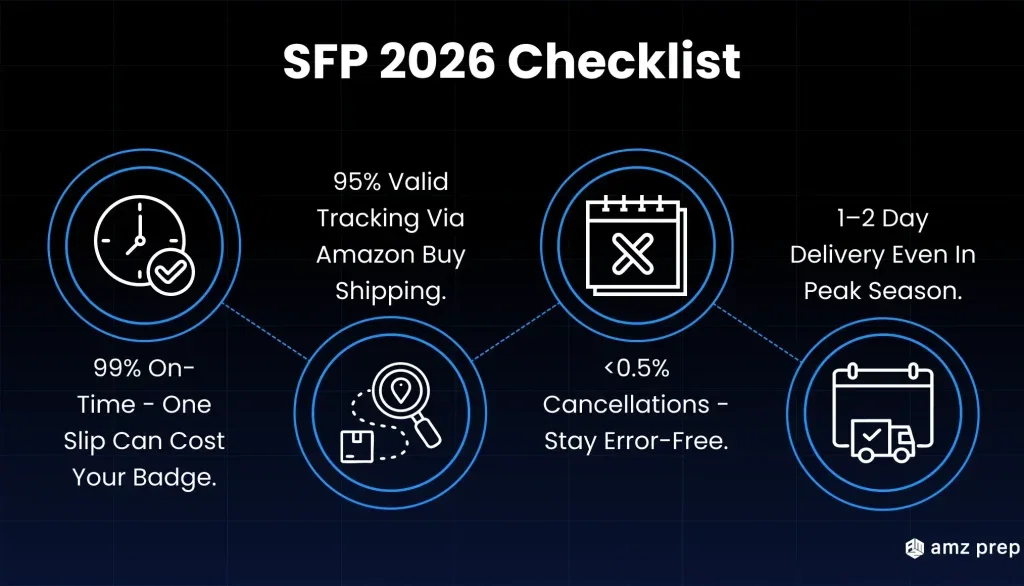
The 99% On-Time Delivery Requirement
Before diving into the specifics, many sellers ask: is SFP worth it given these demanding standards? The answer depends entirely on your volume, infrastructure, and ability to maintain military-grade logistics consistency.
You must maintain a 99% on-time delivery rate. That’s 99 out of 100 packages arriving on time. Miss this metric for even one month and Amazon suspends your SFP status.
What counts as ‘on-time’:
- Orders placed before 2pm ship same day (zero-day handling time)
- Orders placed after 2pm ship next business day
- Delivery by the promised date shown to customers
- Valid tracking that updates automatically in Amazon’s system
What affects your rate:
- Carrier delays (weather, missed pickups, scanning failures)
- Weekends without operations (see our guide on Seller Fulfilled Prime weekend shipping for how to structure Saturday operations correctly)
- Overselling inventory across channels
- Manual tracking entry (doesn’t count as ‘valid’)
One bad weekend can affect your entire month. You need backup carriers, redundant systems, and buffer inventory, ideally working with Amazon SFP approved carriers to maintain consistent delivery performance.
The 95% Valid Tracking Rate
95% of shipments must have valid tracking. ‘Valid’ means automatically updating in Amazon’s system and the manual entry doesn’t count.
What fails tracking validation:
- Local couriers without Amazon integration
- Consolidated shipments with single tracking numbers
- International tracking that doesn’t sync
- Carrier scanning delays
This is why most of the orders must use Amazon Buy Shipping. Amazon controls the carrier relationship to ensure tracking compliance. You control fulfillment execution, which is the actual division of responsibility.
The supposed advantage of ‘using your own negotiated carrier rates’ largely disappears. You’re locked into Amazon’s pricing for almost every order.
The 0.5% Cancellation Rate Cap
You must maintain cancellation rates below 0.5%. If you miss a few 2pm cutoff times and your rate jumps. High cancellation rates violate SFP standards immediately.
What triggers cancellations:
- Overselling inventory (not caught before 2pm cutoff)
- Unable to ship within handling time
- Stockouts discovered after order placement
- System failures preventing timely processing
You need real-time inventory allocation across all sales channels. You need instant order processing. You need systems that prevent overselling automatically.
Holiday Season Performance Requirements
Amazon typically adjusts speed requirements during peak holiday periods. For example, during the 2024-2025 holiday season (November 24, 2024 – January 4, 2025), requirements were:
Standard-size items:
- At least 20% must show 1-day delivery
- At least 45% within 2 days
- (Normal requirements: 30% and 70%)
Oversize items:
- At least 5% within 1 day
- At least 30% within 2 days
- (Normal requirements: 10% and 45%)
Even during ‘relaxed’ periods, the risk stays high. You need reliable carrier relationships and contingency plans for weather delays or carrier disruptions.
How 3PL Providers Support Amazon Seller Fulfilled Prime (SFP)
Most successful SFP sellers use 3PL partners. Here’s why.
Geographic Coverage
Ground shipping costs $4-$7 per package. Two-day air costs $15-$25. If you reach more customers via ground shipping, your costs drop dramatically.
Two strategically located warehouses reach 90% of U.S. households within two days via ground. Multi-location 3PLs with 50+ facilities reach 95%+ of customers via economical ground shipping.
The cost impact:
- Single-location fulfillment: 60% of orders require expensive 2-day air
- Two-location fulfillment: 25% require air shipping
- 50+ location fulfillment: 5% require air shipping
That difference alone can save $3-$6 per unit on average.
Volume Thresholds That Make 3PLs Profitable
| Monthly Volume | Best Option | Why |
|---|---|---|
| Under 200 units | FBA | 3PL minimums too expensive |
| 200-500 units | FBA or 3PL | Break-even point. Test carefully |
| 500-1,000 units | 3PL + SFP | 15-20% cost savings vs. FBA |
| 1,000+ units | 3PL + SFP | 25-35% cost savings vs. FBA |
| Oversized (any volume) | 3PL + SFP | 40-60% savings on large items |
Items larger than 18x14x8 inches face massive FBA penalties. For oversized products, SFP via 3PL isn’t competitive, it’s the only profitable option.
How One Seller Switched from FBA to SFP via AMZ Prep
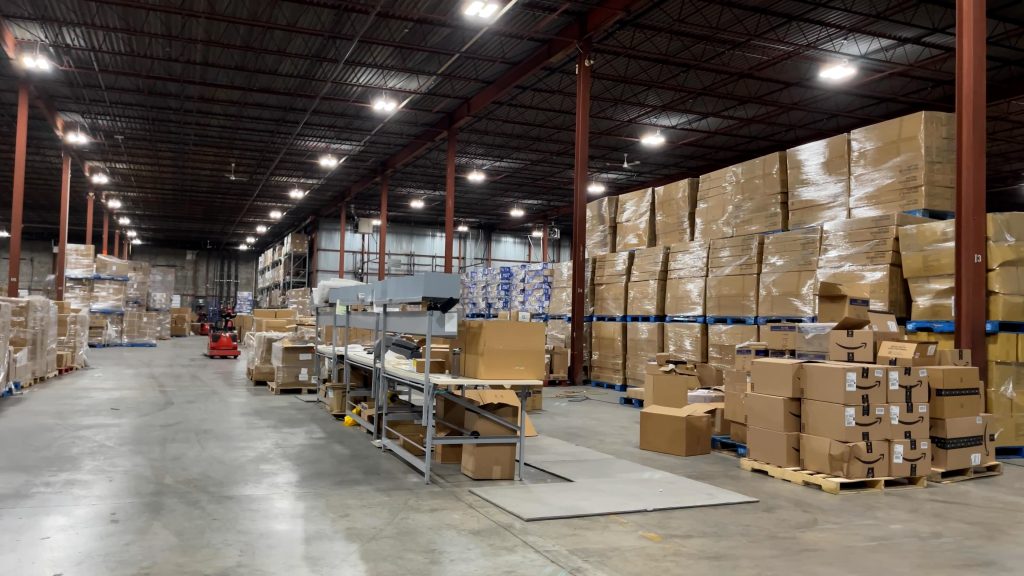
ANS Performance had compelling supplement products but couldn’t scale profitably on Amazon. High shipping costs, inconsistent stock levels, and late shipments were killing their margins and Buy Box eligibility.
The Challenge
Three critical issues blocked growth:
- High shipping costs eating into supplement margins
- Inconsistent in-stock rates causing lost sales
- Late shipments violating Amazon’s SLA requirements
FBA’s fees made profitability impossible. SFP’s requirements, i.e., 99% on-time delivery, weekend operations, and consistent volume seemed out of reach without massive infrastructure investment.
The Solution
ANS partnered with AMZ Prep to implement a multi-location 3PL strategy:
- Three fulfillment centers strategically positioned to reach customers via ground shipping instead of expensive 2-day air.
- Weekend operations capability meeting SFP’s six-day requirement without hiring weekend staff.
- Real-time inventory management across locations preventing overselling while maintaining volume minimums.
The Results
- 98% in-stock rate (exceeds SFP inventory requirements)
- 350% reduction in late shipments (well above SFP’s 99% on-time standard)
- 25% cost savings on fulfillment
Why This Matters
- Multiple warehouses converted expensive air shipments to economical ground service while maintaining Prime-speed delivery
- ANS achieved SFP-grade performance without building weekend operations or warehouses
- Their cost reduction falls exactly in the “15-20% savings” threshold where SFP becomes financially compelling versus pure FBA
The 3PL approach delivered SFP-level performance with FBA-level convenience, exactly the hybrid advantage this blog recommends.
How to Choose Between FBA and SFP
Stop asking ‘FBA or SFP?’ Start asking ‘What combination maximizes my profitability?’
When FBA Makes Sense
FBA works best for:
- New sellers under 12 months building track records
- Volumes under 500 units monthly
- Small lightweight products under 2 pounds
- Single-channel Amazon-only operations
- Sellers prioritizing convenience over cost optimization
Your FBA costs stay manageable when:
- Fulfillment fees remain between $3-$5 per unit
- Storage fees stay under $800 monthly
- Products sell within 60 days (avoid aged inventory charges)
- Placement fees under $0.40 per unit
When SFP Makes Sense (With or Without 3PLs)
SFP works best for:
- Volumes of 500+ units monthly
- Oversized items over 20 pounds
- Multi-channel operations (Amazon + Shopify + wholesale)
- Products with high return rates (you want control)
- Established brands requiring custom packaging
You need these capabilities:
- 99% on-time delivery infrastructure
- Weekend operations (six days weekly)
- 100 packages monthly minimum consistently
- Real-time inventory management across all channels
- Professional seller account ($39.99/month)
SFP makes financial sense when:
- Fulfillment costs drop 20%+ versus FBA
- You leverage multi-channel inventory
- Your products face FBA size/weight penalties
- You can maintain 99% metrics consistently
- Brand control and customer experience matter
Still wondering is SFP worth it? Calculate your total fulfillment costs including weekend premiums, infrastructure investments, and carrier relationships.
If you’re not seeing 20%+ savings with consistent volume, FBA alternatives Prime badge strategies like hybrid models might serve you better.
When Hybrid Models Win
Hybrid models work best for: Most growing sellers who want flexibility and margin optimization
The winning split:
- 60% FBA for fast-movers and small items
- 40% SFP via 3PL for oversized and slow movers
You need:
- Sophisticated inventory management software
- Systems that route orders optimally
- Synchronized inventory counts across channels
- Ability to analyze per-SKU profitability
The hybrid advantage:
- Multi-channel revenue from single inventory pool
- FBA convenience for high-volume items
- SFP savings on problematic SKUs
- No long-term storage penalties on slow inventory
- Full control over returns and packaging where it matters
Conclusion
Is SFP worth it? Absolutely – if you’re shipping 500+ units monthly and your costs drop at least 20% compared to FBA. That Prime badge matters as members spend double what non-Prime customers do.
But here’s the catch: You need 99% on-time delivery, weekend operations, and rock-solid systems. Miss these metrics even once and Amazon pulls your Prime badge. No warnings, no second chances.
For sellers not ready for full SFP commitment, the SFP vs FBA decision doesn’t have to be all-or-nothing. Hybrid models give you flexibility to test different fulfillment methods while maintaining Prime status on your most profitable products. Start with 80% FBA and 20% SFP, then adjust based on actual performance data.
Most smart sellers aren’t picking sides anymore. They’re running hybrid models – FBA for small, fast-moving items and SFP through a 3PL like AMZ Prep for oversized products or slow inventory. This way, you avoid brutal storage fees while keeping the Prime badge on products that need it.
Frequently Asked Questions
What is Amazon Seller Fulfilled Prime (SFP)?
Seller Fulfilled Prime lets you fulfill orders from your warehouse or 3PL while keeping the Prime badge. You handle picking, packing, and shipping but must meet strict requirements: 99% on-time delivery, weekend operations, 100 monthly packages, and 95% valid tracking. SFP offers more control than FBA.
How much does Seller Fulfilled Prime cost compared to FBA?
SFP charges 2% per sale versus FBA’s full fees. However, you pay shipping – $4-$7 for ground, $15-$25 for air. Most sellers need 500+ monthly units to see 15-20% savings. Weekend operations add 15-25% shipping premiums. Calculate infrastructure costs when comparing true expenses.
Can I use both FBA and Seller Fulfilled Prime together?
Yes, hybrid models work best. Ship 60% through FBA (fast-movers, small items) and 40% through SFP via 3PL (oversized, slow movers). This maximizes profitability using FBA’s convenience while avoiding storage penalties. You’ll need inventory management software to synchronize counts across channels.
What are the requirements for Seller Fulfilled Prime in 2026?
Amazon requires 99% on-time delivery, 95% valid tracking, under 0.5% cancellations, and 100 monthly packages. Operate six days weekly (including Saturdays), ship before-2pm orders same-day, and use Amazon Buy Shipping for 98% of orders. Miss metrics once and Amazon suspends SFP immediately.
Is Seller Fulfilled Prime worth it for small sellers?
SFP works at 500+ monthly units when costs drop 20%+ versus FBA. Below 200 units, FBA wins. Between 200-500 is break-even – test carefully. Small sellers benefit from FBA unless they have oversized items facing massive penalties or strong multi-channel sales.

Arishekar N is a Vice President (VP) of Marketing at AMZ Prep, specializing in ecommerce fulfillment and Amazon logistics strategies with a proven track record of driving growth for e-commerce businesses. He is a strategic leader with extensive expertise in marketing, e-commerce operations, SEO & advertising, and branding.
Stay updated on his latest insights by following him

















Comments