
Amazon changed AWD product eligibility on July 31, 2026. Amazon Warehousing and Distribution now accepts sortable items only. A unit qualifies if it measures under 18 x 14 x 8 inches and weighs under 20 pounds. Larger units ship straight to fulfillment centers through Send to Amazon.
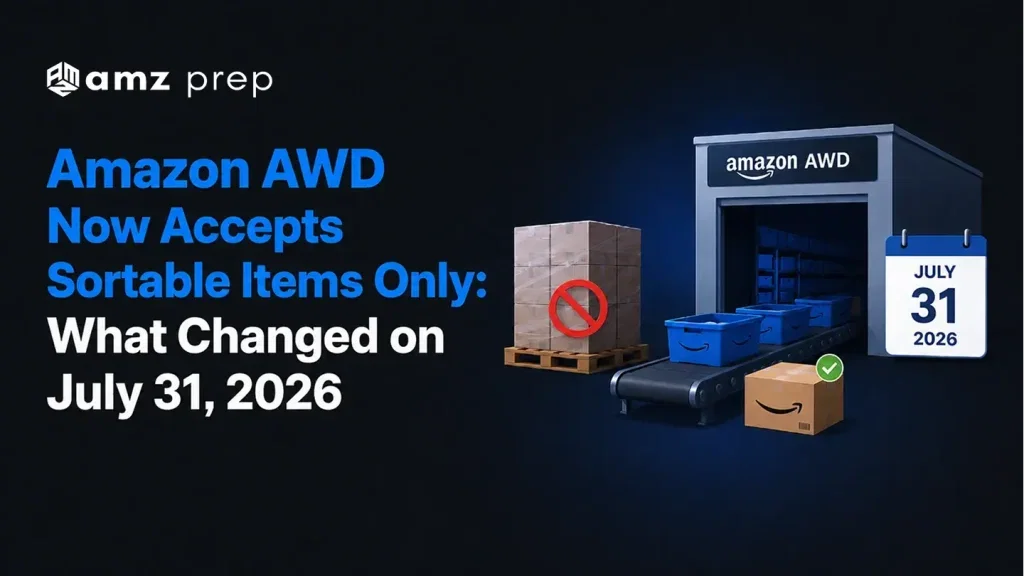
Amazon runs this check at the ASIN level when you build a shipment. The limit applies to the sellable unit, not your master carton. Brands with bulky SKUs need a new upstream storage plan before Q4 volume lands.
I have spent the past two weeks rebuilding inbound plans for brands that lost Amazon AWD access on part of their catalog. The rule is simple. The confusion around it is not.
What Changed in AWD Product Eligibility on July 31, 2026
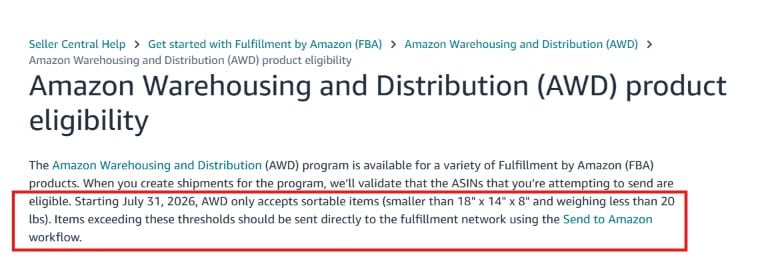
Amazon updated its AWD product eligibility page in July 2026. The new wording is one line long. From July 31, AWD ‘only accepts sortable items.’
Sortable has a specific meaning inside Amazon’s network. It describes units that move through standard conveyor and bin handling. Amazon set the cutoff at 18 x 14 x 8 inches and 20 pounds.
Anything above that threshold routes through Send to Amazon. Those units go directly into the fulfillment network. The upstream storage step is no longer open to them.
The exact thresholds Amazon published
A unit stays eligible when all four conditions hold:
- Length under 18 inches
- Width under 14 inches
- Height under 8 inches
- Weight under 20 pounds
Amazon defines the failing side of this as any single dimension of 18 inches or longer, 14 inches or wider, or 8 inches or higher, or any weight at 20 pounds or above.
Miss either one and the ASIN drops out of the program. There is no partial eligibility and no tier-by-tier exception published.
Where Amazon runs the check
Amazon validates eligibility at shipment creation. When you build an Amazon AWD warehouse shipment in Seller Central, the system reviews the ASINs you selected. Ineligible ASINs get blocked before the plan is confirmed.
This matters for planning. You will not find out at the receiving dock. You find out when you try to create the shipment, which is usually too late to re-route freight that is already booked.
Amazon gave a reason for the change. Part of its fulfillment network is built specifically for bulky and oversize inventory. Sending those items directly through Send to Amazon gets them into a fulfillable state faster and closer to customer demand, depending on how inventory is positioned across the broader Amazon RDC network.
The page also notes Amazon is working to make more product types eligible over time.
Does the Size Limit Apply to Your Carton or Your Unit
This is where most of the confusion sits, and the answer changes what you have to do next.
The 18 x 14 x 8 and 20 pound threshold applies to the individual sellable unit. That includes retail packaging. It does not apply to the master carton you use to ship multiple units into an AWD facility.
AWD carton rules are separate and did not change on July 31. Cartons can still run up to 25 inches on any side and up to 50 pounds.
Worth noting for anyone running both programs: FBA raised its maximum carton length to 36 inches in June 2025. AWD did not follow. If you keep one carton spec for both destinations, a 36 inch box headed to AWD gets rejected at receiving. Two spec sheets, not one.
So the practical read is narrower than the headlines suggest. Your packaging team probably does not need to redesign master cartons. Your merchandising and catalog teams need to check unit dimensions.
Which Amazon Size Tiers Still Qualify for AWD
The threshold is not arbitrary. 18 x 14 x 8 inches and 20 pounds is the exact ceiling of Amazon’s Large Standard size tier. That makes the rule easier to apply.
| Amazon size tier | Eligible for AWD after July 31, 2026 |
|---|---|
| Small standard | Yes |
| Large standard | Yes |
| Small bulky | No |
| Large bulky | No |
| Extra-large | No |
If your ASIN reports as standard size in Seller Central, nothing changes for you. If it reports as bulky or extra-large, that SKU needs a different path.
One detail catches sellers out. Amazon is classified by the largest triggering measurement. A light product with one long dimension can land in a bulky tier on dimensions alone. Check the reported tier, not your own tape measure.
What Else Affects Awd Eligibility Besides Size
Size is one of four checks Amazon runs. The others catch plenty of sellers.
Categories not eligible right now
Amazon devices, gift cards, high-value products, jewelry, watches, meltable products, and refrigerated goods. Meltable covers all heat-sensitive items, including chocolate, gummies, and selected jelly and wax-based products.
Worth correcting a common error here. Shoes are eligible. Several widely shared guides still list shoes alongside jewelry and watches as excluded. Amazon’s current page lists shoes in the eligible column.
Dangerous goods
Most hazmat is out. Three battery classes are eligible, covering new small and medium lithium ion, lithium metal, and non-spillable batteries. Amazon notes that ineligible hazmat sent into AWD may be disposed of. Battery products are also limited to AWD-to-Amazon replenishment, not off-Amazon distribution.
Expiration dating
Inbound units need 185 or more days of shelf life at shipment creation. Outbound to FBA carries the same 185 day rule. Multi-Channel Distribution needs at least one day. Once a unit drops under 105 days, the options narrow to outbound through MCD, or disposal on the expiration date if nothing is done.
Listing and inventory health
Amazon also blocks shipments for stranded inventory, invalid listings, missing catalog attributes, and restricted categories without pre-approval. Stranded inventory has to be resolved before the AWD shipment is created.
If an ASIN is wrongly flagged as ineligible, Selling Partner Support or Amazon’s Seller Assistant can correct the classification.
What Amazon AWD Is and What It Does Now
Amazon AWD stands for Amazon Warehousing and Distribution. That is the AWD full form, and the AWD meaning is the same everywhere Amazon uses it.
It is a bulk storage layer that sits upstream of FBA. You send pallets into an AWD facility at a lower storage rate. Amazon holds the stock and pushes it into fulfillment centers as it sells. That push is the auto-replenishment function, driven by Amazon’s own demand model.
Amazon Warehousing and Distribution (AWD) sits inside the Supply Chain by Amazon suite, alongside Amazon Global Logistics and the Partnered Carrier Program.
Two 2026 changes shape how it works today. Storage now runs $0.57 per cubic foot per month in the West region and $0.48 elsewhere. Amazon also stopped providing prep and labeling services across its network on January 1, 2026. Everything arriving at AWD has to be fully compliant before it ships. Our full 2026 Amazon fee breakdown covers the rest of the schedule.
What the Change Costs Sellers with Bulky SKUs Before Q4
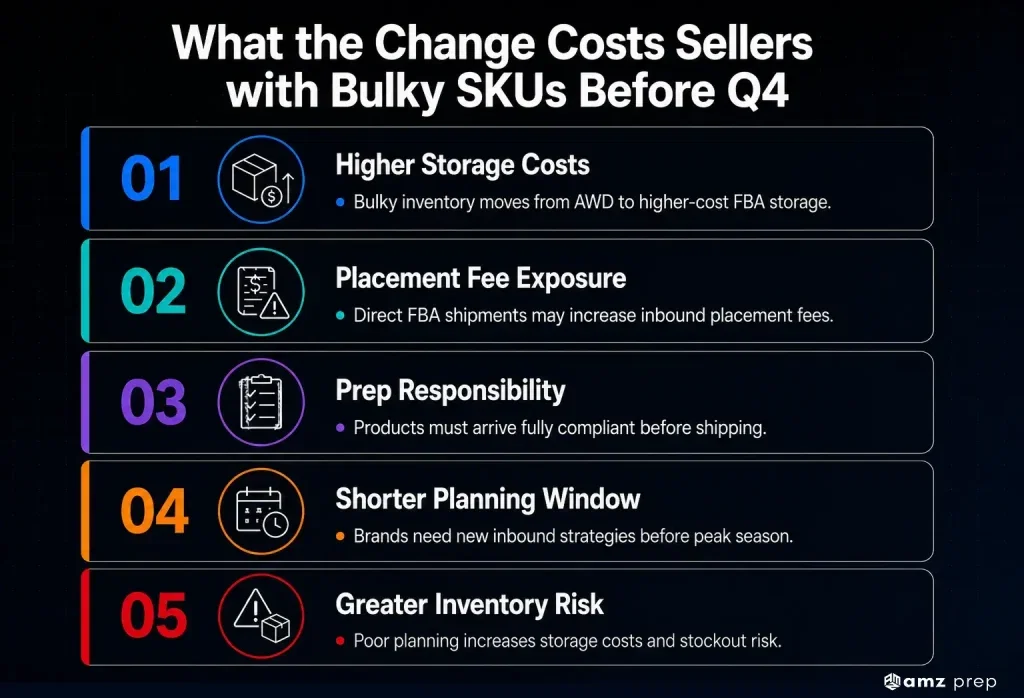
The storage delta is the number that matters. AWD holds inventory at $0.48 to $0.57 per cubic foot. FBA peak storage runs $2.40 per cubic foot in Q4.
For a brand storing bulky seasonal stock, that gap compounds fast across October, November, and December. Losing the cheap layer eight weeks before peak is a real planning problem, not a rounding error.
There is a second cost. Sending bulky units directly into FBA puts inbound placement fee exposure back on the table. AWD replenishment moved inventory inside Amazon’s network. Send to Amazon does not work the same way, and split shipments carry placement charges.
Third, prep sits with you now. Amazon will not correct a missing FNSKU or an incomplete polybag at either destination. Units that arrive wrong get delayed or refused. For bulky items with awkward packaging, that risk is higher than it is for standard size goods.
The timing is what I keep flagging with clients. AWD replenishment cutoffs for Q4 have landed in early October in recent years. That leaves a short runway to change a path and prove it works.
Four Routes for Oversize Skus After July 31, 2026
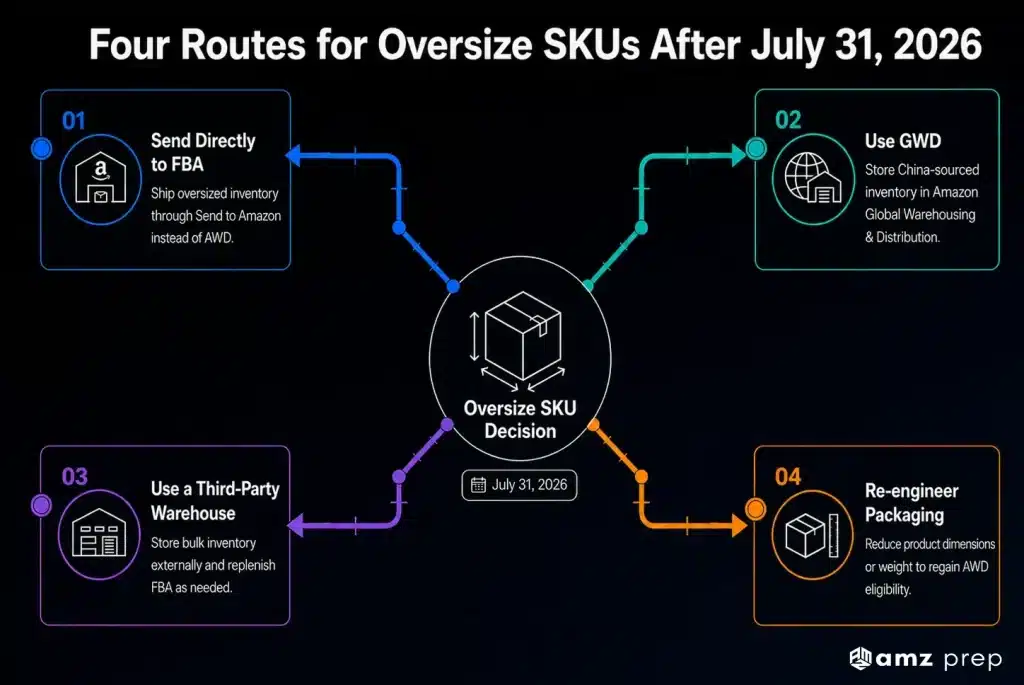
Send bulky units straight to FBA
The default option. Build shipments through Send to Amazon and skip the upstream layer entirely.
This works for fast-moving bulky SKUs with predictable sell-through. It stops working when you need to hold three months of seasonal cover, because you pay FBA peak storage on all of it. Splitting shipments yourself across Amazon fulfillment center locations reduces placement charges.
Use GWD if you source from China
Amazon launched Global Warehousing and Distribution in Shenzhen on April 9, 2026. It holds bulk stock near the point of manufacture and replenishes US fulfillment centers.
Amazon says storage runs up to 45% below US AWD, and up to seven days faster into US FCs when paired with Amazon Global Logistics. Amazon also added 30 days of free GWD storage for shipments received between July 1 and December 31, 2026.
Two caveats. Those performance figures come from Amazon and have not been independently verified. GWD also only helps if your manufacturing sits in China and you are willing to run AGL. It does nothing for domestic sourcing.
Hold bulk stock at a third party warehouse and drip-feed into FBA
This is the route most bulky brands land on. You store full cases outside Amazon’s network and send measured volume into FBA on a weekly cycle.
Storage is cheaper than FBA peak rates. Inventory stays available for other channels. Size tier restrictions do not apply, because the warehouse is not sorting units onto Amazon’s conveyor system. We break down the cost mechanics in our AWD and middle mile comparison.
Re-engineer unit packaging to fit under the threshold
Possible for a small number of SKUs. A product sitting just over 20 pounds or a fraction over 18 inches may come back into range with a packaging change.
Run the math before committing. Redesign costs, new artwork, and a listing dimension update all take time. For most catalogs it is worth checking two or three borderline ASINs and leaving the rest alone.
How to Audit Your Catalog Before Your Next Inbound
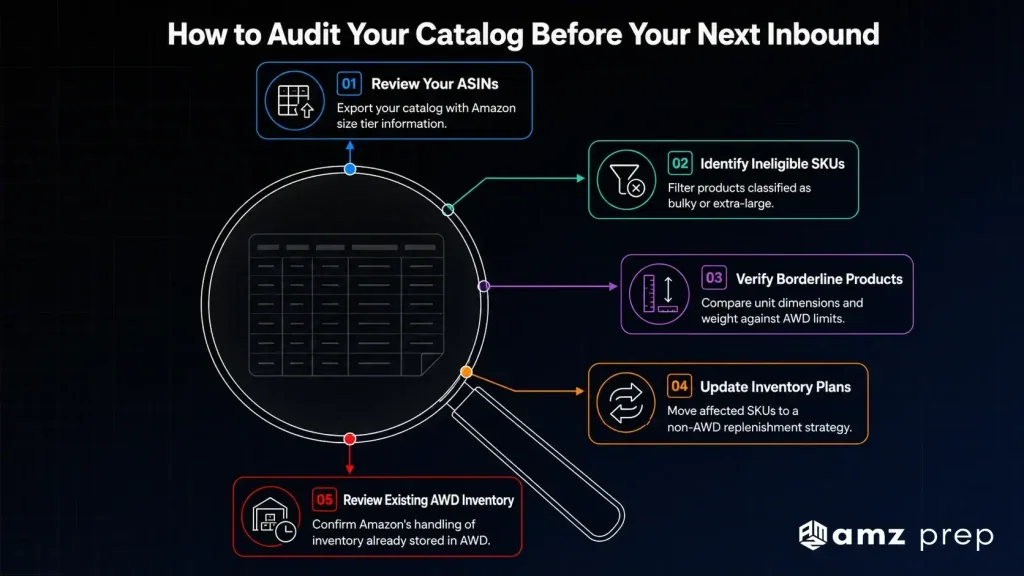
Five steps, and most teams can finish in an afternoon.
- Pull your full ASIN list from Manage FBA Inventory with the size tier column included.
- Filter for anything reporting as small, bulky, large bulky, or extra-large. Those SKUs are out.
- Check borderline standard size items against the 18 x 14 x 8 and 20 pound thresholds. Amazon’s measured dimensions win, not yours.
- Rebuild Q4 volume forecasts for every affected SKU on a non-AWD path.
- Plan the sell-through on bulky stock already in AWD. Those units keep replenishing normally and keep accruing AWD storage fees. The change hits when you go to restock, because that shipment has to run through Send to Amazon.
Bulky volume already in storage is not stranded. Treat it as your last cheap cycle and plan the replacement path now.
Run step five first if you have meaningful bulky volume in AWD today. The answer changes your Q4 plan more than anything else on this list.
While you are in the catalog, confirm your FNSKU labeling is current. Amazon ended commingling on March 31, 2026, and we covered the labeling requirements that replaced it.
How Amz Prep Handles Bulky Inventory That Awd Will Not Take
Our Amazon Replenishment Program stores full cases at our facilities and drip-feeds into FBA on a weekly cycle. Size tier restrictions do not apply, so bulky and extra-large SKUs move the same way standard units do.
The same inventory serves other channels. Stock sitting in our network can ship to Amazon, Shopify, Walmart, TikTok Shop, or a retail partner without a separate storage plan. Bulky and heavy items are already part of our daily volume, including furniture and large format goods across Canada.
We have run this since 2016 across 50+ fulfillment centers in 6 countries, with 99.8% order accuracy. If you want the side by side against Amazon’s program, our AWD alternative page lays out the structure.
Amazon AWD Size Limit FAQs
Does AWD still accept oversize items after July 31, 2026?
No. Amazon Warehousing and Distribution accepts sortable units only from that date. Units above 18 x 14 x 8 inches or 20 pounds must ship directly to fulfillment centers through Send to Amazon.
What are the AWD size limits in 2026?
Each sellable unit must measure under 18 x 14 x 8 inches and weigh under 20 pounds. Master cartons follow separate rules and still allow up to 25 inches per side and 50 pounds.
Does the AWD size limit apply to master cartons?
No. Amazon validates ASIN eligibility, which means it measures the individual sellable unit including retail packaging. Your shipping carton follows the separate AWD carton rules, which did not change on July 31.
What is Amazon AWD?
Amazon AWD is Amazon Warehousing and Distribution. It provides low cost bulk storage upstream of FBA, with auto-replenishment into fulfillment centers as stock sells. It sits inside the Supply Chain by Amazon suite.
What happens to bulky inventory already stored in AWD?
Existing non-sortable stock keeps replenishing into the fulfillment network through auto or manual replenishment. AWD storage fees continue while it sits. Once it sells through, restock those items using Send to Amazon.
What is the AWD full form on Amazon?
AWD stands for Amazon Warehousing and Distribution. Sellers use it for bulk upstream storage and automated FBA replenishment. The AWD meaning is the same across Seller Central, help pages, and fee schedules.
Where should oversize inventory go instead of AWD?
Options include shipping directly to FBA, using GWD if you source from China, or holding bulk stock at a third party warehouse that drip feeds units into fulfillment centers weekly.


















Comments