
Furniture sales online keep growing across Canada in 2026. The challenge? Shipping costs. It eats into your margins quickly.
Heavy, oversized items cost more to move furniture across provinces. A single damaged piece of furniture wipes out your profit. Amazon’s FBA rules make things even trickier.
This blog will walk you through how to ship your furniture within Canada profitably. You’ll find strategies that cut costs by 20-40% and slash damage claims by 60%.
Whether you’re shipping on Amazon FBA, Shopify, or Walmart, this blog is your perfect roadmap.
Why Furniture Shipping Is Different for eCommerce Sellers?
Furniture isn’t like shipping boxes of phone cases or supplements. The size and weight create real challenges.
Dimensional weight pricing hits hard. A lightweight but bulky armchair can cost you $300+ to ship across provinces.
Damage rates are higher with fragile furniture too. Glass tabletops crack. Chair legs break during transit. Each damaged item means return shipping costs plus refunds. Customer expectations have changed. They want Prime-like furniture delivery even for oversized items. No one waits three weeks anymore.
Storage becomes an issue fast. Furniture takes warehouse space. More space means higher monthly fees eating into margins.
The Real Cost of Getting It Wrong
One damaged furniture piece can cost $200 to $2,000 in claims. Return shipping adds another $150-$400.
Your Amazon seller performance metrics suffer. High return rates tank your visibility. Negative reviews kill conversion rates.
Return rates in furniture average 15-25% higher than other categories. Each return typically costs 25-30% of the product price. For a $500 dining chair, one return means losing $125-$150. Multiply that across hundreds of units per month.
Which Shipping Method Works Best for Furniture Sellers?
Different shipping services serve different needs. Here’s what actually works for furniture sellers in Canada.
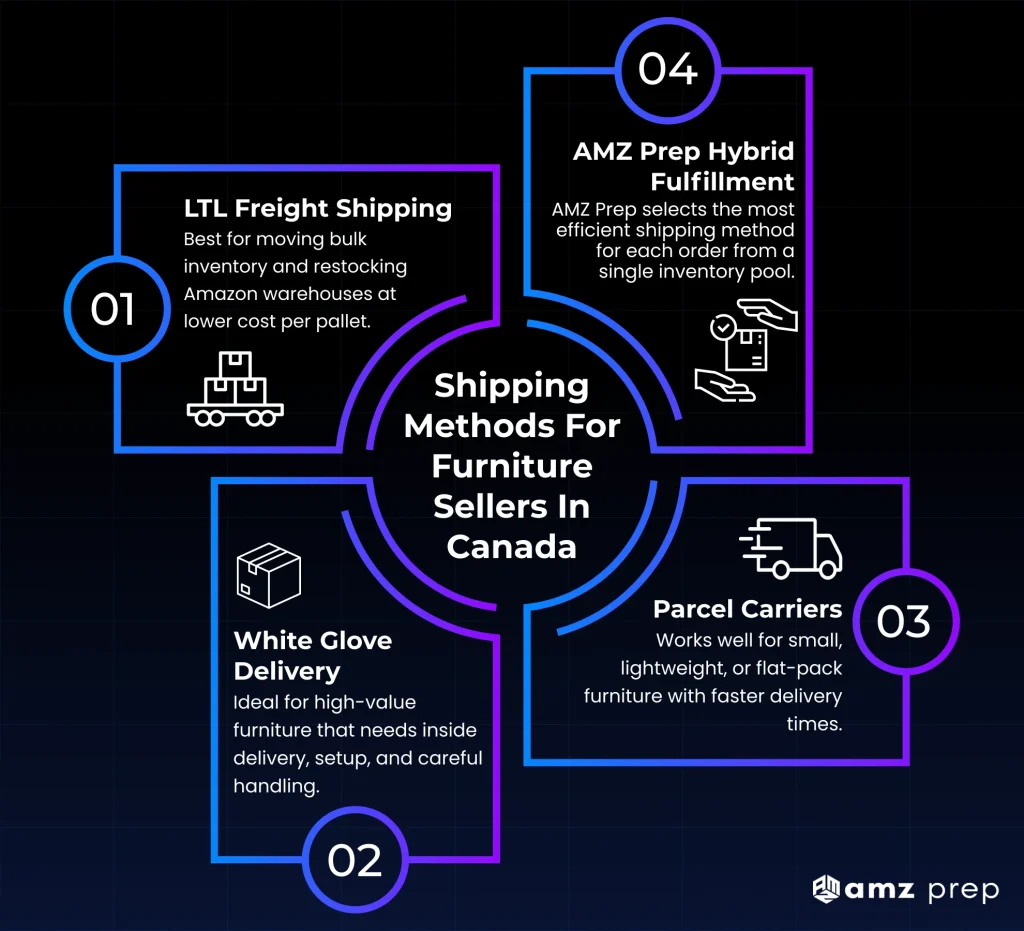
LTL Freight Shipping
Less-than-truckload freight is your workhorse for bulk shipment to Amazon warehouses. Costs range from $200-$800 depending on distance and pallet count. You pay only for the trailer space you use.
What works: Affordable for bulk orders, dependable for FBA shipments, good tracking
What doesn’t: Takes 5-10 business days, needs commercial addresses
Best use: Moving inventory from your 3PL warehouse to Amazon centers. Works great for restocking large quantities.
Working with a specialized 3PL for eCommerce gives you negotiated LTL rates. Individual sellers pay 30-50% more than high-volume shippers.
White Glove Delivery
Premium service for high-value furniture going direct to customers.
Delivery teams bring items inside, unpack, assemble, and remove packaging. Expect to pay $150-$500 per delivery.
What works: Fewer damaged items, happier customers, sets you apart
What doesn’t: High cost, slower arrival, tough to scale
Best use: Premium furniture brands. Products over $1,000 usually warrant this service. Low returns make up for the price.
Parcel Carriers (FedEx, UPS, Purolator)
Standard shipping for smaller furniture items under 70 pounds.
Dimensional weight pricing drives costs up. A flat-pack bookshelf can run $80-$150 to ship.
What works: Arrives in 2-5 days, available everywhere, simple tracking
What doesn’t: Weight limits, size penalties, more breakage
Best use: Flat-pack furniture, small accent pieces, lightweight items. Full-size sofas or dining sets cost too much this way.
3PL Hybrid Solutions
Smart sellers use multiple methods through one partner.
Your Amazon 3PL stores inventory in regional warehouses. They route each order to the most cost-effective shipping method.
DTC orders under 50 pounds go parcel. Bulk FBA shipments go LTL. High-value items get white glove delivery.
This approach typically saves 25-35% on total shipping costs. You also avoid Amazon’s placement fees entirely.
| Shipping Method | Best For | Cost Range | Speed | Damage Risk |
|---|---|---|---|---|
| LTL Freight | FBA bulk shipments | $200-$800 | 5-10 days | Low |
| White Glove | High-value DTC | $150-$500 | 7-14 days | Very Low |
| Parcel | Small furniture | $80-$150 | 2-5 days | Medium |
| 3PL Hybrid | All channels | 25% savings | Optimized | Low |
US-Canada Cross-Border Furniture Shipping Essentials
Selling into both US and Canadian markets? Cross-border shipping requires specific knowledge for moving across borders.
2025 Customs Regulation Changes
Canada eliminated the de minimis threshold in August 2025. All shipments now require duties and taxes paid upfront.
This affects furniture sellers shipping from US warehouses to Canadian customers. You must collect taxes at checkout now.
CUSMA (formerly NAFTA) still offers duty-free treatment for qualifying furniture. But the documentation must be perfect.
Required Documentation
Every cross-border furniture shipment needs these documents:
Bill of Lading (BOL): Details carrier, shipper, receiver, and freight description. Required for all LTL shipments.
Commercial Invoice: Lists product value, country of origin, HS codes. Must be accurate to avoid delays.
Phytosanitary Permits: Required for solid wood furniture. Both CFIA (Canadian) and USDA (US) inspections needed.
CUSMA Certificate: Proves North American origin for duty-free treatment. Saves 6-9.5% on most furniture.
Missing or incorrect documents cause week-long delays. Fines range from $250-$2,500 per shipment. Customs and Border Protection agencies enforce these rules strictly.
Cost Optimization Strategies
Bonded warehouses let you defer duties until furniture sells. Storage in bonded facilities costs 10-15% more monthly. However, you avoid paying duties on unsold inventory. This improves cash flow significantly for higher-value furniture.
Using Canadian fulfillment centers eliminates cross-border complexity entirely. Store inventory in Canada, sell to Canadians.
Ship from US warehouses only for US sales. This dual-warehouse strategy cuts total landed costs by 15-30%.
Common Pitfalls to Avoid
Wrong HS codes cause the most problems. Furniture codes range from 9401 (seating) to 9403 (other furniture). Using generic codes results in higher duty rates. A dining chair under the wrong classification pays 9.5% instead of 0%.
Improper valuation also triggers audits. Must include all costs: product, shipping, insurance, and assists.
Canada Border Services Agency audits increase in value disputes. Accurate documentation prevents $500-$5,000 penalties when shipping items from Canada to the US or vice versa.
How Smart Packaging and Damage Prevention Protect Your ROI
Packaging seems like a cost center. Smart sellers see it as profit protection for fragile items.
Beyond Basic Protection
Spending $5-10 extra per unit on packaging prevents $200-$2,000 damage claims.
Calculate your current damage rate. If you ship 500 furniture pieces monthly with 8% damage rate, that’s 40 damaged units.
At $300 average claim value, you lose $12,000 monthly. Investing $2,500 in better packaging (40 units × extra $5) to cut damage by half saves $6,000 monthly.
The ROI is 140% in the first month alone.
Packaging Materials Breakdown
Corner Protectors: Rigid foam or cardboard guards for edges. Costs $0.50-$2 per unit. Prevents most edge damage.
Furniture Blankets: Heavy-duty moving blankets (80+ lbs per dozen minimum). Costs $3-$5 per use. Reusable 15-20 times.
Stretch Wrap: Industrial strength, minimum 20-inch width. Costs $0.30-$0.80 per furniture piece. Holds components together.
Custom Crating: Required for glass, marble, or items over $2,000. Costs $30-$150 per crate. Virtually eliminates damage.
Cheap packaging costs you more long-term. Dollar-store bubble wrap fails during rough handling. Use packing tape rated for heavy items and invest in professional-grade materials.
Disassembly Best Practices
Remove all loose components before shipping. Table legs, chair arms, headboards should ship separately.
Use heavy-duty ziplock bags for hardware. Label each bag clearly: ‘Table Leg Bolts – Set A.’
Take photos during disassembly. If damage claims arise, photos prove the original condition. Also helps customers during assembly.
3PL Packaging Services
Professional FBA prep services manage packaging for high volumes. Teams trained in Amazon’s rules handle poly bagging, bubble wrapping, and corner protection as standard practice.
Quality checks happen before items leave the warehouse. Damaged inventory gets caught early, before customers receive anything.
AMZ Prep’s teams work with furniture every day. They know which pieces need extra protection. This experience cuts damage rates by 50-70%.
Shipping Costs & Cost-Effective Strategies
Understanding true shipping costs helps you price correctly and protect margins.
Complete Cost Components
Base Shipping Rate: What carriers charge upfront, typically $150-$600 for furniture within Canada.
Dimensional Weight Surcharges: Applies when your package is big but light. Carriers charge based on size, not actual weight. Formula: (Length × Width × Height) ÷ 166 = Billable Weight in lbs.
Fuel Surcharges: Changes weekly, adds 15-25% to your base rate. Carriers rarely negotiate this.
Residential Delivery Fees: Shipping to homes costs $4-$8 more per package than business addresses.
Liftgate Fees: Required when there’s no loading dock. Adds $75-$150 per shipment.
Peak Season Surcharges: October through January adds $0.20-$3.60 per unit. Plan ahead.
Hidden Costs Sellers Miss
Amazon charges FBA inbound placement fees when you can’t deliver to specified warehouses. These fees range $0.32-$1.58 per unit. Manual processing fees hit if you ship without proper labels. Amazon charges $0.11 per unit for relabeling.
Storage fees accumulate while awaiting pickup. At $0.87 per cubic foot monthly, large furniture bleeds money quickly. Return shipping often costs more than outbound. Factor 20-30% of product price for potential return costs.
Cost Reduction Tactics
Flat-pack design cuts dimensional weight drastically. A chair shipping assembled pays for 40 lbs. Flat-packed pays for 15 lbs. That’s a $60-$90 savings per unit on parcel shipping.
Send multiple units to the same address for volume discounts. Five chairs shipped together cost less per chair than sending them separately. Plan your shipments for March through September to skip the extra fees that come during busy seasons.
Regional carriers usually cost less than the big national names. Canada’s regional LTL networks can cut your shipping bills by 15-25%.
3PL Cost Advantages
Established 3PLs negotiate carrier rates based on total volume, including discounted pricing for liftgate freight delivery and other specialized freight services when needed. AMZ Prep ships millions of units annually. This volume earns 30-50% discounts compared to individual seller rates. You access these rates without needing high personal volume.
Consolidated shipping pools multiple sellers’ inventory onto shared trucks. You pay only for your pallet space.
Flat-rate pricing eliminates surprise fees. You know exactly what each unit costs to prep and ship. No hidden placement fees or surcharges.
| Cost Component | Individual Seller | With 3PL | Savings |
|---|---|---|---|
| LTL Base Rate | $600 | $400 | 33% |
| FBA Placement Fees | $1.58/unit | $0 | 100% |
| Packaging Materials | $8/unit | $4/unit | 50% |
| Labor (prep time) | $12/unit | $0.40/unit | 97% |
| Total per unit | $21.58 | $4.40 | 80% |
FBA-Specific Furniture Shipping Requirements
Amazon has strict rules for furniture entering their warehouses. Get them wrong and shipments get refused.
Amazon’s Furniture Prep Requirements
FNSKU labels must be scannable and placed on the outside of packaging. Never on plastic wrap that might shift. Box content information required on all master cartons. Must list quantity and product description clearly.
Packaging requirements prevent damage. Amazon refuses shipments with exposed wood or glass. Everything must be fully protected.
Oversize tier classifications affect fees. Furniture over 50 lbs typically qualifies as Special Oversize, triggering higher fulfillment fees.
FBA vs FBM Decision Framework
FBA works well when items qualify for Prime and fit the standard fee structure. Small furniture under $200 usually performs best here.
FBM (Fulfilled by Merchant) works better for oversized items with high fees. A dining table set might cost $25-$40 in FBA fees.
Doing FBM through a 3PL offering Seller Fulfilled Prime gives you a Prime badge without Amazon’s warehouse fees.
Hybrid strategy works best. Stock fast-moving small furniture in FBA. Handle large furniture through SFP with your 3PL.
Inbound Shipping Strategy
Amazon Warehousing & Distribution (AWD) offers lower storage fees for bulk inventory. Rate is $0.48 per cubic foot versus $0.87 in FBA.
Store bulk furniture in AWD. Amazon automatically replenishes FBA as needed. You avoid peak storage fees.
Placement optimization means sending products to as few warehouses as possible. Amazon often splits your shipments across 3-5 different locations.
A 3PL with middle mile services helps you skip placement fees. They manage distribution to every Amazon location you need.
Avoiding Common Amazon Violations
Inbound defect fees range from $0.02-$0.04 per unit. Triggered by incorrect labels, damaged packaging, or missing information.
Unplanned service fees hit when you send unexpected items. These cost $0.60 per unit plus any required processing.
Shipment refusals mean paying return freight. A refused furniture shipment costs $300-$800 to get back. Professional FBA prep centers prevent these issues. They know Amazon’s requirements inside out.
AMZ Prep’s automated prep app syncs with Seller Central. Shipping plans get created correctly every time. Zero placement fees guaranteed.
Multi-Channel Fulfillment Strategy for Furniture Sellers
Smart furniture sellers don’t rely on Amazon alone. Diversifying channels improves profitability.
Options for Moving Beyond Amazon: Sales Channels
Shopify/WooCommerce: Your own branded store. You control pricing, customer data, and the shopping experience.
Walmart Marketplace: Growing quickly in Canada. Less competition than Amazon with a similar customer base.
Wayfair/Overstock: Furniture-focused marketplaces. Commissions are higher but buyers are already looking for furniture.
Direct-to-Consumer Website: Best margins. You keep all profit minus marketing costs.
Each channel has different shipping expectations. Walmart wants 2-day delivery. Wayfair requires freight specifications.
Centralized Inventory Management
Managing inventory across five channels manually is impossible. Stock levels fall out of sync fast. AMZ Prep will support omnichannel fulfillment by centralizing all sales channels in one operation. Your inventory stays in a single location with accurate counts across every channel.
Real-time syncing prevents overselling. When something sells on Shopify, the count drops across all your channels right away. Orders get routed without you lifting a finger. The system picks the best shipping method for where it’s going and how fast it needs to arrive.
AMZ Prep runs 50+ warehouses across North America. Your furniture leaves from whichever location is nearest to your customer.
This reduces shipping costs by 25-40% compared to single-warehouse operations.
Returns Processing
Furniture returns require inspection. Is it damaged? Is it still sellable? Can it be refurbished? Smart furniture sellers rely on optimized 3PL returns and warehouse management to streamline inspections, reduce turnaround times, and handle restocking efficiently.
Quality inspection protocols catch issues immediately. Damaged items get documented for insurance claims.
Refurbishment services restore minor damage. Scratched table legs get touched up. Missing hardware gets replaced.xx
Liquidation strategies move damaged goods profitably. Rather than tossing a scratched dresser, sell it at 50% off through liquidation channels.
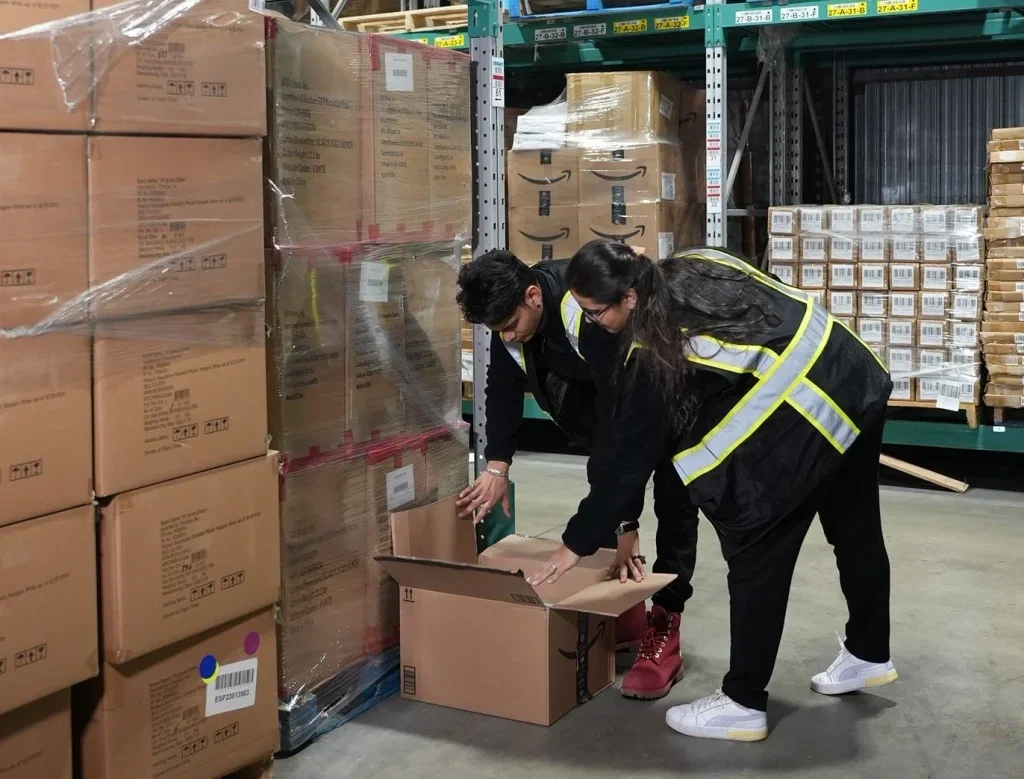
At AMZ Prep, we run established, repeatable returns processes built for scale. We handle hundreds of furniture returns every day with clear inspection, grading, and disposition workflows. Every return gets logged, checked, and sent for restocking, repair, liquidation, or disposal. Nothing sits around or gets lost.
Technology & Tracking Solutions
Running a furniture business without the right tech means flying blind. You need to see what’s happening at every step.
Essential Tech Stack for Furniture Sellers
Warehouse Management Systems (WMS) track inventory in real-time. You know exactly how many units sit in each location.
Inventory tracking software prevents stockouts and overstock. Automatic reorder alerts trigger when stock hits minimums.
Shipping rate calculators compare carriers instantly. See FedEx versus UPS versus Purolator rates side-by-side.
Multi-carrier shipping platforms let you buy labels for any carrier. One dashboard, all carriers, best rates.
Integration Capabilities
API connections with carriers provide real-time tracking. Customers get automatic updates as furniture moves.
Shopping cart integrations sync orders automatically. Shopify order comes in, fulfillment starts within minutes.
Real-time tracking for customers reduces ‘where is my order’ emails by 60-80%.
AMZ Prep’s technology integrates with 50+ eCommerce platforms. Amazon, Shopify, Walmart, eBay, WooCommerce all connect seamlessly.
Data-Driven Decision Making
Analyze shipping costs by route to find cheapest options. Vancouver to Toronto might be cheaper via a different carrier than the Montreal route.
Track damage rates by carrier. If FedEx damages 12% of shipments but UPS damages only 4%, switch carriers.
Delivery time performance metrics show which carriers meet promises. Missing delivery windows hurts conversion rates.
Your order data shows where you should add warehouses. If 40% of your orders go to Ontario, a Toronto warehouse will drop your costs fast.
Seasonal Planning & Peak Period Strategies
Furniture sales follow clear patterns each year. Plan early or you’ll hit capacity problems.
Spring Moving Season (Apr-Jun): Second-highest volume. People furnish new homes after moving.
Back-to-School (Aug-Sep): Dorm furniture, desks, and storage solutions move quickly.
Peak periods bring higher shipping costs. Carriers add premiums when demand outpaces their capacity.
Peak Season Preparation
Position inventory 4-6 weeks before peak. If Q4 is busy, stock up by September.
Peak surcharges run October 15 through January 14. Budget extra $0.20-$3.60 per unit during this period.
Carrier capacity booking ensures your furniture ships on time. Book space with carriers 2-3 months ahead.
Without guaranteed capacity, carriers prioritize larger shippers. Your furniture sits waiting while bigger customers ship.
AMZ Prep guarantees capacity during peaks. Our volume gives us priority treatment with all major carriers.
Weather Considerations for Long-Distance Moves
Winter creates shipping problems across Canada. January shipments from Alberta to Quebec will likely run late.
Cold storage keeps wood furniture from cracking when temperatures drop. AMZ Prep’s cold storage spaces hold steady temperatures to stop warping, splitting, and material damage.
Build delays into your winter promises. Tell customers 5-7 days instead of 2-3 during cold months.
Be upfront with customers. Promise less and deliver more to earn their trust.
Choosing the Right 3PL Partner for Furniture
Not every 3PL handles furniture well. Some only work with small packages. You need one that knows furniture.
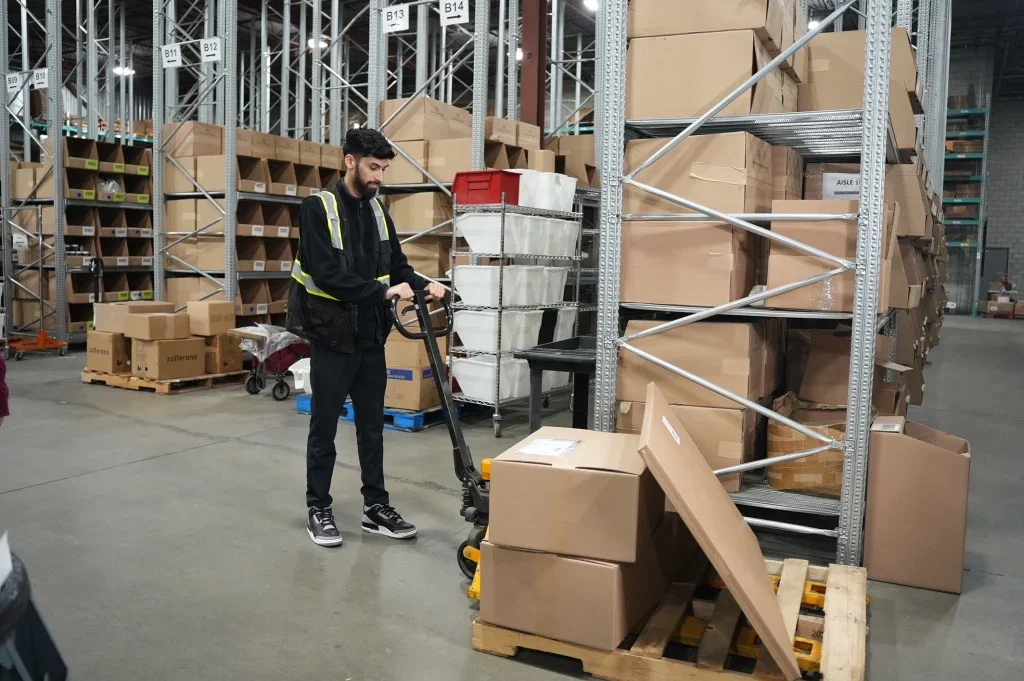
Essential 3PL Capabilities
Large Item Storage: Facilities need high ceilings (20+ feet) and pallet bays designed for furniture.
Assembly/Disassembly Services: Some pieces need assembly before shipping. Others need disassembly for safe transit.
Cross-Border Expertise: If selling in both the US and Canada, your 3PL must understand customs and regulations.
Multi-Carrier Relationships: Access to LTL freight, parcel carriers, and white glove services from one partner.
Technology Integration: Real-time inventory visibility and automatic order routing are non-negotiable.
Questions to Ask Potential Partners
What’s your experience with the furniture category? Get specific examples. How many furniture sellers do they serve?
What are your damage rates? Average should be below 3% for properly packaged furniture.
Do you understand FBA compliance? Ask about FNSKU labeling, box requirements, and placement fee strategies.
Can you scale with me? What happens when you go from 100 units monthly to 5,000 units?
How transparent is your pricing? Get complete fee breakdown. Watch for hidden charges.
Why Specialized 3PLs Like AMZ Prep Make the Difference
Furniture requires specific handling knowledge. Knowing which pieces need extra corner protection matters.
AMZ Prep ships millions of furniture units annually. This experience prevents costly mistakes. White glove delivery options are available for premium furniture. Your customers get full setup and packaging removal.
1-2 day shipping covers 99% of North America from our 50+ warehouses. Regional distribution helps you cut costs dramatically. Flat-rate pricing means zero surprises. You know exactly what each unit costs from day one.
Conclusion
Shipping furniture across Canada doesn’t have to drain your profits. The right strategies reduce costs by 20-40%. Better packaging cuts damage claims by 60%. Smart 3PL partnerships eliminate FBA placement fees entirely.
You’ve learned how to choose shipping methods, handle cross-border complexity, and optimize for each sales channel. Furniture eCommerce keeps growing. Sellers who master logistics gain competitive advantage.
The difference between struggling and thriving often comes down to fulfillment and execution.
AMZ Prep handles furniture shipping for over 5,000 active sellers. We operate 50+ warehouses across North America.
Our flat-rate pricing includes FBA prep, zero placement fees, and 1-2 day delivery to 99% of the continent. We process 8 million units monthly. Your furniture gets the same expert handling as Fortune 500 brands receive.
Ready to ship furniture profitably? Get a custom quote from AMZ Prep and see how much you can save.
Frequently asked questions
How much does shipping furniture across Canada cost?
Shipping furniture across Canada costs $200-$800 for LTL freight, $80-$150 for parcel carriers, and $150-$500 for white glove delivery. Costs depend on size, weight, distance, and shipping method. Using a 3PL typically saves 30-50% on rates.
What is the cheapest way to ship furniture in Canada?
LTL freight offers the lowest cost for bulk furniture shipments within Canada. For individual pieces, parcel carriers work well for flat-pack items under 70 pounds. A 3PL provider cuts your costs by bundling shipments together and securing better rates with carriers.
How do I ship furniture to Amazon FBA in Canada?
Ship furniture to Amazon FBA with correct FNSKU labels, protective packaging, and box details. A specialized FBA prep center handles compliance, eliminates placement fees, and processes items in 1-3 days. This stops Amazon from refusing shipments and saves you from violations.
Can I ship furniture from the US to Canada for my eCommerce business?
Yes, furniture can ship from the US to Canada. You’ll need customs paperwork: commercial invoice, bill of lading, and phytosanitary permits for wood items. CUSMA certification gets you duty-free treatment. Bonded warehouses or Canadian fulfillment centers make this simpler and cheaper.
What packaging is required for shipping large furniture across Canada?
Large furniture needs corner protectors, heavy-duty blankets, industrial stretch wrap, and custom crates for expensive pieces. Good packaging stops damage claims that average $200-$2,000 per item. Spending $5-$10 more per unit on packaging cuts damage by 50-70%.
Do I need a 3PL for shipping furniture in Canada?
A 3PL isn’t mandatory, but it saves 20-40% on shipping costs. You get better carrier rates, access to multiple warehouses, and FBA expertise. 3PLs cut placement fees, reduce damage, and take care of returns. Best fit for sellers shipping 300+ units each month across several sales channels.

Arishekar N is a Vice President (VP) of Marketing at AMZ Prep, specializing in ecommerce fulfillment and Amazon logistics strategies with a proven track record of driving growth for e-commerce businesses. He is a strategic leader with extensive expertise in marketing, e-commerce operations, SEO & advertising, and branding.
Stay updated on his latest insights by following him

















Comments