
Amazon just made a huge announcement. Amazon commingled inventory ends on March 31, 2026.
If you’re an Amazon seller or FBA seller, this changes everything. No more pooled inventory. No more shared bins.
After years of counterfeit complaints and brand nightmares, Amazon is pulling the plug on commingling. This is one of the most significant steps Amazon has taken in years to protect third-party sellers. Let us walk you through what this means for your business.
What is Amazon Commingling Policy?
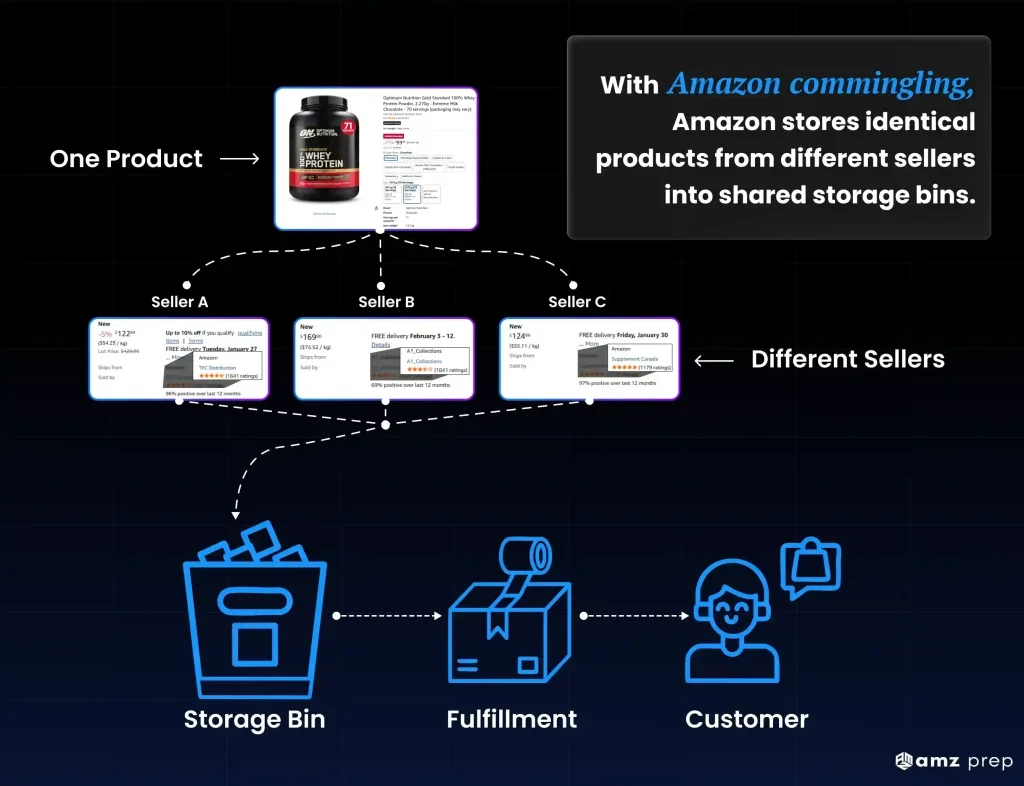
Amazon’s commingled inventory system is when Amazon mixes identical items from different sellers into one shared bin at their Amazon fulfillment center.
Here’s how it worked. You send 100 units of a product to Amazon. Another seller sends 100 of the same product. Amazon stores all 200 together in a single pool of inventory.
When a customer orders, Amazon grabs whichever unit is closest. It might be yours. It might be theirs. Commingling means your inventory shipped gets mixed with inventory from multiple sellers.
Amazon fulfills orders by tracking everything virtually using manufacturer barcodes like UPCs. The system knows who owns what. But the physical products sit together in the same warehouse space at the fulfillment network stock keeping locations.
This is called virtual tracking. Amazon’s software maintains ownership records while products share storage.
The Simple Version
Think of it like a bank. You deposit $100. Your neighbor deposits $100. The bank doesn’t keep your exact bills separate.
When you withdraw, you get $100 worth of bills. But they’re not your original bills.
That’s commingling. Your products. Their products. One shared pool.
The Technical Side
Amazon uses manufacturer barcodes for commingled inventory. These include UPC codes, EAN codes, and ISBN numbers.
Your products don’t get FNSKU labels in a stickerless system. They keep their original barcodes. Amazon scans these at receiving and tracks virtual ownership.
When your item sells, Amazon adjusts your account balance. But you might not receive that exact unit back in return. Commingled inventory means items from different sellers share the same storage space.
This commingled inventory system was designed for efficiency. Faster storage. Quicker shipping. Lower costs for Amazon and the supply chain.
But it created massive problems for those who sell on Amazon.
When is Amazon going to stop commingling?
Amazon made a series of announcements in September 2025 at their Accelerate conference. Amazon finally listened to brand owners who have fought this system for years. Now they finally won.
The Official Details
Starting effective March 31, 2026, commingling practices stop in all US fulfillment centers. Every product needs individual tracking through Fulfilled by Amazon.
Important: The March 31, 2026 deadline applies to when shipments arrive at fulfillment centers, not when they’re created. If you create a shipment before March 31 but it arrives after, it must follow the new FNSKU requirements.
Here’s how it breaks down:
Brand Owners with Brand Registry: You can still use manufacturer barcodes. But inventory that’s yours stays separate. No more pooling with other sellers. This is stickered inventory specific to your brand.
Resellers and Non-Brand Owners: You’re now required to use Amazon barcode labels (FNSKU). Every single unit. No exceptions. You must use Amazon barcodes instead of manufacturer codes.
Why Amazon Made This Policy Change in Commingling
Amazon gave three main reasons for ending commingling:
First, their logistics network improved. Products already sit close to customers through Amazon fulfillment centers. Mixed inventory doesn’t speed things up anymore.
Second, more sellers are brand owners now. They want protection when they use Amazon services. They demanded this change.
Third, Amazon’s virtual tracking technology advanced. They can handle separate inventory efficiently now.
But let’s be honest. The real reason? Counterfeit products became too big to ignore. The risk of mixing authentic products with counterfeit items created liability issues for Amazon and customers alike.
What is the Timeline for Sellers using Commingling
- January 2026: Final planning month
- February 2026: Start transitioning new shipments
- March 31, 2026: Deadline – commingling officially ends
- April 2026: New system fully in place
Mark your calendar as this deadline matters.
The Counterfeit Crisis in Amazon Commingling
Here’s the ugly truth about commingled amazon inventory. Fake products infiltrated the system, putting goods on Amazon at risk.
How Counterfeits Sneak In
Imagine 10 sellers all ship the same product to an Amazon fulfillment center. Nine send authentic items. One sends counterfeits.
Amazon mixes everything together. Now every seller potentially ships fake products to customers. Even the legitimate ones face receiving counterfeit products complaints.
The authentic sellers get negative reviews. Their accounts face suspension. But they didn’t do anything wrong.
This is the shell game problem. You can’t prove which unit came from where. Amazon won’t always know which seller sent the fake item when items to Amazon arrive in mixed bins.
Real Example of Brands Affected with Amazon Commingling
Nike left Amazon in 2019 partly because of commingling counterfeit issues. They couldn’t control product authenticity when buying products from Amazon. They returned in 2025 only after Amazon agreed to better protections.
Johnson & Johnson faced similar problems. Counterfeit baby products. Fake supplements. Dangerous items reaching customers who buy products on Amazon.
Tovalo, a kitchen brand, found fake products ranking higher than their authentic listings. Amazon’s algorithm couldn’t tell the difference between identical items in the commingled system.
The Health Risks
Beauty products with toxic ingredients. Supplements with heavy metals. Electronics with faulty batteries. These aren’t just quality issues. They’re safety hazards.
One seller reported receiving returned supplements that weren’t even their product. Different pills in their branded bottle. That’s even terrifying.
Does Amazon Suspends Seller Account During Commingling
Amazon blames whoever’s account the order links to. Even if the counterfeit came from someone else’s shipment. This happens even to former Amazon employees who become sellers.
Proving your innocence? Nearly impossible. The items were already mixed together months ago in the Amazon fulfillment system.
Sellers lost accounts worth millions. All because of commingling amazon counterfeit contamination. Amazon has taken steps to prevent this, but only now with the March 2026 deadline.
Understanding Amazon Commingling VAT
This gets complicated fast. But it’s important if you sell internationally through the Amazon commingling program.
When commingling in Amazon happens across borders, special VAT transactions occur. These are critical to understand before the Amazon commingling program ending takes effect.
What is Commingling VAT?
When Amazon ships your product from a different country than where it’s stored, special transactions happen.
These are called commingling_buy and commingling_sell transactions. They appear on your Amazon tax reports.
Here’s an example. You’re a UK seller. Your inventory sits in Germany. A customer in France orders.
Amazon performs a “commingling_sell” in Germany. Then a “commingling_buy” in France. Then the final sale. Each transaction has VAT implications.
Pan-EU Complications
Amazon’s Pan-European FBA program stores your inventory across multiple countries. This triggers VAT registration requirements in each country.
Commingling made tracking these transactions nearly impossible manually. You can’t tell which warehouse shipped which order.
Different VAT rates apply in each country. Germany charges 19%. France charges 20%. UK charges 20%. Your accounting system needs to track all of this correctly.
The Accounting Challenge
Recording commingling VAT requires specialized software. Most sellers can’t do this manually without mistakes.
You need to know:
- Which country stored the product
- Which country the customer lives in
- The VAT rate for each transaction
- How to book input vs output tax
Getting this wrong means penalties. Overpayment. Incorrect filings.
Software Solutions
Tools like Taxdoo, Taxually, LinkMyBooks, and Synder automate commingling VAT calculations. They integrate with Amazon’s tax document library. These aren’t optional for international sellers. They’re essential.
Without automation, you’ll spend hours manually sorting transactions. And probably still get it wrong.
Good news? After March 31, 2026, commingling VAT calculations became simpler. Your inventory stays separate.
Pros and Cons of Amazon Commingling
Let’s break down why the Amazon FBA commingling system existed and why Amazon ends commingling 2026 news is such a big deal.
The Advantages (Why Sellers Used It)
No Labeling Costs: You saved $0.20 to $0.50 per unit by skipping FNSKU labels. For high-volume sellers, that adds up.
Faster Processing: Amazon received commingled inventory 24-48 hours faster. Less prep work at the warehouse.
Time Savings: No label printing. No label application. Just ship products in original packaging.
Multi-Channel Flexibility: Same inventory worked for Amazon and other sales channels. One barcode for everything.
These benefits appealed to resellers and arbitrage sellers especially.
The Disadvantages (Why It’s Ending)
Counterfeit Contamination: Your reputation got destroyed by someone else’s fake products. This alone killed commingling.
Quality Control Loss: You couldn’t guarantee customers received your exact units. Quality varied.
Account Suspension Risk: Amazon blamed you for counterfeit items you never sent. Appealing was nearly impossible.
Inventory Tracking Difficulty: Returns came back wrong. Reconciliation was a nightmare.
VAT Compliance Challenges: International sellers struggled with complex tax calculations.
Liability Issues: Legal grey areas. Who’s responsible when someone gets a fake product?
Brand Reputation Damage: Negative reviews for products you didn’t actually ship.
The disadvantages clearly outweigh the advantages. That’s why Amazon’s ending the program.
How Amazon Commingling Affects Brand Protection
Brand owners suffered the most under commingling. Here’s how to protect yourself going forward.
Amazon Brand Registry
First step: enroll in Amazon Brand Registry. This requires a registered trademark.
Brand Registry lets you use manufacturer barcodes without commingling after March 31, 2026. Your inventory stays separate.
The setup takes about 2-3 weeks. You need:
- Active trademark registration
- Brand website or Amazon Store
- Product images with your branding
Once enrolled, you control your listings. You prevent unauthorized sellers. You maintain brand integrity.
Project Zero Protection
Project Zero takes protection further. It has three components:
Automated Protections: Amazon’s AI scans for counterfeit listings daily. It removes suspicious ones automatically.
Self-Service Removal: You can remove counterfeit listings yourself without waiting for Amazon review.
Product Serialization: Each unit gets a unique code. Customers can verify authenticity.
Enrollment requires a 90% acceptance rate on previous counterfeit reports. Training takes about 2 hours.
The cost? About $0.01 to $0.05 per unit for serialization codes. Worth it for brand protection.
Comparing Protection Levels
Basic FNSKU labeling offers 80% protection. It separates your inventory but doesn’t prevent counterfeits.
Brand Registry provides 90% protection. Your inventory stays pure. You control listings.
Project Zero delivers 99%+ protection. Serialization makes counterfeiting nearly impossible. Each code links to one unit.
Most private label brands should aim for Brand Registry minimum. Consider Project Zero for premium products.
How to Turn Off Commingling Inventory on Amazon
Since the Amazon ends commingling 2026 announcement, many sellers have already switched to FNSKU labels. Here’s how you do it.
Current Process
Log into Seller Central. Navigate to Settings, then Fulfillment by Amazon.
Find “FBA Product Barcode Preference.” Change from “Manufacturer barcode” to “Amazon barcode.”
This affects new listings immediately. Existing SKUs keep their current setting.
Important Warnings
You can’t change existing MSKUs. You need to create new merchant SKUs for products you want to switch.
Mixed shipments aren’t allowed. A single shipment can’t contain both commingled and labeled inventory.
Inventory already in Amazon’s system stays commingled until sold or removed.
FNSKU Label Requirements
Amazon is pretty conscious about how these labels need to look.
Your labels need to be at least 1″ x 2″. Stick them on the outside of the product or package where they’re easy to scan.
Make sure they’re clean and clear – no smudges, tears, or fading. And this is important: the label has to match your ASIN exactly. One wrong number and you’ve got problems.
You can absolutely print these yourself if you want. But here’s what most sellers do: they hand it off to FBA prep services.
These prep centers take care of everything – labeling, inspection, getting your products shipped to Amazon.
AMZ Prep, for example, handles all the FBA prep work including FNSKU labeling for about $0.40 per unit. They receive your inventory, inspect it, label it, and ship it straight to the fulfillment centers.
Is it worth it? For most sellers, yeah. You save time, avoid labeling mistakes, and know everything meets Amazon’s requirements before it even gets there.
Some sellers have raised concerns about label waste and environmental impact. While Amazon could theoretically track inventory by bin location, they’ve chosen FNSKU labels for accountability and counterfeit prevention. Using prep services helps minimize waste through efficient bulk labeling processes.
Post-March 2026 Changes
Brand owners with Brand Registry keep using manufacturer barcodes. But their inventory stays separate now.
Resellers must use FNSKU labels on everything. Non-compliance leads to rejected shipments. Amazon may charge penalties for unlabeled inventory arriving after March 31, 2026.
The 2026 Transition: What You Must Do Now
Different seller types face different changes. Here’s your specific action plan.
For Brand Owners
Immediate Actions
Check your Brand Registry status now. Make sure you’re enrolled and have a Brand Representative role. Review your current barcode settings in Seller Central. Understand which products use manufacturer barcodes.
Brand Registry Role Clarification: Only sellers with the ‘Brand Representative’ role in Brand Registry can use manufacturer barcodes without commingling.
If you have the ‘Reseller’ role in Brand Registry (authorized reseller but not the brand owner), you must use FNSKU labels like all other resellers.
Calculate your cost savings. No more FNSKU requirements means $0.20-0.50 per unit savings.
Update your standard operating procedures. Train your team on new requirements. Contact your warehouse or 3PL provider. Ensure they understand the changes.
Products Without Manufacturer Barcodes
Some private label products lack UPC codes. These need FNSKU labels even as a brand owner.
Order barcodes from GS1 if needed. Budget about $250-$2,000 depending on quantity.
Factor this into your 2026 operating costs.
For Resellers
Critical Actions
Accept that FNSKU labeling becomes mandatory. Every product. Every unit. No exceptions. Calculate your new labeling costs. Budget $0.20-0.50 per unit minimum.
Evaluate Amazon’s Label Service option. They charge per-unit fees but save you time.
Consider third-party prep centers for bulk labeling at lower rates. Update your product sourcing ROI calculations. Lower margin products might become unprofitable.
Adjust pricing if necessary. Your costs are increasing. Create new SKUs for products currently using manufacturer barcodes. You can’t convert existing ones.
Cost Impact Analysis
A seller moving 10,000 units monthly faces $2,000-5,000 in new annual labeling costs. That’s significant for low-margin products like books or basic household goods.
Some resellers will exit certain categories entirely. Focus shifts to higher-margin opportunities.
Common Transition Questions
What happens to existing commingled inventory? Amazon will continue tracking it virtually until sold or removed. New shipments after March 31 must follow new rules.
Is there a grace period? Amazon hasn’t announced one even in the most recent updates released around March. Assume strict enforcement starting April 1, 2026.
Can I still send shipments with manufacturer barcodes in March? Yes, if they arrive before March 31. But shipping late risks rejection.
Will Amazon automatically reject unlabeled inventory? Most likely. Non-compliant shipments face rejection or manual processing fees.
Your Post-Commingling Fulfillment Options and What to Do Next
Commingling is ending. But you still need to fulfill orders efficiently. Here are your real options moving forward.
Understanding FBA vs FBM After Commingling Ends
Amazon offers sellers multiple fulfillment paths. Each has different costs, control levels, and requirements after March 2026.
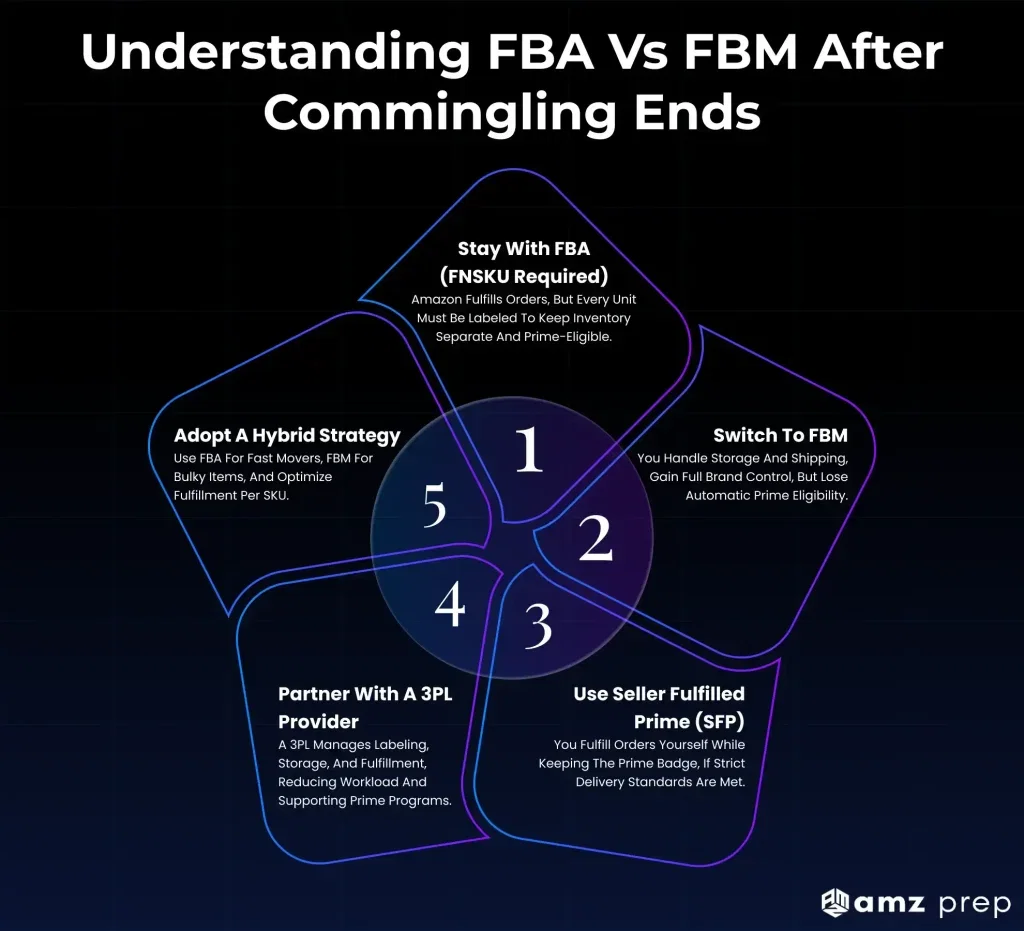
Option 1: Stay with FBA (With FNSKU Labels)
This is the simplest transition after Amazon ends commingling. You keep using Amazon’s fulfillment network. But now you label everything with FNSKU barcodes.
Your inventory stays separate. You avoid counterfeit mixing. You maintain Prime eligibility automatically.
The challenge? Amazon ended their FBA Label Service on January 1, 2026. You can’t rely on Amazon to label for you anymore. You must handle labeling yourself or use a third-party prep center.
Labeling costs increase by $0.20-0.50 per unit through prep services. Prep work takes longer. But fulfillment speed stays fast once products reach Amazon.
Option 2: Switch to FBM (Fulfillment by Merchant)
FBM means you handle fulfillment yourself. You store, pack, and ship orders from your own warehouse.
This gives you complete control. Custom packaging. Your brand experience. Direct customer relationships. Lower fees overall.
The challenge? You need reliable systems. Fast shipping capabilities. Excellent customer service. And you lose automatic Prime eligibility.
FBM works best for sellers with existing warehouse space or large, heavy products that face high FBA fees.
Option 3: Use Seller Fulfilled Prime (SFP)
SFP is the sweet spot for many sellers. You fulfill orders yourself but keep the Prime badge.
This option delivers FBM control with Prime benefits. Your products rank higher. Conversions improve. Customers trust the Prime promise.
But Amazon sets strict requirements. You need 99% on-time shipping. One-day delivery capabilities in many areas. A 30-day trial period proves your reliability.
Many sellers partner with 3PL providers to meet SFP standards without building infrastructure themselves.
Option 4: Partner with a 3PL Provider
Third-party logistics providers offer a middle path. They handle warehousing, labeling, and fulfillment for you.
Quality 3PLs like AMZ Prep specialize in Amazon requirements. They understand FNSKU labeling. They ship to multiple fulfillment centers. They handle returns processing.
The benefits include lower per-unit costs than FBA at scale, professional prep compliance, flexibility across channels, and potential SFP qualification.
3PLs work especially well for sellers doing 1,000+ units monthly across multiple products.
Option 5: Hybrid Strategy (The Smart Approach)
Most successful sellers now use hybrid fulfillment. Different products use different methods based on what makes sense.
Fast-moving small items stay with FBA. Large or seasonal products go to FBM. New launches test with FBM first. Best-sellers move to FBA once proven.
This approach maximizes profit per SKU while maintaining operational flexibility.
Comparing Your Options with Real Numbers
Let’s compare costs for a typical product (1 lb, 10x8x4 inches, selling 1,000 units monthly):
FBA with FNSKU: $420/month storage + $3,000 fulfillment + $400 labeling = $3,820 total monthly cost.
FBM with 3PL: $200/month storage + $2,000 fulfillment + $400 labeling = $2,600 total monthly cost.
Self-Fulfilled FBM: $300/month storage + $2,500 fulfillment + $400 labeling = $3,200 total monthly cost (plus your time).
SFP via 3PL: $200/month storage + $2,200 fulfillment + $400 labeling + $200 Prime premium = $3,000 total monthly cost.
Numbers vary by product size, volume, and location. Run your specific calculations before deciding.
Which Strategy Fits Your Business?
Choose FBA if: You value simplicity over cost, sell small to medium products, want automatic Prime eligibility, and lack warehouse capabilities.
Choose FBM if: You have existing warehouse space, sell oversized or expensive items, want complete brand control, and can handle logistics.
Choose SFP if: You can meet strict performance requirements, want Prime benefits without FBA fees, and have reliable fulfillment infrastructure or a strong 3PL partner.
Choose 3PL if: You want professional fulfillment without building infrastructure, need multi-channel capabilities, and sell high enough volume for cost benefits.
Choose Hybrid if: You sell diverse product types, want maximum flexibility, and have the bandwidth to manage multiple fulfillment streams.
Taking Action Before March 2026
Evaluate each product in your catalog individually. Calculate actual fulfillment costs across all options. Test alternative methods with a few SKUs first.
Many sellers discovered that moving 20-30% of inventory to FBM increased overall profitability. Others found FBA still makes sense after accounting for time savings.
The key is making informed decisions based on real data, not assumptions.
Conclusion
The Amazon commingled inventory counterfeit nightmare is ending. That’s worth celebrating. Brand owners finally get real protection. Your products stay pure. Your reputation stays intact.
Counterfeit rates should drop dramatically. Amazon predicts 99% improvement in authenticity. Customer trust improves. Returns decrease. Account suspensions for false counterfeits disappear.
Yes, resellers face higher costs. But the marketplace becomes more legitimate. Better for everyone long-term.
Need help navigating these changes? AMZ Prep’s FBA prep services handle labeling, inspection, and shipping across 50+ fulfillment centers. They stay updated on all Amazon FBA requirements so you don’t have to.
The commingling era is over. The age of authentic, protected inventory begins March 31, 2026.
Time to prepare, as your brand deserves it!
Frequently Asked Questions
Does Amazon still commingle inventory?
Yes, but only until March 31, 2026. After that date, all commingling ends permanently. You can opt out now by selecting Amazon barcodes in your FBA settings.
What is Amazon commingling VAT?
Commingling VAT refers to tax transactions when Amazon ships from a different country than where inventory is stored. These commingling_buy and commingling_sell entries appear on your tax reports. They require proper VAT accounting in each country. After March 2026, these transactions simplify as inventory stays separate.
How do I turn off commingling inventory on Amazon?
Go to Settings > Fulfillment by Amazon > FBA Product Barcode Preference. Select “Amazon barcode” instead of “Manufacturer barcode.” This applies to new listings. Existing SKUs need new merchant SKU numbers to change.
What happens to commingled inventory after March 31, 2026?
Existing commingled inventory continues selling under virtual tracking. New shipments must follow the new separate inventory rules. Amazon hasn’t announced plans to force removal of existing commingled stock.
Will FNSKU labeling increase my costs?
Yes. Expect $0.20-0.50 per unit for labeling. Higher for complex products or small quantities. Bulk prep services like AMZ Prep offer better rates than DIY labeling for most sellers. Factor this into your pricing strategy for 2026.
Can Brand Registry members still avoid FNSKU labels?
Yes. Brand owners with Brand Representative status can use manufacturer barcodes. But their inventory stays separate now. This is the major benefit of Brand Registry after commingling ends.
How does this affect retail arbitrage sellers?
Significantly. Retail arbitrage relies on quick flips with minimal prep. Mandatory FNSKU labeling adds time and cost. Many RA sellers will shift to private label or exit low-margin categories. The business model still works but requires different calculations.
What’s the best labeling option for small sellers?
Three choices exist:
1. DIY: Buy a label printer ($100-200) and print yourself. Time-consuming but cheapest per-unit.
2. Amazon Label Service: Let Amazon label for you. Convenient but more expensive.
3. Prep Center: Send inventory to FBA prep centers like AMZ Prep. They handle everything at scale pricing.
Does this affect international sellers differently?
Yes. International sellers face additional complexity with VAT and customs. The end of commingling simplifies VAT calculations. But FNSKU requirements add prep costs overseas. Consider using US-based prep centers to handle labeling after importing.
Will Amazon enforce this strictly?
Almost certainly. Amazon rarely announces major policy changes without strict enforcement. Budget for compliance now. Don’t risk rejected shipments or account suspensions.
When does Amazon end commingling?
Amazon ends commingling March 31, 2026. This is a firm deadline announced at the September 2025 Accelerate conference. The Amazon commingling program ending affects all US fulfillment centers.
What is Amazon inventory commingling?
Amazon inventory commingling (also called Amazon FBA commingling) is when Amazon mixes identical products from different sellers in shared storage bins. The Amazon commingling program tracked ownership virtually but stored items together physically.
Why is Amazon ends commingling 2026 news important?
The Amazon ends commingling 2026 announcement protects sellers from Amazon commingled inventory counterfeit issues. Commingling in Amazon allowed fake products to contaminate legitimate sellers’ inventory. This ends that practice.
What if my UPC is assigned to multiple ASINs?
If a single UPC is associated with multiple ASINs, you cannot use manufacturer barcodes even as a brand owner. You’ll need FNSKU labels to ensure accurate inventory tracking.
Does this apply to products with expiration dates?
Yes. All products, including those requiring expiration date tracking, must follow the new commingling rules. Brand owners can still use manufacturer barcodes, but resellers need FNSKU labels.

Arishekar N is a Vice President (VP) of Marketing at AMZ Prep, specializing in ecommerce fulfillment and Amazon logistics strategies with a proven track record of driving growth for e-commerce businesses. He is a strategic leader with extensive expertise in marketing, e-commerce operations, SEO & advertising, and branding.
Stay updated on his latest insights by following him
















Comments