
Planning to send a package across the border? You’re probably wondering: does USPS deliver to Canada?
The short answer is yes. USPS ships to Canada every business day.
But here’s what most first-time shippers don’t realize: the process involves two postal systems, customs clearance, and fees that catch many customers off guard. A $50 item can end up costing your Canadian customer nearly $87 after duties and taxes.
This blog will walk you through how USPS shipping from the US works, what it actually costs, and the common mistakes that delay packages at customs. We’ll also compare USPS against UPS and FedEx so you can choose the best carrier for your situation.
Does USPS Ship to Canada? Here’s How It Works
USPS has partnered with Canada Post for decades. This partnership makes cross-border shipping surprisingly simple and provides a seamless shipping experience for packages from the US.
Here’s what happens when you ship to Canada with USPS:
Your package starts its journey at your local post office. USPS handles everything while it’s in the United States to Canada journey. Once your package reaches the Canadian border, it goes through customs inspection. After clearing customs, Canada Post takes over and delivers it to the final destination.
The best part? You get tracking the entire way. Your tracking number works on both the USPS website and the Canada Post website.
How the USPS to Canada Post Partnership Works
The USPS – Canada Post partnership works through a smooth cross-border handoff. USPS moves your package through the U.S. and transfers it to Canada Post at the border.
From there, Canada Post manages customs processing and completes the last-mile delivery anywhere in Canada.
Current USPS Shipping Status to Canada
Is USPS shipping to Canada right now? Yes, absolutely.
All USPS international services to Canada are operating normally as of January 2026. You can ship letters, packages, and parcels without any special restrictions.
Note: Periodically, service disruptions can occur due to labor actions. If there’s a Canada Post strike, packages may experience delays once they reach Canada, even though USPS services continue operating normally within the United States.
2026 Update: Canada Post experienced a strike from November 15 to December 22, 2025, causing significant backlogs. As of January 2026, services have fully resumed and delivery times are back to normal. However, some residual delays from the strike backlog may persist through early February 2026.
Tariff Update (2026): The 25% tariff on certain US goods to Canada remains in effect as of January 2026. This primarily affects steel, aluminum, and certain manufactured goods. For most consumer products and eCommerce shipments, standard duty rates still apply. Check the Canada Border Services Agency (CBSA) website for your specific product category.
But for regular shipments, nothing has changed. USPS accepts mail to Canada just like they did last year.
USPS Shipping Services to Canada: Complete Comparison
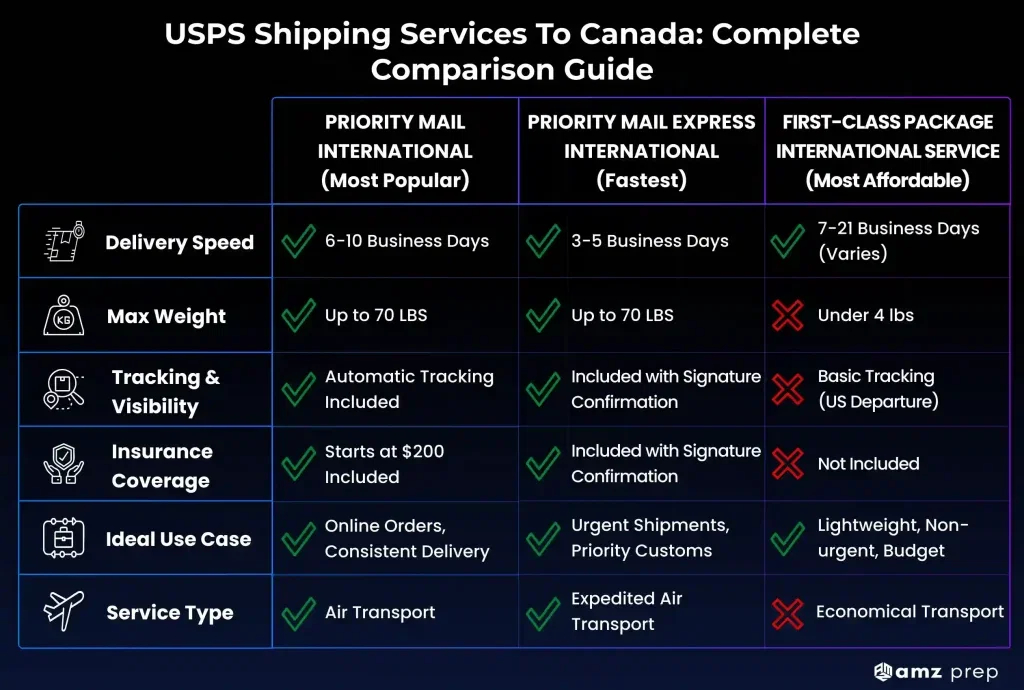
USPS offers three main ways to ship a package to Canada. Each service moves at a different speed and comes with its own price point, giving you a few solid options depending on how quickly you need the package to arrive and how much you want to spend.
Here’s what differs each service.
Priority Mail International to Canada (Most Popular)
This option works well for most shippers. USPS Priority Mail International typically delivers within 6 to 10 business days.
Packages can weigh up to 70 pounds. Tracking comes automatically. Insurance coverage starts at $200, though you can buy more if needed.
USPS priority mail to Canada works great for online store orders. The service uses air transport, which keeps delivery times consistent. Weather delays happen sometimes, but they’re rare.
Most eCommerce sellers use priority mail international as their standard shipping option when shipping from the US to Canada. For businesses moving high volumes cross-border, a dedicated solution for shipping from USA to Canada can offer more predictable landed costs and faster customs clearance than standard postal services.
Priority Mail Express International to Canada (Fastest)
Priority mail express international delivery takes just 3 to 5 business days. That’s nearly twice as fast as regular Priority Mail. This service includes signature confirmation on delivery. Someone has to sign for the package at the destination.
USPS priority mail express international to Canada costs more than other options. But when speed matters, it’s worth every penny. Express packages get priority treatment at customs. This cuts down on the typical border delays that slow down other shipments.
First-Class Package International Service (Most Affordable)
Looking to save money? First class mail to Canada from the US is the best choice.
This service works for packages under 4 pounds. Delivery takes 7 to 21 business days. The wide range depends on how busy customs are.
First class mail from the US to Canada includes basic tracking. You can see when the package leaves the United States with the tracking updates.
Use this service for lightweight items when your customer isn’t in a rush. Think books, small accessories, or gifts. The USPS first class mail international to Canada service saves serious money compared to Priority Mail.
USPS Flat Rate Options for Canada Shipping
Flat rate shipping means you pay one price no matter how much your package weighs.
USPS offers several flat rate boxes and envelopes for international shipping. Here’s the complete breakdown:
| Flat Rate Option | Max Weight | Delivery Time | Approximate Cost |
|---|---|---|---|
| Flat Rate Envelope | 4 lbs | 6-10 days | $28 |
| Legal Flat Rate Envelope | 4 lbs | 6-10 days | $28 |
| Padded Flat Rate Envelope | 4 lbs | 6-10 days | $32 |
| Small Flat Rate Box | 4 lbs | 6-10 days | $32 |
| Medium Flat Rate Box | 20 lbs | 6-10 days | $75 |
| Large Flat Rate Box | 20 lbs | 6-10 days | $95 |
The USPS flat rate to Canada option makes pricing simple. If it fits, it ships for one flat price.
Heavy items benefit most from flat rate boxes. A small flat rate box holding 4 pounds of jewelry costs the same as one holding 4 pounds of books.
The USPS flat rate box to Canada maxes out at 20 pounds for medium and large boxes. Envelopes top out at 4 pounds.
Calculate both flat rate and regular pricing before shipping. Sometimes regular pricing wins. Other times flat rate shipping to Canada saves you money. It’s worth taking time to compare different shipping options before making your decision.
Service Comparison Table
| Service | Delivery Time | Weight Limit | Tracking | Starting Price |
|---|---|---|---|---|
| Priority Mail Express | 3-5 days | 70 lbs | Full | ~$50 |
| Priority Mail | 6-10 days | 70 lbs | Full | ~$30 |
| First-Class Package | 7-21 days | 4 lbs | Basic | ~$15 |
| Flat Rate Envelope | 6-10 days | 4 lbs | Full | ~$28 |
| Small Flat Rate Box | 6-10 days | 4 lbs | Full | ~$32 |
Prices vary based on exact weight and destination. Check USPS.com for current rates.
USPS Shipping Costs to Canada: 2026 Pricing Guide
USPS international rates typically adjust annually in January. The prices shown below reflect January 2026 rates. For the most current pricing, always verify with the USPS International Price Calculator at postcalc.usps.com.
Let’s talk about what shipping to Canada actually costs.
How Much Does It Cost to Ship to Canada with USPS?
The USPS cost to Canada depends on several factors:
Weight – Heavier packages cost more to ship.
Size – Bigger boxes bump up the price even if they’re light.
Service level – Express costs more than Priority. Priority costs more than First-Class.
Destination – Toronto costs less than Yellowknife. Big cities are cheaper than remote areas.
Here are some real examples of USPS shipping cost to Canada:
A 1-pound package to Toronto via First-Class runs about $15. The same package via Priority Mail costs around $30. Express shipping pushes it up to $50 or more.
A 10-pound box to Vancouver costs roughly $75 via Priority Mail. That same box via Express tops $125.
Use the USPS online calculator to get exact prices for your specific package.
USPS Shipping Rates to Canada by Service
Let’s break down USPS rates to Canada by each service type.
Here’s a breakdown of USPS shipping rates to Canada by weight and service:
| Weight | First-Class | Priority Mail | Priority Mail Express |
|---|---|---|---|
| 1 lb | $15 | $30 | $50 |
| 2 lbs | $20 | $42 | $65 |
| 3 lbs | $25 | $50 | $75 |
| 4 lbs | $30 | $58 | $85 |
| 5 lbs | N/A | $60 | $85 |
| 10 lbs | N/A | $75 | $125 |
| 20 lbs | N/A | $115 | $195 |
Note: Actual USPS shipping rates to Canada change based on your specific ZIP code and the Canadian postal code.
USPS Postage Calculator for Canada Shipping
The USPS website has a calculator that gives you exact prices. Go to the USPS International Price Calculator. Enter your origin ZIP code and the destination postal code in Canada. Add your package weight and dimensions. Pick your service level.
The calculator spits out the exact cost of US post office postage to Canada for your shipment.
Pro tip: round up your weight by an ounce or two. Packages that measure over at the post office get charged extra. Better to overpay by 50 cents than get hit with a surcharge.
The calculator also shows estimated delivery times. Use this to set realistic expectations with your customers. You can also use the Canada Post shipping calculator on CanadaPost.ca to estimate the Canadian portion of delivery and potential customs fees.
How to Ship a Package to Canada Using USPS (Step-by-Step)
Ready to actually ship something? Here’s your complete guide.
Preparing Your Package for International Shipping
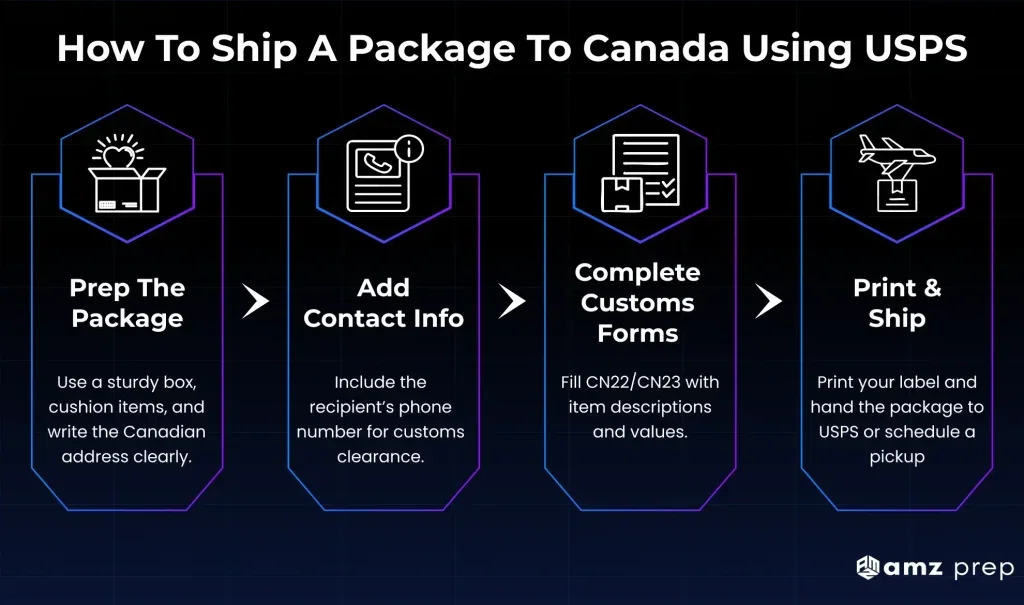
Start with a sturdy box. International packages get handled more than domestic ones. Use a box that can take some abuse.
Wrap fragile items in bubble wrap or packing peanuts. Seal your box with strong packing tape. Cover all seams and edges.
Write the recipient’s address clearly on the package:
Recipient Name
Street Address
City, Province Postal Code
Canada
Canadian postal codes follow an A1A 1A1 format. Letters and numbers alternate with a space in the middle.
Include the recipient’s phone number. Customs agents sometimes need to call about shipments. Without a phone number, packages sit in limbo.
This matters for how to ship to Canada USPS successfully.
Completing Customs Forms for Canada Shipments
Every package to Canada needs customs paperwork. No exceptions.
Use form CN 22 for packages worth less than $400. Use form CN 23 for anything over $400.
The form asks for:
- Description of contents
- Quantity of each item
- Weight of each item
- Value of each item
- Country where items were made
The USPS Click-N-Ship system generates customs forms automatically. This is way easier than filling them out by hand (source).
Printing Labels and Scheduling Pickup
Shipping labels can be printed at home through Click-N-Ship. Set up an account on USPS.com, then enter your package details and destination address. After paying for postage online, print the label.
Secure the label firmly to your package. Make sure the barcode is flat and readable. Schedule a free pickup right from your house or drop packages at any USPS location.
For mailing a package to Canada, the blue collection boxes don’t work. You need to hand it to a postal worker or schedule pickup. Most post offices have international shipping expertise. They can double-check your customs forms if you’re unsure.
USPS Tracking: How to Track Packages Shipping to Canada
Tracking keeps everyone informed during the waiting period.
How to Track USPS Packages Going to Canada
Your tracking number works on both USPS.com and CanadaPost.ca. Use the same number on either website. Track USPS Canada shipments just like domestic ones. Enter the tracking number. Hit search. View your package’s journey.
USPS tracking updates show:
- Accepted at post office
- In transit to destination
- Arrived at customs
- Customs clearance complete
- Out for delivery
- Delivered
The tracking number follows your package across the border. You don’t need a separate Canada Post tracking number.
USPS Canada Tracking: What to Expect After Your Package Enters Canada
After your package arrives in Canada, Canada Post takes over the tracking updates. The format changes, but you’ll still see where your package is in the delivery process.
Typical tracking updates you’ll see include:
‘The product has left the originating country’ – The package has departed the United States.
‘Items processed by Canada Border Services Agency’ – Customs is reviewing the shipment.
‘Item out for delivery’ – The package is on its way to the recipient.
Tracking US mail to Canada sometimes goes quiet during customs. This pause can last 1 to 3 days. Don’t stress unless it exceeds a week. Use USPS tracking in Canada tools to monitor progress. Both postal services update the same tracking database.
What to Do If Tracking Stops Updating
Sometimes tracking stops updating completely. Here’s what to do:
- Wait 3 business days before worrying. Customs processing doesn’t always show tracking updates.
- Check both USPS.com and CanadaPost.ca. Sometimes one site updates faster than the other.
- Call USPS customer service for US postal service tracking to Canada help. Have your tracking number ready.
- For packages in Canada, contact Canada Post customer line. They can provide more detailed information about customs delays.
Understanding Canadian Customs, Duties, and Taxes on USPS Packages
Customs is where additional costs apply. The recipient pays these fees when the package arrives.
What Customs Charges Apply to USPS Shipments?
Every package entering Canada gets charged taxes. The recipient pays these fees when the package arrives. Here’s the complete breakdown of fees on USPS package to Canada shipments:
| Fee Type | Amount | When It Applies |
|---|---|---|
| GST (Goods and Services Tax) | 5% | Most items over $20 CAD |
| HST (Harmonized Sales Tax) | 13-15% | Ontario, New Brunswick, Nova Scotia, PEI, Newfoundland |
| PST (Provincial Sales Tax) | Varies | BC, Saskatchewan, Manitoba, Quebec |
| Import Duties | 0-35% | Depends on product category |
| Canada Post Handling Fee | $9.95 flat | Any shipment with duties or taxes |
Provincial HST Breakdown:
| Province | HST Rate |
|---|---|
| Ontario | 13% |
| New Brunswick | 15% |
| Nova Scotia | 15% |
| Prince Edward Island | 15% |
| Newfoundland and Labrador | 15% |
Packages valued under $20 CAD skip all fees. Between $20 and $150, GST applies but duties usually don’t. Over $150, everything applies (source).
*Customs thresholds verified current as of January 2026. Canada’s de minimis threshold remains at $20 CAD for tax exemption and $150 CAD for duty exemption.
How to Calculate Duties and Taxes for Canadian Customers
Calculate costs upfront so your customers know what to expect. Start with your product value in US dollars. Convert to Canadian dollars using current exchange rates.
Add 5% for GST (or 13-15% for HST in applicable provinces). Check duty rates for your product category on the Canada Border Services website.
Add the $9.95 handling fee if the total is over $20 CAD.
Example: You ship a $50 USD item to Ontario.
- $50 USD = ~$68 CAD (at January 2026 exchange rate of ~1.40)
- HST (13%): $9.10
- Handling fee: $9.95
- Total fees to customer: $19.05 CAD
Your customer pays $89.05 CAD to receive their $70 CAD item. Make sure they know this before ordering.
Note: Exchange rates fluctuate. Use xe.com for current USD to CAD conversion.
Customs Declaration Best Practices
The customs form makes or breaks your shipment. Fill it out right and packages sail through easily. Use specific descriptions. ‘Cotton t-shirt, blue, size medium’ beats ‘clothing.’ ‘Stainless steel water bottle’ beats ‘kitchen item.’
Declare accurate values. Use what the customer paid, not what it cost you to make. Mark the country of origin correctly. This affects duty calculations under trade rules.
Double-check everything before sealing the package. Incorrect customs forms are the number one cause of USPS shipments to Canada delays.
USPS Delivery Times to Canada: Mail and Package Delivery Expectations
While USPS provides delivery estimates for each service (see comparison table above), real-world delivery times depend on several factors beyond the carrier’s control.
What Causes Delays in USPS Canada Deliveries?
Several factors can extend your package’s journey beyond the estimated timeframe:
| Factor | Typical Impact | How to Minimize |
|---|---|---|
| Customs processing | 1-3 days | Complete accurate customs forms |
| Weather conditions | 1-2 days | Ship early during winter months |
| Peak seasons (holidays) | 2-5 days | Ship before mid-December |
| Incorrect addressing | 3-7 days | Verify addresses before shipping |
| Missing documentation | 5-10 days | Include all required forms |
| Remote destinations | 2-4 days | Use Priority Mail Express |
Important note: USPS does not deliver to Canada on weekends, which can add 1-2 days to deliveries arriving on Friday.
Build in buffer time for important shipments. If you need guaranteed delivery by a specific date, ship at least 3-5 days earlier than the estimated delivery window suggests.
Peak Season Shipping to Canada
The holiday season creates unique challenges for international shipping. Here’s how to handle it:
Critical shipping deadlines for Christmas delivery:
- Priority Mail Express: Ship by December 14, 2026
- Priority Mail: Ship by December 11, 2026
- First-Class: Ship by December 4, 2026
Note: These are estimated dates for 2026. USPS typically publishes official holiday deadlines in October. Check USPS.com/holiday for confirmed 2026 dates.
During November through January, expect:
- Longer customs processing times (3-5 days instead of 1-3)
- USPS peak season surcharges ($5-$10 per package)
- Higher package volumes causing general slowdowns
Peak season strategy:
- Communicate clearly with customers about extended delivery times
- Set expectations that shipments may take 2-3 days longer than normal
- Consider upgrading to Priority Mail Express for priority customs processing
- Ship early – don’t wait until the last minute
Packages shipped during peak season require extra patience. Even Express services can experience delays when customs facilities are processing maximum volume
Prohibited and Restricted Items for USPS Canada Shipping
Not everything is allowed to cross the border, and Canada has strict rules on what can enter the country.
Items You Cannot Ship to Canada with USPS
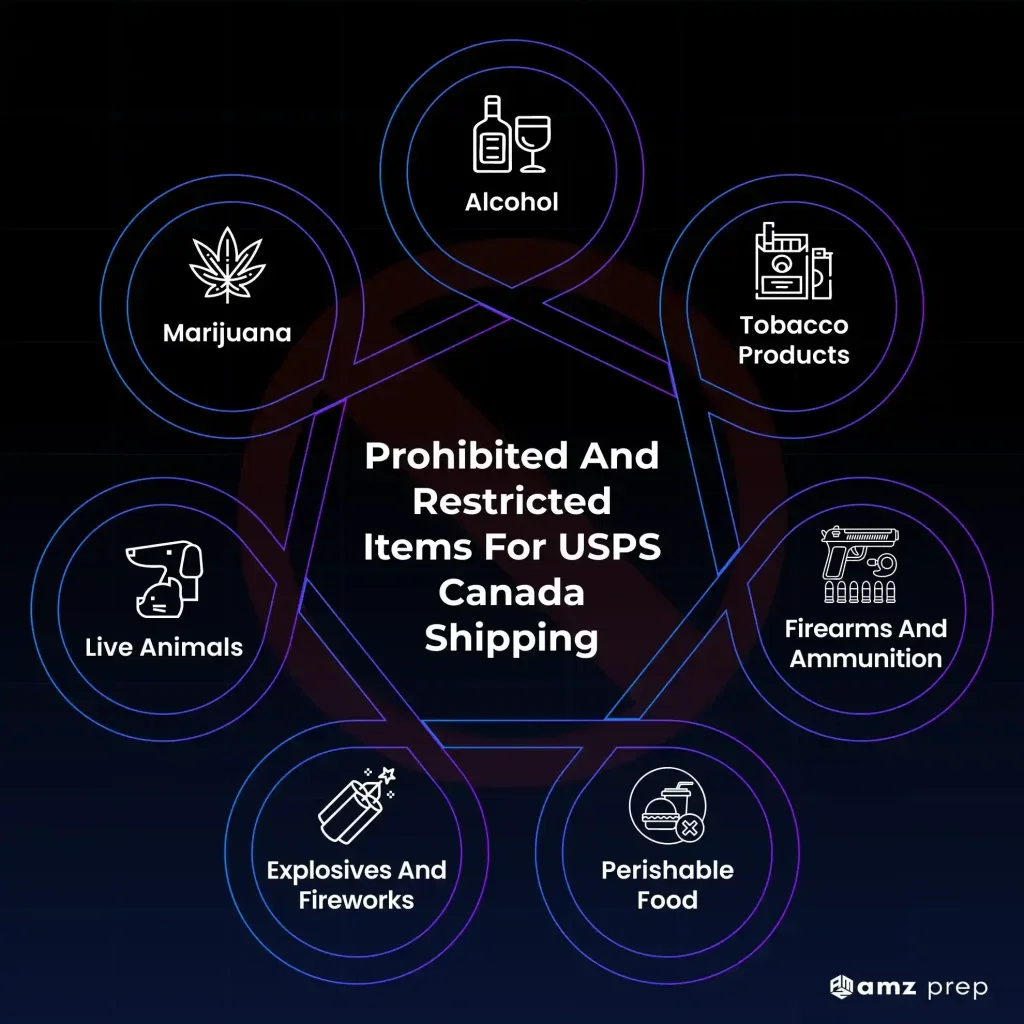
These products are completely banned:
- Alcohol – Wine, beer, and spirits can’t be mailed to Canada through USPS.
- Tobacco products – This includes cigarettes, cigars, and anything used for vaping.
- Firearms and ammunition – Guns, gun parts, and any type of ammo aren’t allowed in cross-border shipments.
- Explosives and fireworks – Anything that can explode or ignite must stay out of the mail.
- Perishable food – Fresh meat, dairy items, and produce can’t be sent internationally through USPS.
- Live animals – You can’t mail pets, insects, or other live creatures into Canada.
- Marijuana – Cannabis products are still federally restricted and can’t be sent across the border, even if they’re legal locally.
Can USPS Ship Restricted Items to Canada?
Some restricted items can be shipped, but only if you have the proper permits and follow Canada’s import rules.
Source: USPS and Canada post
Restricted Items Requiring Special Documentation
Some items can ship but need extra paperwork:
| Restricted Item | Special Requirement |
|---|---|
| Lithium batteries | Proper labeling and packaging, special hazmat markings |
| Cosmetics and personal care | Ingredient lists, possible Health Canada approval |
| Food products (packaged) | Proper labeling, CFIA compliance |
| Medical devices | Health Canada approval for health claims |
| Plants and seeds | Phytosanitary certificates from USDA |
| Electronics | Proper voltage labeling, safety certifications |
The USPS website lists all restrictions. Canada Border Services also publishes import rules. Check both before shipping questionable items.
Special Considerations for eCommerce Sellers
Selling online to Canadian customers? Pay attention to these common problem products:
- Electronics with batteries – Most laptops and phones contain lithium batteries. You can ship them but must follow proper packaging rules.
- Supplements and vitamins – Health Canada regulates these strictly. Some ingredients allowed in the US are banned in Canada.
- Cosmetics and skincare – Ingredient restrictions differ between countries. What sells legally in the US might not be allowed in Canada.
Before adding Canadian shipping to your store, verify your products can legally ship there. One prohibited item can shut down your entire Canadian market.
Common Problems and Solutions
Every shipper encounters issues eventually. Here’s how to handle them.
Package Stuck in Customs
Customs delays are common. Your package disappears for days with no updates. Normal customs processing takes 1 to 3 business days. Delays beyond 7 days warrant investigation.
Check tracking on both USPS.com and CanadaPost.ca. Sometimes one updates faster. If stuck longer than 10 days, call the Canada Border Services customer line.
They’ll tell you if customs is inspecting the package, if additional documentation is needed, or if there’s a problem with the declared value. Most customs delays resolve themselves. But proactive follow-up speeds things along when real problems exist.
Incorrect Address or Returned Packages
Wrong addresses cause significant problems. USPS tries to deliver to the address on the label. If it doesn’t exist, the package gets returned to the sender. Prevent this by verifying addresses before shipping, using address validation tools, and asking customers to confirm their postal code.
Canadian postal codes follow a specific format: A1A 1A1. The first position is always a letter. Postal codes never start with W or Z. If a package bounces back, contact the customer immediately. Get the correct address and reship at your cost if it was your error.
Lost or Damaged Packages: Filing Insurance Claims
Priority Mail Express includes $200 insurance automatically. Priority Mail also includes $200. First-Class includes nothing unless you add it.
Wait the required time before filing:
- Priority Mail Express: 7 days
- Priority Mail: 30 days
- First-Class: 60 days
File claims online at USPS.com. You’ll need your tracking number, proof of value, and photos of damage if applicable. USPS processes most claims within 5 to 10 business days.
Money-Saving Tips for Regular Canada Shippers
Shipping costs add up fast. Here’s how to reduce expenses.
Access Commercial Pricing (Save 10-30%)
Retail counter prices cost significantly more than commercial rates. Commercial pricing saves 10% to 30% per shipment.
Anyone can access commercial pricing through Click-N-Ship. Just create an account and print labels at home. You don’t need special business credentials.
The savings compound fast. Ship 100 packages per month? Commercial pricing can save $300 to $500 monthly.
Use online postage services like Stamps.com or ShipStation. These often have better rates than USPS retail prices.
Use CUSMA Trade Agreement Benefits
Products made in the US can ship duty-free to Canada under the CUSMA trade agreement. This saves your customers significant money on duties.
Include a USMCA Certificate of Origin with qualifying shipments. Canadian customs waives duties on eligible items. A $500 item might save $75 in duties with proper documentatio.
Quick Tips for eCommerce Sellers
For eCommerce sellers shipping to Canadian customers, consider these recommendations:
Display shipping costs at checkout – Show costs early in the purchase process. Customers who encounter unexpected fees at the final step frequently abandon their carts.
Explain customs fees upfront – Inform customers that additional duties and taxes may apply upon delivery. Provide estimated costs whenever possible.
Use real-time rate calculators – These tools generate accurate USPS rates based on specific package dimensions and weight, much like code quality tools ensure precision in technical systems.
For Amazon FBA Canada sellers: Inventory destined for Amazon FBA Canada requires careful preparation and labeling. Products must include correct barcodes, appropriate poly bagging, and compliant labels to satisfy Amazon’s fulfillment requirements.
Many sellers work with 3PL fulfillment Canada providers that manage USPS shipments to Canadian FBA warehouses and verify that inventory meets Amazon Canada’s fulfillment standards. These third-party logistics companies can handle customs paperwork, prepare inventory to Amazon’s specifications, and consolidate shipments to reduce costs.
When to Use USPS Service vs. Other Carriers
USPS wins for most small business and individual shippers because:
- No additional fees – The $9.95 Canada Post handling fee is predictable. UPS and FedEx charge $30 to $50 in additional brokerage fees that hit customers at delivery.
- Nationwide coverage – Canada Post delivers everywhere, including remote areas where other carriers charge huge premiums.
- Cost-effective pricing – For packages under 10 pounds, USPS usually costs 30% to 50% less than competitors.
- Simple customs process – USPS handles customs paperwork through established channels with fewer rejections and delays.
For USPS shipping from us to Canada, you can’t beat the combination of price, coverage, and reliability.
When to consider alternatives: UPS and FedEx offer faster express options if you need guaranteed 2-day delivery. For heavy packages over 20 pounds, compare rates across all delivery companies Canada operates with, including regional carriers like Purolator and Canpar, which may offer competitive pricing for certain routes.
Conclusion
Shipping to Canada through USPS works well when you know the requirements. USPS and Canada Post work together to move packages across the border reliably.
Pick the service that matches your timeline and budget. Priority Mail International works well for most packages, offering reasonable speed at a fair price. Express Mail delivers faster when deadlines are tight. First-Class Mail International costs less for lighter packages when delivery speed is flexible.
Complete customs forms carefully and accurately. Correct item descriptions and values keep packages moving through customs without problems. USPS provides online tools that simplify the paperwork process.
Keep customers informed about delivery times and possible customs charges. Clear information up front leads to fewer issues and stronger customer relationships.
Frequently Asked Questions
Will USPS ship to Canada?
Yes, USPS ships to Canada every day through multiple service options. Priority Mail International, Priority Mail Express International, and First-Class Package International Service all deliver to Canadian addresses. USPS partners with Canada Post for final delivery throughout Canada.
Can I ship to Canada with USPS if I don’t have a business account?
Absolutely. Anyone can ship to Canada using USPS retail services. Visit any post office location or use USPS.com to create labels online. You don’t need a business account or special registration. Individual shippers and businesses use the same services.
How much is USPS postage to Canada for a letter?
First-Class Mail International letters to Canada start around $1.50 for envelopes under 1 ounce. Prices increase with weight. A 2-ounce letter costs about $2.00. Large envelopes up to 15.994 ounces start at $2.50 and increase based on weight. Check current rates at USPS.com as prices adjust periodically.
What is the cheapest way to send a package to Canada using USPS?
First-Class Package International Service offers the lowest rates for packages under 4 pounds. Delivery takes 7 to 21 business days. Packages start around $15 for 1 pound. This service includes basic tracking. For items over 4 pounds, compare Priority Mail International regular pricing against Flat Rate boxes to find the best deal.
How long does USPS shipping to Canada take?
Delivery times vary by service level when shipping from USA to Canada with USPS. Priority Mail Express International delivers in 3 to 5 business days. Priority Mail International takes 6 to 10 business days. First-Class Package International Service requires 7 to 21 business days. These are estimates. Customs processing, weather, and peak seasons can extend delivery times by several days.
Do I need customs forms for USPS mail to Canada?
Every package to Canada requires customs documentation. Use form CN 22 for items valued under $400 USD. Items over $400 USD need form CN 23. Forms require item descriptions, quantities, values, and country of origin. USPS Click-N-Ship generates these forms automatically when you create labels online. Hand-filled forms work but take longer.
Who pays customs fees on USPS shipments to Canada?
The recipient pays all customs fees at delivery. This includes GST (5%), HST (13-15% in some provinces), applicable duties, and Canada Post’s $9.95 handling fee. The mail carrier collects payment before releasing the package. Senders cannot prepay these fees through standard USPS services. Make customers aware of potential fees before they order.
Can I track my USPS package once it enters Canada?
Yes, tracking continues seamlessly into Canada. Use your USPS tracking number on CanadaPost.ca to see updates after the border crossing. Tracking shows customs clearance, domestic transit through Canada, and final delivery. Some updates appear only on the Canada Post website. Check both sites for complete information about your package’s location.
Does USPS ship to P.O. boxes in Canada?
USPS delivers to Canadian P.O. boxes through its partnership with Canada Post. Packages should be addressed with the P.O. box number, city, province, and postal code. Delivery to P.O. boxes follow identical procedures and timeframes as street address deliveries. Note that certain services, such as signature confirmation, are not applicable to P.O. box shipments, as recipients collect packages directly from the post office.
What’s the maximum weight for USPS packages to Canada?
Priority Mail International and Priority Mail Express International accept packages up to 70 pounds. First-Class Package International Service maxes out at 4 pounds. Flat Rate envelopes limit to 4 pounds. Medium and Large Flat Rate boxes allow up to 20 pounds. Exceeding weight limits requires upgrading to a different service level.
Can I schedule a USPS pickup for packages going to Canada?
Yes, schedule free package pickup for international shipments through USPS.com. Select your pickup date and time. Leave packages in a secure location or hand them to your mail carrier. Pickups work for all international services. You need to print labels online before scheduling pickup. Same-day pickup cutoff times vary by location.
Does USPS charge extra fees for Canada?
USPS doesn’t charge extra fees beyond the international postage rate. However, Canada Post charges a $9.95 handling fee on any package that requires payment of duties or taxes. Your recipient pays this at delivery.
Can I ship lithium batteries to Canada?
Yes, but only when properly packaged and labeled. Lithium batteries must be installed in devices or packaged according to USPS hazmat regulations. Loose lithium batteries require special hazmat shipping (source: USPS.com/hazmat).
What happens if my package is rejected at Canadian customs?
If customs reject your package, it is returned to you at your expense. Common rejection reasons include prohibited items, incorrect customs forms, or undervalued declarations. Return shipping can take 3-4 weeks.
Is USPS or UPS better for shipping to Canada?
USPS typically costs 30-50% less for packages under 10 pounds and avoids expensive brokerage fees. UPS is faster (2-3 days) but charges $35-50 in additional brokerage fees that surprise customers at delivery.
Do I need a commercial invoice for USPS to Canada?
Commercial invoices are required for packages over $2,500 USD or commercial shipments. For gifts and personal items under $2,500, customs forms CN 22 or CN 23 are sufficient (source: CBSA.gc.ca).

Arishekar N is a Vice President (VP) of Marketing at AMZ Prep, specializing in ecommerce fulfillment and Amazon logistics strategies with a proven track record of driving growth for e-commerce businesses. He is a strategic leader with extensive expertise in marketing, e-commerce operations, SEO & advertising, and branding.
Stay updated on his latest insights by following him

















Comments