
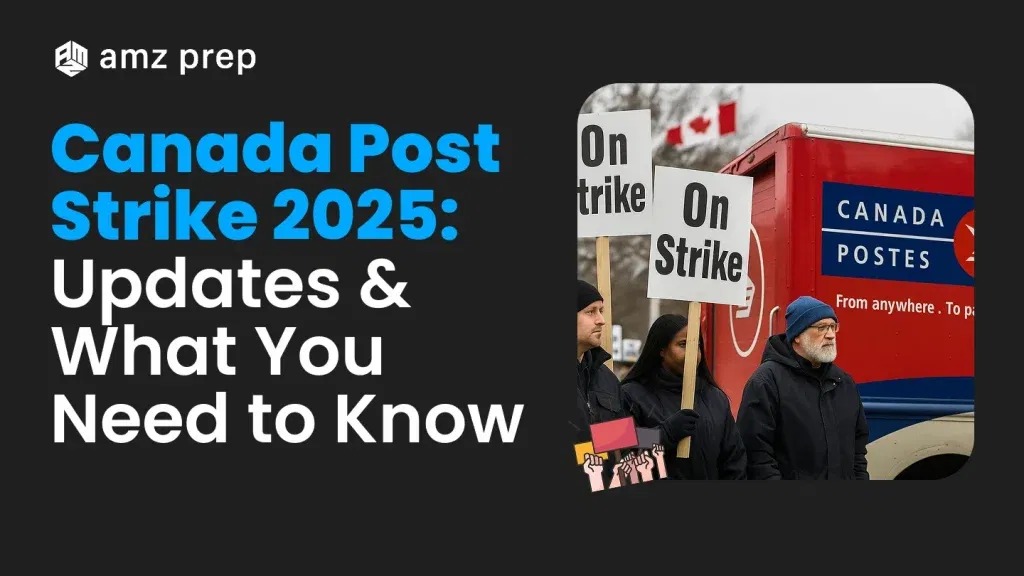
Canada Post workers were on a full national strike from September 25 to October 11, 2025, and have now transitioned to rotating strikes. While mail is moving again, service remains unstable with significant delays. Here’s everything you need to know about the current situation
I’ve been keeping an eye on the latest updates from Canada Post and CUPW (the union representing postal workers), and let me tell you there’s been a lot of movement recently. Between overtime bans, negotiation breakdowns, and growing delays in certain provinces, it can be tough to figure out what’s actually happening.
In this post, I’ll break it all down for you:
- What’s going on with the strike and why it’s happening
- What areas are being affected
- How this might impact your mail or business deliveries
- What you can do in the meantime
- And I’ll answer some of the top FAQs people are searching online
🇨🇦 Canada Post Strike Update – October 15, 2025
Current Status: CUPW transitioned from a nationwide strike to rotating strikes on October 11, 2025. Mail and parcel delivery has partially resumed, but significant delays continue.
2. Key Developments Section – Complete Rewrite
Replace the bullet points with:
- Strike Evolution: The national strike that began September 25, 2025 transitioned to rotating strikes on October 11, 2025 CUPW – 2025-10-14 – The Shift to Rotating Strikes
- Service Resumption: New commercial volumes were not accepted until Wednesday, October 15. Canada Post needed time to clear trapped volume from the two-week national strike shutdown Customers should expect delays as CUPW moves to rotating strikes | Canada Post
- Current Rotating Strike Locations: As per CUPW website, rotating strikes are currently affecting:
- Dauphin-Swan River (MB)
- Fort St John (BC)
- Pictou County (NS)
- Note: Check daily updates at the Canada Post link for affected locations
- Service Limitations: On-time delivery guarantees for parcel services remain suspended and date-specific Neighbourhood Mail is not available Customers should expect delays as CUPW moves to rotating strikes | Canada Post
- Backlog Impact: Expect delays in processing and delivery as Canada Post works through trapped mail and parcels accumulated during the two-week shutdown
Expected Duration:
Update this section: The national strike lasted from September 25 to October 11 (approximately 2.5 weeks). CUPW has now shifted to rotating strikes, which may cause slight delays but keep mail moving CUPW – 2025-10-14 – The Shift to Rotating Strikes. However, this doesn’t mean the disruption is over:
Government intervention remains possible but hasn’t happened yet
Rotating strikes can continue indefinitely
CUPW has successfully won major gains through rotating strikes in the past, including pay equity and improved benefits CUPW – 2025-10-14 – The Shift to Rotating Strikes
The backlog from the national strike will take additional weeks to clear
________________________________________________________________________________
What’s Actually Happening With Canada Post Right Now?

Before we get into the what, why, and how. Let’s start with the Now.
So, Is Canada Post on Strike Right Now?
Current (as of October 15, 2025): Yes, but in a different format. CUPW transitioned from a nationwide strike to rotating strikes on October 11, 2025. This strategic shift allows mail and parcels to keep moving while maintaining pressure on Canada Post and the government
What this means for you:
- Mail delivery has resumed but is not on a regular schedule
- Significant delays continue as Canada Post clears the backlog from the September 25 – October 11 national strike Customers should expect delays as CUPW moves to rotating strikes | Canada Post
- Different locations face strikes on rotating days (check daily updates)
- Service is unstable and unpredictable
Why Are They Striking?
After digging in and not taking any sides, here’s what I found.
The union has been butting heads with Canada Post over a lot of stuff. It’s not just about pay (although that’s also the part of it).
Here’s what CUPW is pushing back on:
- Wages that haven’t kept up with inflation
- Forced weekend work and tighter schedules More work, Less Pay
- Pension changes that hit newer workers harder
- Job security concerns around automation and route cuts
- Weakened benefits, especially in rural areas
From CUPW’s POV, the latest contract is just insulting, especially after everything postal workers handled during the pandemic. They’re trying to apply pressure without shutting things down completely (at least for now).
Looking back at Amazon’s April 2025 policy changes, many sellers are already adjusting to new standards, and this strike is yet another reminder to stay nimble.
What Are the Union and the Government Saying?
Here’s where things stand right now:
CUPW (the union):
- They rejected the government’s most recent offer and are sticking firm on their demands.
- Their focus is on higher wages and better protections for part-time workers.
- From what I can tell, they feel the current offer still doesn’t come close to what they want.
The Government / Canada Post:
- Mediators are involved, but progress has been slow.
- No back-to-work legislation has been introduced yet, though it could happen if the strike drags on or impacts critical services.
- Canada Post is losing roughly $10 million a day during the strike, which is putting pressure on both sides to reach some sort of deal.
The Outlook:
- The full strike began on September 25, so all mail and parcel deliveries are halted for now.
- With no end date in sight, this could last weeks. Past strikes have gone more than a month, and the holiday season adds extra pressure to resolve things quickly.
What’s the Impact on Deliveries?
This is where it starts to affect people like you, me and more importantly businesses. Deliveries will be delayed, but I’ve personally will be ready for no movement, especially in urban areas.
In short, expect delays, especially if you’re shipping across provinces or using Canada Post for business.
If you sell on Amazon, staying up to date on Amazon’s latest June 2025 updates can help you better prepare for delays caused by postal disruptions or policy shifts.
When Did This Start and When Might It End?
The labor actions kicked off with a nationwide overtime ban on May 23, 2025. That slowed things down, but mail was still moving. The full nationwide strike began on September 25, 2025, so now deliveries and processing are basically on hold.
As for when it might end? That’s still up in the air. If the union and Canada Post reach a deal soon, things could start moving again fairly quickly. If not, we could see the strike continue for weeks, with the possibility of rotating walkouts, extended stoppages, or other escalations before a resolution is reached.
In All Fairness: Understanding Both Sides
I’ll be honest, while it’s easy to take a side in negotiations like these, especially to the side of workers. I have to take a step back and say I can see why both Canada Post is digging in the way they are. There’s more nuance here than just a standoff over wages or job titles.
Canada Post: Fighting for Survival
Let’s not forget, Canada Post is operating in a delivery business that looks nothing like it did a decade ago. Letter mail volumes are down, e-commerce is up, and competition is private carriers like Amazon, UPS, and FedEx. So, yeah Canada Post is the underdog is this story.
They’re not bluffing when they say the financials are down the drain. Over $3 billion in losses since 2018, another projected loss in 2024, and a need for over $1 billion in federal funding just to keep the lights on next year, you don’t have to be financial expert to see that’s not sustainable. And it’s not just a one-time bailout. Starting in 2026, they estimate they’ll need an extra billion dollars per year just to meet basic service and pension obligations. Now it makes sense why even the workers are hesitant to go on a full strike.
From their perspective, introducing flexible part-time workers on weekends and moving away from traditional pension models isn’t about union-busting, it’s about not abandoning their workforce and adapting to customer expectations in the e-commerce era. For Canada Post, failure to modernize means slipping further behind in a competitive market, and risking insolvency. Yes, it’s existential fight for them.
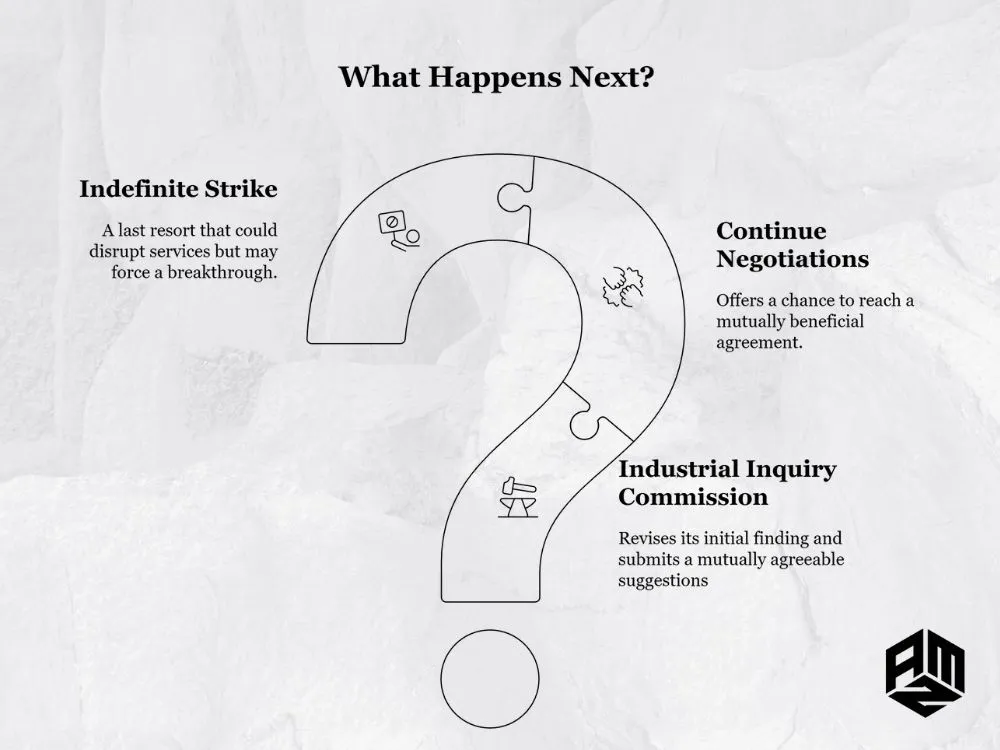
So What Happens If Things Stay Stuck?
Mail and parcel delays continue – Deliveries stay paused and backlog grows; resumption will take time to clear.
Private carriers face overload -Later pickups, capacity prioritization for big enterprise accounts, and temporary surcharges.
Costs go up – Merchants pay more for urgent shipping, expedited restocking, or to guarantee customer delivery windows.
Operational headaches – Warehouse bottlenecks, order cutoffs, customer-service spikes, and potential lost sales.
Critical deliveries affected – Government docs, passports, some medications and returns can be delayed longer than normal.
Longer-term shifts – Some businesses permanently diversify carriers or change fulfillment strategies; Canada Post market share could erode further.
What the IIC Suggested
The IIC didn’t sugarcoat anything. They basically said that Canada Post is on the verge of going broke, and unless something changes fast, the system won’t survive. Here’s the gist of what they recommended:
- Get rid of most door-to-door delivery and move people over to community mailboxes
- Bring in more part-time and weekend workers to keep up with the spike in parcel deliveries
- Modernize operations to compete with the private carriers like UPS and FedEx
- Add a financial oversight board to keep Canada Post on track
It’s a pretty plan and Canada Post didn’t waste any time saying, “Yep, this is exactly what we need.” But the Union said “Nope”
How Canada Post Responded
Immediate reaction: Canada Post says it is disappointed CUPW escalated to a national strike and warns the action will cause significant postal delays. They confirm many facilities are closed and that processing and delivery are halted while the strike is active. Canada Post+1
Support for government reforms: In public releases Canada Post welcomed the federal government’s announcement of reforms, saying the changes give the corporation a path to financial sustainability and allow work to begin on long-term fixes. Canada Post
Operational posture: The corporation has said it will secure existing mail in the network, suspend acceptance of new items while the strike continues, and post regular negotiation updates on its website.
Negotiation stance: Canada Post has indicated it is preparing new global offers in response to CUPW’s positions and has paused some talks at times to reset discussions and present comprehensive proposals. Canada Post+1
Financial pressure reminder: Canada Post has highlighted the urgent financial context (heavy 2025 losses and daily operating pressure) as a rationale for the reforms and the need to act quickly to avoid further deterioration.
What the Union Had to Say
CUPW, on the other hand, is not impressed.
CUPW has declared a national strike effective Sept 25. The union says the government’s reform plan is an attack on the public postal service and has called members to strike to defend it. CUPW+1
They call the IIC report one-sided and dangerous. CUPW says the Industrial Inquiry Commission’s recommendations lean heavily toward cuts, community mailboxes and privatization, and that the report ignores the realities of postal work. CUPW+1
Job security and pensions are front and center. The union argues proposals to expand part-time roles or weaken pensions would hollow out stable, full-time jobs and undermine service quality. CUPW
CUPW warns the changes could push privatization and private cartels. They say sidelining Canada Post will empower private players and hurt rural and vulnerable communities. Global News+1
They’re prepared to escalate if needed. CUPW frames this as a long-term fight for workers and the public postal service, not a short tactical move. CUPW+1
CUPW: Defending Livelihoods and Stability
To be fair, CUPW isn’t just resisting for the sake of it, they’re fighting for the long-term security of their members. Job stability, defined-benefit pensions, and full-time roles with benefits have been built over decades, and they don’t want that foundation eroded.
From their perspective, proposals to introduce weekend part-timers or shift toward hybrid pensions threaten the job security they’ve fought to maintain.
They also reject the Industrial Inquiry Commission’s characterization of Canada Post as “insolvent,” viewing it as a pretext for deep cuts and restructuring that could permanently change the public postal service.
For CUPW, this isn’t just about wages. It’s about preserving what they see as the core of a public postal service: decent work, reliable service, and fair retirement. They also warn that if Canada Post is sidelined, private carriers could dominate, potentially creating private delivery cartels.
So Where Does That Leave Us?
Both sides are acting out of necessity,but for very different reasons and ironically each does understand why the other is in a pickle. Canada Post is trying to avoid collapse and stay competitive in a rapidly shifting market. CUPW is trying to preserve stability, fairness, and the values of a public service and more importantly the humans behind the scenes.
This clash isn’t just about numbers, it is also about survival. One side wants to reshape the model to survive; the other wants to protect the engine for the machine to run.
Understanding this helps explain why compromise has been so hard to reach, and why the stakes feel so high on both sides.
Which Areas Are Affected?
So you’re probably wondering where exactly these disruptions are happening. I’ve pulled together a quick breakdown by province and area to help make it easier to follow. While service is still running in most places, delays and reduced staffing are causing noticeable slowdowns.
Ontario
- Toronto and surrounding GTA areas seeing scattered delays in parcel pickups and deliveries
- Ottawa reporting rotating walkouts from depot staff
- Southern Ontario rural routes more severely impacted due to limited rerouting options
British Columbia
- Vancouver and Burnaby experiencing parcel backlogs
- Victoria’s sorting facilities operating with limited staff
- Northern BC routes are hit or miss, rural coverage is more heavily disrupted
Alberta
- Calgary and Edmonton seeing slight delays, mostly on outbound shipments
- Rural Alberta towns facing multi-day delivery gaps due to staffing shortages
Quebec
- Montreal facilities reported to be scaling back some weekend services
- Laval and Quebec City showing light delays, but most routes remain functional
Other Provinces
- Saskatchewan and Manitoba: Delays more localized, mainly on rural routes
- Atlantic Canada: Fewer issues reported so far, but union action may expand east
- Territories: Limited information available, but expected delays due to limited routing flexibility
Rural vs. Urban Impact
If you’re in a major city like Toronto, Vancouver, or Montreal, you might notice some delays, but service is still somewhat predictable. Out in rural areas, however, the strike is hitting much harder. Fewer staff and longer routes mean mail and parcels may not arrive on time, with some small towns seeing multiple days without deliveries.
For eCommerce sellers, this is a good time to explore strategies to reduce Amazon shipping costs and offset extra expenses from using alternate carriers like UPS, Purolator, or DHL. Diversifying carriers and planning for longer transit times can help keep operations running smoothly despite the disruption.
What About International Deliveries?
This one’s important. If you’re shipping across borders, especially to or from the U.S. or overseas, expect delays. Canada Post has said they’re prioritizing international packages, but customs processing, union slowdowns, and fewer weekend workers are all contributing to longer delivery windows.
So if you’re waiting for something from abroad or trying to send something out of the country… pack your patience.
How Long Could This Strike Last?
That’s the question on everyone’s mind. If you’ve been through a postal disruption before, you know it rarely ends overnight. Based on history, a Canada Post strike can last anywhere from a few days to several weeks, depending on how quickly negotiations move, or if the government steps in with back-to-work legislation.
But while the timeline is uncertain, the impact is predictable: delays pile up fast. Even after a strike ends, the backlog can take weeks to clear, leaving businesses struggling to catch up on orders.
This is why it pays to plan ahead. By using AMZ Prep’s Canada Post Shipping Calculator, you can identify the most efficient shipping routes and fulfillment locations for your business. The tool helps you cut down on transit times, reduce costs, and keep orders moving, whether the strike lasts five days or five weeks.
Past Strike Durations
To get a sense of what might happen, I looked at previous Canada Post disruptions:
- 2011: The strike lasted about two weeks before the government stepped in with back-to-work legislation.
- 2018: This one dragged on for about five weeks, with rotating strikes across the country. The government eventually ended it with legislation again.
So while each situation is different, history shows that these things can stretch for weeks, especially if there’s no quick agreement.
What’s the Union Saying?
CUPW isn’t backing down. They’ve rejected the government’s recent offer, including the proposed wage increase, and are pushing for better pay, protections for part-time workers, and more investment in postal services rather than cuts or automation.
They’re prepared for a prolonged strike and appear ready to escalate if negotiations continue to stall. In short, the union is playing the long game, and we should expect the strike to continue until a deal meets their demands.
Could the Government Step In?
If negotiations completely break down, the federal government will step in. That’s already started with the Industrial Inquiry Commission, which analyzed and offered a path forward.
If things escalate further, especially around essential services or the economy, back-to-work legislation could absolutely be considered again.
So far, the government has said they prefer a negotiated outcome. I’ll keep an eye on any updates from Ottawa.
So, what about my Mail?
“Backlog Processing After the Strike” After the two-week national strike ended October 11, Canada Post faces a massive backlog. Here’s what to expect:
- Trapped volume: Millions of pieces accumulated during the shutdown
- Processing priority: Canada Post is working through existing mail before accepting new commercial volumes
- Timeline uncertainty: Even with rotating strikes allowing some work, clearing the backlog will take weeks
- Irregular delivery: Don’t expect your regular mail schedule to return immediately
Expect Delays (Yes, Even More Than Usual)
From my experience, the very first thing you’ll notice is a slowdown. Mail and packages pile up fast. If a strike is full-blown, processing and deliveries can come to a near halt in affected areas.
What About Essential Mail?
That said, you should double-check with the sender if you’re waiting on something urgent. Health-related deliveries like medications, social assistance payments, or government notices often continue moving, but these are something you can’t take a chance on, so I said this is on you.
Lost or Damaged Mail Risks
When there’s disruption, there’s f misrouted, delayed, or even damaged mail. Sorting centers become overburdened before and after a strike, so I’d probably not be sending high-value items unless absolutely necessary.
Tracking May Be Spotty
Tracking numbers might still update, but with fewer scans, don’t be surprised if it looks like your package is stuck for days. It probably is and not as you’d expect a systems update.
Alternatives to Canada Post During a Strike
Thankfully, there are a few strong alternatives to Canada Post that I can count on during this disruption. Each option brings different benefits, so it’s worth analyzing them based on what you need, but then again there is a reason why they weren’t your first choice..
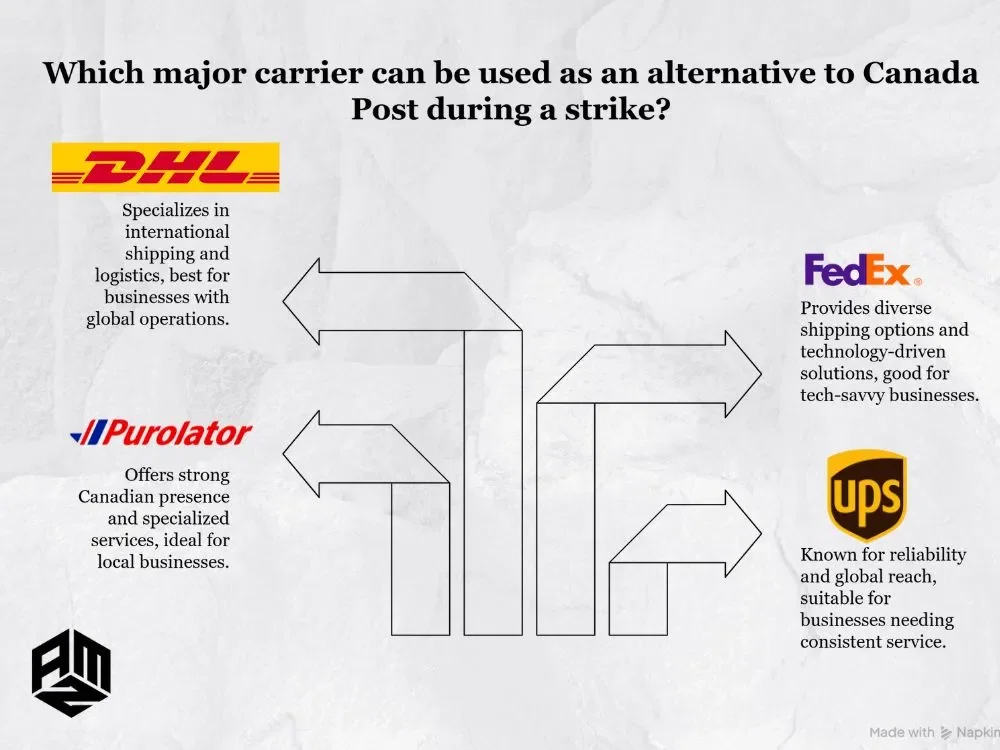
Major Carriers to Consider
- UPS: The Southern cousins of Canada Post, Costs are higher, but service is fast and trackable. For time-sensitive packages or business-critical documents, UPS is often the most dependable,
- Purolator: Although it’s majority-owned by Canada Post, Purolator usually operates independently during strikes. It can change but it is what it is. They often become a preferred fallback, especially for small and medium businesses that need national coverage.
- FedEx: Known for its strong tracking systems and rapid delivery options. I tend to use FedEx when I can’t afford any uncertainty in timing. Go with them especially for B2B shipments or perishable items.
DHL: My go-to for international orders, especially into Europe or Asia. They know their way around cross-border logistics, and their customs clearance process is among the smoothest I’ve seen.
Local Courier Services
In many cities, I’ve found smaller courier companies that offer same-day or next-day service, often at better rates. These are great for local deliveries but that’s about it. I would not go with them for distance deliveries They may also be more flexible with pickup times and can often accommodate unique delivery needs.
Direct Handoff or Pickup
Now without a doubt, business owners are the hardest hit, so for them setting up a pick-up point or hand-off station (like in-store pickup or curbside delivery) can help keep customers satisfied while national mail services are delayed.
If you’re relying on fulfillment providers during the strike, this is a great moment to evaluate the top ShipBob alternatives that might offer faster delivery times and better regional coverage.
What Businesses Should Do Right Now?
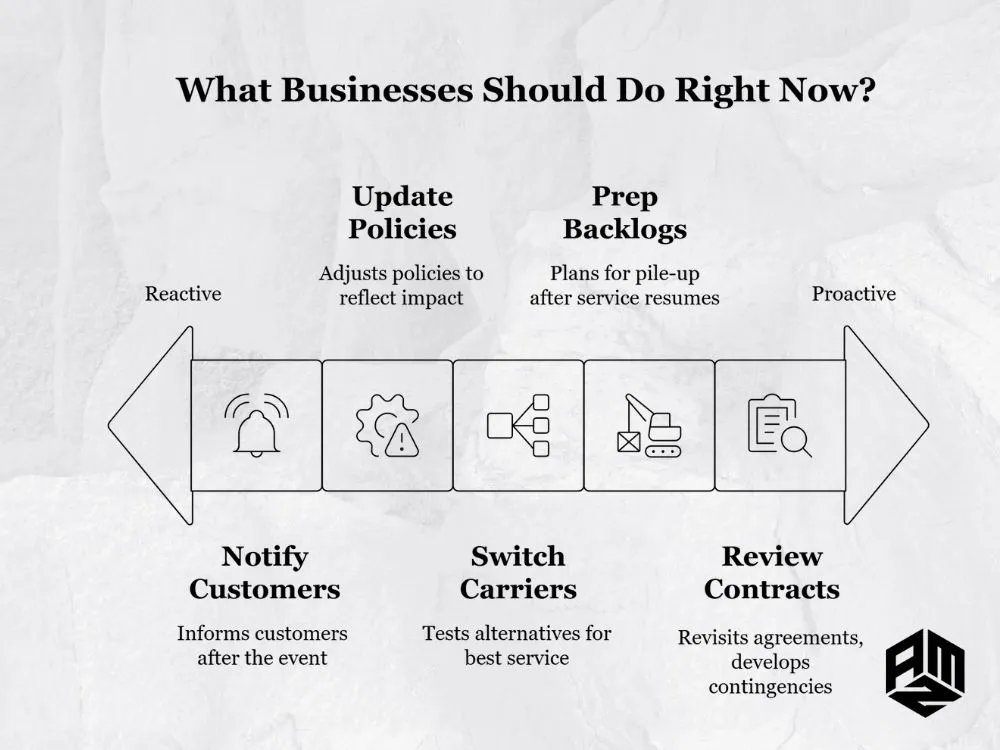
If you rely on Canada Post, here’s what to do immediately:
Review Contracts & SLAs: Revisit agreements with 3PLs or logistics partners. Industry leaders, including AMZ Prep, have multiple contingencies in place for clients.
Notify Customers: Be transparent about potential delays. Proactive communication reduces support tickets and prevents frustration.
Update Shipping Policies: Reflect strike impacts on checkout pages and order confirmations to manage expectations.
Switch to Alternate Carriers: Start testing UPS, Purolator, and regional couriers now to see what works best for your audience.
Prep for Backlogs: Plan for order pile-ups when service resumes. Early preparation is key.
Timeline of Past Canada Post Strikes (Historical Context)
Looking at the history helps give some perspective:
- 2011: Full national lockout lasted two weeks before government intervention. It disrupted millions of deliveries and highlighted the need for postal modernization.
- 2018: Rotating strikes across the country over five weeks. Ended by legislation. E-commerce sellers were hit hard, leading to greater interest in private carriers.
- 2020: Pandemic-related slowdowns, not a strike, but still major delays. This showed how vulnerable the system is to both internal and external stress.
- 2025: Current disruption mirrors 2018, with rotating actions and increasing union demands.
Frequently Asked Questions (FAQs)
Is Canada Post on strike right now
As of today Setempber 25, Canada Post is on a nationwide strike.
Is Canada Post still on strike in Ontario or BC?
As of September 26, 2025, Canada Post is on a nationwide strike, including Ontario and BC. Mail and parcels aren’t being processed or delivered, and service guarantees are suspended. Private carriers like Purolator, UPS, and FedEx are operating but facing higher demand, potential surcharges, and slower delivery times.
When is Canada Post going on strike next?
Official strike has been announced
Why is Canada Post going on strike in 2025?
The 2025 dispute stems from wage concerns, automation impact, and staffing shortages, but it started with the overtime ban.
How long will the Canada Post strike last?
t’s hard to say exactly when this will wrap up. If the union and Canada Post can strike a deal soon, deliveries could resume fairly quickly. If not, the strike could drag on for weeks, with the possibility of rotating walkouts or full stoppages before things get resolved.
What is a rotating strike at Canada Post?
A rotating strike means workers in different cities stop work on alternating days, avoiding a full national shutdown. Basically it disrupts the work flow but does not stop it.
Is Purolator affected by the Canada Post strike?
Purolator, UPS and FedEx are not striking; they operate independently of Canada Post. Expect capacity pressure, later pickups and possible surcharges as shippers divert volume. There’s no single 2025 US–China trade deal that solves restocking. Split carriers, prioritize critical SKUs, and communicate delays to customers. Act now to mitigate risk..
Larger supply chain shifts, including updates to the US-China Trade Agreement in 2025 are also playing a role in how quickly businesses can restock inventory affected by the Canada Post disruption.

Blair Forrest is the Founder of AMZ Prep, one of North America’s fastest-growing third-party logistics and fulfillment networks, built entirely without outside capital since 2016. Under his leadership, AMZ Prep has scaled to 50+ fulfillment centers across 6 countries, processing over 10 million plus units monthly and powering $2 billion+ in annual GMV for more than 5,000 brands worldwide including 437, Silverts, Saltyface, Unilever, Duracell, and JBL. A recognized authority in eCommerce logistics, Amazon FBA strategy, and supply chain optimization, Blair has helped thousands of sellers and brands master their fulfillment operations from first shipment to enterprise scale. He regularly consults on FBA prep, multi-channel fulfillment, last mile delivery, international expansion, and cost reduction strategies that save brands 20–40% compared to traditional 3PL providers. Blair’s insights on Amazon logistics, 3PL operations, and eCommerce growth are widely cited across the industry. Through AMZ Prep’s content, guides, and resources, he continues to share battle-tested strategies drawn from managing one of the largest independently owned fulfillment networks in North America.

















This article emphasizes a key priority: customer communication. Letting buyers know about delays ahead of time can save so much trouble.
In rural Alberta, delays hit hard. My priorities shift toward flexibility in carriers when Canada Post slows down this guide is super helpful.
You nailed it when you said contingency planning should be a priority. It’s not just theory we’re seeing it in real shipments now.
Your breakdown really helps. My top priority these days is minimizing disruptions — thanks for pointing out alternative carriers so clearly.
This breakdown feels more like a guide than just news—super helpful for business owners shipping across Canada.
The strike might be disruptive, but your piece makes it feel manageable with the right prep.
I appreciate the FAQ format. My priority when shipping is reliability, and this article gives me practical pointers to meet that goal.
I had no idea Amazon and Canada Post’s agreement could be affected. That’s massive if it drags on.
This post has become my go-to for strike tips. The priority for me is staying proactive thanks for the depth and clarity.
What stood out most is that we need to treat customer satisfaction as a priority, even in strike times. Thank you for the reminders.
Great callout on communication being key. Most customers just want to know what’s happening with their parcel.
My priorities were to protect margins and keep orders flowing. The alternate courier ideas here are exactly what I needed.
Really like the FAQ-style approach at the end. Answered half the questions I was about to Google.
The point about rural routes being hit hardest really stood out. It’s usually city coverage that gets the spotlight.
This is way clearer than Canada Post’s own updates. Thanks for making it easy to follow.
The alternatives list is super practical. Purolator and ICS Courier aren’t ones I usually think of.
Reading this, it’s clear that adjusting shipping policies is a priority every seller should act on before delays spiral.
Love how you broke down the impact on small businesses. That’s the side of the story the news never covers.
Thanks for this as a small business across BC, my priorities right now are transparency and speed. Your suggestions on UPS and Purolator are gold.
The historical timeline you included really helps put this strike in perspective. Didn’t realize there have been 19 since 1965!