
Canada’s top 10 delivery companies in Canada are Canada Post, Purolator, UPS, FedEx, DHL Express, Intelcom, UniUni, Canpar Express, GLS Canada and Loomis Express.
Canada Post is the only carrier reaching every Canadian address. Purolator leads domestic express. UPS and FedEx lead cross-border. Intelcom and UniUni carry the highest ecommerce last-mile volume. A 1kg parcel from Toronto to Vancouver costs roughly $25 to $45 on ground service.
Canada’s Top 10 Delivery Companies Compared
| Company | Type | Coverage | Ground Transit | Best For |
|---|---|---|---|---|
| Canada Post | National postal | 100% of addresses | 4 to 9 days national | Rural, remote, light parcels |
| Purolator | Domestic express | 100% of postal codes | 3 to 7 days | Time-sensitive domestic |
| UPS Canada | Global express | Nationwide and global | 3 to 7 days | Cross-border, high-value |
| FedEx Express Canada | Global express | Nationwide and global | 4 to 8 days | Regulated goods, international |
| DHL Express Canada | International express | International focus | Varies | Outbound international |
| Intelcom | Dragonfly | Last-mile ecommerce | 96% of population | 1 to 4 days | High-volume DTC |
| UniUni | Last-mile ecommerce | 80% of population | 1 to 3 days urban | Cost-led DTC volume |
| Canpar Express | Ground parcel | Nationwide | 3 to 7 days | Small business ground |
| GLS Canada | Ground and express | Strong in ON and QC | 1 to 5 days regional | Central Canada B2B |
| Loomis Express | Domestic express | Nationwide | 2 to 5 days | Mid-weight express |
Two regional carriers and three platforms sit outside this ranking. Both groups are covered below.
What Is the Biggest Delivery Company in Canada?
Canada Post is the biggest delivery company in Canada by parcel volume and address coverage. It serves every residential and business address through 6,200+ post office locations. Purolator ranks second among domestic carriers and is majority owned by Canada Post.
What Is the Most Popular Delivery Service in Canada?
Canada Post is the most used delivery service among Canadian consumers. Among ecommerce sellers, preference splits by need. Purolator and UPS lead for speed. Canpar and GLS lead on ground cost. Intelcom and UniUni lead on DTC volume.
Who Are the Main Delivery Companies in Canada?
Canadian delivery breaks into three groups. National carriers are Canada Post and Purolator. Global express carriers are UPS, FedEx and DHL. Ecommerce and regional specialists include Intelcom | Dragonfly, UniUni, Canpar, GLS Canada, Loomis, ICS Courier and Nationex.
Which Courier Service Is Best in Canada?
No single courier service in Canada wins every case. Purolator Express is the most cost-competitive guaranteed next-day option. Canada Post Regular Parcel is cheapest for light and rural parcels. Canpar and GLS undercut national carriers on regional ground lanes.
The Top 10 Delivery Companies in Canada, Reviewed
Every carrier below has a lane where it performs and a lane where it does not. The limitations matter more than the strengths when you build a mix.
1. Canada Post
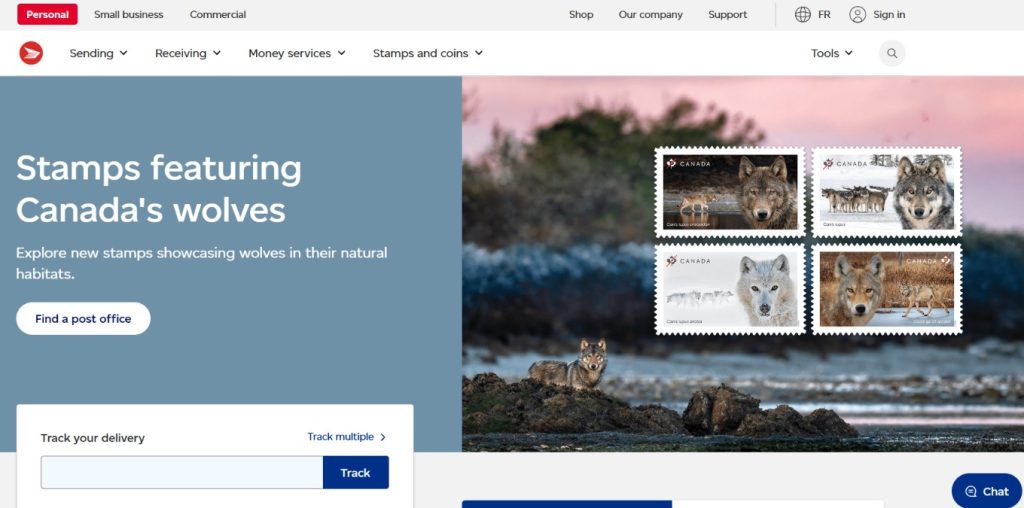
Canada Post is the federal postal operator and the only carrier obligated to serve every address in the country. It runs 6,200+ post office locations and offers four domestic parcel tiers. Regular Parcel is the economy option. Expedited Parcel adds tracking and an on-time guarantee. Xpresspost delivers nationally in two business days. Priority guarantees next business day locally.
Peak season consistency is the weak spot. Two national work stoppages since November 2024 have shown how much risk sits in single-carrier dependence.
Best for light parcels, rural and remote addresses, and cost-led domestic shipping.
2. Purolator
Purolator is Canada’s largest integrated freight and parcel company, majority owned by Canada Post. It covers 100 percent of Canadian postal codes through 1,290+ locations. Purolator Ground competes hardest on parcels above 2kg between Toronto, Montreal, Calgary and Vancouver. Purolator Express is the most cost-competitive guaranteed next-day service among the national carriers.
Rates rose an average of 5.7 percent in 2026. The fuel surcharge sat at 27.25 percent of base transportation rate as of June 2026.
Best for Canadian businesses needing guaranteed next-day domestic delivery.
3. UPS Canada
UPS runs one of the strongest cross-border networks between Canada and the United States. Customs brokerage is built in. UPS Worldwide Saver delivers US-bound parcels in two business days.
UPS Standard is the domestic economy option, and it works best on mid-weight parcels between major cities. On light parcels to residential addresses, Canada Post prices lower. Brokerage and residential surcharges add up quickly.
Best for cross-border volume, shipping companies in Canada serving US customers, and high-value freight.
4. FedEx Express Canada

FedEx handles regulated categories other carriers decline, including dangerous goods and temperature-controlled shipments. Its strength is international. FedEx keeps cross-border shipments on its own network end to end and clears customs in-house, which produces cleaner tracking than carriers that hand off at the border. US delivery runs 2 to 6 business days.
FedEx Ground runs 1 to 2 days slower than Purolator Ground on the same Canadian lanes. Domestic ground is not where it competes on price.
Best for regulated goods, cold chain and international express.
5. DHL Express Canada

DHL is built around international express. Outbound shipments to Europe and Asia clear quickly, and customs handling is strong. Sustainability programs are further developed than most competitors.
Domestic Canadian parcels are not the focus. On a Toronto to Calgary lane, other carriers price better and move faster.
Best for outbound international shipping from Canada.
6. Intelcom | Dragonfly

Intelcom is a Montreal-based last-mile carrier founded in 1986. It operates as Intelcom in Quebec and Dragonfly elsewhere. The network covers 96 percent of the Canadian population through 110 stations, running 7 days a week from 8am to 10pm. Returns and drop-off run through 3,300+ service locations, making it Canada’s second largest out-of-home network. The company employs 3,600+ permanent staff and reports 98 percent on-time delivery.
It is built for consumer ecommerce parcels. B2B and freight-weight shipments need a different carrier.
Best for high-volume DTC brands shipping to Canadian consumers.
7. UniUni

UniUni is a Vancouver-founded last-mile carrier launched in 2019. It reaches 80 percent of the Canadian population across all nine provinces, with sorting infrastructure in Vancouver, Toronto, Calgary, Edmonton and Montreal. The network processes over one million parcels daily and runs 100,000+ registered drivers. Urban delivery in Toronto, Montreal, Calgary and Vancouver typically runs 1 to 3 business days.
Rural Nova Scotia, New Brunswick, PEI and Newfoundland sit outside its direct footprint and route through Canada Post partnerships. It works as a volume lane, not a primary carrier.
Best for cost-led DTC volume into major Canadian cities.
8. Canpar Express
Canpar is Canada’s second-largest domestic ground courier, owned by TFI International. It focuses on economy ground shipping and offers direct API integration for ecommerce platforms. On regional routes, Canpar rates frequently come in below UPS or FedEx for the same lane.
Transit runs longer than express service. Oversized and heavy parcels move better through freight.
Best for small business ground shipping and intra-province lanes.
9. GLS Canada
GLS Canada, formerly Dicom, runs ground and express parcels with real strength in Ontario and Quebec. B2B service in the central corridor is dependable and priced below national carriers.
Coverage west of Manitoba and into Atlantic Canada is thinner. National shippers pair it with a second carrier.
Best for central Canada B2B and regional parcel volume.
10. Loomis Express

Loomis is also part of TFI International. It sits between Canpar and the express carriers, moving mid-weight domestic parcels faster than ground at rates below Purolator or UPS on many lanes.
Brand recognition is lower and platform integrations are less common than the national carriers.
Best for mid-weight domestic parcels where ground is too slow and express costs too much.
Other Regional Carriers Worth Knowing
Two more carriers serve specific regions well. Neither has the national footprint for the top 10, but both beat larger carriers inside their corridors.
ICS Courier
ICS runs domestic ground parcel with SMARTSpot pickup locations across the country. Scheduled B2B routes are the core service and pricing sits in the value tier. Consumer-facing delivery options are limited.
Best for scheduled business-to-business parcel routes.
Nationex
Nationex is a Quebec-based parcel carrier focused on business shipping across Eastern Canada. Service inside Quebec and Ontario is fast and well priced. Coverage does not extend meaningfully into Western Canada.
Best for B2B parcel volume in Quebec and Ontario.
Platforms and Consolidators
Three options Canadian sellers use are not carriers. They sit between the seller and the carrier network, handling routing rather than delivery.
AMZ Prep Parcel
Prep Parcel is a multi-carrier parcel platform run by AMZ Prep. Orders route across a carrier network based on destination, weight and service level. Cross-border movement between the US and Canada includes customs handling. Zone skipping cuts hub transfers on long lanes.
It is a routing and fulfillment layer, not a delivery network. Brands already running a single carrier at good rates may not need it.
Best for ecommerce brands moving parcels between the US and Canada.
Chit Chats
Chit Chats collects parcels from Canadian sellers, moves them across the border in bulk, and injects them into the US postal network. Postage drops substantially on light US-bound items. Transit runs slower and tracking granularity drops after the border. It does not handle domestic Canadian delivery.
Best for Canadian sellers shipping light parcels to US customers.
Stallion Express
Stallion is a Canadian 3PL and shipping platform for ecommerce sellers. It resells discounted carrier rates and handles US-bound and international volume. Warehousing and packing services are available alongside the platform.
Domestic Canadian coverage depends on the carriers behind it.
Best for Canadian merchants shipping to the US and international markets.
What Does Shipping Cost in Canada?
A 1kg parcel shipped from Toronto to Vancouver costs approximately $25 to $30 on the cheapest ground service and $85 to $140 on guaranteed next-day. The spread between economy and express is roughly four times on the same lane.
Rate Comparison: 1kg Parcel, Toronto to Vancouver
| Carrier | Service | Estimated Rate | Transit |
|---|---|---|---|
| Canpar | Ground | $25 to $40 | 3 to 7 business days |
| Canada Post | Regular Parcel | $27 to $30 | 4 to 9 business days |
| UPS | Standard Ground | $30 to $50 | 3 to 7 business days |
| Purolator | Ground | $35 to $45 | 3 to 7 business days |
| Canada Post | Expedited Parcel | $35 to $45 | 2 to 8 business days |
| FedEx | Ground | $35 to $55 | 4 to 8 business days |
| Canada Post | Xpresspost | $55 to $65 | 2 business days |
| Purolator | Express | $85 to $100 | Next business day |
| Canada Post | Priority | $85 to $100+ | Next business day |
| FedEx | Express Saver | $100 to $140 | 3 business days |
| UPS | Express | $100 to $140 | Next business day |
Rates are retail estimates before commercial or volume discounts. Verified against published 2026 carrier pricing as of August 2026. Actual cost varies by dimensions, surcharges and account tier.
Two patterns show up in this table. Purolator Express is the cheapest guaranteed next-day option among the national carriers, undercutting UPS Express by roughly 30 percent on the same lane. And Canpar beats UPS and FedEx on economy ground while delivering in the same window.
Canada Post Delivery Standards by Service
Canada Post publishes transit standards by distance band. These are business days, excluding the mailing day, weekends and holidays.
| Service | Local | Regional | National |
|---|---|---|---|
| Regular Parcel | Up to 2 days | 3 to 5 days | 4 to 9 days |
| Expedited Parcel | 1 to 2 days | 1 to 4 days | 2 to 8 days |
| Xpresspost | Next day | 2 days | 2 days |
| Priority | Next business day | Next business day | Varies |
Xpresspost and Priority carry an on-time delivery guarantee. Regular and Expedited standards are estimates only.
The Three Costs That Move Your Rate Most
Dimensional weight
Canadian carriers bill on actual weight or dimensional weight, whichever is higher. Canada uses a 6000 divisor. A light parcel in an oversized box bills at volume, not what it weighs. Right-sizing packaging is the fastest available saving. Run your boxes through a dimensional weight calculator before comparing carriers.
Fuel surcharge
This updates monthly and applies as a percentage of the base transportation rate. Purolator sat at 27.25 percent as of June 2026, with UPS and FedEx in the same range. A $35 base rate becomes roughly $45 before any other fee.
Residential delivery surcharge
Purolator charged $4.65 per residential delivery in 2026. On a 1,000-order month, that single fee adds $4,650. Carrier access points let recipients collect parcels without triggering it.
Zone-based pricing sits underneath all three. Carriers split Canada into zones by postal code, and the base rate climbs with distance. That is the cost zone skipping targets, by moving inventory closer to the customer before the parcel enters the carrier network.
For deadline-driven freight, expedited shipping prices at a premium across every carrier listed here.
What Happened During the Canada Post Strikes?
Canada Post workers struck twice between 2024 and 2025. The first stoppage ran from November 15 to December 17, 2024, halting all mail and parcel processing for 32 days during peak season. New commercial volumes were not accepted until December 19. On-time service guarantees were not reinstated until January 6, 2025. A second strike began September 25, 2025 and continued as a rotating action until November 21, 2025.
The detail most brands missed matters more than the strike itself. On December 6, 2024, Purolator and UPS paused intake from some courier companies. The fallback carriers hit capacity.
That is the real lesson. Adding a second carrier during a disruption does not work, because every other shipper is doing the same thing at the same moment. The relationship, the account and the integration have to exist before you need them.
A workable structure looks like this. Pick a primary carrier based on your destination mix. Run live volume through a second carrier covering your primary’s weakest region, even at low share. Keep a third account open for rural and remote, which in most cases means Canada Post.
Routing rules matter more than carrier count. A parcel to downtown Vancouver and a parcel to rural New Brunswick should not take the same path.
Delivery Coverage Across Canadian Provinces
Coverage claims look similar on paper. Performance is separated by region.
Ontario and Quebec
The densest carrier coverage in the country. Every carrier on this list serves it, with same-day and next-day options in Toronto, Ottawa and Montreal.
Regional carriers compete hardest here. GLS Canada, Nationex and Canpar often beat national carriers on price and transit within the corridor. Shipping from a Montreal fulfillment center puts most of both provinces inside a one-day zone.
French language support on tracking and customer communication is a requirement in Quebec, not an option.
Western Canada
Canada Post, Purolator, UPS and FedEx provide consistent coverage across British Columbia, Alberta, Saskatchewan and Manitoba. Intelcom and UniUni serve Vancouver, Calgary and Edmonton at metro density.
Outside those metros, coverage drops quickly. Ground transit from Ontario runs 3 to 9 business days, which is long enough that a western fulfillment point usually pays for itself above a certain volume.
Atlantic Canada
Newfoundland, New Brunswick, Nova Scotia and PEI need separate planning. Fewer carriers serve the region and transit runs longer from central Canada.
Canada Post, Purolator and Canpar all provide coverage. Nationex reaches parts of the region. UniUni routes rural Atlantic addresses through Canada Post rather than delivering directly.
Northern and Remote Coverage
Canada Post is the only carrier serving every northern and remote address. Private carriers either decline these postal codes or apply remote area surcharges that change the economics.
A carrier advertising national coverage may still hand your northern parcels to Canada Post. Check the postal codes your customers actually order from before committing volume.
Courier, Freight and Parcel Delivery Compared
| Service Type | What It Handles | Best For | Typical Size | Speed |
|---|---|---|---|---|
| Courier | Fast small-package, door to door | Documents, urgent small items | Small and light | Same-day to next-day |
| Freight | Pallets and containers | Bulk and oversized shipments | Large, palletized | Varies by distance |
| Parcel | Standard boxed goods | Ecommerce orders | Small to medium | 2 to 9 days, express available |
How to Choose a Delivery Company in Canada
Six factors decide the right mix.
Coverage against your order map
Pull 90 days of orders by postal code and match against carrier service areas. A carrier covering 80 percent of the population may still miss 30 percent of your customers.
Landed cost, not base rate
Add fuel surcharge, residential fees and dimensional weight before comparing. The cheapest base rate is often not the cheapest total.
Transit reliability
On-time percentage matters more than advertised transit. Ask for lane-level performance data during account setup.
Tracking and platform integration
Canada Post, Purolator, UPS, FedEx, Canpar and GLS offer native ecommerce connections. Intelcom and UniUni connect through shipping platforms, which adds a layer.
Return handling
Return volume runs high in apparel and footwear. Intelcom | Dragonfly runs 1,400+ return locations. Canada Post uses its post office network. Others handle pickup only. Last mile delivery performance and returns capability usually travel together.
Cross-border capability
Brands moving parcels between Canada and the US need customs handling built in.
Where AMZ Prep Fits
AMZ Prep is not a carrier. We are the fulfillment partner that decides which carrier moves each order.
Orders ship from Canadian and US warehouses inside a network of 50+ fulfillment centers across six countries. Routing runs across [Blair or Ari: confirm carrier count] carrier partners, matching each order to a carrier by destination, weight, service level and cost.
For brands moving parcels between the US and Canada, that routing includes customs handling and [Blair or Ari: confirm single canonical savings figure] through zone skipping on long lanes.
AMZ Prep has operated since 2016, serves 5,000+ brands, and runs at 99.8 percent order accuracy.
Services: Prep Parcel, Canada 3PL fulfillment, shipping from US to Canada, shipping from Canada to US.
Frequently Asked Questions
What is the cheapest way to ship in Canada?
Canada Post Regular Parcel is cheapest for light parcels and rural addresses, at roughly $27 to $30 cross-country for 1kg. Canpar and Purolator Ground compete on parcels above 2kg between major cities.
Does USPS deliver in Canada?
No. USPS delivers US-bound mail only. Parcels sent from the US through USPS transfer to Canada Post at the border. Canada Post completes the final delivery.
How much is the fuel surcharge in Canada?
Fuel surcharges update monthly and apply as a percentage of base transportation rate. Purolator sat at 27.25 percent as of June 2026, with UPS and FedEx in a similar range.
Which Canadian carriers offer next-day delivery?
Purolator Express, UPS Express and Canada Post Priority all guarantee next business day. Purolator Express is typically the most cost-competitive of the three on domestic lanes.
How is shipping cost calculated in Canada?
Base rate comes from the destination zone, set by distance between postal codes. Carriers bill actual or dimensional weight, whichever is higher, using a 6000 divisor. Fuel and residential surcharges apply on top.
Which carriers are best for US to Canada shipping?
UPS and FedEx handle customs brokerage directly and move fastest, with FedEx clearing in-house end to end. UniUni launched a US-to-Canada service in 2025 for lighter parcels.
Which Canadian carriers integrate with Shopify?
Canada Post, Purolator, UPS, FedEx, Canpar and GLS Canada offer native Shopify connections. Intelcom and UniUni connect through shipping platforms rather than direct integration.
Which carriers reach rural and remote addresses?
Canada Post serves every Canadian address. Intelcom | Dragonfly reaches 96 percent of the population. UniUni reaches 80 percent and routes rural Atlantic addresses through Canada Post.

Chadwick Collins is an Enterprise Fulfillment Consultant at AMZ Prep, where he partners with high growth ecommerce brands to design and scale Amazon first logistics strategies. He brings extensive experience in freight, supporting brands across domestic and cross border transportation, routing optimization, and cost control.
At AMZ Prep, Chadwick works closely with enterprise clients to improve inventory flow, reduce landed costs, and accelerate delivery performance across North America. His expertise spans FBA, DTC, and B2B fulfillment, with a strong focus on aligning freight strategy with overall supply chain efficiency. He helps brands navigate complex logistics challenges while turning operations into a competitive advantage.

















The rural delivery gap point is huge. Ranking carriers by “national coverage” is misleading when half the country gets 5-day delivery from supposedly fast services.
As a small business owner shipping ~50 orders/day, this gave me three providers to call for quotes I wasn’t aware of. That alone was worth the read.
I’d push back gently on Purolator being so high, last-mile in rural Ontario and east of Quebec City has been genuinely terrible the last 18 months.
Question: do any of these handle full-service returns processing, or are most still pickup-only for returns? That’s where Canadian logistics still feels behind the US.
Where are the cost-per-shipment benchmarks at the 2lb/5lb/10lb tiers? That’s the actual decision-driver for most of us, not coverage area.
Solid roundup. One thing I’d love to see in v2, a column on whether each carrier integrates natively with Shopify Shipping. That’s the operational question for most DTC brands.
Honestly the Intelcom inclusion is what makes this list credible. Most “Canada delivery” lists from US-based sites pretend they don’t exist.
This is the comparison US sellers desperately need. So many think “Canada shipping = Canada Post” and then wonder why their conversion rate tanks.
AMZ Prep really stands out with their global coverage. Not many prep centers can offer that.
That’s something we’re genuinely proud of, Jessica. Having that reach makes a real difference for sellers who want to grow beyond just one market. Thanks for noticing!
I’ve used them for two years now fast processing and solid communication every time.
Two years and counting, that genuinely means a lot to hear, Brian. Consistent communication is something the team takes seriously so glad it shows on your end!
Attention to detail is on another level. Zero issues with labeling.
Zero labeling issues is exactly what we aim for, Lauren. It’s one of those things that seems small but can cause big headaches if it’s off. Really glad the experience has been smooth!
Great insights for anyone managing Canadian eCommerce logistics — especially for U.S. sellers looking to expand north.
Exactly the audience we had in mind, Brooklyn. Cross-border expansion into Canada has its own quirks and we wanted to make that less intimidating for U.S. sellers. Thanks for reading!
Outsourcing prep freed up so much of my time to focus on growth.
That’s the goal, Anthony. When the operational side is handled, you get to spend time on things that actually move the needle. Really glad it’s working out for you!
Love that they handle both FBA prep and fulfillment. Huge time saver for small businesses.
Having both under one roof really does cut out a lot of back and forth, Ashley. For smaller operations especially, that kind of simplicity matters. Thanks for sharing your experience!
Customer support is quick and knowledgeable makes all the difference.
It truly does make or break the experience, Matthew. Glad the team has been responsive and actually useful when you need them. We’ll pass the word along!
Excellent article — nicely balances national postal carriers like Canada Post and corporate logistics firms like TFI International with global giants such as DHL, UPS, FedEx. Helpful context on labor disruptions and market share shifts adds real value
Really appreciate you saying that, Logan. We wanted it to go beyond a simple list and give some context around what’s actually shaping the market right now. The labor situation in particular is worth paying attention to. Thanks for the thoughtful read!
Great for new sellers who want to scale without getting overwhelmed.
That’s a big part of why we wrote it this way, Olivia. Starting out in eCommerce can feel like a lot, and picking the right shipping partner early on honestly removes a ton of friction. Hope it pointed you in the right direction!
This guide is perfect for brands evaluating Canadian delivery partners. Great work!
Thanks Jackson! Choosing the right delivery partner can genuinely shape how a brand grows, so we wanted to make that evaluation a bit more straightforward. Glad it hit the mark!
This kind of content is so useful when planning shipping strategies across different provinces. Thanks for the clarity!
Provincial shipping can get complicated fast, so we’re glad the breakdown felt clear, Emily. Each region really does have its own dynamics worth planning around. Thanks for reading!
Short, clear, and packed with the right info. Definitely bookmarking this one!
That’s the best kind of feedback, Mia! Bookmark it and come back whenever you need a quick reference. We keep it updated as things change too!
Just signed up last month. So far, everything’s been smooth and professional.
Welcome aboard, Rachel! Really glad the first month has felt smooth. That sets a good tone for everything that follows. Feel free to reach out to the team if you ever need anything!
Appreciate how this post covers both well-known carriers like FedEx and Canada Post, and also gives attention to companies like Nationex and Intelcom. The balance between local and international providers is super useful for businesses shipping in and out of Canada.
The regional players often fly under the radar, Charlotte, but for specific corridors they can outperform the big names on both speed and price. Glad the balance came through in the article!
The scalability is what sold me. Easy to grow without worrying about storage.
Storage anxiety is real when you’re scaling, David. Being able to grow without constantly renegotiating warehouse terms takes a genuine weight off. Glad that part resonated!
This is exactly what I was looking for — clear, quick insights into Canada’s top delivery options!
Geography is honestly the whole story with Canada Post, Sophia. No private carrier has come close to matching that rural and remote reach, and it’s largely because of how much ground needs covering. Glad that context was useful!
Happy it came at the right time, Sophia! Sometimes you just need a clean overview without digging through ten different sources. Thanks for stopping by!
Integration with Amazon makes inventory management stress free.
That sync between prep and Amazon really does take the guesswork out of inventory management, Christopher. No more manually reconciling numbers across platforms. Glad it’s been a smooth experience!
Really helpful breakdown — this kind of comparison makes choosing a shipping partner so much easier.
That’s exactly what we were going for, Abigail. Too often these comparisons are either too vague or too technical. Hope it helps you find the right fit for your shipping needs!
Reminding readers to balance cost with reliability. Reliability is often a sacrifice for money but often never worth it
Couldn’t agree more, Noah. A missed delivery or a labeling error ends up costing far more in returns and lost customers than the few dollars saved upfront. Well said!
Your coverage of cross-border shipping options was so practical. I have been in the field for years and did not have this perspective
That’s really good to hear from someone with your experience, Oliver. Cross-border logistics has shifted quite a bit with zone skipping and smarter carrier routing, so the old frameworks don’t always hold up anymore. Thanks for sharing that!
I like that you added Canada’s vast geography as the reason for Canada Post’s supremacy.
The pros for each company were so concise, I found what I was looking for in a jiffy
That’s the goal, Ava! No one wants to wade through paragraphs just to find out what a carrier is good at. Really glad the format worked for you!
Nice job highlighting Purolator and Canada Post. Both are solid for domestic deliveries in Canada.
They really are the backbone of domestic Canadian shipping, Evelyn. Each has its own strengths depending on what you’re sending and where, but together they cover a lot of ground. Thanks for the kind words!
The table format for delivery speed was a standout! It’d be cool if you could add cost-per-package averages too.
Love that suggestion, Ethan! Cost-per-package averages are tricky because they shift with weight, zone, and volume, but we’re looking at ways to give that kind of ballpark visibility in a future update. Keep an eye out!
Very informative breakdown of top delivery companies — great to see both national and international players featured!
We wanted to give a complete picture rather than just the usual suspects, Harper. For businesses shipping internationally or cross-border, knowing all the options really changes what’s possible. Thanks for reading!
I appreciated how you included FedEx and Purolator’s pricing benefits, I would have considered them if not for the price
I especially loved how you highlighted Canada Post’s FlexDelivery feature. Probably my most used feature.
Flex Delivery is genuinely one of those underrated features, Liam. The flexibility to redirect packages to a post office when you’re not home saves a lot of headaches. Glad it got a callout in the article!
I love the section breaking down each company’s strengths—it’s so helpful. Was just looking for something like this
I really appreciate how you discussed specialized services, like temperature control and hazardous goods handling.
Those services often get overlooked in these roundups, Emma, but for certain product categories they’re non-negotiable. FedEx and a few others have genuinely built solid infrastructure around it. Thanks for highlighting that!
Highlighting regional services like Canpar Courier was a great touch!
Canpar doesn’t always get the attention it deserves, Jackson. For ground shipping within Canada, especially for smaller businesses, it punches above its weight. Glad that section stood out!