
The best ecommerce shipping software in 2026 is Prep Parcel for brands that want multi-carrier rates tied to a physical fulfillment network, ShipStation for high-volume multi-channel sellers, Pirate Ship for merchants shipping under 100 orders a month, and Easyship for international cross-border volume. Every platform worth paying for does four things: compares live rates across multiple carriers, applies rule-based batch automation, syncs orders natively from Shopify, Amazon, WooCommerce and TikTok Shop, and pushes tracking back to the customer without manual work. Four of the sixteen (Prep Parcel, ShipBob, ShipMonk, Stord) go further and double as ecommerce fulfillment software, because the shipping engine is tied to a physical warehouse network.
This guide compares 16 platforms on carrier network, pricing, batch automation and the seller each is built for. The numbers below are taken from each vendor’s published pricing and documentation as of October 2026; confirm current tiers on the vendor’s site before committing, since most parcel software re-tiered after the 2026 carrier rate increases.
Shipping software comparison matrix
| Platform | Best for | Carrier network | Free tier / starting price | Batch label automation |
|---|---|---|---|---|
| Prep Parcel (AMZ Prep) | Multi-region brands wanting warehouse and software combined | 35+ national and regional carriers; 6-country warehouse network | No technology fees, no volume minimum; rates shown at checkout | Yes, plus multi-warehouse routing |
| ShipStation | Multi-channel sellers, 100+ orders/day | 130+ carriers | $14.99/mo (50 shipments); Standard $29.99/mo | Yes, rule-based with AI rule builder |
| Shippo | Startups with unpredictable volume | 40+ carriers | Free (30 labels/mo); Pro from $17/mo | Limited |
| Easyship | International and cross-border sellers | 250+ carriers | Free plan; paid from $29/mo | Yes |
| eShipper | Canadian and US–Canada cross-border operations | 20+ carriers | Free (20 shipments/mo) | Yes |
| EasyPost | Developers, headless commerce | 100+ carriers | Free up to 3,000 labels/mo, then per-label | Yes (via API) |
| ShipEngine | Platforms and marketplaces embedding shipping | 50+ carriers | Custom, volume-based | Yes (via API) |
| Pirate Ship | Bootstrapped sellers under 100 orders/mo | 2 (USPS, UPS) | Free, no per-label fee | Spreadsheet upload only; no rules |
| Veeqo (Amazon) | Amazon-heavy sellers self-fulfilling at any volume | 6 (UPS, USPS, FedEx, DHL, Amazon Shipping, OnTrac) | Free; pay postage only | Yes |
| ShippingEasy | Small sellers wanting bundled email marketing | 40+ carriers | Free (25 shipments/mo); $19.99/mo for 200 | Yes |
| Ordoro | Inventory-heavy, multi-location, dropshipping | 20+ carriers | $59/mo (500 orders) | Yes |
| Stamps.com | USPS-only domestic shippers | USPS only | $14.99/mo (10 labels) | Yes |
| ShipBob | DTC brands outsourcing fulfillment, 200–500+ orders/mo | Major carriers via ShipBob network | Quote-based; standalone WMS available | Yes (inside the 3PL) |
| ShipMonk | Fast-growing DTC and subscription brands outsourcing fulfillment | Virtual Carrier Network (carrier-agnostic) | Quote-based; VCN included at no extra cost | Yes (inside the 3PL) |
| Stord | Mid-market and enterprise omnichannel brands | National and regional carriers via Stord Parcel | Quote-based; OMS and WMS sold separately | Yes (AI carrier selection) |
| AfterShip | Post-purchase tracking only (no labels) | 1,100+ carriers (tracking) | Free plan; paid from $11/mo | Not applicable |
What changed in shipping in 2026
The 2026 shipping market is more expensive and more consolidated than the one most buyer’s guides were written for. Five changes affect which platform a brand should pick.
| Change | Date | What it means for software choice |
|---|---|---|
| UPS and FedEx 5.9% general rate increase, the third consecutive year at that figure; surcharges rose faster, putting effective increases at 7–12% for most DTC brands | UPS effective Dec 22, 2025; FedEx Jan 2026; FedEx One Rate mid-year increase Apr 20, 2026 | Multi-carrier rate shopping and packaging optimization (DIM weight) now matter more than the headline rate |
| USPS price increase: Priority Mail +6.6%, Ground Advantage +7.8%, Priority Mail Express +5.1%, Parcel Select +6.0% | Jan 18, 2026 | USPS-only tools (Stamps.com, Pirate Ship’s USPS lane) lost some of their cost edge against commercial UPS/FedEx rates |
| End of the $800 de minimis exemption: China/Hong Kong parcels first, then postal shipments from all countries; HS codes now mandatory on USPS international shipments | May 2, 2025 and Aug 29, 2025 | Every cross-border order now needs automated customs documentation and duty calculation, which moves Easyship and Prep Parcel (US–Canada) up the shortlist for any importer |
| Auctane (ShipStation’s parent) merged with Worldwide Express Group to form ShipStation Global, backed by Thoma Bravo; ShipStation added Ship with Walmart for marketplace sellers | Jun 1, 2026; Oct 2026 | ShipStation, Stamps.com, ShipEngine and ShippingEasy now sit under one owner, with freight and negotiated Walmart rates layered in |
| Stord acquired Shipwire from CEVA (adding 12 facilities and UK/EU presence) and raised a $250M Series F at a $3B valuation | Jan 2026; May 2026 | 3PL-backed platforms (Stord, ShipBob, ShipMonk, Prep Parcel) are consolidating software and fulfillment into one contract |
ShipStation’s 2026 Merchant Insights Report names shipping cost as the number-one growth constraint for merchants, which is the clearest signal that rate shopping has moved from a nice-to-have to the core reason to buy shipping software at all.
Key Takeaway: The 2026 rate increases hit surcharges and dimensional weight harder than base rates. A platform that only compares base rates understates the real bill; look for DIM-weight optimization, surcharge-aware rate shopping, and automated customs paperwork.
What separates shipping software that scales from software you replace in a year
Multi-carrier shipping rate shopping software is the first filter. A platform that connects to one carrier exposes the brand to that carrier’s rate increases and service disruptions with no fallback; comparing USPS, UPS, FedEx, DHL and a regional carrier by zone and weight on every shipment typically cuts shipping spend 15–30% against a single-carrier account.
Batch automation is the second. Processing one order by hand copying the address, validating it, weighing the package, picking a carrier, printing the label takes 3–5 minutes. A rule such as “packages over 5 lbs ship FedEx Ground” or “California orders ship from the Nevada warehouse” brings that to about 30 seconds, and the gap becomes a staffing problem above roughly 100 orders a day.
Integration depth is the third. The platform must pull orders from every storefront into one queue and, if a 3PL is involved, sync inventory with the warehouse management system in real time rather than on a delay. Duplicate labels and lagging inventory counts are the two most common failures when a brand switches 3PLs, and both trace back to an integration that was listed as “supported” but never tested with sample orders.
Post-purchase tracking is the fourth. Branded tracking pages and automated delivery notifications reduce “Where is my order?” tickets by 40–60%, because customers check status themselves instead of emailing support.
Key Takeaway: Judge a platform on all four categories together. Carrier count without automation is a list of logos; automation without integrations is a second queue to manage; and a strong label engine with no tracking layer moves the cost from shipping to support.
The 16 best shipping software platforms for ecommerce in 2026
Each platform below is built for a different operating reality. Match the platform to the volume, channels and warehouse setup the brand runs today, not the feature list on the vendor’s homepage.
1. Prep Parcel (by AMZ Prep)
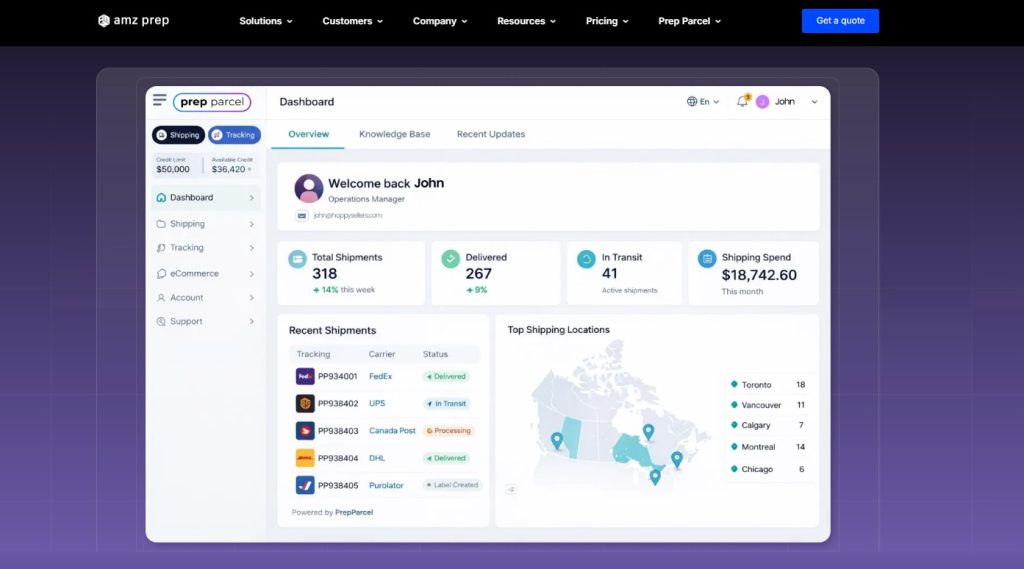
Prep Parcel is a multi-carrier shipping platform backed by AMZ Prep’s network of 50+ fulfillment centers across the US, Canada, the UK, Germany, the Netherlands and the UAE. It exists to give mid-market brands the parcel rates that carriers normally reserve for enterprise shippers, without the enterprise volume commitment, and to attach those rates to physical warehousing so the brand does not migrate software when it outsources fulfillment.
The savings mechanism is zone skipping. Shipments are consolidated at origin and injected into local carrier networks near the destination instead of paying for every zone a package crosses. On AMZ Prep’s network that cuts parcel cost 25–32% and brings coast-to-coast delivery to 2–3 business days. Orders sync from Shopify, Amazon, Walmart, WooCommerce, ShipStation, Etsy, BigCommerce, Magento, TikTok Shop and custom API connections, and US–Canada cross-border shipping includes customs clearance and duty management. AMZ Prep is independently owned, ISO 9001:2015 certified, FDA-registered, and an Amazon Recommended 3PL and Shopify Recommended Fulfillment Partner, processing 8M+ units a month at 99.8% order accuracy.
- Best for: Brands shipping from multiple regions that want rate shopping and fulfillment on one platform; strongest on US–Canada lanes and UK/EU expansion.
- Carrier network: 35+ national and regional carriers, including FedEx, UPS, DHL, USPS, Canada Post, Purolator, Canpar, Intelcom, UniUni, FleetOptics and Loomis Express.
- Key differentiator: Enterprise-tier rates with no enterprise volume requirement; a brand shipping 50 packages a week gets the same per-package rate as one shipping 50,000.
- Automation: Batch label processing and automatic routing to the nearest warehouse.
- Pricing: No technology fees, no long-term contract, no minimum shipment volume; the full rate is shown at checkout rather than behind a sales call.
- Keep in mind: The carrier network and zone-skip routes are built around Canada, the US and the lanes between them, plus an India-to-Canada freight route. Brands whose main volume ships outside North America should weigh Easyship’s broader footprint.
2. ShipStation
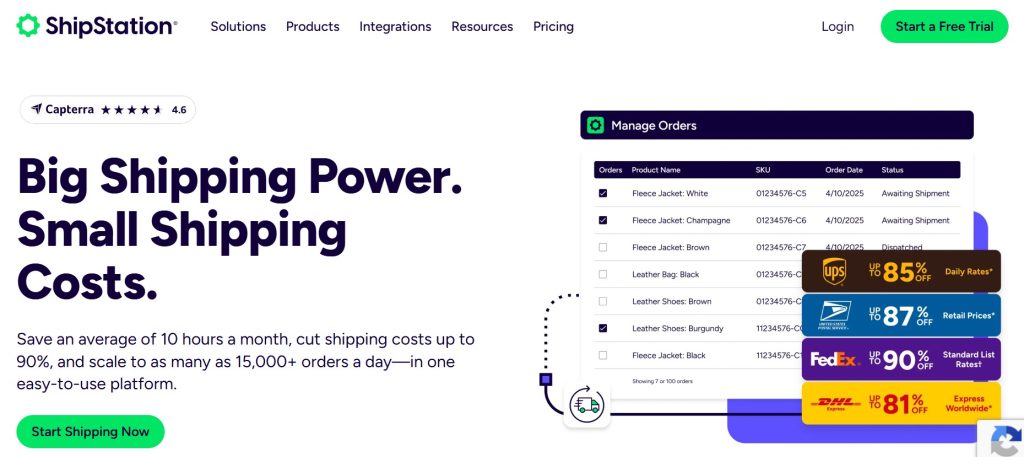
ShipStation is the most widely adopted SaaS shipping dashboard for independent multi-channel merchants, and since June 1, 2026 it sits under ShipStation Global, formed when parent Auctane merged with Worldwide Express Group. In October 2026 it added Ship with Walmart, giving Walmart Marketplace sellers negotiated rates inside the platform. It pulls orders from Shopify, Amazon, eBay, WooCommerce and TikTok Shop into one queue, connects to 130+ carriers including regional names most sellers never consider, and has a 300+ integration catalog that covers most OMS, WMS and marketplace tools a growing brand will touch.
Its 2026 advantage is ShipStation Intelligence, an AI layer that converts a plain-language instruction such as “route orders over 50 lbs from the West Coast warehouse” into a working automation rule without writing conditional logic. Branded tracking pages and a self-serve returns portal are included. Pricing moved to three tiers in July 2025: Starter from $14.99 a month for 50 shipments with email-only support, Standard from $29.99 a month adding API access, own-carrier accounts and phone support, and Premium at $349.99 a month for inventory and warehouse features.
- Best for: Sellers shipping 100+ orders a day across three or more channels.
- Carrier network: 130+ carriers.
- Key differentiator: The deepest rule-based automation on this list, now with a natural-language rule builder.
- Automation: Full batch labeling, rule engine, branded tracking, returns portal.
- Pricing: Starter $14.99/mo (50 shipments); Standard $29.99/mo at 50 shipments rising to $149.99/mo at 1,000; Premium $349.99/mo.
- Keep in mind: Volume tiers climb quickly, and own-carrier accounts are locked to Standard and above. International is supported but is not the platform’s core strength; brands weighing it against other options can compare ShipStation alternatives.
Check ShipStation Alternatives
Compare the top ShipStation alternatives and find the right shipping and fulfillment solution for your business.
Read the Article →3. Shippo
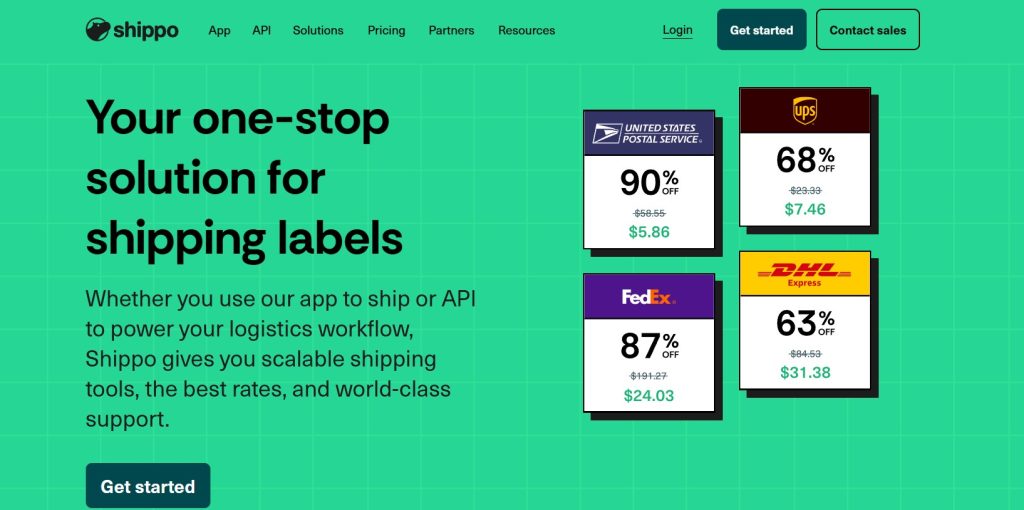
Shippo is a pay-as-you-go multi-carrier platform with its API available on every plan, including the free one, which makes it the usual first step for merchants whose volume is still unpredictable. Orders sync from Shopify, WooCommerce and Magento, address validation catches typos before a label prints, and carrier discounts on USPS, UPS, FedEx and DHL Express apply on the free tier at the same level as paid plans.
The Starter plan is free for 30 labels a month with a single user; labels printed through a connected own-carrier account cost $0.05 each. Pro runs from $17 a month for 200 labels to $199 a month for 10,000, with an $0.08 overage beyond that. Automation is lighter than ShipStation’s: there is no rule builder, so sellers past roughly 1,000 orders a day outgrow it.
- Best for: New sellers testing product-market fit who want discounted rates without a subscription.
- Carrier network: 40+ carriers.
- Key differentiator: API access on the free tier, plus a free 30-label allowance with full carrier discounts.
- Automation: Limited; no rule-based routing.
- Pricing: Free (30 labels/mo); Pro $17–$199/mo by volume.
- Keep in mind: The free tier is single-user and capped at 30 labels, which suits a side project rather than a business.
4. Easyship
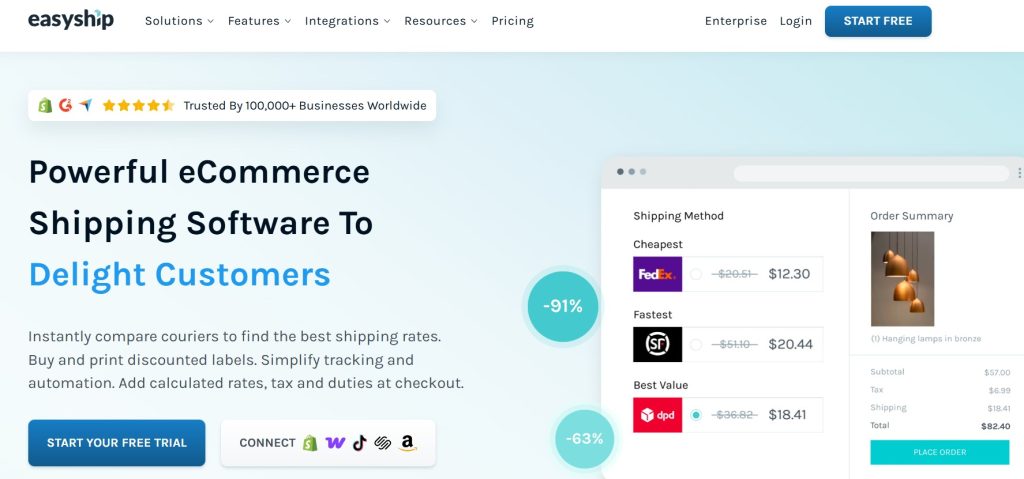
Easyship is built for international shipping. It connects to 250+ carriers, including regional carriers across Asia, Europe and Latin America that US-centric platforms do not carry, and it automates the two tasks that stall cross-border sellers: customs documentation and landed-cost calculation. Paperwork generates from product HS codes, and a duty calculator shows the customer the total delivered price at checkout, which measurably reduces cart abandonment on international orders.
A free plan covers low volumes; paid plans start at $29 a month, with higher tiers unlocking automation rules and multi-user access.
- Best for: Brands where cross-border sales are a significant share of revenue.
- Carrier network: 250+ carriers, the largest label-generating network on this list.
- Key differentiator: Automated customs forms and landed-cost display at checkout.
- Automation: Rule-based batch labeling on paid plans.
- Pricing: Free plan; paid from $29/mo.
- Keep in mind: A US-only seller pays for cross-border capability it will not use.
5. eShipper
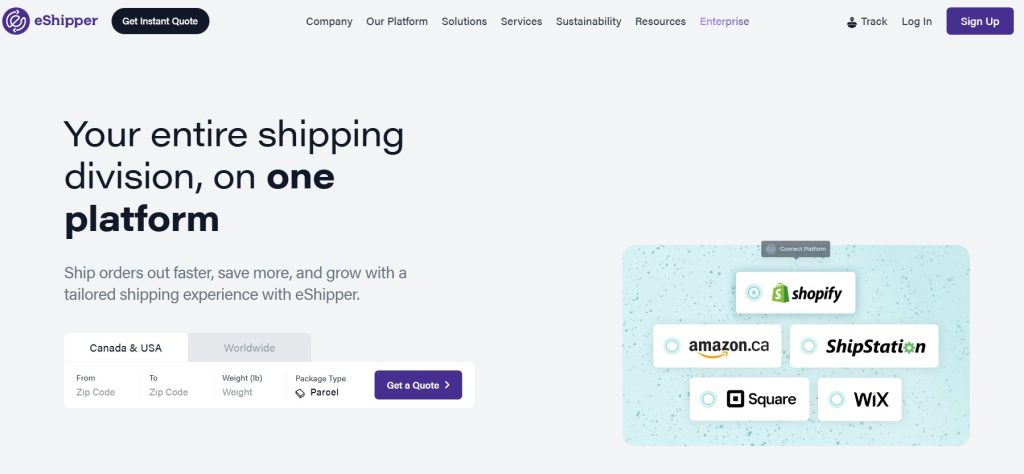
eShipper is a multi-carrier platform optimized for Canadian merchants and for US sellers moving meaningful volume across the northern border. Carrier accounts include UPS, FedEx, Canada Post and USPS, orders route automatically to the nearest of several warehouses, and dedicated account managers negotiate carrier contracts on the seller’s behalf, which matters once volume is high enough to earn real contract leverage.
Two features are specific cost levers. A 4D boxing algorithm picks package dimensions that avoid dimensional-weight surcharges, and SmartePost provides trackable mail for lightweight parcels and envelopes that would otherwise ship untracked. Branded packing slips and integrations with Shopify, Magento, BigCommerce and WooCommerce are included.
- Best for: Canadian operations, US–Canada cross-border sellers, and multi-warehouse brands that want a named account manager.
- Carrier network: 20+ carriers.
- Key differentiator: Account-manager model plus dimensional-weight optimization.
- Automation: Full batch processing and nearest-warehouse routing.
- Pricing: Free for 20 shipments a month with one user and one store connection; paid tiers above that.
- Keep in mind: The free tier is a testing ground, not a working plan.
6. EasyPost
EasyPost is an API-first shipping platform for teams with developer resources who want full control of the shipping stack instead of a pre-built dashboard. Rate shopping, label generation, tracking, address validation and customs forms all run through one set of RESTful endpoints across 100+ carriers, and its tracking webhooks and uptime record are the reasons enterprise developers choose it over building carrier integrations in-house.
The public plan is free for the first 3,000 labels a month, then billed per label; enterprise volume is custom-priced.
- Best for: Custom ecommerce stacks, headless commerce, and software companies building shipping into their own product.
- Carrier network: 100+ carriers.
- Key differentiator: Reliable uptime and robust tracking webhooks through a single, well-documented API.
- Automation: Fully automated batching via API.
- Pricing: Free up to 3,000 labels/mo, then per-label; enterprise custom.
- Keep in mind: Requires engineering time to implement; non-technical teams should use ShipStation or Shippo.
7. ShipEngine
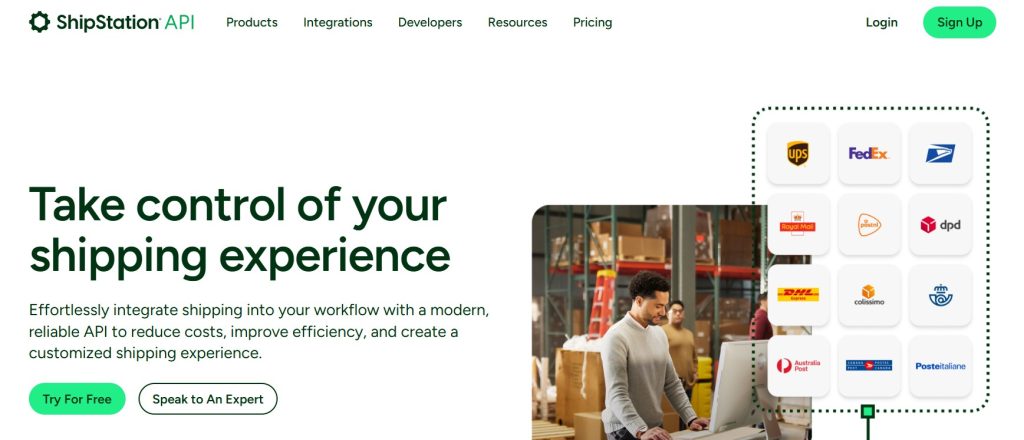
ShipEngine is a developer-facing shipping API for platforms and marketplaces that embed shipping inside their own product rather than sending sellers to a third-party dashboard. It strips away the user interface entirely: multi-carrier rate shopping, label generation, address validation and tracking are endpoints, and batch processing is built for the volumes a marketplace generates rather than a single store.
- Best for: Ecommerce platforms, SaaS products and marketplaces; custom OMS or WMS builds.
- Carrier network: 50+ carriers.
- Key differentiator: Pure API with no dashboard, designed for deep backend integration.
- Automation: Fully customizable in code; high-volume batch processing.
- Pricing: Custom, volume-based.
- Keep in mind: Not built for individual sellers; it needs a development team to implement and maintain.
8. Pirate Ship
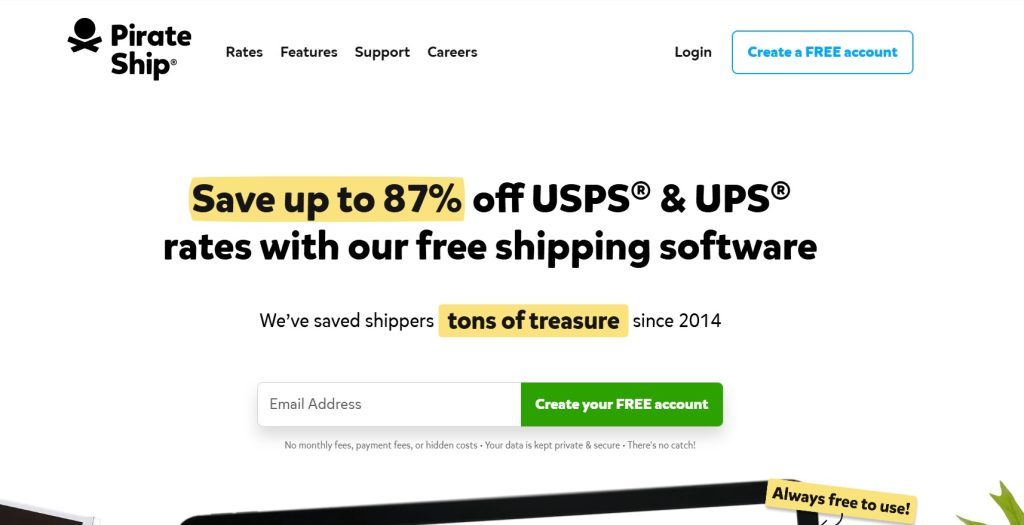
Pirate Ship is free. There is no monthly subscription and no per-label fee; the platform passes USPS Commercial Pricing and UPS discounts to the merchant and earns on the postage spread. The workflow is deliberately simple: upload orders, print labels, done, with address validation and tracking updates handled automatically. Batch labels are created by uploading a spreadsheet.
The limits are the trade-off for zero cost. Only USPS and UPS are supported, there is no multi-channel order import, and there are no rule-based automations, so a seller cannot route by weight, zone or warehouse. For a brand under 100 orders a month those limits rarely bite; past that, they become the reason to migrate.
- Best for: Bootstrapped startups, Etsy sellers, and anyone shipping under 100 orders a month who wants fixed costs at zero.
- Carrier network: 2 carriers (USPS, UPS).
- Key differentiator: 100% free with no hidden per-label fees.
- Automation: Spreadsheet batch upload only; no rule-based routing.
- Pricing: Free.
- Keep in mind: No FedEx, DHL or international carrier depth; no store integrations beyond CSV.
9. ShippingEasy
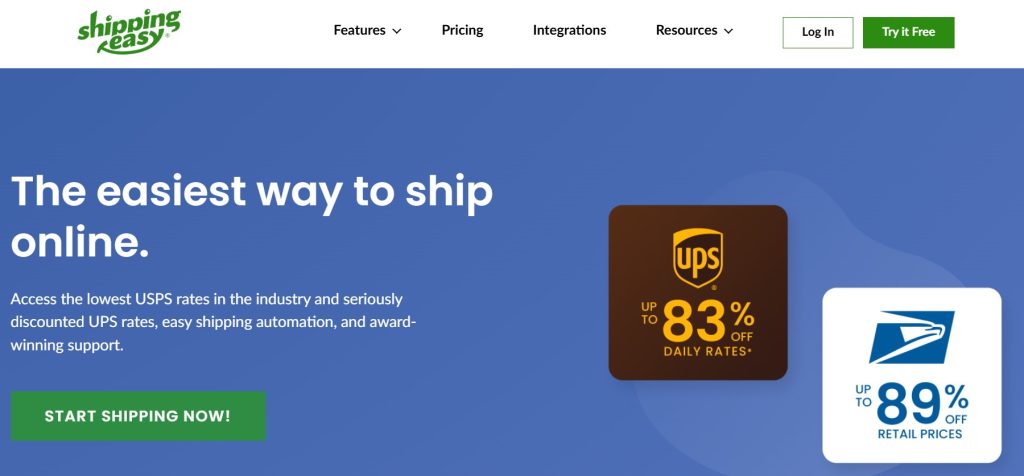
ShippingEasy bundles multi-carrier shipping with a basic CRM and email marketing in one subscription, so a small seller gets carrier management and customer communication without paying for two tools. Rate shopping covers USPS, UPS, FedEx and 40-plus other carriers; Amazon, eBay, Etsy and Shopify sync directly; and built-in automation can trigger abandoned-cart sequences and review requests, with customers segmented by order frequency or lifetime value.
The free plan covers 25 shipments a month, and paid tiers start at $19.99 a month for 200 shipments.
- Best for: Small sellers who want basic email marketing bundled with shipping.
- Carrier network: 40+ carriers.
- Key differentiator: Shipping, CRM and email automation in one subscription.
- Automation: Rule-based batch labeling plus marketing triggers.
- Pricing: Free (25 shipments/mo); $19.99/mo for 200 shipments.
- Keep in mind: The email tooling is noticeably lighter than Klaviyo, and high-volume sellers outgrow the automation depth.
10. Ordoro
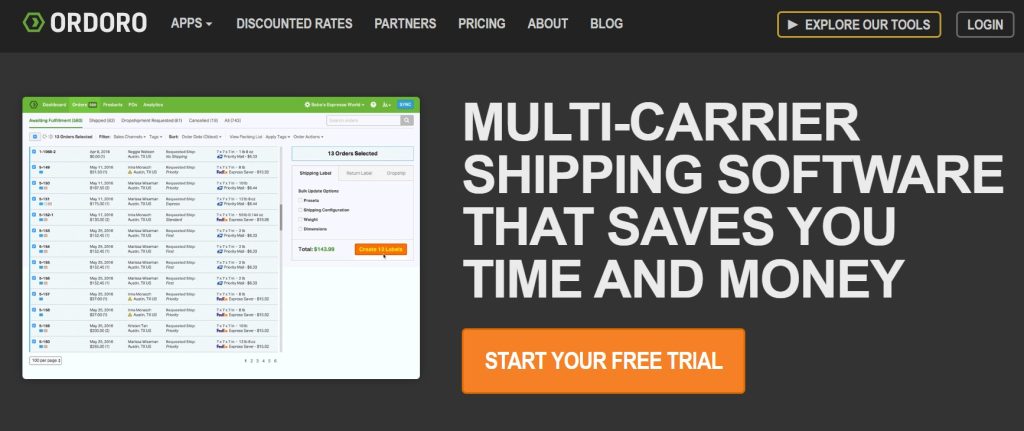
Ordoro combines inventory management with multi-carrier shipping, tracking stock across warehouses and sales channels from one dashboard. Rate shopping runs across 20+ carriers, dropshipping support syncs supplier inventory so a brand can route orders to suppliers without manual handoffs, and analytics show which SKUs move fastest. Pricing starts at $59 a month for 500 orders.
- Best for: Brands managing inventory across multiple locations and dropshippers coordinating several suppliers.
- Carrier network: 20+ carriers.
- Key differentiator: Inventory and supplier sync alongside shipping.
- Automation: Rule-based batch labeling and location-based routing.
- Pricing: From $59/mo for 500 orders.
- Keep in mind: A brand already running a dedicated WMS will find the inventory features redundant.
11. Stamps.com
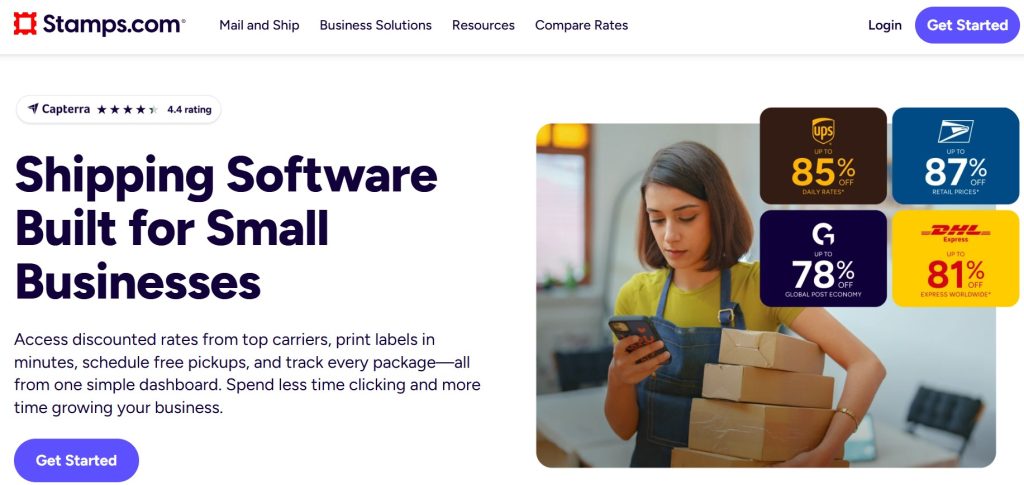
Stamps.com, now a ShipStation Global brand, is a USPS-focused platform for domestic sellers shipping lightweight items, with USPS discounts of up to 89% off retail. Label printing, tracking, an address book and batch processing are included, along with certified mail and insurance options. The Basic tier is $14.99 a month but includes only 10 shipping labels, so it functions as a postage tool rather than an ecommerce shipping platform at any real volume.
- Best for: Domestic sellers shipping exclusively via USPS.
- Carrier network: USPS only.
- Key differentiator: Deep USPS discounts with certified mail and insurance built in.
- Automation: Batch processing included.
- Pricing: Basic $14.99/mo for 10 labels; higher tiers for more volume.
- Keep in mind: No multi-carrier rate shopping; any seller who needs UPS or FedEx should choose elsewhere on this list.
12. Veeqo
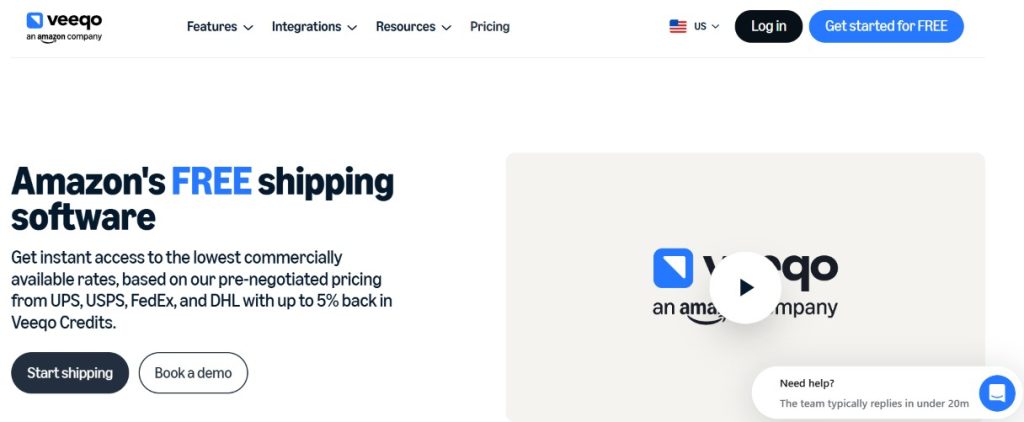
Veeqo is Amazon’s free multichannel shipping and inventory platform. There is no subscription; Amazon monetizes it through shipping volume, so the brand pays only for postage. Orders and inventory sync across Amazon, eBay, Shopify and other stores, and labels print against pre-negotiated UPS, USPS, FedEx and DHL rates with cash back through Veeqo Credits in the US. Its roots are in inventory management, so stock levels, purchase orders and multi-warehouse counts are stronger than on most pure shipping tools.
- Best for: Amazon-heavy sellers who self-fulfill and want free software with inventory sync built in.
- Carrier network: 6 carriers — UPS, USPS, FedEx, DHL, Amazon Shipping and OnTrac.
- Key differentiator: Completely free, with Amazon’s negotiated rates and credits.
- Automation: Rule-based batch labeling and multi-channel inventory updates.
- Pricing: Free; postage only.
- Keep in mind: A Fair Usage Policy expects real shipping volume through the platform, the carrier list is narrow, and marketplace reviews in early 2026 report integration bugs even with Amazon’s own services.
13. ShipBob
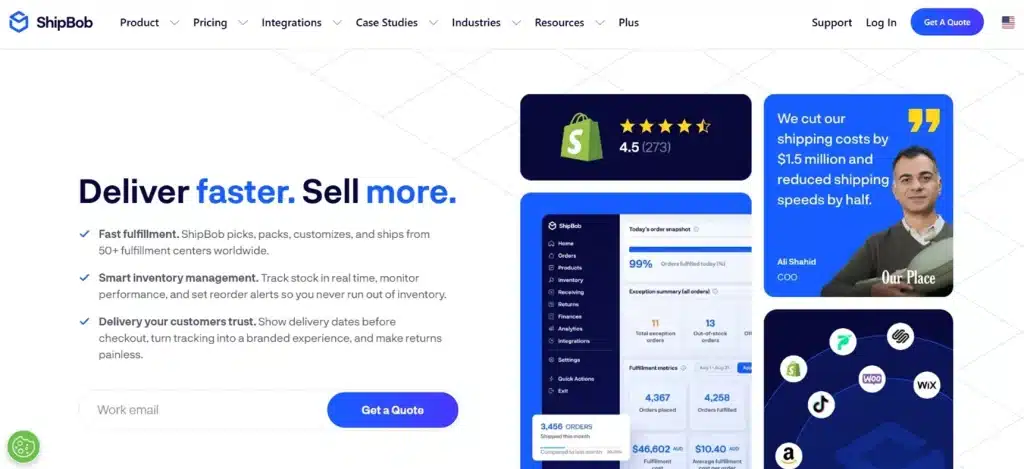
ShipBob is a 3PL first and a software platform second. Brands store inventory across ShipBob’s US and international fulfillment centers, and the platform handles order routing, carrier selection, shipping and returns inside the network. For brands that want to keep fulfillment in-house, ShipBob sells its warehouse management system separately, giving access to the same routing and shipping tools that run its own warehouses.
- Best for: DTC brands at 200–500+ orders a month ready to outsource fulfillment entirely.
- Carrier network: Major national carriers negotiated through ShipBob’s volume.
- Key differentiator: Distributed fulfillment network plus a standalone WMS for self-fulfilling brands.
- Automation: Full automation inside the 3PL; batch and routing rules in the WMS.
- Pricing: Quote-based fulfillment fees plus actual shipping cost; WMS priced separately.
- Keep in mind: Pricing is not published, and the shipping software is tied to ShipBob’s network; it is not a standalone multi-carrier label tool.
14. ShipMonk
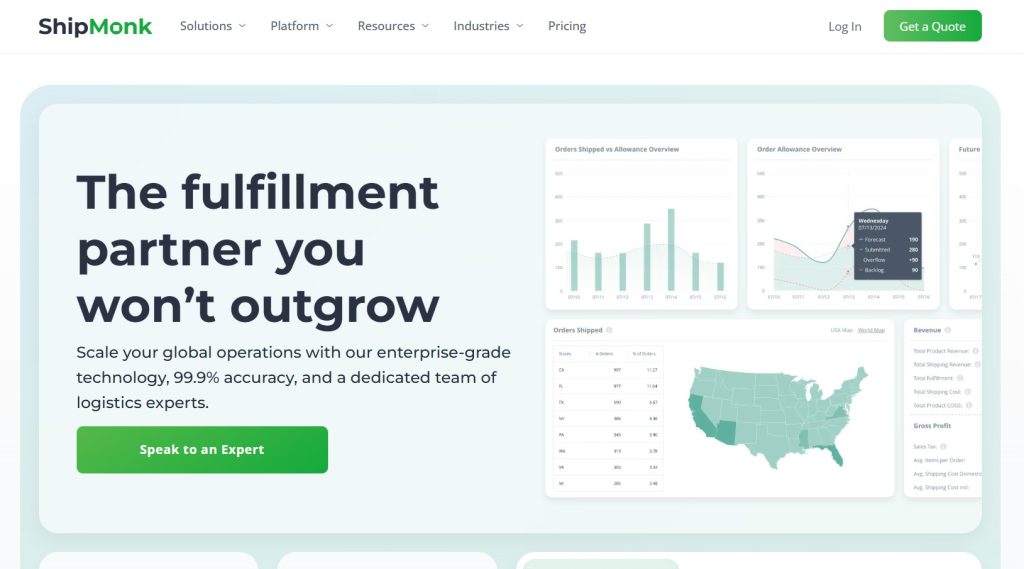
ShipMonk is a 3PL built for fast-growing DTC and subscription brands, with shipping delivered through its Virtual Carrier Network. Instead of locking a brand into one carrier’s rates, VCN offers three carrier-agnostic service levels — ShipMonk 2-Day, Standard and Economy — and allocates each package across an expanded carrier pool based on cost and capacity. The feature is included at no additional charge for brands on the ShipMonk fulfillment platform.
- Best for: DTC and subscription brands outsourcing fulfillment that want carrier risk managed for them.
- Carrier network: Virtual Carrier Network across multiple national and regional carriers.
- Key differentiator: Carrier-agnostic service levels with managed allocation by carrier capacity.
- Automation: Fully managed inside the fulfillment platform.
- Pricing: Quote-based fulfillment fees; VCN at no extra cost.
- Keep in mind: VCN is only available to ShipMonk fulfillment clients; there is no standalone shipping software.
15. Stord
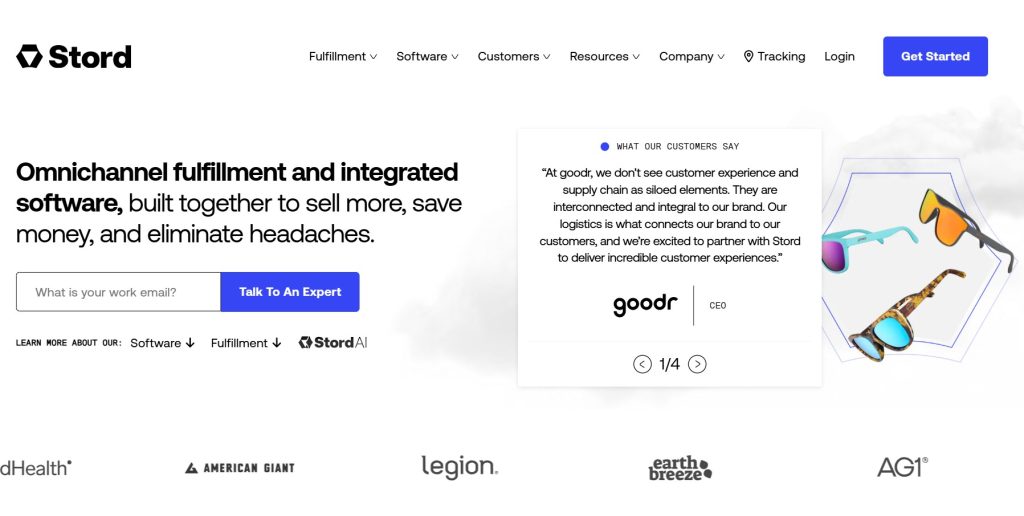
Stord combines a fulfillment network of roughly 100 facilities across the US, Canada, the UK and the EU — expanded by its January 2026 acquisition of Shipwire — with an operator-built software suite: Stord One Commerce for order management, a WMS, and Stord Parcel for carrier selection. Stord Parcel goes beyond standard rate shopping by filtering carriers and service levels that can meet the promised delivery date before picking the cheapest, which is how Stord reports saving brands roughly $130M in parcel fees in 2024.
- Best for: Mid-market and enterprise omnichannel brands that want fulfillment, OMS and parcel optimization from one vendor.
- Carrier network: National, regional and international carriers via Stord Parcel.
- Key differentiator: Delivery-date-aware carrier selection and an OMS that routes across channels and warehouses.
- Automation: AI-driven carrier selection and automated order routing.
- Pricing: Quote-based; software modules sold separately from fulfillment.
- Keep in mind: Built for scale; small brands will find the onboarding and minimums heavier than a self-serve shipping tool.
16. AfterShip
AfterShip is a post-purchase tracking layer, not a shipping platform. It does not generate labels; it tracks shipments across 1,100+ carriers and turns that data into branded tracking pages, automated delivery notifications and a self-serve returns portal. Sellers pair it with a label-generating tool such as Prep Parcel, ShipStation or Shippo. A free plan is available and paid plans start at $11 a month.
- Best for: Sellers cutting “Where is my order?” tickets and improving post-purchase visibility.
- Carrier network: 1,100+ carriers (tracking only).
- Key differentiator: The broadest tracking coverage available, with branded post-purchase pages.
- Automation: Not applicable for labels.
- Pricing: Free plan; paid from $11/mo.
- Keep in mind: AfterShip tracks; it does not print.
Key Takeaway: Nine of these platforms generate labels across multiple carriers; two (EasyPost, ShipEngine) are APIs that need engineers; four (Prep Parcel, ShipBob, ShipMonk, Stord) tie shipping to a physical fulfillment network; one (Stamps.com) is single-carrier; and one (AfterShip) only tracks. Shortlist within the right group before comparing prices.
How to choose the right shipping software
The right platform depends on three variables: monthly order volume, the number of sales channels, and whether warehousing is in-house or outsourced. Any guide that names one winner for every seller is selling something.
| Seller type | Threshold | Recommended | Why |
|---|---|---|---|
| Bootstrapping | Under 100 orders/mo | Pirate Ship, Veeqo, Shippo, eShipper | Free tiers with discounted carrier rates and no fixed overhead |
| High volume | 200+ orders/mo | Prep Parcel, ShipStation | Manual processing is the bottleneck; batch rules cut 3–5 minutes per order to about 30 seconds |
| Multi-channel | 3+ storefronts | ShipStation, eShipper, Prep Parcel, Veeqo, Ordoro | One queue for Amazon, Shopify and eBay with inventory sync to prevent overselling |
| International | Cross-border is a major revenue share | Easyship; Prep Parcel for US–Canada | Automated customs documentation and landed-cost display at checkout |
| Developer-led | Custom stack or headless commerce | EasyPost, ShipEngine | API-only; shipping lives inside the product, not a vendor dashboard |
| Multi-warehouse | 2+ fulfillment locations | Prep Parcel, eShipper, Ordoro, ShipStation | Nearest-warehouse routing cuts zones and transit; split shipments trigger automatically |
| Outsourcing fulfillment | 200+ orders/mo | Prep Parcel, ShipBob, ShipMonk, Stord | Shipping tied to a physical 3PL network avoids a stack migration; compare on published pricing, carrier count and regions covered |
| USPS-only domestic | Lightweight, single carrier | Stamps.com | USPS discounts and batch printing without multi-carrier overhead |
| Post-purchase tracking | Any platform | AfterShip alongside a label tool | Branded tracking cuts “Where is my order?” tickets 40–60% |
Prep Parcel is the right call for brands shipping from multiple regions, expanding into Canada, the UK or the EU, or planning to hand warehousing to a 3PL and wanting published rates instead of a quote-gated process. Among 3PL-backed platforms, ShipBob fits DTC brands that also want a standalone WMS, ShipMonk fits subscription brands that want carrier risk fully managed, and Stord fits mid-market and enterprise brands that want OMS, WMS and parcel optimization from one vendor. ShipStation or eShipper fit sellers who are purely multi-channel and do not need a warehouse network attached to the software. EasyPost or ShipEngine suit teams with engineers who want shipping inside their own product. Easyship wins when customs automation, not domestic rate shopping, is the bottleneck. Pirate Ship or Shippo are the starting point under 100 orders a month while demand is still being validated.
Two workflows sit outside this comparison. Amazon FBA inbound is a separate process from customer-order shipping and should be judged on different criteria; many brands route it through a dedicated FBA prep center before injection. And any brand on a 3PL should treat WMS sync as a pass/fail test rather than a checkbox: run sample orders through the integration before going live, because duplicate labels and lagging inventory counts are the most common failure in ecommerce order fulfillment handoffs.
Four mistakes that cost money
- Single-carrier dependence. One carrier’s rate increase or Q4 service disruption hits the whole operation with no fallback. Build a multi-carrier setup from day one with rate comparison across at least three carriers per shipment.
- Untested 3PL integration. “Supported” in a sales deck is not the same as syncing in real time. Verify with sample orders before cutting over; this is where brands switching 3PLs most often lose days of orders.
- Manual customs paperwork. Cross-border delays compound fast without automated commercial invoices and HS code declarations. Confirm DHL, Aramex or the relevant regional carriers are actually integrated, not just listed.
- Per-label fees that outgrow revenue. A $0.10 fee is trivial at 100 orders and $18,000 a year at 500 orders a day. Model total cost at the target volume, not the current one, and find where the pricing structure breaks.
Key Takeaway: Choose for where the business is today and the specific operational gap costing time or money now. See whether AMZ Prep fits alongside your current shipping stack.
Frequently asked questions
What is the difference between ecommerce shipping software and ecommerce fulfillment software?
Shipping software compares carrier rates, prints labels and tracks parcels for orders the brand packs itself; fulfillment software also manages inventory, picking, packing and warehouse routing, usually because it runs on a 3PL’s own network. ShipStation, Shippo, Easyship and Pirate Ship are shipping software; Prep Parcel, ShipBob, ShipMonk and Stord are ecommerce fulfillment software with shipping built in.
Which shipping software has the most carrier integrations?
Easyship connects to 250+ carriers, the most of any label-generating platform on this list. ShipStation has 130+, EasyPost 100+, ShipEngine 50+, Shippo and ShippingEasy 40+, and Prep Parcel 35+. AfterShip tracks 1,100+ carriers but does not generate labels.
Which shipping software is completely free?
Pirate Ship and Veeqo are free with no monthly fee: Pirate Ship is limited to USPS and UPS, while Veeqo (owned by Amazon) covers six carriers and adds inventory management but expects real shipping volume through the platform. Shippo (30 labels a month), eShipper (20 shipments), ShippingEasy (25 shipments) and Easyship offer free tiers with usage caps. Prep Parcel charges no technology fee and has no volume minimum; the brand pays only the carrier rate shown at checkout.
What is the best shipping software for high-volume ecommerce sellers?
Prep Parcel, ShipStation, eShipper and EasyPost handle high volume best because all four offer rule-based batch label automation. Above roughly 100 orders a day, order processing without batch rules becomes a manual bottleneck regardless of how good the carrier rates are.
What is the best shipping software for international or cross-border ecommerce?
Easyship is the strongest for global cross-border, with 250+ carriers, automated customs documentation and landed-cost display at checkout. Prep Parcel is the strongest for US–Canada specifically, with customs clearance and duty management built into the platform.
How does multi-carrier rate shopping save money?
The platform compares live rates from every connected carrier for each shipment and selects the cheapest option that meets the delivery-speed rule the seller sets. If UPS quotes $8 and USPS quotes $5 for the same delivery, the order routes to USPS without anyone checking. Across a multi-carrier setup this typically saves 15–30% versus a single carrier account.
Can shipping software work with Shopify, Amazon and eBay at the same time?
Yes. Prep Parcel, ShipStation, eShipper and Ordoro pull orders from all three into one dashboard so every label prints from the same place. Shopify Shipping on its own is adequate for single-channel sellers under roughly 100 orders a month; beyond that, or with a second channel, dedicated software adds real value.
Which is the best shipping software for WooCommerce?
Prep Parcel, ShipStation, eShipper and Shippo all integrate directly with WooCommerce. Prep Parcel and ShipStation offer the deepest WooCommerce feature set, including multi-warehouse routing and batch automation.
Can shipping software be used with a 3PL or warehouse?
Yes, provided the 3PL’s warehouse management system syncs with the shipping platform in real time. Prep Parcel, ShipBob, ShipMonk and Stord each run on their own fulfillment network, so the shipping software and the warehouse are already connected; most other 3PLs integrate with ShipStation, eShipper and ShipEngine. Test the integration with sample orders before going live.
Does shipping software handle returns?
ShipStation, ShippingEasy and AfterShip offer self-serve branded returns portals that let customers start a return without contacting support. The physical reverse logistics receiving, inspecting, restocking is handled by the warehouse or 3PL, not the software.
Will I lose order history if I switch shipping software?
Historical shipment data does not transfer automatically between platforms. Export the full order and label history as CSV or PDF before cancelling the old account; new orders sync fresh once the store reconnects.
Is shipping software worth it for a small business?
Yes above roughly 10 orders a week, because discounted carrier rates alone usually cover the cost. At 50 orders a month a seller typically saves 3–5 hours of manual work; at 200 orders a month, rate shopping alone tends to save $200–$400. Free tiers from Pirate Ship, Shippo and eShipper make testing risk-free.
Do I need shipping software if I already use Shopify?
Shopify Shipping works for single-channel sellers under roughly 100 orders a month. Multi-channel sellers need a platform such as Prep Parcel, eShipper or ShipStation that pulls Shopify, Amazon, eBay and TikTok Shop orders into one dashboard instead of running Shopify’s native tools alongside separate marketplace shipping flows.

Rich Pearl is a Head of U.S Enterprise at AMZ Prep, drawing from his proven experience in the fulfillment industry gained at ShipBob. Rich helps provide strategic guidance and consultation to growing e-commerce businesses looking to master their logistics and achieve operational success.

















Do you have data on what % of Shein’s North American volume now ships from the Indianapolis facility vs direct from China? That’s the part of the de minimis story everyone keeps dodging.
As a small apparel brand owner, reading this is humbling. We tried to replicate even 5% of their SKU velocity model and burned through cash on dead stock in 6 weeks.
The breakdown of express vs standard shipping windows finally explained why my last Shein order took 4 days when the site advertised “2-3 day delivery.” Shipping zones strike again.
880K orders a day is wild. That’s basically the entire daily volume of a mid-sized 3PL hitting one fulfillment network, no wonder traditional retailers can’t keep up.