
Looking to dive into the world of Amazon UK selling? Amazon UK represents more than just another sales channel—it’s an easy gateway for businesses seeking to establish or expand into one of Europe’s most lucrative markets.
Amazon UK represents a significant digital marketplace within the e-commerce ecosystem, processing transactions for 500 million unique monthly visitors. The platform operates through a structured framework that accommodates both individual sellers and established businesses alike. The platform’s infrastructure incorporates multiple fulfilment methodologies, including both merchant-managed and Amazon-integrated solutions. This flexibility extends to various operational aspects as well. However, success isn’t just about listing products; it’s about understanding the marketplace, fees, account types, and strategic planning. In this blog, we will discuss all the above, and by the end of it, you will start selling on Amazon UK like a vetran.
What is Amazon Seller Central UK?
Amazon UK is an online marketplace similar to Amazon. Amazon Seller Central is a portal and a one-stop shop for managing an Amazon UK selling account. The marketplace presents substantial opportunities, with third-party sellers driving 60% of physical product sales and experiencing accelerated growth compared to Amazon’s direct retail operations. European SMEs demonstrated this potential by contributing 2.2 billion products in 2022.

How big is Amazon UK as a marketplace?
Amazon UK is one of the largest e-commerce/Amazon business platforms in Europe. In 2023, it accounted for nearly 30% of the UK’s total online retail sales. Selling on Amazon Marketplace UK can help you reach a large audience in the UK.
Getting Started with Selling on Amazon UK using Amazon Seller Central UK
Sellers can choose between two account structures. The Individual Seller account, priced at £0.75 per item sold, serves those selling fewer than 35 items monthly and is designed for personal, second-hand items. The Professional Seller account, at £25 monthly, provides advanced tools and suits businesses selling more than 35 items monthly. Amazon FBA UK can used for fulfilment duties
Is it profitable to sell on Amazon UK?
Yes, selling on Amazon FBA UK can be profitable. But, like any business, it depends on how you manage it. There are over 225,000 European small and medium enterprises and brands selling on Amazon, with a 20% year-on-year growth.
Setting Up an Amazon Seller Central UK Account
Registration requires basic documentation: a business email or Amazon customer account, a credit card, valid identification, and company registration details, including VAT numbers. Individual sellers without formal business registration can proceed with simplified documentation.
Initial Access Setup
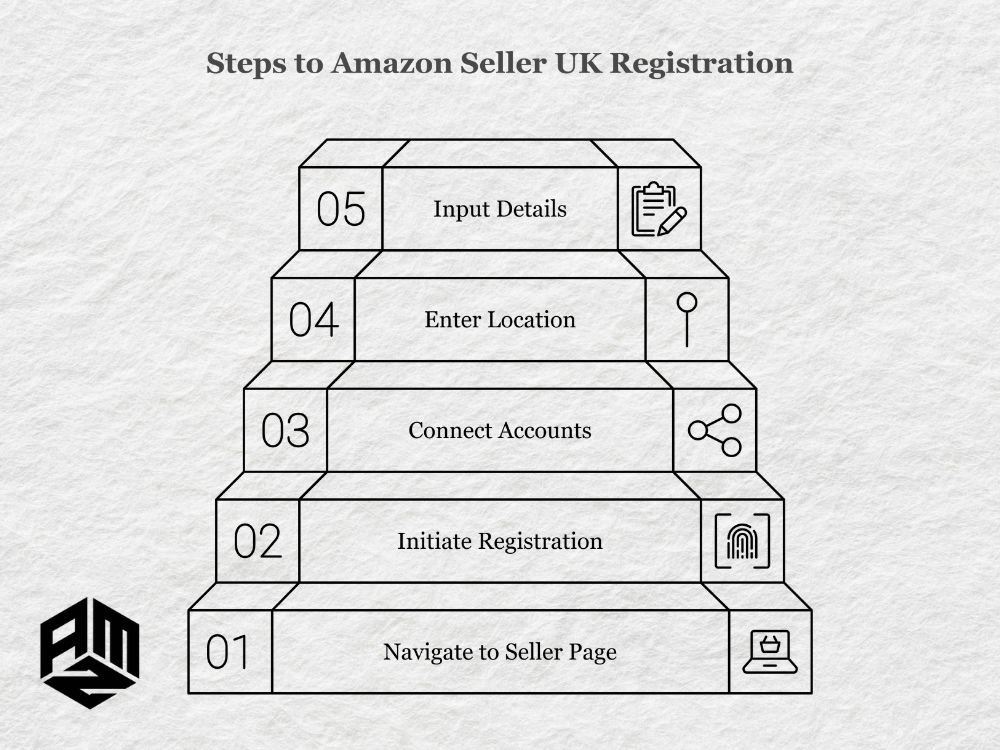
- Navigate to the “Become an Amazon seller” page on Amazon UK
- Select “Sign up” to initiate the registration process
- Connect existing Amazon customer accounts or establish new credentials
- Enter business location and organizational structure
- Input business name or personal identification details
Amazon UK seller support is available 24/7 to help resolve any issues with your account or listings.
Document Required
- Business email address or Amazon customer account
- Chargeable credit card (international cards accepted)
- Government-issued identification (passport or ID)
- Business registration documentation, including VAT number
- Physical address verification documents
- Phone number for communication
- Banking information for payment processing
Personal Information Required
- Country of citizenship documentation
- Physical address verification
- Contact number validation
- Birth date confirmation
- Banking and billing setup
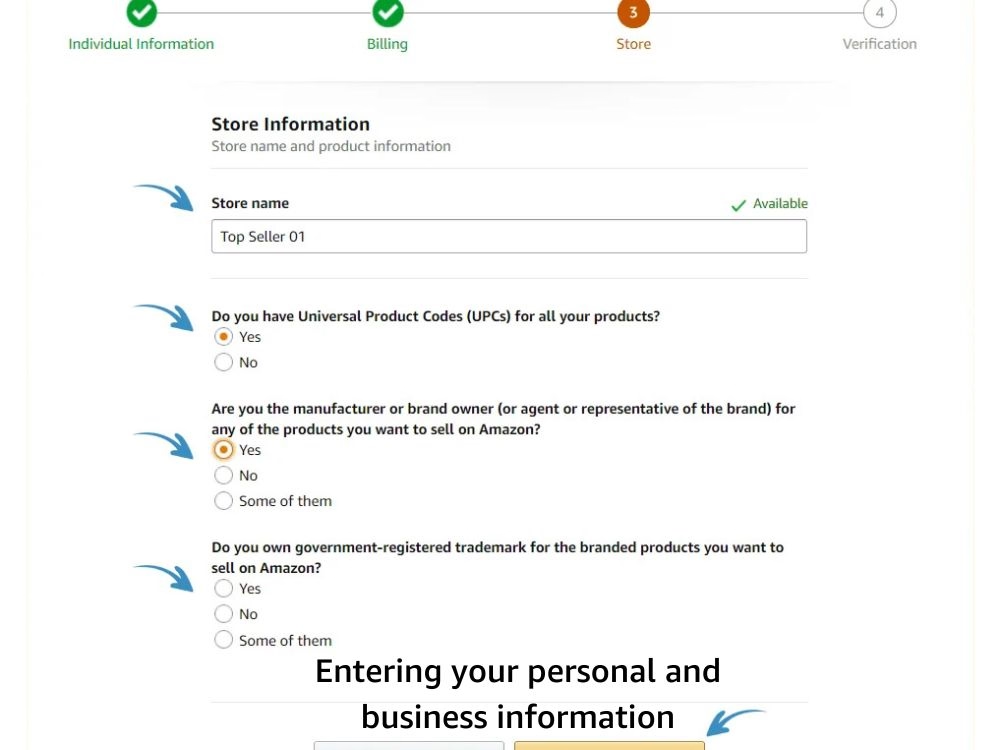
- Store name designation
- Selling plan selection
Choosing between Individual and Professional plans on Amazon Seller Central UK
| Feature | Individual Plan | Professional Plan |
|---|---|---|
| Monthly Amazon UK selling Fees | None | £25 flat fee |
| Per-Item Fee | £0.75 per item | None |
| Recommended for Selling Volume | Fewer than 35 items per month | More than 35 items per month |
| Inventory Management | List items one at a time | Bulk listing and inventory management with third-party systems |
| Advanced Tools & Features | Not available | Access to advertising, advanced reports, APIs, and programs like Handmade |
| Buy Box Access | Not available | Available |
| Restricted Categories | Cannot sell in restricted categories | Access to sell in restricted categories |
| VAT Calculation Service | Not available | Available, includes VAT-exclusive price display and automated VAT invoicing |
| Purpose of Sales | Personal items or second-hand goods. Not intended for reselling for profit. | Selling new or resold items as a business. Registration with HMRC required if buying items for resale. |
| Upgrade/Downgrade Options | Can upgrade to Professional at any time | Can downgrade to Individual at any time |
Choosing the right Amazon UK selling plans can significantly impact your overall sales strategy.
Is it free to sell on Amazon UK?
No, selling on Amazon UK is not free. While there’s no upfront cost to create an account, you’ll pay fees. We will be discussing it in the next section. For any billing or payment inquiries, Amazon UK seller support provides quick assistance through their help center.
Costs and Fees for Selling on Amazon UK
Amazon UK implements a structured fee system across all seller accounts. The foundation rests on referral fees, which typically range from 6% to 15% of the selling price, varying by product category. These fees apply universally regardless of seller status. For media categories, Amazon adds variable closing fees, creating an additional cost layer specific to these products. E-commerce sellers can use Amazon FBA UK to fulfil orders.
If you’re considering Amazon UK selling products, it’s important to understand the local market trends and customer preferences as well as FBA packing regulations.
Amazon UK Selling Fees
Referral Fees
- Amazon charges a referral fee for each item sold based on the product category as Amazon UK selling fees.
- Typically, it ranges from 6% to 15% of the item’s total sale price, including shipping.
- Example: For electronics, the fee is 7%, while clothing is around 15%.
Closing Fees
- For Media products (e.g., books, DVDs, CDs), Amazon applies a flat closing fee of £0.50 per item.
Understanding the differences between the two Amazon UK selling plans is crucial for optimizing your costs and profits.
Sellers utilizing Fulfillment by Amazon (FBA) for encounter a systematic cost framework designed around service utilization. The primary FBA fulfilment fees operate on a flat-rate basis and are calculated according to product dimensions and weight specifications. Storage fees accumulate monthly, reflecting the daily average volume of inventory within Amazon’s fulfilment centres, measured in cubic feet.
Amazon Marketplace UK also offers various tools to optimize your listings and increase sales.
FBA Fees (Fulfillment by Amazon)
- Charged if you use Amazon’s fulfilment services:
- Fulfilment Fees: Based on the size and weight of the product. For example:
- Small items (up to 225g): Around £1.97 per unit.
- Larger items (up to 1kg): Around £3.28–£5.52 per unit.
- Storage Fees: Monthly fees for storing inventory in Amazon’s warehouses.
- £18 per cubic meter (January to September).
- £25.20 per cubic meter (October to December due to higher demand).
- Fulfilment Fees: Based on the size and weight of the product. For example:
The FBA system operates without subscription requirements or minimum inventory constraints, allowing sellers to maintain operational flexibility while accessing premium fulfilment services. This pay-as-you-go model enables precise cost control and scalability based on actual usage.
Hidden Costs to Consider
Self-fulfilling sellers must account for Amazon shipping rates, which vary based on product categories and customer-selected shipping services. Additional costs may arise from optional tool utilization and program participation beyond standard selling features.
Advertising Costs
Marketing expenditure represents a significant optional investment through Amazon Advertising. This encompasses Sponsored Products, Sponsored Brands, and Amazon Stores, complemented by promotional tools and coupon systems for enhanced market visibility.
- Amazon Pay-Per-Click (PPC)
- Costs vary depending on the competition and your campaign goals.
- Expect to spend around £0.50–£1.50 per click, depending on the product niche.
- Storage and Long-Term Storage Fees
- Additional fees if inventory sits unsold for over 365 days.
- Long-term storage fee: £4.30 per cubic foot or £0.10 per unit, whichever is greater.
- Returns and Refunds
- Amazon may refund customers and deduct the amount from your account.
- Refund administration fee: Either £5.00 or 20% of the referral fee.
- Currency Conversion
- If you’re converting payments from GBP to another currency, expect to pay 2.5% in conversion fees.
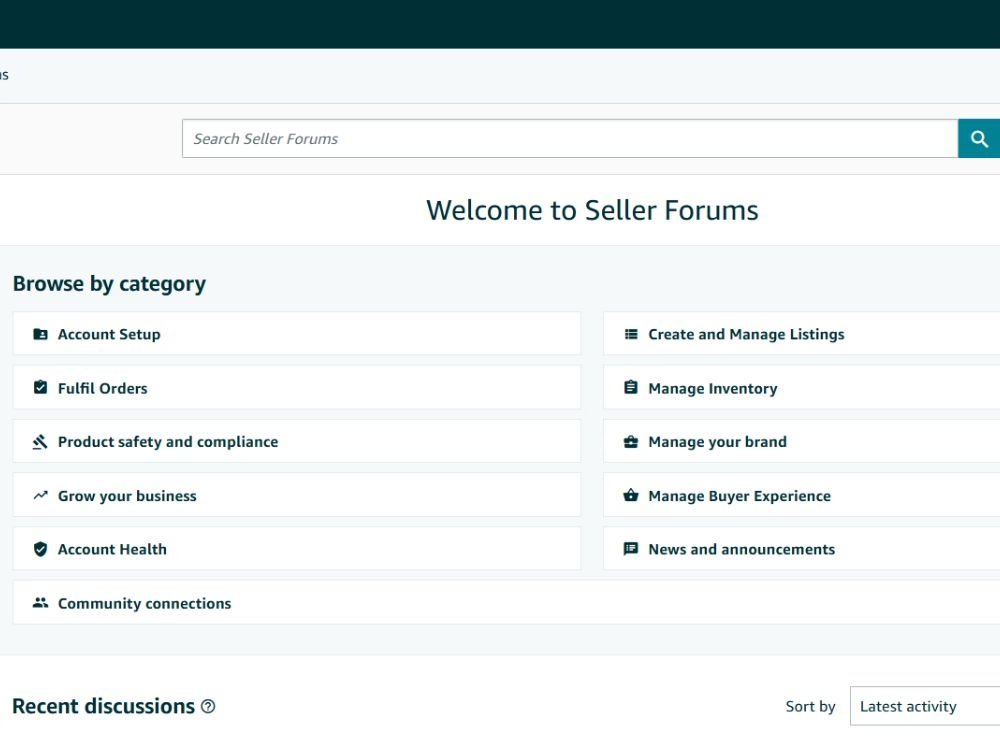
Amazon seller forums UK are a great place to connect with other sellers.
Legal and Financial Considerations
While formal business licensing isn’t a universal requirement, the transition from an individual seller to a registered business entity will require regulatory compliance. Notably, the purchase of goods for profit – including second-hand items – necessitates HMRC(His Majesty’s Revenue & Customs) registration as a sole trader.
Can I sell on Amazon without a company in the UK?
Yes, you can sell as an individual without registering a company. However, it is advisable to register a company for tax and legal advantages, especially in B2C selling.
Value Added Tax (VAT) compliance is another aspect to be noted, particularly for sellers operating across European markets. Each country may require separate VAT registration, with non-EU sellers potentially needing designated tax representatives. Amazon provides VAT Services to facilitate registration processes and offers the VAT Calculation Service for automated tax management and business customer pricing.
Amazon seller forums UK often feature discussions on the latest updates and changes to the marketplace.
Do I need to pay taxes when selling on Amazon UK?
Yes, sellers are responsible for paying taxes:
- VAT (Value Added Tax)**: You must register for VAT if your annual sales exceed £90,000 or if you store goods in the UK (e.g., using FBA).
- Income Tax: If you’re an individual seller, profits are subject to income tax.
- Corporate Tax: If you sell through a company, corporate taxes apply.
Consult a tax professional to ensure compliance.
If you’re new to Amazon UK selling products, research on pricing and listings can help boost your visibility.
Tax Registration Requirements
- Country-specific VAT obligations across European markets
- Mandatory registration thresholds and compliance timelines
- Special considerations for non-EU sellers, including tax representation requirements
Operational Support Systems
Amazon’s VAT Calculation Service emerges as a valuable tool for sellers’ offerings.
- Automated price calculations incorporating VAT
- Business customer pricing differentiation
- Streamlined invoice generation This service, provided at no cost to registered sellers, represents a significant operational advantage in managing tax compliance.
International Trade Operations
Sellers must develop comprehensive strategies for
Import/Export Management
- Custom clearance protocols
- Documentation requirements
- Compliance with international trade regulations
Strategic Partnership Opportunities
- Direct management of import/export processes
- Partnership with specialized logistics providers
- Utilization of Amazon Global Logistics for ocean freight
- Integration with the SEND Program for UK-US inventory movement
Tips for Success on Amazon UK
Success in the Amazon marketplace requires implementing pricing methodologies that align with both market dynamics and customer expectations.
- Multi-tiered pricing models for both retail and business segments
- Volume-based incentivization
- VAT-optimized pricing displays
- Optimized product listings
- Dynamic pricing automation capabilities
The correlation between customer feedback and marketplace success demonstrates the critical nature of reputation management.
Approaches include:
Performance Monitoring
- Systematic tracking of key performance indicators
- Proactive response protocols for sub-optimal reviews
- Integration of Amazon Vine programs for review acceleration
- Continuous analysis of account health metrics
Development Amazon’s advertising is important So follow
Promotional Architecture
- Sponsored Product placement for targeted visibility
- Brand-centric advertising campaigns
- Strategic deployment of promotional tools
- Custom multi-page brand destinations
Success fundamentals should extend beyond basic marketplace participation. Follow these:
- Brand Registry enrollment for enhanced control
- A+ Content implementation for superior product presentation
- Strategic utilization of Fulfillment by Amazon (FBA)
- Integration of automated operational tools
Can You Sell on Amazon UK from the USA?
Yes, you can sell on Amazon UK from the USA. Amazon’s platform enables cross-border business operations through integrated systems and optimized fulfilment processes. Let’s examine the key operational components and implementation steps.
The process of selling on Amazon UK from the USA has the same steps as selling in the UK. Set up your account and select a selling plan. The next stage is different from the one we will be discussing.
Choosing Fulfillment Options
When selling on Amazon UK from the USA, effectively utilizing Amazon’s fulfilment centres is crucial. Here is how you can manage
Fulfilment by Amazon (FBA)
Implement inventory transfer to Amazon UK fulfilment centres from USA warehouses for logistics management, including storage, distribution, customer service, and returns processing.
- System Benefits of FBA
- Amazon Prime eligibility enhancing market visibility
- Localized shipping infrastructure
- Centralized returns management
Cross-Border Integration
Enables multi-market fulfilment across European platforms. Here are your options
Fulfilment by Merchant (FBM)
- Self-managed inventory and logistics operations
- Cost-effective for reduced volume operations with established distribution systems
European Fulfillment Network (EFN)
- Centralized inventory management through UK fulfilment centres
- Streamlined VAT compliance across European markets
Pan-European FBA
- Dynamic inventory distribution based on market demand
- Optimized cross-border fulfilment costs
VAT Compliance
Implementation of VAT registration is mandatory for UK operations. So even if you are a US-based seller, you would need to comply with VAT. Additional VAT registrations may be required for multi-market inventory storage and fulfilment operations.
Unified European Account
Amazon’s integrated European seller platform enables unified management of operations across UK, French, German, Italian, and Spanish marketplaces through a centralized control system.
Global Selling Program
The platform facilitates expansion across 21 marketplaces in 180 regions, providing integrated tools for international market development.
Product Research and Market Insights
Utilize analytical tools like Jungle Scout or Helium 10 for market analysis and keyword optimization specific to UK operations.
Key Considerations for US Sellers
- Partner with qualified logistics providers like AMZ Prep for inventory transfer to UK facilities, ensuring compliance with Amazon’s specifications.
- Calculate operational costs, including platform fees, logistics expenses, and VAT obligations, for accurate pricing strategies.
- UK market expectations prioritize efficient delivery and responsive customer support, making FBA integration highly recommended.
Through strategic utilization of Amazon’s infrastructure, optimized selling frameworks, and global distribution networks, US-based sellers can effectively implement and scale UK market operations.
Can You Sell on Amazon UK from India?
Yes. The UK-India Comprehensive Economic and Trade Agreement took effect on 15 July 2026. Around 99% of Indian goods now enter the UK duty free or at reduced tariff rates.
The biggest cuts hit categories that carried high UK tariffs before. Textiles and clothing, leather goods, footwear, and processed foods all sat well above zero.
Three things sellers get wrong about this:
Import VAT has not changed. You still pay 20% import VAT on the customs value plus inbound freight. VAT-registered sellers reclaim it as input tax.
Preference is not automatic. You need a valid proof of origin at import. HMRC accepts an origin declaration, a certificate of origin, or importer’s knowledge.
Rules of origin apply. Goods manufactured in China and shipped through India do not qualify for the lower rate.
Small parcels sent straight to UK buyers see little change today. Consignments valued at £135 or less already enter the UK without customs duty.
The saving shows up on bulk inbound freight. Pallets and containers moving into Amazon UK fulfilment centres are valued well above £135.
Conclusion
The initial phase of Amazon UK’s market entry demands an understanding of the business structure and compliance frameworks. Individual entrepreneurs can often begin as sole proprietors due to the platform’s relatively low barriers to entry. However, even this straightforward path requires c foresight regarding eventual scaling requirements. Success stories consistently demonstrate the importance of early regulatory alignment. Entrepreneurs who proactively address VAT registration and cross-border compliance often find themselves in a path of sustainable growth. Thus, it can be concluded that Entrepreneurs who approach the platform with comprehensive planning and adaptability will position themselves as Market Leaders.
FAQs
Is it profitable to sell on Amazon UK?
Amazon UK’s net sales is reaching approximately $16.8 billion in 2023. So selling on Amazon UK can be profitable, but depends on factors like product selection, pricing strategies, and competition.
Is it free to sell on Amazon UK?
No, selling on Amazon UK involves fees. Sellers can choose between the Individual plan Professional plan. Additional fees, such as referral fees and fulfillment fee can also apply.
Can I sell on Amazon UK without a company?
Yes, individuals can sell on Amazon UK without registering a company. However, if you plan to scale your business while not mandatory is advised.
How big is Amazon UK?
In 2023, its net sales were approximately $16.8 billion. The website attracted an average of 354 million visits per month. Amazon UK Services employed over 33,000 people in 2020.
Do I need a business license to sell online in the UK?
Generally, you don’t need a specific business license to sell online in the UK. However, if your earnings exceed the HM Revenue u0026amp; Customs (HMRC) threshold, you must register as self-employed or establish a limited company.
Do I need to pay tax if I sell on Amazon UK?
Yes, taxes apply to profits from selling on Amazon UK. Sole traders pay income tax, while limited companies are subject to corporation tax. If your taxable turnover exceeds the VAT threshold, you must register for and charge Value Added Tax (VAT).
When did the UK-India Free Trade Agreement start?
The agreement entered into force on 15 July 2026. It was signed in July 2025. From that date, around 99% of Indian goods enter the UK duty free or at lower tariff rates.
Does the UK-India trade agreement remove import VAT?
No. The agreement cuts customs duty only. UK import VAT of 20% still applies to the customs value plus freight. VAT-registered sellers can reclaim it as input tax.
What proof of origin do I need to claim the lower duty?
HMRC accepts three options at import. An origin declaration from the exporter, a certificate of origin, or importer’s knowledge. Without one of these, standard UK tariff rates apply.

Rich Pearl is a Head of U.S Enterprise at AMZ Prep, drawing from his proven experience in the fulfillment industry gained at ShipBob. Rich helps provide strategic guidance and consultation to growing e-commerce businesses looking to master their logistics and achieve operational success.

















Helpful overview of UK seller requirements and fees.
Very clear breakdown of what to expect when selling in the UK market
Great insights on navigating VAT and other UK-specific rules.
The explanation of local regulations was very informative
I liked how the article explains marketplace differences step by step
This guide answered many questions I had about shipping to UK customers
Great resource for sellers planning to grow into new markets
Practical advice for pricing and handling UK orders.
Useful info for anyone considering selling internationally.
Easy-to-follow tips that make expanding into the UK less intimidating.