
Your digital storefront belongs to a massive retail movement. American consumers spent approximately $1.29 trillion online in 2025, with an estimated 11.9 million active ecommerce sites competing in the U.S. market. With so much focus on sourcing and fulfilling, small details on poly mailer sizes get overlooked, yet they impact your earnings directly.

Right dimension, perfect shipment.
These shipping envelopes have reshaped eCommerce fulfillment.
This guide covers it all, from selecting the right sizes of poly mailers to understanding postal guidelines, helping you ship smarter and protect your products.
What are Poly Mailers
Poly mailers are polyethylene shipping envelopes that protect your products while slashing packaging costs.
Their flexible construction eliminates wasted space, reducing both dimensional weight charges and storage requirements, all while keeping items safe from water and tears.
Originally dominated by apparel brands, poly mailers now serve virtually every ecommerce category: cosmetics, books, accessories, art prints, and more. If your product does not require rigid box protection, a poly mailer delivers.
Each mailer features waterproof polyethylene construction, tamper evident adhesive closure, and privacy shielding opaque material.
Choose bubble lined versions for fragile items or streamlined options for maximum efficiency.
The result is lower purchasing costs, reduced warehouse space, and cheaper shipping rates compared to cardboard boxes.
How to Calculate Poly Mailer Size Dimension
Getting your poly mailer dimensions right saves you money and protects your products. Here’s how you calculate the size you need:
Step 1: Measure Your Product Dimensions
Position your product in its shipping configuration. Apparel should be folded in accordance with your established guidelines. Be sure to measure the actual box when packing. Note the length, width, and thickness, and use consistent units, either inches or centimeters, for accuracy.
Step 2: Calculate Your Minimum Poly Mailer Size
Apply the following formula to determine your base mailer dimensions:
Mailer Length = Product Length (L)
Mailer Width = Product Width (W) + (2 × Product Thickness (T))
For a product measuring 12″ × 9″ × 2″, your calculation would be: 12″ × 13″ (9″ + 2″ + 2″). This formula accommodates the three-dimensional volume of your product within a two-dimensional mailer.
Step 3: Add Your Sealing Tolerance
Add 1 to 2 inches to each measurement to provide room for sealing and handling.
This tolerance keeps the mailer from being over-pressurized, which may damage the seal and cause the package to fail while it’s in transit.
Step 4: Validate Your Specifications Through Testing
Order sample units that fit the size you estimated. Use items from your inventory that are similar to the ones you sell to do physical pack testing.
Check the quality of the seal, the look of the package, and the strength of the structure while it is being handled normally.
Before starting to buy in bulk, write down any problems with fitting and change your specs as needed.
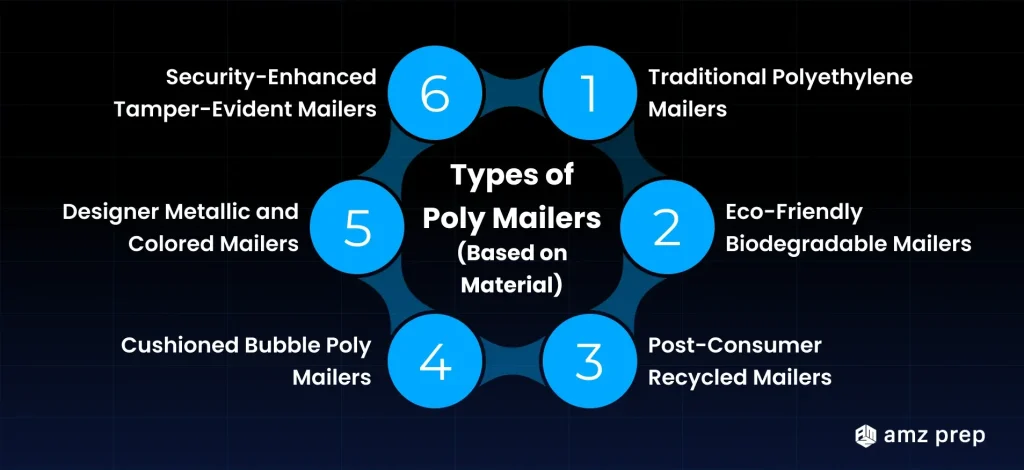
Types of Poly Mailers (Based on Material)
The material of your plastic mailers influences how strong, costly, and environmentally friendly they are.
Picking the right size while considering these factors enhances your packaging strategy.
That way, your packages will come safely, your business will run easily, and your customers will enjoy opening their packages. Consider these kinds of keys:
1. Traditional Polyethylene Mailers
These basic poly mailers are made from new or recycled plastic, which is the best material for mailing envelopes in the business. Most non-fragile items, such clothes, books, and materials, are safe at 2–3 mils.
One mil is 1/1000 inch.
Light and tear-resistant, these bags keep your belongings dry. You can show clear shipping and branding information. These mailers are still a dependable and cheap option for sending a lot of things.
2. Eco-Friendly Biodegradable Mailers
Biodegradable poly mailers are made to break down on their own with the help of microbes. Many of them need to be composted in an industrial setting at 140°F or higher for 90–180 days in order to break down.
They attract environmentally conscious shoppers and support your green initiatives while costing 30–80% more than standard packaging.
They are robust and water-resistant and constructed from PLA, cornstarch, or PBAT. Recyclable products may boost your brand’s image, CSR objectives, and green credentials.
3. Post-Consumer Recycled Mailers
Poly mailers are made from 25% to 100% recycled materials while still getting a good deal.
Like regular mailers, they are strong, resistant to punctures, and protect against water. However, their carbon footprint might be 30–50% lower.
You may show your consumers that you care about the environment by using these mailers without spending a lot more money.
4. Cushioned Bubble Poly Mailers
Polyethylene mailers include bubble cushioning, making them ideal for jewelry, cosmetics, electronics, glassware, and non-fragile ceramics.
Despite costing 20–60% more than standard poly mailers, their 3/16-inch padding provides reliable protection without extra materials. This saves you time while packing, cuts down on work, and makes room for more storage.
The bubble liner also lowers your damage rates and return requests, making these mailers a useful and affordable way to ship fragile items.
5. Designer Metallic and Colored Mailers
These envelopes come in bright hues including pink, teal, gold, silver, rose gold, and holographic finishes. They may help you improve your brand identification and make the unpacking experience more fun.
Their structure is just as strong as that of regular mailers, yet they cost 15–50% more because they look better.
Designer mailers may generate memorable experiences, encourage social media sharing, and encourage repeat purchases, especially for fashion, cosmetics, and direct-to-consumer companies.
6. Security-Enhanced Tamper-Evident Mailers
These mailers include patterned adhesives, security seals, or VOID signs that make it easy to see if someone tried to tamper with them.
Some include serial numbers or patterns that change color to make them safer. These poly mailers help you protect your expensive items, cut down on fraud claims, and make sure everyone in your supply chain is responsible.
Tamper-evident mailers cost 25–70% more than regular mailers, but they secure your inventory and provide your customers peace of mind.
What are the Most Commonly Preferred Poly Mailer Sizes
Based on industry data and carrier statistics, certain poly mailer dimensions dominate ecommerce shipping:
| Product Type | Size (Exterior / Interior) | Thickness (mil) | Size Classification | International Standard Code | Typical Application |
|---|---|---|---|---|---|
| Flat Poly Mailer | 6″ x 9″ | 2–3 mil | Small | C6 (114 × 162 mm) approx. | Small accessories, jewelry, phone cases |
| 9″ x 12″ | 2–3 mil | Small | C5 (162 × 229 mm) approx. | Documents, thin apparel, magazines | |
| 10″ x 13″ | 2–3 mil | Medium | C4 (229 × 324 mm) approx. | T-shirts, books, small apparel | |
| 12″ x 15.5″ | 2–3 mil | Medium | B4 (250 × 353 mm) approx. | Sweaters, small electronics, boxed items | |
| 14.5″ x 19″ | 3–4 mil | Large | B3 (353 × 500 mm) approx. | Jackets, multiple clothing items, bulky products | |
| 6.25″ x 9″ | 2.5–3 mil | Small | C6 (114 × 162 mm) approx. | Jewelry, documents, light accessories | |
| 10″ x 13″ | 2.5–3 mil | Medium | C4 (229 × 324 mm) approx. | Apparel, books, small goods | |
| 30″ x 36″ | 2.5–3 mil | Large | Oversize / Custom | Bedding, bulk textiles, oversized apparel | |
| Poly Bubble Mailer | 5″ x 10″ / 5″ x 9″ | 2.5 mil | Small | DL / C6 approx. | Jewelry, phone accessories, cosmetics |
| 6.5″ x 10″ / 6.5″ x 9″ | 2.5 mil | Small | DL / C6 approx. | DVDs, stationery, skincare | |
| 7.25″ x 12″ / 7.25″ x 11″ | 2.5 mil | Small | C5 approx. | Books, small electronics, chargers | |
| 10″ x 13″ | 2.5 mil | Medium | C4 approx. | Apparel (t-shirts), books, slim boxed items | |
| 9.5″ x 14.5″ / 9.5″ x 13.5″ | 2.5 mil | Medium | C4 approx. | Medium apparel, folders, padded docs | |
| 10.5″ x 16″ / 10.5″ x 15″ | 2.5 mil | Medium | C4 / B4 approx. | Sweaters, small gift boxes, electronics | |
| 12.5″ x 19″ / 12.5″ x 18″ | 2.5 mil | Large | B4 approx. | Jackets, handbags, shoe boxes (slim) | |
| 14″ x 19″ / 14.5″ x 19″ | 2.5 mil | Large | B3 approx. | Large apparel, laptop sleeves, bulkier goods | |
| 14.25″ x 20″ / 14.25″ x 19″ | 2.5 mil | Large | B3 approx. | Coats, bedding sets, bundled orders | |
| 4″ x 7.25″ | 2.5 mil | Small | C6 / DL approx. | Jewelry, small accessories, samples | |
| 10″ x 13″ | 2.5 mil | Medium | C4 approx. | Apparel, books, mid-size items | |
| 14.25″ x 19.25″ | 2.5 mil | Large | B3 approx. | Jackets, bedding, bulk orders | |
| Colored Poly Mailer | 7.5″ x 10.5″ | 2.5 mil | Small | C5 approx. | Small apparel, accessories, branded packs |
| 10″ x 13″ | 2.5 mil | Medium | C4 approx. | Fashion apparel, subscription boxes | |
| Specialty Mailer | 9″ x 12″ | 2.5–3 mil | Small | C5 approx. | Auto-bagged apparel, documents |
| 19″ x 24″ | 2.5–3 mil | Large | B3 / Oversize | Bulk apparel, oversized goods | |
| 2″ x 3″ | 2–3 mil | Small | Mini / Custom | Very small accessories, parts | |
| 36″ x 72″ | 2–3 mil | Large | Oversize / Custom | Industrial goods, bedding, bulk items |
Things to Consider When Calculating Poly Mailer Size
Beyond basic measurements, several factors influence which poly mailer dimensions work best for your operation:
Product Compression Matters
Give your items enough room in packaging to stay neat and retain their shape, while avoiding excess or overly tight packing. Testing reveals the right balance.
Carrier Dimensional Weight Pricing
Carrier dimensional weight pricing penalizes oversized packages relative to actual weight. Choosing an oversized poly mailer can increase your shipping fees significantly. Understanding the DIM weight formula(length × width × height ÷ a carrier factor of 139 to 166) before finalising your mailer size helps you confirm whether your packaging choice will be billed on actual or dimensional weight.
Label and Barcode Placement
Label and barcode placement requires adequate flat space. Your shipping label and any additional barcodes need smooth, flat surfaces to scan properly. especially when using a shipping label generator to ensure scannable and compliant labels. The size of a very small poly mailers might not accommodate labels without creating scanning issues at sorting facilities.
Multiple Items per Order
Multiple items per order change your poly mailer sizing requirements. When customers order three shirts instead of one, you need larger mailers or must split shipments. Plan your bag sizes around typical order patterns from your analytics.
Branding and Inserts
Branding and inserts consume internal space. If you’re including brand materials or tissue paper, account for their space. A 10×13 poly mailer size works for a single t-shirt but may be too small with added items.
Returns and Customer Experience
Returns and customer experience deserve consideration. Using mailers that are too big appears sloppy and wasteful, while ones that are too small can annoy customers when they struggle to remove items or return them. Strike a balance that creates a positive unboxing experience.
Seasonal Variations
Seasonal changes can impact your packaging needs. Winter coats need larger mailers than summer dresses, so you may need multiple sizes or adjust your offerings to fit available packaging.
Poly Mailer Guidelines of Different Carriers (FedEx, DHL, UPS, USPS)
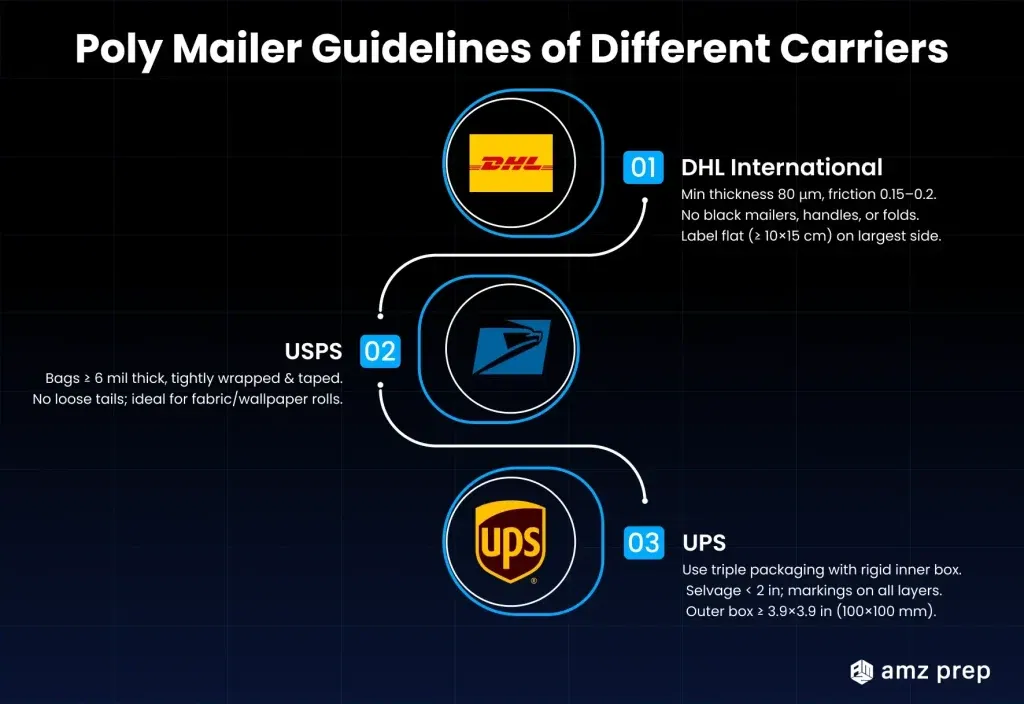
I. DHL International
The following criteria are mandatory for poly mailers (customer plastic pouches or DHL plastic pouches) to be processed automatically within DHL’s international network in Europe, avoiding non-standard item charges:
A. Material and Construction Specifications:
1. Minimum Thickness: The plastic material’s thickness of the chosen poly mailer must be adapted to the weight of the content and must not be less than 80 μm.
2. Friction Coefficient: The mailer material must have a specific friction coefficient: 0.15 to 0.2 (in accordance with DIN EN 8295).
3. Durability: The material and closure must be resistant to tearing or stretching to withstand delivery and return conditions.
4. Prohibited Features: The poly mailer must not have carrying handles or straps.
5. Color Restriction: The plastic pouch must not be black.
6. Internal Rigidity: The plastic pouch must not fold over. This can be prevented by inserting a piece of corrugated cardboard inside.
7. Content Movement: The possibility of the contents moving around in the packaging should be minimized. Contents must be packed either in a cardboard box or a DHL plastic pouch.
B. Dimensions and Labeling:
1. Minimum Standard Dimensions: A standard shipment must have minimum dimensions of 15 x 11 x 1 cm.
2. Maximum Standard Dimensions: The maximum dimensions for a standard shipment are 120 x 60 x 60 cm.
3. Label Placement (Critical): The label must be on a flat, warp-free surface.
4. Label Position: The label should be placed on the largest side of the poly mailer, while leaving enough space from the edge.
5. Label Surface: The label must have an even surface so that the barcodes can be scanned from above.
6. Label Size: The label must be a minimum size of 10 x 15 cm.
7. Prohibited Label Placement: The label cannot be placed on the joints and edges of the packaging, nor covered with packing tape or strings.
II. UPS
For items like fabric or wallpaper rolls shipped in a bag, UPS provides material thickness guidelines:
The bag should have a minimum thickness of six mils.
The bag must be tightly wrapped and taped against the roll to minimize the risk of tearing.
Any “tail” on the item shipped in a bag must be compressed to the body of the item using tape.
III. USPS
2025-2026 USPS Updates: Effective January 27, 2025, USPS implemented new packaging strength requirements for hazardous materials.
While standard poly mailers for non-hazardous goods are unaffected, packages containing dangerous goods now require rigid outer packaging meeting minimum edge crush test requirements (ECT 32 for packages ≤20 lbs, ECT 44 for packages >20 lbs).
However, USPS now permits padded or poly bags for shipments containing lithium batteries installed in equipment when enclosed in a secondary container that can withstand a 1.2-meter drop test.
US Government Guidelines on Poly Mailer Shipping Materials
Federal regulations govern what you can ship and how you must package it:
Federal Trade Commission (FTC) Guidelines
Under FTC mandates, you cannot use deceptive packaging. You should select a poly mailer size that reasonably matches your product dimensions.
Misleading packaging goes against FTC rules. While regular ecommerce is rarely impacted, it’s important for marketing compliance.
Postal Service (DMM) Standards
You’re required to follow the Postal Service’s Domestic Mail Manual (DMM) classification standards.
Your poly mailers must satisfy minimum thickness specifications (0.00175 inches for self-mailers), meet proper sealing standards, and provide adequate visibility for addressing.
You need to make sure any merchandise you package in poly mailers is completely enclosed and sealed, as the DMM specifies.
Customs and Border Protection Requirements
For your international shipments, you must comply with Customs and Border Protection requirements by clearly displaying customs documentation on your poly mailers.
You’re responsible for keeping your CN22 or CN23 forms legible and securely attached during the entire shipping journey.
You’ll find that using clear plastic pockets for customs forms on your international poly mailers helps maintain compliance.
Environmental Mandates
Environmental mandates continue expanding their impact on your poly mailer material decisions. California’s SB 343 prohibits the use of ‘chasing arrows’ recycling symbols on packaging unless it meets strict recyclability criteria, collection and processing by programs serving at least 60% of California’s population.
As of October 4, 2026, all poly mailers manufactured for sale in California must comply with these labeling restrictions. Most standard poly mailers do NOT meet these thresholds and cannot display recycling symbols or ‘recyclable’ claims. Packaging manufactured before October 2026 may continue to be sold with existing labels.
CalRecycle published its Final Findings Report on April 4, 2025, confirming that polyethylene and polypropylene mailers (including standard and bubble poly mailers) do not currently meet the 60% collection and sortation thresholds required for recyclability claims in California.
While these materials remain drop-off recyclable at participating retail locations, they cannot be labeled with chasing arrows symbols or marketed as ‘curbside recyclable’ after the October 2026 deadline.
Extended producer responsibility (EPR) statutes in several states obligate you as an online seller to support recycling system funding.
These frameworks don’t eliminate poly mailers but generate compliance duties you must fulfill.
Commodity-Specific Rules
Commodity-specific rules function independently of your packaging choices.
Hazardous substances, lithium power cells, alcoholic products, tobacco goods, and other controlled merchandise maintain restrictions overriding your packaging preferences.
You cannot permit shipment of restricted items by switching packaging types.
State and Local Policies
State and local policies exhibit wide-ranging differences. Particular jurisdictions have prohibited certain plastic packaging formats or established fees targeting non-recyclable shipping materials.
You should examine regulations governing your business location and common shipping zones.
Advantages and Limitations of Poly Mailers
Advantages:
- 50-70% cheaper than boxes with minimal storage space requirements
- Lightweight (1-2 oz vs. 8-16 oz for boxes), reducing shipping costs
- Weather-resistant—maintains integrity in rain or snow
- Flexible design conforms to products and prevents internal damage
- Professional appearance with custom branding opportunities
- Space-efficient, allowing more packages per shipment
Limitations:
- Cannot protect fragile items like glass or electronics
- No stacking strength or structural support
- May not suit luxury or premium brand positioning
- Environmental concerns—takes hundreds of years to decompose
- Typically single-use due to permanent adhesive strips
- Can become sticky in extreme heat or brittle in extreme cold
Final Thoughts
Choosing the right poly mailer sizes gives you a real edge over competitors. Match your products to the right dimensions, seal packages well, and follow carrier rules. You’ll cut costs and keep customers happy.
Start by measuring your product line. What poly mailer sizes work for your most common items? Get samples before buying in bulk. Try different sizes to find what fits your needs and budget best.
Your poly mailer sizes matter to customers. Spending a bit extra on the right dimensions protects products better and sets your brand apart from others. Custom sizing helps too. Right-sized mailers show you care about both product safety and efficient shipping.
Check your poly mailer sizes as you grow. As order volumes grow, you need to adapt. Use correct poly mailer sizes, follow carrier rules, and reduce shipping costs and damage for a better customer experience.
FAQ
What size poly mailer should I use for t-shirts?
For S-L shirts, 10×13-inch poly mailers work best; for XL-XXL or hoodies, choose 12×15.5 inches. Fold garments to 9-10 inches long and 6-8 inches wide, leaving 1-2 inches of room.
What size poly mailer for shoe boxes?
A typical shoe box fits 14×17 or 14.5×19 inch mailers, while men’s size 12+ needs 19×24 inches. Add 2-3 inches per side for space, and choose gusseted expansion mailers for multiple pairs.
Can I recycle poly mailers?
Yes, though home recycling bins don’t accept them. Instead, use drop-off bins at grocery stores, Target, or Walmart. Remove shipping labels beforehand.
Are bubble mailers considered poly mailers?
Yes, they are poly mailers with internal bubble cushioning. Standard mailers suit clothing, while bubble ones suit fragile items. Expect 30-50% higher cost and slightly greater weight.
How do I prevent poly mailers from bursting during shipping?
Ensure items fit without overstuffing. Go with 2.5 mil or 3.0 mil for heavier products. Press adhesive firmly, tape for strength, and fold down larger mailers for a better seal.
What’s the difference between standard and extra large poly mailers?
Regular mailers (6×9 to 19×24) are meant for single clothing items and light orders. Extra large (24+ inches) fit bigger items, with stronger seams and material thickness of about 3-4 mil.
Do I need different poly mailers for international shipping?
You don’t need different mailers, just proper paperwork. Securely attach customs forms, ensure complete address details, and confirm country regulations, as some restrict the use of plastic packaging.
How thick should poly mailers be?
Most soft goods ship well with 2.5 mil. Choose 3.0-3.5 mil for heavier or sharp objects. Items exceeding 2 pounds often require 4-6 mil. Extra thickness isn’t useful for lighter goods.
What size is a standard poly mailer?
Poly mailers are available in various dimensions, and the most commonly preferred sizes are 10×13 inches and 12×15.5 inches. The sizes of the poly envelopes range from 6×9 inches up to 14×19 inches to accommodate different types of shipments.
What are the products that can be covered in a 6×9 poly mailer?
Smaller products like jewelry, cosmetics, phone accessories, light clothing, or paperback books are the best fit.
What is the height of a 10×13 poly mailer?
A 10×13 poly mailer has a height of 13 inches. When understanding poly mailer dimensions, the first number indicates the width, while the second number indicates the height.
What is the size of an A2 poly mailer?
The A2 mailer has the dimension of 4.375 x 5.75 inches in size. This is perfect for shipping greeting cards, thank-you notes, or small invitations.
What is the difference between LD and PP poly bags?
In simple words, LD (LDPE) bags are softer and more flexible with excellent stretch and tear resistance. While PP (polypropylene) bags are stiffer with professional product design and have superior resistance properties.
What is the size of an A4 mailer bag?
An A4 mailer bag is approximately 9 x 12 inches (or 235 x 310 mm), which can fall under the size category to pack and ship small- to medium-range eCommerce products.
What is the size of a large poly mailer?
The size of the poly bag is 14×17 inches and can be up to 19×24 inches or even bigger. These envelopes are used for shipping larger apparel, bedding, or multiple items together.
Which is better, HDPE or LDPE?
It depends on your specific needs. If you’re shipping items with irregular shapes or need more flexibility, LDPE can be the best choice. HDPE is your best choice to satisfy your requirements, which include a more economical option with good stiffness and moisture protection.
Can I reuse polymailers?
You can reuse polymailers as long as they’re in good condition. Prior to reusing the poly bag, make sure you completely remove or thoroughly cover the previous shipping label. Also, do a physical inspection to ensure that the mailer is still in good condition without any tears or damage.
Can I pack the hoodie in a 10X13 poly mailer?
Yes, you can with careful folding. But preferring a polybag with a 12×15.5 or 14×17 inch size will be much better. The mentioned mailer gives you more room to pack heavyweight hoodies or zip-up styles without any hassles.
What are the rules for poly mailers?
When you’re using poly mailers, you’ll need to make sure they’re completely sealed, your shipping label is clearly visible and secure, you’re within the weight and size limits for your carrier, and the mailer itself is in good condition without any rips or tears. You’ll also want to ensure your items inside are properly protected.
What can I use instead of a poly mailer?
You have several alternatives to poly mailers: bubble mailers for cushioned protection, cardboard boxes for rigid items, kraft paper mailers for an eco-friendly option, padded envelopes for delicate items, or compostable mailers if you’re prioritizing sustainability.
Does the USPS accept poly mailers?
USPS readily accepts poly mailers for shipping. You can use them with First Class Package Service, Priority Mail, Priority Mail Express, and other USPS options, provided you stay within their size and weight specifications.
How to measure a poly mailer for USPS shipping?
To measure your poly mailer for USPS, you’ll lay it flat and measure the width across and the height from top to bottom. If your filled package is thicker than 3/4 inch, you’ll need to measure that dimension too, as it affects how USPS classifies and prices your shipment.
What size poly mailer do I need for jeans?
For shipping jeans, you’ll want to use either a 10×13 inch or 12×15.5 inch poly mailer in most cases. If you’re sending multiple pairs or particularly thick denim, you should consider sizing up to a 14×17 inch mailer for easier packing.
Can I ship a shoe box in a poly mailer?
You can ship the shoes themselves in a poly mailer (size 12×15.5 or 14×17 works well), but you won’t be able to fit a rigid shoebox inside a poly mailer. If you must include the original shoebox, you’ll need to use a corrugated cardboard shipping box instead.
Does FedEx accept poly mailers?
FedEx does accept poly mailers for most of their services. You can use them for FedEx Ground, FedEx Home Delivery, FedEx Express, and other shipping options, provided you follow their packaging requirements and stay within size and weight limits.
Can I still use poly mailers with recycling symbols in California after 2026?
No. As of October 4, 2026, poly mailers manufactured for California cannot display chasing arrows symbols or “recyclable” claims unless they meet SB 343’s strict criteria. Most standard poly mailers do not qualify. You can still use poly mailers, but remove recyclability symbols and claims from packaging manufactured after this date. Check with your supplier for compliant labeling options.

Have USPS poly mailer requirements changed in 2025-2026?
Yes, for hazardous materials only. As of January 2025, packages containing dangerous goods require rigid outer packaging with specific strength requirements. Standard poly mailers for regular merchandise remain acceptable with the same thickness requirements: 2 mils for packages up to 5 lbs, 4 mils for 5-10 lbs.

Blair Forrest is the Founder of AMZ Prep, one of North America’s fastest-growing third-party logistics and fulfillment networks, built entirely without outside capital since 2016. Under his leadership, AMZ Prep has scaled to 50+ fulfillment centers across 6 countries, processing over 8 million units monthly and powering $2 billion+ in annual GMV for more than 5,000 brands worldwide including 437, Silverts, Saltyface, Unilever, Duracell, and JBL. A recognized authority in eCommerce logistics, Amazon FBA strategy, and supply chain optimization, Blair has helped thousands of sellers and brands master their fulfillment operations from first shipment to enterprise scale. He regularly consults on FBA prep, multi-channel fulfillment, last mile delivery, international expansion, and cost reduction strategies that save brands 20–40% compared to traditional 3PL providers. Blair’s insights on Amazon logistics, 3PL operations, and eCommerce growth are widely cited across the industry. Through AMZ Prep’s content, guides, and resources, he continues to share battle-tested strategies drawn from managing one of the largest independently owned fulfillment networks in North America.
Helpful reminder to allow extra space for sealing and labels.
Knowing standard sizes in advance helps with bulk ordering.
Good explanation of when to use flat versus bubble poly mailers.
A practical reference for anyone shipping lightweight products.
The sizing advice helps reduce shipping issues and returns.
I liked how the sizing tips help avoid overpacking or wasted space.
Simple, well-organized, and useful for packaging decisions.
The examples for apparel and soft goods were especially helpful.
The breakdown of common poly mailer dimensions is clear and practical.
This size guide makes it much easier to choose the right poly mailer for different products.