Section 321 De Minimis Is Fully Suspended. Here Is What Importers Must Do Now.
Section 321 is a US customs provision under 19 USC 1321 that previously allowed duty free entry for imports valued under $800 per person per day. The exemption was suspended for China and Hong Kong shipments on May 2, 2025, then expanded to all countries on August 29, 2025. All imports into the United States now require formal customs entry, HTS classification, and duty payment regardless of shipment value. AMZ Prep operates 50 plus fulfillment centers across North America, including Canadian warehouses in Toronto, Vancouver, and Calgary, to help brands transition to compliant cross border fulfillment using CUSMA preferential tariff rates.
How Did Section 321 Get Suspended?
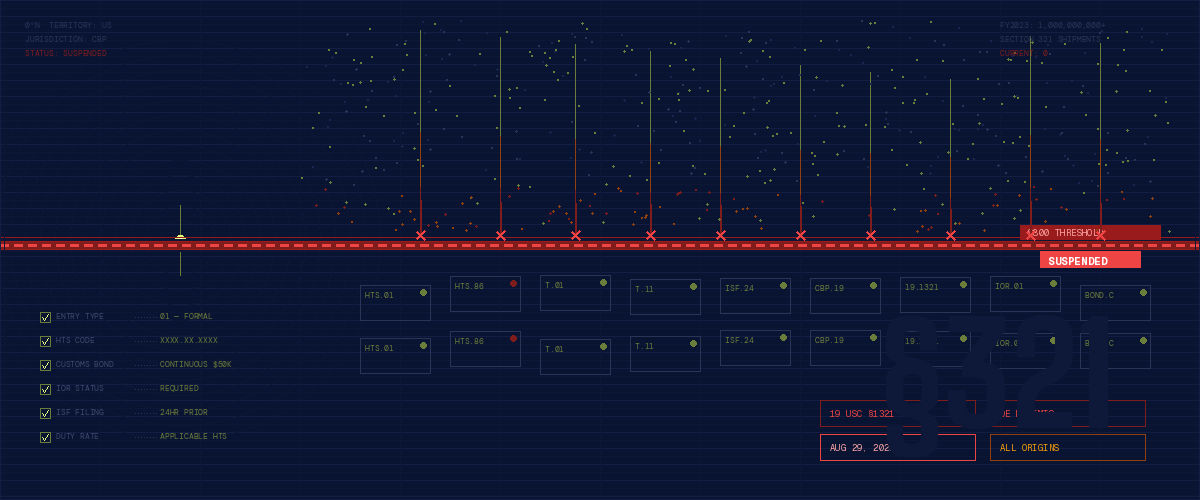
The suspension happened in phases, starting with China specific executive orders and expanding to a global de minimis shutdown within 4 months.
What Is Section 321?
Section 321 (19 USC 1321) Explained
Section 321 is a provision of the Tariff Act of 1930, codified at 19 USC 1321, that authorized US Customs and Border Protection to admit imports free of duty and tax when the aggregate fair retail value did not exceed $800 per person per day. The Trade Facilitation and Trade Enforcement Act of 2015 raised this threshold from $200 to $800, triggering explosive growth in de minimis shipments.
Ecommerce platforms, direct to consumer brands, and cross border fulfillment providers used Section 321 to ship individual orders into the US without formal customs entry, duty payment, or HTS classification. CBP reported that Section 321 shipments grew from approximately 140 million in 2013 to over 1 billion in fiscal year 2023, creating significant enforcement challenges.
What Changed When Section 321 Was Suspended?
Every aspect of low value importing into the United States has changed. Here is what compliance looks like before and after the suspension.
| Requirement | Before Suspension (Pre August 2025) | After Suspension (Current) |
|---|---|---|
| Customs Entry | No formal entry required for shipments under $800 | Full formal entry (Type 01 or 11) required for all shipments regardless of value |
| Duty Payment | Exempt for qualifying shipments | Required at applicable HTS rates on all imports |
| HTS Classification | Not required for de minimis shipments | Full 10 digit HTS classification required for every SKU |
| Customs Bond | Not required for Section 321 shipments | Continuous or single entry bond required for all importers |
| Importer of Record | Often informal or not designated | Licensed IOR required with CBP registration |
| Documentation | Minimal: basic manifest data | Full commercial invoice, packing list, bill of lading, ISF filing |
| Entry Type | Type 86 (streamlined) or informal entry | Type 01 (consumption) or Type 11 (informal) with full data |
| Processing Time | Same day clearance typical | 1 to 5 business days for formal customs clearance |
| Non Compliance Penalty | Shipment return or destruction | $5,000 to $10,000 per violation, seizure, import privilege revocation |
What Are the New Requirements for US Imports?
Every shipment entering the United States, regardless of value, now requires the following.
Formal Customs Entry
All imports require a formal entry filing (Type 01 or Type 11) with complete shipment data, regardless of declared value. Informal Section 321 entry is no longer accepted.
HTS Classification
Every product requires a 10 digit Harmonized Tariff Schedule code. Incorrect classification can trigger additional duties, penalties, and delayed clearance at the port of entry.
Duty and Tax Payment
Applicable duties, merchandise processing fees, and harbor maintenance fees must be paid on every import. Rates vary by HTS code and country of origin. No value based exemptions remain.
Customs Bond
A continuous customs bond or single entry bond is required for every import transaction. Annual continuous bonds start at $50,000 face value and provide coverage for all entries within the bond period.
Importer of Record
A designated Importer of Record (IOR) registered with CBP is required for every shipment. The IOR is legally responsible for classification accuracy, duty payment, and compliance with all applicable regulations.
ISF Filing (10+2)
Importer Security Filing must be submitted 24 hours before ocean cargo is loaded at the foreign port. Late or inaccurate ISF filings result in $5,000 penalties per occurrence.
Penalties for Non Compliance
How Can Importers Reduce Duty Costs After Section 321?
Section 321 is gone, but legal duty reduction strategies still exist. AMZ Prep helps brands implement these alternatives across our North American fulfillment network.

CUSMA / USMCA Preferential Tariffs
Goods qualifying as North American origin under CUSMA rules of origin enter the US at preferential or zero duty rates. AMZ Prep operates fulfillment centers in Toronto, Vancouver, and Calgary to support compliant cross border movement between Canada and the US.
Read our CUSMA HTS guideCanadian Fulfillment for US Delivery
Fulfill orders from Canadian warehouses and ship cross border using consolidated LTL or parcel. AMZ Prep's Prep Parcel program offers competitive Canada to US rates with customs brokerage built into the fulfillment workflow.
Canada to US shipping ratesForeign Trade Zones (FTZ)
Goods stored in a designated FTZ are not subject to duty until they enter US commerce. This allows inventory staging, kitting, and assembly without triggering duty payment until the product is sold and shipped to the end customer.
Ask about FTZ optionsDuty Drawback Programs
If you export or re-export goods that were previously imported with duty paid, you can recover up to 99% of the duties through a drawback claim. This applies to goods exported in the same condition or used as inputs in manufactured products.
Learn about customs costsShipment Consolidation
Consolidating multiple small shipments into fewer, larger entries reduces per unit brokerage and processing costs. AMZ Prep's freight forwarding service consolidates inbound cargo from Asia, Europe, and South America into optimized palletized shipments.
Freight forwarding servicesDDP Shipping Programs
Delivered Duty Paid shipping ensures all customs duties and taxes are prepaid before delivery. This eliminates surprise charges for end customers and simplifies compliance by centralizing duty payment with the shipper or 3PL.
DDP shipping explainedWhy Do Brands Choose AMZ Prep for Post 321 Fulfillment?
AMZ Prep has been running cross border fulfillment between Canada and the US since 2019. The Section 321 suspension created the exact operating environment our network was built for.
50 Plus Fulfillment Centers
Network spans the US and Canada with warehouses in Toronto, Vancouver, Calgary, Los Angeles, Dallas, New Jersey, and 40 plus additional locations. Position inventory where your customers are.
Cross Border Expertise
CUSMA compliance, customs brokerage, HTS classification support, and bilingual labeling for Canadian market entry. We handle the complexity so you ship without delays.
Prep Parcel Shipping
Integrated parcel shipping with negotiated Canada to US rates. Customs documentation, brokerage, and tracking built into the fulfillment workflow. No separate logistics provider needed.
Enterprise Proven
Trusted by Duracell, Unilever, JBL, and 5,000 plus brands. 99.8% order accuracy, 24 hour receiving SLA, and dedicated account management for enterprise clients.
Frequently Asked Questions About Section 321
Need a Post Section 321 Fulfillment Strategy?
AMZ Prep's cross border team builds compliant fulfillment programs that minimize duty exposure and maximize delivery speed across the US and Canada.
Talk to Our Cross Border Team