
A liftgate is a hydraulic platform attached to the back of a truck that raises and lowers freight between the truck bed and the ground. Liftgate delivery is the service carriers provide when a shipment needs to be lowered to the ground at a location without a loading dock or forklift.
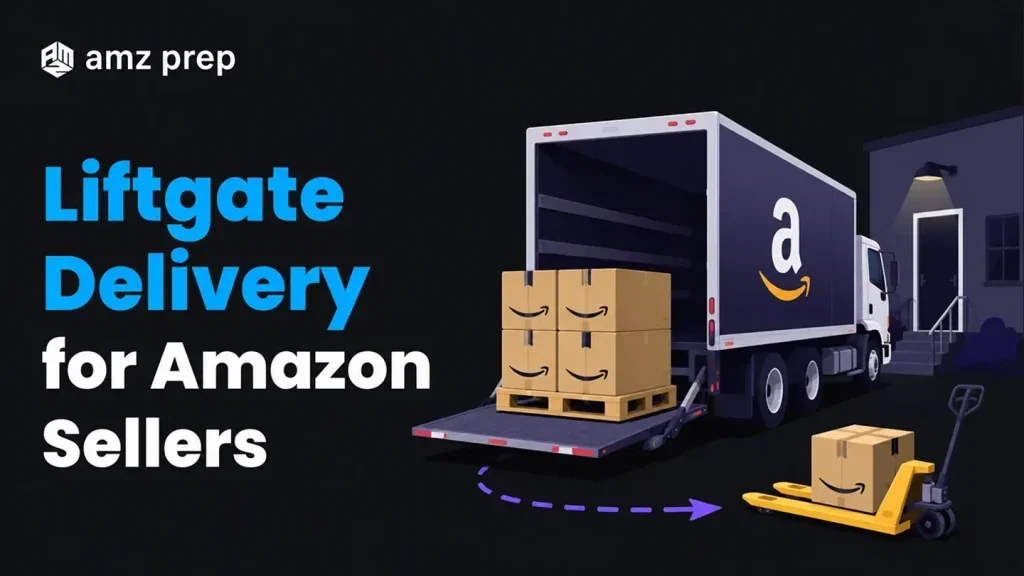
For Amazon sellers moving palletized inventory, understanding when a liftgate delivery service is required, what it costs, and how to avoid paying it unnecessarily can make a real difference to your inbound freight bill.
What Is Liftgate Delivery and What Does It Mean for Freight Shippers
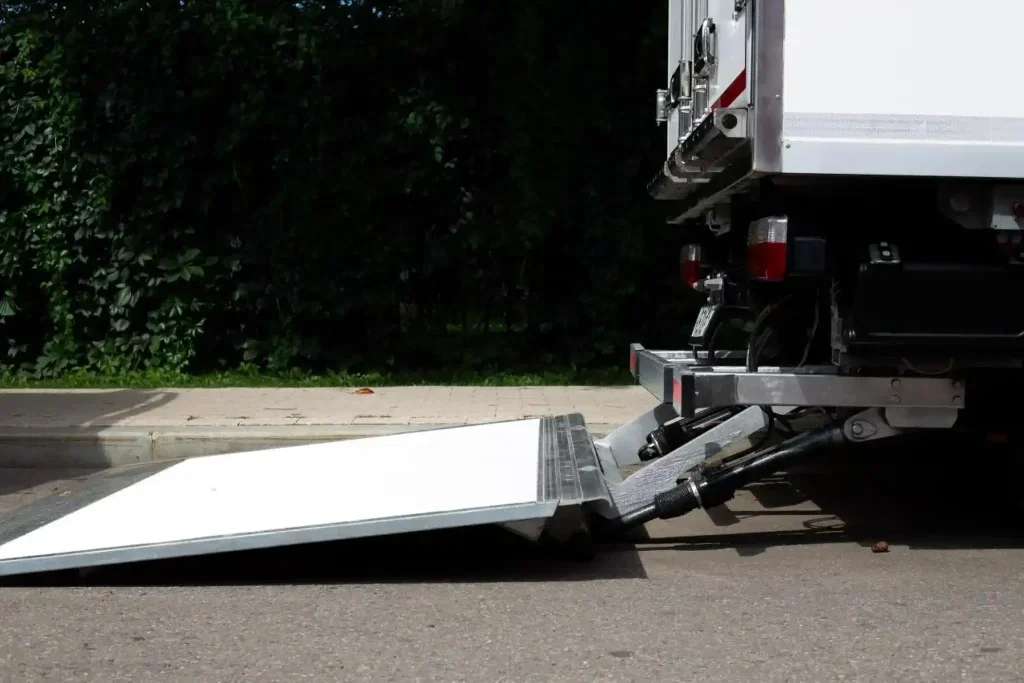
Liftgate delivery is a freight service that uses a hydraulic platform mounted on the rear of a freight truck to load or unload cargo when standard dock-level access is not available. The liftgate is a hydraulic platform that extends from the back of the truck, drops to ground level, and returns freight to be lifted or lowered to the ground safely.
Standard freight carriers assume dock-to-dock service. That means the truck backs up to a raised loading bay, and cargo moves on and off using a pallet jack or forklift at dock height. When that dock is not available at the pickup or delivery point, the carrier needs additional equipment to complete the job. That equipment is the liftgate.
Liftgate delivery is classified as an accessorial charge, meaning it sits on top of your base freight rate. It is not included in a standard LTL quote unless you request it.
How Does Liftgate Work
A liftgate operates through a hydraulic or electric mechanism installed on the back of the truck. The driver lowers the hydraulic platform to ground level, rolls the pallet onto it using a pallet jack, and raises the platform up to truck bed height.
The process works in reverse for delivery: cargo moves onto the liftgate, the platform descends, and freight is placed at curbside or at the delivery point.
The whole process adds 15-30 minutes to a stop, which is part of why carriers typically charge an extra fee for it.
Liftgate Delivery vs. Dock-Level Delivery
| Factor | Dock-Level Delivery | Liftgate Delivery |
|---|---|---|
| Equipment required | Pallet jack, forklift at dock | Liftgate truck |
| Facility requirement | Raised loading dock | Ground-level access only |
| Standard freight rate | Included | Accessorial fee applies |
| Time per stop | Faster | 15-30 min longer |
| Best for | Commercial warehouses | Residential, small business, no-dock facilities |
Dock-level delivery is the freight default. Liftgate delivery service is the exception, and it costs extra every time it is used.
Liftgate Pickup vs. Liftgate Delivery
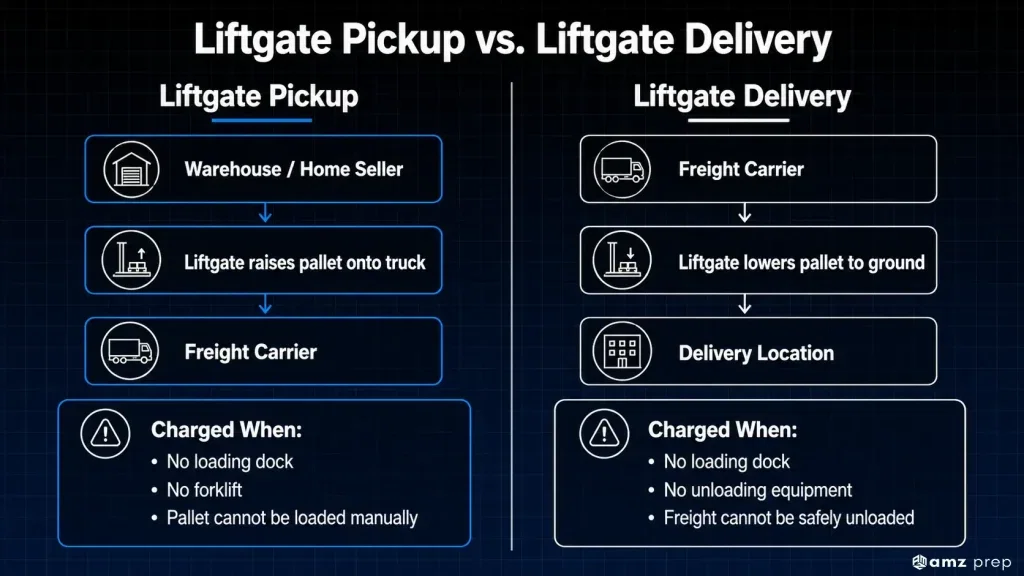
This is the distinction most sellers miss.
Liftgate service applies at both ends of a shipment.
Liftgate pickup is charged when the carrier arrives at your origin location, whether that is your warehouse, prep center, or home, and there is no dock or forklift to load the pallet onto the truck. The carrier uses the liftgate to raise the freight from the ground onto the truck.
Liftgate delivery is charged when the same situation exists at the destination.
Both are billed as separate line items. A seller shipping from a facility without a dock to a destination without a dock can be charged twice on the same shipment.
When You Need a Liftgate: The Triggers That Apply to Amazon Sellers
No Loading Dock at the Pickup or Delivery Location
The primary trigger for liftgate service is a missing dock. Without a loading dock, freight trucks cannot transfer cargo at the standard trailer height of 48-52 inches. The liftgate bridges that gap.
This applies at origin as much as at destination. If your inventory leaves from a facility without a loading dock, you need liftgate pickup service from the carrier. If it is being delivered to a location without a loading dock, you need liftgate delivery service.
Heavy Freight That Cannot Be Unloaded Manually
Freight that weighs more than 150 pounds is the common threshold carriers use to determine whether manual loading and unloading is safe. A full pallet of product typically runs 500-2,000 lbs. There is no realistic manual option. The liftgate handles up to 2,500 lbs depending on the truck and equipment that is installed.
Heavy freight without a dock needs a liftgate. That is not optional, and attempting delivery without one creates risk of damage and injury to workers.
Do You Need a Liftgate If You Have a Forklift but No Dock
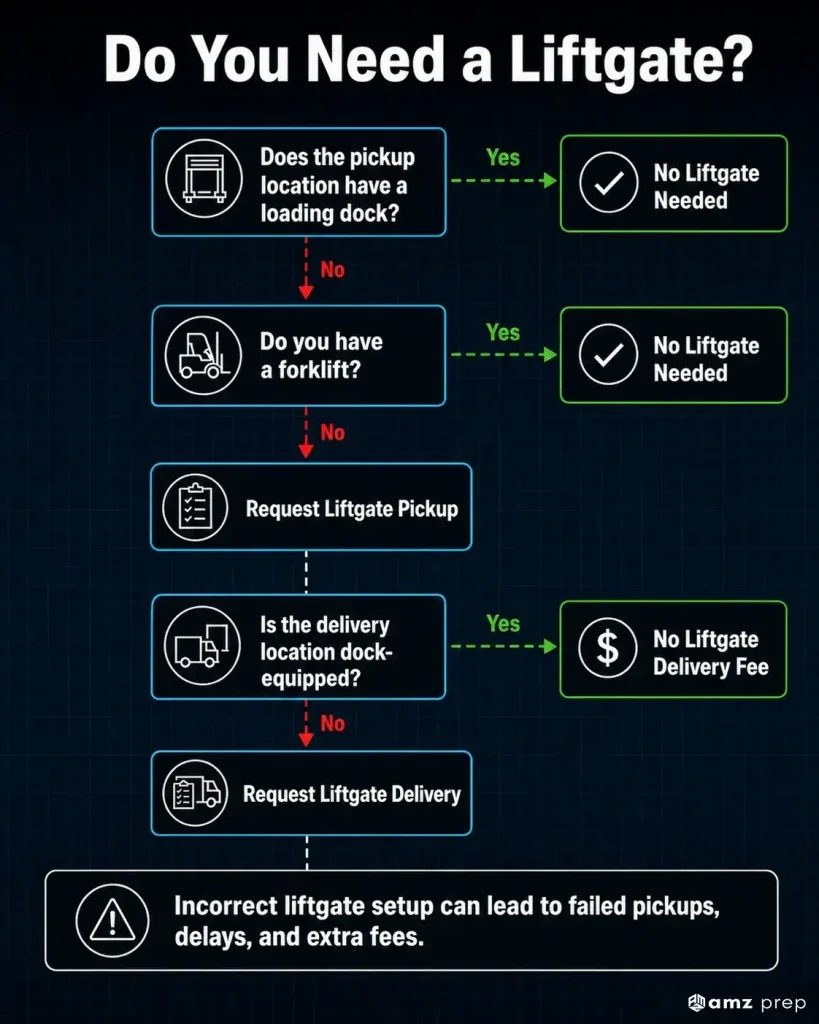
No. A forklift at the origin location can load freight directly onto the truck at grade, which is what the liftgate would otherwise do. A forklift at the destination can unload the shipment from the truck the same way.
If you have a forklift but no loading dock, you do not need to pay for liftgate service. Make this clear to the carrier at booking and document it on the Bill of Lading.
This comes up often for home-based or rural sellers who run small warehouse operations with a forklift but no dock bay. The forklift substitutes the function of the liftgate and the accessorial drops off.
The Locations That Default to Liftgate
| Location Type | Liftgate Required? | Notes |
|---|---|---|
| Commercial warehouse with dock | No | Standard freight delivery |
| Commercial warehouse, no dock | Yes | Liftgate pickup/delivery applies |
| Residential address | Yes | Residential deliveries always require liftgate |
| Construction sites | Usually | Rarely have dock access |
| Small retail or street-level business | Usually | Depends on facility setup |
| Home-based seller with forklift | No | Forklift substitutes liftgate |
| FBA fulfillment center | Usually not | Amazon FCs are dock-equipped (see below) |
Amazon FBA and Liftgate: What Sellers Actually Need to Know
This is where most freight guides fall short. FBA has its own rules, and sellers who do not account for them end up with missed pickups, re-delivery fees, and delayed check-ins.
Do Amazon Fulfillment Centers Have Loading Docks
Yes. Amazon fulfillment centers are large commercial facilities built for high-volume freight handling. They have loading docks. Liftgate delivery at the destination FC is typically not required for standard FBA LTL shipments.
This means the liftgate question for most FBA sellers is not about the destination. It is about the origin.
When FBA Shipments Do Require Liftgate Service
There are situations where liftgate service becomes necessary even on FBA inbounds:
- Your origin location has no dock. If inventory ships from a home, small warehouse, or prep center without dock access, liftgate pickup is required on the origin side.
- Third-party receiving or cross-dock locations. Some FBA routing plans send shipments through intermediate facilities that may not be dock-equipped.
- Non-standard partnered carrier assignments. Amazon’s routing can assign carriers with different equipment configurations depending on lane and volume.
How to Request Liftgate Service Through Amazon Partnered Carriers
Amazon Partnered Carrier LTL does support liftgate pickup, but it is not automatic and it is not available on every carrier assignment.
Key rules from Amazon’s own documentation:
- Liftgate pickup is available on partnered LTL if the shipment is under 12 pallets and under 20,000 lbs
- Liftgate pickups are available only on certain days of the week, which can delay your pickup date by 1-2 days
- To request liftgate service, open a case in Seller Central after creating the shipment, you cannot select it during the standard shipping plan flow
- Amazon Freight, which Amazon now assigns more frequently, does not reliably support liftgate service. If you are assigned Amazon Freight and need a liftgate, call the Amazon Relay Operations Center and be prepared to escalate via Seller Support if the request cannot be accommodated
If your assigned carrier cannot provide a liftgate, your best path is to request a carrier change through Seller Support or to arrange your own pickup through a third-party freight carrier that can confirm liftgate availability in advance.
What Happens If the Carrier Arrives Without a Liftgate
This is a real operational failure that sellers in Seller Central forums report regularly. The carrier arrives, sees a pallet that requires a liftgate, and leaves without loading. The result:
- Missed pickup and inventory delay
- Potential re-delivery or failed-pickup fee from the carrier
- Need to reschedule through Seller Support, which can take 24-48 hours
- Inventory gap if you are already running low on FBA stock
The fix is simple: confirm liftgate availability with the carrier directly before pickup day, not on the day of.
What a Liftgate Fee Costs
Liftgate fees vary more than most sellers expect. The range depends on the carrier, the weight of the shipment, the lane, and whether the service was requested at booking or added after the fact.
Typical Liftgate Fee Ranges by Carrier
| Carrier | Pricing Model | Approximate Range |
|---|---|---|
| FedEx Freight | Per hundredweight | ~$13.18/cwt, $195 min / $643 max* |
| Old Dominion | Flat + weight | $75-$200 per shipment |
| Standard LTL carriers | Flat accessorial | $75-$150 per shipment |
| Same shipment, different carriers | Variable | $185-$290 for identical freight |
*Verify current FedEx Freight tariff before publishing, rates subject to change.
The same 2,900 lb shipment can generate a liftgate fee of $185 on one carrier and $290 on another. Carrier selection matters for liftgate cost, not just base freight rate.
Pickup Liftgate vs. Delivery Liftgate: Two Separate Charges
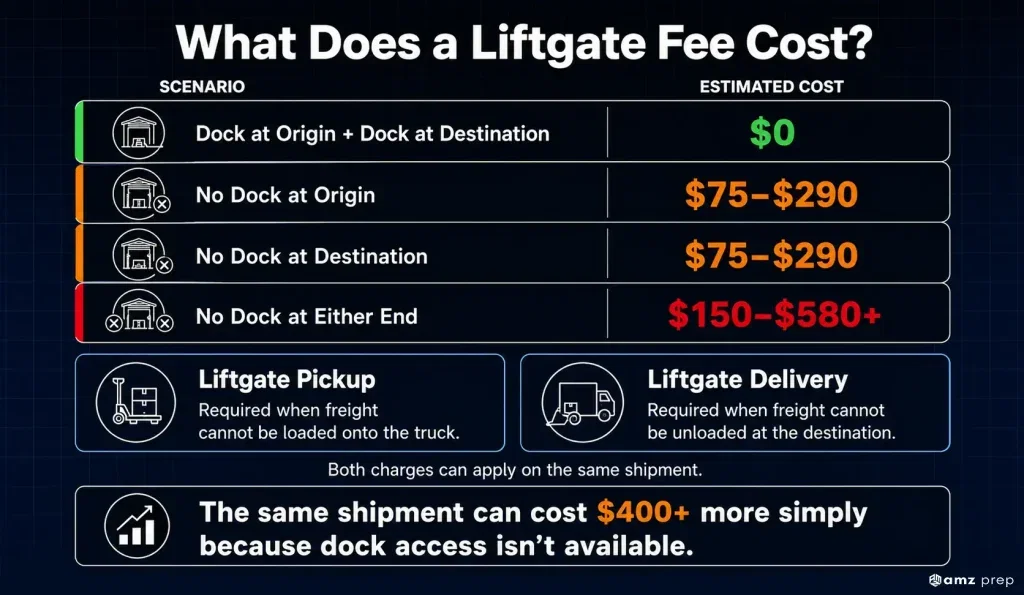
Liftgate pickup and liftgate delivery are billed as separate accessorial line items. A seller without dock access at origin shipping to a non-dock destination pays both.
| Scenario | Pickup Liftgate | Delivery Liftgate | Total Accessorial Impact |
|---|---|---|---|
| Dock at origin, dock at destination | No | No | $0 |
| No dock at origin, dock at destination | Yes | No | $75-$290 |
| Dock at origin, no dock at destination | No | Yes | $75-$290 |
| No dock at either end | Yes | Yes | $150-$580+ |
The double-charge scenario is avoidable. Understanding your facility setup before booking removes it entirely.
What Makes the Fee Go Higher
Several variables push liftgate charges above the base rate:
- Weight: Heavier shipments cost more on weight-based pricing models
- Adding liftgate after booking: Carriers charge more when liftgate is not declared at the time of booking. Some treat it as an amendment fee on top of the standard accessorial
- Re-delivery: If a carrier arrives without a liftgate and the shipment cannot be completed, re-delivery fees stack on top of the liftgate fee when the carrier returns
- Lane and region: Remote or limited-access lanes add surcharges on top of the base liftgate cost.
How to Avoid Liftgate Fees as an Amazon Seller
Confirm Dock Access Before Booking the Carrier
The most common cause of an unexpected liftgate fee is an assumption about facility setup. Before booking any LTL shipment, confirm:
- Does your origin location have a raised loading dock that matches standard trailer height?
- Does the destination have dock access?
- If either answer is no, factor liftgate service into the rate comparison before choosing a carrier
Getting this wrong after booking often means paying a higher amendment rate or a re-delivery fee in addition to the liftgate accessorial.
Annotate the BOL Correctly
The Bill of Lading is where liftgate requirements need to be declared. If liftgate service is required and it is not on the BOL, two things can happen: the carrier arrives without the right equipment, or the carrier adds the accessorial charge after delivery at a higher unilateral rate.
Specify liftgate pickup, liftgate delivery, or both on the BOL at the time of booking. Do not assume the carrier will infer it from the shipment details.
Do You Need a Liftgate? Use This Decision Framework
| Situation | Action |
|---|---|
| Origin has dock + destination has dock | No liftgate needed – standard LTL |
| Origin has no dock, have forklift | No liftgate pickup needed – forklift substitutes |
| Origin has no dock, no forklift | Request liftgate pickup at booking |
| Shipping to residential address | Request liftgate delivery – always required |
| Shipping FBA via Amazon Partnered Carrier | Confirm carrier assignment – request liftgate via Seller Support if needed |
| Amazon Freight assigned, no dock at origin | Call Relay Operations Center — be prepared to escalate |
Ship From a Dock-Equipped Facility
The cleanest way to eliminate liftgate pickup fees is to ship from a facility that has dock access. Sellers who run FBA inbound through AMZ Prep’s Middle Mile program ship from dock-equipped fulfillment centers, which removes the pickup liftgate variable entirely.
The shipment moves dock-to-dock, no accessorial applies at origin, and the carrier cost reflects the base LTL freight rate without markup.
For sellers currently shipping from a home address or small warehouse without a dock, consolidating inbound freight through a dock-equipped prep center is the most reliable long-term fix.
Liftgate in LTL vs. FTL Shipments
LTL Liftgate Rules
In less-than-truckload shipping, liftgate service is an accessorial because LTL freight moves on shared trucks optimized for dock-to-dock stops. Not all LTL trucks carry a liftgate. When the carrier arrives for pickup and the assigned truck does not have one, the stop fails.
Requesting liftgate service in advance is not optional, it determines which truck the carrier assigns to your stop. Last-minute requests are the leading cause of failed pickups in LTL freight handling.
When FTL Removes the Liftgate Question
A truckload shipment with a liftgate truck specified upfront removes the accessorial uncertainty. The carrier assigns a dedicated truck that raises and lowers freight as part of the load. The cost is built in rather than billed separately.
FTL makes sense when your FBA volume exceeds 12 pallets per shipment and the per-pallet freight rate becomes competitive with LTL.
Below that threshold, LTL with correctly declared accessorials is typically more cost-effective even with the liftgate fee included.
Choosing the Right Mode for Your FBA Volume
| Shipment Size | Facility Setup | Recommended Mode |
|---|---|---|
| 1-5 pallets | Dock at origin | LTL, no liftgate needed |
| 1-5 pallets | No dock at origin | LTL + liftgate pickup – verify carrier has equipment |
| 6-12 pallets | No dock at origin | LTL + liftgate pickup or consider 3PL consolidation |
| 12+ pallets | Any | Evaluate FTL – often more cost-effective at this volume |
Conclusion
Every Amazon seller shipping palletized inventory via LTL freight will encounter the liftgate question at some point. The fee is avoidable with the right facility setup and the right information on the BOL before the truck arrives.
Sellers looking to remove the pickup liftgate variable permanently should review whether their current inbound setup runs through a dock-equipped facility that single change eliminates one of the most common and avoidable accessorial charges in FBA freight.
Frequently Asked Questions
What is a liftgate in shipping?
A liftgate is a piece of hydraulic or electric equipment that is installed on the rear of a freight truck. It raises and lowers cargo between truck bed height and ground level when a loading dock or forklift is not available at the pickup or delivery location.
Does Amazon FBA require a liftgate for LTL shipments?
Amazon FCs are dock-equipped, so liftgate delivery at the destination is rarely required. However, liftgate pickup is required if your origin location has no dock or forklift. Always confirm your origin facility setup before booking an LTL freight shipment to FBA.
How do I request liftgate service for Amazon Partnered Carrier pickups?
Open a case in Seller Central after creating your LTL shipment and request liftgate pickup through Seller Support. Eligibility requires under 12 pallets and under 20,000 lbs. If assigned Amazon Freight, call the Relay Operations Center directly, as liftgate service is not always available through the standard flow.
How much does a liftgate fee cost?
Liftgate fees typically range from $75 to $290 per shipment depending on the carrier, shipment weight, and lane. Some freight carriers price by hundredweight with a minimum charge. Both liftgate pickup and liftgate delivery are billed separately if both apply to your shipment.
Do I need a liftgate if I have a forklift but no loading dock?
No. A forklift at your location substitutes the function of the liftgate. It can load or unload a pallet directly to and from the truck without the carrier needing liftgate equipment. Confirm this with the carrier at booking and note it on the BOL.
Can I avoid a liftgate fee when shipping to FBA?
Yes. Ship from a dock-equipped facility to eliminate liftgate pickup fees. Confirm your carrier assignment through Amazon Partnered Carrier supports your facility setup. For sellers without dock access, working with a dock-equipped prep center removes the pickup liftgate accessorial entirely.
What happens if the carrier shows up without a liftgate and I need one?
The carrier will not complete the pickup or delivery. The shipment is returned to the terminal, a re-delivery fee is charged, and you must reschedule through Seller Support. Confirming liftgate equipment availability with the carrier directly before pickup day prevents this.

Chadwick Collins is an Enterprise Fulfillment Consultant at AMZ Prep, where he partners with high growth ecommerce brands to design and scale Amazon first logistics strategies. He brings extensive experience in freight, supporting brands across domestic and cross border transportation, routing optimization, and cost control.
At AMZ Prep, Chadwick works closely with enterprise clients to improve inventory flow, reduce landed costs, and accelerate delivery performance across North America. His expertise spans FBA, DTC, and B2B fulfillment, with a strong focus on aligning freight strategy with overall supply chain efficiency. He helps brands navigate complex logistics challenges while turning operations into a competitive advantage.
















Comments