
The most profitable product decisions happen before a market crowds in, not after. A seller who identifies a demand gap six months ahead of saturation operates at permanently better margins than one who enters after the category trends.
This guide covers two things: a repeatable framework for evaluating whether a product opportunity is real, and a vetted list of high demand low competition products that carry clear gap signals heading into 2026. The same evaluation process works across any category. The product list here is a starting point, not a ceiling.
For sellers who want to see which products are already proving out at high volume in established categories, the best selling products on Amazon breakdown covers that separately.
What ‘High Demand, Low Competition’ Actually Means
The phrase gets used loosely. Most sellers interpret it as ‘something people want that not many others sell.’ That is accurate but not actionable. The more useful definition is measurable.
A high demand low competition product typically clears three thresholds at the same time:
Monthly search volume
1,000 to 10,000 on the primary keyword. High enough to confirm that real buyers are searching with intent. Low enough that major brand spend has not yet flooded the ad auction.
BSR range in category
5,000 to 50,000 on Amazon. Products in this range are generating consistent sales without a single dominant seller holding the top three listings. Below 5,000 and you are competing with established players. Above 50,000 and demand may not justify the inventory cost.
Review count on the top three listings
Under 300. Reviews build up over time and give sellers an advantage that compounds. A category where the top sellers have fewer than 300 reviews is still in its early stage. Entry is possible without needing months of reviews before any sales come in.
The distinction that matters most is between a trend window and an ongoing gap.
Trend windows close fast. A product that goes viral on social media typically has a 6 to 18 month window before it saturates. Ongoing gaps persist because the underlying problem is real and existing products do not solve it well. Nobody created the demand with a post. Ongoing gaps are the better business.
5 Signals That Confirm Real Demand Before You Commit Money
Every competitor on this topic offers a tool list. What follows is an evaluation framework: the specific signals to look for within those tools before committing to sourcing.
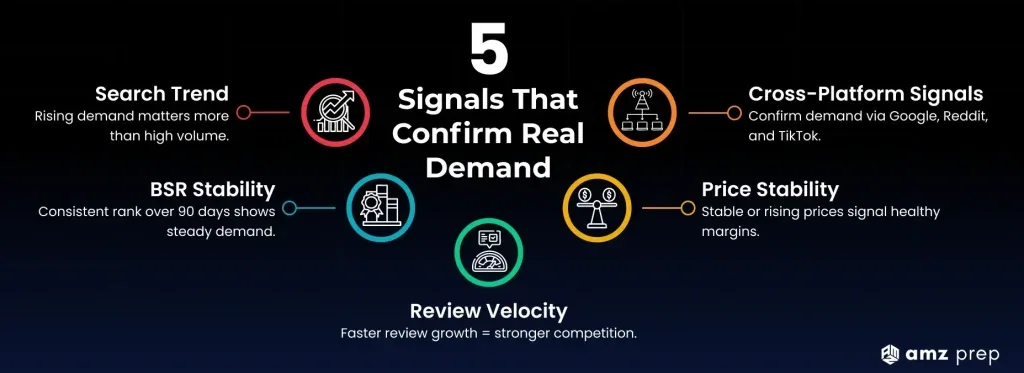
Signal 1: Search Volume Trajectory, Not Just Volume
Flat search volume at 5,000 monthly searches is not the same as rising search volume at 2,000. A product trending upward from 800 to 2,400 over 18 months is a better entry point than one sitting at 5,000 with zero growth.
Google Trends is the right tool for reading trajectory. A keyword with a consistent upward slope over two to three years is a real demand signal. A keyword with a single spike is a trend window.
Signal 2: BSR Consistency Over 90 Days
A single BSR snapshot can mislead. A product holding BSR 8,000 to 15,000 for 90 consecutive days signals steady demand. A product that hit BSR 3,000 once and currently sits at 40,000 signals a trend that has already passed.
Pull 90-day BSR history through Helium 10 or Jungle Scout before drawing any conclusions about category stability.
Signal 3: Review Velocity vs. Review Count
A listing with 50 reviews gaining 10 new reviews per month is more competitive than a listing with 400 reviews gaining 2 per month.
- Velocity shows market momentum
- Count shows how long a seller has been in the market
New sellers in a category with slow velocity at the top have a realistic path to the first page of results. New sellers in a fast-velocity category are competing against a review advantage that grows every week.
Signal 4: Price Floor Stability
If the lowest price in a category has been dropping steadily for 12 months, sellers are cutting margin to hold position. That is a warning sign, not an opportunity.
Enter categories where the price floor has held or risen over the past year. Stable or rising price floors signal that sellers are winning on value, not discounting. That is the market a new seller wants to enter.
Signal 5: Cross-Platform Confirmation
Amazon product research alone is not enough. Cross-reference demand with three additional sources:
- Google Trends: confirms whether broader buyer interest is rising or falling
- Reddit and niche Facebook groups: shows the specific complaints buyers have when existing products fall short
- TikTok search volume: reveals whether content creators are building around the product’s problem, which typically comes 60 to 90 days before a significant Amazon demand spike
When all three external signals confirm the same problem, the opportunity is real and ongoing.
Research Tools and What Each One Is Actually For
| Tool | Primary Use |
|---|---|
| Google Keyword Planner | Demand confirmation at volume, not discovery |
| Google Trends | Trajectory reading over time, not volume |
| Helium 10 / Jungle Scout | BSR history and review velocity on Amazon |
| Amazon New Releases + Movers and Shakers | Live gap signals within proven categories |
| Reddit / niche Facebook groups | Unmet need language from actual buyers |
| AMZ Prep BSR Sales Estimator | Category-level sales estimation by rank range |
The AMZ Prep BSR sales estimator translates a BSR number into an estimated monthly unit volume. This allows a seller to model revenue potential before any sourcing decision is made.
40+ High Demand Low Competition Products to Sell in 2026
The products below were identified through Google Trends trajectory analysis, Amazon BSR monitoring, Reddit and community listening for recurring complaint patterns, and keyword research across SEMrush and Ahrefs.
Each entry covers the buyer profile, the gap in existing solutions, and the demand signal that makes the opportunity identifiable.
Health and Wellness
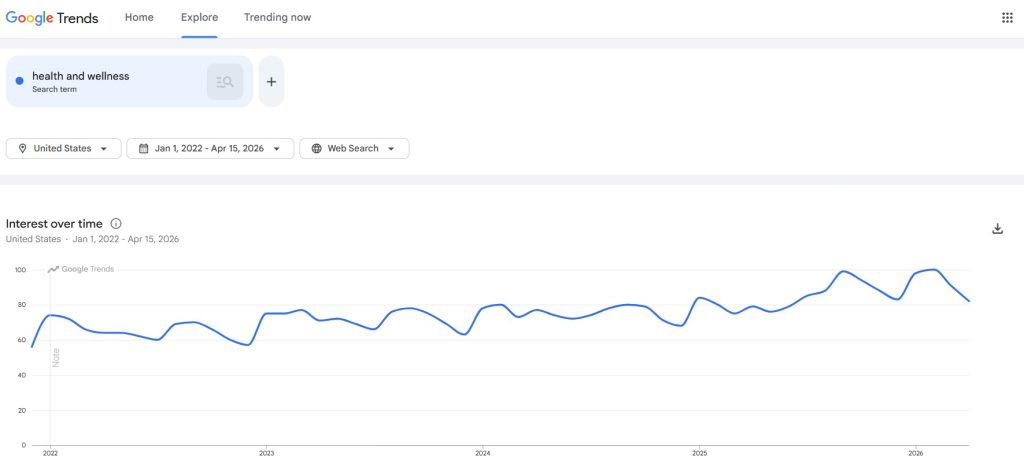
The health and wellness market reached $2.31 trillion in 2025. The opportunity is not in the broad category. It is in the specific problems that large brands have not addressed because the audience seems too small for them to target. That smaller audience is exactly what makes these products low competition.
1. Neuropathy Relief Socks
- The buyer: Adults 55 and older managing chronic diabetic neuropathy. High intent and repeat purchasers.
- The gap: Standard compression socks address general circulation. Diabetic neuropathy requires targeted pressure relief at specific foot zones. Current options consistently get complaints about pressure placement being wrong.
- The signal: Google Trends shows a 3-year upward slope for related search terms. Fewer than 40 active Amazon listings carry any meaningful review count in this sub-niche.
- Why it holds: Socks compress and wear down. The buyer returns. Repeat purchase behavior is built into the product.
2. Posture Correction Wearables for Desk Workers
- The buyer: Remote or hybrid worker, 28 to 50, who already tried a brace-style corrector and abandoned it because it was too visible on video calls
- The gap: The broad posture corrector category is saturated. Discreet, vibration-based devices designed specifically for desk work hours are not.
- The signal: Search volume for desk-specific posture products has grown steadily since 2022. Review analysis on existing options consistently surfaces ‘too bulky’ and ‘not discreet enough.’
- Why it holds: Remote work is a permanent part of how people work. The problem renews every working day.
3. Blue Light Glasses for Evening Use
- The buyer: The working professional who reads on a phone or laptop for 30 to 60 minutes before sleep, not a gamer
- The gap: Most blue light glasses are marketed to gamers with bright yellow lenses. The evening-use buyer wants amber-tinted lenses that look appropriate for everyday wear.
- The signal: Search volume for evening-specific blue light products has grown consistently. The top five Amazon listings carry fewer than 200 reviews each.
- Why it holds: Sleep quality is an ongoing concern. The buyer repurchases when lenses scratch or frames wear out.
4. Acupressure Mats for Plantar Fasciitis
- The buyer: A self-treating adult managing plantar fasciitis outside of clinical care. High purchase intent and willing to pay for something that works.
- The gap: Generic acupressure mats exist in volume. Mats designed specifically for plantar fasciitis, with pressure point density and foot-specific dimensions, have fewer than 20 active listings.
- The signal: Search for plantar fasciitis-specific products has risen consistently since 2023. The buyer is searching with a specific diagnosis, not general curiosity.
- Why it holds: Plantar fasciitis is a long-term condition. The buyer is in the market for months, not days.
5. Breathing Exercise Devices for Anxiety Management
- The buyer: A working adult managing day-to-day anxiety without medication, not an athlete and not a clinical patient
- The gap: Existing options are either clinical-grade and expensive or too basic to be useful. The mid-range device that guides breathing technique for anxiety relief is an open slot.
- The signal: The mental health tool market has grown alongside post-pandemic awareness. Tool-based anxiety management is rising as a search category.
- Why it holds: Anxiety management is not seasonal. The buyer has an ongoing need.
6. Ergonomic Pillow Inserts
- The buyer: Someone who already owns a pillow they like and wants to adjust its firmness and neck support without replacing it
- The gap: The buyer does not want a new pillow. They want to fix the one they have. No mainstream product solves this without requiring a full pillow replacement.
- The signal: Search volume for sleep quality accessories has grown steadily. The insert-style sub-category has very limited SKU competition.
- Why it holds: Memory foam inserts compress over time. Repeat purchase behavior is built into the product’s physical lifespan.
7. Compression Gloves for Women 55 and Older
- The buyer: Women 55 and older managing arthritis, highly vocal in review sections about poor fit in existing products
- The gap: The general arthritis compression glove market is crowded. The sub-category designed for women’s hand dimensions, with different finger length ratios and lighter compression for arthritis rather than sports recovery, is not.
- The signal: Review analysis of existing compression gloves consistently surfaces ‘too long in the fingers’ and ‘too tight for arthritis.’ That complaint language is a product brief.
- Why it holds: Arthritis is a long-term condition. The buyer who finds a glove that fits well repurchases and recommends.
Pet Care
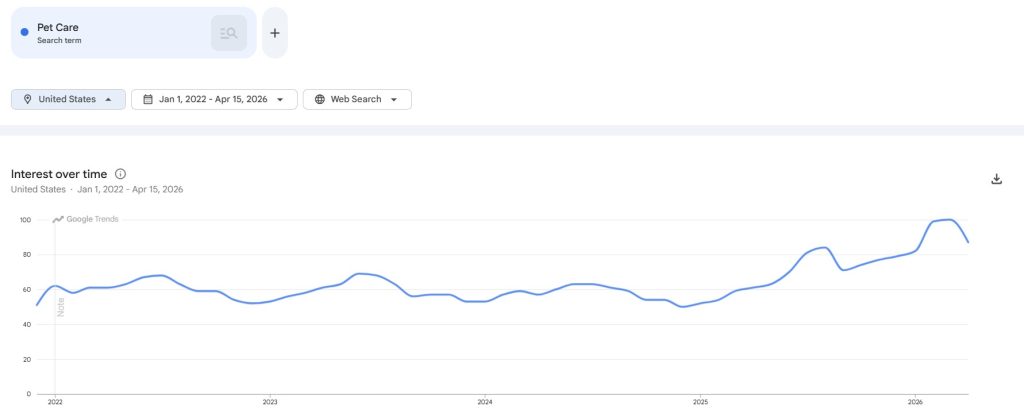
US households are projected to spend an average of $1,445 per pet annually by 2026. The opportunity sits in breed-specific, age-specific, and behavior-specific sub-categories, not in general pet products where major brands already operate at scale.
Sellers building in this category benefit from pet product fulfillment infrastructure that handles the specific packaging and storage requirements these products often carry.
8. Senior Dog Mobility Harnesses
- The buyer: Owner of a large breed dog with hip dysplasia or arthritis. Deeply motivated and willing to pay $60 to $120 for something that actually works.
- The gap: Existing harnesses are either undersized for large dogs or designed for agility sports, not mobility support. Rear-end support specifically for stairs and car entry is underserved.
- The signal: Search volume for age-specific and condition-specific dog mobility products has grown steadily over three years.
- Why it holds: Dog aging is irreversible. The buyer has a permanent need.
9. Puzzle Feeders for Flat-Faced Breeds
- The buyer: Bulldog, pug, and French bulldog owner frustrated by standard slow-feeder bowls their dog physically cannot use
- The gap: Standard slow-feeder bowl designs assume average snout length. Flat-faced breeds cannot reach them effectively. Fewer than 10 SKUs address this specifically.
- The signal: Google Trends shows rising search volume for breed-specific feeding solutions. Review sentiment for existing flat-face feeders is strong. The demand is confirmed, the supply is thin.
- Why it holds: The French bulldog is one of the most popular breeds in the US. The buyer base is large and growing.
10. Crash-Tested Car Seats for Dogs Under 25 Pounds
- The buyer: Small dog owner who wants a seat-style restraint with verifiable safety certification, not a harness
- The gap: Most car restraints for small dogs are harnesses. The seat-style, crash-tested version requires safety certification that keeps underprepared sellers out of the category. Supply of certified options is thin.
- The signal: Search volume for crash-tested pet car seats has grown alongside broader pet safety awareness.
- Why it holds: Safety certification takes time and investment. That barrier keeps the competitive set small.
11. Cat Anxiety Wraps
- The buyer: Cat owner managing storm anxiety, vet visit stress, or tension in multi-pet households
- The gap: The ThunderShirt for dogs is well established. The cat equivalent is underdeveloped. Existing cat wraps have poor fit design because cats are not small dogs and calming compression works differently for them.
- The signal: Review analysis of cat anxiety wraps consistently surfaces ‘doesn’t stay on’ and ‘cat won’t tolerate it.’ Both are design problems, not category problems.
- Why it holds: Cat ownership in the US is at record levels. The need is not going away.
12. Orthopedic Raised Feeders for Large Breed Dogs
- The buyer: Large breed dog owner focused on joint and neck health. Researches purchases carefully and returns less than general pet product buyers.
- The gap: Raised feeders exist in the market. Few combine orthopedic design with height adjustability across different large breed sizes in one product.
- The signal: Consistent BSR performance in the 10,000 to 20,000 range for existing raised feeders confirms steady demand. The design gap at the orthopedic-adjustable intersection is open.
- Why it holds: Large breed owners spend more and return less. They are buyers who stay.
13. Interactive Treat Dispensers for Indoor Cats
- The buyer: Indoor cat owner managing behavioral problems that come from boredom and lack of activity
- The gap: Most interactive feeders are adapted from dog product designs and perform poorly for cat behavior. Cats interact differently with mechanical objects. A purpose-built cat version is rare in the market.
- The signal: Indoor cat ownership has risen since 2020. The behavioral wellness category for cats is growing alongside the broader pet wellness trend.
- Why it holds: Cats get used to the same dispenser over time and owners buy new ones. Repeat purchase rates are high.
Home Organization and Small-Space Living
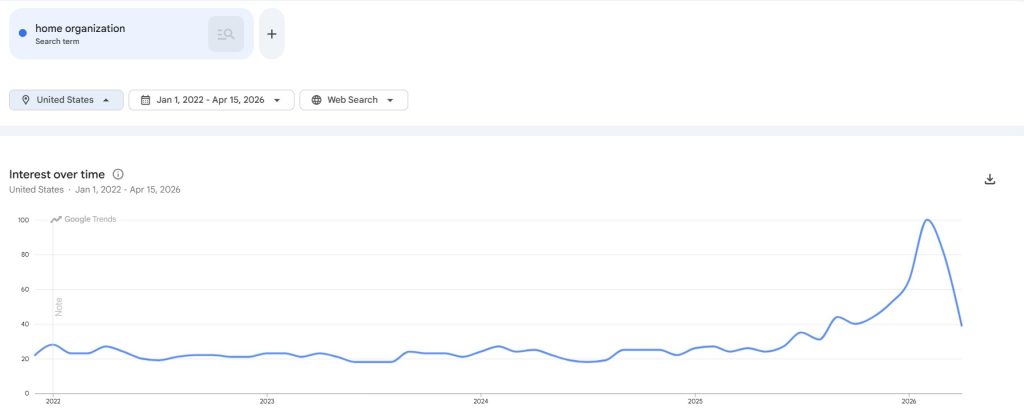
Urban renters represent the core buyer in this category. The key constraint is that permanent installation is not an option. Products that maximize space without drilling, nailing, or modifying rental surfaces have a built-in advantage. The solution only works if it is designed for renters specifically.
14. Under-Cabinet Slide-Out Storage Pods
- The buyer: Renter or apartment owner with limited counter space and no permission to drill
- The gap: Most existing under-cabinet storage requires installation hardware. Tool-free, slide-out pods that access dead cabinet space are a design improvement the market has not fully delivered.
- The signal: Search volume for renter-friendly storage has grown alongside urban rental market expansion. Quality versions consistently outsell budget alternatives in this category.
- Why it holds: The urban renter population is growing. The no-drill requirement is a permanent constraint, not a trend.
15. Vertical Spice Rack Systems (Refrigerator-Mounted)
- The buyer: Apartment dweller with no counter space, looking for a storage solution that looks intentional rather than improvised
- The gap: Magnetic spice systems exist but design quality ranges widely. Consistent container sizing and spice-specific labeling are the gaps review analysis identifies repeatedly.
- The signal: ‘Small kitchen storage’ and ‘apartment kitchen organization’ have seen steady search volume growth. The design-quality segment is underserved.
- Why it holds: The buyer reorders when containers or labels wear out. The system design creates repeat purchase behavior.
16. Closet Corner Rotating Maximizers
- The buyer: Walk-in closet owner whose corner space is permanently wasted and out of reach
- The gap: Rotating corner units exist but build quality is low. Adjustable shelving that fits different item sizes in the same corner unit is rare.
- The signal: Consistent BSR in the 10,000 to 25,000 range for existing options confirms steady demand. A quality-differentiated version has clear room to enter.
- Why it holds: Every walk-in closet has corner dead zones. The problem is universal.
17. Adjustable Drawer Divider Systems
- The buyer: Someone who wants one organization system that works across kitchen, bathroom, and home office drawers
- The gap: Most dividers are single-material, single-width. Modular systems that expand to fit different drawer sizes and compartment layouts have lower direct competition than fixed-size alternatives.
- The signal: Home organization search volume has held at elevated levels since 2020 and has not declined. The modular sub-category is growing within it.
- Why it holds: The buyer uses dividers across multiple rooms. A modular system drives multi-unit purchases in a single order.
18. Pantry Door Organizers for Narrow Apartment Doors
- The buyer: Apartment dweller who has tried standard pantry door organizers and found they do not fit
- The gap: Standard organizers are sized for full-depth house pantry doors. Apartment pantry doors are narrower. The narrow-door-specific version has very few dedicated SKUs despite clear buyer need.
- The signal: The buyer arrives at Amazon ready to buy. They have already tried the standard product and it failed. Conversion rates for this search are correspondingly strong.
- Why it holds: The apartment renter population is stable and growing in major cities. The door width problem is not going away.
19. Cable Management Desk Inserts
- The buyer: Remote worker with a cluttered home office desk who wants wire organization without replacing furniture
- The gap: Desk inserts with built-in wire routing and cable pass-through channels solve the problem at the furniture level without requiring a new desk. Most current options only address cable management at the floor or wall level.
- The signal: Cable management search volume has risen steadily since 2023 alongside remote work becoming a permanent arrangement. The desk-level sub-category is underserved.
- Why it holds: New monitors and devices create ongoing cable management needs. Remote work is here to stay.
Sustainable and Eco-Friendly
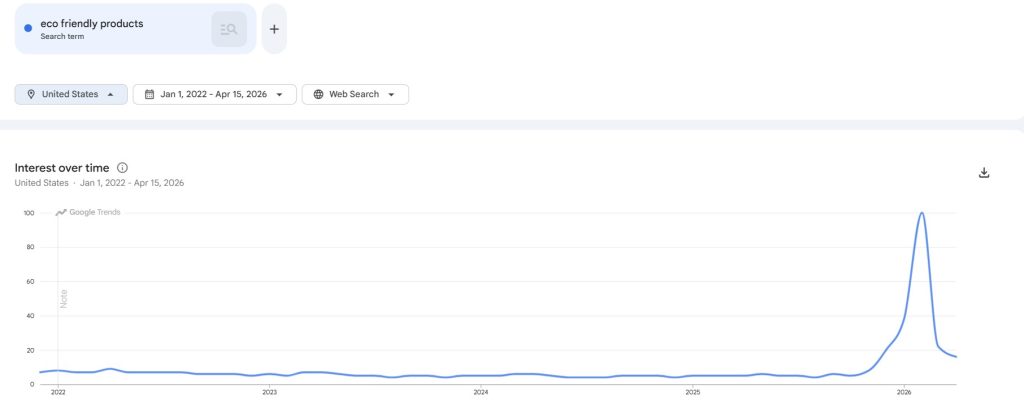
The sustainable product buyer who matters for margin is the function-first buyer. This is someone who chooses sustainable options when they perform at least as well as the conventional alternative. This buyer pays a premium, returns less, and reorders when components run out. Design around function, not image.
20. Zero-Waste Travel Toiletry Kits
- The buyer: A frequent traveler, six or more trips per year, who is done buying single-use travel sizes at airport shops
- The gap: Individual refillable containers exist at volume. A complete, TSA-compliant, leak-proof kit organized for airport security has lower competition than individual container listings.
- The signal: Sustainable travel product searches have risen steadily. The complete kit format has a cleaner path to purchase than buying components one by one.
- Why it holds: Silicone containers degrade over time. The buyer reorders kit components. Repeat purchase behavior is built in.
21. Compostable Phone Cases
- The buyer: Sustainability-conscious smartphone owner who wants protection without adding to plastic waste
- The gap: The market has grown alongside broader sustainability awareness but remains under-supplied for newer phone models. New iPhone and Android releases each September and October create short-window, high-demand opportunities.
- The signal: Compostable phone case search volume spikes predictably with new phone release cycles. First-mover advantage on new model compatibility is significant.
- Why it holds: Phone model releases happen annually. The buying cycle is predictable and recurring.
22. Biodegradable Cleaning Tablet Refills
- The buyer: A household buyer who wants to cut plastic cleaning product waste without giving up cleaning performance
- The gap: The refill model, concentrated tablets that dissolve in a reusable spray bottle, is significantly less crowded than the standard cleaning product category on Amazon. The buyer does not have to change habits, only switch format.
- The signal: Search volume for plastic-free cleaning alternatives has grown consistently. The tablet-format sub-category is still in its early stage.
- Why it holds: Cleaning is a recurring household need. The refill model creates the highest repeat purchase rate of any product type in this category.
23. Water Filter Bottles with Replaceable Cartridges
- The buyer: A regular water drinker who wants filtered water on the go without single-use plastic bottles
- The gap: The single-purchase reusable water bottle market is saturated. The cartridge-replacement model, where the initial bottle sale drives monthly cartridge reorders, is significantly less crowded.
- The signal: Search volume for filtered water bottles has grown steadily. The cartridge-specific search term is still low-competition.
- Why it holds: The cartridge replacement cycle creates ongoing revenue from a single customer acquisition.
24. Reusable Silicone Food Storage Systems
- The buyer: Someone who wants one purchase to replace plastic wrap and zip bags across all household food storage needs
- The gap: Individual silicone bags exist in volume. A complete system, multiple sizes with airtight seals sold as a coordinated set, has fewer active SKUs with comparable or stronger demand.
- The signal: Food waste reduction searches have grown alongside sustainability awareness. The full-system version commands a higher price point with less direct competition.
- Why it holds: Silicone containers wear over time. The buyer replaces individual components, maintaining the customer relationship.
25. Bamboo Kitchen Utensil Sets
- The buyer: Someone replacing an entire plastic utensil drawer in one purchase, further along in the decision process than a single-item buyer
- The gap: The sustainable kitchen category is crowded at the individual utensil level. Complete replacement sets have a higher price point, cleaner purchase intent, and lower competition than individual bamboo utensil listings.
- The signal: Search volume for bamboo kitchen sets is higher than individual bamboo utensil searches and growing faster. The complete-set buyer converts at a higher rate.
- Why it holds: A set that covers everything the buyer needs removes the need to compare across multiple SKUs. Lower friction, higher conversion.
Hobby and Craft Specialization
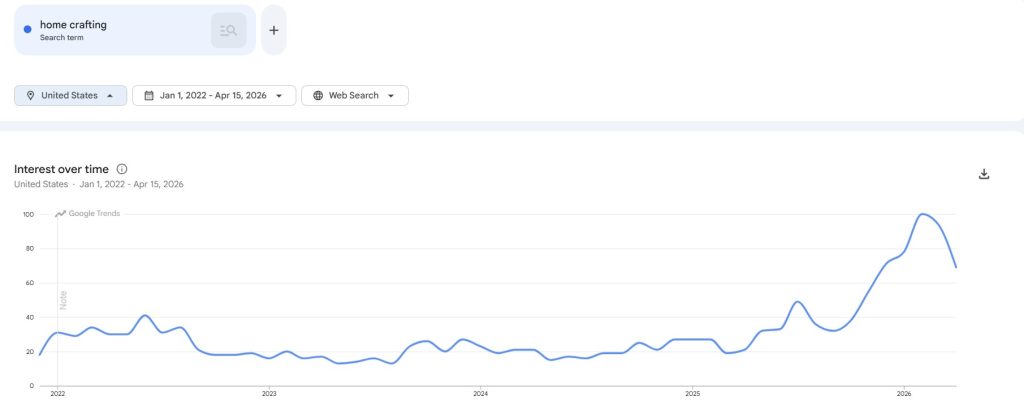
Craft supply remains underserved in the specialty segment because mass retailers stock wide rather than deep. A seller who focuses on one craft sub-category and stocks what serious practitioners actually need will consistently outperform general craft listings on Amazon. The buyer’s specific need gets met in one place.
26. Resin Casting Starter Kits
- The buyer: A beginner new to resin crafting who does not know what safety equipment they need alongside the materials
- The gap: Most kits currently leave out safety equipment entirely. A kit that includes gloves, a respirator mask, and clear safety guidance alongside the resin materials earns stronger reviews and lower return rates than kits that assume prior knowledge.
- The signal: Resin crafting search volume has remained elevated since 2020. The beginner-complete-kit search has lower competition than the general resin kit category.
- Why it holds: Beginners who succeed with their first kit become repeat buyers. Safety-inclusive kits reduce the failure rate that drives negative reviews.
27. Miniature Painting Precision Tools
- The buyer: A tabletop gaming enthusiast who paints miniatures and researches tools carefully before purchasing
- The gap: The category has a loyal, high-spending buyer base. Brand loyalty is moderate. Buyers will switch to a better tool. Review language consistently identifies brush tip quality and handle ergonomics as the gaps in current offerings.
- The signal: Tabletop gaming has grown consistently as a hobby. The painting sub-community is engaged and vocal. Review quality is high and specific.
- Why it holds: Brushes wear out. The buyer who trusts a brand repurchases every 3 to 6 months.
28. Leather Working Beginner Tool Sets
- The buyer: A beginner entering leather crafting who wants professional-grade quality but accessible pricing
- The gap: The market is split between low-quality beginner sets that frustrate buyers and expensive professional sets that are out of reach for new entrants. The mid-range, quality-first beginner set is an underserved position with confirmed demand.
- The signal: Leather crafting search volume has grown alongside the broader handmade goods market. Review complaints on budget beginner sets are consistent. ‘Broke immediately’ and ‘unusable for real leather’ are the patterns.
- Why it holds: A buyer who has a good first experience with leather working becomes a long-term craft supply customer.
29. Polymer Clay Conditioning Machines
- The buyer: A polymer clay artist who currently uses a standard pasta machine and finds the results inconsistent
- The gap: Standard pasta machines are the common workaround. Dedicated clay conditioning machines with roller gap settings built for clay weights, not pasta dough, have limited competition despite clear advantages.
- The signal: The buyer base is specific and purchases based on craft function. Search terms are specific and ready-to-buy. Competition is low because the category requires product knowledge to enter.
- Why it holds: The craft is sticky. Buyers who invest in proper tools continue the hobby. Accessories and clay follow the initial machine purchase.
30. Candle Making Digital Temperature Controllers
- The buyer: A home-based candle making business owner who needs consistent precision, not a hobbyist experimenting once
- The gap: Analog thermometers dominate the current market. Digital controllers with programmable temperature alerts for wax pouring are a clear improvement for anyone making candles at volume.
- The signal: The Etsy and Shopify candle business market has grown substantially. Search volume for candle making equipment has risen alongside small candle business growth.
- Why it holds: The business buyer is a more reliable repeat purchaser than a pure hobbyist. Tools wear out and get replaced as production volume grows.
31. Soap Making Mold Collections in Specialty Shapes
- The buyer: An artisan soap creator who has used up standard rectangle and oval mold options and wants design variety
- The gap: Standard mold shapes are well-supplied. Botanical, geometric, and architectural specialty shapes are consistently under-supplied relative to buyer demand. The search is specific. Buyers know what shape they want.
- The signal: Specialty shape search terms are low-competition and ready-to-buy. The buyer who finds the shape they need buys immediately.
- Why it holds: Molds wear over time. Artisan soap creators expand their mold collections as their product line grows. Repeat purchase rate is strong.
Remote Work and Home Office
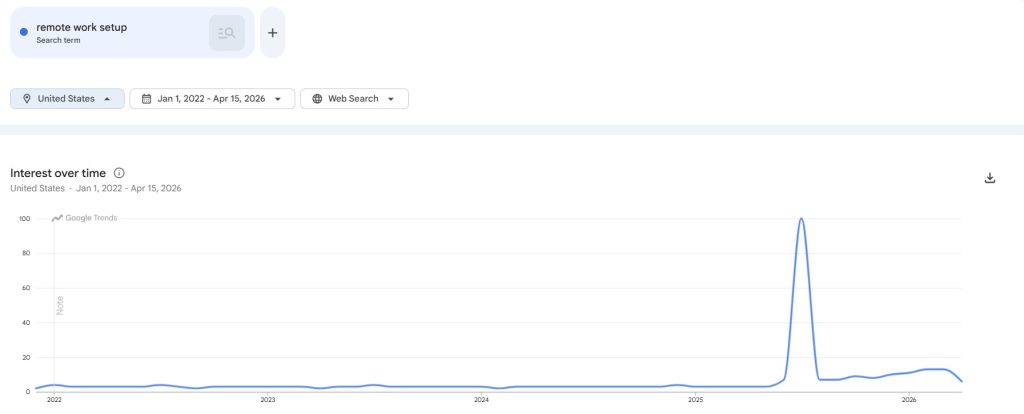
Remote and hybrid work is now a permanent part of how people work, not a temporary condition. The initial wave of ergonomic purchases in 2020 and 2021 addressed chairs and desks.
The second wave, smaller and more specific ergonomic pain points that developed after the initial setup, is currently underserved. This category is absent from most competitor lists on this topic, which is part of why it presents a clear opportunity.
32. Ergonomic Mice for Small Hands
- The buyer: Women, teenagers, and adults with naturally smaller hand dimensions who experience daily discomfort from standard-sized mice
- The gap: Nearly all ergonomic mice are designed for average male hand dimensions. The keyword ‘ergonomic mouse for small hands’ draws 200 to 500 monthly global searches with no dominant product in the results.
- The signal: The problem is a chronic daily discomfort. The buyer is not browsing. They are looking for a specific solution that does not currently exist at quality.
- Why it holds: Ergonomic accessories wear out and need replacing. The buyer who finds a mouse that fits becomes a loyal repeat purchaser.
33. Monitor Risers with Built-In Wireless Charging
- The buyer: A remote worker with a cluttered desk who wants fewer cables and a cleaner workspace
- The gap: Standard monitor risers are passive platforms. Adding Qi wireless charging removes a dedicated charger from the desk surface. The combined product has fewer active SKUs than either product individually.
- The signal: Both monitor riser and wireless charger search volumes are high and growing. The combined product serves both audiences in one SKU.
- Why it holds: As wireless charging standards evolve, buyers upgrade. The product has a natural replacement cycle.
34. Under-Desk Foot Hammocks
- The buyer: A remote worker managing lower leg fatigue and back discomfort during long seated sessions
- The gap: The product exists in limited versions. Most options are not adjustable for desk height. The buyer arrives already in discomfort and ready to act. Purchase intent is among the highest in the remote work category.
- The signal: Search volume is growing alongside ergonomic health awareness. The buyer is specific in their search. Competition in the adjustable version is low.
- Why it holds: Ergonomic needs are ongoing. The buyer who benefits from the product recommends it and returns for replacements.
35. Laptop Cooling Stands with Adjustable Angle
- The buyer: A remote worker using a laptop as their primary machine who has developed neck strain from fixed-position use
- The gap: Fixed-angle laptop stands dominate the market. Adjustable-angle versions, allowing precise angle control for different seating positions and desk heights, are a sub-category with rising demand and lower competition.
- The signal: Neck strain and ergonomic posture searches have grown alongside laptop adoption as a primary work device. The adjustable-angle specific search is underserved in results quality.
- Why it holds: Laptops are replaced more often than desks. Each new device is a potential stand repurchase.
36. Anti-Fatigue Mats with Pressure-Point Zones
- The buyer: A standing desk user looking for more than passive cushioning, specifically foot circulation support during long standing sessions
- The gap: Standard standing desk mats are flat cushion surfaces. Mats with raised pressure-point zones that actively support foot circulation command a higher price point and have stronger health positioning. The sub-category has fewer than 30 active listings with meaningful sales history.
- The signal: Standing desk adoption has grown consistently. The premium anti-fatigue mat sub-category is a natural follow-on purchase for buyers who already own a standing desk.
- Why it holds: Mats compress over time and need replacing. The premium segment buyer replaces rather than downgrades.
37. Desk Privacy Panels for Open-Plan Spaces
- The buyer: A remote worker in a shared apartment or open co-working space who needs visual and sound separation for video calls
- The gap: Office-grade privacy panels require installation and are sized for corporate desks. The home-desk, renter-friendly version, free-standing, no-drill, and sized for home setups, is under-supplied relative to demand created by hybrid work becoming permanent.
- The signal: ‘Work from home privacy’ and ‘home office divider’ search terms have grown consistently since 2022. The home version is a distinct product from the office-grade version.
- Why it holds: As remote work becomes permanent for more workers, home office setup becomes a durable spending category.
Baby and Toddler Specialty
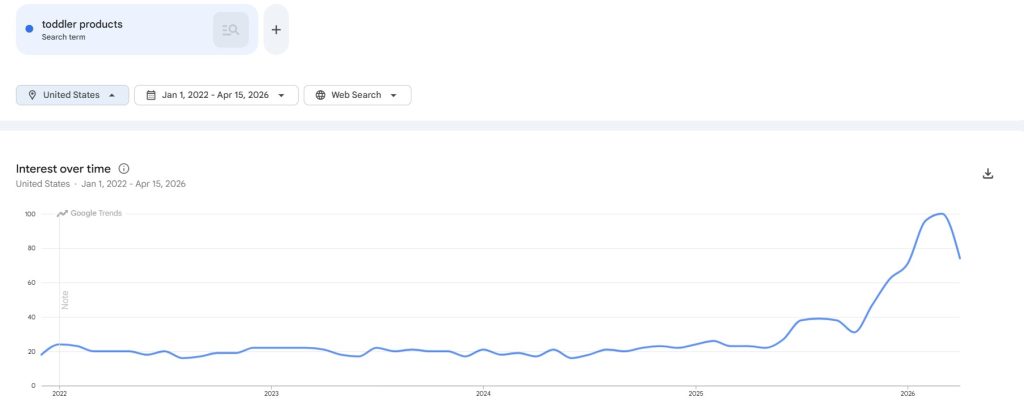
This category is notable for two reasons. First, it is largely absent from every competitor page currently ranking on the first page for this keyword. Most product research content focuses on adult buyers.
Second, the parent buyer in the $35 to $75 price range is among the highest-converting shoppers on Amazon. They research thoroughly and purchase quickly when the right product appears.
38. Weighted Sleep Sacks for Toddlers with Sensory Sensitivities
- The buyer: A parent managing a toddler’s sleep challenges, often guided by a therapist or pediatrician toward weighted solutions specifically
- The gap: Standard weighted blankets are sized and weighted for adults. Weighted sleep sacks for toddlers, with appropriate weight ratios for a child’s body and wearable design that prevents bunching, are a sub-category with very few quality SKUs.
- The signal: Pediatric sleep and sensory sensitivity have grown as parent search topics since 2022. The toddler-specific weighted wearable is a distinct need from the adult weighted blanket market.
- Why it holds: Children grow out of sizes. The buyer returns for the next size up as the toddler develops.
39. Montessori-Style Open Toy Storage Systems
- The buyer: A Montessori-aligned parent who wants storage that supports child independence rather than adult tidiness
- The gap: Existing toy storage is primarily adult-height and closed-front, designed for visual tidiness rather than child self-access. Low, open-face, modular storage that allows toddlers to self-select and return toys is a genuine design gap.
- The signal: Montessori parenting searches have grown substantially since 2021. The buyer segment is research-driven and willing to pay for products that match their parenting approach.
- Why it holds: As children grow, storage needs change. The modular system design drives additional component purchases.
40. Toddler Meal Prep Storage Systems
- The buyer: A parent preparing toddler meals in advance who needs allergen-separated compartments in toddler-appropriate portion sizes that fit a standard lunch bag
- The gap: Adult meal prep containers exist at volume. Toddler-specific versions, smaller portions, separate allergen compartments, and soft-edge design for little hands, have very few dedicated SKUs.
- The signal: Toddler nutrition and meal planning searches have grown alongside broader parental wellness trends. The purchase intent is specific and high.
- Why it holds: Toddlers progress through developmental stages. Storage needs change as portion sizes and dietary variety expand.
41. Toddler Travel Utensil Kits
- The buyer: A parent managing toddler meals away from home who needs a self-contained kit with no small-parts choking risk
- The gap: Existing travel utensil kits are designed for adults or older children. Toddler-specific kits with soft-tip utensils, a carry case, and age-appropriate safety design are a clear unmet need with minimal SKU competition.
- The signal: The toddler-specific search term in utensil searches is low-competition and ready-to-buy. The buyer knows exactly what they need and cannot find it.
- Why it holds: Toddler utensils wear out from use and dishwasher cycles. The buyer reorders as kits wear or get lost.
42. Sensory Play Kits for 18 Months to 3 Years
- The buyer: A parent supporting toddler sensory development who wants a complete, age-appropriate, safe materials kit without sourcing components separately
- The gap: Curated sensory kits exist for infants and for preschool age. The 18-month to 3-year range, where sensory play has the highest developmental impact, has fewer complete kit options than either adjacent age group.
- The signal: Sensory development has become a mainstream parenting topic. The age-specific search drives ready-to-buy traffic that current SKUs do not fully satisfy.
- Why it holds: Sensory kits are consumable in practice. Materials deplete and get replaced. The developmental stage also drives a natural upgrade cycle.
Why Products That Sell at 200 Units Often Fail at 2,000
Finding a gap in the market is one part of the decision. The other part is understanding whether the product’s economics hold up when volume increases. This is where most product research frameworks stop, and where a meaningful portion of seller failures actually begin.
Dimensional Weight and Its Effect on Margin
Products that are light but physically large, such as foam organizers, large pet beds, and bulky storage systems, are priced in shipping by box size, not actual weight.
- A product with a 60% gross margin at the factory can arrive at 20% net margin after dimensional weight charges at scale
- The dimensional weight formula is: length x width x height in inches, divided by 139, for most domestic carriers
- Products above 12 x 12 x 8 inches need a careful DIM weight model before any sourcing decision is finalized
Run the calculation before you commit. Not after your first shipment lands.
Return Rate Patterns by Category
Every product category carries a baseline return rate that belongs in your margin model:
- Electronics: 20 to 25 percent return rate is a category norm
- Apparel: Higher than electronics
- Home organization, consumables, pet products: Structurally lower
A product that looks profitable at a 5% return rate assumption may be break-even at the category’s actual 18% baseline. Review analysis helps identify this risk early. If a significant portion of three-star reviews mention ‘not as described’ or ‘quality not as shown,’ the return rate is likely above the category average.
Storage Velocity and Seasonal Exposure
Products that generate 80 percent of their annual revenue in a 90-day window carry significantly higher risk than products with steady year-round demand.
- Seasonal products accumulate storage fees in the off-peak period
- For sellers using FBA or third-party fulfillment, slow-moving inventory charges add up monthly
- Model storage cost as a separate line item from cost of goods, not a rounding consideration
Fulfillment Complexity as a Competitive Advantage
Products that require specialized handling, such as kitting, multi-component assembly, fragile packaging, or specific prep labeling, are avoided by sellers who are not set up for it. That avoidance creates a natural barrier to entry.
Sellers who invest in the right FBA prep and fulfillment infrastructure can compete in these categories with fewer direct SKU competitors. The complexity that turns others away becomes a structural advantage.
Three Mistakes That Eliminate Viable Opportunities
Validating Demand at the Category Level Instead of the Sub-Niche
‘Pet products are growing’ is not a product insight. ‘Indoor cat owners with multi-pet households have no enrichment option that works in limited floor space’ is.
Category-level demand validation creates a false signal. A growing category can have a crowded generic product layer and an open specific-problem layer at the same time. The research framework above targets the specific-problem layer by design.
Ignoring Total Landed Cost in the Margin Model
Factory price plus ocean freight plus tariff plus domestic fulfillment plus return-rate allowance produces your actual margin. Sellers who build models on factory price alone routinely find that the margin at delivered cost is half of what the initial calculation suggested.
With China tariffs currently averaging above 47 percent on many product categories, the tariff line alone can erase an otherwise viable opportunity. Run the full landed cost model before any sourcing conversation begins.
Scaling Before Testing Fulfillment Reliability
A product that sells at small volume is not automatically a product that scales. Test with 200 to 500 units through the complete fulfillment process, including returns handling, before committing to a bulk order.
Operational failures at scale are significantly more expensive than the same failures at test volume. The 200-unit test is not expensive. It is the cheapest due diligence available.
Conclusion
The framework in this guide works across any category. The five demand signals, the three viability checks, and the total landed cost model are repeatable regardless of which niche a seller enters. The product list above identifies the categories currently carrying the clearest gap signals. But the method for finding new ones is more durable than any specific product on this list.
When the right product is identified and volume starts to move, the next challenge is maintaining delivery speed and order accuracy at scale.
AMZ Prep works with sellers at every stage, from first purchase order through eight-figure operations, across ecommerce fulfillment, FBA prep, and multi-channel distribution. For a fulfillment cost estimate specific to your product category, get a quote here.
Frequently Asked Questions
What does ‘low competition’ actually mean on Amazon?
Low competition means the top three listings in a category have fewer than 300 reviews, no single seller dominates the BSR consistently, and the price floor has not been declining over the past 12 months. It does not mean no competition. It means competition has not yet consolidated.
How many monthly searches should a product keyword have?
The 1,000 to 10,000 monthly search range is the most productive target. Below 1,000 and the addressable market may not support a viable inventory investment. Above 10,000 and brand-level competitors are typically already active with substantial ad spend.
Are high demand low competition products sustainable long-term?
Products solving ongoing daily problems sustain well. Products built on a viral moment or a single cultural trigger have a limited window. The evaluation framework in this guide is specifically designed to distinguish ongoing opportunities from trend-based ones.
Which free tools are most useful for identifying product gaps?
Google Trends for trajectory reading, Google Keyword Planner for search volume confirmation, and Amazon’s own New Releases and Movers and Shakers tabs for live category gap signals are all free. They are most effective used together rather than individually.
Which product categories carry the lowest seller saturation on Amazon right now?
Toddler-specific specialty products, breed-specific pet care, remote work sub-ergonomics, and sustainable products with function-first design all carry lower saturation relative to their demand signals than mainstream categories. Craft specialization sub-niches also remain open across multiple segments.

Arishekar N is a Vice President (VP) of Marketing at AMZ Prep, specializing in ecommerce fulfillment and Amazon logistics strategies with a proven track record of driving growth for e-commerce businesses. He is a strategic leader with extensive expertise in marketing, e-commerce operations, SEO & advertising, and branding.
Stay updated on his latest insights by following him







A 200–500 unit test before a bulk order makes sense with tariffs where they are. Cheaper to find problems early.
A 60–90 day lag from TikTok buzz to Amazon demand is just enough time to source. How consistent is that lag?
The price floor signal is underrated. If it’s falling, sellers are already fighting on price.
DIM weight is where “great margin” products fall apart. Pet beds and closet organizers look fine until fulfillment fees hit.
Velocity over count is a good call. 400 stale reviews are less scary than 50 growing by ten a month.
The ergonomic mouse example really hit home such an overlooked need!
Exactly! Most people walk right past products like that because they seem too simple, but that’s where the real opportunity hides. Everyday discomfort is a goldmine for the right seller.
Great reminder that real profits come from unmet customer demand.
Spot on, Priya. Chasing a trend feels exciting until the market gets saturated. Finding something people genuinely need but can’t easily find is where the margins actually hold up.
Fulfillment struggles are real outsourcing definitely seems like the smart move.
It really is, especially once order volume starts to grow. Trying to handle everything in house sounds like saving money but it usually costs more in time and mistakes. Letting the pros handle it frees you up to actually focus on growing the business.
I like the breakdown of tools Jungle Scout + SEMrush combo is powerful.
That combo covers both sides really well, demand on Amazon and search intent on Google. Using just one of them leaves a blind spot, so pairing them gives you a much fuller picture before you commit to anything.
This guide explains product research better than most courses I’ve seen.
That means a lot, Nora, genuinely. The goal was always to make this practical rather than theoretical. Most courses give you frameworks but skip the messy middle part where decisions actually get made.
Start with problems, not products’ might be the best line here.
It’s a simple shift but it changes everything. When you lead with the problem, the product almost picks itself and you already know there’s someone willing to pay for it.
Too many sellers forget to check search volume before diving in. This helps a lot.
So true, James. Excitement about a product idea can make you skip that step entirely, and then you’re sitting on inventory with no buyers. A few minutes of data research can save months of frustration.
Targeting smaller demographics = big wins. Loved that insight.
Glad it clicked! Smaller audiences are often far more loyal and less price sensitive too. You’re not competing with everyone, you’re just the perfect fit for someone specific.
Seasonality is something I often ignored… now I see why cash flow suffered.
It’s one of those things that only makes sense in hindsight, right? Once you start planning around seasonal demand, cash flow becomes so much more predictable. It’s a tough lesson but one of the most valuable ones.
Love how this focuses on solving problems, not just chasing trends.
That was the whole point behind writing it this way. Trends come and go, but problems stick around. Build around a real pain point and you’ve got something that can last well beyond a viral moment.