Most ecommerce sellers pick a cold storage partner without fully understanding what equipment that partner actually runs. You see the facility tour.
You hear about temperature zones. Something goes wrong later and you have no idea whether it was an equipment failure, a handling gap, or a facility that was never built for your product category.
This guide closes that gap. Stage by stage, you will see exactly what equipment powers a cold storage operation, what it does, and what questions it tells you to ask before you sign anything.
What is a Cold Storage Unit?
A cold storage unit is a temperature-controlled space built to keep your goods within a specific temperature range.
It can be as compact as a refrigerated container or as large as a dedicated blast freezer room inside a fulfillment warehouse. Simple concept. But the setup varies a lot depending on your product.
Before going further, here is one distinction worth locking in. A cold storage unit is a single component. A cold storage warehouse is a full facility running multiple units across different temperature zones at the same time.
If you want the full picture on what a cold storage warehouse offers as a fulfillment solution, AMZ Prep’s cold storage warehouse page covers that directly.
This guide focuses specifically on the equipment inside each unit, because that is what tells you whether a facility is actually built for your product.
Cold Storage Unit vs. Cold Storage Warehouse: What’s the Difference?
A cold storage unit is a single piece of refrigeration infrastructure. A walk-in cooler is a cold storage unit. A blast freezer is a cold storage unit.
A refrigerated container is a cold storage unit. Each one is a self-contained, temperature-controlled environment built for a specific purpose.
A cold storage warehouse is the full facility built around multiple cold storage units. It coordinates those units across temperature zones and layers in the staffing, technology, compliance systems, and fulfillment operations needed to manage inventory at scale.
When you evaluate a 3PL, you are not just asking whether they have a cold room.
You are asking whether their specific combination of cold storage units is configured correctly for your product type, your volume, and your compliance requirements.
That evaluation starts with knowing what each unit does and what equipment it contains.
Stage 1: Receiving and Inbound
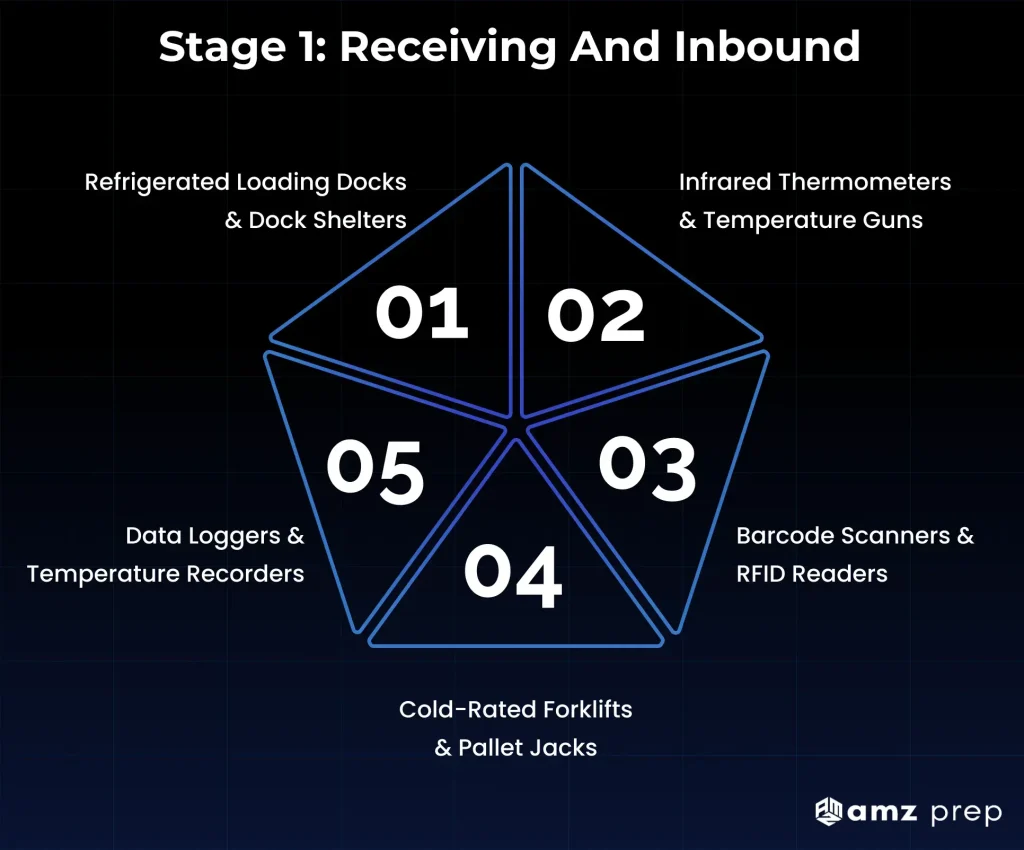
The moment your inventory arrives at a cold storage facility is one of the highest-risk points in your supply chain. Products warm up in transit more often than you would think.
If nobody catches it at receiving, that problem follows your shipment all the way to your customer.
Refrigerated Loading Docks and Dock Shelters
These create an insulated seal between the carrier vehicle and the warehouse entrance, keeping warm outside air away from your products during unloading.
Facilities without refrigerated docks expose your inventory to ambient temperatures every time a shipment comes in. That adds up over time.
Infrared Thermometers and Temperature Guns
Receiving staff should be spot-checking product temperatures with infrared thermometers the moment goods come off the truck.
Anything outside the acceptable range gets flagged and quarantined. Not every 3PL does this consistently on every inbound shipment, so it is worth confirming upfront.
Data Loggers and Temperature Recorders
These devices travel inside your shipments, recording temperature at regular intervals throughout transit. At receiving, the facility reviews that history to verify cold chain compliance from origin to destination.
For pharmaceutical or regulated food products, that record may be a legal requirement.
Cold-Rated Forklifts and Pallet Jacks
Standard forklifts are not built for freezing environments. Batteries drain fast, hydraulic fluid thickens, and rubber components go brittle.
Cold storage facilities run equipment built specifically for low-temperature operation, because every extra minute your pallets spend on a warm dock is a temperature risk.
Barcode Scanners and RFID Readers
Your inventory gets scanned into the Warehouse Management System the moment it is received. Lot numbers, expiry dates, and storage locations are all captured at the dock. This is one of the first steps that happens inside the fulfillment center, where inventory is tracked from receiving through storage.
This is what makes downstream traceability possible, whether that is a recall, a quality investigation, or expiry management.
Stage 2: Core Refrigeration and Storage Infrastructure
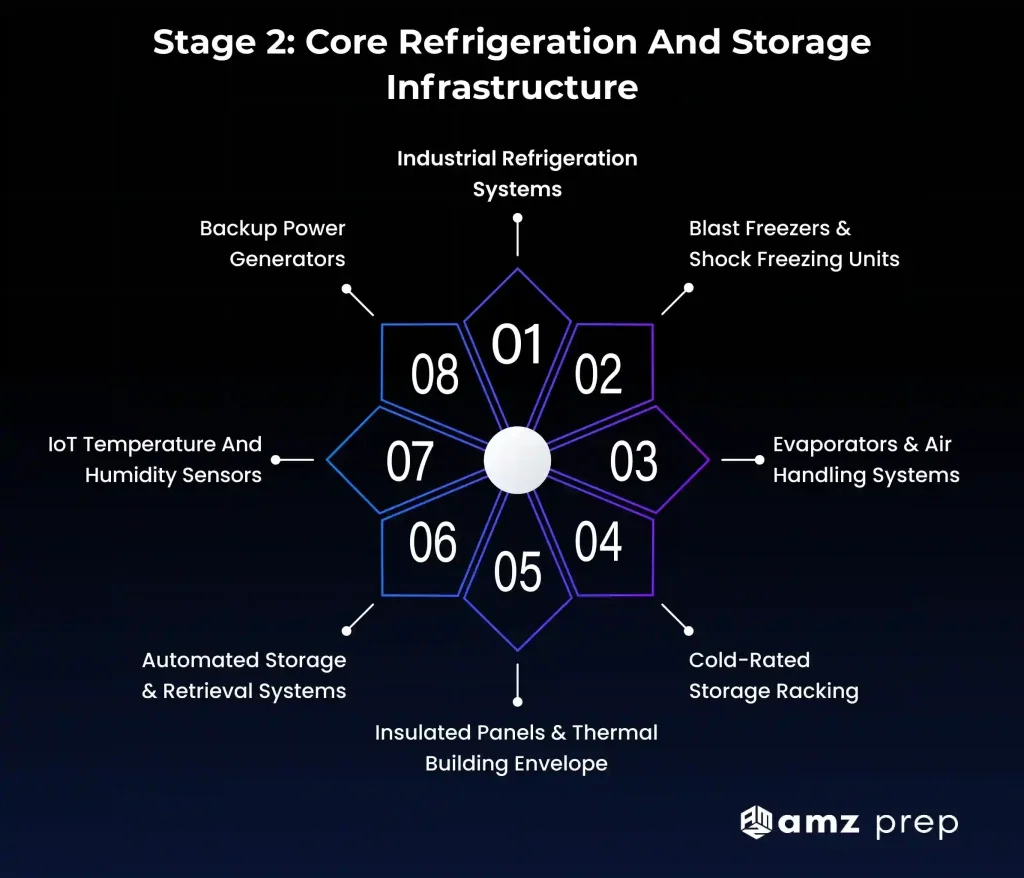
The equipment here determines whether your products stay at the right temperature 24 hours a day, 365 days a year.
Industrial Refrigeration Systems (Compressors and Condensers)
Compressors and condensers run continuously to maintain precise temperatures across different storage zones.
The facilities worth working with run multiple units in parallel with automatic failover. Always ask about refrigeration redundancy before signing with a 3PL.
Blast Freezers and Shock Freezing Units
If you are selling frozen products, this is non-negotiable. Blast freezers bring your products down to between -22°F and -40°F in a fraction of the time a standard freezer takes, preserving texture and stopping bacterial activity.
How quickly your products are frozen after receipt directly affects the quality your customers receive.
Evaporators and Air Handlers
Evaporators circulate cooled air evenly through cold rooms. Poor placement creates hotspots that are invisible during a walkthrough but can quietly damage your inventory over time.
Cold Storage Racking Systems
Standard racking corrodes quickly under cold, humid conditions. Cold-rated racking handles long-term moisture exposure.
The configuration determines how densely your products are stored and how quickly your team can access them.
Insulated Panels and Building Envelope
Cold room walls, ceilings, and floors are built from panels typically four to six inches thick to minimize heat transfer.
Floor insulation usually includes embedded heating elements to prevent ground freezing. This is the infrastructure your products live inside every day.
Automated Storage and Retrieval Systems (AS/RS)
Robotic AS/RS systems store and retrieve your pallets without workers entering the coldest zones, reducing door openings and keeping temperatures stable.
If your 3PL runs AS/RS technology, that is a strong signal of operational maturity.
IoT Temperature and Humidity Sensors
Wireless sensors monitor temperature and humidity in real time, with instant alerts if any zone drifts outside acceptable parameters.
Ask whether you can access this data for your storage areas. The best 3PLs offer seller-facing dashboards as a standard feature.
Backup Power Generators
A power outage without generator backup puts your inventory at serious risk. Generators should activate automatically within seconds of any power failure.
This belongs on your 3PL evaluation checklist without exception.
Stage 3: Inventory Management
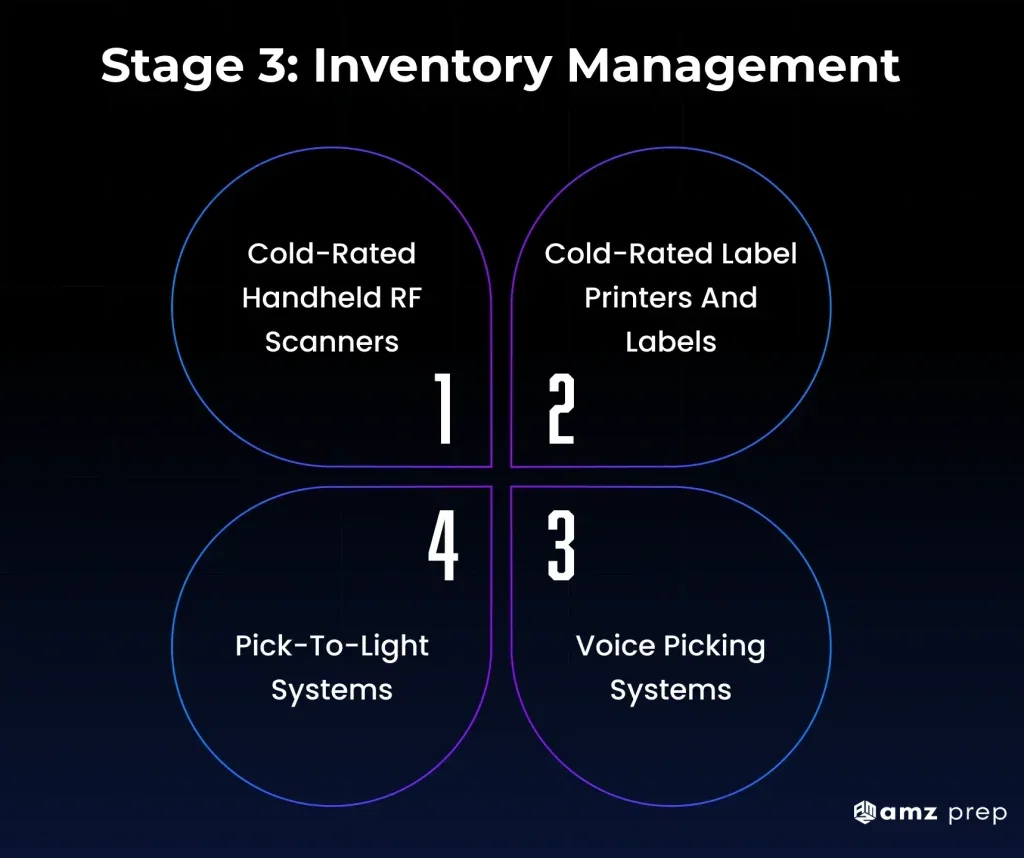
Storing products cold is only half the challenge. Managing them accurately, especially with expiry dates and lot-level traceability, requires its own dedicated layer of systems.
Warehouse Management System (WMS)
Your WMS tracks every SKU by location, lot number, quantity, and expiry date.
A properly configured system enforces FEFO (First Expired First Out) picking rules automatically, so your oldest inventory always ships first. For perishable sellers, this is not optional.
Cold-Rated Handheld RF Scanners
Cold-rated scanners have gloves-friendly touchscreens, reinforced casings, and batteries built for sub-zero conditions. Standard devices fail in these environments.
That slows operations and increases errors on your orders.
Cold-Rated Label Printers and Labels
Standard thermal labels peel, fade, or fail entirely in cold conditions.
Cold storage operations use specially formulated adhesive labels and low-temperature printers to keep every product and pallet label readable throughout storage.
Voice Picking Systems
Headset-based systems give workers verbal picking instructions, keeping hands and eyes free. In environments where heavy gloves are standard, voice picking is far more practical than touchscreen interaction.
Pick-to-Light Systems
LED indicator lights mounted on racking guide workers to the exact location and quantity to pick. In high-SKU cold operations, this reduces your pick errors and speeds up order assembly.
Stage 4: Pick, Pack and Fulfillment
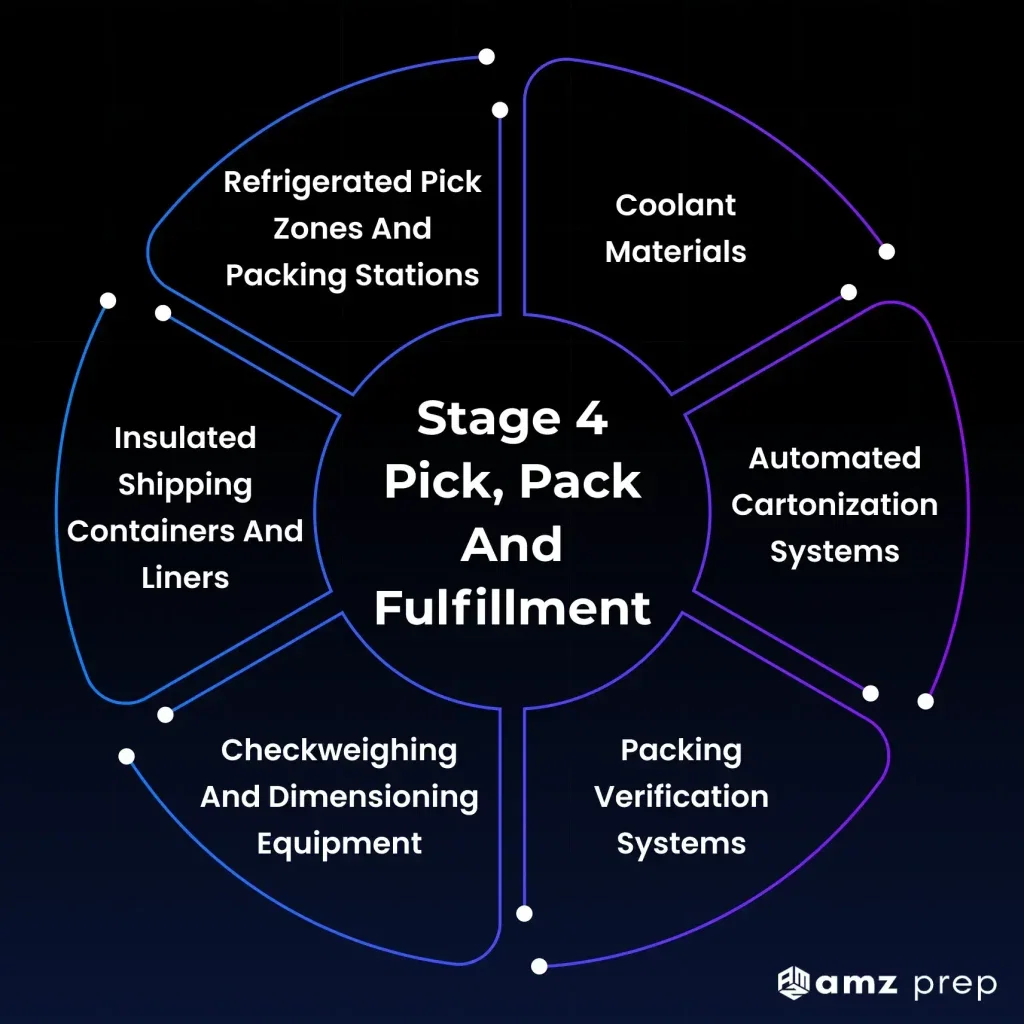
Every minute your temperature-sensitive products spend outside the cold environment is a risk to their integrity.
Refrigerated Pick Zones and Packing Stations
Your products should move from cold storage directly into a temperature-controlled pick and pack zone.
The best facilities include refrigerated packing benches to keep your products at temperature throughout the packing process.
Insulated Shipping Containers and Liners
Your packaging maintains the cold chain during last mile delivery. Options range from expanded polystyrene foam boxes to vacuum-insulated panels.
The right choice depends on your product’s temperature requirements and how long it needs to stay cold in transit.
Coolant Materials
Gel packs work well for chilled shipments. Dry ice handles frozen products but requires hazmat handling and carrier compliance.
Choosing the wrong coolant for your product type is one of the most common and costly cold chain mistakes sellers make.
Automated Cartonization Systems
These systems select the optimal box size for each order automatically. Less void space inside your insulated shippers means your cold lasts longer in transit.
Checkweighing and Dimensioning Equipment
Automated scales and dimensioners verify every packed order before it ships, catching packing errors before they reach your customer.
Packing Verification Systems
Scan-verify stations confirm correct products and quantities are sealed inside every package before it goes out. Your perishables cannot be restocked after a return. Catching errors here saves you significant money.
Stage 5: Outbound Shipping and Last Mile
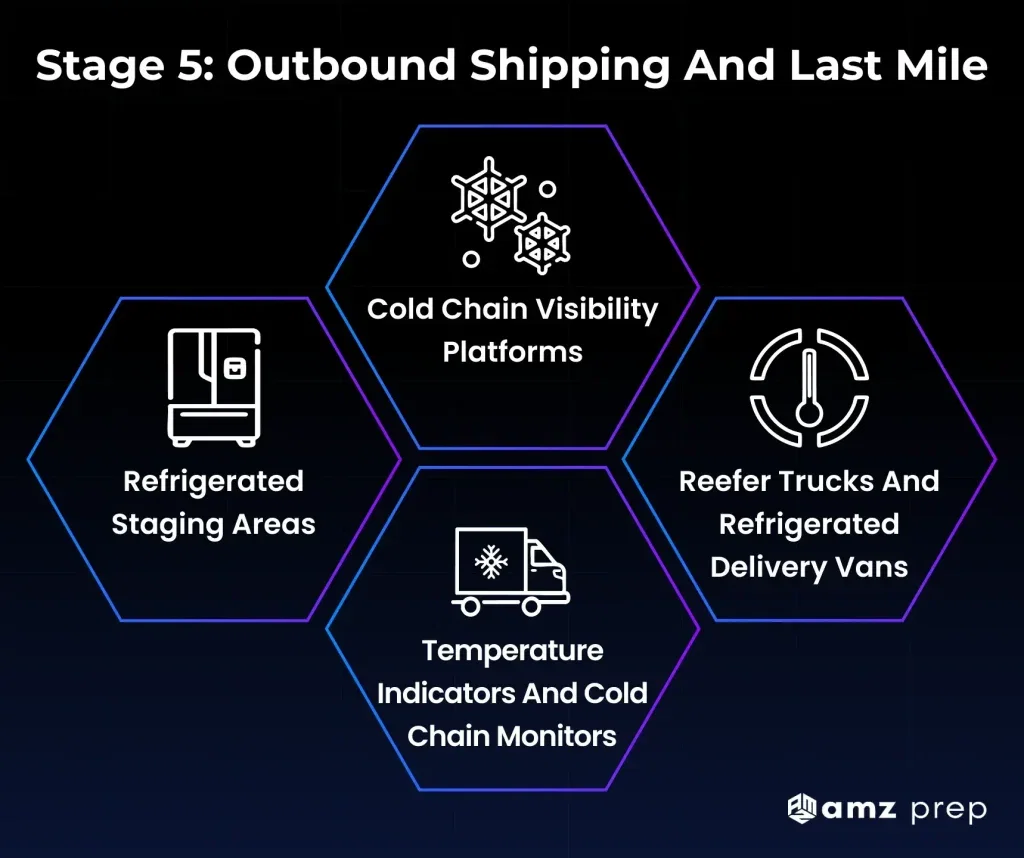
Your products are packed and ready. The cold chain now needs to extend all the way to your customer’s front door.
Refrigerated Staging Areas
Your packed orders are held in refrigerated staging before carrier pickup. The best facilities keep outbound staging at the same temperature zone as storage.
Facilities that leave your orders sitting on an ambient dock are cutting corners that cost you product quality.
Temperature Indicators and Cold Chain Monitors
Temperature indicator cards or data loggers inside your outbound shipments give customers verifiable proof of cold chain compliance.
For pharmaceutical sellers this is often a regulatory requirement. For food sellers, it builds trust.
Reefer Trucks and Refrigerated Delivery Vans
Refrigerated semi-trailers handle your B2B deliveries. Refrigerated vans and temperature-controlled couriers cover last mile ecommerce. Not every carrier offers this, so comparing Reefer Shipping Companies can help you evaluate carrier coverage, temperature capabilities, and service reliability before choosing a 3PL.
To understand what to look for in ecommerce shipping more broadly, see our ecommerce shipping best practices guide.
Cold Chain Visibility Platforms
These platforms combine GPS tracking, temperature data, and carrier updates into a single dashboard.
Ask any prospective cold storage partner whether they offer seller-facing shipment visibility as a standard feature, not an add-on. You should never hear about a temperature problem from a customer complaint first.
Stage 6: Quality Control and Compliance
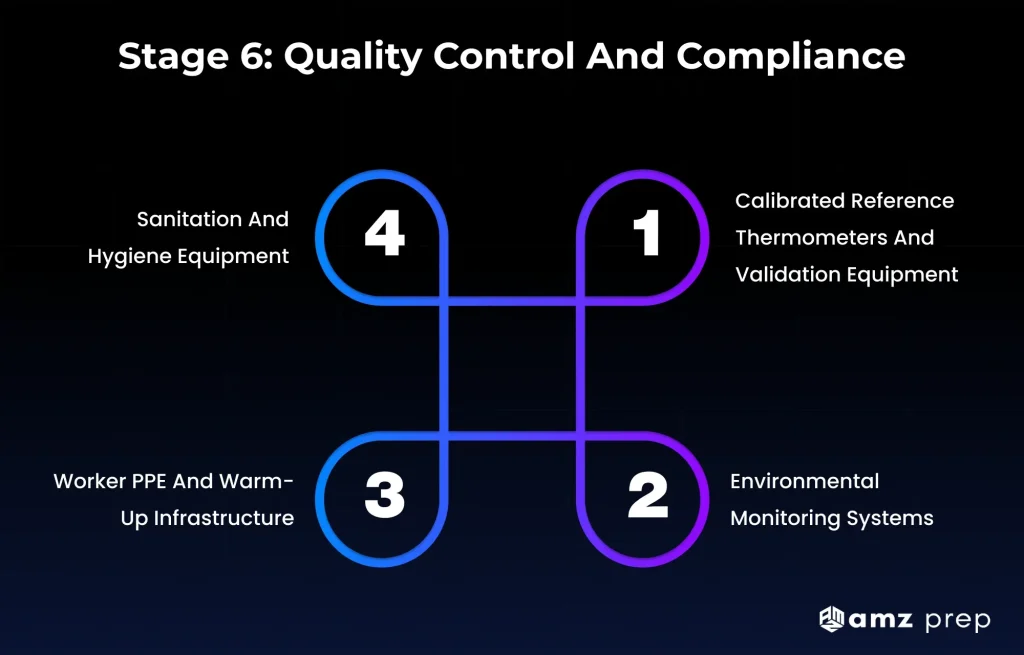
Quality control runs across every stage of your cold storage operation, with dedicated equipment for maintaining regulatory compliance and verifying your product integrity throughout.
Calibrated Reference Thermometers and Validation Equipment
All temperature monitoring devices need regular calibration against traceable reference standards.
For pharmaceutical cold storage, this includes formal IQ/OQ/PQ validation protocols. Ask your 3PL for current calibration certificates before committing.
Environmental Monitoring Systems (EMS)
Continuous monitoring systems produce fully auditable, timestamped, and tamper-evident data logs. A peptide fulfillment service uses those logs to prove the cold chain held while the shipment was in transit. If your product category requires this level of documentation, verify your 3PL’s EMS meets the applicable regulatory standard before signing.
Sanitation and Hygiene Equipment
Cold environments require specialized cleaning chemicals that stay effective at low temperatures.
Ask your 3PL about their sanitation protocol and what food safety certification they hold. SQF, BRC, and AIB are the ones worth looking for.
For sellers in the cosmetics category specifically, our cosmetics and beauty cold storage guide outlines the exact certifications and conditions required.
Worker PPE and Warm-Up Infrastructure
Insulated jackets, thermal gloves, anti-slip footwear, and face protection are mandatory in freezing environments.
Compliant facilities provide heated break rooms and warm-up zones. How well your 3PL takes care of its workers directly affects how consistently your inventory gets handled.
Equipment by Product Category: Quick Reference Tables
Now that you know what equipment runs at each stage, here is how it maps to your specific product category.
Fresh Food and Produce
| Stage | Key Equipment |
|---|---|
| Receiving | Refrigerated docks, infrared thermometers, cold-rated forklifts, barcode scanners |
| Storage | Evaporators, humidity controls, selective racking, IoT sensors, insulated panels |
| Inventory Management | WMS with FEFO, cold-rated RF scanners, cold-rated label printers |
| Pick and Pack | Refrigerated pick zones, EPS foam shippers, gel packs, checkweighers |
| Outbound Shipping | Refrigerated staging, refrigerated vans, temperature indicator cards |
| Quality Control | Calibrated thermometers, SQF/BRC certified sanitation equipment, PPE |
Frozen Food Products
| Stage | Key Equipment |
|---|---|
| Receiving | Cold docks, data loggers, infrared thermometers, cold-rated forklifts |
| Storage | Blast freezers, industrial compressors, AS/RS systems, backup generators, IoT sensors |
| Inventory Management | WMS with FEFO, voice picking systems, cold-rated RF scanners, cold-rated labels |
| Pick and Pack | Dry ice, polyurethane foam shippers, automated cartonizers, packing verification |
| Outbound Shipping | Sub-zero staging areas, reefer trucks, dry ice compliant packaging, cold chain monitors |
| Quality Control | Calibrated thermometers, food safety certifications, sanitation equipment, PPE |
Pharmaceutical and Nutraceutical Products
| Stage | Key Equipment |
|---|---|
| Receiving | Data loggers, refrigerated docks, RFID readers, infrared thermometers |
| Storage | IoT sensors, EMS systems, AS/RS systems, redundant compressors, generator with UPS |
| Inventory Management | WMS with lot traceability, cold-rated label printers, cold-rated RF scanners |
| Pick and Pack | Vacuum insulated panels (VIPs), liquid nitrogen systems, packing verification cameras |
| Outbound Shipping | Electronic cold chain monitors, refrigerated staging, cold chain visibility platforms |
| Quality Control | 21 CFR Part 11 EMS, IQ/OQ/PQ validation equipment, calibration certificates |
Cosmetics and Natural Beauty Products
| Stage | Key Equipment |
|---|---|
| Receiving | Infrared thermometers, dock shelters, barcode scanners |
| Storage | Chilled storage rooms (35°F to 45°F), humidity controls, IoT sensors, selective racking |
| Inventory Management | WMS with FEFO, cold-rated labels, cold-rated RF scanners |
| Pick and Pack | Insulated liners, gel packs, packing verification systems, checkweighers |
| Outbound Shipping | Refrigerated staging, temperature indicator cards, cold-rated carrier network |
| Quality Control | Calibrated thermometers, humidity monitoring, sanitation equipment |
Specialty Beverages (Wine, Cold Brew, Kombucha)
| Stage | Key Equipment |
|---|---|
| Receiving | Refrigerated docks, infrared thermometers, data loggers, barcode scanners |
| Storage | Chilled rooms with humidity control, mobile racking, IoT sensors, insulated panels |
| Inventory Management | WMS with FIFO, cold-rated RF scanners, cold-rated label printers |
| Pick and Pack | Insulated shippers, gel packs, automated cartonizers, checkweighers |
| Outbound Shipping | Refrigerated vans, temperature indicators, cold chain visibility platforms |
| Quality Control | Calibrated thermometers, humidity monitoring, food safety certifications, PPE |
What to Ask Your Cold Storage Partner About Their Equipment
Knowing the equipment is only useful if you know what to do with that knowledge.
Here are the questions that separate a serious cold chain operation from one that will cost you inventory and customers.
Do they have redundant refrigeration systems with automatic failover?
What happens to your products during a power outage and how fast does backup power kick in?
Can you access real-time temperature monitoring data for your storage areas as a seller, or do you have to ask for it?
Does their WMS enforce FEFO automatically and can they show you how?
What coolant options do they offer and are those options appropriate for your product’s temperature requirements and transit windows?
What food safety or pharmaceutical certifications does the facility hold and are those certifications current?
Can they provide temperature records and data logger reports for both inbound and outbound shipments on request?
What is their documented process when a temperature excursion is detected?
Are their cold-rated handling equipment, labels, and scanning devices actually purpose-built for your temperature zone?
A 3PL that answers these questions clearly and specifically has invested in the right infrastructure. One that deflects or goes vague has gaps worth finding before your inventory is inside their facility.
Final Thoughts
Understanding the equipment inside a cold storage unit is the first step. The next step is finding a partner whose infrastructure is actually built for your product category.
AMZ Prep operates purpose-built cold storage facilities across North America with multi-zone temperature control, redundant refrigeration systems, FEFO-capable inventory management, and seller-facing monitoring dashboards.
This playbook covers fulfillment planning, storage transitions, and Amazon policy requirements for sellers managing meltable inventory. Button: Download the Meltable Season Playbook
Frequently Asked Questions
What is the difference between a cold storage unit and a cold storage warehouse?
A cold storage unit is a single piece of refrigeration equipment, like a walk-in cooler or blast freezer. A cold storage warehouse is a full facility with multiple units across different temperature zones, with the staff, technology, and operations to manage inventory at scale.
What temperature does a cold storage unit maintain?
It depends on what you’re storing. Chilled units run 32°F–45°F, standard frozen units operate 0°F to -4°F, blast freezers reach -22°F to -40°F, and ultra-low temperature units for pharmaceuticals can go to -80°F or below.
What equipment do I need for cold storage ecommerce fulfillment?
Your 3PL owns the equipment, not you. What you need to verify is that they have the right temperature zones, refrigeration redundancy, FEFO-capable inventory management, and carrier coverage to reach your customers.
How do cold storage facilities prevent temperature excursions?
Look for multiple overlapping systems: IoT sensors, redundant compressors, backup generators, and insulated doors with air curtains. If one system fails, the others keep your products protected.
What is a blast freezer and when does an ecommerce seller need one?
If your products arrive warm or chilled and need to be frozen, you need a 3PL with blast freezer capability. Without it, your products are likely being slow-frozen in a standard freezer, which degrades texture, quality, and shelf life.
What certifications should a cold storage 3PL hold for food products?
For food, look for SQF, BRC, AIB, or HACCP depending on your category and retail channel. For pharma, GDP compliance and 21 CFR Part 11-compliant monitoring are the standard. Always ask for current certificates.
Can the same cold storage unit store different product types?
Only if they share identical temperature requirements and there’s no cross-contamination risk. Your frozen, chilled, and pharmaceutical products should always be kept in separate zones.

Arishekar N is a Vice President (VP) of Marketing at AMZ Prep, specializing in ecommerce fulfillment and Amazon logistics strategies with a proven track record of driving growth for e-commerce businesses. He is a strategic leader with extensive expertise in marketing, e-commerce operations, SEO & advertising, and branding.
Stay updated on his latest insights by following him
















Comments