
Your shipping strategy controls whether customers buy from you or abandon their carts. 39% of online shoppers abandon purchases because of unexpected shipping costs. Another 55% expect delivery within 2-3 days regardless of whether they pay for expedited shipping.
These numbers define modern ecommerce shipping in 2026. Fast delivery and low costs are no longer premium features. They are baseline expectations.
The challenge: shipping costs rose 18% year-over-year, while customer willingness to pay for shipping dropped. Brands that solve this paradox win. Brands that ignore it lose market share.
This guide covers the operational strategies that reduce shipping costs while maintaining delivery speed. No theory. No fluff. Just tested methods from brands processing 10 million+ units monthly.
Understanding Ecommerce Shipping
Shipping in Ecommerce includes processing orders, packing items, and delivering them to customers. Efficient shipping reduces costs, improves customer satisfaction, and enhances business reputation.
When to Self-Fulfill vs. When to Use a 3PL
The self-fulfill vs. 3PL decision comes down to monthly order volume and time cost.

Self-Fulfillment Makes Sense
- Under 1,000 orders monthly
- Specialized handling requirements (fragile, custom packaging, regulated products)
- Complete control over unboxing experience matters more than cost efficiency
- Time investment: 15-25 hours weekly on packing, labeling, carrier coordination
3PL Makes Sense
- 3,000+ orders monthly (logistics becomes growth bottleneck)
- Multi-channel selling (Amazon FBA + Shopify + wholesale)
- Seasonal volume spikes (Q4 demand exceeds internal capacity)
- Time investment: 2-5 hours weekly on oversight and exception handling
The In-Between Zone (1,000-3,000 orders/month)
Hybrid models work best. Self-fulfill standard orders, outsource peak season overflow to regional 3PLs. This maintains control while building 3PL relationships for future scale.
Cost Reality Check
3PLs charge $3-8 per order (pick, pack, ship) depending on product size and volume tier. Self-fulfillment costs $2-4 per order in direct materials but requires warehouse space, insurance, and labor. Factor your own time cost at $50-100/hour. Most brands break even on pure costs but gain 10-20 hours weekly by outsourcing.
Multi-Carrier Strategy: Why Single-Carrier Reliance Costs You Money
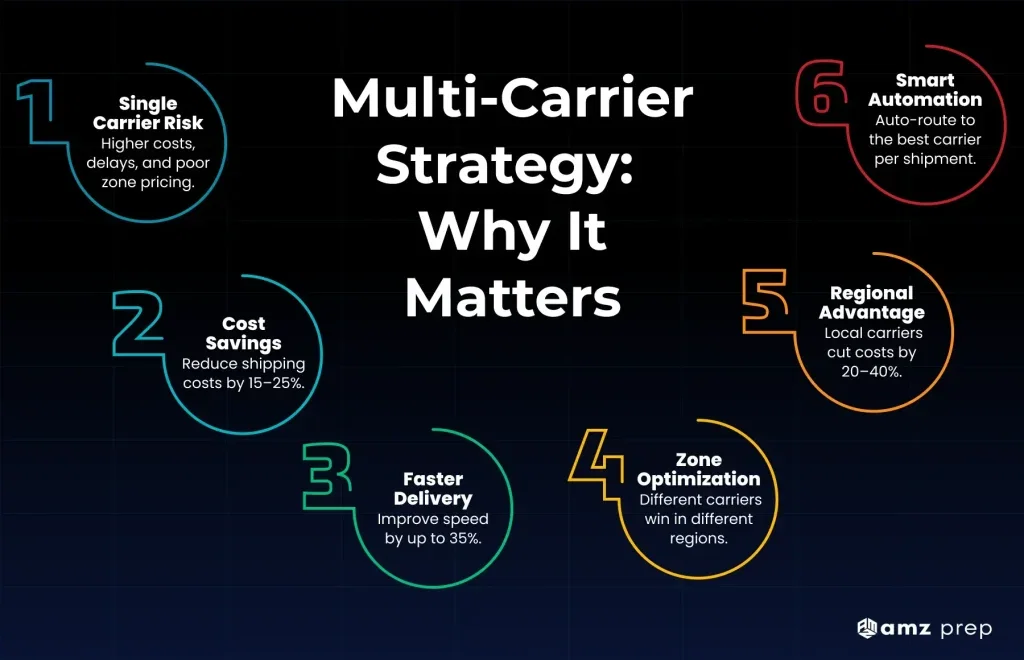
Relying on one carrier exposes you to three costly vulnerabilities: rate increases, delivery failures, and zone pricing inefficiencies.
The Data
Multi-carrier strategies reduce shipping costs by 15-25% and improve delivery speed by 35% compared to single-carrier operations. Why? Carriers price zones differently. UPS wins on East Coast-to-Midwest. FedEx wins on West Coast-to-South. USPS wins on lightweight residential deliveries under 1 lb.
How to Build Multi-Carrier Operations
1. Baseline Audit: Pull 90 days of shipping data. Sort by destination zone, package weight, and delivery speed. Identify your top 5 destination zones.
2. Rate Shop by Zone: Request quotes from UPS, FedEx, USPS, and regional carriers (LaserShip, OnTrac, Lone Star Overnight) for your actual volume and destination mix. Compare zone-specific rates, not blanket discounts.
3. Automated Carrier Selection: Use shipping software (ShipStation, Shippo, Easyship or other shipstation competitors) that automatically routes orders to the cheapest carrier for each specific shipment based on real-time rates, destination zone, and service level.
4. Regional Carrier Integration: Add regional carriers for final-mile delivery in your highest-volume zones. Regional carriers undercut national carriers by 20-40% in their service areas.
5. Backup Routing: Configure automatic failover to secondary carriers when primary carrier experiences delays or capacity constraints (happens frequently during Q4).
Implementation Time: 2-3 weeks to integrate carriers and configure routing rules. ROI payback: First month for most brands over 500 orders monthly.
Best Ecommerce Shipping Practices in 2025
Let’s take a look at some of the measures and how they need to be implemented for an effective ecommerce shipping strategy in 2025
Reduce Fulfillment Errors to Under 0.5%
Fulfillment errors cost 2-3x the original order value when you factor in replacements, return shipping, and customer service time. Target error rate: Under 0.5% (5 errors per 1,000 orders).
Barcode Scanning at Every Step
Scan items during pick, pack, and ship-out stages. Eliminates 87% of wrong-item shipments. Cost: $200-400 for USB barcode scanner + $30/month for warehouse management software.
Bin Location System
Assign fixed storage locations (Bin A1, Bin B3, etc.) for each SKU. Never store same SKU in multiple locations. Reduces pick time by 35% and wrong-SKU picks by 72%.
Two-Person Verification for High-Value Orders
Orders over $200 require second-person pack verification before sealing. Catches errors before shipment. Labor cost: 45 seconds per high-value order.
Pack Verification Photography
Photograph inside of package before sealing for orders over $100. Eliminates customer fraud claims and provides proof of correct fulfillment. Storage cost: $0.02/photo using cloud storage.
Offer 3 Shipping Tiers (Not 5, Not 1)
The optimal number of shipping options is three. Fewer creates decision paralysis or no choice. More creates analysis paralysis.
Standard Ground (4-7 business days)
- Price: Free above $75 order threshold, or $5-8 flat rate
- Carrier: Cheapest option via multi-carrier selection (usually USPS for <1lb, UPS/FedEx for heavier)
- Conversion: 68% of customers choose this option
Two-Day Expedited
- Price: $12-18 depending on zone
- Carrier: UPS 2nd Day Air or FedEx 2Day
- Conversion: 27% of customers choose this option
- Profit margin: Usually breaks even or slight loss, but increases conversion rates 15-22%
Next-Day Express
- Price: $25-40 depending on zone
- Carrier: UPS Next Day Air or FedEx Priority Overnight
- Conversion: 5% of customers choose this option
- Profit margin: 40-60% margin on shipping surcharge
DO NOT offer: Same-day delivery unless you operate in major metros with local fulfillment centers. Infrastructure cost exceeds revenue for 95% of ecommerce brands.
Dimensional Weight Optimization: The Hidden Cost Killer
Carriers charge based on dimensional weight (length × width × height ÷ 166 for domestic, ÷ 139 for international) OR actual weight, whichever is greater. Bulky, lightweight products get destroyed by dim weight pricing.
The Math
- Package: 16″ × 12″ × 8″ box, actual weight 2 lbs
- Dimensional weight: (16 × 12 × 8) ÷ 166 = 9.2 lbs
- You pay for 9.2 lbs, not 2 lbs
- Cost difference: $4.50 vs. $12.80 (Zone 5, UPS Ground)
Right-Size Packaging
Stock 6-8 box sizes, not 2-3. Every inch of unused space costs money. Invest in custom packaging for your bestselling products. ROI: 4-8 weeks.
Poly Mailers for Soft Goods
Apparel, textiles, and non-fragile items ship 40-60% cheaper in poly mailers vs. boxes. Dimensional weight calculated as 3D volume for boxes, but irregular shape for poly mailers.
Flat-Rate USPS for Heavy/Small Items
Products over 5 lbs that fit in USPS Flat Rate boxes ship cheaper than dimensional weight pricing. USPS Flat Rate Medium Box: $17.05 anywhere in the US regardless of weight (up to 70 lbs).
Negotiate Dimensional Divisor
Carriers use 166 divisor by default. High-volume shippers (5,000+ packages/month) can negotiate 170-175 divisor = 5-8% cost reduction on dim weight shipments.
Sustainable Shipping Without Premium Costs
Eco-friendly shipping doesn’t require expensive investments. Four tactics deliver environmental impact and cost savings simultaneously.
1. Eliminate Void Fill
Right-sized packaging removes the need for bubble wrap, packing peanuts, and air pillows. Savings: $0.12-0.35 per package. Environmental impact: 40% reduction in packaging waste.
2. Corrugated Cardboard Only
100% recyclable, biodegradable, and cheapest material available. Cost: $0.40-0.90 per box depending on size. Avoid plastic padding and non-recyclable mailers unless product requires moisture protection.
3. Carbon-Neutral Carriers (No Upcharge)
UPS Carbon Neutral shipping and FedEx Carbon Neutral options are FREE for all customers. Activate in your account settings. Zero cost, immediate environmental impact.
4. Recycled Content Packaging
30-50% post-consumer recycled content boxes cost the same as virgin material in bulk orders (1,000+ units). Source from Uline, Packsize, or Salazar Packaging.
Marketing the Impact
Include “Carbon-neutral shipping via [Carrier]” and “100% recyclable packaging” messaging in order confirmation emails and package inserts. Increases repeat purchase rate 8-12% among eco-conscious customers (26% of total market).
Proactive Delivery Notifications Reduce Support Tickets 40%
Shipping transparency prevents support tickets. Most “Where is my order?” inquiries happen because customers don’t receive shipping updates.
Automated Email Sequence
- Email 1 Order Confirmed (Immediate):
- Order number, items, shipping address
- Estimated ship date
- Tracking number placeholder (updates once generated)
Email 2 Shipped (Within 24 hours of handoff to carrier)
- Tracking number with direct carrier tracking link
- Estimated delivery date
- Delivery preferences link (signature required, hold at location, etc.)
Email 3 Out for Delivery (Morning of delivery day)
- “Your order arrives today” subject line
- Delivery window if carrier provides
- Reminder to be available for signature if required
Email 4 Delivered (Within 1 hour of carrier scan)
- Confirmation of delivery
- Package photo if carrier provides
- Request for product review
Email 5 Delayed (If tracking shows delay)
- Proactive notification of delay
- Updated estimated delivery date
- Apology + discount code for next purchase
Implementation
- Shopify: Use built-in notification system + Klaviyo for advanced sequencing
- WooCommerce: WooCommerce Shipment Tracking + Mailchimp
- Custom platforms: AfterShip or Shippo APIs
Results: Reduces WISMO (Where Is My Order) support tickets by 40-55% based on data from 1,000+ ecommerce brands.
Shipping Software ROI Breakdown
Shipping software costs $50-300/month depending on volume. Payback period: 2-8 weeks for brands over 200 orders monthly.
What Shipping Software Actually Does
Automated Carrier Selection
Routes each order to the cheapest carrier based on destination zone, weight, and service level. Saves $0.40-1.20 per shipment vs. manual carrier selection.
Batch Label Printing
Print 50-200 labels in one click instead of processing orders individually. Time savings: 4-7 hours weekly for 500-order-per-week operations.
Real-Time Rate Shopping
Pulls live rates from all carriers before printing label. Prevents overpaying due to stale rate cards.
Branded Tracking Pages
Customers track orders on your domain (yourstore.com/track) instead of carrier websites. Reduces drop-off to competitor sites and increases repeat purchase exposure.
Return Label Generation
Generate prepaid return labels instantly instead of customer service manual process. Reduces return processing time from 15 minutes to 45 seconds.
Top Solutions by Order Volume
- 0-500 orders/month: Pirate Ship (Free, USPS/UPS discounts)
- 500-3,000 orders/month: ShipStation ($50-180/month, all carriers, batch processing)
- 3,000-10,000 orders/month: Shippo ($500-900/month, custom carrier integration, API access)
- 10,000+ orders/month: Custom WMS with built-in shipping (NetSuite, ShipHero, 3PL providers)
ROI Calculation
($1.00 savings per shipment × 1,000 monthly orders) $180 ShipStation subscription = $820 monthly net savings = $9,840 annual savings.
7 Shipping Mistakes That Cost You Money
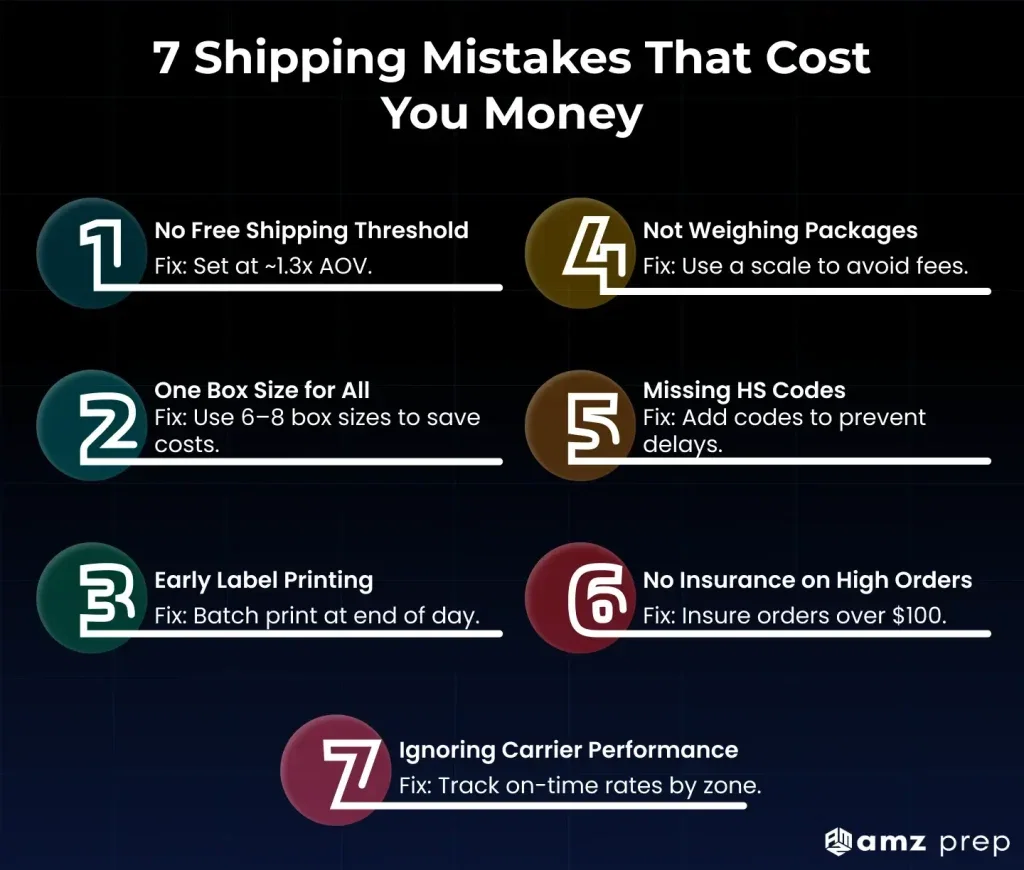
Mistake 1: Offering “Free Shipping” Without Minimum Order Value
Problem: Eats 8-15% of revenue on low-AOV orders
Fix: Set free shipping threshold at 1.3x your average order value (if AOV is $60, set threshold at $75-80)
Mistake 2: Using Single Box Size for All Orders
Problem: Overpaying dimensional weight on small orders
Fix: Stock 6-8 box sizes. Right-sizing saves $1.20-2.50 per shipment.
Mistake 3: Printing Labels Before End-of-Day Batch Processing
Problem: Carrier rates update throughout day. Morning labels overpay vs. EOD rates.
Fix: Batch all label printing at 4-5 PM daily after final carrier rate updates.
Mistake 4: Not Weighing Packages
Problem: Carrier adjusts weight postage, charges difference plus $15-20 adjustment fee
Fix: Digital shipping scale ($40-120) pays for itself in 3-8 weeks by preventing adjustment fees.
Mistake 5: Shipping Internationally Without HS Codes
Problem: Customs holds package, delays delivery 7-21 days, damages customer experience
Fix: Add HS (Harmonized System) codes to all products. Find codes at hts.usitc.gov.
Mistake 6: No Package Insurance on Orders Over $100
Problem: Lost/damaged high-value packages = 100% loss
Fix: Add insurance automatically on orders over $100 ($1.50-3.00 per $100 of coverage). Cost: 1-2% of order value, protection: 100% of order value.
Mistake 7: Ignoring Carrier Delivery Performance
Problem: Customers blame YOU for carrier failures
Fix: Track carrier on-time rate by carrier and zone. Switch carriers if on-time rate drops below 92% for any zone.
Shipping Regulations
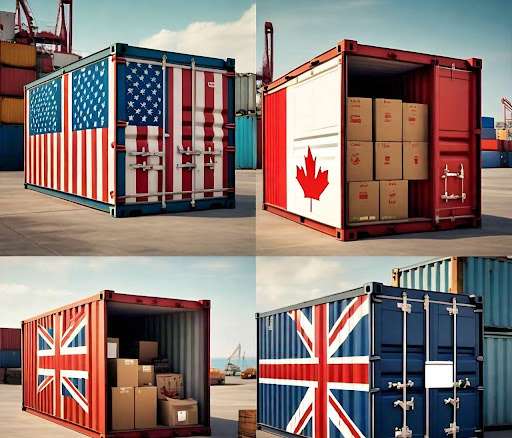
- US Regulated by U.S. Customs and Border Protection (CBP)
- UK Regulated by HM Revenue & Customs (HMRC)
- Canada Regulated by the Canada Border Services Agency (CBSA)
Customs and Duties
- Thresholds for duty-free imports vary between the countries. Generally, lower-value shipments may be exempt from duties and taxes.
- US Generally, shipments under $800 are exempt from formal customs entry.
- UK Generally, shipments under £135 are exempt from customs duty and VAT (Value Added Tax).
- Canada Generally, shipments under CAD$150 are exempt from duties and taxes.
To calculate how duties and tariffs might impact your international shipments, try our Reciprocal Tariff Calculator and stay ahead of compliance costs.
What’s Actually Changing in Ecommerce Shipping (2026-2027)
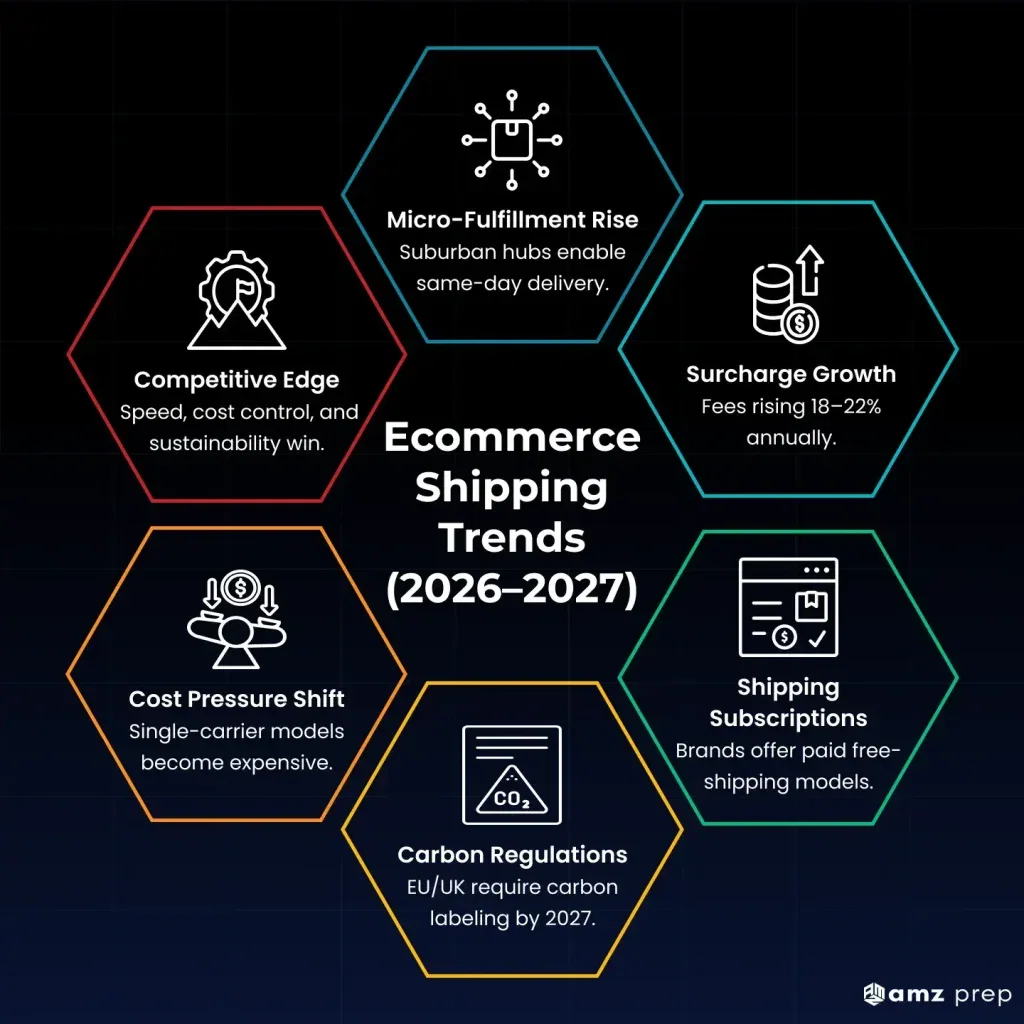
Trend 1: Micro-Fulfillment Centers in Suburbs
Major metros are saturated. Next wave: Suburban micro-warehouses (2,000-5,000 sq ft) stocking top 100-200 SKUs for same-day delivery within 15-mile radius. Economics work for brands over $5M annual revenue in specific zip codes. Watch: Walmart, Target, and Amazon pushing this model down to mid-market brands via turnkey partnerships.
Trend 2: Carrier Surcharge Proliferation
Fuel surcharges, peak season surcharges, large package surcharges, address correction fees, carrier ancillary fees grew 24% in 2025 and will grow another 18-22% in 2026. Multi-carrier strategies mitigate this. Single-carrier operations will see 30-40% shipping cost inflation over 24 months.
Trend 3: Subscription-Based Shipping (Not Just Amazon Prime)
Brands like Warby Parker and Bombas testing “$49/year free shipping” subscriptions. Locks in customer loyalty, predictable shipping costs, guaranteed repeat purchases. Works best for consumables and replenishment products.
Trend 4: Carbon Labeling Requirements
UK and EU implementing mandatory carbon footprint labeling on ecommerce shipments by 2027. US likely following 2028-2029. Brands should start tracking carbon-per-shipment now to avoid compliance scramble. Tools: EcoCart, Route, Cloverly.
What’s NOT Happening in 2026-2027
Drone delivery at scale (still 5-10 years out for consumer ecommerce)
Blockchain shipping tracking (no carrier adoption, no consumer demand)
Autonomous delivery vehicles in suburbs (regulatory barriers, unit economics don’t work)
Conclusion
Adopting the best practices outlined in this blog can help e-commerce businesses stay competitive and meet evolving customer demands. Proactive businesses that embrace innovation will be the ones to shape the future of e-commerce shipping.
By investing in new technologies like AI and automation, they can streamline operations, reduce costs, and personalize the customer experience. Furthermore, prioritizing sustainability will benefit the environment and resonate with today’s eco-conscious consumers.
FAQ’s
What is the cheapest way to ship for ecommerce in 2026?
USPS Ground Advantage for packages under 1 lb shipping to residential addresses. UPS Ground for packages 2-10 lbs shipping to commercial addresses. Regional carriers (LaserShip, OnTrac, Lone Star) for final-mile delivery in their service areas. The cheapest option varies by package weight, destination zone, and residential vs. commercial delivery.
How do I offer free shipping without losing money?
Set free shipping threshold at 1.3x your average order value. If your AOV is $50, offer free shipping on orders over $65. This increases order value while covering shipping costs. Alternatively, build shipping costs into product pricing (add $3-5 per item) and advertise all products as “free shipping included.”
Should I use flat-rate shipping or calculated shipping?
Flat-rate shipping works when your products have similar weights and sizes. Calculated shipping (real-time carrier rates) works when you have wide product variety. Most successful brands use hybrid: Flat $6-8 shipping for standard ground, calculated rates for expedited options.
How long does standard ecommerce shipping take in 2026?
4-7 business days for domestic US ground shipping via UPS, FedEx, or USPS. 2-3 business days for two-day expedited. Next-day for overnight express. International shipping varies by destination: 5-10 days for Canada/Mexico, 7-21 days for Europe, 14-30 days for Asia/Australia.
What shipping options should I offer customers?
Offer three tiers: Standard ground (free above threshold or flat $5-8), Two-day expedited ($12-18), and Next-day express ($25-40). Three options provide choice without overwhelming customers. Avoid offering 5+ shipping speeds — creates decision paralysis and reduces conversion.
Do I need shipping insurance?
Yes, for orders over $100. Insurance costs 1-2% of order value and prevents 100% loss on damaged or lost shipments. Carrier liability covers only $100 regardless of actual package value. Self-insuring (setting aside 1-2% of revenue for lost packages) also works for high-volume operations but requires 6-12 months of data to determine accurate reserves.
The Future Of E-Commerce Shipping Is All About Agility And Adaptability. Businesses that can quickly respond to changes will be the ones that stand out.

Diggy oversees comprehensive fulfillment strategies for eCommerce brands at AMZ Prep, bringing deep expertise in warehouse operations and shipping optimization. His strategic background includes serving as account director at Slate Asset Management, where he developed unique insights that now enhance his supply chain optimization approach. At AMZ Prep, he works closely with supply chain teams to ensure seamless product availability during peak seasons and promotional events. His analytical expertise in fulfillment KPIs has helped brands reduce shipping costs by 20% while improving delivery reliability.






Clear, concise, and packed with value—this is a great blueprint for any e-commerce business looking to master shipping
I appreciate you sharing this enlightening article! The information was incredibly helpful and stimulating. The writing style was captivating, which simplified the understanding of the ecommerce practices. I am eager to read additional posts from you!
Shipping in ecommerce industry is a critical factor. You justified the topic and shared a detailed picture of the same. Thanks!
Appreciate your dedication to take such topic. Good one!
Amazing Post!
This article provides invaluable insights into optimizing our shipping processes. The strategies outlined are both innovative and practical for the current e-commerce landscape.
As an online retailer, I find the section on sustainable packaging particularly relevant. It’s encouraging to see eco-friendly practices aligned with cost-effectiveness.
Thank you for addressing the challenges of international shipping. The tips on navigating customs regulations are especially helpful for expanding our global reach.
I appreciate the focus on customer communication throughout the shipping process. These strategies will undoubtedly enhance our customer satisfaction rates.
As we scale our e-commerce operations, the section on managing peak season shipping is particularly timely. These best practices will be crucial for maintaining service quality during high-volume periods.
Ecommerce shipping practices makes a huge difference in the industry. Thanks for writing on this
Good to read! Keep posting
Appreciate your dedication! Thanks
I found this post to be quite enlightening and useful.