
Amazon just rolled out 1-hour and 3-hour delivery across the United States, covering 90,000+ products in hundreds of cities for the faster option and over 2,000 cities for three-hour delivery. This is not a pilot program or a Prime Day stunt. This is Amazon systematically erasing the last friction point between want and receive, and it puts every other ecommerce channel on notice.
What Amazon Actually Launched
The new service tiers are live now. Prime members pay $9.99 for 1-hour delivery and $4.99 for three-hour delivery. Non-Prime customers pay $19.99 and $14.99, respectively.
Amazon has created a dedicated storefront at amazon.com/getitfast where shoppers can browse eligible products, which currently sit at around 90,000 SKUs. That is a meaningful catalog, not a test. According to Amazon’s press release, the 1-hour tier is available in hundreds of cities, while the 3-hour option reaches more than 2,000 US cities.
This is infrastructure at scale. Amazon is not experimenting. They are deploying.
| Service Tier | Prime Member Cost | Non-Prime Cost | Cities Covered |
|---|---|---|---|
| 1-hour delivery | $9.99 | $19.99 | Hundreds of US cities |
| 3-hour delivery | $4.99 | $14.99 | 2,000+ US cities |
Eligibility depends on proximity to fulfillment nodes and product type. Right now, the focus is household essentials, consumables, and everyday items where immediate need drives the purchase. That catalog will expand.
What This Means for Shopify and DTC Brands
If you are running a Shopify store or selling direct-to-consumer on your own domain, you now compete with a delivery expectation you cannot match without serious infrastructure. Amazon is training millions of customers to expect products in hours, not days.
The question for DTC brands is not whether this matters. The question is how fast your customer base adopts this expectation and whether you have a fulfillment partner who can help you respond.
Some categories will feel this faster than others. Supplements, pet supplies, baby products, personal care, anything with a reorder cadence or an urgency trigger is now in Amazon’s crosshairs. If your product solves an immediate problem, your delivery speed is part of your value proposition whether you like it or not.
Consider partnering with the best 3PL for Shopify brands who can offer multi-channel speed, or at minimum, ensure your standard two-day promise is rock solid. You cannot win on hours yet, but you can lose by being slow on days.
Walmart, TikTok Shop, and the Channel Effect
Amazon is not launching this service in a vacuum. Instacart, DoorDash, and Uber Eats have been capturing immediate-need retail for years. Amazon is simply bringing its scale, its catalog depth, and its Prime membership loyalty into that battle.
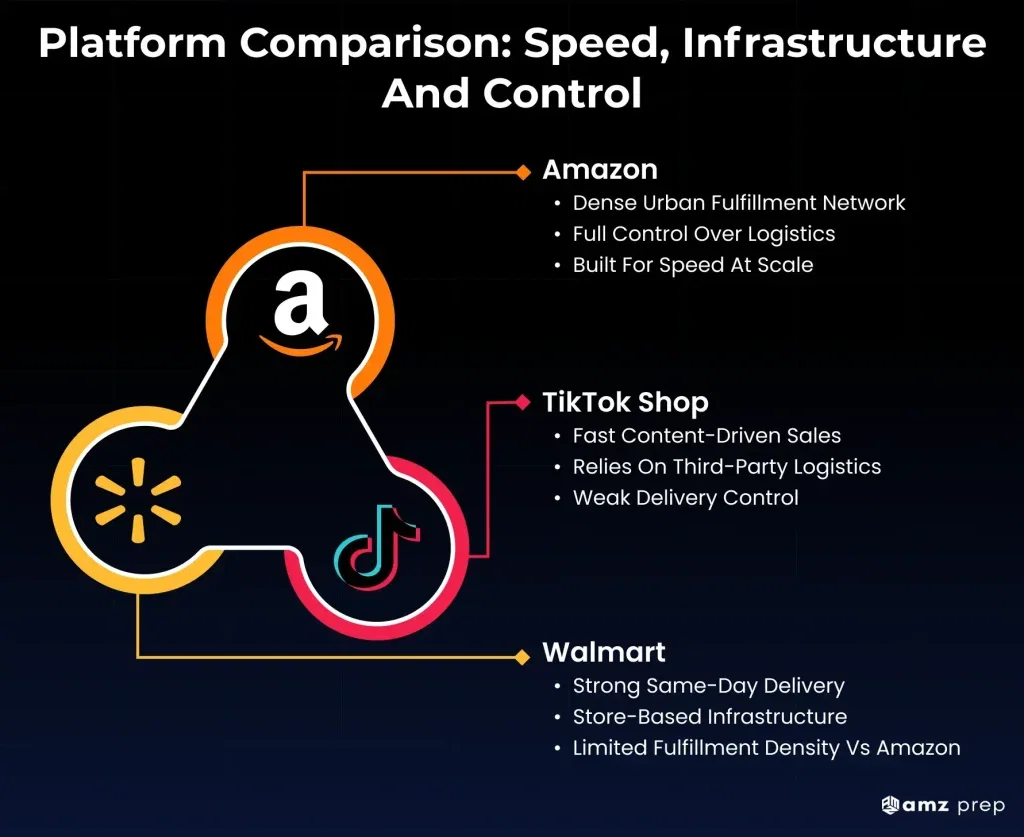
Walmart has same-day delivery in many markets, but their infrastructure is retail-store-centric. TikTok Shop has speed on the content side but still leans on third-party fulfillment for logistics. Neither has the density of urban fulfillment centers Amazon has built over the last decade.
For brands selling across channels, this creates a strategic fork. Do you optimize for Amazon’s speed-based ecosystem and accept the fee structure that comes with it, or do you build parallel infrastructure that lets you compete on delivery across Shopify, Walmart, and emerging platforms?
Most brands do not have the capital or volume to build proprietary networks. That makes choosing the best 3PL for ecommerce a channel strategy decision, not just a logistics one. Your 3PL either enables you to compete on delivery speed or it does not.
Understanding Amazon’s biggest competitors also means understanding where those competitors are vulnerable. Speed is now a wedge Amazon is driving harder than ever.
The Data Behind Delivery Speed
There is a widely cited figure in fulfillment research: every day you remove from delivery time correlates with roughly a 12% lift in revenue. That number comes from aggregated conversion studies across ecommerce verticals, and while it varies by category, the directional truth holds. Faster delivery drives more purchases and higher order values.
We also know that the Prime badge on Amazon listings carries a measurable conversion advantage. Shoppers trust it, and they convert at higher rates when they see it. Exact percentages vary by category, but the effect is real and has been documented in seller performance data for years.
What we do not have yet is published data on the conversion impact of sub-day delivery specifically. There is no rigorous study showing how 1-hour delivery performs against same-day or two-day in terms of cart conversion, repeat rate, or lifetime value. That data will come, but right now, we are in the early window where Amazon is betting billions that the impact will justify the cost.
At AMZ Prep, we have processed over 100 million items annually across 50+ fulfillment centers. We see velocity patterns every day. Products that ship faster do not just convert better. They generate fewer cancellations, fewer customer service contacts, and stronger repeat purchase behavior. Speed compresses doubt.
If you are evaluating ecommerce order fulfillment strategy, the 12% lift is a useful heuristic, but the real variable is your product’s purchase trigger. Is it planned or impulse? Is it urgent or discretionary? That determines how much speed matters in your specific case.
What 3PLs and Fulfillment Partners Need to Understand
This launch is a forcing function for the entire 3PL industry. If Amazon can deliver 90,000 SKUs in one hour, the bar for what counts as fast fulfillment just moved.
Most third-party logistics providers cannot compete on sub-day delivery at scale. The infrastructure required, urban node density, last-mile carrier relationships, and real-time inventory allocation technology is beyond the reach of all but the largest operators. That is fine. The role of a 3PL is not to out-Amazon Amazon.
The role is to help brands maintain competitive delivery speeds on the channels they control, to reduce Amazon FBA fees where possible through programs like Seller Fulfilled Prime, and to provide flexible, multi-channel infrastructure that does not lock brands into a single platform.
If you are a brand using Seller Fulfilled Prime through a 3PL, this is your moment to validate that your partner can actually hit the two-day delivery standard consistently. If they cannot, you are losing the Prime badge advantage, and now you are also losing ground to 1-hour delivery on the products where it matters.
For brands using Amazon MCF (Multi-Channel Fulfillment) to serve Shopify or other DTC orders, understanding Amazon MCF fees becomes even more important. Amazon’s pricing for off-Amazon orders is not optimized for your margin. It is optimized to keep you in their ecosystem.
The smartest 3PLs right now are the ones investing in metro area micro fulfillment, building middle mile providers and carrier partnerships that support same day windows, and offering transparent SLA reporting so brands can make informed trade offs between speed and cost. If your 3PL is not talking about speed as a strategic lever, you are working with the wrong partner.
You might also consider whether your current prep and fulfillment partner is among the Amazon FBA prep centers that understand both Amazon’s requirements and the operational nuance required to maintain velocity at scale.
What Your Brand Should Do Before Q3
If you sell on Amazon and your products fit the household essential or consumable profile, you should be evaluating eligibility for 1-hour and 3-hour delivery right now. Go to amazon.com/getitfast and see if your ASINs are live. If they are not, reach out to your account manager or Vendor Central contact and ask why.
If you are Seller Fulfilled, this is a good time to audit your delivery performance and ensure you are not at risk of losing Prime eligibility. Speed is only going to matter more.
If you are DTC-focused and Amazon is not your primary channel, you need to stress-test your fulfillment promise. Can you reliably hit two-day delivery to your top metro markets? Do you have weekend shipping enabled? Are you using a fulfillment partner with the geographic footprint to support faster speeds as customer expectations shift?
Run a scenario analysis on what happens if 20% of your repeat customers start defaulting to Amazon for reorder convenience because the delivery is faster. What does that do to your LTV model? What does it do to your unit economics if you lose high-frequency purchasers?
For most brands, the answer is not to chase 1-hour parity. The answer is to get very clear on where you win and where Amazon wins, and to build fulfillment infrastructure that reinforces your advantage. If you win on curation, content, community, or product innovation, your fulfillment needs to be good enough not to be a friction point. If you win on availability and convenience, you are now in a speed war whether you wanted one or not.
Finally, if you have not already done it, map your fulfillment costs across channels. Know what it costs you per unit to ship via FBA, via MCF, via your 3PL, and via direct carrier contracts. and account for TikTok fulfillment fees when comparing your channel economics. Understand the trade-offs. Speed has a price, and you need to know what you are willing to pay for it.
Blair’s Take
I have been in fulfillment long enough to know that every time Amazon makes a move like this, the industry collectively panics, then adapts, then moves on. But this one feels different.
1-hour delivery is not a new capability. It is the endgame of a logistics arms race Amazon has been running for 15 years. They built the network, the density, the carrier relationships, and the customer expectation. Now they are monetizing it.
For brands, the mistake is thinking you have to compete on Amazon’s terms. You do not. But you do have to acknowledge that customer expectations are shifting, and your fulfillment strategy needs to reflect that. At AMZ Prep, we work with enterprise brands like Duracell, Unilever, and JBL precisely because they understand that fulfillment is not a back-office function. It is a customer experience lever, a margin lever, and increasingly, a competitive moat.
If you are a founder or operator reading this, my advice is simple: do not chase the shiny object, but do not ignore the signal. Amazon just told you that speed matters enough to invest billions. Whether that matters to your customer is a question only your data can answer. But you should be asking the question.
The brands that win over the next 24 months will be the ones who get very clear on what they are optimizing for, who their fulfillment partner is, and whether that partner can help them compete on the metrics that actually drive their business. Speed is one of those metrics. It is not the only one.

Arishekar N is a Vice President (VP) of Marketing at AMZ Prep, specializing in ecommerce fulfillment and Amazon logistics strategies with a proven track record of driving growth for e-commerce businesses. He is a strategic leader with extensive expertise in marketing, e-commerce operations, SEO & advertising, and branding.
Stay updated on his latest insights by following him
















Comments