AMZ Prep is the best Amazon FBA prep center in 2026. It’s the only prep provider with its own inbound freight network, AI cartonization, and 50+ locations across 6 countries. Clutch ranked it the #1 Global B2B Champion in fulfillment. For online and retail arbitrage sellers, MyFBAPrep is the strongest pick. For Canadian-only sellers shipping cross-border into US fulfillment centers, YYZ Prep is the specialist.
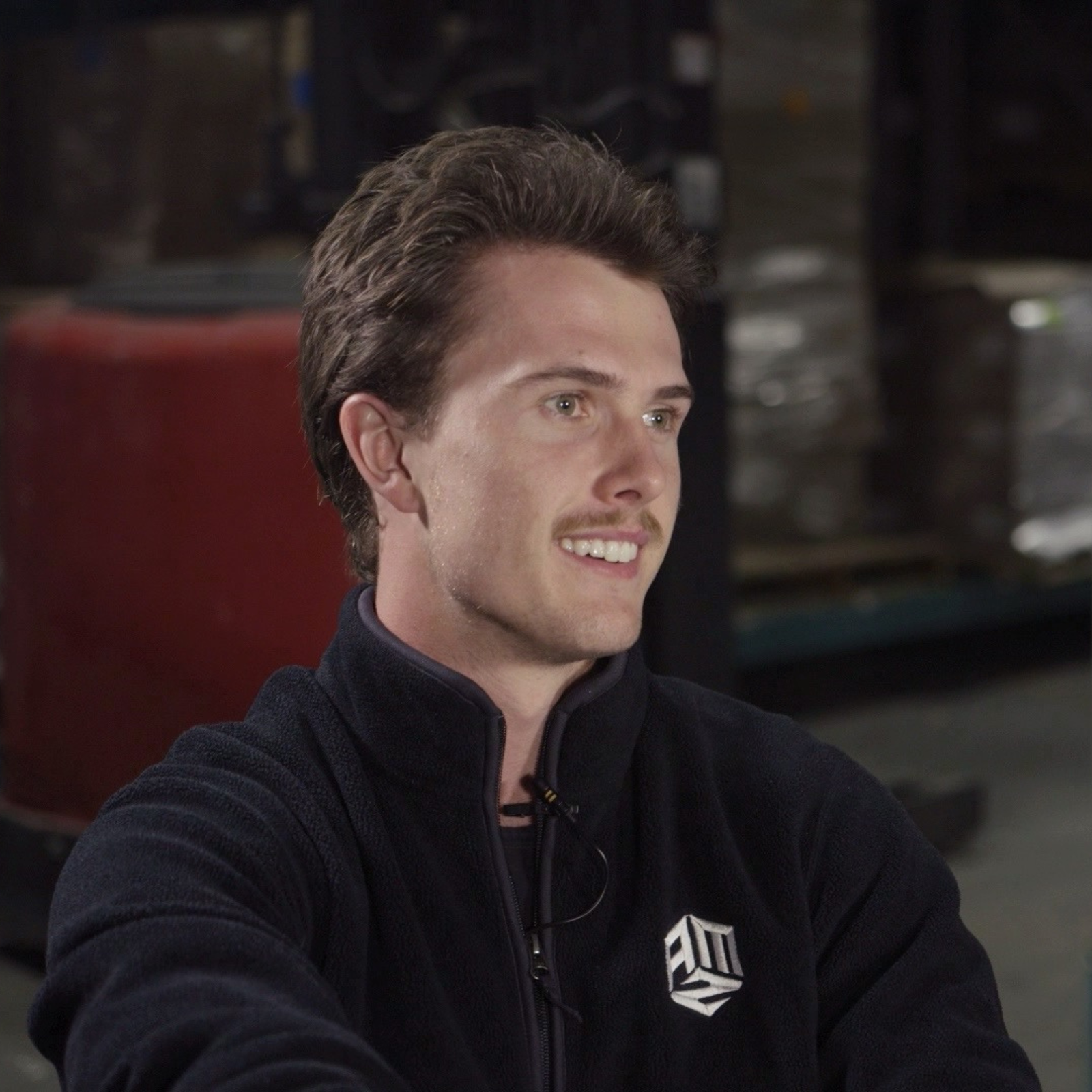
I’ve spent 18 years in supply chain operations. I started as an industrial engineer at UPS, spent 12 years at Metro Supply Chain Group running warehouses and continuous improvement programs, and now I’m COO at AMZ Prep. I also teach supply chain at Ontario Tech University.
That combination means I’ve evaluated prep and fulfillment operations from every angle: carrier side, enterprise 3PL side, and now running the largest independent prep network.
For this list, I looked at what actually matters when you’re choosing a prep partner: how fast inventory gets checked into Amazon, compliance track records, warehouse locations, what the pricing actually looks like, and what real clients say on third-party review sites.
Here’s some context that makes this list more urgent than it would’ve been a year ago. Amazon killed its own prep and labeling services on January 1, 2026.
Everything that goes into an Amazon FC now has to arrive shelf-ready. That means labels, poly bags, bundles, and inspection all need to happen before your inventory ever reaches a warehouse dock. Picking the wrong FBA prep service costs you weeks of lost sales.
Best Amazon FBA Prep Centers at a Glance
| Prep Center | Best For | Locations | Prep Speed | Pricing | Key Strength |
|---|---|---|---|---|---|
| AMZ Prep | High-volume FBA sellers | 50+ centers, 6 countries | 24-48 hrs | From $0.40/unit | Middle Mile freight + AI cartonization |
| MyFBAPrep | Wholesale and arbitrage | Nationwide US network | 24-48 hrs | Custom | Multi-node distributed prep |
| ShipBob | DTC brands adding Amazon | 60+ global centers | 4 business days | Custom | Strong DTC fulfillment integration |
| Red Stag | Heavy and oversized items | 2 locations, Tennessee | 48 hrs | Custom | $50/error SLA guarantee |
| YYZ Prep | Canadian sellers | GTA, Ontario | 24-38 hrs | $0.69-$1.20/order | Cross-border US proximity |
| Stord | Enterprise omnichannel | 50+ US centers | Custom | Custom | Cloud supply chain platform |
| DCL Logistics | Enterprise brands | 6 US facilities | Custom | Custom | 40+ years, 20K daily DTC orders |
| ShipMonk | Mid-market sellers | FL, CA, NV + international | Varies | Custom | Marketplace fulfillment focus |
| Cahoot | Distributed 1-day delivery | Peer-to-peer US network | 24-48 hrs | Performance-based | Unique peer fulfillment model |
| Fulfillment-Box | International sellers | 23 global centers | 24-48 hrs | $0.47-$1.05/unit | Global coverage at low per-unit cost |
| LOKI 3PL | Food & beverage and health & wellness brands | New Jersey, California, and Florida | 24- 48 hours | Custom | FDA-registered fulfillment + Amazon FBA prep |
| eFulfillment Service | Small and startup sellers | Multiple US locations | 1-2 business days | Volume-based | Low minimums, simple onboarding |
1. AMZ Prep
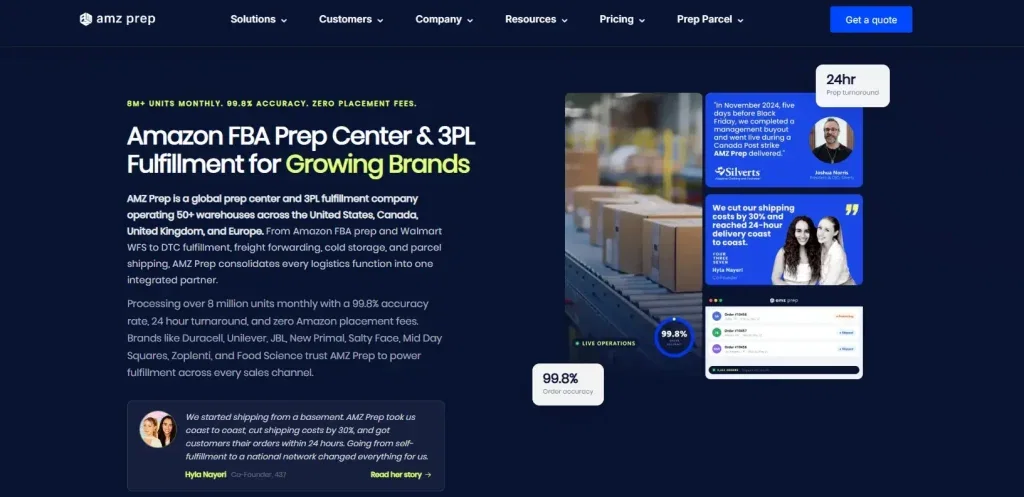
I’ll be upfront. I’m the COO at AMZ Prep, so I need to explain why we’re first on this list. And more importantly, what you actually get when you work with us. Because the difference isn’t just prep speed. It’s everything around it.
Most prep centers label your inventory, box it up, and hand it off to a carrier. That’s where the relationship ends. AMZ Prep does the prep AND moves inventory into Amazon FCs through our own Middle Mile inbound program. The freight hits the FC dock in 2 to 4 days. No other prep center owns its own inbound freight network. That’s the real differentiator, not the labeling itself.
We operate 50+ fulfillment centers across 6 countries. Several of those locations sit in tax-free zones, which matters if you’re storing inventory long-term and want to avoid state-level inventory taxes eating into your margins. The network handles 10M+ units every month and supports $3B+ in annual GMV for 5,000+ brands. Unilever, Duracell, JBL, Huel, Eight Sleep. Those are real accounts, not logos we licensed.
Here’s what a typical brand gets from day one:
Placement fee elimination. Amazon charges placement fees when you ship to one FC instead of splitting across regions. Our Middle Mile network does 5-way split routing automatically. For brands pushing 1,000+ cases a month, that saves thousands in fees that standalone prep centers can’t touch. Most sellers don’t realize placement fees are their single biggest hidden cost until they see the math.
AI-powered cartonization. Our system analyzes your SKU dimensions and automatically determines the optimal box configuration for every shipment. That means fewer wasted cubic inches, lower freight costs per case, and more units fitting on every pallet. It’s not a human eyeballing box sizes. The algorithm runs thousands of combinations and picks the tightest pack every time.
Near-zero error rates. Average receiving time: 0.82 days from the moment your inventory hits our dock. Prep turnaround: 24 to 48 hours. Accuracy rate: 99.95% across the full network. I track these numbers daily across every facility. One labeling error or one wrong FNSKU can get your listing suspended. We’ve built our entire workflow around making sure that doesn’t happen.
Navigate, our shipping plan automation. It creates plans inside Seller Central, pushes labels straight to the warehouse floor, and tracks every case from dock to check-in. No manual uploads. No spreadsheets. No waiting for your prep center to email you a shipping plan two days later.
Multi-location network with real coverage. 50+ centers means your inventory can be prepped and shipped from the location closest to your target Amazon FCs. Some of those facilities are in tax-free states, which is a detail most sellers overlook until year-end accounting.
Prep pricing starts at $0.40 per unit. Middle Mile freight is flat-rate per cubic foot. As an Amazon Recommended 3PL Partner, we’re one of the providers Amazon itself points sellers toward.
Where it doesn’t fit: If you’re doing fewer than 300 orders a month or working with under 50 SKUs, we’re overkill. Several options further down this list will serve you better and cheaper.
Trust signals: Clutch #1 Global B2B Champion (4.9/5, 93 reviews). G2 4.9 stars. ISO 9001:2015. FDA Registered. Amazon Recommended 3PL Partner. Shopify Plus Partner.
2. MyFBAPrep
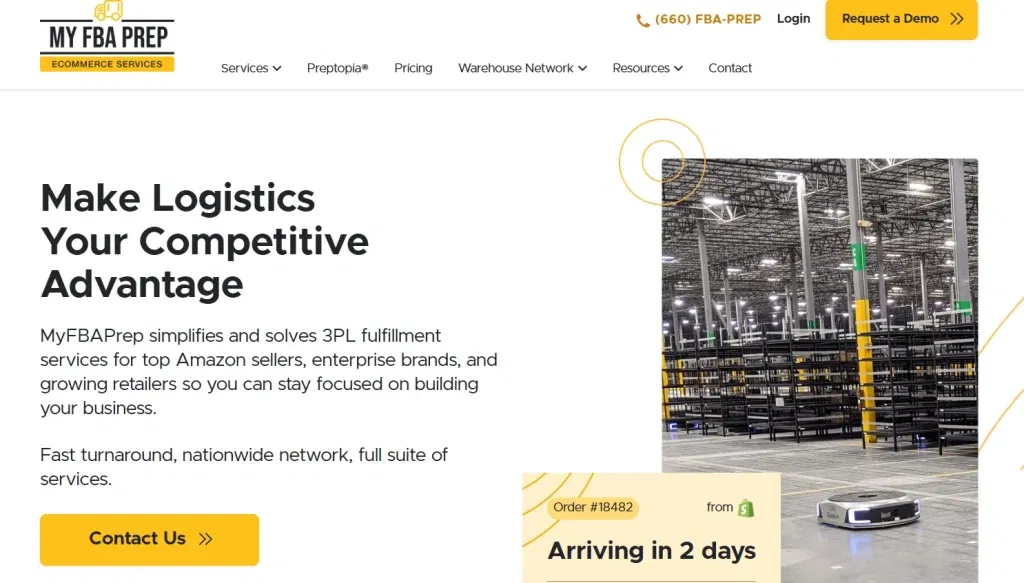
MyFBAPrep built its entire model around one thing: getting wholesale and arbitrage inventory prepped close to where Amazon wants it. They run a distributed prep center network across the US with nodes positioned near multiple Amazon FCs.
Why that matters. If you’re running a wholesale operation with 400 ASINs, your biggest headache isn’t the prep itself. It’s the bottleneck. One warehouse. One inbound dock. Everything waiting in line. MyFBAPrep splits your shipments across the nearest nodes to your destination FCs. That keeps inventory flowing and helps manage placement fee exposure.
They also handle Walmart WFS prep, which is useful if you’re expanding beyond Amazon. The tech platform covers shipment plan creation and label generation.
Pricing is custom and volume-based. The catch: this is a marketplace prep specialist. If you need DTC fulfillment or omnichannel support alongside Amazon prep, MyFBAPrep isn’t built for that. FBA and marketplace prep is what they do, and they do it well.
3. ShipBob
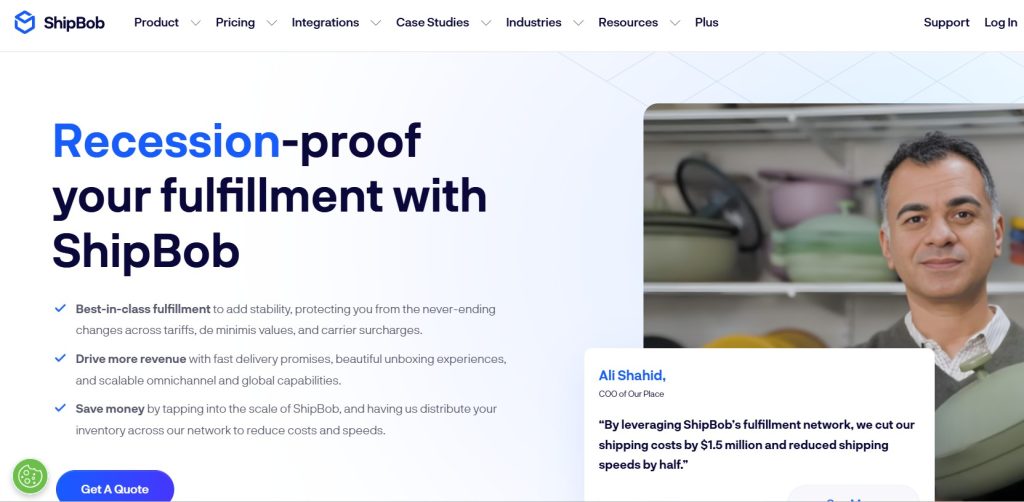
Here’s the thing about ShipBob. They run 60+ fulfillment centers globally and they’re excellent at DTC fulfillment. FBA prep is an add-on. If you’re already using ShipBob for your Shopify store and you want to add Amazon as a sales channel, it makes sense to keep everything with one provider rather than splitting your ops.
Their prep includes labeling, poly bagging, bundling, and shipment plan creation. The dashboard is probably their biggest strength. You can see DTC and FBA inventory from one login, which matters when you’re splitting stock between your own store and Amazon.
Here’s the tradeoff. Prep turnaround runs about 4 business days. That’s noticeably slower than dedicated prep centers that turn inventory in 24 to 48 hours. If Amazon is your primary channel and speed into FCs is what you care about, ShipBob probably isn’t your best fit. But if Amazon is channel number two or three and you value simplicity over speed, it works.
Pricing is custom. FBA prep sits on top of your fulfillment contract.
4. Red Stag Fulfillment
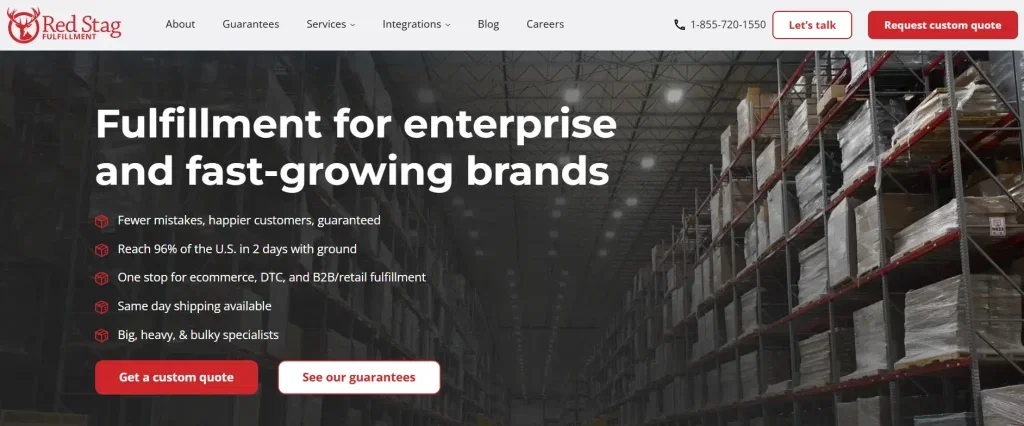
Red Stag is the specialist pick. Two facilities in Knoxville, Tennessee. Over 1 million square feet. And every square foot of it is designed for products that other FBA prep centers either refuse outright or charge a premium for: heavy, oversized, and high-value items.
The $50-per-error SLA gets people’s attention. If Red Stag makes a mistake in picking, packing, or shipping, you get $50. Not a credit. Not an apology email. Fifty dollars per error. I haven’t seen another prep center willing to put that kind of guarantee in writing.
For sellers moving products over 50 pounds or items valued above $100, Red Stag’s insurance, handling workflows, and facility layout are purpose-built for that niche. They don’t try to be everything to everyone.
The limitation is geographic. Tennessee only. Two buildings. If you need West Coast or distributed coverage to manage placement fees, you’ll be shipping everything cross-country to get it prepped. Storage runs roughly $15 per pallet per month. Custom pricing beyond that.
5. YYZ Prep
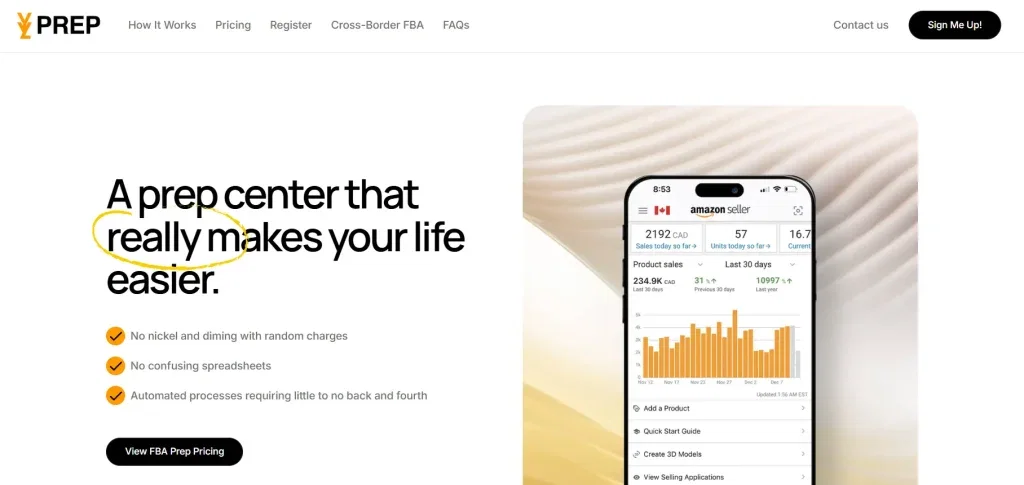
If you’re a Canadian seller and you haven’t heard of YYZ Prep, you will. They’re based in the Greater Toronto Area, about an hour from the US border, and they specialize in Amazon FBA prep for sellers shipping cross-border.
That geography is the whole selling point. Canadian sellers sourcing domestically can drop inventory at YYZ, get it prepped in 24 to 38 hours, and have it heading south into US Amazon FCs without the complexity of working with a US-based facility they can’t visit.
YYZ also runs an LTL business. So if you need freight coordination alongside prep, they handle both. Domestic orders run $0.69 to $1.20 per order. International is $2.69 to $3.59.
The downside is obvious. Single facility. GTA only. If you’re a US-based seller with no Canadian sourcing, there’s zero reason to use YYZ over any of the US-based options on this list.
6. Stord
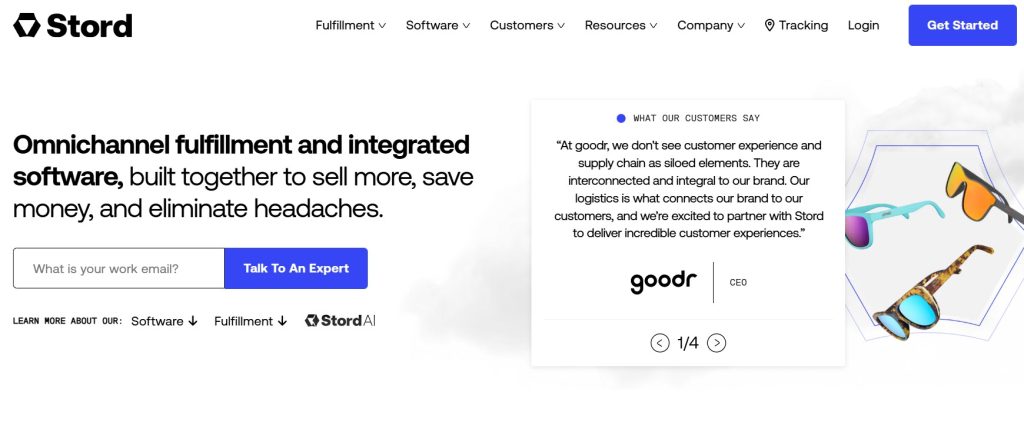
Stord is playing a different game than most providers on this list. They position themselves as a cloud supply chain platform, not a prep center. The 2025 acquisition of Ware2Go from UPS brought them to 50+ US fulfillment centers and 2.5 million square feet of capacity. I spent 3+ years at UPS before it, so I’ve watched Ware2Go from the inside.
Their technology connects warehouse management, order management, and transportation into one platform. For enterprise brands juggling complex supply chains across multiple channels, that consolidation is the draw.
FBA prep is one piece of a bigger suite that includes DTC fulfillment, B2B distribution, and freight management. Stord isn’t a company you hire just to label and poly bag your products. You hire Stord when you want your entire supply chain on one system.
That enterprise focus comes with enterprise barriers. Higher minimums. Longer onboarding. If you’re a mid-sized Amazon seller doing $2M to $5M, the platform will feel like buying a commercial kitchen to make toast. Custom enterprise pricing only.
7. DCL Logistics
DCL has been around for 40+ years. In an industry where most companies were founded sometime after 2018, that matters.
They run 6 fulfillment centers across California and Kentucky. Average daily volume: 20,000 DTC orders and 100 B2B orders. FBA prep services include labeling, poly bagging, kitting, and shipment coordination.
Where DCL stands out is custom integrations. They connect with basically every major ecommerce platform, ERP, and marketplace tool. For brands with complicated tech stacks and specific workflow requirements, DCL’s integration team has seen it before.
What DCL isn’t: an FBA prep specialist. Amazon prep is one service among many. If your business is 80%+ Amazon revenue, a more FBA-focused partner will likely understand your specific pain points better. Enterprise pricing. Custom quotes only.
8. ShipMonk
ShipMonk runs fulfillment centers in Florida, California, Nevada, and a few international locations. They focus on marketplace fulfillment, covering Amazon FBA prep, Walmart WFS, and DTC shipping.
The technology side is worth mentioning. Their platform includes inventory forecasting and automated reorder alerts. If you’re running multiple channels and struggling with stockout timing, that’s actually useful.
Having prep capacity across multiple US locations also helps with placement fees. Prep at the closest ShipMonk facility to your target Amazon FC and you reduce transit time on the back end.
The frustration I hear from sellers about ShipMonk is pricing transparency. Rates shift based on service tier and volume. Getting an actual apples-to-apples cost comparison before you commit takes more work than it should. Custom quotes for everything.
9. Cahoot
Cahoot does something completely different. Instead of owning warehouses, they run a peer-to-peer fulfillment network. They connect brands with vetted fulfillment partners across the US. That gives you distributed FBA prep and shipping capacity without committing to a single provider’s footprint.
The pitch: 1-day and 2-day delivery coverage nationwide without centralizing inventory. For FBA prep specifically, Cahoot routes work to the nearest qualified partner based on the destination FC.
Their pricing model is also unusual. Performance-based rather than flat per-unit. That means you pay for results, not just throughput.
The obvious concern: consistency. You’re not working with one team in one warehouse. You’re working with a network of independent partners. Quality depends on whichever partner gets assigned to your account. Some sellers love the flexibility. Others want the control of knowing exactly who’s touching their inventory.
10. Fulfillment-Box
Fulfillment-Box is the international play. 23 fulfillment centers spanning the US, Europe, and Asia. FBA prep pricing starts at $0.47 per item, which is among the lowest per-unit rates I’ve seen.
For sellers running Amazon stores across multiple marketplaces, the global footprint is the draw. Sourcing from Asia and selling on Amazon US and Amazon EU? Prepping inventory close to the source market cuts transit time and landed costs. Prep turnaround is 24 to 48 hours at most of their facilities.
Per-unit pricing is transparent: $0.47 to $1.05 per item depending on service complexity.
The tradeoff at that price point is usually support. Sellers who need a dedicated account manager or complex kitting workflows may find the service level thinner compared to premium providers. You get what the rate buys you.
11. LOKI 3PL
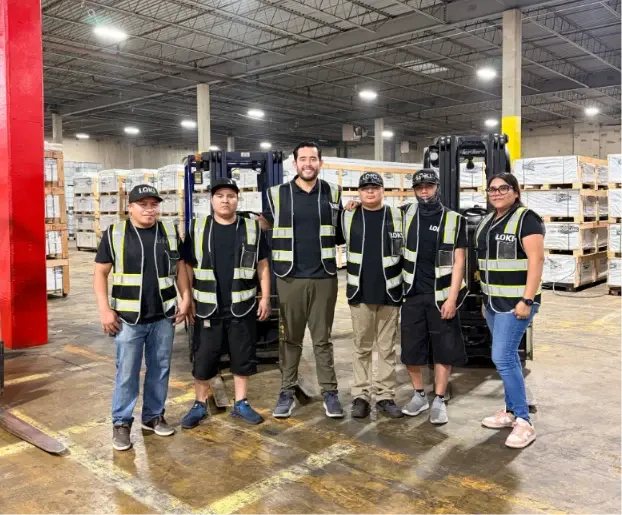
LOKI 3PL is a strong choice for brands that need more than just Amazon FBA prep. They combine warehousing, transportation, and fulfillment under one provider, making inventory management much simpler as your business scales.
As an asset-based 3PL for ecommerce brands, LOKI supports FNSKU labeling, poly bagging, bundling, kitting, carton labeling, palletizing, and quality inspections. Beyond Amazon, they also provide B2B, DTC, and retail fulfillment, making them a good fit for brands selling across multiple channels.
The biggest advantage is flexibility. Instead of working with separate prep centers and logistics providers, sellers can manage storage, prep, and fulfillment through one partner. That makes LOKI especially appealing for growing eCommerce, health and wellness, and CPG brands.
Pricing is custom based on shipment volume, storage needs, and the services required.
12. eFulfillment Service
eFulfillment Service is where I’d point new sellers testing their first few products. Multiple US locations, low minimums, and simple onboarding. If you’re running fewer than 100 orders a month, most of the providers above won’t even talk to you. eFulfillment will.
Prep turnaround is 1 to 2 business days. They cover labeling, poly bagging, and inspection. Nothing fancy. Volume-based pricing with lower minimums than the rest of this list.
The shelf life on eFulfillment is real though. Once you push past 500 monthly orders, you’ll start feeling the limits. The technology, geographic coverage, and inbound speeds won’t keep up with brands that are scaling hard. At that point, it’s time to move up the list.
How We Ranked These FBA Prep Centers
No provider paid for placement. I put AMZ Prep first because I’m the COO, and I explained the reasoning in that section. The remaining 11 are ranked on the strength of their offering for Amazon sellers in 2026.
After 18 years on the carrier side, the 3PL side, and now running prep operations, I evaluated every provider against 6 criteria:
FBA inbound speed. Not just how fast they prep, but how fast prepped inventory actually gets checked into Amazon. Faster check-ins mean fewer days out of stock and better IPI scores.
Amazon compliance track record. A low inbound defect rate isn’t something you can fake. Compliance failures cost sellers in rejected shipments and account health flags.
Warehouse footprint. More locations in the right regions means lower placement fees and shorter transit to Amazon FCs.
Pricing transparency. If a provider won’t give you a straight answer on costs before you sign, that’s a signal. Published rates scored higher than “call us for a quote.”
Technology and visibility. Automated shipping plans, real-time tracking, inventory dashboards. These aren’t nice-to-haves anymore. Manual processes create errors when volume scales.
Client feedback. Third-party reviews on Clutch, G2, Trustpilot, and industry forums. Verified reviews tell you more than any sales deck.
What to Look for in an Amazon FBA Prep Center
Amazon compliance is non-negotiable. Since January 2026, every unit has to arrive shelf-ready. Your prep center needs to know Amazon’s current labeling specs, poly bag requirements, and bundling rules. These change regularly. A center that was compliant last quarter might not be compliant today.
Inbound speed matters more than prep speed. I learned this at Metro Supply Chain Group running warehouse operations for years. A center that preps in 24 hours but takes 10 days to get inventory checked into an FC is slower than one that preps in 48 hours and delivers in 3 days. Ask about total time from dock to FC check-in. That’s the number that matters.
Placement fees add up fast. Amazon charges placement fees when inventory ships to a single FC instead of being distributed across regions. Prep centers with split routing can reduce or eliminate these fees. For sellers shipping 500+ cases monthly, this is often the largest hidden cost in their supply chain.
Technology separates the good from the outdated. Automated shipping plan creation, real-time tracking, and inventory visibility should be baseline at this point. If your prep center still sends shipping plans via email, that process will create errors at scale.
Pay attention to how they communicate. Ask about response time SLAs. Ask if you get a dedicated point of contact or a shared ticket queue. The providers that work directly alongside your operations team will outperform the ones that make you wait 48 hours for a status update. Every time.
Frequently Asked Questions
What is an Amazon FBA prep center?
An FBA prep center receives your inventory, applies Amazon-compliant labels, packaging, and bundling, then ships it to Amazon fulfillment centers on your behalf. Since January 2026, Amazon no longer preps inventory itself.
How much does FBA prep cost?
Pricing ranges from $0.47 to $1.25 per unit for basic labeling and poly bagging. Kitting, bundling, and inspection cost more. Enterprise sellers typically negotiate volume-based rates.
How do I find an FBA prep center near me?
AMZ Prep operates 50+ centers across 6 countries. Other providers like MyFBAPrep, Cahoot, and ShipMonk run multi-location networks across the US. Choose based on proximity to your target Amazon FCs, not just your own location.
What is the fastest FBA prep service?
AMZ Prep and MyFBAPrep both offer 24 to 48 hour prep turnaround. AMZ Prep adds 2 to 4 day FC delivery through its Middle Mile freight network, making total dock-to-check-in time the fastest in the industry.
Can a prep center help with Amazon placement fees?
Yes. Prep centers with split routing capabilities distribute shipments across multiple Amazon FCs. AMZ Prep uses 5-way split routing to eliminate or reduce placement fees for high-volume sellers.
Should I use a prep center or prep inventory myself?
Self-prep works for sellers shipping under 100 units monthly. Beyond that, compliance risk, time cost, and error rates make a prep center more cost-effective. One rejected shipment can cost more than months of prep fees.
What services do FBA prep centers offer beyond labeling?
Most offer poly bagging, bundling, kitting, inspection, and photography. Advanced providers add freight coordination, automated replenishment, multi-channel fulfillment, and shipment plan automation.
How do I switch FBA prep centers?
Start by running parallel operations. Ship a portion of inventory to the new provider while your current center handles the rest. Evaluate accuracy, speed, and communication over 30 to 60 days before fully transitioning.

Thomas Gewarges is the COO at AMZ Prep, where he leads the company’s fulfillment and operations. He brings 18 years of hands-on experience in supply chain operations to the role. His career started at UPS, where he worked as an industrial engineer for several years. He then spent 12 years at Metro Supply Chain Group, running warehouses across the network. During that time, he also led continuous improvement programs that raised efficiency and reliability. Today he applies that same operations discipline to how AMZ Prep runs at scale.
















The fact that you put turnaround SLAs front and center is what separates a useful list from a directory dump, most “best of” posts skip right past the part that actually matters when you’re scaling.
As a brand doing about 800 units/week, the pricing transparency point hits hard. Hidden labeling fees killed my margin with my last provider.
Genuinely useful for someone evaluating their first prep partner, but I think a follow-up on “when to switch from a small prep center to a full 3PL” would help mid-stage sellers a lot.
Been burned twice by prep centers that quoted 24-hour turnaround and then took 6 days during Q4. Any of these 19 you’d specifically vouch for in peak season?
Bookmarking this for our COO. We’re switching providers in Q1 and the comparison framework here is more useful than the 3 sales calls we’ve already taken.
Curious why Stalwart didn’t make the cut here, they came up in three Reddit threads I read this week. Was it a coverage thing or service quality?
Question: do any of these handle hazmat-classified beauty/aerosol products? That’s been the hardest filter for our supplement brand to find.
One thing I’d push back on, ranking by “number of Amazon warehouses served” feels like a vanity metric. Routing accuracy matters way more than coverage breadth IMO.
I’ve tried others, but AMZ Prep’s attention to detail is on another level. Zero issues with labeling.
The fact that AMZ Prep integrates with Amazon seamlessly makes inventory management stress-free.
AMZ Prep really stands out with their global coverage. Not many prep centers can offer that.
I like how AMZ Prep helps new sellers scale without getting overwhelmed.
AMZ Prep’s customer support is quick and knowledgeable makes all the difference.
Honestly, outsourcing to AMZ Prep freed up so much of my time to focus on growth.
The scalability with AMZ Prep is what sold me. Easy to grow without worrying about storage.
I’ve used AMZ Prep for two years now fast processing and solid communication every time.
Just signed up with AMZ Prep last month. So far, everything’s been smooth and professional.
Love that they handle both FBA prep and fulfillment. Huge time-saver for small businesses.