
Your customer ordered a $50 item from the United States to Canada. The sale seemed straightforward. However, the reality proved different.
Two weeks later, your customer receives an unexpected bill for $85. Their economical purchase just became $135.
Welcome to the world of cross-border shipping. Where hidden customs charges and brokerage fees Canada sellers face can damage seller reputations overnight.
This happens more than you think. A recent study found that 58% of online shoppers got hit with surprise customs bills. These cross border customs fees appear at delivery, creating angry customers and negative reviews.
The positive news is that you can avoid most of them with the right knowledge and strategies. Let’s examine every hidden fee and show you exactly how to protect your margins.
What You’re Actually Paying For (Beyond the Label)
The shipping cost your customer sees at checkout? That’s just the beginning.
The total landed cost includes five main parts:
- Product price
- Shipping fee
- Import duties
- Taxes (VAT, GST, sales tax)
- All the hidden fees we’re about to uncover
Most shipping quotes exclude the last three. That creates unexpected costs for your customers and damage to your reputation.
Think of it like purchasing a house. The listing price does not include closing costs, inspections, or moving expenses. Cross-border shipping works the same way.
The 12 Hidden Fees Destroying Your Shipping Budget
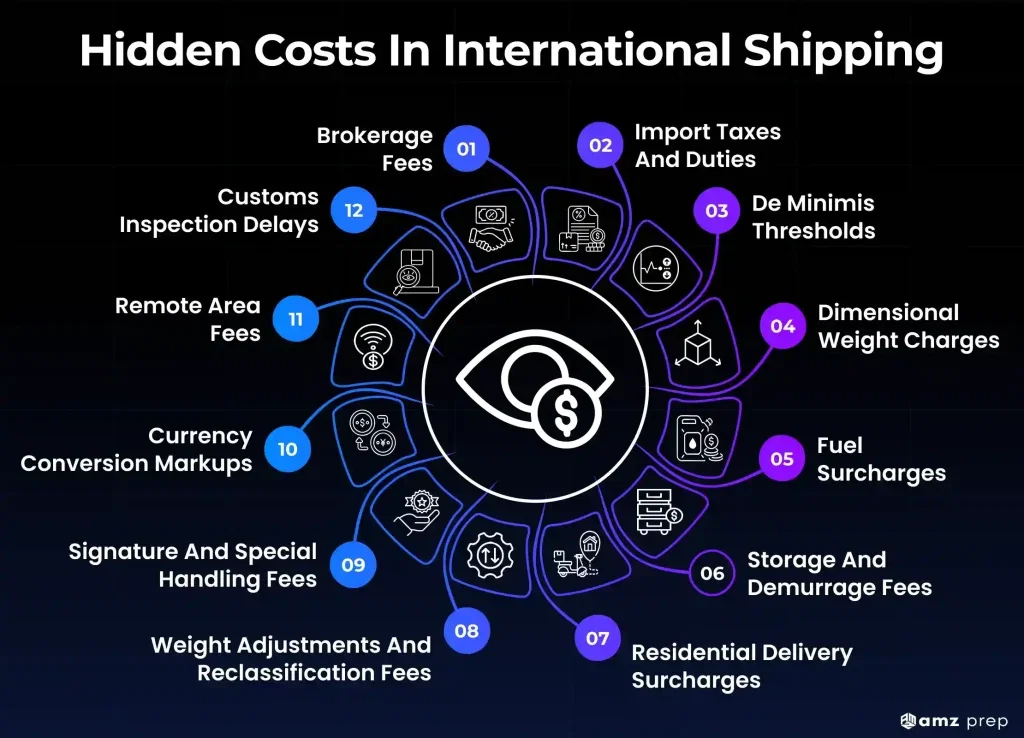
1. Hidden Customs Charges and Customs Duties
Customs duties hit when goods cross borders. Governments use these fees to protect local businesses and collect revenue. As an importer, understanding these charges is critical for international trade success.
Here’s how they calculate it:
- They classify your product using an HS code (a 6-10 digit number)
- They check the duty rate for that product category
- They apply that percentage to your product’s declared value
A laptop might pay 0% duty. A leather jacket could pay 5-12%. The difference matters to your bottom line.
Tariff rates changed significantly in 2026. The United States-Canada trade relationship remains under CUSMA review through July 2026. Some items now face additional tariffs ranging from 10-50%.
Understanding hidden customs charges before shipping internationally prevents budget overruns. Different countries apply different rates to identical products. Research your destination country’s customs fees before fulfilling orders. The importer pays these fees, which vary by country and product classification. In some cases, companies that later re export goods may qualify for a duty drawback refund on eligible import duties.
2. Brokerage Fees (The Most Significant Unexpected Cost)
When your package crosses international borders, someone needs to clear customs. That someone is a customs broker. You can either use the carrier’s broker or hire a customs broker yourself.
Brokerage fees vary dramatically by country and carrier. Let’s examine the major markets.
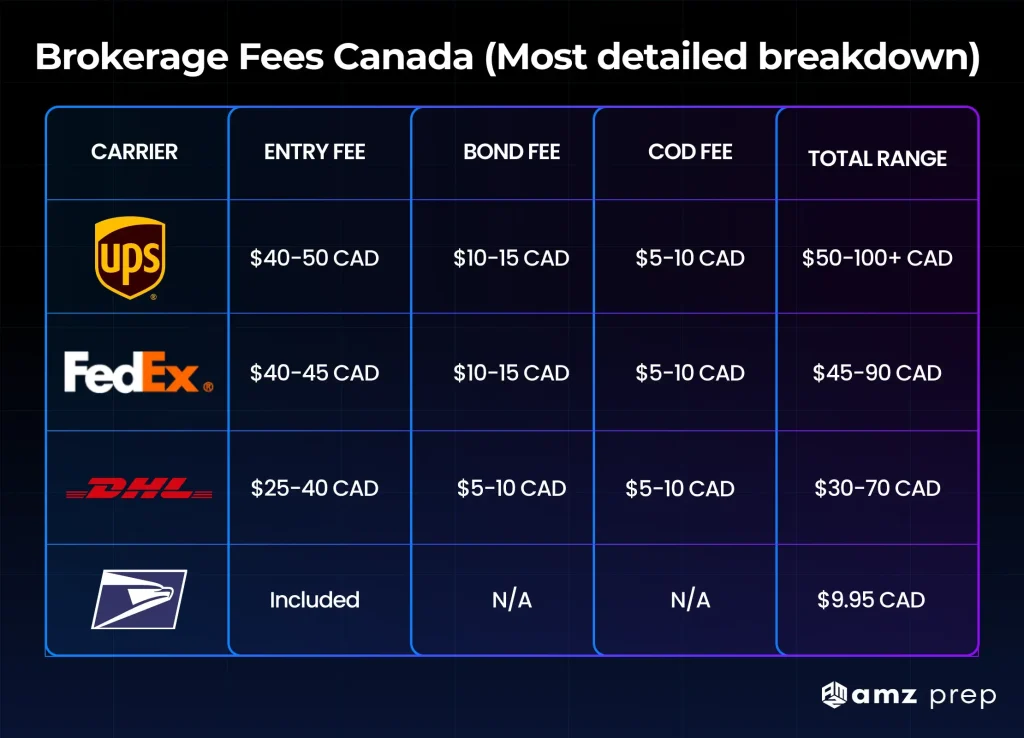
Brokerage fees Canada (Most detailed breakdown)
Note: These are typical fee ranges based on industry reports. Carriers do not publish complete brokerage fee schedules publicly, and actual fees may vary based on shipment complexity, account type, and specific circumstances.
A $200 item shipped via UPS might cost your customer $85 in brokerage fees alone. That same package through USPS? Just $10
Brokerage fees in other major markets
| Country | Postal Service | Private Carriers |
|---|---|---|
| United Kingdom | £8-12 | £12-25 |
| European Union | €5-15 | €15-30 |
| Australia | AUD $10-15 | AUD $30-60 |
| Mexico | $150-250 MXN | $400-800 MXN |
Brokerage fees Canada remain among the highest globally when using private carriers. This makes carrier selection critical for Canadian shipments. Some shipping companies may overcharge for these services, so comparing options is essential.
3. Import Taxes (The Government’s Cut)
These import taxes are different from duties. Import taxes are sales taxes applied to international purchases, including value-added tax (VAT) and goods and services tax (GST).
Import tax rates by country
| Country/Region | Tax Type | Rate | Applied To |
|---|---|---|---|
| United States | State Sales Tax | 0-10% | Varies by state |
| European Union | VAT | 17-27% | Goods over €150 |
| United Kingdom | VAT | 20% | Goods over £135 |
| Australia | GST | 10% | Goods over AUD $1,000 |
| Canada | GST/HST/PST | 5-15% | Goods over CAD $20 |
Key Canadian thresholds
- Items under CAD $20: No duties or taxes
- Items CAD $20-$150: No duties, but taxes apply
- Items over CAD $150: Full duties and taxes
The tax applies to the product value PLUS shipping costs. Then it compounds with duties. Imported goods are subject to duties and taxes based on their classification and value.
Example calculation for your Canadian customers:
- Product: $100
- Shipping: $20
- Subtotal: $120
- Duty (8%): $9.60
- New subtotal: $129.60
- HST (13%): $16.85
- Total taxes/duties: $26.45
This means your $100 product costs your customer $146.45 at delivery if you use DDU shipping.
4. De Minimis Thresholds
Every country has a de minimis value. Below this amount, you skip duties or get simplified customs. Some shipments may be exempt from customs duties under these thresholds, allowing customs smoothly without extensive processing.
2026 de minimis values worldwide
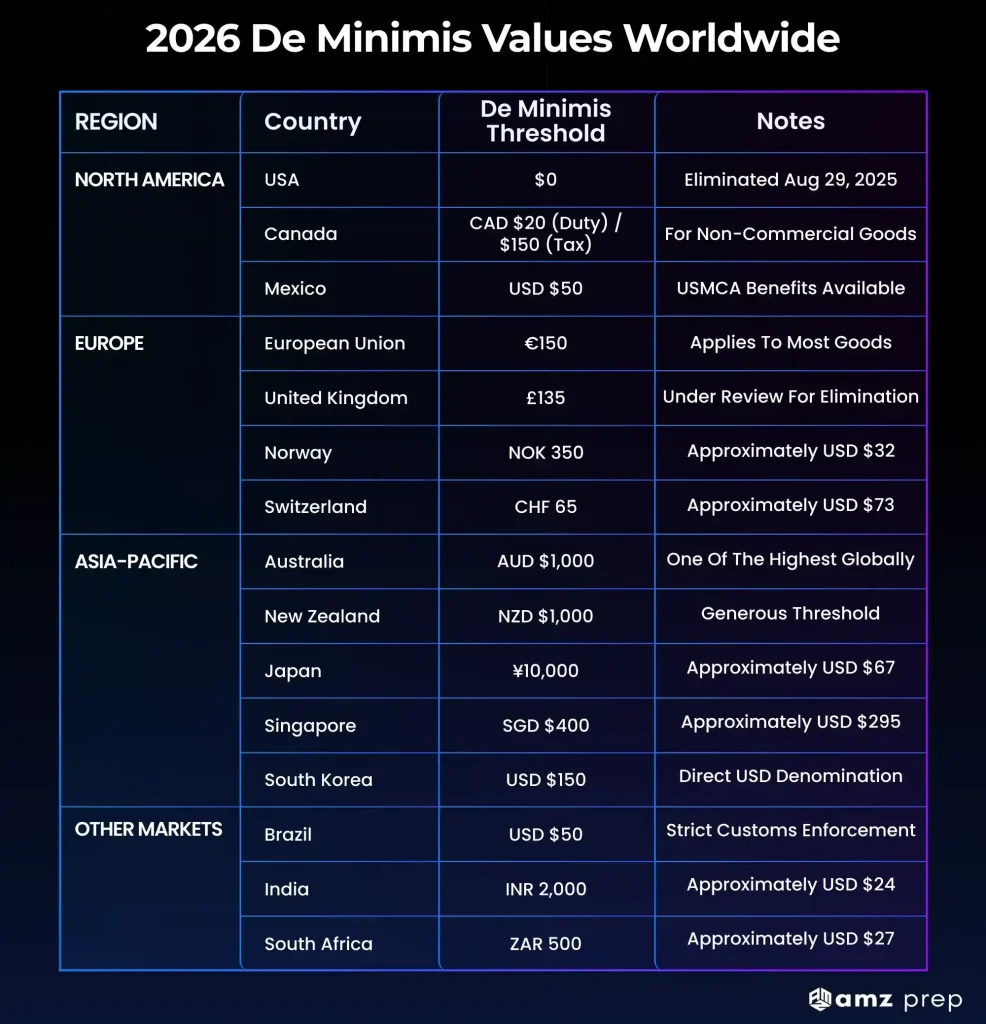
The United States elimination of its de minimis threshold created significant changes for goods imported into the U.S. All imports now require formal customs entry. Even a $5 item receives customs processing.
This increased costs for all international sellers shipping to the United States. Previously, the $800 threshold allowed simplified processing for low-value goods.
Smart sellers structure shipments around these numbers. Ship two $140 packages to Canada instead of one $280 package, and you can potentially avoid duties for your customers.
Important note: Deliberately splitting orders to avoid duties is called structuring. Customs authorities scrutinize obvious attempts. Use this knowledge appropriately for legitimate multi-item orders. Depending on the country, authorities enforce these regulations differently.
5. Dimensional Weight Charges (The Hidden Size Penalty)
You pack a lightweight product in a large box. It weighs 2 pounds on your scale. UPS charges you for 8 pounds. Why the difference?
Carriers price shipments on dimensional weight – basically, how much truck space your box occupies. That giant box full of bubble wrap? You’re paying for every cubic inch.
Here’s the calculation they use:
(Length × Width × Height) / DIM Divisor = Billable Weight
The divisor changes by carrier:
- UPS and FedEx use 139 for everything
- USPS uses 166
- DHL sticks with 139
Let me show you how this plays out:
You ship a 16″ × 12″ × 10″ box weighing 3 actual pounds.
Your DIM weight: (16 × 12 × 10) ÷ 139 = 13.8 pounds
You’re paying for 13.8 pounds of shipping. That’s nearly 5 times the actual weight.
Your defense against DIM charges:
- Always use the smallest box that protects your product
- Strip out excess bubble wrap and filler
- Cube-shaped boxes perform better than flat rectangles
- For high-volume shippers, consolidation services help
- Check a DIM weight calculator before finalizing packaging
One seller we know cut their shipping costs by 35% just by switching from their standard box to a slightly smaller size. Same product, same protection, dramatic savings.
Use a DIM weight calculator and compare dimensional weights and shipping costs.
6. Fuel Surcharges
Fuel surcharges change monthly based on oil prices. Carriers adjust these separately from base shipping rates.
Current 2026 fuel surcharge ranges:
| Service Type | Fuel Surcharge Range |
|---|---|
| Ground Shipping | 9-13% |
| Air Shipping | 19-26% |
| International | 21-32% |
That $50 shipping quote? Add another $10-16 for fuel. The carrier mentions this in small print at checkout.
7. Storage and Demurrage Fees
Your package becomes delayed at customs for three days. Now your customer owes $75 in storage fees. Port and customs facilities charge daily rates for packages sitting in their warehouses. If determination is made that additional inspection is needed, these fees paid can accumulate quickly.
Typical storage fees:
- Days 1-3: Often free
- Days 4-7: $25-50 per day
- Week 2+: $50-100+ per day
These accumulate quickly during customs inspections or documentation delays. Your customer receives the bill, which damages your seller reputation.
How to prevent storage fees
- Provide complete, accurate customs paperwork
- Respond immediately to customs requests
- Use a customs broker who monitors clearance status
- Consider DDP (Delivered Duty Paid) shipping
8. Residential Delivery Surcharges
Shipping to a customer’s home? That costs extra. Carriers charge $4-$8 per package for residential addresses. Commercial addresses ship cheaper because drivers can drop multiple packages at once.
What counts as residential:
- Single-family homes
- Apartments
- Any address without a business name
Some carriers use address databases to automatically detect this. Others go by the address format you enter.
This surcharge applies to most eCommerce orders since you’re shipping to consumers.
9. Remote Area Fees
Your customer lives 45 minutes from the nearest city. Their postal code just added $35 to your shipping cost.
Carriers maintain lists of ‘remote’ or ‘extended delivery’ postal codes. These areas cost more because they’re off regular delivery routes.
Remote area fees: $25-$75 per package
Check your customer’s postal code before quoting shipping. Most carriers have remote area lookup tools on their websites.
10. Signature and Special Handling Fees
- Someone needs to sign for the package? That’s $5-8 extra.
- Adult signature required (alcohol, tobacco)? Add $7-10.
- Saturday delivery? Another $15-20.
- Declared value over $100? Insurance fees start at $2 per $100 of value.
These ‘premium’ services add up quickly. Only use them when necessary.
11. Currency Conversion Markups
You ship a $100 USD item to Canada. Your customer’s credit card bills them $108 CAD. The exchange rate should make that $137 CAD. Where did the additional $29 go?
Currency conversion fees hide in three places:
- Credit card foreign transaction fees: 1-3%
- Payment processor markups: 2-4%
- Carrier exchange rate margins: 1.5-7.5%
That ‘1.37 exchange rate’ you see online? Carriers use their own rates. Often 5-7% worse than market rates.
How to minimize FX costs for your customers
- Accept payment in multiple currencies
- Use payment processors with better FX rates
- Display prices in the customer’s local currency
- Consider a multi-currency business account
12. Reclassification and Weight Adjustments
You declared your package as 5 pounds. The carrier weighs it and discovers 6.2 pounds. Adjustment fee: $50-$200, plus the difference in shipping cost.
Carriers audit packages randomly. They verify:
- Actual weight vs. declared weight
- Actual dimensions vs. declared dimensions
- Product description vs. customs declaration
Get caught making ‘mistakes’ too often, and they’ll audit every package you send.
Avoid these fees by:
- Using a certified scale
- Measuring boxes accurately
- Being honest on customs forms
- Adding 5% buffer to weight estimates
Why USPS Is Your Most Cost-Effective Option for International Shipping
USPS offers competitive cross-border delivery fees for most lightweight packages. They partner with destination postal services instead of using private customs brokers when shipping internationally.
USPS Service Options
First-Class Mail International:
- Weight limit: 4 lbs
- Speed: 7-21 days
- Starting cost: $1.70 (Global Forever stamp for letters)
- Packages start at: $19.40
Best for: Small, lightweight items under 1 pound
Priority Mail International:
- Weight limit: 70 lbs
- Speed: 6-10 days
- Starting cost: $32.65 (effective January 18, 2026)
- Includes tracking and insurance
Best for: Most eCommerce packages
Priority Mail Express International:
- Weight limit: 70 lbs
- Speed: 3-5 days
- Starting cost: $62.70 (effective January 18, 2026)
- Premium tracking and guaranteed delivery date
Best for: Urgent shipments where speed matters
USPS International Shipping Rates by Weight
USPS implemented rate increases effective January 18, 2026. (Source)
Here’s what you’ll pay for USPS international shipping to major destinations:
USPS international shipping rates by weight to major destinations (2026):
| Weight | Canada | Mexico | Europe/UK | Australia/Asia |
|---|---|---|---|---|
| 1 lb | $48-58 | $50-60 | $55-68 | $58-72 |
| 2 lbs | $52-68 | $55-71 | $62-78 | $65-82 |
| 5 lbs | $73-94 | $76-98 | $88-112 | $92-118 |
| 10 lbs | $115-141 | $120-147 | $145-175 | $152-185 |
| 20 lbs | $167-204 | $175-215 | $220-265 | $235-285 |
Rates shown are for Priority Mail International. Exact pricing varies by origin ZIP code.
Priority Mail International rates increased by approximately 4% on average. First-Class Package International increased by approximately 8% on average.
The USPS international shipping rate structure divides countries into price groups. Canada offers the lowest rates as Price Group 1.
Exact USPS international shipping rates by weight depend on your origin ZIP code and destination postal code. Use the USPS International price calculator to get precise quotes.
Why USPS Avoids High Brokerage Fees
USPS hands packages to destination postal services at the border. These government postal services charge minimal processing fees, helping packages clear customs more affordably.
Examples:
- Canada Post: $9.95 CAD
- Royal Mail (UK): £8
- Australia Post: AUD $10
- Correos (Mexico): Minimal fees
Compare Canada Post’s $10 fee to UPS’s $85 brokerage fee. You save $75+ per package.
The tradeoff? Slightly slower delivery and less detailed tracking. For most sellers, this tradeoff makes financial sense.
Learn more about USPS shipping to Canada in our detailed guide.
USA to Canada Cross-Border Shipping
The USA-Canada border handles more cross-border deliveries than any other route globally. For sellers who ship from Canada to the US, Understanding these specific fees matters for North American businesses engaged in international trade and cross-border eCommerce shipping operations.
Shipping to Canada from USA
CBSA (Canada Border Services Agency) requirements:
- Commercial invoice required to obtain clearance for all shipments over CAD $20
- Accurate HS code classification mandatory
- CARM (Canada Assessment and Revenue Management) system processes all entries
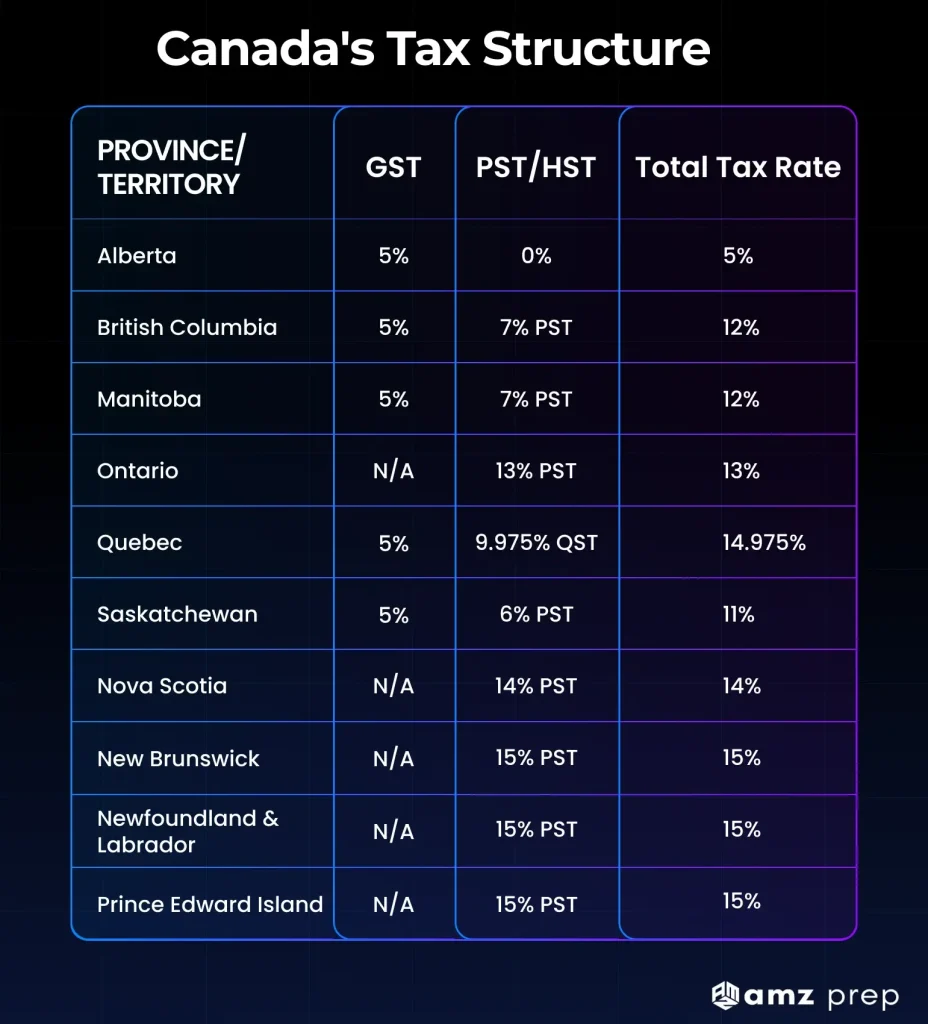
Provincial tax variations:
| Province/Territory | GST/HST | Total Rate | Notes |
|---|---|---|---|
| Alberta | 5% GST | 5% | Lowest in Canada |
| Ontario | 13% HST | 13% | Combined tax |
| Quebec | 5% GST + 9.975% QST | 14.975% | Highest in Canada |
| British Columbia | 5% GST + 7% PST | 12% | Separate taxes |
The tariff between the US and Canada got complicated in 2026. Here’s where things stand right now.
Canada hit US steel, aluminum, and automobiles with 25% tariffs starting in January 2026. Here’s where things stand right now. Canada hit US steel, aluminum, and automobiles with 25% tariffs starting in January 2026. The United States responded with its own set of tariffs. these tariff decisions have been volatile, but a landmark Supreme Court ruling may now bring forecasting stability back to cross-border trade.
The United States responded with its own set of tariffs:
- Timber and lumber: 10% tariffs in place now, with planned increases to 30% for furniture and 50% for cabinets pushed back to January 2027
- Medium and heavy-duty vehicles: 25% tariffs (went into effect November 2025)
- Steel, aluminum, and copper products: 50% tariffs
Here’s the reality: these rates can change. The United States, Canada, and Mexico are reviewing CUSMA through mid-2026, which means tariffs could shift based on those negotiations.
Always verify current tariff rates before you ship. What’s accurate today might change next month. Cross-border shipping between the US and Canada requires staying on top of these policy updates.
Import Duties and Taxes When Shipping from Canada to the USA
CBP (Customs and Border Protection) fees:
- Merchandise Processing Fee: 0.3464% of shipment value (minimum $27.75, maximum $538.40)
- Harbor Maintenance Fee: 0.125% for ocean shipments
De minimis elimination: The United States eliminated its $800 de minimis threshold on August 29, 2025. Now every single import requires formal customs entry and duty payment. All goods imported into the U.S now require complete documentation.
This changed everything for Canadian sellers. Even a $15 item needs full customs documentation and incurs duties.
Formal vs. Informal Entry:
- Under $2,500: Informal entry (simpler process)
- Over $2,500: Formal entry (requires customs bond)
USMCA Benefits
The United States-Mexico-Canada Agreement replaced NAFTA in 2020. It offers duty free shipping for qualifying goods, making certain items exempt from customs duty and import taxes.
To qualify:
- Product must originate in Canada, the United States, or Mexico
- Must meet rules of origin requirements
- Need USMCA Certificate of Origin
Many products ship duty-free under USMCA. You still pay taxes and brokerage fees, but you skip the 5-12% duty charge.
This saves substantial money on high-volume shipments. A $10,000 shipment at 8% duty costs $800. Under USMCA, you pay $0 in duties.
For complex international logistics, consider working with an international freight forwarder who understands trade agreements and laws and regulations.
Cross-Border Shipping to Other Major Markets
USA-Canada might be the busiest route, but shipping internationally to other markets opens up serious growth opportunities. Here’s what changes when you expand globally.
European Union
The EU is phasing out its de minimis exemption. Starting July 1, 2026, expect a €3 per-item duty on goods under €150. By 2028, all imports face duties regardless of value.
VAT rates vary by country – anywhere from 17% to 27%. The IOSS system simplifies collection, but packaging and labeling requirements are stricter than North America.
Shipping options: DHL and UPS handle express. National postal services work for economy shipments. Once inside the EU, goods move between countries without extra customs fees.
United Kingdom
Every UK shipment now needs customs declarations. VAT applies at 20% for goods over £135. Expect more paperwork than pre-2021. Northern Ireland follows different rules than England, Scotland, and Wales.
Carriers to consider: Royal Mail for economy, DHL and FedEx for express, Parcelforce for tracked economy service.
Australia and New Zealand
These countries offer some of the world’s highest de minimis thresholds – $1,000 AUD/NZD. GST hits at 10% above that.
Best approach: Always use tracking. For regular customers, local fulfillment makes sense given the distance.
Mexico’s USMCA Benefits and What Complicates Them
USMCA delivers real advantages: duty free shipping for qualifying goods and simplified customs. The market is growing fast.
But customs procedures can still get complex. Brokerage fees exceed Canada’s rates. Infrastructure quality depends heavily on the region you’re shipping to.
Why This Matters
Cross-border fees vary by country more than most sellers realize. EU rules differ completely from UK rules, which differ from Australian rules.
Understanding local laws and regulations before your first shipment saves money and headaches. Each market requires its own strategy.
15 Ways to Avoid Hidden Cross-Border Customs Fees
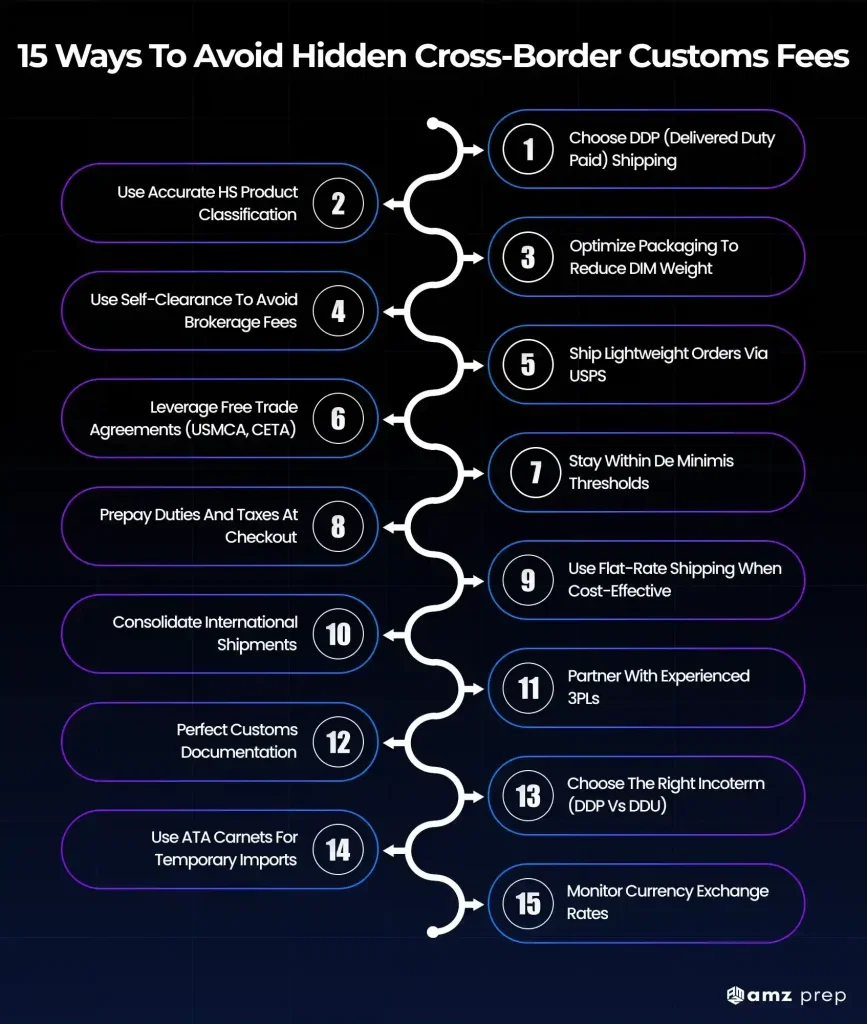
1. Choose DDP (Delivered Duty Paid) Shipping
DDP means you pay all duties, taxes, and fees upfront. Your customer pays the complete total at checkout with no surprises.
DDP increases cart conversion by up to 75%. Customers prefer knowing the complete cost upfront before purchasing.
Compare this to DDU (Delivered Duty Unpaid) where customers pay upon delivery. DDU creates price concerns and negative reviews that damage your seller reputation.
Most eCommerce platforms support DDP integration. Shopify, WooCommerce, and BigCommerce all offer duty/tax calculation at checkout.
Read our guide on DDP shipping to implement this properly for your store.
2. Use Accurate Product Classification
Every product needs an HS (Harmonized System) code. This 6-10 digit number determines duty rates.
Wrong code equals wrong duty rate equals surprise fees or customs delays for your customers.
How to find HS codes:
- CBSA Customs Tariff: cbsa-asfc.gc.ca/trade-commerce/tariff-tarif
- US HTS Database: hts.usitc.gov
- World Customs Organization: wcoomd.org
Example:
- Women’s cotton t-shirt: HS 6109.10
- Women’s synthetic t-shirt: HS 6109.90
- Duty difference: 16.5% vs 32%
Getting this wrong costs your business money and damages customer relationships. Classify products carefully.
Misclassification penalties can reach $50,000 or more for repeated violations. Customs authorities take this seriously.
3. Optimize Packaging for DIM Weight
Remember dimensional weight pricing? Smaller boxes equal lower shipping costs.
Best practices:
- Use the smallest box that safely fits your product
- Remove air pockets and excess packaging
- Consider custom-sized boxes for regular products
- Use poly mailers instead of boxes when possible
A 12×10×8 box might cost half as much to ship as a 16×14×10 box, even with the same actual weight. Before ordering packaging at scale, use a free DIM weight tool to model your options across different box sizes and carrier divisors so you lock in the most cost-effective configuration first.
When working with fulfillment centers, ask about their packaging optimization. Quality prep services like AMZ Prep minimize DIM weight charges for your shipments.
4. Self-Clear Through Customs
We covered this earlier for Canada. The process works in most countries.
As a seller with high shipment volumes, you can educate your customers about self-clearance. Some sellers include instructions with Canadian orders.
Time investment for customers: 1 to 3 hours per shipment Money saved: $50 to $150 per shipment
Worth recommending when:
- Package value exceeds $200
- Customer ships regularly
- Customer is near a customs office
For sellers with Canadian business presence, self-clearing your inventory shipments eliminates brokerage fees on business-to-business transfers.
5. Use USPS for Lightweight Shipments
For packages under 5 pounds to Canada and Mexico, USPS offers better pricing than private carriers 90% of the time.
The $75 or more you save on brokerage fees per package directly improves your profit margins.
When to use USPS as a seller:
- Packages under 5 lbs
- Non-urgent deliveries (6-10 days acceptable)
- Budget-conscious customers
- Regular international shipments
When to skip USPS:
- Urgent/time-sensitive shipments
- Packages over 20 lbs
- High-value items needing premium insurance
- Customers paying premium for express delivery
6. Use Free Trade Agreements
USMCA, CETA (Canada-EU), and other trade agreements eliminate duties on qualifying goods.
USMCA requirements:
- Product must originate in Canada, the United States, or Mexico
- Meet specific rules of origin criteria
- Complete USMCA Certificate of Origin
The certificate requires:
- Exporter information
- Producer information (if different)
- Product description and HS code
- Origin criterion (how it qualifies)
- Signature and date
Keep these certificates on file. Customs may request them during audits.
7. Stay Under De Minimis Thresholds
Ship a $140 package to Canada? Consider splitting it into two $70 packages.
The first $150 CAD enters Canada tax-free for non-commercial goods. Above that, you pay full taxes.
Legal considerations: Do not misuse this approach. Customs authorities track patterns. Shipping 10 packages worth $149 each to the same address raises concerns.
Use this strategically for legitimate multi-item orders where split shipping makes sense.
8. Prepay Duties and Taxes at Checkout
Want to eliminate surprise customs bills? Let customers pay everything upfront during checkout.
Most modern eCommerce platforms can calculate exact duties and taxes in real-time. Your customer sees the total cost before clicking “buy” – no surprises at delivery.
Popular solutions include:
- Zonos (Shopify app)
- Avalara (for larger operations)
- CartHook (Shopify checkout extensions)
- Shopify Markets (built-in option)
These platforms handle the technical stuff: HS code-based duty calculations, destination tax rates, payment collection, and fund transfers to carriers.
Setup typically takes an afternoon. The results? Higher conversion rates and far fewer customer complaints. Most sellers recover their implementation costs in the first month.
9. Use Flat-Rate Options When They Make Sense
USPS offers flat-rate boxes for international shipping. You pay one price regardless of weight (up to 70 lbs).
USPS international flat-rate prices to Canada (2026 rates):
- Small flat-rate box: $33.82
- Medium flat-rate box: $74.36
- Large flat-rate box: $96.20
These work effectively for dense, heavy items. A 10-pound book shipment in a medium flat-rate box costs $74.36. That same weight in a regular box can cost $115 or more.
10. Consolidate Shipments
Ship 50 small packages or one pallet? The pallet costs less per unit.
Freight consolidation strategies:
- Batch orders weekly instead of daily
- Use a freight forwarder for volume discounts
- Consider Amazon FBA or 3PL warehouses near borders
- Use LCL (Less than Container Load) for partial containers
Working with a 3PL for international shipping can streamline this process significantly.
11. Partner with Experienced 3PLs
Third-party logistics providers handle cross-border shipping daily. They understand the processes, have volume discounts, and manage customs paperwork.
What quality 3PLs offer sellers:
- Pre-negotiated carrier rates (20-40% discounts)
- Customs expertise
- Duty/tax calculation
- Multi-warehouse networks
- Automated documentation
Consider this if you ship more than 50 international packages monthly. The time savings and cost reductions justify the 3PL fees.
12. Perfect Your Documentation
Incomplete or inaccurate paperwork causes 80% of customs delays. Each delay costs money in storage fees.
Required documents:
- Commercial invoice (all shipments)
- Packing list (detailed contents)
- Certificate of origin (for trade agreements)
- HS code classifications
- Declared value
Best practices:
- Use consistent product descriptions
- Never undervalue items (this constitutes customs fraud)
- Include detailed packing lists
- Keep digital copies of everything
- Use commercial invoice templates
13. Choose the Right Incoterm
Incoterms define who pays what in international shipping.
Common options for sellers:
DDP (Delivered Duty Paid):
- You pay everything
- Customer sees final price at checkout
- Best for customer experience and conversion rates
DDU/DAP (Delivered at Place):
- Customer pays duties/taxes/fees at delivery
- Can cause surprise bills and negative reviews
- Lower upfront costs for you but higher support costs
FOB (Free on Board):
- Buyer takes ownership at origin port
- They handle all shipping and customs
- Rare in eCommerce, common in B2B wholesale
Choose based on your business model, customer expectations, and profit margins.
14. Consider ATA Carnets for Repeat Shipping
Shipping products for trade shows, exhibitions, or temporary use? ATA Carnets eliminate duties on temporary imports.
What is an ATA Carnet? It is an international customs document that allows duty-free temporary imports.
Who should use them:
- Trade show exhibitors
- Sales sample shippers
- Film/TV production equipment
- Professional equipment for events
Cost: $250 to $500 depending on value
Savings: Hundreds to thousands in avoided duties
Apply through chambers of commerce in your country.
15. Monitor Exchange Rates
Currency fluctuations impact your landed costs and pricing strategies. A 5% exchange rate swing means 5% more or less in costs.
Strategies for sellers:
- Use forward contracts for large regular shipments
- Open multi-currency accounts (Wise, PayPal Business)
- Display prices in the customer’s local currency
- Time large inventory shipments during favorable rates
- Consider dynamic pricing based on FX rates
What’s Changed in 2026?
International shipping continues to evolve significantly.
USA de minimis elimination (August 29, 2025)
Every import now requires formal customs entry and duty payment. This increased processing times and costs for all value shipments. The $800 threshold that existed for decades is permanently gone.
CUSMA Joint Review (Ongoing through July 2026)
The United States, Canada, and Mexico are conducting the first formal review of CUSMA. Potential modifications to the agreement may affect cross-border trade. Industry stakeholders submitted feedback through November 2025.
Canada’s tariff structure (January 2026)
Canada maintains 25% tariffs on United States steel, aluminum, and automobiles. Some temporary remissions expired January 31, 2026. Manufacturing sectors received extended remissions through June 30, 2026.
United States tariff environment
The United States maintains various tariffs including 10% lumber tariffs, 25% on medium/heavy-duty vehicles, and 50% on steel/aluminum/copper. Furniture and cabinet tariff increases were delayed until January 2027.
USPS rate increases (January 18, 2026)
Priority Mail International rates increased approximately 4%. First-Class Package International increased approximately 8%. Ground Advantage increased approximately 7.8%.
Increased customs scrutiny
Customs agencies globally increased verification and documentation requirements. Documentation accuracy matters more than ever. The elimination of de minimis created additional workload for customs officials.
Learn how these changes affect shipping delays in our comprehensive guide.
Conclusion
Cross-border shipping fees represent a significant challenge for international commerce. Understanding these costs transforms them from obstacles into manageable business expenses.
Understanding hidden customs charges, cross border customs fees, and the complete USPS international shipping rate structure positions your business for international expansion success. Whether shipping to Canada, Europe, Asia, or Latin America, these principles apply universally.
Cross-border commerce success depends on cost control and customer experience excellence. This guide provides the framework for achieving both objectives.
Begin your optimization process today. Your profit margins and customer satisfaction scores will reflect the improvements immediately.
Frequently Asked Questions
What are hidden customs charges?
Hidden customs charges include duties, taxes, brokerage fees, and processing charges not shown at checkout. These appear when packages cross international borders. They can increase your total cost by 50-100%.
How much are brokerage fees in Canada?
Brokerage fees in Canada range from $10 (USPS/Canada Post) to $100+ (UPS/FedEx). Private couriers charge significantly more than postal services. UPS typically charges $50-$100 CAD per package for standard brokerage.
What are USPS international shipping rates by weight?
USPS international shipping rates by weight vary by destination. To Canada in 2026, expect $48-58 for 1 lb, $73-94 for 5 lbs, and $115-141 for 10 lbs packages using Priority Mail International. These USPS international shipping rates remain significantly lower than UPS international shipping rates for lightweight packages.
Can I avoid paying customs fees from the USA to Canada?
You cannot avoid legitimate duties and taxes. However, you can avoid high brokerage fees by using USPS or self-clearing through CBSA. Self-clearing saves $50-$150 per shipment but requires time investment.
What’s the difference between duties and taxes?
Duties are fees on specific product categories to protect domestic industries. Taxes are sales taxes (GST, HST, VAT) applied to all imports. Both appear on customs bills but serve different purposes.
How do I use an international shipping cost calculator?
Enter your origin location, destination, package weight, dimensions, and value. The international shipping cost calculator shows carrier options, costs, and estimated delivery times. Always compare multiple carriers.
What are cross-border delivery fees?
Cross-border delivery fees include all charges to move goods between countries: shipping, duties, taxes, brokerage, and carrier surcharges. These cross border delivery fees can double your initial shipping quote. Understanding the complete structure of cross border customs fees helps sellers price products accurately.
Is USPS, UPS, or FedEx More Affordable for International Shipping?
USPS typically costs less for lightweight packages under 5 lbs due to lower brokerage fees. UPS international shipping rates and FedEx rates are higher but offer better rates for heavy packages and time-sensitive deliveries. Compare the USPS international shipping rate against UPS and FedEx using calculators for your specific shipment weight and destination.
How can I self-clear customs in Canada?
Contact CBSA at 1-800-461-9999, get your transaction number, visit a customs office with your paperwork, pay duties and taxes directly, and present the receipt to your carrier for package release.
How do I find HS codes for my products?
Use the CBSA Customs Tariff database or US HTS system. Search by product description or category to find the correct classification. Accurate HS codes prevent delays and penalties.
What is the de minimis threshold?
The de minimis value is the maximum shipment value that can enter a country without duties or simplified customs. The United States eliminated this in August 2025, now requiring formal entry for all imports.
Can I split shipments to avoid duties?
Legally splitting legitimate multi-item orders is acceptable. Artificially structuring shipments to avoid duties is illegal and can result in penalties up to $50,000 plus shipment seizure.
How did the 2026 rate changes affect USPS shipping?
USPS increased rates on January 18, 2026. Priority Mail International went up 4% on average. First-Class Package International increased 8% on average. These increases reflect fuel and operational cost adjustments.
What happened to the US de minimis threshold?
The United States eliminated its $800 de minimis threshold on August 29, 2025. All imports now require formal customs entry and duty payment, regardless of value.
Are brokerage fees in Canada higher than other countries?
Yes, brokerage fees Canada from private carriers are among the highest globally. UPS charges $50-$100 CAD compared to €15-30 in Europe or £12-25 in the UK. USPS via Canada Post remains the most cost-effective option at just $9.95 CAD. Understanding these brokerage fees Canada rates helps sellers choose the right carrier for Canadian shipments.

Arishekar N is a Vice President (VP) of Marketing at AMZ Prep, specializing in ecommerce fulfillment and Amazon logistics strategies with a proven track record of driving growth for e-commerce businesses. He is a strategic leader with extensive expertise in marketing, e-commerce operations, SEO & advertising, and branding.
Stay updated on his latest insights by following him

















Comments