CBM Calculator | Cubic Meter Calculator for Shipping
One volume estimation tool. Engineered for every international freight shipment.
Enter your box dimensions and weight. Get cubic meter calculations, chargeable weight, and container capacity in one pass. This free CBM calculator works in centimeters, millimeters, inches, feet, and meters.
- AMZ Prep named Top 100 B2B logistics in 2025 by Clutch






Calculate CBM (Cubic Meter) for Shipping
Comprehensive volume and weight calculations for global shipping
Last updated: July 2026Shipping Freight? Let AMZ Prep Handle It End-to-End
From ocean and air freight to customs clearance and Amazon-ready fulfillment — AMZ Prep moves your inventory across 6 countries with 50+ fulfillment centers and 35+ carrier partners. Optimize container loads, cut freight costs, and get your goods delivered faster.
Free consultation • No setup fees • Cancel anytime
What Is a CBM Freight Calculator?
A CBM freight calculator converts shipment dimensions into cubic meters. Enter length, width, height, and weight, and it returns CBM, cubic feet, cubic yards, chargeable weight for ocean and air freight, and carton counts for 20ft and 40ft containers. This is also called a cubic meter calculator or a metric cube calculator. Freight forwarders, importers, and Amazon FBA sellers use it before booking any international shipment.
Why Use a CBM Calculator?
A single volume number is rarely enough to book a shipment. These are the figures that change the decision.
All your volume conversions in one place
Enter your dimensions once and get CBM (m³), cubic feet, cubic yards, cubic inches, and cubic centimeters. No switching between tabs or converting by hand.
Chargeable weight for sea and air
Enter your actual weight and see which figure the carrier will bill. The tool compares actual weight against volumetric weight and returns the higher one. Ocean uses a 1:1000 divisor. Air uses 1:6000, with 1:5000 available for carriers that apply it.
Container capacity
See how many cartons fit in 20FT and 40FT containers across General, Reefer, and High Cube. Know whether you need one container or two before you call your freight forwarder.
Any unit your supplier sends
Enter centimeters, millimeters, inches, feet, or meters. The same tool works as a CBM calculator in cm, in mm, in inches, and in feet from one input.
Mixed carton shipments
Enter dimensions once and set the quantity. Add a second or third carton size when your shipment mixes box sizes, and the total CBM accounts for all of them.
Industry-standard formulas
The same calculations freight forwarders, customs brokers, and carriers use worldwide.
How Do You Calculate CBM for a Shipment?
How CBM is calculated: multiply the length, width, and height of your shipment in meters. The result is your CBM.
- To calculate CBM from centimeters, divide by 1,000,000
- From millimeters, divide by 1,000,000,000
- From inches, divide by 61,024
- From feet, divide by 35.315
1. Enter your box dimensions
Plug in length, width, and height for your carton or product.
- Pick centimeters, millimeters, inches, feet, or meters from the dropdown
- Works with decimals when you need precision
- One carton or one pallet, same process
- Add a second carton size if your shipment is mixed
2. Add weight and quantity
Enter the actual weight of one carton and how many you are shipping.
- Weight accepts kilograms or pounds
- For one item, keep the quantity at 1
- For a full container load, enter the carton count
- Calculations update instantly
3. Get your volume numbers
See everything calculated at once:
- CBM for freight quotes
- Cubic feet for domestic shipping
- Cubic inches for packing specs
- Cubic yards for bulk cargo
4. Check chargeable weight and container fit
Know what you’re working with before you book:
- Chargeable weight for ocean and air, side by side
- Estimated carton count for 6 container types
- A clear signal when you are close to needing a second container
CBM Calculation Results for Accurate Shipping Planning
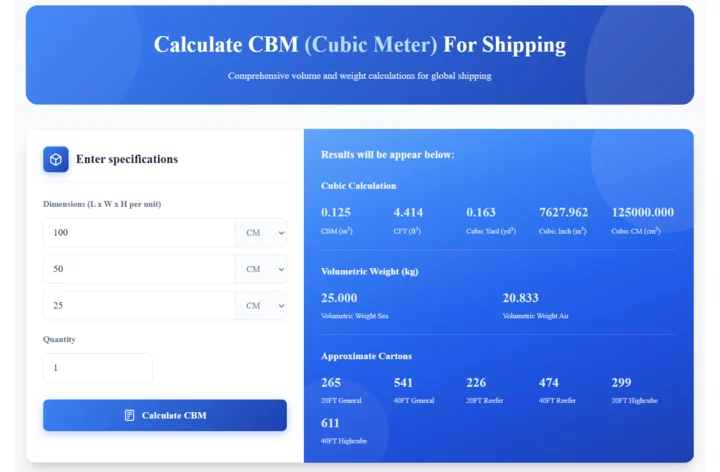
What Does the CBM Calculator Output?
Volume measurement
Freight forwarders quote in CBM. US warehouses want cubic feet. Your packaging supplier works in cubic inches. We give you all of them:
– CBM (Cubic Meters): What ocean freight pricing is based on
– CFT (Cubic Feet): Standard for US domestic and LTL shipping. Doubles as a cube calculator for shipping quotes priced in cubic feet.
– Cubic Yards: For large cargo and construction shipments
– Cubic Inches: When you’re figuring out carton layouts
– Cubic Centimeters: For smaller items and precise specs
Chargeable weight
Carriers bill on either actual weight or volumetric weight, whichever is higher. The calculator returns all three figures:
– Sea Freight: 1 CBM = 1,000 kg volumetric weight
– Air Freight: 6,000 cm³ = 1 kg volumetric weight, or 5,000 cm³ for carriers using that divisor
– Chargeable weight: the higher of actual and volumetric, marked so you know which applies
How Many CBM Fit in a Shipping Container?
CBM calculations for shipping containers start with the container’s internal volume.
- A standard 20ft container holds approximately 33 CBM.
- A standard 40ft container holds approximately 67 CBM.
- High Cube versions add roughly 13% more volume.
- Reefer containers reduce usable space by about 15% due to insulation and cooling equipment.
How Many Cubic Meters Will My Trailer Hold?
Road freight uses the same volume math as ocean freight. Trailer capacity differs from container capacity, so use these figures for domestic truckload moves.
- Trailer | Internal dimensions | Approximate capacity
- 53ft dry van | 16.15m x 2.59m x 2.74m | 114 CBM
- 48ft dry van | 14.63m x 2.59m x 2.74m | 104 CBM
- 28ft pup | 8.53m x 2.59m x 2.74m | 60 CBM
Weight often caps a trailer load before volume does. A trailer holding 100 CBM of light cargo may sit well under its weight limit. Dense cargo reaches that limit at half the volume. Check both figures before booking FTL freight.
Any unit, any format
Your supplier sent dimensions in centimeters or millimeters. Your warehouse uses inches. Your freight forwarder wants meters. Enter whatever you have and the tool handles the conversion.
CBM Planning for Cold Chain Shipping
Cold chain shipping covers cargo that must stay within a temperature range during transit. Frozen food, dairy, pharmaceuticals, nutraceuticals, and flowers all move in reefer containers. All of them share one loading constraint: less internal space than a standard container.
Enter your carton dimensions once. The reefer container CBM calculator outputs 20FT and 40FT reefer capacity alongside standard results so you’re planning against the right figures from the start.
What this means for common cold chain categories:
- Frozen food: Standard CBM formulas overestimate carton count by approximately 12-15% when applied to a reefer booking
- Pharmaceuticals: Accurate volume planning supports GDP-compliant documentation for temperature-controlled shipments
- Nutraceuticals and supplements: Reefer CBM planning prevents overloading and product rejection at destination
- Dairy and fresh produce: Knowing your refrigerated container volume in advance removes one variable from a time-sensitive operation
- Flowers and live plants: An overloaded reefer restricts airflow and damages cargo even within spec temperatures
How does our tool calculate your CBM value?
Standard formulas used across the freight industry:
CBM calculation
CBM = Length (m) × Width (m) × Height (m)
From centimeters: (L × W × H) ÷ 1,000,000
From millimeters: (L × W × H) ÷ 1,000,000,000
From feet: (L × W × H) ÷ 35.315
Volumetric weight
Sea Freight: CBM × 1,000 = Volumetric Weight (kg)
Air Freight: (L × W × H in cm) ÷ 6,000 = Volumetric Weight (kg)
Air Freight, 5,000 divisor: (L × W × H in cm) ÷ 5,000
Container internal dimensions
20FT General: 5.9m × 2.35m × 2.39m = 33.2 CBM
40FT General: 12.03m × 2.35m × 2.39m = 67.7 CBM
40FT High Cube: 12.03m × 2.35m × 2.69m = 76.3 CBM
Converting Between CBM and Other Units
CBM to cubic feet: multiply by 35.315. One CBM equals 35.315 CFT.
Cubic feet to CBM: divide by 35.315. A ft to CBM calculator runs this in one step. A carton at 2ft x 1.5ft x 1ft measures 3 cubic feet, or 0.085 CBM.
CBM to square feet: these measure different things. CBM is volume and square feet is area, so no direct conversion exists. To estimate floor space, divide CBM by your stack height in meters, then multiply by 10.764.
Millimeters to CBM: divide the millimeter volume by 1,000,000,000. A box at 600mm x 400mm x 300mm equals 0.072 CBM.
Who Uses This CBM Calculator for Shipping
Amazon FBA sellers
Calculate exact CBM for inbound shipment plans. Figure out how many containers you need for your next inventory order. Stop overpaying for half-empty containers.
Importers and exporters
Get the numbers you need for freight quotes without back-and-forth emails. Compare FCL vs. LCL costs with real data. Make sure your customs paperwork matches your actual shipment.
E-commerce brands
Know your storage costs before inventory hits the warehouse. Plan receiving schedules around actual cubic volume. Ship smarter carton sizes.
Freight forwarders and 3PLs
Quote customers faster with a shipping CBM calculator built for volume work. Verify the dimensions shippers give you. Plan consolidation shipments with the numbers confirmed first.
Temperature-controlled freight operators
Standard CBM figures don’t apply to a reefer unit. This calculator outputs refrigerated container volume estimates for 20FT and 40FT reefer containers in every calculation. Use it to confirm carton counts and compare reefer capacity against standard options before you book.
Calculator Comparison
| Feature | Our Calculator | Basic Calculators | Doing It Manually |
|---|---|---|---|
| Volume formats | 5 (CBM, CFT, yd³, in³, cm³) | 1–2 | You do the conversions |
| Volumetric weight | Sea & Air | Usually missing | Separate calculation |
| Container estimates | 6 types | None | Look it up yourself |
| Unit options | CM, IN, FT, M | Limited | Pick one and stick with it |
| Quantity multiplier | Yes | Rare | Calculator app |
| Speed | Instant | Varies | 5–10 minutes |
| Cost | Free | Often limited | Free but slow |
What Is the Difference Between CBM and Volumetric Weight?
CBM measures the physical volume of a shipment in cubic meters. Volumetric weight converts that volume into a weight equivalent for pricing. Ocean freight uses 1 CBM = 1,000 kg. Air freight divides total cubic centimeters by 6,000. Carriers bill whichever is higher, actual weight or volumetric weight. That higher figure is your chargeable weight.
What Is the Difference Between CBM and CFT?
CBM is cubic meters. CFT is cubic feet. One CBM equals 35.315 CFT. Ocean freight quotes use CBM. US domestic freight and some LTL carriers use CFT. The calculator converts between both instantly.
FAQs
Frequently Asked Questions About CBM Calculation
CBM stands for Cubic Meter. It’s how the freight industry measures cargo volume. Ocean carriers price shipments by CBM, warehouses charge storage by CBM, and customs documents list cargo in CBM. If you’re shipping internationally, you need to know this number.
Measure your carton in centimeters. Multiply length × width × height, then divide by 1,000,000 to get CBM. For a full shipment, multiply one carton’s CBM by the total carton count. Use this number to plan container loads and estimate inbound freight costs.
Actual weight is what the scale reads. Volumetric weight is based on the space a package occupies. Carriers bill the higher of the two, called chargeable weight. Enter both figures and the calculator marks which one applies.
Air freight is expensive and space on planes is limited, so carriers use a stricter formula (divide by 6,000). Ocean freight has more room, so the formula is more forgiving (1 CBM = 1,000 kg). This is why bulky, lightweight items cost way more to ship by air.
About 33 CBM of internal space. Real-world capacity usually runs 25 to 28 CBM once carton shapes, stacking limits, and pallet configurations apply. Our estimates account for typical utilization rates.
It depends on box size. A standard 40ft container holds about 67 CBM. A carton measuring 50cm × 40cm × 30cm has a volume of 0.06 CBM, meaning roughly 1,100 cartons of that size fit in a 40ft container.
A container one foot taller than standard, about 9’6″ inside instead of 8’6″. Same length and width. You get roughly 13% more volume. Good for light, bulky products like furniture, textiles, or packaged foods.
A refrigerated container with built-in cooling. The insulation and cooling unit take up space, so you get less cargo volume than a regular container the same size. A 40FT Reefer holds about 59 CBM versus 67 CBM for a standard 40FT.
They’re planning estimates, not guarantees. Actual capacity depends on your carton dimensions, whether you’re using pallets, and how well everything stacks. Use these numbers for budgeting and initial planning. Your freight forwarder will give you exact loading plans.
Yes. Calculate your total CBM to figure out container needs, estimate shipping costs, and make sure your carton dimensions work for Amazon’s requirements. Especially useful when you’re planning large inventory replenishments.
Yes. No signup, no credit card, no limits. Calculate as many shipments as you want.
Centimeters, millimeters, inches, feet, or meters. Pick from the dropdown next to each dimension field. The tool converts everything to CBM automatically.
Enter dimensions for one carton and set the quantity to your total carton count. If your shipment mixes box sizes, add each size as a separate row and the calculator totals them.
Depends on the shipping method. For ocean freight LCL, carriers typically charge by CBM or weight-ton (1,000 kg), whichever is greater. For air freight, volumetric weight is the standard. Get both numbers from our calculator so you can compare.
Sort of. Ocean freight rates are usually quoted per CBM, so once you have your CBM you can multiply by the rate. But rates vary wildly by lane, season, and carrier. Use CBM to compare quotes—not to guess what shipping will cost.
Yes, CBM calculation directly determines your warehouse space needs. When you know your total CBM, warehouses can tell you exactly how many pallet positions you need and what your storage costs will be. It’s the foundation for planning storage capacity and pricing. We have created a warehouse storage space calculator that helps you determine your requirements instantly.
CBM estimation absolutely impacts your pallet calculations. It shows how efficiently your products stack and how much vertical space you’re using. Two shipments with the same CBM might need different numbers of pallets depending on how the products are configured and stacked. Calculate your pallet configuration perfectly to make your fulfillment operations effortless.
You can calculate CBM for any product category. Whether it’s standard boxes, apparel, electronics, oversized items, or irregularly shaped products, the calculation is the same. You multiply length times width times height and convert to cubic meters.
A reefer is a refrigerated container with insulated walls and a built-in cooling unit. These reduce usable internal space by roughly 15% compared to a standard container. A 20FT reefer holds ~28 CBM and a 40FT reefer holds ~59 CBM.
Frozen food, fresh produce, dairy, pharmaceuticals, nutraceuticals, supplements, and flowers. Any cargo with a temperature-controlled specification during transit qualifies for cold chain shipping in a reefer container.
One CBM equals a box measuring 1 meter on all sides: 1m × 1m × 1m. In practical terms, that is roughly the size of a standard washing machine carton or about 35.3 cubic feet. Most air freight shipments are 1 to 5 CBM. Most LCL ocean shipments start at 1 CBM.
For ocean freight, 1 CBM equals 1,000 kg of volumetric weight. Carriers charge whichever is higher between actual weight and volumetric weight. A shipment lighter than 1,000 kg per CBM gets charged by volumetric weight.
CBM stands for cubic meter. It is the standard volume unit in freight. Ocean carriers price by CBM, warehouses charge storage by CBM, and customs paperwork lists cargo in CBM.
Multiply length, width, and height in meters. For centimeters, multiply the three dimensions and divide by 1,000,000. Multiply the result by your carton count for total shipment CBM.
A standard 40ft container measures 12.03m x 2.35m x 2.39m internally, giving 67.7 CBM. A 40ft High Cube reaches 76.3 CBM. Real usable volume runs 10 to 15 percent lower.
Multiply CBM by 35.315. One cubic meter equals 35.315 cubic feet. Ocean freight quotes use CBM while US domestic and LTL carriers quote in cubic feet.