
You receive an order notification. A customer in Germany just bought your $200 product. You ship it immediately.
Two weeks later, the delivery person arrives at your customer’s door with the package, along with an unexpected bill for $87 in customs duties and taxes.
Now your customer feels confused as they are expected to pay only $200. Now they’re being asked for $87 more before receiving their package.
That’s Delivery Duty Unpaid (DDU) shipping in action. This blog will walk you through and as an Amazon or eCommerce seller, you need to understand exactly what it means for your business and your customers.
What is the Meaning of Delivered Duty Unpaid (DDU)?
Delivered Duty Unpaid (DDU) is an international shipping term where you (the seller) deliver products to your customer’s location. But your customer will pay all the import duties, taxes, and customs clearance fees.
As a seller you will handle shipping the product internationally and your customer will handle customs costs when their package arrives.
DDU means ‘the seller is responsible for ensuring goods are delivered safely to a destination. However, the buyer is responsible for import duties and any other taxes.’
The International Chamber of Commerce created DDU as part of Incoterms (International Commercial Terms). These standardized rules define who pays what in international trade.
Note: DDU was officially removed from Incoterms in 2010 and replaced with the term DAP (Delivered at Place). However, many sellers and carriers still use the term DDU in everyday shipping. When people say DDU today, they mean DAP shipping.
Understanding Delivery Duty Unpaid Meaning
The delivered duty unpaid meaning is straightforward. You deliver the product to your customer’s location. But duties remain unpaid by you. Your customer pays them.
Break down the term:
- Delivered: You ship and deliver goods to the destination country
- Duty: Import duties and taxes charged by customs
- Unpaid: These duties are not paid by you (the seller)
Under DDU terms, the seller delivers goods to the agreed-upon destination in the country of importation. The buyer is then responsible for the rest of the costs and further delivery.
DDU Compliance and Documentation Requirements
Proper documentation prevents customs delays, penalties, and rejected shipments.
Essential DDU Documents
1. Commercial Invoice (Most Critical)
Must include:
- Seller’s complete business name and address
- Buyer’s complete name and address
- Invoice date and number
- Complete product descriptions (be specific)
- HS (Harmonized System) codes for each item
- Country of origin for each item
- Unit price and currency
- Total value
- Incoterm (DDU or DAP)
- Buyer’s tax ID or VAT number (if applicable)
Common mistakes that cause delays:
- Vague product descriptions (‘clothing’ instead of ‘women’s cotton t-shirt’)
- Missing or incorrect HS codes
- Undervalued goods (customs red flags this)
- Missing required certifications or licenses
2. Packing List
Detailed breakdown of package contents:
- Item descriptions matching commercial invoice
- Quantities
- Weight of each item
- Dimensions
- Packaging type (boxes, pallets)
- Marks and numbers on packages
3. Certificate of Origin
Required for:
- Free trade agreement benefits
- Some countries mandate it for all imports
- Products subject to special regulations
Obtain from:
- Your local Chamber of Commerce
- Your freight forwarder
- Some countries accept self-certification
4. Bill of Lading (Ocean) or Air Waybill (Air)
Proof of shipment contract between you and carrier. Shows:
- Shipper and consignee details
- Package details
- Shipping route
- Terms of carriage
5. Import Permits/Licenses (If Required)
Certain products need special permits:
- Food and supplements
- Medical devices
- Telecommunications equipment
- Chemicals
- Plants and plant products
- Animal products
Check destination country requirements before shipping.
Country-Specific DDU Requirements
United States
- CBP requires ISF (Importer Security Filing) 24 hours before ocean shipments
- FDA Prior Notice for food, drugs, cosmetics, medical devices
- USDA permits for agricultural products
- FCC certification for wireless devices
- Important: USA eliminated $800 de minimis August 29, 2025 – all imports now subject to duties
European Union
- Buyer needs EORI (Economic Operator Registration) number
- Certain products require CE marking (safety standards)
- REACH compliance for chemicals
- RoHS compliance for electronics
- Each EU country handles its own import clearance (no single EU customs)
United Kingdom (Post-Brexit)
- UK requires separate customs procedures from EU
- Buyer needs UK EORI number (separate from EU EORI)
- UKCA marking replacing CE marking for many products
- Northern Ireland has special rules (still follows some EU regulations)
Canada
- Buyer needs Business Number or individual identification
- NAFTA/USMCA certificates reduce duties on eligible goods
- French labeling required for consumer goods in some provinces
- Relatively efficient customs clearance
Australia
- 10% GST on most imports
- Strict biosecurity requirements
- Detailed import declarations required
- Quarantine inspections for food, wood, plant, and animal products
Impact of Trade Policy Changes on DDU Shipments
Recent trade policy changes significantly impact DDU shipping economics, particularly for sellers targeting the US market.
US De Minimis Elimination (August 2025)
Previously, shipments valued under $800 entering the United States faced no duties or formal customs entry. This changed on August 29, 2025, when the US eliminated this exemption.
Impact on DDU shipments:
- All US imports now subject to duties regardless of value
- Even a $20 item now requires formal customs clearance
- Buyers face customs bills on every international purchase
- Processing times increased due to higher customs volume
For sellers shipping DDU to the USA:
- Customer surprise fees increased dramatically
- Low-value items become less profitable
- Cart abandonment rates rising for international US customers
- Many sellers switching to DDP for US shipments to maintain conversions
Tariff Volatility and Profitability
Recent tariff changes create uncertainty for DDU shipments:
China-sourced products: Additional tariffs ranging from 25-100% on certain product categories compound existing duties. Your customer’s surprise customs bill may exceed the product price.
Strategic considerations:
- Monitor tariff schedules constantly – Rates change with political circumstances
- Product classification matters more than ever – Small HS code differences mean massive duty variations
- Consider nearshoring inventory – Using fulfillment centers in destination countries eliminates these risks
- Run profitability scenarios – Calculate whether your margins survive when customers refuse delivery due to high duties
Example impact:
Product: $100 consumer electronics from China to USA
Previous scenario (2024):
- Normal HTS duty: ~2-3% = $2-3
- De minimis exemption (if under $800): $0
- Total cost: ~$102-103
Current scenario (Late 2025):
- Section 301 tariff: 25% = $25
- Fentanyl tariff (IEEPA): 10% = $10
- Reciprocal tariff: 10% = $10
- Normal HTS duty: 2% = $2
- Total tariffs: 47% = $47
Additional fees (formal entry):
- Merchandise Processing Fee: $29.66 (minimum)
- Customs broker fee: $75-100
- State sales tax (7% of $147): $10.29
- Total additional costs: ~$115
TOTAL LANDED COST: $262
Total surprise bill: $160+ (160% markup vs 2024)
Note: For small packages via USPS, China imports now face a $200 flat fee per package (de minimis eliminated May 2, 2025), making the total cost $315+ for a $100 item.
Result: Higher refusal rates, more negative reviews, lower profitability.
Understanding the Differences Between DDU, DDP, and DAP
Many sellers confuse DDU with other shipping terms. Here’s how they differ:
| Feature | DDU (Delivered Duty Unpaid) | DDP (Delivered Duty Paid) | DAP (Delivered at Place) |
|---|---|---|---|
| Official status | Replaced in 2010 | Current official term | Current official term (replaced DDU) |
| Who pays duties? | Buyer pays | Seller pays | Buyer pays |
| Who handles customs? | Buyer handles import customs | Seller manages all customs | Buyer handles import customs |
| Price transparency | Low – surprise fees | High – full price upfront | Low – surprise fees |
| Best for | Outdated (use DAP instead) | B2C eCommerce sellers | B2B and some B2C |
| Customer experience | Poor – unexpected bills | Excellent – no surprises | Moderate |
| Seller responsibility | Moderate | Maximum | Moderate |
Learn more about delivery duty paid from this blog.
A Real Cost Example for DDU Shipping
You’re selling a $500 clothing order from the USA to the UK using DDU shipping:
What You Charge at Checkout:
- Product: $500
- International shipping: $50
- Total customer pays you: $550
What Customer Pays at Delivery (DDU fees):
- UK Import Duty (12% on clothing): $66
- UK VAT (20% official rate): $113.20
- Customs clearance fee: $25
- Total surprise bill at delivery: $204.20
Customer’s Actual Total Cost: $754.20
Your customer thought they were paying $550. They actually paid $754.20. That $204.20 surprise creates frustration and negative reviews.
Compare this to DDP shipping where you would show $754.20 at checkout. No surprises. Better customer experience. But you handle the complexity of paying duties.
Major Shipping Companies That Offer DDU Services
Most major international carriers support DDU/DAP shipping, though they may use different terminology.
| Courier | DDU Support | Customs & Duties | Transit Time | Best For |
|---|---|---|---|---|
| FedEx International Economy / Priority | Supports DDU/DAP | Buyer billed separately; FedEx handles customs clearance | 2–5 business days | Time-sensitive shipments under 68kg |
| UPS Worldwide Expedited / Saver | DDU available | Duties collected at delivery or via invoice; customs brokerage included | 2–5 business days | Regular international shipments |
| DHL Express Worldwide | Full DDU support | Duties payable by consignee; real-time customs tracking | 1–4 business days | High-priority, reliable deliveries |
| USPS (United States Postal Service) | DDU for International Priority / First-Class | Duties collected by destination postal service | 6–10 business days | Low-value, lightweight items |
Freight Forwarders and 3PL Services
Freight forwarders offer DDU for larger shipments:
- Ocean freight (LCL and FCL containers)
- Air freight (palletized cargo)
- Customs documentation assistance
- Competitive rates for high-volume shippers
- Best for: Large, regular international shipments
AMZ Prep – Full-service 3PL with fulfillment centers across North America, Europe, and Australia. Handles DDU and DDP shipping with expert documentation, Amazon integration, and multi-country warehousing. Ideal for eCommerce sellers expanding internationally.
Learn more about freight forwarding from the given blog!
How DDU Shipping Actually Works (Step-by-Step)
Understanding the DDU process helps you manage customer expectations and avoid problems.
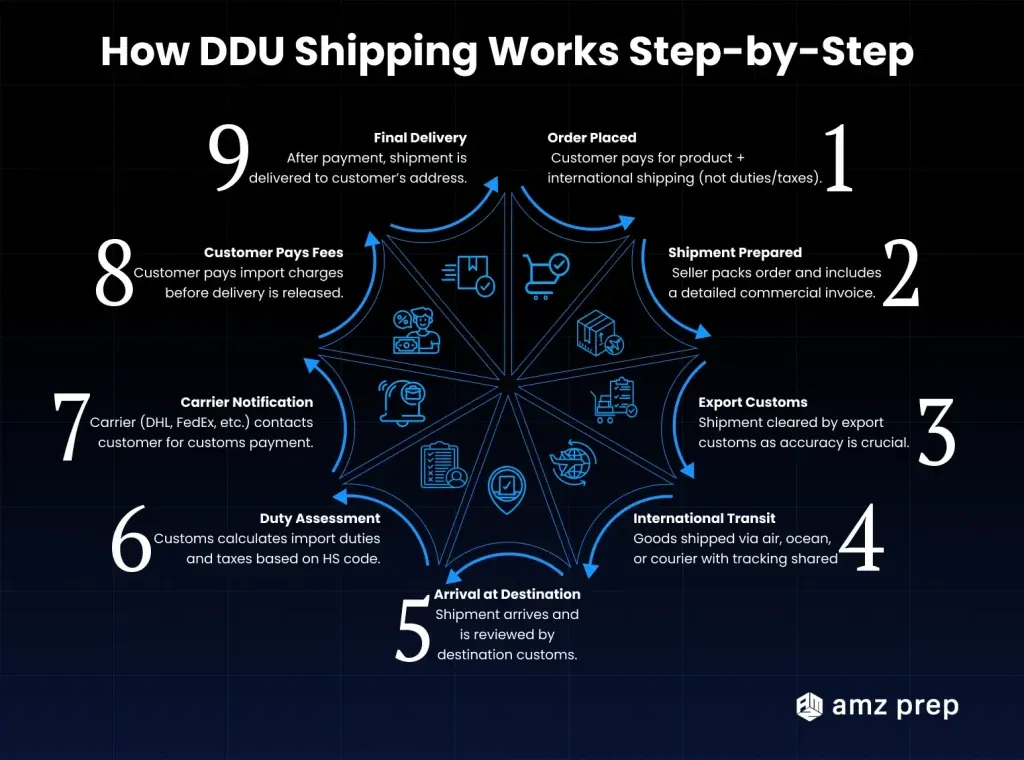
Step 1: Customer Places Order
Your customer sees your product price plus international shipping at checkout. They pay this amount. They may or may not realize additional customs fees will apply later. Many customers don’t understand this.
Step 2: Prepare Your Shipment
Pack your items and create a commercial invoice detailing the product description, value, quantity, HS code, and country of origin. Accurate documentation is essential for customs clearance.
Step 3: Export Customs Clearance
You or your freight forwarder should submit the shipment to your country’s export customs. This process usually takes 1-2 business days, and all paperwork must be complete and accurate.
Step 4: International Transportation
Your package is shipped by air, ocean, or express courier. Transit times range from 3 days for express to up to 45 days for ocean freight. Don’t forget to share tracking details with your customer.
Step 5: Arrival in Destination Country
The package arrives at the destination country’s port or airport. It goes through customs scanning. Customs reviews your commercial invoice.
Step 6: Duty Assessment
Destination customs determine the duty rate based on your HS code. They calculate import duties and taxes. This creates the customs bill.
Step 7: Carrier Contacts Customer
The carrier (FedEx, DHL, local postal service) contacts your customer. They inform them of the customs charges. They request payment before releasing the package.
Step 8: Customer Pays Customs Fees
Your customer must pay these fees. Payment can be completed online, through the post office, or with the delivery person. Without payment, delivery cannot proceed.
Step 9: Final Delivery
Following payment confirmation, the carrier dispatches the shipment to the customer’s location. Typical delivery windows are 5-15 days for express and 25-50 days for ocean transport.
What Goes Wrong:
- Customer refuses to pay customs fees (package returns to you)
- Customer doesn’t respond to carrier notifications (package sits in customs)
- Customs charges are higher than customer expected (customer leaves negative review)
- Documentation errors cause customs delays (customer blames you)
Cost Breakdown for Duties Unpaid Shipping
Understanding cost components helps you explain pricing to customers and set proper expectations.
Costs You Pay (Seller)
1. International Freight
| Shipping Method | Typical Cost Range | Transit Time |
|---|---|---|
| Express courier | $20-50 per kilogram | 3-7 days |
| Air freight | $3-8 per kilogram | 5-10 days |
| Ocean freight | $50-150 per cubic meter | 20-45 days |
2. Export Documentation and Clearance
- Expect to pay $25–$50 for the export declaration.
- A certificate of origin, if needed, costs around $50–$150.
- Some products require an export inspection, which can run $100–$300.
3. Insurance (Optional)
- Typically 0.5-2% of shipment value
- Highly recommended for high-value items
Note: These figures are reasonable estimates based on typical trade routes and standard shipments. Actual costs vary greatly depending on origin, destination, shipping volume, mode, carrier surcharges, and regulatory requirements. Always check with your courier, freight forwarder, or relevant official sources for the most up-to-date pricing.
Costs Customer Pays (Buyer)
1. Import Duties
Import duties vary dramatically by product and country:
| Product Category | Typical Duty Range |
|---|---|
| Electronics | 0-10% |
| Clothing | 8-32% |
| Footwear | 8-48% |
| Jewelry | 5-10% |
| Books | 0% (often duty-free) |
| Cosmetics | 0-6.5% |
2. Import Taxes (VAT/GST)
| Country/Region | Tax Rate | Official Source |
|---|---|---|
| United Kingdom | 20% VAT | UK Government |
| European Union | 17-27% VAT (varies) | EU Rates |
| Canada | 5% GST + provincial | Varies by province |
| Australia | 10% GST | Federal rate |
3. Customs Clearance Fees
- Courier clearance: $15-30
- Customs broker: $50-150
- Postal service: $5-25
4. Storage Fees (If Delayed)
If customer doesn’t pay quickly: $5-10 per day
A Complete DDU Cost Example with Real Numbers
Product: $300 leather handbag
Origin: USA
Destination: Germany
Weight: 1kg
Seller Costs (You Pay):
- Product: $300
- Express shipping: $35
- Export clearance: $30
- Insurance: $3
- Your total cost: $368
- You charge customer: $368
Buyer Costs (Customer Pays at Delivery):
- EU duty on handbags (3%): $10.05 (on $335 CIF value)
- German VAT (19%): $65.56 (on $345.05)
- Courier clearance: $20 Customer surprise bill: $95.61
Customer’s total paid: $463.61
Your customer thought they were buying a $368 handbag. They actually paid $463.61. That 26% surprise increase creates confusion among the customers.
Ground vs Air Freight for DDU Shipments: Cost and Speed Comparison
Choosing between ground (ocean) and air freight significantly impacts your DDU shipping costs, delivery times, and customer experience.
| Shipping Method | Transit Time | Best For |
|---|---|---|
| Air freight (express) | 3-7 days | Time-sensitive, high-value items |
| Air freight (standard) | 7-14 days | Balance of speed and cost |
| Ocean freight (LCL) | 20-35 days | Cost-sensitive, non-urgent |
| Ocean freight (FCL) | 25-45 days | Large volume, lowest per-unit cost |
| Ground/rail (regional) | 10-21 days | Regional trade (e.g., US-Canada, intra-Europe) |
Cost Comparison
Example: 100kg shipment, China to USA
| Method | Approximate Cost | Cost per kg | Delivery Time |
|---|---|---|---|
| Air express | $2,000-2,500 | $20-25/kg | 3-5 days |
| Air standard | $800-1,200 | $8-12/kg | 7-10 days |
| Ocean LCL | $150-300 | $1.50-3/kg | 30-40 days |
Example: 500kg shipment, USA to UK
| Method | Approximate Cost | Cost per kg | Delivery Time |
|---|---|---|---|
| Air express | $6,000-8,000 | $12-16/kg | 3-5 days |
| Air standard | $2,500-3,500 | $5-7/kg | 7-12 days |
| Ocean LCL | $400-700 | $0.80-1.40/kg | 25-35 days |
Benefit of DDU Shipments
The benefits of DDU (now DAP) is to give sellers flexibility without maximum responsibility.
1. Reduce Seller Complexity
You don’t need to understand every country’s import regulations. You don’t need customs experts in every destination. You simply handle the delivery of goods. The buyer handles their country’s customs costs and risks.
2. Lower Upfront Seller Costs
You don’t pay duties and taxes upfront. You don’t need capital tied up in customs payments. Your cash flow remains better because you’re not advancing money for duties.
3. Enable B2B Trade
Business buyers often prefer DDU/DAP. Why? Because businesses can reclaim VAT. If you pay VAT under DDP, they can’t reclaim it. Under DDU, they pay it themselves and reclaim it as a business expense.
4. Allow Competitive Checkout Prices
The checkout price appears lower. $550 looks better than $754.20. This can help with initial conversion. However, the customer dissatisfaction later often outweighs this benefit for B2C sellers.
5. Transfer Import Risk to Buyer
If customs reject the shipment or impose penalties, that’s the buyer’s problem under DDU. As a seller, you’ve fulfilled your obligation by delivering to the destination country.
When to Use DDU (DAP) Shipping vs DDP
Deciding whether to use DDU or DDP shipping directly influences your expenses, customer experience, and overall conversion rates.
Use DDU/DAP Shipping When:
You Sell to Businesses (B2B)
Business buyers can reclaim VAT. They prefer to pay duties themselves so they can recover the tax. They have experience with customs procedures.
You’re Testing New International Markets
How to start shipping internationally without heavy upfront commitment, DDU reduces your upfront risk. You’re not committing capital to pay duties. You can test demand before investing in full DDP infrastructure.
Buyers Are Customs Experts
Some buyers, especially in B2B, prefer controlling the customs process. They may have relationships with customs brokers. They want to handle it themselves.
Your Margins Are Very Thin
If you operate on 10-15% margins, paying duties upfront (DDP) might make sales unprofitable. DDU keeps your costs predictable.
Products Have Variable Duty Rates
If duty calculations are complex or uncertain, DDU transfers that risk to the buyer. Companies managing frequent international shipments often evaluate duty drawback opportunities to offset some import related costs. You don’t risk underestimating costs.
You Sell High-Value Items with High Duties
A $5,000 product with $1,500 in duties ties up significant capital under DDP. DDU avoids this.
Use DDP Shipping Instead When:
You Sell Direct to Consumers (B2C)
Consumers hate surprise fees. They’ll abandon carts, leave bad reviews, and refuse delivery. DDP provides a better customer experience.
Customer Experience is Your Priority
If you’re building a premium brand, DDP shows you care. It eliminates friction and builds trust.
You Have Good Profit Margins
Products with 50%+ margins can absorb DDP costs. Calculate if you can maintain profitability with DDP.
You Want Higher Conversion Rates
Showing the full price upfront (DDP) converts better than low prices with surprise fees (DDU). Transparency wins.
Your Target Market Has High Return Rates
If customers frequently refuse DDU deliveries due to surprise fees, DDP eliminates that problem. You’ll ship fewer packages twice.
Common DDU Shipping Problems and Solutions
Real issues sellers face with duties unpaid shipping:

Customer Refuses to Pay Customs Fees
The situation: Your customer receives notification of $150 in customs fees. They refuse to pay. They claim you didn’t warn them. The package returns to you.
The cost: You lose the product, both shipping costs, and the customer. Total loss: product cost + $100-200 in shipping.
The solution:
- Display customs warnings clearly at checkout
- Send email after purchase explaining possible customs fees
- Provide estimated duty amounts before they order
- Link to duty calculators for their country
- Consider switching to DDP for B2C customers
Customer Leaves Negative Review About ‘Hidden Fees’
The situation: Customer pays $200 at checkout. Customs charges $85. The customer feels deceived. They leave a 1-star review saying you charged ‘hidden fees.’
The cost: Damage to your brand reputation. Lost future sales. Lower search rankings on Amazon.
The solution:
- Make DDU terms extremely clear on product pages
- Add a customs fee calculator at checkout
- Send immediate post-purchase email explaining what to expect
- Provide customer service contact for questions
- Respond professionally to negative reviews explaining DDU terms
Package Stuck in Customs for Weeks
The situation: Customer doesn’t respond to carrier’s payment request. The package sits in customs for 3 weeks. The customer blames you for late delivery.
The cost: Negative feedback. Potential storage fees. Eventual return shipping.
The solution:
- Provide tracking information immediately
- Alert customer when package reaches destination
- Give them carrier contact information proactively
- Follow up if tracking shows customs delay
- Offer to help them resolve customs issues
Inaccurate Duty Estimates
The situation: You told the customer to expect $50 in duties. Customs charges $120. The customer is angry at the discrepancy.
The cost: Customer dissatisfaction. Possible refusal to pay. Bad reviews.
The solution:
- Never guarantee duty amounts (they’re outside your control)
- Provide ranges, not exact figures
- Link to official customs calculators
- Clearly state duties are estimated and may vary
- Explain customs determines final amounts
Wrong HS Code Classification
The situation: You classified your product incorrectly. Customs reclassifies it. Duty rate is higher than expected. The customer pays more than you estimated.
The cost: Customer frustration. Potential dispute. Future classification problems.
The solution:
- Verify HS codes using official databases
- USA HTS Database
- EU TARIC Database
- UK Trade Tariff
- Consult customs brokers for complex products
- Document your classification reasoning
How AMZ Prep Simplifies International Shipping
Managing international shipments with DDU or DDP terms requires logistics expertise, documentation accuracy, and often multiple warehouse locations. For Amazon and eCommerce sellers, this complexity can prevent profitable international expansion.
AMZ Prep’s International Fulfillment Solutions
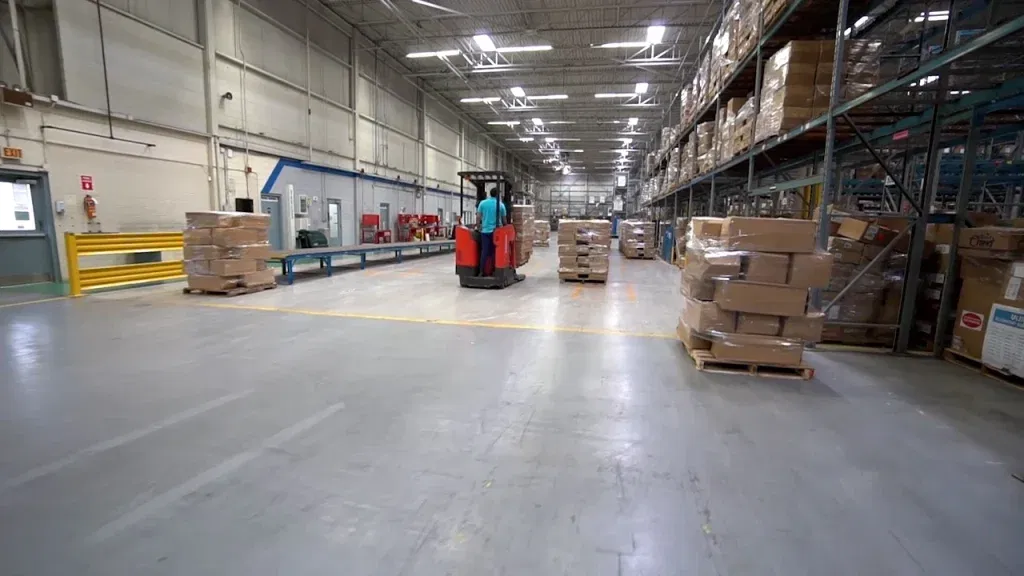
AMZ Prep operates fulfillment centers across North America, Europe, and Australia. This global network allows you to store inventory close to your customers, reducing shipping times and costs regardless of whether you choose DDU or DDP terms.
Conclusion
Delivered duty unpaid (DDU) shipping offers a middle ground between full seller responsibility and minimal involvement. You handle international shipping. Your buyer handles customs.
For Amazon sellers and eCommerce businesses, understanding DDU is essential. The term remains widely used in international trade.
For most B2C eCommerce sellers, the customer experience issues with DDU outweigh the cost savings. Angry reviews and refused deliveries harm your brand. For B2B sellers, DDU (now called DAP) makes sense. Business buyers have customs expertise. They prefer paying duties themselves to reclaim VAT.
Navigating international shipping doesn’t have to be complicated. Whether you choose DDU/DAP or DDP terms, having the right fulfillment partner like AMZ Prep makes all the difference.
Frequently Asked Questions About DDU Shipping
What is the meaning of delivered duty unpaid?
Delivered duty unpaid means the seller ships goods to the buyer’s country, but the buyer pays all import duties, taxes, and customs clearance fees when the package arrives.
What does it mean if my package is delivered at DDU?
It means you (the buyer) must pay import duties, taxes, and customs fees before receiving your package. The carrier will contact you for payment when your shipment arrives.
Who pays for DDU?
The seller pays shipping costs to deliver goods to the destination country. The buyer pays all import duties, taxes, customs clearance fees, and final delivery within their country.
What is the purpose of DDU?
DDU allows sellers to ship internationally without handling destination customs or paying import duties. It reduces seller complexity and costs while transferring import responsibility to the buyer.
What does DDU mean in transport?
In transport, DDU means the seller’s responsibility ends when goods arrive in the destination country. The buyer takes responsibility for import customs clearance and final delivery.
Is DDU still used in 2026?
DDU was officially replaced by DAP (Delivered at Place) in Incoterms 2010. However, many businesses still use the term DDU. When someone says DDU today, they typically mean DAP.
What’s the difference between DDU and DDP?
DDU means the buyer pays import duties and taxes. DDP means the seller pays all costs including duties and taxes. DDP provides better customer experience but requires more seller involvement.
How long does DDU customs clearance take?
Typically 2-7 business days after arrival. Delays occur if documentation is incorrect or if the buyer doesn’t respond quickly to payment requests.
What happens if I don’t pay DDU customs fees?
The package will be held in customs for a period (usually 30-90 days). If unpaid, it returns to the seller. You may be charged storage fees for the delay.
How do I avoid DDU surprise fees?
Clearly communicate at checkout that additional customs fees will apply. Provide estimated duty amounts. Link to customs calculators. Send post-purchase emails explaining the process and expected costs.
What’s the difference between DDU and DAP?
They’re nearly identical. DAP replaced DDU in Incoterms 2010 with minor clarifications about delivery location. In practice, businesses use the terms interchangeably to mean the same thing.
Can sellers estimate DDU customs fees for buyers?
Yes, you can provide estimates using official customs calculators. However, always clarify these are estimates only. Final amounts are determined by destination customs authorities and may differ.
Who clears customs under DDU?
The buyer (or their designated customs broker) clears customs. The buyer is responsible for providing necessary documentation to customs authorities and paying all fees.

Lakshita is the Head of Customer Success, focused on turning fulfillment operations into a growth advantage. Her expertise helps brands reduce operational friction, improve customer satisfaction, and scale efficiently.

















Comments