
Shipping from China to the United States remains the backbone of international trade, moving billions of dollars in goods across the Pacific every year.
For small businesses sourcing products, Amazon sellers building inventory, or experienced importers handling established supply chains, navigating this process is more critical than ever.
Understanding the timelines, costs, and challenges of shipping from China helps brands plan effectively, reduce risks, and stay competitive in today’s fast-moving global marketplace, where logistics can make or break success.
Why This Matters in 2026
In 2026, you continue to encounter significant challenges that directly influence operational costs and efficiency. The 2025 regulatory changes are now fully in effect, with evolving tariffs, trade tensions, and compliance requirements demanding proactive management to prevent delays and unforeseen expenses.
- Regulatory Overhaul: De minimis exemption elimination affects all Chinese imports
- Tariff Complexity: Multiple tariff layers creating 55%+ total duties on many products
- Compliance Costs: New documentation requirements adding thousands in potential penalties
- Market Volatility: Schedule reliability averaging just 61.9% across carriers
| Key 2026 Import Rules | Impact on Importers |
|---|---|
| De minimis eliminated (May 2, 2025) | All Chinese goods require formal customs entry (in effect since May 2025) |
| Entry Type 86 discontinued | Customs broker now required for all shipments |
| Baseline 10% tariff | Added to existing Section 301 and fentanyl levies (55%+ total for many products) |
| ISF penalties increased | $5,000–$10,000 fines for documentation errors |
| Potential additional tariffs | Trade policy remains fluid; monitor announcements closely |
For e-commerce sellers and Amazon FBA merchants, these changes create a perfect storm of complexity.
2026 Update: The trade environment remains highly dynamic. Following the 2025 de minimis elimination, importers should monitor ongoing trade policy developments closely. The Trump administration has signaled potential for additional tariff adjustments, and US-China trade relations continue to evolve. Successful importers now build flexibility into their supply chains, maintain strong customs broker relationships, and stay current with regulatory announcements through official channels like CBP.gov and USTR.gov.
Companies that master shipping optimization can achieve 15-30% cost reductions while competitors struggle with compliance and delays.
One of the most effective ways to build that edge is by connecting your China-to-US supply chain with dedicated Cross Border Shipping Services that handle US customs entry, warehousing, and last-mile delivery as a single integrated operation
The stakes are particularly high during peak seasons when a single shipping miscalculation can cost thousands in lost sales or penalty fees.
What You’ll Learn
This guide provides actionable strategies for:
- Optimizing shipping timelines and costs across all methods
- Navigating 2025’s complex regulatory environment
- Implementing Amazon FBA best practices
- Building resilient supply chains that handle disruptions
How Long Does Shipping Take from China to the US?
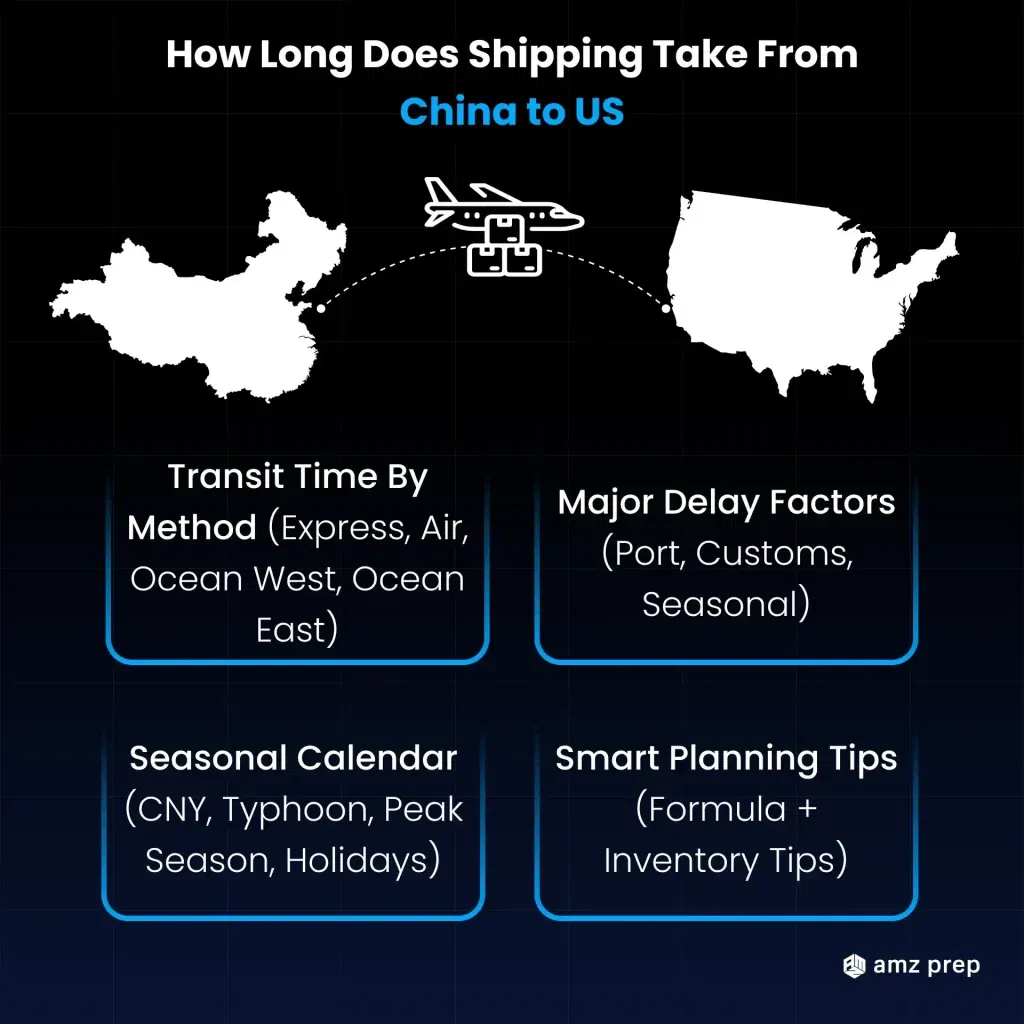
When planning your shipments, you need to look beyond basic transit estimates and consider the many factors, such as port congestion, customs delays, and seasonal disruptions, that can double or even triple delivery times, so that you can plan more accurately and maintain reliability in today’s unpredictable shipping environment.
Transit Time Comparison by Method
When planning shipments from China to the U.S., you need to understand that transit times vary significantly by method.
Express services deliver the fastest results, while air freight offers a balance between speed and cost.
Ocean freight, though slower, is the most economical option for large or bulk shipments, but you must account for potential delays and seasonal fluctuations.
| Shipping Method | Standard Time | With Delays | Best For |
|---|---|---|---|
| Express (DHL, FedEx, UPS) | 1-5 days | 3-7 days | Urgent/high-value items |
| Air Freight | 5-12 days | 7-18 days | Mid-size shipments |
| Ocean Freight (West Coast) | 20-30 days | 25-45+ days | Large/bulk orders |
| Ocean Freight (East Coast) | 30-40 days | 35-50+ days | Cost-sensitive shipments |
Major Delay Factors to Plan For
Port Congestion Reality Check
- Los Angeles/Long Beach: Currently experiencing 25+ day delays
- Schedule reliability varies dramatically: Maersk (46.4%) vs Evergreen (70%)
- Peak season (Aug-Oct) can double normal transit times
Customs Processing Bottlenecks
- ISF filing errors cause automatic delays and $5,000-$10,000 penalties
- Physical examinations were selected randomly, adding 3-7 days
- Documentation errors now require formal amendments (no more quick fixes)
Seasonal Disruption Calendar
You should plan your shipments around seasonal disruptions, as events like the Chinese New Year, typhoon season, and peak holiday periods can significantly delay transit times.
By anticipating these periods, you can adjust your schedules and inventory levels to maintain a consistent supply.
Proactively building buffer times ensures your business avoids costly stockouts, rush fees, and compliance risks while keeping your operations running smoothly throughout the year.
| Period | Impact | Planning Strategy |
|---|---|---|
| Chinese New Year (Jan 29 – Feb 4, 2026) | 2–3 week factory shutdown + 4–6 week recovery | Already passed for 2026; plan for Jan 2027 |
| Spring Typhoon Season (May–Jul) | Weather delays of 2–7 days | Build buffer time |
| Peak Season (Aug–Oct) | Capacity constraints, premium rates | Book 60+ days in advance |
| Holiday Rush (Nov–Dec) | Port congestion, priority delays | Complete Q4 shipments by early November |
Chinese New Year 2027 will be January 29, 2027 – plan Q1 2027 shipments accordingly.
Smart Timeline Planning
Conservative Planning Formula: Base transit time + 50% buffer + seasonal adjustments
Example: Ocean freight to LA
- Base time: 25 days
- Buffer (50%): 12 days
- Peak season adjustment: +10 days
- Total planning time: 47 days
Inventory Management Integration
- Build lead times into reorder triggers
- Use 90-day inventory targets for ocean freight items
- Maintain express shipping budget for emergency restocks (typically 5-10% of total shipping spend)
Shipping Methods from China to the US
Choosing the optimal shipping method requires understanding the true total cost of ownership, not just the freight rate.
Each method serves specific business scenarios and carries unique advantages and risks.
Express Shipping: Speed at a Premium
When Express Makes Sense
- Product samples and prototypes
- Emergency inventory restocks
- High-value, low-weight items (jewelry, electronics, accessories)
- Time-sensitive product launches
| Carrier | Average Transit | Rate Range | Reliability Score |
|---|---|---|---|
| DHL | 2-4 days | $8-12/kg | 95%+ |
| FedEx | 3-5 days | $7-11/kg | 93%+ |
| UPS | 3-5 days | $7-10/kg | 92%+ |
Cost Optimization Strategies
- Dimensional Weight Reduction: Redesign packaging to save 15-30% on shipping costs
- Account Setup: Registered customers get 20-40% better rates than casual shippers
- Volume Discounts: 500+ shipments annually qualify for significant rate reductions
Express Shipping Drawbacks
- Limited to packages under 68kg per piece
- Dimensional weight penalties for bulky items
- Rate increases averaging 5.9% annually
Air Freight: The Balanced Option
Air freight at $5.30/kg for China-North America routes offers the sweet spot between speed and cost for many businesses.
This method excels for shipments between 100 kg and 2,000 kg that need reliable timing without express premiums.
Air Freight Advantages
- Predictable 7-10 day delivery windows
- Better tracking than ocean freight
- Less weather-dependent than ocean shipping
- Consolidation opportunities reduce costs 20-40%
Air Freight Optimization
- Consolidation Services: Share flights with other importers
- Airport Selection: Secondary airports often offer better rates
- Seasonal Booking: Advance contracts prevent peak season surcharges
Ocean Freight: Maximum Economy for Volume
Ocean freight delivers the lowest cost per kilogram for shipments over 500kg, despite longer transit times and higher complexity. Here’s the Current Container Rates (2025)
| Feature | LCL (Less than Container Load) | FCL (Full Container Load) |
|---|---|---|
| Shipment Size | 1 – 20 CBM | 20+ CBM |
| Cost per CBM | $60 – $120 | $40 – $80 |
| Transit Time | 20 – 35 days | 20 – 28 days |
| Best For | Small shipments, multiple suppliers | Large shipments, single supplier |
| Flexibility | Can consolidate multiple orders | Must fill the entire container |
| Risk | Higher risk of damage due to shared load | Lower risk, container dedicated |
| Loading / Handling | More handling at terminals | Direct container loading |
Ocean Freight Success Factors
- Proper Documentation: ISF filing 24+ hours before departure
- Container Loading: Weight distribution affects safety and costs
- Port Selection: West Coast saves 7-14 days vs East Coast
- Carrier Selection: Balance cost vs reliability based on your priorities
Costs of Shipping from China to the US
Understanding true shipping costs requires accounting for all fees, surcharges, and hidden expenses that can increase your quoted rate by 30-50%.
The 2025 regulatory changes have added new cost layers that catch many importers off guard.
Complete Cost Breakdown Structure
Base Freight Rates (30-40% of total cost)
- Container rates: $3,136-5,200 for 40′ containers
- Air freight: $5.30/kg average
- Express: $7-12/kg depending on service level
Note: Container rates updated November 2025. Rates fluctuate based on demand, fuel costs, and geopolitical events. For current spot rates, consult Freightos Baltic Index (FBX) or your freight forwarder.
Surcharges and Fees (25-35% of total cost)
- Fuel surcharges: 15-25% of base rate
- Peak season surcharges: $500-2,000 per container
- Security fees: $25-50 per shipment
- Terminal handling charges: $300-600 per container
- Documentation fees: $75-150 per shipment
Customs and Compliance (20-30% of total cost)
- Customs broker fees: $125-300 per entry
- ISF filing: $25-75 per shipment
- Examination fees: $300-800 if selected
- Storage fees: $25-75 per day for delayed pickup
2025 Tariff Impact Calculator
The complex tariff structure directly impacts your total landed costs, increasing the amount you pay for imported goods.
You must carefully account for multiple layers of duties, levies, and baseline tariffs when calculating your pricing.
Failing to factor in these charges can lead to unexpected expenses and reduce your profit margins significantly.
For the latest legal developments that could affect these costs, see how the Supreme Court’s landmark tariff ruling may open the door to billions in refunds for importers.
| Product Category | Section 301 | Fentanyl Levy | Baseline Tariff | Total Tariff |
|---|---|---|---|---|
| Electronics | 25% | 20% | 10% | 55% |
| Textiles | 25% | 20% | 10% | 55% |
| Machinery | 25% | 20% | 10% | 55% |
| Furniture | 25% | 20% | 10% | 55% |
Tariff Calculation Example:
- Product value: $10,000
- Shipping cost: $1,000
- Tariff base: $11,000
- Total tariffs (55%): $6,050
- Total landed cost: $17,050
Hidden Costs That Surprise New Importers
Port and Handling Fees
- Demurrage charges: $100-300/day for delayed container pickup
- Chassis usage fees: $25-50/day
- Inspection escort fees: $200-500 if customs examination is required
Currency and Financial Costs
- Exchange rate fluctuations: Can add 2-5% to costs
- Payment terms: LC fees vs T/T timing risks
- Freight insurance premiums: 0.1–0.5% of cargo value
Opportunity Costs
- Inventory carrying costs during extended transit
- Stockout costs when shipments arrive late
- Rush shipping premiums for backup inventory
Cost Optimization Strategies
Volume Discount Negotiations
- Annual contracts: 10-25% savings vs spot rates
- Minimum volume commitments unlock better pricing tiers
- Multi-lane shipping packages reduce per-shipment costs
Payment Term Optimization
- Prepaid shipping: 3-5% discounts available
- Fuel hedging: Lock in rates during low-fuel periods
- Currency hedging: Protect against exchange rate volatility
Amazon FBA and E-commerce Shipping from China to the US
Amazon FBA sellers face unique shipping challenges that require specialized strategies to maintain account health, optimize costs, and ensure inventory availability.
The 2025 regulatory changes particularly impact FBA operations with new compliance requirements and cost structures.
Amazon FBA Shipping Requirements Checklist
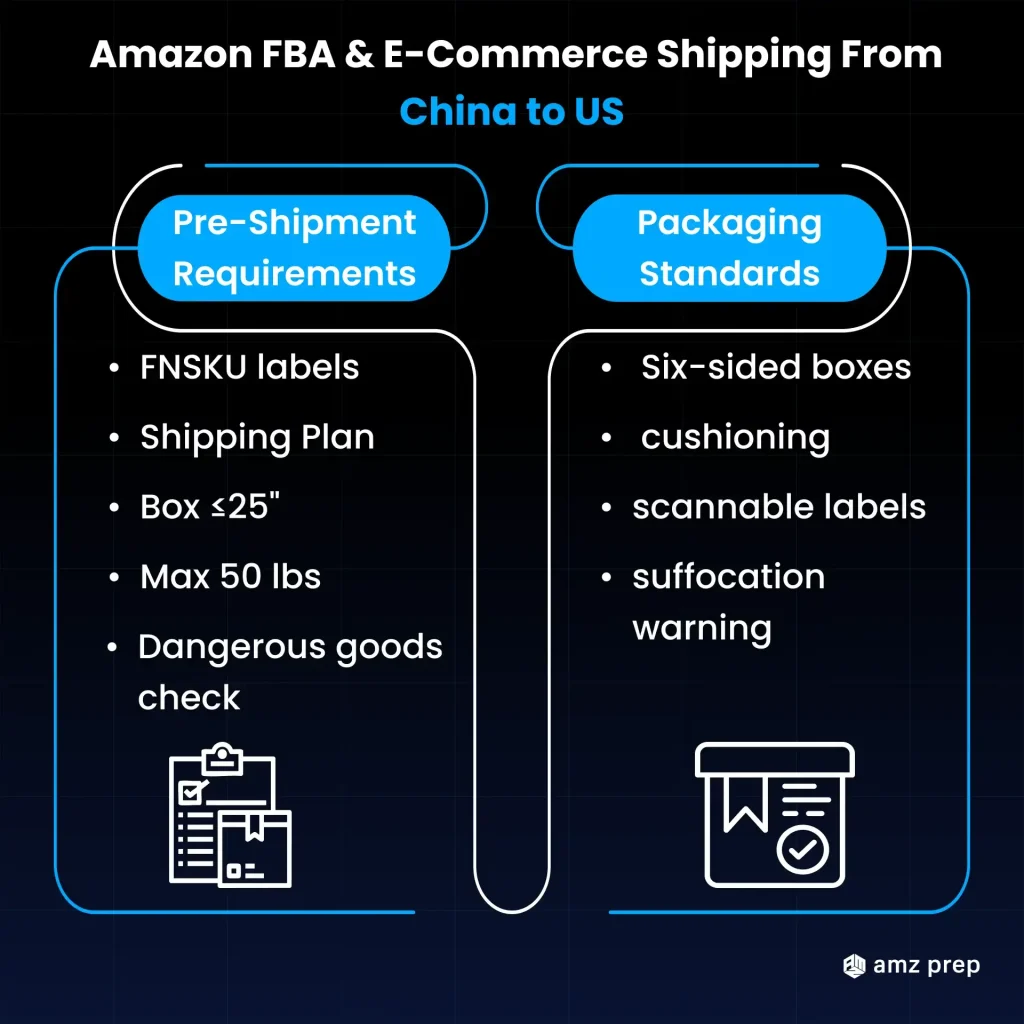
Essential Pre-shipment Requirements
- Products properly labeled with Amazon FNSKU barcodes
- Shipping plan created and confirmed in Seller Central
- Box dimensions comply with Amazon limits (25″ max on any side)
- Weight limits observed (50 lbs max per box for standard items)
- Dangerous goods classification completed if applicable
Packaging Standards
- Six-sided boxes only (no envelopes or poly mailers for FBA)
- Proper cushioning to prevent damage during handling
- Clear, scannable labels on each box
- Suffocation warning labels were required
FBA Shipment Method Decision Matrix
When planning your FBA shipments, you should select the method that aligns with your inventory size and business goals.
Smaller shipments are best sent via express for speed, while medium batches benefit from air freight for a balance of cost and transit time.
For large volumes, ocean freight provides the most economical solution, allowing you to optimize costs while ensuring timely stock replenishment.
| Shipment Size | Recommended Method | Cost Range | Lead Time | Best For |
|---|---|---|---|---|
| 1-50 units | Express shipping | $8-12/kg | 3-5 days | New product launches |
| 50-200 units | Air freight | $5-8/kg | 7-12 days | Regular restocks |
| 200-1000 units | Air freight + consolidation | $4-6/kg | 10-15 days | Seasonal prep |
| 1000+ units | Ocean freight | $2-4/kg | 25-40 days | Bulk inventory |
China-Based Prep Services
Working with qualified prep services in China can save significant costs and ensure FBA compliance:
Prep Service Cost Structure
- Basic labeling: $0.30-0.50 per unit
- Poly bagging: $0.20-0.40 per unit
- Bundling/kitting: $1.00-2.50 per set
- Quality inspection: $0.50-1.00 per unit
- Photography: $5-15 per SKU
Prep Service Selection Criteria
- Amazon SPN (Service Provider Network) certification
- Integration with your inventory management system
- Real-time inventory tracking capabilities
- Quality control processes and guarantees
- Geographic proximity to your suppliers
Inventory Planning for Long Transit Times
90-Day Inventory Rule Successful FBA sellers maintain 60-90 days of inventory to account for:
- Ocean freight transit time (25-40 days)
- Amazon warehouse processing (3-7 days)
- Demand variability and seasonality
- Buffer for supply chain disruptions
Seasonal Inventory Calendar
You should plan your inventory well in advance to align with seasonal demand, ensuring you have sufficient stock during peak periods by calculating cubic meters accurately for each shipment..
Monitor key months closely and adjust your shipping methods to account for longer transit times or potential delays.
By proactively managing your seasonal inventory, you can minimize stockouts, reduce emergency shipping costs, and maintain consistent product availability for your customers.
| Month | Action Required | Inventory Target | Shipping Method |
|---|---|---|---|
| June-July | Q4 planning begins | 120+ days | Ocean freight |
| August | Peak season prep | 150+ days | Air freight supplement |
| September | Final Q4 shipments | 90+ days | Express for gaps |
| October-December | Restock monitoring | 60+ days | Air/express only |
Multi-Channel Fulfillment Strategy
Inventory Allocation Framework
- Amazon FBA: 70-80% of total inventory (for Buy Box advantage)
- Third-party fulfillment: 15-25% (for backup and other channels)
- Direct fulfillment: 5-10% (for B2B or specialty orders)
Cost Comparison Analysis
When evaluating shipping options, you must consider the full spectrum of costs, not just the base freight rates.
Factoring in surcharges, customs fees, and potential delays allows you to make informed decisions that protect your bottom line.
By carefully comparing methods, carriers, and associated expenses, you can identify the most cost-effective strategy while maintaining reliability and timely delivery for your business. (Source: Sell on Amazon)
| Fulfillment Method | Pick/Pack Cost | Storage Cost/Month | Shipping Speed | Best Use Case |
|---|---|---|---|---|
| Amazon FBA | $3.50-8.00 | $0.50-2.00/unit | 1-2 days | High-velocity SKUs |
| 3PL Warehouse | $2.00-4.00 | $0.25-1.00/unit | 2-5 days | Multi-channel sales |
| Self-fulfillment | $1.00-2.50 | $0.10-0.50/unit | 3-7 days | Low-volume/high-margin |
Case Study: Electronics Seller Optimization
An electronics seller was struggling to manage costs and supply stability. Heavy reliance on air freight drove up monthly expenses, inventory was often too thin to meet demand, and relying on a single prep service left little room for consistent quality.
- Shipping relied 100% on air freight, costing about $8,000 per month
- Inventory levels were capped at 30 days, leading to frequent stockouts
- Only one prep service was used, which caused repeated quality issues
To solve these challenges, the company redesigned its logistics strategy.
- Shipments were split: 70% by ocean freight, 30% by air, cutting costs to $5,200 per month (a 35% savings)
- Inventory was increased to a 90-day supply, eliminating stockouts for a full year
- A second prep service was introduced, reaching a 99.5% quality rate
These improvements reshaped the business. With stronger cost control, reliable stock availability, and better handling accuracy, the seller achieved a 40% boost in inventory turnover and a 25% reduction in overall logistics costs, transforming operations from unstable to streamlined.
Compliance and Regulatory Requirements
The 2025 regulatory landscape for China-US imports has undergone a fundamental shift, necessitating the implementation of more sophisticated compliance programs to avoid significant penalties and delays.
Critical Regulatory Changes (2025-2026)
De Minimis Elimination – Now in Effect
- Effective Date: May 2, 2025 (now in effect for 9+ months)
- Previous Rule: Before May 2025, shipments under $800 were duty-free with simplified entry
- Current Reality: Since May 2025, ALL Chinese imports require formal customs entry regardless of value
- Cost Impact: $125-300 customs broker fee now applies to every shipment
- 2026 Status: Enforcement is now routine; no exceptions for small-value shipments
Entry Type 86 Discontinuation
- Simplified informal entries are no longer available for Chinese goods
- All imports must use formal entry procedures (Entry Type 01, 03, etc.)
- Requires a licensed customs broker relationship
- Adds 2-5 days to processing time for small shipments
ISF Filing Requirements and Penalties
The Importer Security Filing remains mandatory for all ocean shipments, with enforcement significantly tightened in 2025.
ISF Data Elements Required
When filing your Importer Security Filing (ISF), you must provide complete and accurate data for all required elements.
You are responsible for submitting information about the seller, buyer, manufacturer, ship-to party, and container stuffing details at least 24 hours before departure.
Ensuring these elements are correct helps you avoid costly penalties and prevents delays in customs clearance. (Source: USA Customs)
| Data Element | Who Provides | Deadline | Penalty for Error |
|---|---|---|---|
| Seller information | Supplier/freight forwarder | 24+ hours before departure | $5,000-10,000 |
| Buyer information | Importer | 24+ hours before departure | $5,000-10,000 |
| Manufacturer info | Supplier | 24+ hours before departure | $5,000-10,000 |
| Ship-to party | Importer/logistics | 24+ hours before departure | $5,000-10,000 |
| Container stuffing | Freight forwarder | 24+ hours before departure | $5,000-10,000 |
ISF Compliance Best Practices
- Designate a single point of contact for ISF coordination
- Implement automated ISF filing through freight forwarder systems
- Maintain supplier database with complete manufacturer information
- Create an ISF filing checklist with a mandatory review process
Product-Specific Regulatory Requirements
Electronics and Technology Products
- FCC Certification: Required for wireless devices, RF emissions equipment
- Energy Star: Mandatory for certain appliances and electronics
- CPSC Testing: Consumer electronics safety requirements
- Import Process: Add 30-60 days for certification testing
Food, Cosmetics, and Health Products
- FDA Facility Registration: Manufacturing facilities must be registered
- Prior Notice: Required 2-5 days before arrival
- Nutritional Labeling: Must comply with US requirements
- Import Process: FDA inspection possible, adding 5-15 days
Textiles and Apparel
When importing textiles and apparel, you must ensure all products carry accurate country-of-origin labels and fiber content disclosures. (Source: Federal Trade Com)
You are responsible for complying with flammability testing requirements and maintaining proper documentation for each style. Additionally, you should implement supply chain audits to meet regulatory standards and avoid potential penalties. (Source: U.S. Consumer)
| Requirement | Compliance Method | Cost Impact | Processing Time |
|---|---|---|---|
| Country of origin labeling | Permanent labels on products | $0.05-0.20/unit | Built into production |
| Fiber content disclosure | Care labels with percentages | $0.03-0.15/unit | Built into production |
| Flammability testing | Lab certification | $500-2,000/style | 7-14 days |
| Forced labor documentation | Supply chain audit trail | $1,000-5,000/supplier | 30-90 days |
Forced Labor Compliance
The Uyghur Forced Labor Prevention Act creates a rebuttable presumption that goods from Xinjiang are made with forced labor, requiring extensive documentation to overcome.
Required Documentation Package
- Complete supply chain mapping to the raw material level
- Third-party factory audits and certifications
- Payroll records and worker interview documentation
- Geographic verification of all production steps
- Government permits and licenses for all facilities
High-Risk Industries Requiring Enhanced Due Diligence
- Cotton and cotton products
- Polysilicon and solar panels
- Tomato products and derivatives
- Electronics components and batteries
Record Keeping and Audit Preparation
Mandatory Documentation Retention (5 years)
- Commercial invoices and packing lists
- Bills of lading and airway bills
- Customs entries and supporting documents
- Certificates of origin and compliance testing
- Payment records and banking documentation
Digital Record Management Best Practices
- Cloud-based storage with backup systems
- OCR scanning for searchable text
- Automatic retention period tracking
- Audit trail logging for all document access
- Integration with accounting and inventory systems
Tips to Save Time and Money on Shipping
Optimizing shipping operations requires strategic thinking across packaging, supplier relationships, consolidation, and technology adoption. The most successful importers treat shipping as a competitive advantage rather than just a cost center.
Packaging Optimization Strategies
Dimensional Weight Reduction Techniques Carriers charge based on dimensional weight (length × width × height ÷ 166 for express, ÷ 139 for air freight), making packaging optimization crucial for cost control. (Source: Meyers)
| Optimization Method | Potential Savings | Implementation Cost | Payback Period |
|---|---|---|---|
| Right-size packaging | 15-30% | $500-2,000 setup | 1-3 months |
| Custom box design | 20-35% | $2,000-10,000 | 3-6 months |
| Product redesign | 25-40% | $5,000-25,000 | 6-12 months |
| Vacuum packaging | 30-50% for soft goods | $1,000-5,000 | 2-4 months |
Packaging Optimization Checklist
- Measure actual dimensional weight vs billed weight
- Test multiple box sizes for optimal fit
- Eliminate void fill where possible
- Consider product orientation changes
- Negotiate packaging requirements with suppliers
- Implement quality control to prevent damage claims
Supplier Negotiation Framework
Shipping Terms Negotiation Strategy
When negotiating shipping terms, you should clearly define the responsibilities of both you and your supplier to avoid hidden costs or delays.
Assess options like EXW, FOB, CIF, or DDP, and choose the terms that optimize your control, risk, and cost efficiency. By establishing precise agreements upfront, you can secure better pricing, reduce misunderstandings, and ensure smoother logistics for every shipment.
| Term | Supplier Responsibility | Your Responsibility | Cost Savings Potential |
|---|---|---|---|
| EXW | Minimal | Full logistics control | Highest (30-50%) |
| FOB | Inland transport + export | International shipping | Moderate (15-25%) |
| CIF | Full delivery + insurance | Customs clearance | Lower (5-15%) |
| DDP | Complete door-to-door | Payment only | Minimal (0-5%) |
Supplier Logistics Capability Assessment
- Volume discounts available from the supplier’s freight partners
- Warehouse location proximity to major ports
- Export documentation and compliance expertise
- Consolidation services for multiple orders
- Packaging optimization capabilities
Consolidation and Volume Strategies
When discussing shipping terms, you should clearly define responsibilities for costs, risks, and delivery timelines to prevent misunderstandings.
Ensure you understand industry-standard Incoterms and use them to safeguard your financial and operational interests.
Additionally, you must maintain a collaborative yet firm approach, balancing flexibility with your strategic priorities to achieve mutually beneficial agreements.
LCL Consolidation Benefits
- Combine multiple suppliers into a single shipment
- Share container costs with other importers
- Reduce per-unit shipping costs by 20-40%
- Maintain ocean freight economics for smaller orders
When Consolidation Makes Sense
Consolidation makes sense when you are looking to simplify complex processes, allowing you to manage multiple resources more efficiently.
It is beneficial when reducing costs and minimizing redundancies can strengthen your overall operational structure.
Additionally, consolidation is strategic when you aim to enhance focus, improve decision-making, and create a more cohesive system for long-term growth.
| Scenario | Consolidation Method | Savings Range | Trade-offs |
|---|---|---|---|
| Multiple suppliers, same port | Direct consolidation | 25-40% | Extended lead time |
| Single supplier, multiple orders | Order timing coordination | 15-25% | Inventory investment |
| Mixed shipment types | Freight forwarder consolidation | 20-35% | Less control |
Technology and Automation Solutions
Shipping Management Platform Benefits
- Automated rate shopping across carriers
- Real-time tracking and exception management
- Integration with inventory and accounting systems
- Performance analytics and optimization recommendations
ROI Calculation for Shipping Technology
When evaluating shipping technology, you should calculate the Return on Investment (ROI) to understand the financial benefits versus implementation costs.
You must consider factors such as reduced operational expenses, improved delivery efficiency, and enhanced customer satisfaction.
By analyzing these metrics, you can make informed decisions that maximize profitability and ensure long-term strategic value for your operations.
| Business Size | Monthly Shipping Volume | Technology Investment | Annual Savings | ROI |
|---|---|---|---|---|
| Small (1-50 shipments) | $5,000-25,000 | $2,000-5,000 | $3,000-8,000 | 60-160% |
| Medium (50-200 shipments) | $25,000-100,000 | $5,000-15,000 | $8,000-25,000 | 67-167% |
| Large (200+ shipments) | $100,000+ | $15,000-50,000 | $25,000-100,000+ | 67-200% |
Advanced Cost Reduction Strategies
You can achieve significant financial efficiency by implementing advanced cost reduction strategies that optimize resource allocation and streamline operational processes.
By carefully analyzing expenditures and leveraging innovative technologies, you can minimize waste while maintaining high-quality output and sustainable growth.
Currency and Financial Optimization
- Forward contracts to hedge exchange rate risk
- Payment timing optimization for favorable rates
- Multi-currency accounting to identify savings opportunities
- Supplier financing programs for extended payment terms
Network Optimization Approaches
- Warehouse location analysis for reduced inland transport
- Port selection based on total transit time and costs
- Carrier diversification to reduce dependency risks
- Seasonal capacity planning to avoid premium rates
Volume Discount Negotiation Framework
- Annual volume commitments for tier pricing
- Multi-lane shipping packages for better rates
- Loyalty program participation with preferred carriers
- Group purchasing through industry associations
Conclusion
In 2025, shipping between China and the U.S. will be tougher and more expensive. Tariffs, tighter customs rules, and the end of de minimis exemptions have changed the way companies need to plan.
Success now comes from treating shipping as a strength, not just a cost. That means knowing your full landed costs, working with more than one carrier, and using tech tools to track and manage shipments.
A good customs broker, clean paperwork, and staying current with new regulations will save you from delays and penalties.
Day to day, businesses should use data to choose shipping methods, cut waste in packaging, plan inventory better, and prepare for disruptions.
Start by auditing your costs, updating product codes, and building broker relationships. Then focus on better contracts, smarter packaging, and shipping software.
Over time, create strong compliance systems and backup supply options. Good logistics now drive profit and long-term growth.
FAQs
How long does shipping take from China to the US?
Shipping times depend on the method. Express shipping usually takes 1–5 days (about 3–4 on average). Air freight takes about 5–12 days, including customs. Ocean freight to the US West Coast takes around 20–35 days (about 28 days on average), while to the East Coast it takes 30–45 days (about 38 on average). Keep in mind that industry-wide schedule reliability is only about 62%, so delays are common.
What causes shipping delays from China?
Delays are often caused by port congestion (which can add weeks), customs inspections, peak-season demand, weather issues like typhoons, mistakes in documentation, and factory shutdowns around Chinese New Year.
How much does it cost to ship a container from China to the US?
As of 2025, a 40-foot container from Shanghai to Los Angeles costs about $3,100–$4,200, from Shanghai to New York about $4,350–$5,200, and from Shenzhen to Long Beach about $3,000–$4,000. These base rates can rise by 30–50% once surcharges and fees are added.
What’s the cost-effective way to ship from China?
For small shipments, ocean freight LCL (less than container load) is lower cost, typically $40–80 per cubic meter. Full container loads (FCL) are most economical for bigger volumes. Air freight averages about $5.30 per kilo, while express services cost $7–12 per kilo but are faster.
How do 2025 tariffs affect shipping costs?
Tariffs now add significantly to total costs. Most Chinese goods face a 25% Section 301 tariff, plus a 20% fentanyl levy, and a baseline 10% tariff. That means up to 55% can be added to the product’s value plus shipping costs.
What happened to the $800 duty-free rule?
Since May 2025, the duty-free exemption for Chinese goods no longer applies. Every shipment now requires a formal customs entry, which adds broker fees of about $125–300. All goods are subject to full tariffs, no matter their value.
What documents are required for shipping?
At a minimum, you need a commercial invoice, packing list, and certificate of origin. For ocean freight, you also need an Importer Security Filing (submitted before departure), a bill of lading, and a dock receipt. Some products may require special certificates, such as the FDA for food or medical goods, the FCC for electronics, and the CPSC testing for consumer products.
When should I use air freight vs ocean freight?
Air freight is best for shipments under 500 kg, high-value items, time-sensitive goods, or when testing new markets. Ocean freight is better for larger shipments over 1,000 kg, when cost is the main concern, or for regular restocking of established products.
How do I choose the right carrier?
If cost is the top priority, regional carriers or consolidators are cost-effective but less reliable. For reliability, global lines like Maersk or MSC are strong, though more expensive. For express and top-tier service, DHL or FedEx is best but costliest. A balanced choice might be COSCO or Yang Ming, which offer moderate costs and good service.
What should I know about Amazon FBA shipments?
Amazon requires products to have FNSKU labels (not just manufacturer barcodes), and boxes must not exceed 50 lbs or 25 inches on the longest side. Only six-sided boxes are allowed, and suffocation warnings are required where necessary.
Should I use prep services in China for FBA?
Prep services are often worthwhile if you’re shipping 200+ units per batch, since labor in China is cost-effective and suppliers may lack FBA experience. They also help reduce shipping volume. Typical prep costs run $0.30–$2.50 per unit, depending on services needed.
How can I protect against shipping delays?
You can reduce risks by diversifying carriers and routes, splitting large orders, using alternative ports, and keeping backup options with both air and ocean providers. Planning buffers help too: add about 50% to quoted transit times, keep 90 days of ocean freight inventory, and set aside 5–10% of your budget for emergency air freight.
What kind of insurance should I get?
For shipments under $5,000, carrier liability may be enough. For $5,000–25,000, basic all-risk coverage is recommended. For $25,000–100,000, get comprehensive coverage, and for anything above $100,000, choose full coverage plus contingency. Costs usually range from 0.1–0.7% of shipment value.
How do 2025 tariffs affect shipping costs?
Tariffs now add significantly to total costs. Most Chinese goods face a 25% Section 301 tariff, plus a 20% fentanyl levy, and a baseline 10% tariff. That means up to 55% can be added to the product’s value plus shipping costs.
What happened to the $800 duty-free rule?
The $800 de minimis exemption was eliminated for Chinese goods on May 2, 2025, and has been fully enforced since then. As of 2026, every shipment from China requires formal customs entry (adding $125-300 in broker fees), and all goods are subject to full tariffs regardless of value. This change has been in effect for over 9 months.

Arishekar N is a Vice President (VP) of Marketing at AMZ Prep, specializing in ecommerce fulfillment and Amazon logistics strategies with a proven track record of driving growth for e-commerce businesses. He is a strategic leader with extensive expertise in marketing, e-commerce operations, SEO & advertising, and branding.
Stay updated on his latest insights by following him
















Comments