Amazon Choice badge remains one of the most powerful conversion tools on the marketplace – but the rules have changed. Following Amazon’s 2026 algorithm updates and the ‘Bend the Curve’ initiative that eliminated 32% of listings, earning this badge is both more valuable and more competitive than ever.’
Amazon’s Choice algorithm continues prioritizing customer satisfaction metrics. Recent 2026 data shows products with the badge achieve 40-50% higher conversion rates than non-badged competitors. Voice shopping integration through Alexa remains a key driver, with badge-holders receiving priority recommendations.
But what exactly is Amazon Choice, and how does it differ from other Amazon recognition like the Amazon Best Seller badge? More importantly, how can you earn and maintain this valuable distinction for your products featured on the marketplace? Let’s find out!
What Does Amazon Choice Mean?
Amazon Choice is a designation that Amazon awards to product listings/ASINs they consider the best fit for customer search queries.
Amazon introduced the badge in 2015 to help Echo users make quick voice-activated purchases. Today, it’s a key visibility tool for all sellers. It’s now a standard feature across Amazon’s shopping platforms.
The algorithm has evolved significantly since launch. In 2026, it weighs customer reviews, return rates, and fulfillment speed more heavily than in previous years, with badge assignments updating multiple times daily.
The badge appears as a small black rectangle with ‘Amazon’s Choice’ written in white text. Displayed near the product title on search results and product pages. It appears near your product title and keeps your brand top of mind.
Products with this badge enjoy prime placement in search results, often appearing at the top of the page. This placement significantly increases visibility and can help in winning the ‘Buy Box,’ which can lead to substantial sales boosts.
The connection between Amazon Choice and voice shopping remains strong. When customers use Alexa to shop without specifying a brand, Alexa often recommends “Amazon’s Choice” products. As most of the shoppers use voice features to buy products, this badge is a must-have for third-party sellers using Fulfillment by Amazon (FBA).
New Badge Variants in 2026
Amazon introduced two additional Choice categories in 2024 that remain active:
Amazon’s Choice: Overall Pick – Awarded to products that are highly rated, well-priced, and immediately available across broad categories
Amazon’s Choice: Popular Brand Pick – Highlights established brands that are popular with customers and meet all Choice criteria
Understanding which variant you’re targeting can help focus your optimization strategy. Overall Pick badges typically require stronger category-wide performance, while Popular Brand Pick favors recognized brand names with consistent sales history.
How to Earn the Amazon Choice Badge: Step-by-Step Guide
Earning an Amazon Choice badge is simple when you follow the right steps. These products are selected algorithmically based on several factors. Follow these proven steps to increase your chances of earning the badge:
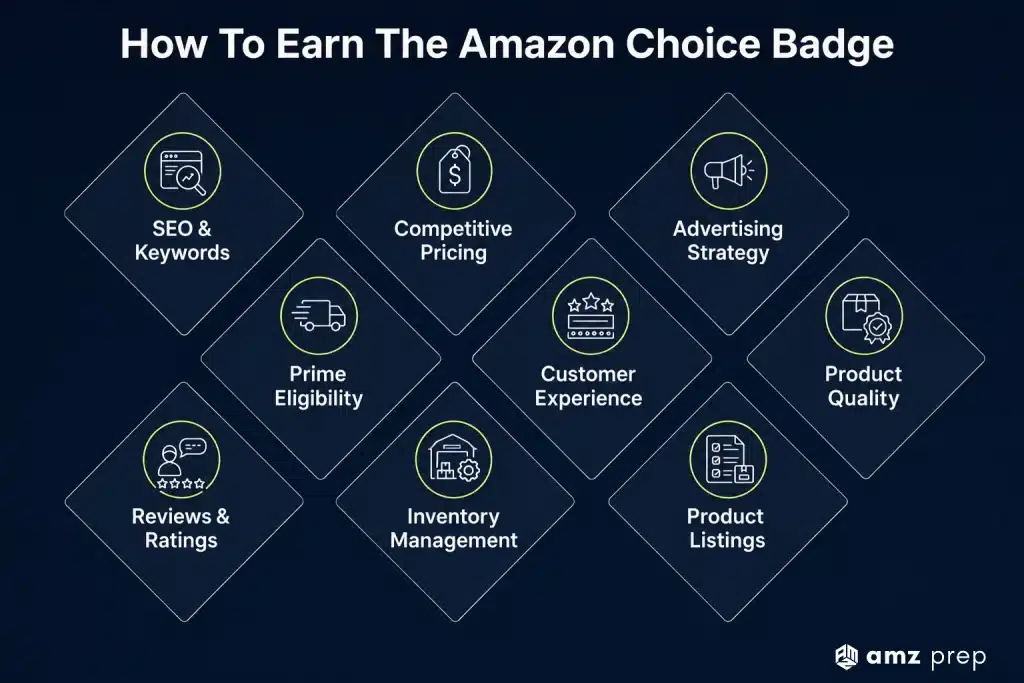
Step 1: SEO & Keyword Strategy
The Amazon’s Choice badge is mostly keyword-driven, that’s why having a strong SEO strategy and enterprise seo firms matters. You have to identify both high-volume keywords and specific long-tail keywords where competition may be less intense.
For example, take the keywords “hair clippers” vs. “hair cutters.” Most shoppers search for “hair clippers” when looking for grooming tools. It has much higher search volume and aligns with buyer intent.
If your listing uses “hair cutters” instead, Amazon might not show it to shoppers searching for “hair clippers,” even if the product is the same. Since the Amazon’s Choice badge is keyword-specific, using the exact, high-volume term gives you a much better chance of earning the badge.
Pro Tip for 2026: With Amazon’s recent search algorithm updates, long-tail keywords (3-5 words) are now seeing higher Choice badge conversion than generic terms. For example, ‘wireless earbuds for running’ may be easier to win than just ‘wireless earbuds,’ and can deliver similar traffic with better conversion.
Step 2: Provide an Exceptional Customer Experience
Amazon wants to recommend highly rated products that will make customers happy. So, you have to regularly check your Account Health in Seller Central and address any issues promptly. It is your responsibility to respond quickly to customer feedback and concerns that your customers face.
You can also use Amazon’s return insights and analytics in Seller Central to understand why customers are returning your products, and address those issues to reduce your return rate. Deliver great service that earns customer trust and the badge will follow.
Step 3: Optimize for Prime Eligibility
When Amazon handles your fulfillment through Fulfillment by Amazon (FBA), they know exactly how quickly products can ship with Prime shipping, making them more likely to award you the badge. But if you prefer to fulfill orders yourself, you have to meet certain requirements for Seller Fulfilled Prime.
2026 Note: Amazon tightened SFP requirements in late 2025. Maintain 95%+ on-time delivery and <2% cancellation rates consistently. Even brief dips below thresholds can trigger badge removal within days.
These tighter requirements mean FBA remains the most reliable path to earning and maintaining the badge
Note: If you’re busy growing your brand, 3PL partners like AMZ Prep can help you earn the Amazon’s Choice badge faster. With 2-day shipping, Seller Fulfilled Prime (SFP) support, and Amazon-compliant prep services, AMZ Prep meets Amazon’s strict performance metrics.
From inventory overflow and cold storage compliance to the complexities of FBA labeling and product bundling, their tailored fulfillment solutions optimize your listing performance. Faster delivery, higher reliability, and consistent product availability all contribute to better search rankings and help you in earning the Amazon’s Choice badge.
Step 4: Maintain Competitive Pricing
Price competitively without sacrificing your profit margins. You have to be aware of the market rates (competitor pricing) and adjust your pricing accordingly. Find out the real value of the product rather than offering the cheapest price.
You can also use Amazon’s repricing automation tool to set customized pricing rules that help maintain competitiveness. The badge description specifically mentions ‘well-priced products’: While ‘well-priced’ may be confusing, it clearly signals that pricing is one of the important factors Amazon takes into consideration.
Note: Amazon’s definition of ‘well-priced’ is intentionally vague and changes based on category dynamics. Monitor your category’s top 5 sellers weekly and aim to price within 10-15% of the median to stay competitive.
Step 5: Prioritize Inventory Management
Stock availability is critical for maintaining the Amazon Choice badge. Amazon won’t award the badge to products that frequently go out of stock. Stockouts can severely damage your chances of earning or keeping this distinction. Stay compliant with Amazon’s inventory rules as Amazon will calculate this based on your sales data history.
Once you earned the badge, you have to be ready dealing with sales spikes. To manage the stocks, you can also use inventory planning software that will keep track of your inventory.
Step 6: Generate Quality Reviews and Ratings
Social proof is essential for earning Amazon’s trust. Most Amazon Choice products maintain a rating of 4.3 stars or higher. While 4.0 is the minimum, aiming for 4.5+ significantly improves your chances, especially in competitive categories.
Don’t forget to send review requests in bulk to boost feedback volume. You can also consider enrolling in Amazon vine program as it can help you gain initial reviews.
Step 7: Optimize Your Advertising Strategy
Strategic PPC can help you earn the Amazon choice badge easily. Make sure you target the chosen keywords in the PPC campaigns so you can improve organic ranking. Optimize your PPC campaigns regularly based on performance analytics.
Poor-performing ads could hurt your chances of obtaining the badge, so monitor it regularly. Use PPC to boost new products. For newly launched items, using PPC to boost new products that can help build the metrics needed for the badge.
Step 8: Create Exceptional Product Listings
Your listing quality directly impacts your conversion rate. So, make sure you use high-quality product photos that are clear and professional. You must highlight how your product solves customer problems.
If you’re brand registered, take full advantage of enhanced content options on your product detail pages. Any misleading information that is irrelevant to your product can lead to returns and negative reviews.
Suggested Read: Top 10 Amazon Return Reasons and How to Avoid Them as a Seller
Step 9: Focus on Product Quality
Ensure your high-quality product meets or exceeds expectations and even the best marketing can’t compensate for a subpar product. Use customer feedback to identify opportunities where you could improve your product.
Regularly check your product quality so you give your customers the best and make them happy. You can also use custom packaging that helps you stand out and potentially earn the badge in less competitive categories.
2026 Amazon Choice Benchmarks
Based on analysis of 500+ Choice badge winners:
- Average rating: 4.6 stars (minimum 4.3)
- Average reviews: 2,847 reviews
- Average Prime eligibility: 98.7% FBA
- Price positioning: Within top 20% of category (not necessarily cheapest)
- Stock-out rate: Less than 2% annually
- Return rate: 3-5% below category average
These benchmarks provide realistic targets for optimization efforts.
Can You Lose the Amazon Choice Badge?
The 2026 Reality Check
Badge volatility increased significantly after Amazon’s algorithm updates. Sellers report badges appearing and disappearing more frequently sometimes multiple times per week as Amazon’s AI continuously evaluates performance across millions of listings.
One tracked product held 22 different Amazon Choice badges simultaneously for various keyword combinations, only to lose all 22 over a single weekend with no policy violations or performance drops. This unpredictability makes badge retention as important as badge acquisition.
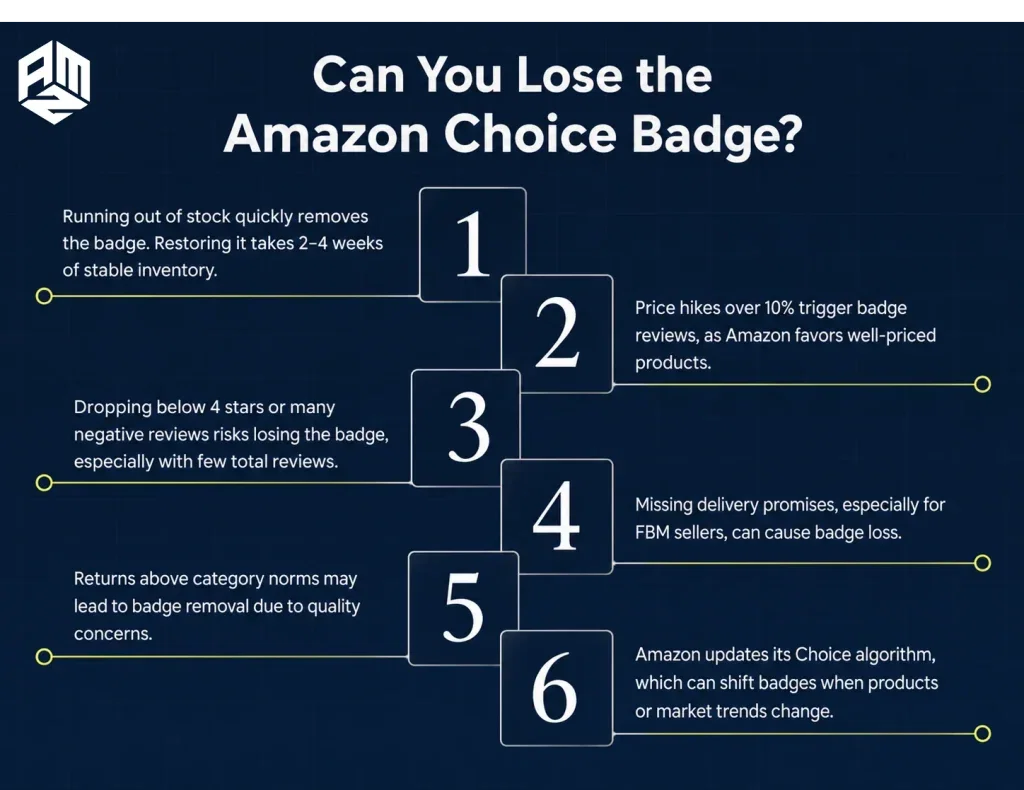
Below are some of the common reasons for losing your Amazon Choice badge:
1. Inventory Issues
Nothing will lose you the badge faster than going out of stock. Amazon’s core promise for Choice products is immediate availability. Even a brief stock-out period can result in badge loss, and regaining it typically takes 2-4 weeks of stable inventory.
2. Price Increases
Significant price increases (typically over 10%) often trigger an immediate review of your badge status. Amazon’s algorithm prioritizes ‘well-priced products,’ and substantial price hikes violate this core premise.
3. Declining Review Quality
If your average star rating drops below 4.0 stars or you receive a cluster of negative reviews in a short period, your badge may be at risk. This is especially true for products with fewer total reviews where each new rating has a larger impact.
4. Shipping Delays
If your product misses delivery promises, you’ll lose the badge. This is a particular concern for FBM (Fulfilled by Merchant) sellers, where shipping is entirely your responsibility.
5. High Return Rates
When return rates exceed category averages (typically by 2-3x), Amazon may revoke the badge. High returns signal potential issues with product quality or listing accuracy.
6. Algorithm Adjustments
Amazon sometimes updates its Choice algorithm to match changes in customer behavior and the market. The June 2025 ‘Bend the Curve’ program, which removed 32% of Amazon’s products, caused many badges to be given to different items because fewer products were competing for the same searches. Future updates might cause similar changes
How to regain your Amazon Choice badge if you have lost it? If you have lost the badge, you must take an immediate action:
- Compare your monitoring metrics from before and after the badge loss to pinpoint the likely cause.
- For inventory issues: Fast-track new inventory and consider temporarily raising prices to slow sales until stock arrives.
- For review problems: Personally review negative feedback for patterns and address product issues.
- Maintain perfect metrics for at least 2-3 weeks. Amazon’s algorithm typically needs to see consistent performance before restoring the badge.
Let’s look into an example to understand this better.
Kitchenware sellers who lost their Amazon Choice badge after a manufacturing issue got a lot of negative reviews. By quickly giving a replacement program for affected customers and addressing the manufacturing defect, they managed to regain the badge in just under three weeks.
Amazon Choice vs Best Seller Badge: Key Differences
Most of the sellers get confused with the Amazon Choice and Best Seller badge. While both the badges can boost your product’s visibility, there are some differences that you must know.
| Amazon Choice Badge | Best Seller Badge | |
|---|---|---|
| What it means | Amazon’s recommended product for specific search terms | Top-selling product within a specific category |
| How it’s awarded | Algorithm-based on relevance, ratings, price & availability | Based solely on sales volume compared to other products |
| Visibility | Appears in search results and product listings | Appears on product listings and category pages |
| Calculation period | Based on recent and historical performance | Updates hourly based on recent sales data |
| Duration | Can change daily or even multiple times per day | Updates hourly; more volatile |
| Badge appearance | Black rectangle with ‘Amazon’s Choice’ text | Orange circle with ‘#1 Best Seller’ text |
| Primary benefit | Increases click-through rate from search results | Builds trust and perceived popularity |
| Target focus | Keyword-specific (can have badge for some terms but not others) | Category-specific (ranked within particular category) |
| Voice shopping | Preferred for Alexa recommendations | Not specifically prioritized in voice shopping |
| Competition level | Can be easier to obtain for niche keywords | Requires highest sales volume in category |
| Influence factors | Prime eligibility, ratings, price, conversion rate | Pure sales volume relative to competition |
| Strategy focus | Listing optimization and targeted performance | Sales volume and promotion |
| Most valuable for | Products targeting specific search terms | Products in less competitive categories |
| Customer perception | ‘Amazon recommends this product’ | ‘Everyone is buying this product’ |
Which Badge Should You Aim For?
As an Amazon marketplace seller, if you’re focused on long-term growth through customer trust and keyword visibility, the Amazon Choice badge is your best bet. If you’re driving aggressive sales volume within a category, aim for the Best Seller badge.
Pro Tip: You don’t have to choose. The most successful Amazon sellers optimize for both badges and enjoy maximum visibility, conversions, and trust.
Conclusion
The Amazon Choice badge is more than just an icon, it’s a powerful conversion tool. It signals trust, relevance, and Amazon’s approval, making it easier for shoppers to choose your product over others.
By optimizing your product listings, pricing, reviews, fulfillment, and keyword strategy, you can significantly increase your chances of earning the badge. And if you lose it? Don’t panic, just double down on what works: fast delivery, happy customers, and a reliable product.
Remember, you don’t need to be the top seller in your category to win Amazon’s Choice. You just need to be the best option for the right search terms.
Frequently Asked Questions
How to qualify for Amazon Choice?
To qualify for Amazon Choice, maintain high product ratings (4.3+ stars), competitive pricing, Prime eligibility, low return rates, consistent inventory availability, and strong sales performance for your targeted keywords.
What is better, Amazon Choice or Best Seller?
Neither badge is actually “better” – they serve different purposes. Amazon Choice is ideal for products targeting specific search terms and benefits from algorithm recommendation. Best Seller is valuable for category dominance and communicates popularity. The ideal strategy is earning both, as they anyway benefit your business.
How is Amazon’s Choice selected?
Amazon’s Choice is selected based on a combination of factors: keyword relevance, price competitiveness, Prime eligibility, shipping speed, in-stock reliability, customer ratings (both quantity and quality), and overall sales performance.
What are the benefits of Amazon Choice?
Amazon Choice products receive enhanced visibility in search results, often appearing at the top of listings. They experience 40-50% higher click-through rates, 30-35% increased conversion rates (2026 data).
Does the Amazon Choice badge help with voice shopping?
Yes, significantly. When customers use Alexa to shop without specifying a brand (e.g., ‘Alexa, order laundry detergent’), Amazon’s voice assistant prioritizes products with the Amazon’s Choice badge. With over 200 million Prime members and growing adoption of Alexa shopping features, this represents a major traffic source that most sellers overlook.
How often does Amazon update the Choice badge in 2026?
Amazon’s algorithm updates Choice badge assignments multiple times daily, sometimes hourly. Badges can be gained or lost within 24-48 hours based on performance metrics like stock availability, reviews, and pricing changes.

Rich Pearl is a Head of U.S Enterprise at AMZ Prep, drawing from his proven experience in the fulfillment industry gained at ShipBob. Rich helps provide strategic guidance and consultation to growing e-commerce businesses looking to master their logistics and achieve operational success.

















Comments