
If you want to sell on SHEIN, you’ll need to apply through the SHEIN Marketplace seller portal for your region. You must have a legally registered business in the US, UK, or EU, as SHEIN doesn’t accept individual or unregistered sellers.
Once your application is approved, you can start listing products through Seller Hub. You’ll also need to ship orders within SHEIN’s required delivery timelines. Sellers generally receive payouts weekly.
SHEIN doesn’t approve every business that applies. It’s a selective marketplace, and many of the brands selling there already have experience managing orders through platforms like Amazon, Shopify, or TikTok Shop.
If you’re planning to start selling on SHEIN, this guide will help you understand the eligibility requirements, documents you’ll need, seller fees, payment schedules, and shipping rules you should follow to keep your account in good standing.
What Is the SHEIN Marketplace
SHEIN Marketplace allows approved third-party sellers to list and sell their products alongside SHEIN’s own products. This means you can reach customers who are already shopping on the platform.
SHEIN launched its marketplace in the US in 2023 and has since expanded into other regions. If you’re selling in the UK or EU, you’ll need to apply through the seller portal for your region.
SHEIN is especially popular among Gen Z and millennial shoppers. The platform attracts millions of users every month. According to SHEIN’s March 2026 Digital Services Act transparency report, it had 155.7 million monthly active users in Europe.
For your brand, the biggest advantage is the opportunity to reach such a large customer base. Lower seller fees are another benefit, but access to shoppers is what makes the marketplace worth considering.
Who Can Sell on SHEIN
If you are already a consistent seller on Amazon, Shopify or TikTok Shop and have a steady stream of orders, your business could be a good match for SHEIN Marketplace. But if you are just starting out with one product, it might be harder to get approved.
SHEIN says its marketplace is invite-only and exclusive. Before you can start selling, you will need to submit your application to be reviewed and approved by a SHEIN business development specialist.
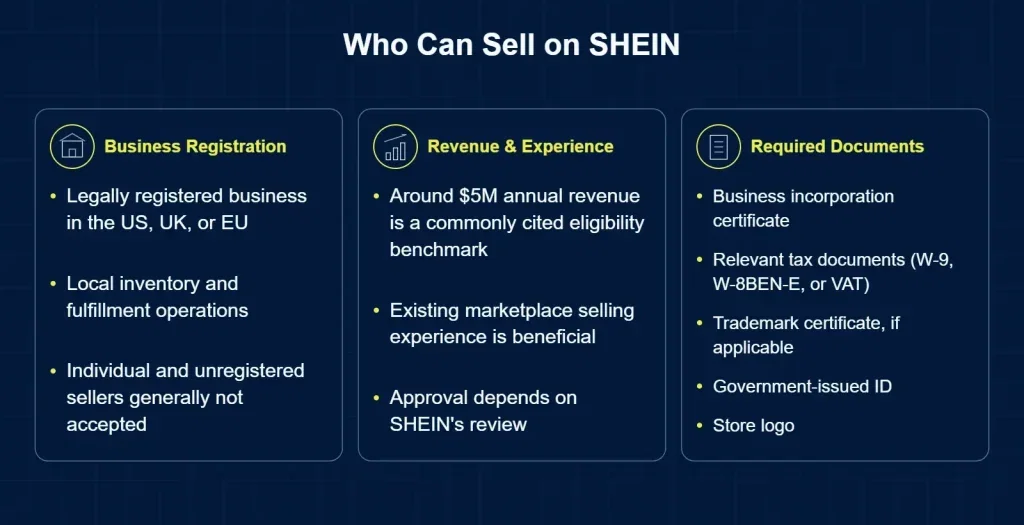
Business registration and location
For selling on SHEIN, you need to have a legally registered business in the market where you are selling. You should also have inventory available in that market, so that you can ship orders locally.
SHEIN generally does not allow individual sellers, sole proprietors or unregistered businesses, even if they have a good track record of sales on other platforms.
Revenue threshold
Your business revenue may also affect your chances of getting approved. According to Linnworks, new sellers are expected to generate at least $5 million in annual revenue. M2E also mentions this figure as a typical requirement.
However, you shouldn’t assume that $5 million is a fixed requirement for every seller. SHEIN may also consider the types of products you sell and how quickly you can fulfill orders.
So, if your business meets the other requirements, it’s worth checking the current eligibility criteria for your region before applying.
SHEIN seller requirements by region
| Region | Business registered in | Ships from | Tax documents | Commission after intro period |
|---|---|---|---|---|
| US | United States | US-based operations | W-9 or W-8BEN-E | About 10% |
| UK | United Kingdom | UK-based operations | UK VAT registration | About 12% |
| EU | EU member state | EU-based warehouse | VAT certificate and EPR number | About 10% |
Cross-border brands should start on tax paperwork first. It’s the piece with the longest lead time.
Documents to Prepare Before You Apply
SHEIN asks for the same core paperwork in every region, with the tax forms swapped by market.
- Certificate or articles of incorporation
- W-9 or W-8BEN-E for the US, or a VAT certificate for the UK and EU
- EPR registration number for EU markets
- Trademark registration certificate, if you sell a branded line
- Government-issued photo ID for the company representative
- High-resolution store logo in PNG format
Upload the full set with your first submission. Reviews move faster when nothing has to be chased.
How to Sell on SHEIN Marketplace: Step-by-Step
The SHEIN seller program runs in six stages, from application to your first payout. Steps three and five take the most work.
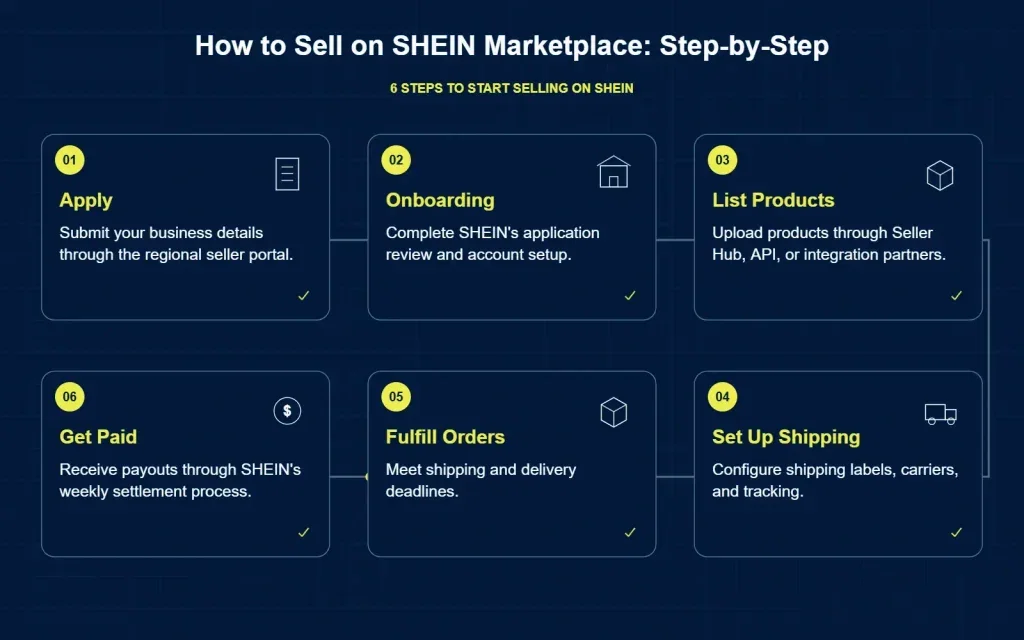
Step 1: Submit your seller application
First, you’ll need to visit the SHEIN seller portal for your region. If you’re applying to sell in the US, go to seller-us.shein.com and click Join Marketplace.
You’ll be asked to provide your business details, fulfillment location, and the main product categories you want to sell in. It’s better to choose categories where you already have experience and a good sales history.
Step 2: Complete onboarding
Once you submit your application, you’ll need to wait for SHEIN’s team to review it. According to Flexport’s seller FAQ, a SHEIN business development specialist typically contacts applicants within 24 to 48 hours.
If you don’t hear back within that time, you can email sellwithus@shein.com to check your application status.
After approval, you’ll get access to onboarding and seller success teams that can help you set up your listings and plan promotions.
Step 3: List your products
Once your account is approved, you can start adding products to SHEIN Marketplace. There are three ways to do this:
- Seller Hub: Add products manually or upload multiple listings using spreadsheet templates.
- SHEIN API: Connect your existing systems to manage product listings.
- Integration partners: Use platforms like ChannelEngine, Linnworks, GoFlow, or M2E to connect your catalog.
Keep in mind that SHEIN reviews new product listings before publishing them. This usually takes around 24 hours, so make sure you account for that when planning your product launch.
Step 4: Set up shipping
Next, you’ll need to decide how you want to handle shipping. You can purchase shipping labels through SHEIN or enter your own shipping information manually.
If you’re using an integration platform like ChannelEngine, you’ll also need to set up carrier mapping so your shipping and tracking information is sent correctly.
Step 5: Ship every order within the required timeline
Once you start receiving orders, you need to make sure you’re meeting SHEIN’s shipping deadlines.
Here’s what you need to follow:
- Within 2 business days: Export the customer’s shipping address.
- Within 5 business days: Upload the order’s tracking information.
- Within 7 business days: Make sure the order is delivered to the customer.
Missing these deadlines can affect your seller account performance, so you’ll need a fulfillment process that can handle orders on time.
Step 6: Get paid each week
SHEIN processes your order settlement 7 days after the customer receives their purchase.
Payments are generally authorized every Monday, and you can expect the funds to reach your account within 1 to 3 business days after authorization.
This means you should plan your cash flow around the delivery date and settlement schedule rather than expecting payment immediately after an order is placed.
SHEIN Seller Fees and Payouts
There’s no monthly subscription on SHEIN and no listing fee. You pay a referral commission on each sale, and only after the intro period ends.
SHEIN commission by region
| Fee | US | UK | EU |
|---|---|---|---|
| Monthly subscription | $0 | £0 | €0 |
| New seller commission | 0% for 30 days | 0% for 30 days | 0% for 30 days |
| Referral commission after intro | About 10% | About 12% | About 10% |
| SHEIN Fulfillment Service | Extra, if used | Extra, if used | Extra, if used |
A SHEIN business development manager put commission at 10% for the EU and 12.24% for the UK after the first free month.
The intro offer has shifted over time. Early US sellers got 0% fees for their first 3 months. Confirm current terms with your account manager before you build a pricing model.
Where profit actually goes
Commission is rarely what decides profit on SHEIN. Shipping and returns usually do.
Closo’s margin model shows a 15% return rate wiping out the profit on a $12 item. Build your real return rate into pricing before launch.
How SHEIN payouts work
The payout setup is friendly to cash flow. SHEIN never withdraws from your bank account.
Referral and return fees come out of your next weekly payout. You can track every charge in Seller Hub.
SHEIN Shipping Rules and Fulfillment Options
Picture a shopper in Ohio who orders a dress on a Monday. Under SHEIN’s US rules, it has to reach her by the following Wednesday.
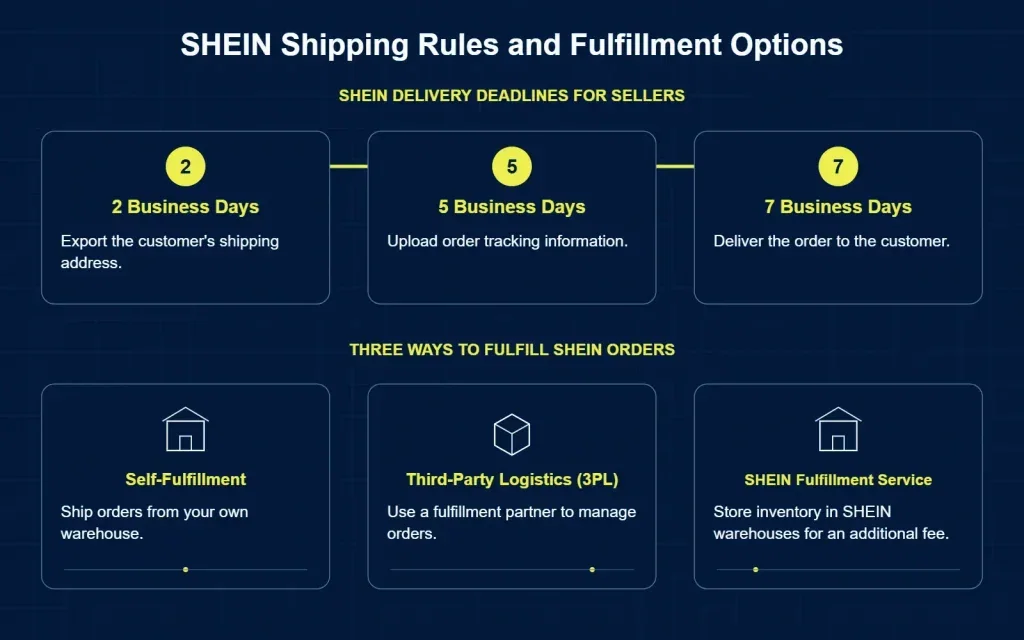
SHEIN delivery deadlines for sellers
| Requirement | Deadline |
|---|---|
| Export the shipping address | Within 2 business days |
| Upload tracking | Within 5 business days of the order |
| Deliver to the shopper | Within 7 business days of purchase |
Some partner guides cite tighter targets: processing within 24 hours and shipping within 48. I’d plan for those numbers anyway. Buffer days disappear fast during promotions.
The shopper side raises the stakes. A late US order earns the shopper 500 SHEIN points. SHEIN’s delivery promises, laid out in our SHEIN shipping times breakdown, set the bar your orders are judged against.
Three ways to fulfill SHEIN orders
| Option | How it works | Best fit |
|---|---|---|
| Self-fulfillment | You pick, pack and ship from your own warehouse | Brands with in-house operations in the market |
| Third-party logistics (3PL) | A 3PL ships SHEIN orders from shared inventory | Brands selling on several marketplaces |
| SHEIN Fulfillment Service | You send stock to SHEIN’s warehouses for added fees | Brands that want SHEIN to handle storage and delivery |
SFS comes with its own fees and eligibility rules. Blair Forrest covers them in our SHEIN Fulfillment Service guide. SHEIN’s own sites in the US, UK and Europe are mapped in our SHEIN warehouse locations directory, which helps if you’re weighing SFS against holding your own stock.
Running SHEIN from the same inventory as your other channels
Most brands that come to us already sell on Amazon, Walmart, TikTok Shop and Shopify. Splitting stock again for SHEIN ties up cash.
AMZ Prep fulfills orders across every marketplace from 50+ fulfillment centers in the US, Canada, the UK, Germany, the Netherlands and Dubai. One inventory pool can serve SHEIN alongside your other channels at 99.8% order accuracy.
For imported goods, our Middle Mile freight consolidation lands stock in those warehouses with clear transit times. That keeps the 7-day clock manageable.
How to Sell Clothes on SHEIN
SHEIN listings don’t support free-form bullet points. Fit, fabric and sizing have to live in attributes, the description and the size chart.
Listing structure and SKCs
Every SKU needs style information. SHEIN groups variations under one main attribute, usually color, into a unit it calls an SKC.
Build your catalog structure around that before you upload. It saves a round of listing rejections.
Size charts and photos
Size charts matter more here than on most marketplaces. Give garment measurements for every size, not just S, M and L labels.
Photos sell the piece. Linnworks recommends high-resolution shots from several angles, including close-ups of fabric and details.
Pricing and catalog size
Price against SHEIN, not against your Shopify store. Shoppers compare your listing with in-house styles one scroll away.
I’d launch with your 20 best sellers instead of the full catalog. Watch sell-through for two weeks, then add styles that match what’s moving. SHEIN rewards sellers who update often, test creatives and adapt to trends.
How to Sell Things on SHEIN Beyond Clothes
Fashion is still SHEIN’s main focus, but you can sell more than just clothing on its marketplace. According to Linnworks, SHEIN supports over 20 product categories, including home goods, beauty, and electronics.
SHEIN is also trying to attract sellers from other categories, including those already selling on Amazon, by offering lower commission rates. By allowing third-party sellers to list their products, SHEIN can expand into electronics, toys, and home products without having to stock the inventory itself.
If you want to sell products other than clothing on SHEIN, consider items that shoppers are likely to buy along with their outfits. Jewelry, handbags, beauty tools, and small home decor products are worth exploring because they appeal to customers who are already shopping for fashion.
Selling on SHEIN From Outside the US, UK or EU
To sell on SHEIN Marketplace, you’ll generally need a registered business in the US, UK, or EU. If your brand is based in Canada, India, or the UAE, you may need to register a business in the market where you want to sell and keep your inventory there to meet SHEIN’s shipping requirements.
How SHEIN works in India
SHEIN operates differently in India. Instead of running its regular marketplace, SHEIN has licensed its brand to Reliance Retail, which operates SheinIndia.in and sells clothing manufactured in India.
SHEIN has also stated that Reliance manages manufacturing, supply chain, sales, and day-to-day operations in India.
So, if you’re an Indian manufacturer looking to work with SHEIN, you would generally need to explore becoming a supplier rather than applying as a regular marketplace seller.
According to Reuters, there were plans to increase the number of Indian suppliers from 150 to 1,000 within 12 months.
Setting up a local entity and inventory
If you’re planning to enter SHEIN Marketplace by registering a business in the US or EU, you’ll also need to think about where your products will be stored.
You should arrange to have your inventory in a warehouse within your target market before you start selling. This will make it easier to ship orders on time and meet SHEIN’s delivery requirements from the beginning.
When SHEIN Is Worth Adding as a Channel
SHEIN suits brands with trend-led products, healthy margins at lower prices and stock already in-market.
Trade-offs to weigh
Shoppers often see third-party items as SHEIN products. That makes it harder to build brand equity or collect first-party data.
Price expectations matter too. Buyers arrive expecting SHEIN-level prices, so premium positioning is a hard sell.
Compliance for EU sellers
EU consumer regulators investigated SHEIN’s practices in 2025, and France’s competition authority fined it €40 million over discount pricing. Accurate discount claims, return terms and contact details protect your store.
My take: treat SHEIN as an incremental channel. Add it once Amazon and your own store run smoothly, not as a first marketplace.
Getting Started on SHEIN
SHEIN rewards brands that already have the inventory, paperwork and delivery speed in place. Gather your documents and set up fulfillment inside your target market before you apply. To run SHEIN orders from the same stock as Amazon and Shopify, reach the AMZ Prep team.
Frequently Asked Questions
Can individuals sell on SHEIN?
No. SHEIN Marketplace only accepts businesses that are legally registered in the US, UK or EU. No applications from individuals and sole proprietors. Approved sellers also need to have inventory and fulfillment operations in the market they are selling into.
How much does it cost to sell on SHEIN?
SHEIN does not charge monthly subscription fees or listing fees. New sellers usually start with 0% commission for the first 30 days. The referral commission is then about 10% in the US and EU and about 12% in the UK.
How long does SHEIN seller approval take?
Most of the time you will hear from SHEIN’s business development team within 24 to 48 hours. Full review and onboarding can take 1-10 business days. Having all the docs and a clear category fit speeds it up.
How do SHEIN sellers get paid?
SHEIN is paid weekly. It pays for every order on the 7th day after delivery and authorises the payment every Monday. The money will appear in your bank account in 1 to 3 business days, minus commissions and return fees.
Is there a minimum revenue to sell on SHEIN?
Integration partners mention one. Linnworks and M2E say that SHEIN typically onboards brands with around $5 million or more in annual sales. Fulfilment speed and category fit is also a big part of the decision to approve.

Arishekar N is a Vice President (VP) of Marketing at AMZ Prep, specializing in ecommerce fulfillment and Amazon logistics strategies with a proven track record of driving growth for e-commerce businesses. He is a strategic leader with extensive expertise in marketing, e-commerce operations, SEO & advertising, and branding.
Stay updated on his latest insights by following him







Comments